 Learn Arabic
If you are wondering how do u say no in Arabic, the simplest answer is لا (lā), which means “no.” It is one of the most basic Arabic words and is understood across the Arabic-speaking world.
However, Arabic has many other ways to refuse, disagree, reject an idea, say that something is impossible, or politely explain that you cannot do something. The expression you choose depends on the situation, your tone, and how direct or polite you want to sound.
Below are 15 useful ways to say no in Arabic, followed by practical examples of the common uses of ‘لا’ in Arabic dialogue, the basics of negation in Arabic, and differences you may hear across Arabic dialects.
1. لا (Lā) — The Standard Way to Say No in Arabic
The most basic and widely understood answer to how do u say no in Arabic is لا (lā), meaning simply “no.” It can stand on its own when someone asks you a direct yes-or-no question, so it is usually one of the first Arabic words beginners learn.
لا is the most basic and widely understood answer to how do u say no in Arabic. You can use it as a standalone answer when someone asks you a yes-or-no question.

For example:
هل تريد قهوة؟
Hal turīdu qahwa?
Would you like coffee?
لا.
Lā.
No.
Although the word itself is simple, tone makes a difference. A calm لا sounds neutral, while a sharper pronunciation can sound more forceful.
2. لا، شكرًا (Lā, Shukran) — No, Thank You
When you want to refuse something without sounding too direct, لا، شكرًا (lā, shukran) is a useful expression meaning “No, thank you.” Adding شكرًا, or “thank you,” immediately makes a simple refusal warmer and more courteous.
This is one of the most useful polite refusals for beginners. Instead of responding with a direct لا, adding شكرًا, meaning “thank you,” makes the answer warmer and more courteous.
For example:
هل تريد المزيد من الطعام؟
Hal turīdu al-mazīda min aṭ-ṭaʿām?
Would you like more food?
لا، شكرًا.
Lā, shukran.
No, thank you.
Use this expression when declining food, drinks, help, a product, or a casual offer.
3. كلا (Kallā) — Certainly Not / No
A stronger alternative to لا is كلا (kallā), which can carry the sense of “certainly not” or an emphatic “no.” Unlike the everyday لا, كلا is more strongly associated with formal or Classical Arabic and is less common in ordinary casual conversation.
كلا is stronger and more emphatic than a simple لا.
It is more common in formal or Classical Arabic than in everyday casual conversation and often carries the meaning of rejecting an idea firmly.
For example:
هل هذا صحيح؟
Hal hādhā ṣaḥīḥ?
Is this correct?
كلا.
Kallā.
Certainly not.
Learners who want to understand expressions like this in formal texts may benefit from studying Classical Arabic, where vocabulary and sentence structures are explored in greater depth.

4. أبدًا (Abadan) — Never / Absolutely Not
The Arabic word أبدًا (abadan) literally means “never.” Depending on the context, it can also be combined with a negative response to make it much stronger, giving a meaning similar to “absolutely not.”
أبدًا literally means “never,” but depending on the context, it can also strengthen a negative statement.
For example:
هل ستفعل ذلك؟
Hal satafʿalu dhālik?
Will you do that?
لا، أبدًا.
Lā, abadan.
No, absolutely not.
Because it is strong, this expression should be used when you genuinely want to emphasize that something will not happen.
5. بالطبع لا (Bil-Ṭab‘ Lā) — Of Course Not
If you want to say “of course not,” you can use بالطبع لا (biṭ-ṭabʿ lā). This phrase is particularly useful when rejecting an assumption or when you feel that the negative answer should already be obvious from the situation.
This phrase is useful when the answer seems obvious or when you want to reject an assumption clearly.

For example:
هل أنت غاضب مني؟
Hal anta ghāḍibun minnī?
Are you angry with me?
بالطبع لا.
Biṭ-ṭabʿ lā.
Of course not.
The tone can make the phrase reassuring, surprised, or emphatic depending on the conversation.
6. لا أريد (Lā Urīd) — I Don’t Want
Sometimes a simple لا does not explain enough. If you specifically want to say “I don’t want,” you can use لا أريد (lā urīd).
Sometimes you need to go beyond a simple “no” and explain that you do not want something.
For example:
هل تريد هذا؟
Hal turīdu hādhā?
Do you want this?
لا أريد هذا.
Lā urīdu hādhā.
I don’t want this.
This expression is particularly useful for beginners because it introduces one of the simplest patterns of negation in Arabic: لا + present-tense verb.
7. لا أستطيع (Lā Astaṭī‘) — I Can’t
If the issue is not that you do not want to do something but that you are unable to do it, use لا أستطيع (lā astaṭīʿ), meaning “I can’t.”
Use لا أستطيع when you are unable to do something rather than simply unwilling to do it.
For example:
هل يمكنك الحضور غدًا؟
Hal yumkinuka al-ḥuḍūr ghadan?
Can you come tomorrow?
لا أستطيع.
Lā astaṭīʿ.
I can’t.
This phrase is useful in everyday life, work, study, and travel because it gives a clear but neutral refusal.
8. ليس الآن (Laysa Al-Ān) — Not Now
Not every refusal means “never.” Sometimes the problem is simply the timing. In that situation, ليس الآن (laysa al-ān) means “not now.”
Sometimes you are not completely refusing a request; you simply do not want to do it at the present moment.
For example:
هل يمكننا التحدث؟
Hal yumkinunā at-taḥadduth?
Can we talk?
ليس الآن.
Laysa al-ān.
Not now.
This is a useful indirect refusal because it leaves open the possibility of doing something later.
9. لا يمكن (Lā Yumkin) — It’s Not Possible
To explain that something cannot be done or is not possible under the circumstances, you can say لا يمكن (lā yumkin), meaning “it is not possible.”
Use لا يمكن when something cannot be done or is not possible under the current circumstances.
For example:
هل يمكن إنهاء العمل اليوم؟
Hal yumkinu inhāʾ al-ʿamali al-yawm?
Can the work be finished today?
لا يمكن.
Lā yumkin.
It’s not possible.
It can also appear in longer sentences:
لا يمكنني الحضور اليوم.
Lā yumkinunī al-ḥuḍūru al-yawm.
I cannot attend today.
10. مستحيل (Mustaḥīl) — Impossible / No Way
For a much stronger reaction, Arabic speakers may use مستحيل (mustaḥīl), literally meaning “impossible.” In the right conversational context, it can also express the idea of “No way!”
مستحيل is a strong expression used to reject something completely or react with disbelief.

For example:
هل ستترك عملك اليوم؟
Hal satatruku ʿamalaka al-yawm?
Are you leaving your job today?
مستحيل!
Mustaḥīl!
No way!
It is stronger than لا, so it is better for emphatic situations rather than ordinary polite refusals.
11. لا أوافق (Lā Uwāfiq) — I Don’t Agree
Saying “no” is not always about refusing a request. Sometimes you want to express disagreement with an opinion, suggestion, or decision. In this situation, لا أوافق (lā uwāfiq) means “I don’t agree.”
Sometimes “no” means disagreement rather than refusal.
For example:
هل توافق على هذا القرار؟
Hal tuwāfiqu ʿalā hādhā al-qarār?
Do you agree with this decision?
لا أوافق.
Lā uwāfiq.
I don’t agree.
This phrase is particularly useful in discussions, meetings, debates, or professional conversations.
Read also: Best Arabic Grammar Books for Beginners – 10 Picks to Start Learning
12. لا أعتقد ذلك (Lā A‘taqid Dhālik) — I Don’t Think So
If لا أوافق feels more direct than you want, a softer option is لا أعتقد ذلك (lā aʿtaqidu dhālik), meaning “I don’t think so.”
This is softer than a direct “no.”
It is useful when someone asks for your opinion or makes a suggestion that you do not fully agree with.
For example:
هل سينجح هذا الحل؟
Hal sayanjaḥu hādhā al-ḥall?
Will this solution work?
لا أعتقد ذلك.
Lā aʿtaqidu dhālik.
I don’t think so.
It allows you to disagree without sounding unnecessarily harsh.
13. عذرًا، لا أستطيع (ʿUdhran, Lā Astaṭī‘) — Sorry, I Can’t
When politeness matters, عذرًا، لا أستطيع (ʿudhran, lā astaṭīʿ) gives you a natural way to say “Sorry, I can’t.”
This is one of the most useful phrases for politely refusing a request.

For example:
هل يمكنك مساعدتي اليوم؟
Hal yumkinuka musāʿadatī al-yawm?
Can you help me today?
عذرًا، لا أستطيع.
ʿUdhran, lā astaṭīʿ.
Sorry, I can’t.
Adding عذرًا softens the refusal and makes it suitable for work, formal interactions, or conversations with people you do not know well.
14. أفضل ألا أفعل (Ufaḍḍil Allā Af‘al) — I’d Rather Not
Another way to avoid a very direct “no” is to express your preference. أفضل ألا أفعل (ufaḍḍilu allā afʿal) means “I’d rather not.”
This expression is useful when you want to decline without giving a strong or confrontational “no.”
For example:
هل تريد مناقشة هذا الآن؟
Hal turīdu munāqashata hādhā al-ān?
Would you like to discuss this now?
أفضل ألا أفعل.
Ufaḍḍilu allā afʿal.
I’d rather not.
It communicates preference rather than absolute rejection, which can make the refusal sound more diplomatic.
Inside Our Classrooms
See how we make learning interactive and engaging! Watch a quick snippet of our live, conversational classes in action:
15. لا مشكلة، ولكن لا أستطيع (Lā Mushkilah, Walākin Lā Astaṭī‘) — No Problem, but I Can’t
Sometimes you want to make it clear that you are not bothered by a request even though you cannot accept it. One way to express this is لا مشكلة، ولكن لا أستطيع (lā mushkilah, walākin lā astaṭīʿ), meaning “No problem, but I can’t.”
This phrase can be used when you want to show that you are not upset by the request, but you still cannot accept it.
For example:
هل يمكنك القيام بهذه المهمة أيضًا؟
Hal yumkinuka al-qiyāmu bihādhihi al-muhimmah ayḍan?
Can you do this task as well?
لا مشكلة، ولكن لا أستطيع الآن.
Lā mushkilah, walākin lā astaṭīʿ al-ān.
No problem, but I can’t right now.
It can help make your response sound cooperative even when you need to say no.
Common Uses of ‘لا’ in Arabic Dialogue
Learning لا as a vocabulary word is useful, but understanding the common uses of ‘لا’ in Arabic dialogue makes it much easier to use naturally.

1. Use لا to Answer Yes-or-No Questions Directly
The simplest use of لا is to answer a direct question.
هل أنت طالب؟
Hal anta ṭālib?
Are you a student?
لا.
Lā.
No.
In this type of exchange, the context already provides the meaning, so no additional words are necessary.
2. Use لا، شكرًا to Politely Refuse an Offer
When someone offers you food, help, or something you do not want, it is usually more polite to say:
لا، شكرًا.
Lā, shukran.
No, thank you.
For example:
هل تريد كوبًا من الشاي؟
Would you like a cup of tea?
لا، شكرًا.
No, thank you.
3. Use لا to Express Disagreement With an Idea or Opinion
لا can also appear when you disagree with an opinion or decision.
هل توافق على هذه الفكرة؟
Do you agree with this idea?
لا أوافق.
I don’t agree.
A softer alternative would be:
لا أعتقد ذلك.
I don’t think so.
Read also: Arabic Alphabet Beginning Middle End
4. Use لا أريد to Say You Don’t Want Something
You can combine لا with the verb أريد, meaning “I want”:
لا أريد هذا.
I don’t want this.
This is more precise than simply saying لا, especially when several options are being discussed.
5. Use لا أستطيع When You Need to Say “I Can’t”
Another frequent use is:
لا أستطيع.
I can’t.
This makes it clear that the issue is ability or circumstances rather than simple refusal.
6. Use لا With a Verb to Tell Someone Not to Do Something
لا can also be used in negative commands.
For example:
لا تلمس.
Lā talmas.
Don’t touch.
لا تذهب.
Lā tadhhab.
Don’t go.
Here, لا is not answering “no.” Instead, it tells someone not to perform an action.
Other Ways to Make Negative Sentences in Arabic
Although لا is central to negation in Arabic, it is not the only negative particle.
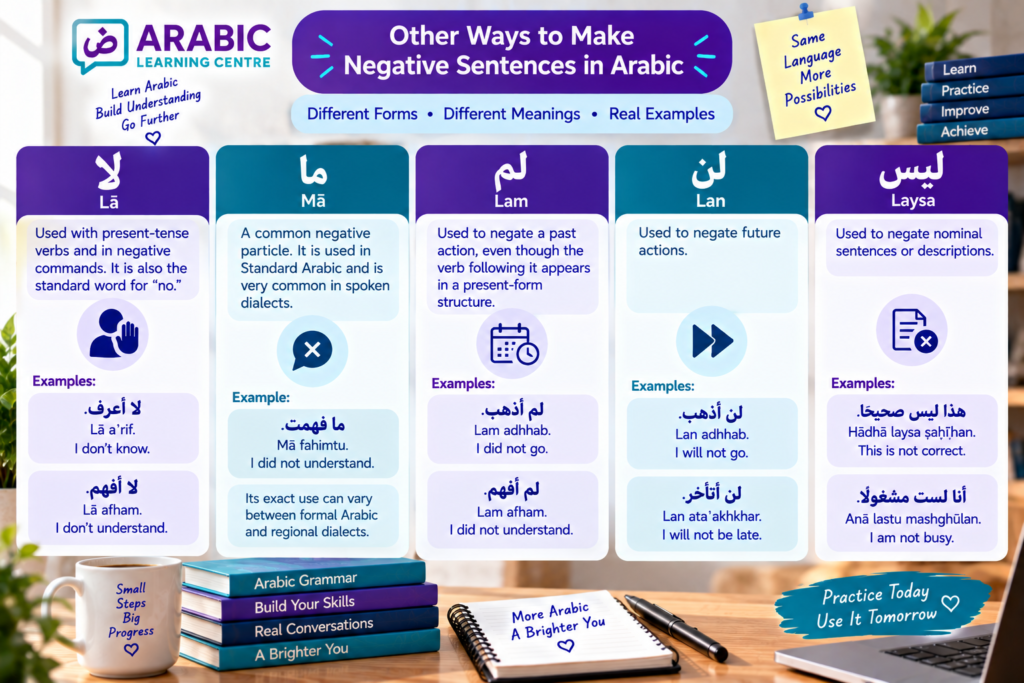
Arabic uses different forms depending on tense, sentence type, and meaning. Five important forms are لا, ما, لم, لن, and ليس.
a.
لا — Lā
لا is commonly used with present-tense verbs and in negative commands.
لا أعرف.
Lā aʿrif.
I don’t know.
لا أفهم.
Lā afham.
I don’t understand.
It is also the standard standalone word for “no.”
b.
ما — Mā
ما is another common negative particle.
In Standard Arabic, it can occur in several negative structures, while it is also extremely common in spoken Arabic dialects.
For example:
ما فهمت.
Mā fahimtu.
I did not understand.
Its exact use can vary between formal Arabic and regional dialects.
c.
لم — Lam
لم is used to negate an action in the past, even though the verb following it appears in a present-form structure.
For example:
لم أذهب.
Lam adhhab.
I did not go.
لم أفهم.
Lam afham.
I did not understand.
d.
لن — Lan
لن is used to negate future actions.
For example:
لن أذهب.
Lan adhhab.
I will not go.
لن أتأخر.
Lan ataʾakhkhar.
I will not be late.
e.
ليس — Laysa
ليس is commonly used to negate nominal sentences or descriptions.
For example:
هذا ليس صحيحًا.
Hādhā laysa ṣaḥīḥan.
This is not correct.
أنا لست مشغولًا.
Anā lastu mashghūlan.
I am not busy.
Understanding when to use each form is an important step beyond memorizing individual expressions.
Practising these structures through written examples can also improve your control of Arabic sentence formation, which is one of the skills developed in an Arabic Writing Course.

How to Say No Politely in Arabic?
Knowing لا (lā) is easy, but knowing how to soften your refusal is just as important. A direct لا may be perfectly acceptable in some situations, while offers, invitations, and professional requests often call for a more courteous response.
Here are several ways to make “no” sound more polite in Arabic:
1. Add “Thank You” When Refusing an Offer
When declining food, a drink, help, or another simple offer, add شكرًا (shukran) to make your response warmer:
لا، شكرًا.
Lā, shukran.
No, thank you.
2. Apologize When You Cannot Accept a Request
If someone asks you to do something that you cannot do, you can soften the refusal with an apology:
عذرًا، لا أستطيع.
ʿUdhran, lā astaṭīʿ.
Sorry, I can’t.
You can also express regret:
للأسف، لا أستطيع.
Lil-asaf, lā astaṭīʿ.
Unfortunately, I can’t.
3. Use an Indirect Phrase Instead of a Direct “No”
If you want to decline without sounding too direct, express your preference rather than simply saying لا:
أفضل ألا أفعل.
Ufaḍḍilu allā afʿal.
I’d rather not.
4. Say “Not Now” When the Timing Is the Problem
If you are not rejecting the request completely but cannot accept it at the moment, you can say:
ليس الآن.
Laysa al-ān.
Not now.
This leaves open the possibility of agreeing or discussing the request later.
5. Give a Brief Reason in Professional Situations
In professional settings, a short explanation can make a refusal sound more considerate than simply saying لا.
You might explain that your schedule is full, that you already have other responsibilities, or that a proposal does not fit your current plans.
For example:
أعتذر، جدول أعمالي ممتلئ تمامًا.
Aʿtadhir, jadwalu aʿmālī mumtaliʾun tamāman.
I’m sorry, my schedule is completely full.
The goal is not necessarily to avoid saying “no,” but to choose a refusal that matches the situation and communicates your meaning respectfully.
How to Say No in Different Arabic Dialects?
Standard Arabic لا (lā) is understood across the Arab world, but everyday expressions vary between dialects.
a. Egyptian Arabic: لأ and Its Alternatives
Egyptians commonly pronounce “no” as لأ (laʾ / laʾa). You may also hear:
مش عايز / مش عايزة — Mish ʿāyiz / mish ʿāyza — I don’t want
ما ينفعش — Ma yenfaʿsh — That’s not possible
b. Levantine Arabic: لا and ما بدي
In Levantine Arabic, لا is widely used, while ما بدي (ma biddī) is a common way to say “I don’t want.”
ما بدي قهوة.
Ma biddī qahwe.
I don’t want coffee.
c. Gulf Arabic: لا and Emphatic Refusals
لا (lā) is also common across Gulf dialects. You may hear لا والله (lā wallāh) to add emphasis or sincerity to a refusal, depending on the context and tone.
For beginners, learning لا and a few common expressions is enough before exploring more dialect-specific forms.
Don’t Just Take Our Word For It
Take a look inside our vibrant classes and see our students and teachers in action. Click below to watch our classroom experience:
Learn to Speak Arabic Naturally With Arabic Learning Centre
Knowing how to say “no” is just one small part of communicating confidently in Arabic. To hold real conversations, you also need to know how to ask and answer questions, express opinions, accept or refuse requests, explain what you want, and build complete sentences naturally.
At Arabic Learning Centre, you can develop these skills through structured Arabic learning that goes beyond isolated vocabulary.
Instead of simply memorizing translations, you can build a stronger understanding of how Arabic vocabulary, grammar, sentence structures, and everyday expressions work together in real communication.
As your Arabic develops, phrases such as لا, لا أريد, لا أستطيع, and لا أوافق become more than expressions you have memorized—they become patterns you can adapt to different conversations. Start le
Start your free trial with Arabic Learning Centre today and take your first step toward speaking Arabic with confidence.
Courses We Offer:
- Online Arabic Course
- Classical arabic course
- Modern Standard Arabic Course
- Fusha Arabic Course
- Learn Saudi Arabic
- Arabic Course for Beginners
- Arabic Classes for Adults
- Arabic Classes for Ladies
- Advanced Arabic Course
- Intensive Arabic Course

Conclusion
So, how do u say no in Arabic? The simplest answer is لا (lā), but real Arabic conversations give you many more options.
You can say لا، شكرًا to politely refuse an offer, لا أستطيع when you cannot do something, لا أوافق when you disagree, or choose a softer expression when a direct “no” does not fit the situation.
The key is to learn these expressions in context rather than memorizing لا alone. As you become familiar with polite refusals, negative sentence structures, and common dialect variations, it becomes much easier to choose an expression that matches what you actually want to say.
It is also worth remembering that saying “no” is closely connected to the wider system of negation in Arabic. Learning when to use لا, ما, لم, لن, and ليس will help you move from short memorized responses to complete negative sentences, whether you want to say “I don’t know,” “I didn’t go,” “I won’t come,” or “this is not correct.”
Frequently Asked Questions
How do u say no in Arabic?
The standard Arabic word for no is لا (lā). It is understood throughout the Arabic-speaking world.
How do you say no thank you in Arabic?
Say:
لا، شكرًا
Lā, shukran
No, thank you.
How do you say “I don’t want” in Arabic?
In Standard Arabic, say:
لا أريدLā urīdI don’t want.
In Egyptian Arabic, you may hear مش عايز or مش عايزة.
How do you say “I can’t” in Arabic?
Say:
لا أستطيعLā astaṭīʿI can’t.
For a more polite version, use:
عذرًا، لا أستطيع.
Sorry, I can’t.
What is the difference between لا and كلا?
لا is the normal everyday word for “no.” كلا is more emphatic and is more common in formal or Classical Arabic.
What is the difference between لا and ليس?
لا commonly negates verbs and also means “no,” while ليس is often used to negate nominal sentences or descriptions.
For example:
لا أعرف.I don’t know.
هذا ليس صحيحًا.This is not correct.