 Learn Arabic
Learning the Arabic alphabet is only the beginning of reading Arabic. The next challenge appears when those familiar letters are placed beside one another and suddenly look different.
These connected forms are often introduced to beginners as Arabic compound letters. Instead of seeing ب, س, and م separately, for example, the learner begins recognizing them when they appear together as بسم.
This stage is especially important for Quran learners because Arabic is normally written as a connected script. A learner may know every letter individually and still struggle with a word if they cannot identify where one connected letter ends and the next begins.
The good news is that Arabic letters do not change randomly. Once you understand where letters connect, how their shapes change, and which letters break the connection, compound forms become much easier to decode.
What Are Arabic Compound Letters?
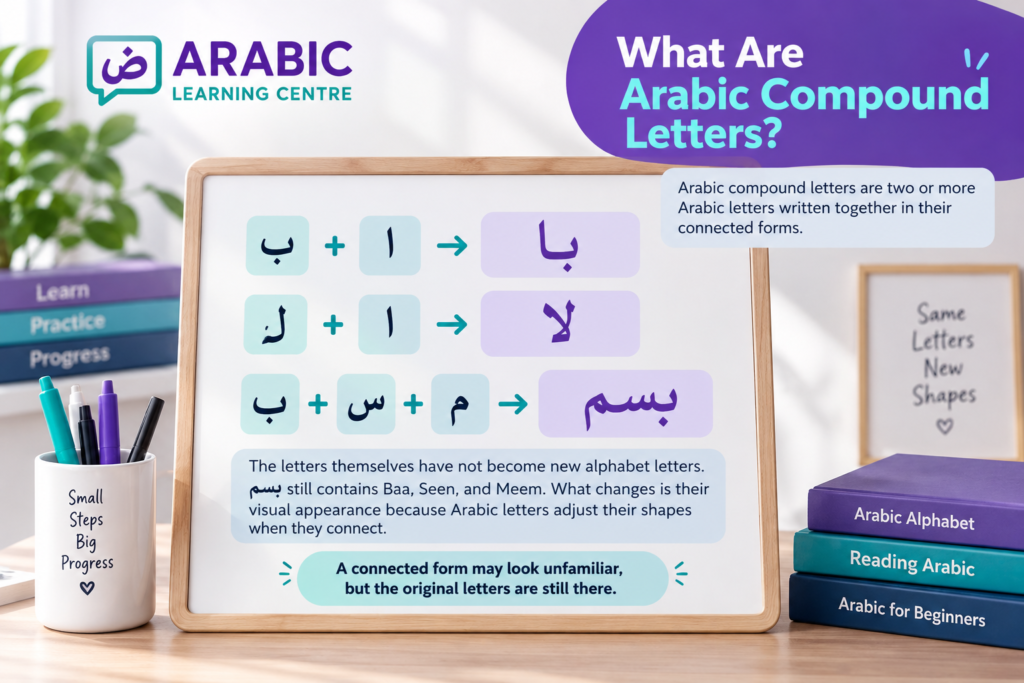
Arabic compound letters are two or more Arabic letters written together in their connected forms.
The term is commonly used in beginner Arabic and Qaida instruction to distinguish joined letter combinations from individual alphabet forms.
For example:
ب + ا → با
ل + ا → لا
ب + س + م → بسم
The letters themselves have not become new alphabet letters. بسم still contains Baa, Seen, and Meem. What changes is their visual appearance because Arabic letters adjust their shapes when they connect.
This is the main idea learners need to understand: a connected form may look unfamiliar, but the original letters are still there.
Why Do Arabic Letters Look Different When They Are Joined?
Arabic is written from right to left, and most letters are designed to connect with neighboring letters. To make that connection possible, the visible form of a letter may change according to its position.
Take Baa (ب) as a simple example:
- Isolated: ب
- Initial: بـ
- Medial: ـبـ
- Final: ـب
All four forms represent the same letter: Baa.
Beginners therefore need to stop memorizing Arabic letters as if each one has only a single fixed picture. The more useful skill is learning to recognize the identity of a letter underneath its changing connected form.
This skill also becomes important beyond beginner reading. Learners who continue into Fusha Arabic encounter connected Arabic constantly in sentences, texts, and formal written communication.

The Four Forms That Help You Decode Arabic Compound Letters
To recognize Arabic compound letters in English, learners need to understand how a letter can appear in four different forms depending on its position and connection.
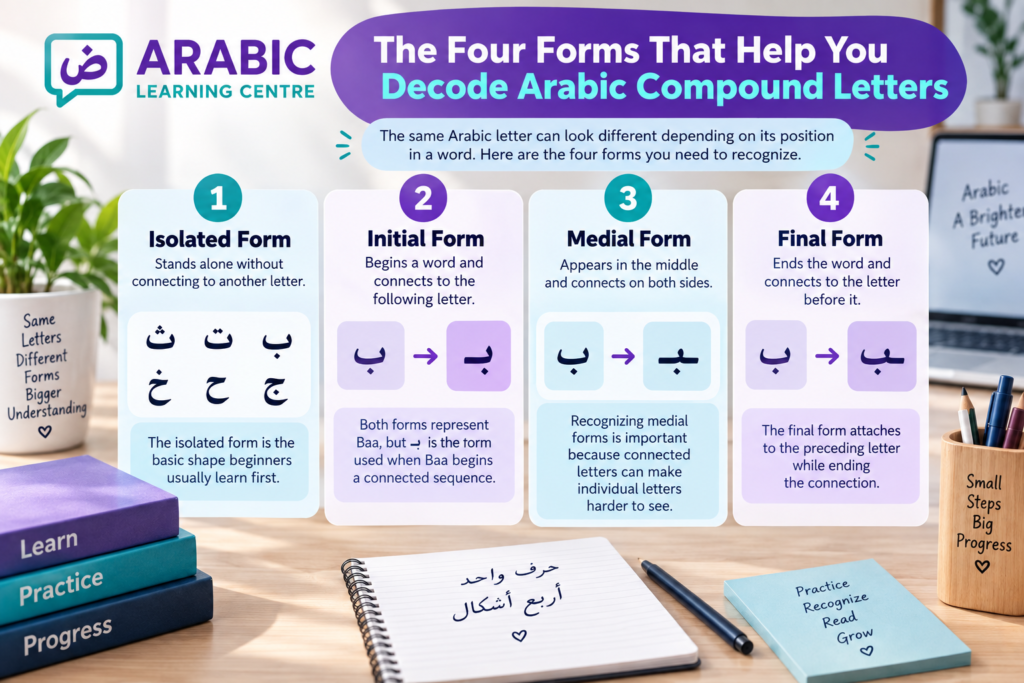
1. An Isolated Letter Stands Alone Without Connecting to Another Letter
The isolated form is the basic shape beginners usually learn first.
For example:
ب — ت — ث — ج — ح — خ
Learning these forms first gives students a clear reference point for recognizing the same letters after they become connected.
2. An Initial Letter Begins a Word and Connects to the Following Letter
When a connectable letter appears at the beginning of a word, it takes its initial form so it can join the next letter.
For example:
ب → بـ
Both forms represent Baa, but بـ is the form used when Baa begins a connected sequence.
3. A Medial Letter Appears in the Middle and Connects on Both Sides
When a connectable letter appears between other letters, it usually connects to both the preceding and following letters.
For example:
ب → ـبـ
Recognizing medial forms is especially important because several connected letters can make individual letter boundaries harder to see.
4. A Final Letter Ends the Word and Connects to the Letter Before It
When a letter appears at the end of a connected sequence, it may attach to the preceding letter while ending the connection.
For example:
ب → ـب
Once learners can recognize these four positional forms, it becomes much easier to separate connected Arabic writing into its individual letters.
How Dots Help You Distinguish Similar Arabic Compound Letters?
Many Arabic compound letters become visually similar when connected. In these cases, the number and position of the dots are often the easiest way to identify each letter correctly.
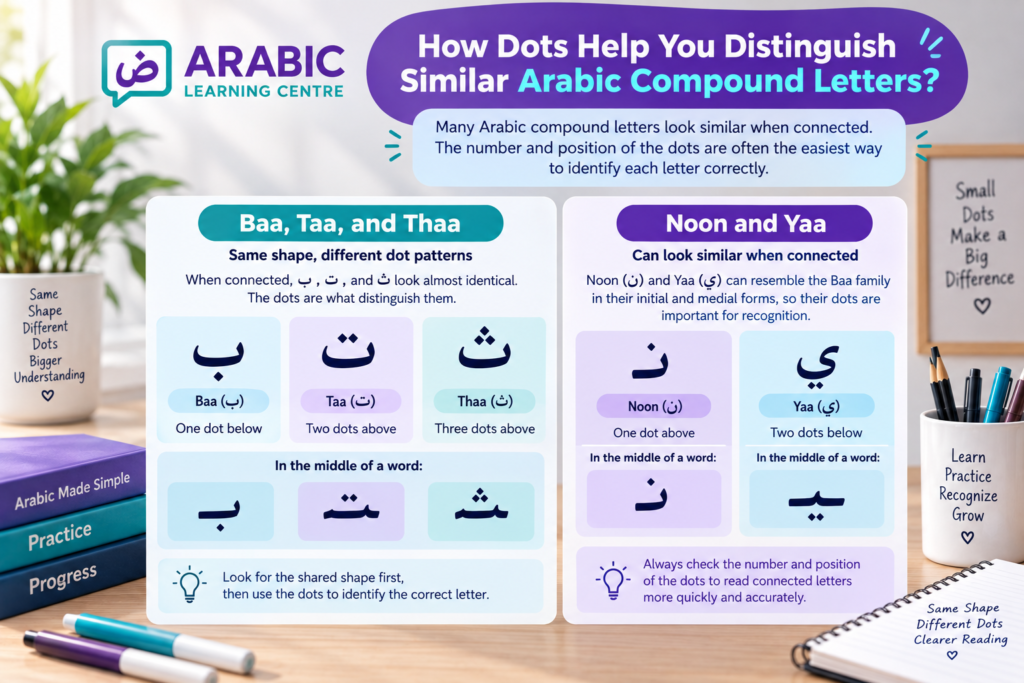
Baa, Taa, and Thaa Have the Same Basic Shape but Different Dot Patterns
When Baa (ب), Taa (ت), and Thaa (ث) are connected, their basic shapes look almost identical:
بـ — تـ — ثـ
The dots are what distinguish them:
- Baa (ب): one dot below
- Taa (ت): two dots above
- Thaa (ث): three dots above
The same distinction appears when these letters are in the middle of a connected sequence:
ـبـ — ـتـ — ـثـ
Instead of memorizing each form as a completely new symbol, learners can recognize the shared shape first and then use the dots to identify the correct letter.
Noon and Yaa Can Also Look Similar When They Are Connected
Noon (ن) and Yaa (ي) can resemble the Baa family in their initial and medial forms, making their dots especially important for recognition.
For example:
نـ — يـ
and:
ـنـ — ـيـ
Learning to check the number and position of the dots helps beginners distinguish these similar connected forms more quickly and accurately.
Six Arabic Letters That Do Not Connect to the Following Letter
One of the most useful rules for beginners learning to read connected Arabic is that not every letter joins to the letter that comes after it. Recognizing this rule makes Arabic word shapes much easier to understand.
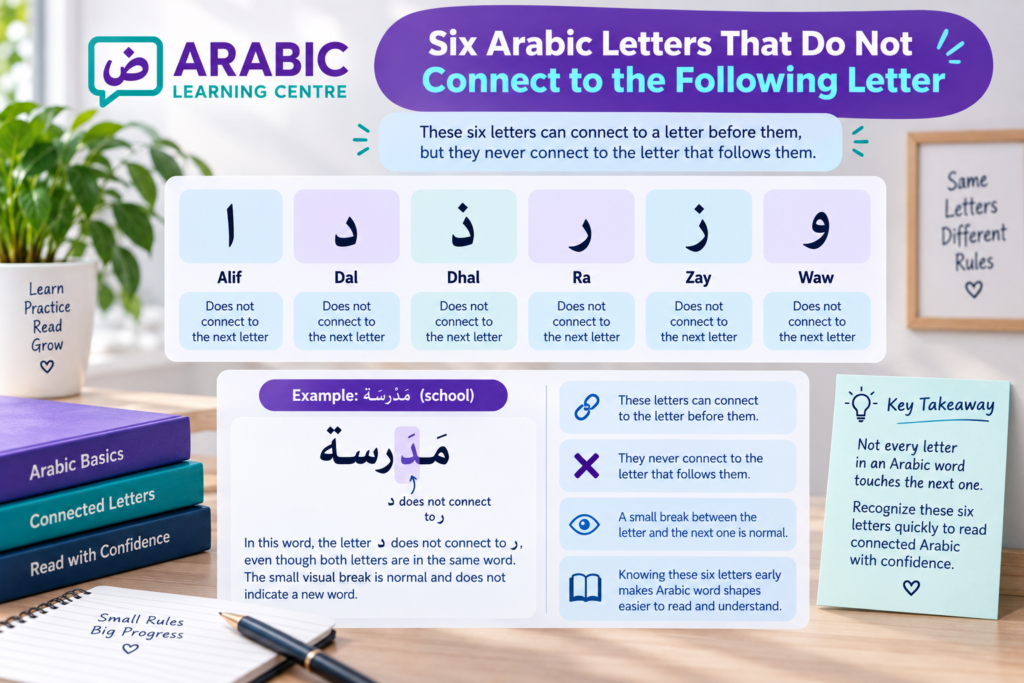
There are six non-connecting Arabic letters:
ا — د — ذ — ر — ز — و
These letters can connect to a compatible letter before them, but they never connect to the letter that follows them. This means that whenever one of these six letters appears in the middle of a word, the next letter begins a new connected section.
For example, in مَدْرَسَة, the letter د does not connect to ر, even though both letters belong to the same word. The small visual break is therefore part of normal Arabic writing—it is not a space and does not indicate a new word.
Learning these six letters early helps beginners avoid the common assumption that every letter within an Arabic word must physically touch the next one. Once you can recognize ا، د، ذ، ر، ز، و quickly, reading and identifying connected Arabic letter forms becomes much easier.
How Can You Separate Arabic Compound Letters Back Into Individual Letters?
A useful way to master Arabic compound letters is to look at a connected form and identify each letter inside it before trying to read it as a complete word.
For example:
بسم → ب + س + م
The learner identifies the connected letters as Baa + Seen + Meem.
Another example is:
نحب → ن + ح + ب
Here, the learner separates the form into Noon + Haa + Baa.
At the beginner Qaida stage, the goal is not to rush into reading every combination as a complete word. Learners should first become confident at recognizing and naming individual letters even when their shapes change through connection.
With practice, connected Arabic begins to look less like a new set of symbols and more like familiar letters appearing in different forms.
Read also: Arabic Root Words – A Complete Guide
Inside Our Classrooms
See how we make learning interactive and engaging! Watch a quick snippet of our live, conversational classes in action:
Are You Recognizing Individual Letters or Just Memorizing Word Shapes?
When practicing Arabic compound letters, it is easy to become familiar with the overall appearance of a word without actually recognizing every letter inside it.
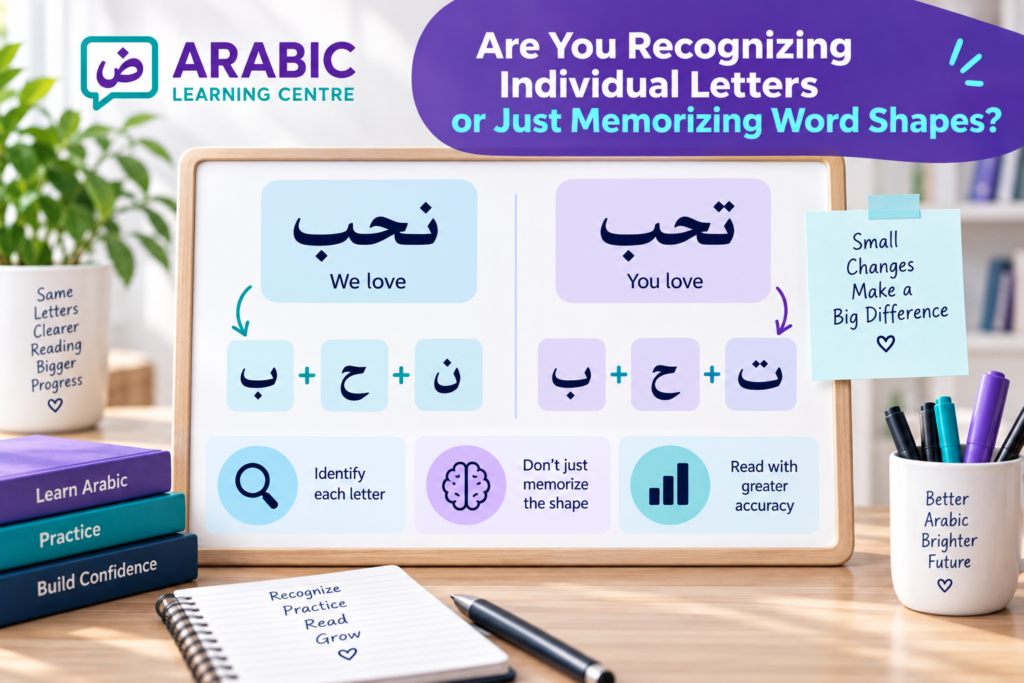
A simple test is to make a small change to a familiar connected sequence and see whether you can still identify each letter correctly.
For example, compare:
نحب — تحب
These two words have a very similar connected structure, but the first letter is different. Instead of recognizing each word only by its overall appearance, try breaking it into individual letters:
نحب = ن + ح + ب
تحب = ت + ح + ب
If you can identify the changed letter immediately and separate the rest of the sequence correctly, you are developing genuine letter recognition rather than relying on memorized word shapes.
You can apply the same test to other Arabic compound letters by changing one letter while keeping the rest of the connected sequence similar. This trains you to identify where each letter begins and ends, recognize it within a connected form, and read unfamiliar combinations with greater accuracy.
What Is the Difference Between Compound Letters and Arabic Words?
The main difference is that compound letters are connected-letter combinations used for reading practice, while Arabic words are meaningful combinations of letters used in the language. This distinction is especially important for beginners studying through a Qaida.
In a compound-letter exercise, two, three, or more Arabic letters may be joined together simply to teach the learner how letter shapes change when they connect. The combination does not necessarily need to form a meaningful Arabic word.
For example, a teacher might present:
تكث
The purpose here is not necessarily to learn vocabulary. Instead, the learner practices separating the connected form into its individual letters:
تكث = ت + ك + ث
This helps beginners recognize each letter even when its shape changes because of its position within a connected sequence.
An Arabic word, on the other hand, carries meaning. Reading real words requires learners to move beyond identifying connected letters and begin paying attention to Harakat, Sukoon, Shaddah, pronunciation, and the way sounds combine to form a complete word.
Understanding compound letters therefore provides an important bridge between recognizing isolated Arabic letters and reading actual Arabic words.
As learners progress, studying Arabic grammar can then help them understand how meaningful words are formed, change, and function within complete sentences.
How Should Beginners Learn Arabic Compound Letters?
The most effective progression moves from recognition to increasingly complex connected forms rather than presenting full words immediately.
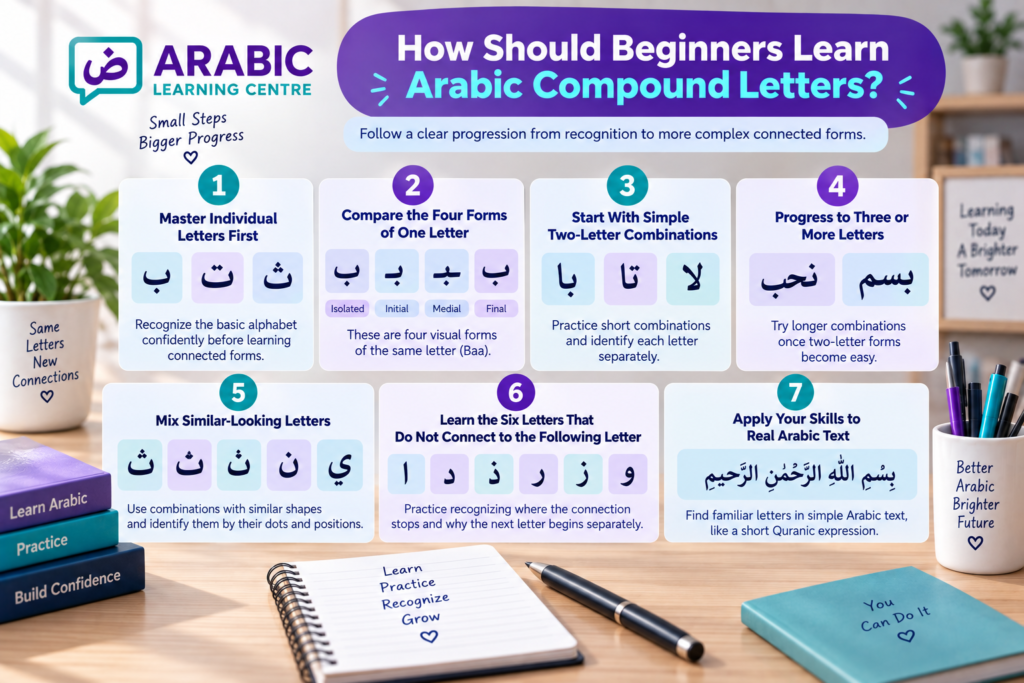
1. Master Individual Arabic Letters Before Studying Their Connected Forms
A learner should first recognize the basic alphabet confidently. If isolated letters are still frequently confused, connected forms will multiply that confusion.
Quickly review letters in random order rather than only reciting the alphabet from Alif to Yaa.
2. Compare One Letter in Its Isolated, Initial, Medial, and Final Forms
Choose one letter and place its forms beside one another.
For Baa:
ب → بـ → ـبـ → ـب
The learner should understand that these are not four different letters. They are four visual forms of the same Baa.
3. Start With Simple Two-Letter Combinations
Two-letter forms allow beginners to concentrate on the connection itself.
Examples include:
با
تا
لا
Ask the learner to identify each letter separately before increasing the length of the combination.
4. Progress to Three or More Connected Letters
Once two-letter forms are easy, introduce longer combinations.
For example:
بسم
نحب
Longer chains help learners practice identifying initial, medial, and final forms inside the same visual unit.
5. Mix Similar-Looking Letters to Test Real Recognition
Use combinations containing ب، ت، ث، ن، ي and ask the learner to identify them by their dots and positions.
This is much more effective than repeatedly presenting the same predictable combinations.
6. Introduce the Six Letters That Interrupt Connection
Give exercises containing:
ا، د، ذ، ر، ز، و
Ask the learner to identify where the visual chain stops and why the next letter begins independently.
7. Move From Qaida Exercises to Familiar Arabic Text
Once compound forms become recognizable in controlled exercises, begin finding familiar letters inside simple authentic Arabic text.
For Quran learners, even a familiar expression such as:
بِسْمِ اللَّهِ الرَّحْمَٰنِ الرَّحِيمِ
can become a recognition exercise. Instead of expecting immediate fluent recitation, the teacher can ask the learner to locate a Baa, Seen, Meem, Laam, Raa, or Haa in its connected form.
This bridges the gap between a learning book and the script the student ultimately wants to read.
Read also: Iqlab Letters In Arabic – Rule, Pronunciation
Common Problems When Learning Arabic Compound Letters
Difficulty with connected letters usually comes from how learners look at the script rather than from the number of letters they need to memorize.
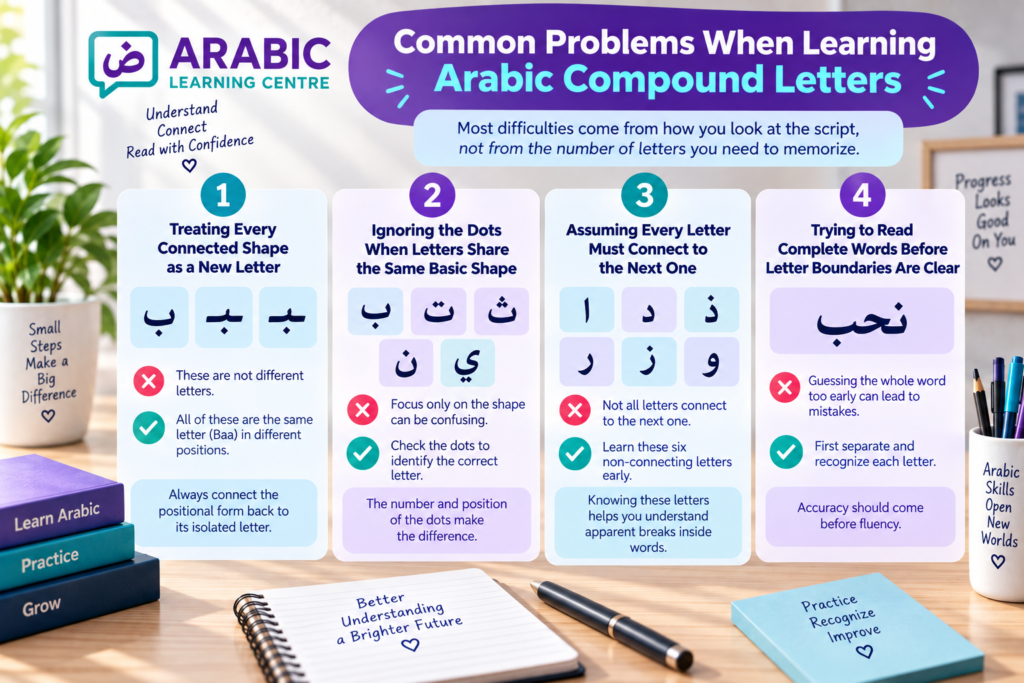
- Treating Every Connected Shape as a New Letter: A learner may see ب, بـ, and ـبـ as unrelated symbols. This creates unnecessary memorization. Always connect the positional form back to its isolated letter.
- Ignoring the Dots When Letters Share the Same Basic Shape: Connected ب، ت، ث، ن، ي can be confusing when learners focus only on the outline.Train the learner to check the dots before naming the letter.
- Assuming Every Letter Must Connect to the Next One: This creates confusion around ا، د، ذ، ر، ز، و. Memorizing these six non-connecting letters makes apparent breaks inside Arabic words much easier to understand.
- Trying to Read Complete Words Before Letter Boundaries Are Clear: Speed should not be the first goal. A learner who can slowly and accurately separate connected letters has built a stronger foundation than one who guesses complete words from their overall shape.
Why Is Compound-Letter Recognition Important for Arabic Beginners?
Recognizing Arabic compound letters is not a skill limited to children or beginner Qaida exercises.
It is a fundamental reading skill for anyone learning Arabic, because Arabic letters frequently change their written form depending on where they appear and how they connect to surrounding letters.
Once your eyes become comfortable separating connected Arabic script into individual letters, you no longer need to stop at every combination and ask, “What letter is this?” Instead, you can begin reading connected forms more naturally and shift your attention toward correct pronunciation, vocabulary, sentence structure, and meaning.
This foundation becomes especially valuable if your goal is to read the Quran, classical Islamic works, or other traditional Arabic texts.
After developing confidence with connected letters and basic reading, a structured Classical Arabic course can help you progress from recognizing the script to understanding vocabulary, grammar, sentence structures, and more advanced Arabic texts.

Read also: Ikhfa Letters in Arabic – 15 Letters, Rules, Examples, and How to Remember Them
Don’t Just Take Our Word For It
Take a look inside our vibrant classes and see our students and teachers in action. Click below to watch our classroom experience:
Learn to Recognize Connected Arabic With Arabic Learning Centre
Recognizing Arabic compound letters is an important step between knowing the Arabic alphabet and being able to read complete words with confidence.
The goal is not to memorize hundreds of connected shapes, but to understand how familiar letters change and connect within real Arabic text.
At Arabic Learning Centre, you can build on this foundation through structured Arabic study designed to develop stronger reading, pronunciation, vocabulary, and language skills.
With guided instruction, you can practice recognizing connected forms, distinguishing similar-looking letters, and understanding how Arabic script works as you progress toward reading complete words and sentences.
If you are ready to move beyond isolated letters and become more confident with connected Arabic, start learning with Arabic Learning Centre and build your reading skills step by step.
Courses We Offer:
- Online Arabic Course
- Classical arabic course
- Modern Standard Arabic Course
- Fusha Arabic Course
- Learn Saudi Arabic
- Arabic Course for Beginners
- Arabic Classes for Adults
- Arabic Classes for Ladies
- Advanced Arabic Course
- Intensive Arabic Course

Conclusion
Learning Arabic compound letters becomes much easier when you understand that connected forms are not completely new symbols.
They are the same Arabic letters you already know, simply changing shape according to whether they appear in the isolated, initial, medial, or final position.
The key is to build recognition gradually. Begin with simple two- and three-letter combinations, learn how dots distinguish similar letters, remember the six letters that do not connect to the following letter — ا، د، ذ، ر، ز، و — and practice breaking connected forms back into their individual letters.
With regular practice, you will begin to recognize connected Arabic without analyzing every shape separately.
What initially looks like a continuous chain of unfamiliar forms will gradually become a clear sequence of familiar letters, giving you the foundation you need to move confidently from Arabic compound letters to complete words and authentic Arabic text.
FAQs About Arabic Compound Letters
What Are Arabic Compound Letters?
Arabic compound letters are combinations of two or more Arabic letters displayed in their connected written forms. The original letters remain the same, but their shapes may change depending on their position and connections.
What Are Arabic Compound Letters in English?
In English-language Arabic teaching, the term Arabic compound letters generally refers to joined or connected Arabic letter combinations. Learners practice identifying the individual Arabic letters inside these connected forms.
Do Arabic Compound Letters Create New Alphabet Letters?
No. Joining letters does not normally create new alphabet letters. For example, با consists of Baa and Alif, while بسم consists of Baa, Seen, and Meem.
Why Do Arabic Letters Change Shape When Connected?
Arabic is a connected script. Many letters therefore have different visual forms depending on whether they appear independently or at the beginning, middle, or end of a connected sequence.
Which Arabic Letters Do Not Connect to the Letter After Them?
The six letters are:
ا، د، ذ، ر، ز، و
They can connect to a preceding compatible letter but do not connect forward to the letter that follows them.
How Can I Recognize Baa, Taa, and Thaa When They Are Connected?
Focus on the dots. Baa has one dot below, Taa has two dots above, and Thaa has three dots above. Their connected bodies can look very similar, so the dots are the clearest identifying feature.
Should Beginners Read Compound Letters as Complete Words?
Not necessarily. In an early Qaida lesson, the learner can first identify and name each individual letter inside the connected form. Complete word reading can develop later as vowels and additional reading skills are introduced.