 Learn Arabic
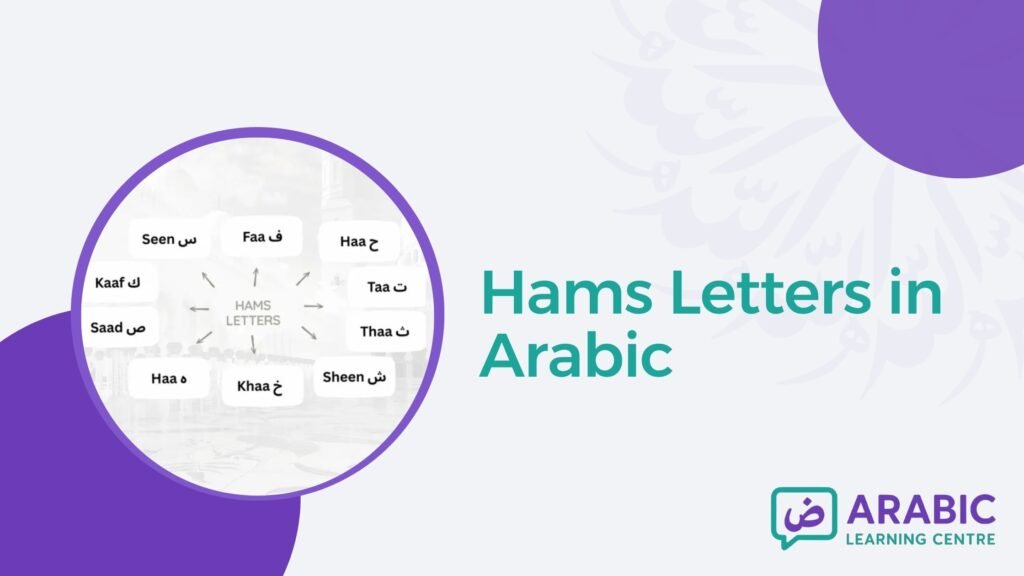
The Hams letters in Arabic are an important part of understanding Arabic pronunciation and Tajweed.
Hams (الهمس) describes a quality in which the breath continues to flow while a letter is pronounced. Its opposite is Jahr (الجهر), where the breath is held or restricted because of the stronger reliance on the letter’s articulation point.
Classical Arabic and Tajweed scholars identified ten Al Hams letters: ف، ح، ث، ه، ش، خ، ص، س، ك، ت. They are traditionally memorized through the famous phrase:
فَحَثَّهُ شَخْصٌ سَكَتْ
Understanding these letters is useful not only for Quran recitation but also for learners who want to improve their awareness of Arabic sounds, articulation, and pronunciation.
As your knowledge develops, studying pronunciation alongside Arabic grammar can also help you build a stronger overall foundation in the language.
What Does Hams Mean in Arabic?
To understand the Hams letters in Arabic with meaning, it helps to distinguish between the linguistic meaning of Hams and its technical meaning in Arabic phonetics and Tajweed.
Hams in the Arabic Language
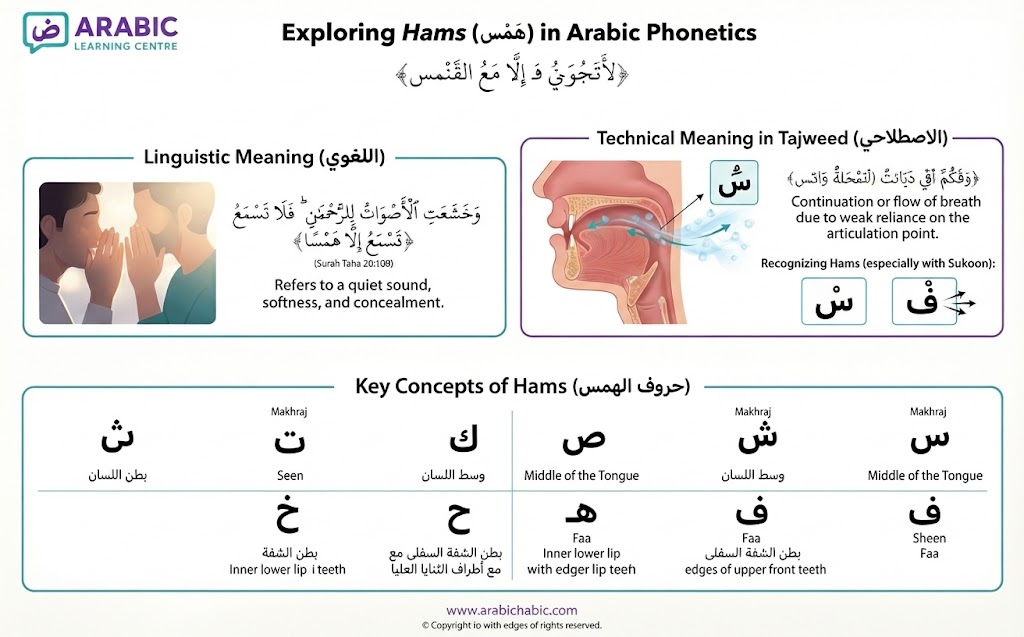
The Arabic word Hams (هَمْس) refers linguistically to a low, hidden, or quiet sound. It is associated with speaking softly or with a voice that is not strongly heard.
This meaning appears in the Quran:
وَخَشَعَتِ الْأَصْوَاتُ لِلرَّحْمَٰنِ فَلَا تَسْمَعُ إِلَّا هَمْسًا
“And all voices will be humbled before the Most Compassionate. Only whispers will be heard.”
The linguistic meaning therefore gives us the idea of softness and concealment in sound.
Hams in Tajweed
Technically, Hams is the continuation or flow of breath when a letter is pronounced because of relatively weak reliance on its articulation point.
Classical scholars described a mahmus (مهموس) letter as one with which the breath flows during pronunciation.
In practical terms, when you correctly pronounce one of the Hams letters, you should notice air escaping with the sound. The effect is particularly easy for beginners to recognize when the letter is sakin, meaning that it carries a sukoon.
Hams should not, however, be understood as simply “whispering” a letter. It is a specific characteristic of the way breath behaves during articulation.
What Are the Hams Letters in Arabic?
According to the classical system followed by Arabic and Tajweed scholars, there are 10 Hams letters in Arabic:
| Arabic Letter | Name | Simple Pronunciation Guide |
| ف | Fa | Similar to English f |
| ح | Ha | A breathy sound produced from the throat |
| ث | Tha | Similar to th in “think” |
| ه | Ha | A light, breathy h |
| ش | Sheen | Similar to English sh |
| خ | Kha | A strong sound from the upper throat |
| ص | Sad | An emphatic/heavy s |
| س | Seen | Similar to English s |
| ك | Kaf | Similar to k, with breath upon release |
| ت | Ta | Similar to English t |
These ten letters are traditionally collected in the mnemonic:
فَحَثَّهُ شَخْصٌ سَكَتْ
Faḥaththahu shakhṣun sakat
The purpose of the phrase is not its meaning but its usefulness as a memory tool. Every letter needed to identify the ten Hams letters appears in it.
Instead of trying to memorize ten disconnected letters, students can memorize فحثه شخص سكت and extract the letters from the phrase whenever they need them.
Learning these letters alongside their meanings and common Arabic words is especially useful for beginners. Building your Arabic vocabulary at the same time allows you to encounter the sounds naturally rather than practicing every letter only in isolation.

How Do You Pronounce Al Hams Letters?
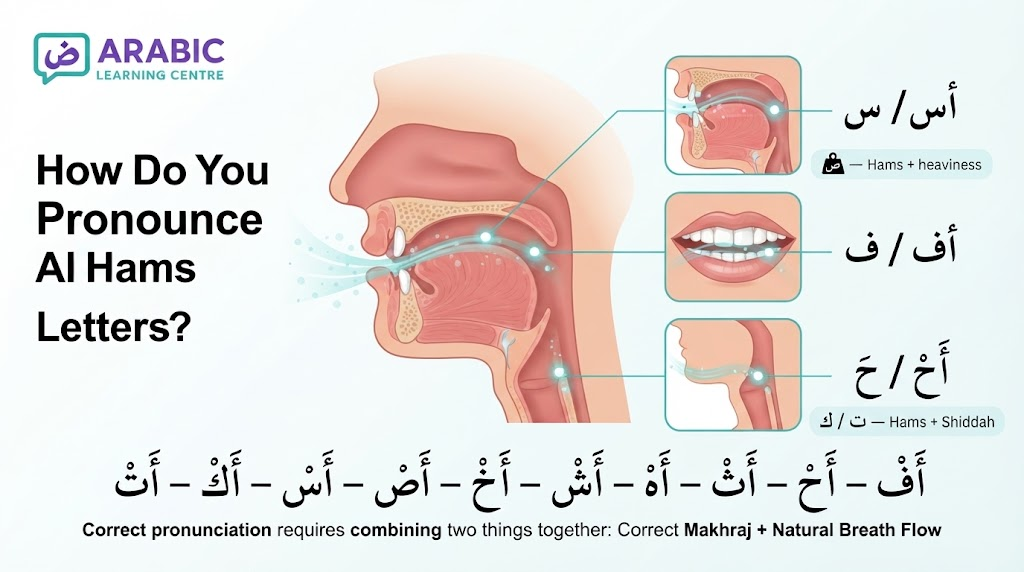
Correct pronunciation of Al Hams letters depends on two things: producing the letter from its correct makhraj and allowing the characteristic flow of breath to occur.
Try pronouncing:
أَفْ – أَحْ – أَثْ – أَهْ – أَشْ – أَخْ – أَصْ – أَسْ – أَكْ – أَتْ
Pay attention to the air that accompanies each sound. For example, when you say أَسْ, you can hear and feel air continuing through the narrow passage created for س.
When you pronounce أَفْ, air continues between the lower lip and upper front teeth. With أَحْ, the breath can be felt passing through the throat.
The amount and quality of the airflow are not identical in every Hams letter because each letter has other characteristics as well. ص, for example, is a Hams letter but also carries heaviness, while ت and ك combine Hams with Shiddah.
The goal is therefore not to force an exaggerated breath into every letter. You should preserve all the characteristics of the letter together.
Hams Letters Examples from the Quran
The best way to understand Hams is to hear and observe it in actual Quranic words. The following Hams letters examples cover all ten letters and show how the breath flows naturally during pronunciation.
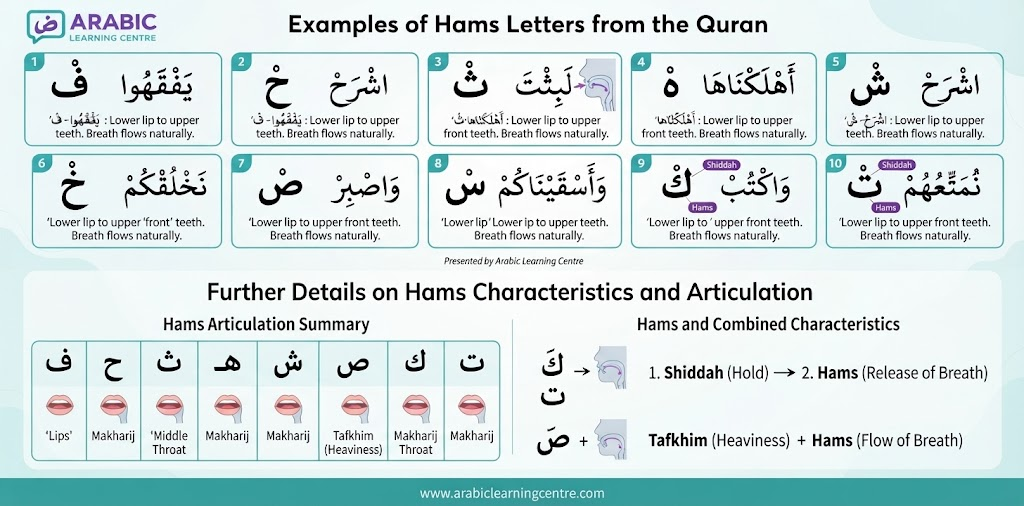
Hams is especially noticeable when the letter carries a sukoon, because there is no vowel sound to mask the airflow.
1. ف – Fa
يَفْقَهُوا
In يَفْقَهُوا, the letter فْ carries a sukoon. Pronounce it from its correct articulation point, with the lower lip lightly touching the upper front teeth, while allowing the breath to continue naturally.
2. ح – Ha
اشْرَحْ
The final حْ in اشْرَحْ clearly demonstrates Hams. The letter comes from the middle of the throat, and the breath should continue through its articulation without turning ح into an ordinary ه sound.
3. ث – Tha
لَبِثْتَ
The ثْ in لَبِثْتَ is a clear example of Hams. The tip of the tongue approaches or passes slightly between the front teeth while air continues to escape. Avoid adding voicing that could make ث resemble ذ.
4. ه – Ha
أَهْلَكْنَاهَا
In أَهْلَكْنَاهَا, the sakin هْ has a light and clearly breathy quality. The throat remains relaxed, allowing the breath to pass without excessive pressure.
5. ش – Sheen
اشْرَحْ
The شْ in اشْرَحْ combines Hams with the characteristic spreading sound of Sheen. The airflow should remain audible, but it should not be exaggerated or prolonged beyond the natural pronunciation of the letter.
6. خ – Kha
نَخْلُقْكُمْ
The خْ in نَخْلُقْكُمْ shows that a Hams letter can also have other strong characteristics. Although خ is pronounced with heaviness, the breath still flows with it. Its heaviness should therefore be preserved without suppressing its Hams.
7. ص – Sad
وَاصْبِرْ
The sakin صْ in وَاصْبِرْ combines Hams with Tafkhim, or heaviness. Pronounce the letter with its full emphatic quality while still allowing the characteristic breath to flow.
8. س – Seen
وَأَسْقَيْنَاكُمْ
The سْ in وَأَسْقَيْنَاكُمْ is one of the clearest Hams letters examples for beginners. Its hissing sound is accompanied by a continuous stream of air, making the characteristic relatively easy to hear and feel.
Read also: Soft Letters in Arabic – Leen Letters, Rules, Examples, and Pronunciation
9. ك – Kaf
وَاكْتُبْ
In وَاكْتُبْ, the كْ combines two characteristics: Shiddah and Hams. The sound is first held because of Shiddah, then the breath is released. A common mistake is either to suppress this breath completely or to exaggerate it after the Kaf.
10. ت – Ta
نُمَتِّعُهُمْ
The letter ت also possesses both Shiddah and Hams. Its articulation requires a firm contact followed by the appropriate release of breath. The Hams should be present naturally wit
Is Hams Applied Only When a Letter Has Sukoon?
This point can sometimes cause confusion Hams is considered an inherent sifah, or characteristic, of its ten letters. In other words, a letter such as س does not stop being a Hams letter simply because it carries a fathah, kasrah, or dammah.
However, the flow of breath is most clearly perceived and practically emphasized when a Hams letter is sakin, including when sukoon occurs because the reciter stops on the word.
Compare the way a Hams letter sounds when it is moving with a vowel and when it is sakin. The vowel can make the breath less noticeable, while sukoon gives the listener more opportunity to perceive the airflow.
This distinction is important: the letter always possesses the characteristic of Hams, but Hams becomes especially apparent in the state of sukoon.
What Is Jahr in Arabic?
To fully understand Hams, you need to understand its opposite: Jahr (الجهر).
Linguistically, Jahr refers to making something clear, apparent, or audible. The word is associated with openly expressing or raising the voice.
Allah says:
وَإِن تَجْهَرْ بِالْقَوْلِ فَإِنَّهُ يَعْلَمُ السِّرَّ وَأَخْفَى
“If you speak publicly, He certainly knows what is secret and what is even more hidden.”
In classical Tajweed terminology, Jahr describes the prevention or restriction of breath during the pronunciation of a letter because of stronger reliance upon its articulation point.
Modern phonetic descriptions often explain the contrast using vocal-fold activity: voiced sounds involve vocal-fold vibration, whereas voiceless sounds do not.
This modern explanation can help students understand the physical distinction, although the classical Tajweed definitions focus especially on the flow or restriction of breath.
What Are the Jahr Letters in Arabic?
In the traditional Tajweed classification, the Jahr letters in Arabic are the letters other than the ten Hams letters.
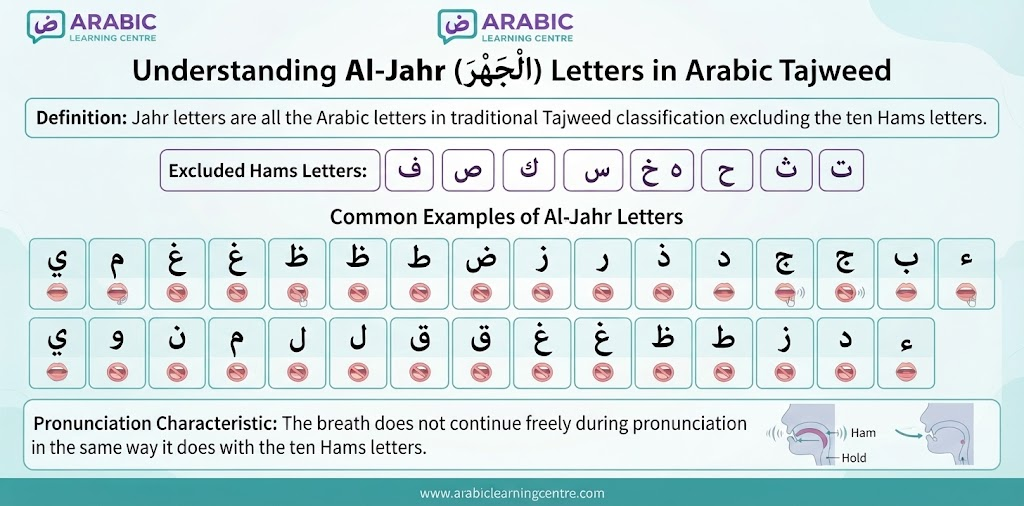
The ten letters excluded from this group are:
ف ح ث ه ش خ ص س ك ت
Therefore, the remaining Arabic letters belong to Al-Jahr letters in the classical Tajweed classification.
Common examples include:
ء، ب، ج، د، ذ، ر، ز، ض، ط، ظ، ع، غ، ق، ل، م، ن، و، ي
When pronouncing them, the breath does not continue freely in the same way that it does with the ten Hams letters.
Inside Our Classrooms
See how we make learning interactive and engaging! Watch a quick snippet of our live, conversational classes in action:
What Is the Difference Between Hams and Jahr Letters?
Hams and Jahr letters represent two opposite qualities in Arabic pronunciation and Tajweed, mainly related to how the breath behaves when a letter is articulated.
| Feature | Hams – الهمس | Jahr – الجهر |
| Linguistic meaning | Hidden or quiet sound | Clear or apparent sound |
| Breath | Flows during pronunciation | Is held or restricted |
| Classical explanation | Weaker reliance on the makhraj | Stronger reliance on the makhraj |
| Number in classical Tajweed | 10 letters | All remaining letters |
| Letters | ف ح ث ه ش خ ص س ك ت | All letters outside the Hams group |
| Easy way to remember | فحثه شخص سكت | Memorize the Hams letters and exclude them |
| Most noticeable | Especially with sukoon or when stopping | Through the stronger restriction of breath and clearer voiced quality |
The main difference between Hams and Jahr letters is therefore the movement of the breath.
With Hams, the breath continues to flow during pronunciation, while with Jahr, the breath is restricted because the letter is articulated with stronger pressure at its makhraj.
A simple way to understand the contrast is to compare س and ز. The letter س allows a noticeable stream of air, while ز has stronger voicing and less free airflow. This makes the difference between Hams and Jahr easier to hear in practice.
Read also: Idgham Letters in Arabic – Rules, Types, and 10 Examples from the Quran
Classical and Modern Views of Hams and Jahr
There is an important distinction between the traditional Tajweed classification and some descriptions found in modern phonetics.
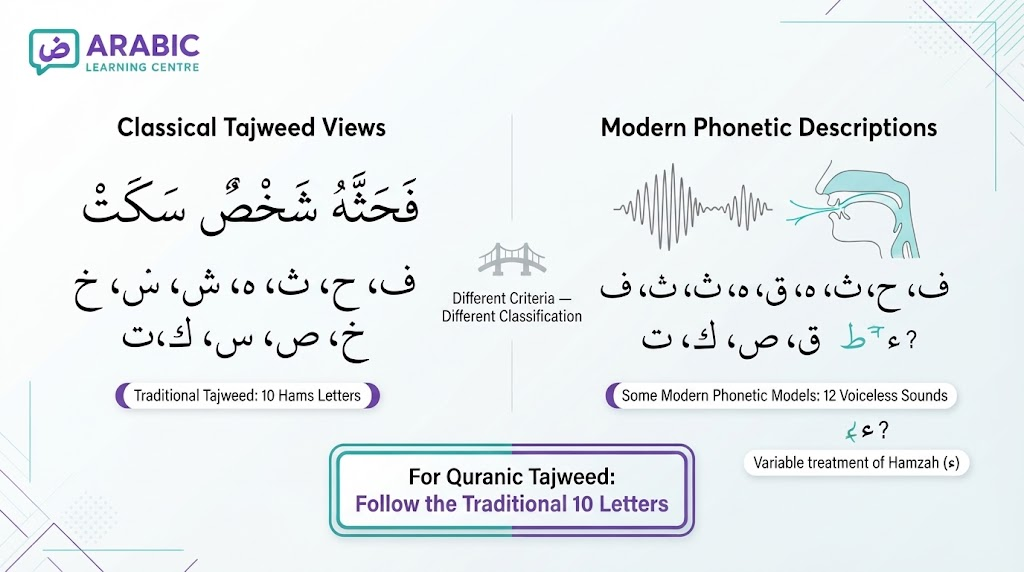
Classical scholars, including Sibawayh and later Tajweed authorities, identify ten Hams letters, represented by:
فَحَثَّهُ شَخْصٌ سَكَتْ
Everything outside this set is traditionally treated as Jahr. Some modern Arabic phoneticians, however, classify ق (Qaf) and ط (Ta) with the voiceless sounds as well, producing a set of twelve rather than ten. Modern scholars have also differed in their treatment of ء (Hamzah).
This difference results from the criteria being used. Classical Tajweed terminology and modern phonetics do not always classify sounds according to exactly the same framework.
For a student learning Quranic Tajweed, the traditional ten-letter classification remains the relevant one:
ف، ح، ث، ه، ش، خ، ص، س، ك، ت
Learners studying broader Arabic phonetics may later encounter the modern classification and should understand that it represents a different analytical approach rather than simply assuming that one of the lists is a spelling mistake.
Why Are Hams and Jahr Important in Arabic Pronunciation?
Hams and Jahr help explain why two letters produced in relatively similar areas can still sound clearly different.
Correct Arabic pronunciation is not determined by the makhraj alone. Each letter also carries a combination of characteristics, or sifat, that gives it its distinctive sound.
Understanding Hams helps students avoid adding unnecessary voicing to letters that require airflow. Understanding Jahr helps them avoid weakening letters whose breath should be restrained.
This is particularly important when reading the Quran because accurate recitation requires preserving the characteristics of individual letters rather than simply producing an approximate sound.
For non-native speakers, these distinctions can also improve everyday Arabic pronunciation. Students who want to combine correct pronunciation with structured study of formal Arabic can explore a Fusha Arabic course to strengthen their ability to read, understand, and use Modern Standard Arabic.

Common Mistakes When Pronouncing Hams Letters
Learning the ten Hams letters is only the first step; applying Hams correctly during pronunciation requires more attention.
Beginners may allow too little breath, exaggerate the airflow, or focus so much on Hams that they lose another essential quality of the letter.
1. Adding Too Much Breath to Hams Letters
Hams requires a natural flow of breath, not an exaggerated release of air. One common mistake is adding an extra breathy sound after the letter, which can make the pronunciation longer than it should be.
For example, تْ should not turn into an extended “t-hhh” sound. The breath should accompany the correct articulation naturally without creating an additional sound.
2. Losing Other Letter Characteristics While Applying Hams
Every Arabic letter has several characteristics that work together, so applying Hams should never cause another important quality to disappear.
For example, ص and خ are Hams letters, but they still retain their heaviness. Similarly, ك and ت possess both Hams and Shiddah. Correct pronunciation requires maintaining these characteristics together rather than emphasizing Hams at the expense of the others.
3. Turning Hams Letters Into Similar Jahr Letters
Incorrect control of voicing can cause a Hams letter to sound like a similar Jahr letter. For example, adding too much voicing to ث may bring its pronunciation closer to ذ, while incorrectly voicing س can make it resemble ز.
Practicing similar letter pairs and listening carefully to the difference in breath and voice can help learners distinguish them more accurately.
4. Not Giving Sakin Hams Letters Enough Breath
Hams becomes especially noticeable when a letter carries sukoon. A common mistake is to pronounce a sakin Hams letter too quickly or firmly, preventing the characteristic airflow from being heard properly.
Practicing forms such as أَفْ، أَسْ، أَحْ، أَشْ can make the airflow easier to recognize. The aim is not to exaggerate it, but to give the letter its natural Hams while maintaining its correct makhraj.
5. Assuming Every Hams Letter Must Sound Light
Hams does not mean that a letter is necessarily light or soft. The term specifically describes the flow of breath during articulation, not whether the letter has a light or heavy sound.
For example, خ and ص are both Hams letters while also carrying qualities of heaviness. They must therefore retain their strong, heavy pronunciation while allowing the required breath to flow naturally.
Read also: Izhar Letters in Arabic – Rules, Pronunciation, and 10 Examples from the Quran
How to Practice the Hams Letters?
Practice the Hams letters in Arabic gradually, starting with memorization and isolated pronunciation before applying them naturally in Quran recitation.
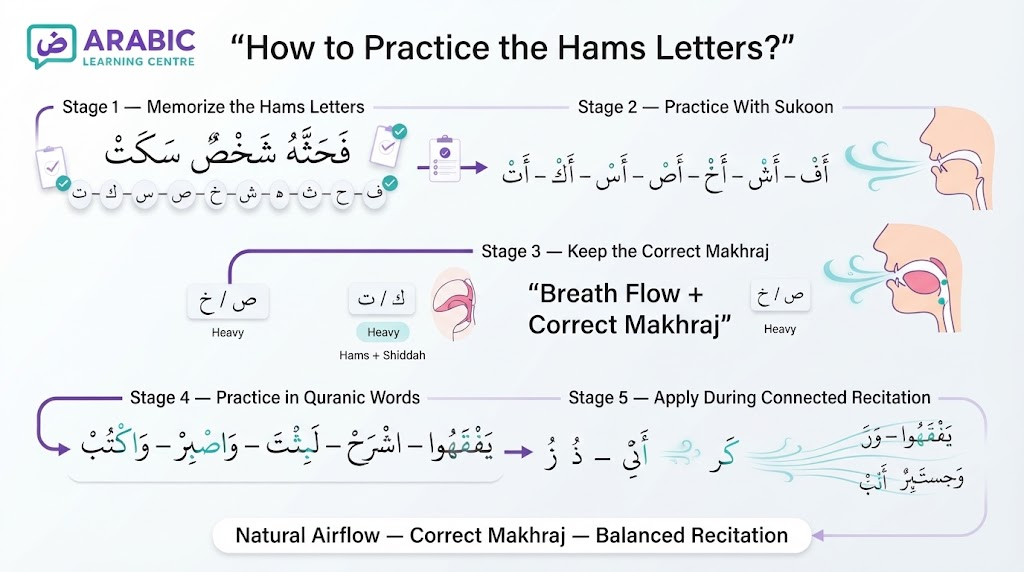
1. Memorize the Ten Hams Letters
Start with the traditional mnemonic:
فَحَثَّهُ شَخْصٌ سَكَتْ
Then identify the ten individual letters:
ف – ح – ث – ه – ش – خ – ص – س – ك – ت
Repeat them until you can recognize every Hams letter without referring to the mnemonic.
2. Practice Each Hams Letter With Sukoon
Place a Hamzah with fathah before each letter:
أَفْ – أَحْ – أَثْ – أَهْ – أَشْ – أَخْ – أَصْ – أَسْ – أَكْ – أَتْ
Sukoon makes Hams easier to notice. Listen for the natural airflow without deliberately forcing extra breath.
3. Maintain the Correct Makhraj
Do not focus on the breath at the expense of correct articulation. Each letter must still come from its proper makhraj and retain its other characteristics.
For example, ص and خ remain heavy, while ك and ت retain their Shiddah while Hams is applied.
4. Practice Hams in Quranic Words
Once you are comfortable with isolated letters, move to examples such as:
يَفْقَهُوا – اشْرَحْ – لَبِثْتَ – وَاصْبِرْ – وَاكْتُبْ
Read slowly at first and pay attention to the natural airflow accompanying the Hams letter.
5. Apply Hams During Connected Recitation
Finally, practice the letters while reading complete ayat. Hams should become a natural part of your pronunciation rather than an exaggerated sound.
The goal is to maintain the correct airflow while preserving the makhraj and other characteristics of every letter.
Don’t Just Take Our Word For It
Take a look inside our vibrant classes and see our students and teachers in action. Click below to watch our classroom experience:
Improve Your Arabic Pronunciation With Arabic Learning Centre
Understanding Hams letters in Arabic is an important step toward clearer and more accurate pronunciation.
But mastering Hams, Jahr, makharij, and other letter characteristics becomes much easier when you learn them as part of a structured Arabic program rather than studying individual rules in isolation.
At Arabic Learning Centre, you can develop your Arabic step by step with guided lessons that strengthen pronunciation alongside grammar, vocabulary, reading, and Fusha Arabic.
This balanced approach helps you understand not only how Arabic letters should sound, but also how to use the language more confidently in real contexts.
Whether you are a complete beginner or want to improve your existing Arabic skills, structured learning and regular practice can help you turn concepts such as Hams and Jahr into natural pronunciation habits while building a stronger foundation in the Arabic language.
Start your Arabic learning journey with Arabic Learning Centre today and book your free trial lesson.
Courses We Offer:
- Quranic Arabic Course
- Arabic Course for Islamic Studies
- Learn Arabic for New Muslims
- Learn Arabic Letters for Tajweed
- Al Azhar Arabic Course
- Madinah Arabic Course
- Online Arabic Classes for Kids
- Arabic Words Course for Kids
- Arabic Lessons for Kindergarten
- Arabic Elementary School
- Arabic Intermediate School
- Arabic High School

Conclusion
The Hams letters in Arabic are the ten letters ف، ح، ث، ه، ش، خ، ص، س، ك، ت, traditionally memorized through فحثه شخص سكت. Hams means that the breath flows during articulation, while its opposite, Jahr, involves holding or restricting that breath.
Although Hams belongs inherently to each of its ten letters, its effect becomes particularly easy to hear when a letter carries sukoon or when the reciter stops on it.
Learning this distinction helps students pronounce Arabic more precisely and apply the characteristics of letters correctly during Quran recitation.
Rather than memorizing Hams as an isolated Tajweed definition, practice hearing and feeling the difference between Hams and Jahr letters in real words.
With repeated listening, correct articulation, and guided practice, the distinction gradually becomes a natural part of accurate Arabic pronunciation.
Frequently Asked Questions About Hams Letters in Arabic
How many Hams letters are there in Arabic?
There are ten Hams letters according to the traditional Arabic and Tajweed classification: ف، ح، ث، ه، ش، خ، ص، س، ك، ت. They are collected in the mnemonic phrase فحثه شخص سكت.
What does Hams mean in Tajweed?
Hams (الهمس) means the flow or continuation of breath during the pronunciation of a letter because of weaker reliance on its articulation point. Linguistically, the Arabic word Hams refers to a hidden, quiet, or subdued sound.
What is the difference between Hams and Jahr?
Hams allows the breath to flow during pronunciation, whereas Jahr restricts or holds the breath. They are opposite characteristics used to distinguish Arabic letters according to how they are articulated.
What is the phrase for remembering Al Hams letters?
The traditional mnemonic is:
فَحَثَّهُ شَخْصٌ سَكَتْ
It contains all ten letters of Hams and is widely used by Tajweed students to memorize them.
Are Hams letters applied only when they have sukoon?
Hams is an inherent characteristic of the ten letters, so they retain this quality whether they are sakin or vowelled. However, the breath flow associated with Hams is most clearly heard when the letter carries sukoon or when stopping on it.
What are some Hams letters examples?
Examples include يَفْقَهُوا for ف, اشْرَحْ for ح and ش, لَبِثْتَ for ث, وَاصْبِرْ for ص, وَأَسْقَيْنَاكُمْ for س, and وَاكْتُبْ for ك. Practicing the letters when they carry sukoon makes the airflow easier to recognize.