 Learn Arabic
Learning the idgham letters in Arabic is an essential part of understanding how Quranic recitation moves naturally from one word to the next. Instead of pronouncing every letter separately, Idgham teaches you when Noon Sakinah (نْ) or Tanween (ـً ـٍ ـٌ) should merge into the following letter.
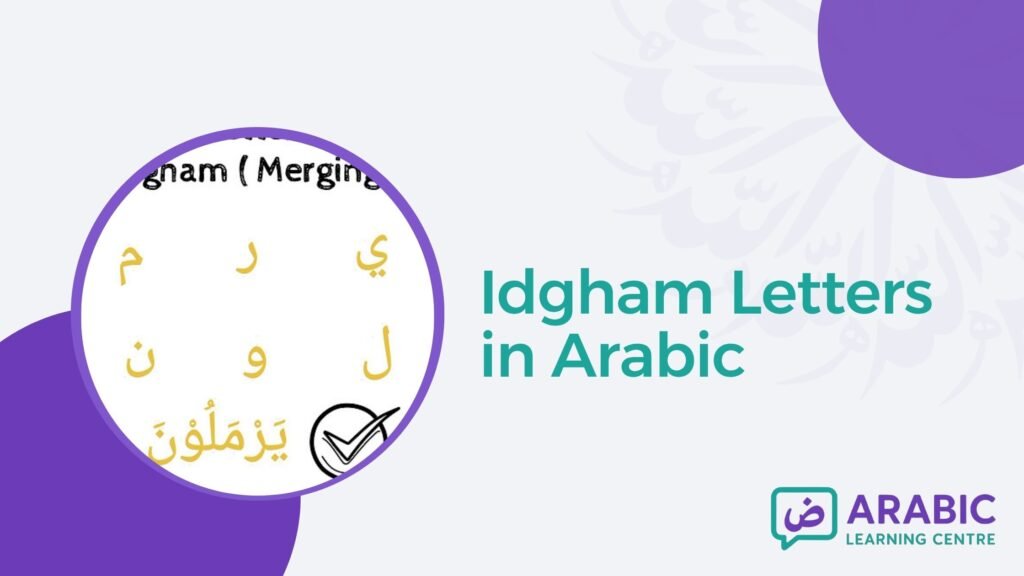
There are six Idgham letters: ي، ر، م، ل، و، ن, commonly memorized through the Arabic word يَرْمَلُونَ (Yarmaloon). Four are pronounced with Ghunnah, while two are pronounced without it.
Once you understand this division, identifying Idgham examples from Quran becomes much easier. More importantly, you begin to hear and apply the rule naturally instead of simply memorizing it.
What Is Idgham in Arabic?
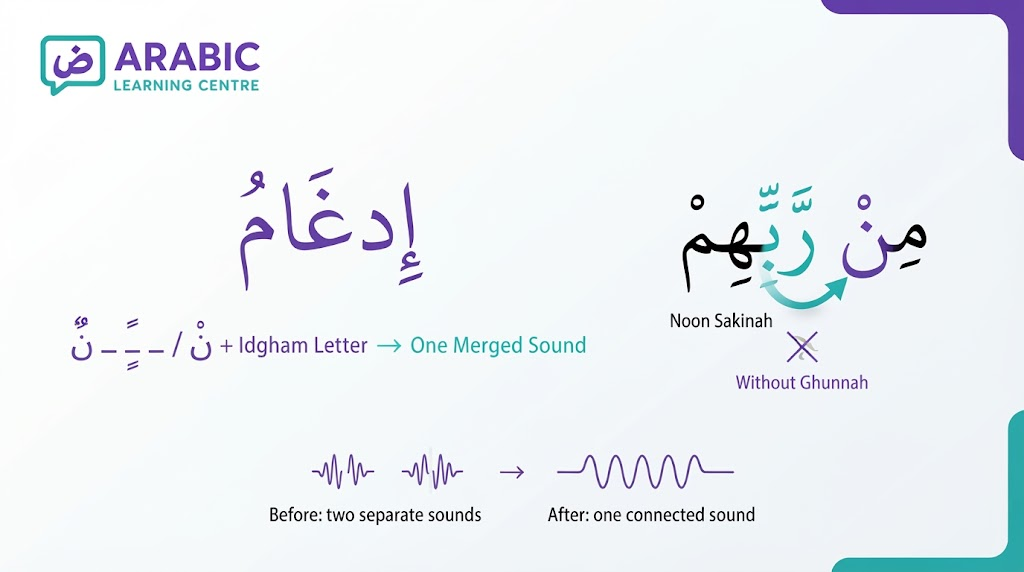
The Arabic word Idgham (إدغام) means insertion or merging. In Tajweed, it describes the merging of one sound into the sound that follows it until they are pronounced as one connected, emphasized sound.
For the rules of Noon Sakinah and Tanween, Idgham occurs when:
Noon Sakinah (نْ) or Tanween (ـً ـٍ ـٌ) + an Idgham letter
The Noon Sakinah or Tanween is not pronounced independently. Instead, its sound is absorbed into the following letter according to the type of Idgham being applied.
For example: مِن رَّبِّهِمْ
The Noon Sakinah in مِنْ is followed by ر, so the Noon merges into the Raa. Because Raa belongs to the letters of Idgham without Ghunnah, there should be no nasal sound from the Noon.
Learning this rule also helps students understand the relationship between Arabic spelling and pronunciation. Learners who want a stronger overall foundation can develop their reading alongside an Arabic course for adults, especially if they are studying Arabic as a non-native speaker.

What Are the Idgham Letters in Arabic?
There are six idgham letters in ي – ر – م – ل – و – ن
They are gathered in the famous mnemonic: يَرْمَلُونَ — Yarmaloon
You do not need to treat all six letters in exactly the same way. They are divided according to whether Ghunnah is retained during the merger.
| Type of Idgham | Letters | Mnemonic | Ghunnah |
| Idgham with Ghunnah | ي، ن، م، و | يَنْمُو | Yes |
| Idgham without Ghunnah | ل، ر | — | No |
This distinction is one of the most important points to memorize. Recognizing يرملون tells you that Idgham occurs, while identifying the particular letter tells you how to pronounce that Idgham.
When Does Idgham Occur?
For Noon Sakinah and Tanween, the basic Idgham rule is applied when three elements come together:
- There is a Noon Sakinah (نْ) or Tanween (ـً ـٍ ـٌ).
- The next word begins with one of the six Idgham letters.
- The reciter connects the two words rather than stopping after the first word.
Consider: مَن يَعْمَلْ
The Noon Sakinah in مَنْ is followed by Yaa (ي), one of the letters of Idgham with Ghunnah. Therefore, the Noon is merged into the Yaa while its nasal quality remains.
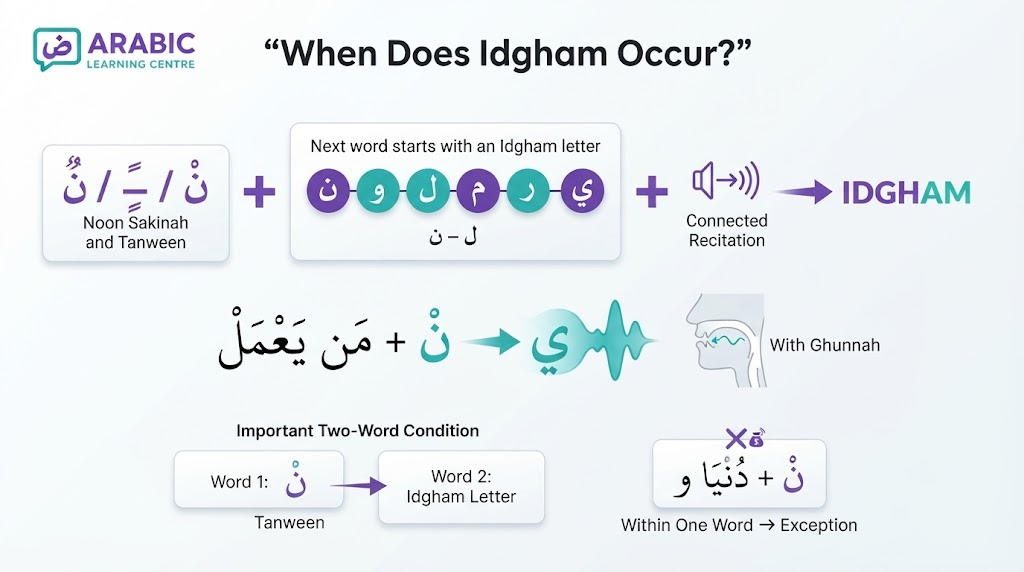
A particularly important point is that this rule normally occurs between two words. When Noon Sakinah and Yaa or Waw occur within certain individual words, the Noon remains clear rather than being merged. We will examine this exception later.
What Are the Letters of Idgham With Ghunnah?
The letters of Idgham with Ghunnah are:
ي – ن – م – و
They can be memorized through:
يَنْمُو — Yanmu
Ghunnah (غنة) is the nasal resonance associated particularly with Noon and Meem. During Idgham with Ghunnah, this nasal quality is maintained for approximately two counts while the Noon Sakinah or Tanween merges into the following letter.
The letters of Idgham Bighunnah are themselves divided into two groups:
- ن and م: complete Idgham with Ghunnah.
- ي and و: incomplete Idgham with Ghunnah.
This difference depends on how completely the original Noon sound and its characteristics disappear during the merger.
What Is Complete Idgham With Ghunnah?
Complete Idgham with Ghunnah occurs when Noon Sakinah or Tanween is followed by Noon (ن) or Meem (م).
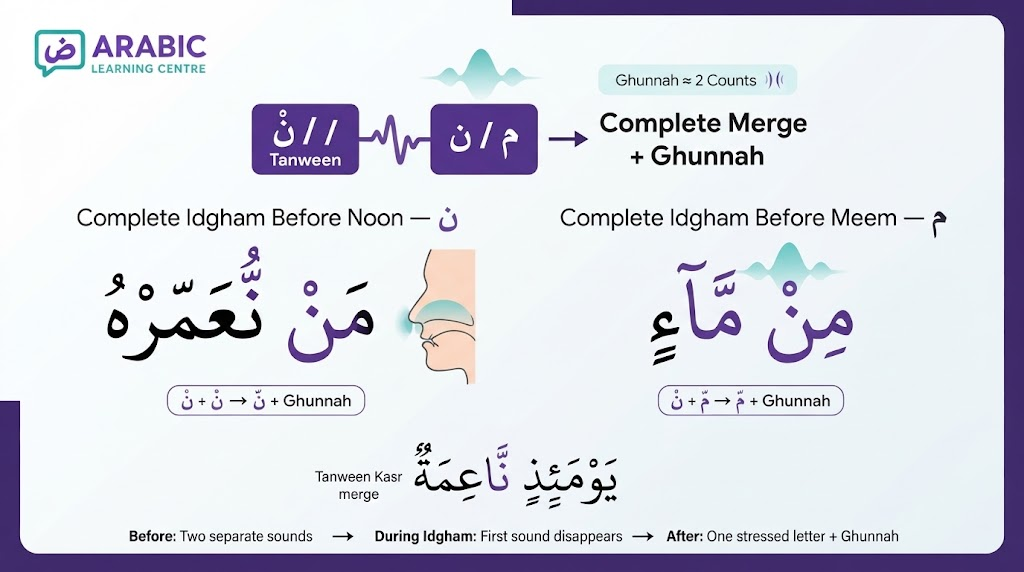
The first sound merges completely into the following letter, while Ghunnah is pronounced for approximately two counts.
Complete Idgham With Ghunnah Before Noon (ن)
When Noon Sakinah or Tanween is followed by Noon (ن), it merges completely into the following Noon, producing a stressed Noon with Ghunnah.
A clear example appears in Surah Ya-Sin:
وَمَن نُّعَمِّرْهُ نُنَكِّسْهُ فِي الْخَلْقِ أَفَلَا يَعْقِلُونَ
“And whoever We grant a long life, We reverse them in development. Will they not then understand?”
In مَن نُّعَمِّرْهُ, the Noon Sakinah in مَن meets the Noon in نُّعَمِّرْهُ. The first Noon merges completely into the second, which is pronounced as a stressed Noon with Ghunnah.
Another example appears in Surah Al-Ghashiyah:
وُجُوهٌ يَوْمَئِذٍ نَّاعِمَةٌ
“On that Day some faces will be bright.”
Here, the Tanween in يَوْمَئِذٍ is followed by Noon in نَّاعِمَةٌ. The Tanween merges into the Noon, resulting in complete Idgham with Ghunnah.
Complete Idgham With Ghunnah Before Meem (م)
When Noon Sakinah or Tanween is followed by Meem (م), it merges completely into the Meem, which is pronounced with Ghunnah.
A clear example appears in Surah Ibrahim:
مِن وَرَائِهِ جَهَنَّمُ وَيُسْقَىٰ مِن مَّاءٍ صَدِيدٍ
“In front of him will be Hell, and he will be made to drink oozing pus.”
In مِن مَّاءٍ, the Noon Sakinah in مِنْ meets the Meem in مَّاءٍ. The Noon merges completely into the following Meem, producing a stressed Meem with Ghunnah rather than two separately pronounced sounds.
What Is Incomplete Idgham With Ghunnah?
Incomplete Idgham with Ghunnah (Idgham Naqis) occurs when Noon Sakinah or Tanween is followed by Yaa (ي) or Waw (و).
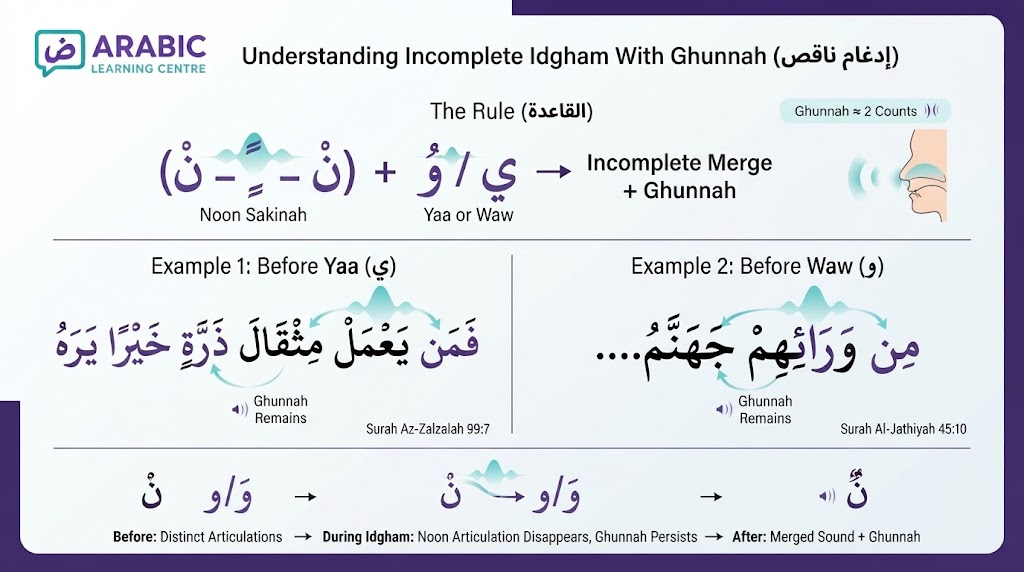
It is called incomplete because the articulation of the Noon disappears into the following letter, while its Ghunnah remains audible for approximately two counts.
Incomplete Idgham With Ghunnah Before Yaa (ي)
When Noon Sakinah or Tanween is followed by Yaa (ي), the Noon sound is not pronounced independently. Instead, it merges into the Yaa while the Ghunnah remains.
Surah Az-Zalzalah provides two clear examples:
فَمَن يَعْمَلْ مِثْقَالَ ذَرَّةٍ خَيْرًا يَرَهُ
“So whoever does an atom’s weight of good will see it.”
In مَن يَعْمَلْ, the Noon Sakinah in مَن is followed by Yaa in يَعْمَلْ. The Noon merges into the Yaa while its Ghunnah remains audible.
The same verse contains another example in خَيْرًا يَرَهُ. Here, the Tanween on خَيْرًا is followed by Yaa in يَرَهُ, so incomplete Idgham with Ghunnah is applied again.
Incomplete Idgham With Ghunnah Before Waw (و)
When Noon Sakinah or Tanween is followed by Waw (و), the Noon sound merges into the Waw while the Ghunnah remains for approximately two counts.
A clear example appears in Surah Al-Jathiyah:
مِن وَرَائِهِمْ جَهَنَّمُ وَلَا يُغْنِي عَنْهُم مَّا كَسَبُوا شَيْئًا
“Awaiting them is Hell. And whatever they have earned will be of no benefit to them whatsoever.”
In مِن وَرَائِهِمْ, the Noon Sakinah in مِنْ is followed by Waw in وَرَائِهِمْ. The Noon is not articulated separately; instead, it merges into the Waw while the Ghunnah remains audible.
For learners, the key is to avoid producing a clear Noon before the Yaa or Waw. The transition should remain smooth, with the Ghunnah connecting the two words naturally. Practicing these sound patterns can also support clearer general Arabic pronunciation, especially when combined with structured Arabic speaking lessons.

What Are the Idgham Bila Ghunnah Letters?
The Idgham Bila Ghunnah letters are Laam (ل) and Raa (ر). The term Bila Ghunnah (بلا غنة) means “without Ghunnah,” which describes exactly how this type of Idgham is pronounced.
When Noon Sakinah or Tanween is followed by Laam (ل) or Raa (ر), the Noon or Tanween merges completely into the following letter. Unlike Idgham with Ghunnah, however, no nasal sound is retained.
The distinction between the two types is simple:
- ي، ن، م، و → Idgham with Ghunnah
- ل، ر → Idgham without Ghunnah
A common mistake among beginners is to apply Ghunnah to every type of Idgham. With Laam and Raa, the merge should be complete and smooth, without extending a nasal sound before the following letter.
Read also: Izhar Letters in Arabic – Rules, Pronunciation, and 10 Examples from the Quran
Idgham Bila Ghunnah Examples
The easiest way to recognize this rule is to examine examples involving both Noon Sakinah and Tanween.
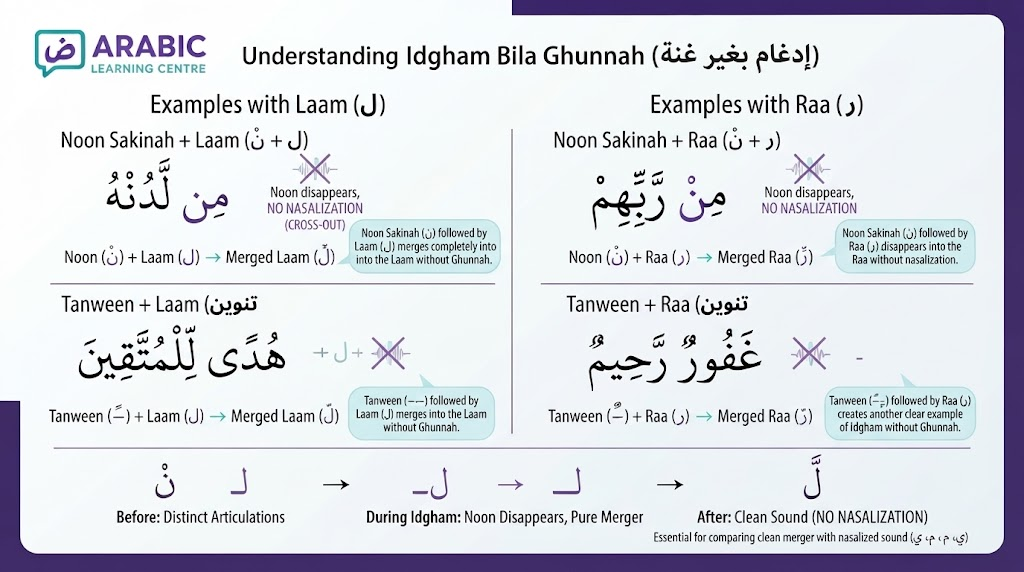
Noon Sakinah + Laam
مِن لَّدُنْهُ
The Noon in مِنْ is followed by Laam. It merges completely into the Laam, and no Ghunnah should remain.
Tanween + Laam
هُدًى لِّلْمُتَّقِينَ
The Tanween on هُدًى is followed by Laam in لِّلْمُتَّقِينَ.
The Tanween is therefore merged into the Laam without Ghunnah.
Noon Sakinah + Raa
مِن رَّبِّهِمْ
Here, the Noon Sakinah meets Raa. The Noon disappears into the Raa without nasalization.
Tanween + Raa
غَفُورٌ رَّحِيمٌ
The Tanween on غَفُورٌ is followed by Raa in رَّحِيمٌ, creating another clear example of Idgham without Ghunnah.
These Idgham Bila Ghunnah examples are useful for ear training because they allow you to compare a clean merger into Laam or Raa with the nasalized sound used before ي، ن، م، و.
Inside Our Classrooms
See how we make learning interactive and engaging! Watch a quick snippet of our live, conversational classes in action:
10 Examples of Idgham in the Quran
Studying 10 examples of Idgham in the Quran makes the rule easier to recognize during actual recitation.
The following examples show how Noon Sakinah and Tanween interact with the different Idgham letters, both with and without Ghunnah.
1. Noon Sakinah + Yaa (ي)
One of the clearest examples of Noon Sakinah followed by Yaa appears in Surah Az-Zalzalah:
فَمَن يَعْمَلْ مِثْقَالَ ذَرَّةٍ خَيْرًا يَرَهُ
“So whoever does an atom’s weight of good will see it.”
In مَن يَعْمَلْ, Noon Sakinah is followed by Yaa. The Noon merges into the Yaa while Ghunnah remains, making this incomplete Idgham with Ghunnah.
2. Tanween + Yaa (ي)
The same verse also provides a clear example of Tanween followed by Yaa:
فَمَن يَعْمَلْ مِثْقَالَ ذَرَّةٍ خَيْرًا يَرَهُ
“So whoever does an atom’s weight of good will see it.”
In خَيْرًا يَرَهُ, the Tanween on خَيْرًا meets Yaa in يَرَهُ. The Tanween merges into the Yaa while Ghunnah remains audible.
3. Noon Sakinah + Noon (ن)
Surah Ya-Sin contains a direct example of Noon Sakinah meeting another Noon:
وَمَن نُّعَمِّرْهُ نُنَكِّسْهُ فِي الْخَلْقِ أَفَلَا يَعْقِلُونَ
“And whoever We grant a long life, We reverse them in development. Will they not then understand?”
In مَن نُّعَمِّرْهُ, the Noon Sakinah merges completely into the following Noon, producing a stressed Noon with Ghunnah. This is complete Idgham with Ghunnah.
4. Tanween + Noon (ن)
A clear example of Tanween followed by Noon can be found in Surah Al-Ghashiyah:
وُجُوهٌ يَوْمَئِذٍ نَّاعِمَةٌ
“On that Day some faces will be bright.”
In يَوْمَئِذٍ نَّاعِمَةٌ, the Tanween is followed by Noon. It merges completely into the following Noon, which is pronounced with Ghunnah.
5. Noon Sakinah + Meem (م)
Surah Ibrahim provides a useful example of Noon Sakinah followed by Meem:
مِن وَرَائِهِ جَهَنَّمُ وَيُسْقَىٰ مِن مَّاءٍ صَدِيدٍ
“In front of him will be Hell, and he will be made to drink oozing pus.”
In مِن مَّاءٍ, the Noon Sakinah in مِنْ meets Meem in مَّاءٍ. The Noon merges completely into the Meem with Ghunnah, making this complete Idgham with Ghunnah.
6. Noon Sakinah + Waw (و)
An example of Noon Sakinah followed by Waw appears in Surah Al-Jathiyah:
مِن وَرَائِهِمْ جَهَنَّمُ وَلَا يُغْنِي عَنْهُم مَّا كَسَبُوا شَيْئًا
“Awaiting them is Hell. And whatever they have earned will be of no benefit to them whatsoever.”
In مِن وَرَائِهِمْ, Noon Sakinah is followed by Waw. The articulation of the Noon disappears while its Ghunnah remains, making this incomplete Idgham with Ghunnah.
7. Noon Sakinah + Laam (ل)
A clear example of Noon Sakinah followed by Laam appears in Surah An-Nisa:
إِنَّ اللَّهَ لَا يَظْلِمُ مِثْقَالَ ذَرَّةٍ وَإِن تَكُ حَسَنَةً يُضَاعِفْهَا وَيُؤْتِ مِن لَّدُنْهُ أَجْرًا عَظِيمًا
“Indeed, Allah never wrongs anyone—even by an atom’s weight. And if it is a good deed, He will multiply it many times over and give a great reward out of His grace.”
In مِن لَّدُنْهُ, Noon Sakinah is followed by Laam. The Noon merges completely into the Laam without Ghunnah, making this Idgham Bila Ghunnah.
8. Tanween + Laam (ل)
Surah Al-Baqarah contains a well-known example of Tanween followed by Laam:
ذَٰلِكَ الْكِتَابُ لَا رَيْبَ فِيهِ هُدًى لِّلْمُتَّقِينَ
“This is the Book! There is no doubt about it—a guide for those mindful of Allah.”
In هُدًى لِّلْمُتَّقِينَ, the Tanween meets Laam and merges completely into it without Ghunnah. This is another example of Idgham Bila Ghunnah.
9. Noon Sakinah + Raa (ر)
Another clear example of Idgham without Ghunnah appears in Surah Al-Baqarah:
أُولَٰئِكَ عَلَىٰ هُدًى مِّن رَّبِّهِمْ وَأُولَٰئِكَ هُمُ الْمُفْلِحُونَ
“It is they who are truly guided by their Lord, and it is they who will be successful.”
In مِن رَّبِّهِمْ, Noon Sakinah meets Raa and merges completely into it without Ghunnah. This is one of the clearest Idgham without Ghunnah examples for beginners.
10. Tanween + Raa (ر)
Surah Al-Baqarah also provides an example of Tanween followed directly by Raa:
فَمَنِ اضْطُرَّ غَيْرَ بَاغٍ وَلَا عَادٍ فَلَا إِثْمَ عَلَيْهِ إِنَّ اللَّهَ غَفُورٌ رَّحِيمٌ
“But if someone is compelled by necessity—neither driven by desire nor exceeding immediate need—they will not be sinful. Surely Allah is All-Forgiving, Most Merciful.”
In غَفُورٌ رَّحِيمٌ, the Tanween on غَفُورٌ meets Raa in رَّحِيمٌ. The Tanween merges completely into the Raa without retaining Ghunnah, making this Idgham Bila Ghunnah.
These Idgham examples from Quran show the two main patterns clearly: Yaa, Noon, Meem, and Waw (ي، ن، م، و) involve Ghunnah, while Laam and Raa (ل، ر) involve Idgham without Ghunnah.
Recognizing these combinations across word boundaries makes the rule much easier to apply during Quran recitation.
Read also: Hams Letters in Arabic – Meaning, Examples, and the Difference Between Hams and Jahr
What Is the Difference Between Idgham With and Without Ghunnah?
The difference is not whether merging occurs. Both types involve Idgham. The difference is whether nasal resonance remains during that merger.
| Feature | Idgham With Ghunnah | Idgham Without Ghunnah |
| Letters | ي، ن، م، و | ل، ر |
| Mnemonic | ينمو | — |
| Noon/Tanween merges | Yes | Yes |
| Ghunnah | Yes | No |
| Ghunnah duration | About two counts | None |
| Example | مَن يَعْمَلْ | مِن رَّبِّهِمْ |
A learner who understands this table has already mastered the central distinction among the six idgham letters in Arabic.
The next step is practical listening. You should be able to hear the difference between the nasalized transition of مَن يَعْمَلْ and the clean, non-nasal transition of مِن رَّبِّهِمْ.
What Is the Difference Between Complete and Incomplete Idgham?
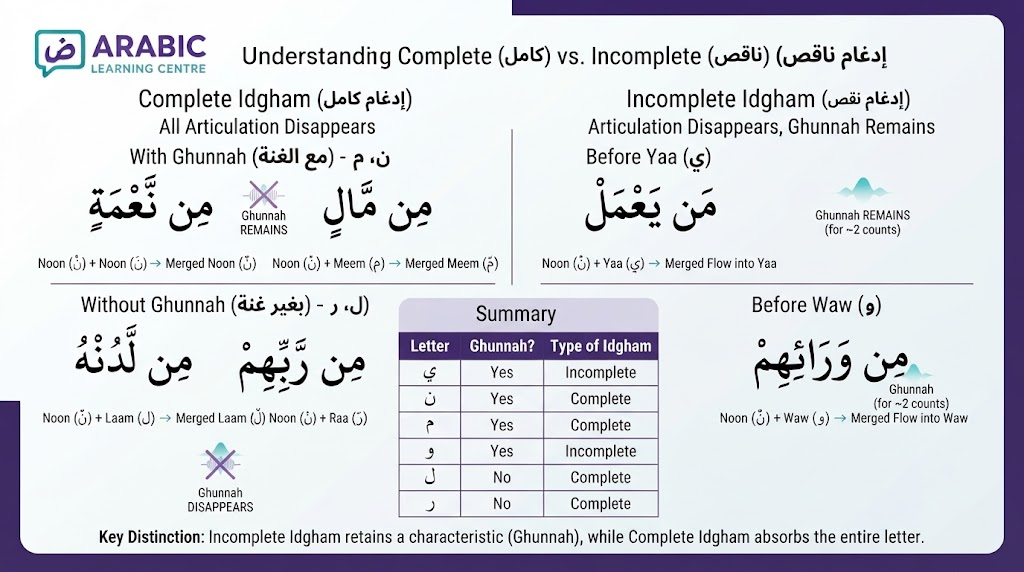
The terms complete (Kamil/Taam) and incomplete (Naqis) describe how much of the first letter remains after the merger.
Complete Idgham
Complete Idgham occurs with four letters: ن – م – ل – ر
In this type, the original Noon Sakinah or Tanween is completely absorbed into the following letter, so its original articulation does not remain.
The pronunciation then depends on the letter that follows:
- With Noon (ن) and Meem (م), the merger is complete but Ghunnah remains in the resulting stressed Noon or Meem.
- With Laam (ل) and Raa (ر), the merger is complete without Ghunnah.
Incomplete Idgham
Incomplete Idgham occurs with two letters: ي – و
When Noon Sakinah or Tanween is followed by Yaa (ي) or Waw (و), the articulation of the Noon disappears, but its Ghunnah remains audible for approximately two counts.
Because one characteristic of the original Noon—Ghunnah—is retained after the merger, this type is described as incomplete Idgham.
The six Idgham letters can therefore be organized as follows:
| Letter | Ghunnah? | Type of Idgham |
| ي | Yes | Incomplete |
| ن | Yes | Complete |
| م | Yes | Complete |
| و | Yes | Incomplete |
| ل | No | Complete |
| ر | No | Complete |
A simple way to remember the distinction is that Yaa and Waw produce incomplete Idgham, while Noon, Meem, Laam, and Raa produce complete Idgham.
The presence of Ghunnah alone does not determine whether Idgham is complete or incomplete; what matters is whether a characteristic of the original Noon remains after the merger.
How to Recognize Idgham in the Mushaf?
Recognizing Idgham becomes easier when you follow the same pattern every time you encounter Noon Sakinah (نْ) or Tanween (ـً ـٍ ـٌ) while reading the Quran.
1. Start by Identifying Noon Sakinah (نْ) or Tanween (ـً ـٍ ـٌ)
The first sign to look for is Noon Sakinah or one of the three forms of Tanween. Once you find one, do not stop at that word; look immediately at the first letter of the word that follows.
2. Idgham Occurs When the Next Word Begins With One of the Six Letters يَرْمَلُونَ
If the following word begins with ي، ر، م، ل، و، or ن, Idgham may apply when the two words are read continuously.
The six Idgham letters in Arabic are commonly memorized through:
يَرْمَلُونَ
3. The Letters ي، ن، م، و Require Ghunnah, While ل and ر Do Not
After identifying an Idgham letter, determine whether the merger requires Ghunnah:
- ي، ن، م، و (يَنْمُو) → Idgham with Ghunnah
- ل، ر → Idgham without Ghunnah
This distinction tells you how the Idgham should be pronounced, not simply whether the rule occurs.
4. Noon Sakinah and Tanween Idgham Is Recognized Across Two Words
For this rule, you need to examine the relationship between the end of one word and the beginning of the next. Noon Sakinah or Tanween appears first, while the Idgham letter begins the following word.
This is also why learners should avoid examining each word in isolation when identifying Tajweed rules.
5. Understanding the Idgham Letters Is More Reliable Than Depending Only on Mushaf Symbols
Visual signs in the Mushaf can help you recognize Tajweed patterns, but they should not replace understanding the rule itself. Knowing يَرْمَلُونَ, and knowing which letters require Ghunnah, allows you to identify Idgham across different Mushaf styles.
Strong Arabic literacy can make these written patterns easier to recognize as well. Structured Arabic writing lessons can help learners become more familiar with Arabic letter forms, Tanween, Shaddah, diacritics, and other written features they encounter while reading.

How to Practice the Idgham Letters?
The best way to practice the Idgham letters is to move gradually from memorizing the letters to recognizing and pronouncing them correctly in Quranic phrases.
1. Memorize the Six Idgham Letters Through يَرْمَلُونَ
Start by memorizing the six letters that cause Idgham after Noon Sakinah or Tanween:
يَرْمَلُونَ — ي، ر، م، ل، و، ن
Knowing these letters by heart allows you to recognize the rule quickly instead of stopping to recall it every time you read.
2. Divide the Idgham Letters Into With and Without Ghunnah
Once you know يَرْمَلُونَ, separate the letters according to whether Ghunnah is required:
- With Ghunnah: يَنْمُو — ي، ن، م، و
- Without Ghunnah: ل، ر
Practice recalling these two groups until you can immediately determine whether a combination requires Ghunnah.
3. Practice Idgham Through Short Quranic Combinations
Instead of pronouncing the six letters in isolation, practice them in short combinations where the rule actually occurs:
مَن يَعْمَلْ
مِن مَّاءٍ
مِن وَرَائِهِمْ
هُدًى لِّلْمُتَّقِينَ
مِن رَّبِّهِمْ
For each phrase, identify the Noon Sakinah or Tanween, find the following Idgham letter, and determine whether the merger should be pronounced with or without Ghunnah.
4. Move From Short Idgham Phrases to Complete Quranic Verses
Once you can recognize and pronounce the rule confidently in short phrases, begin practicing the same combinations within complete verses. This helps you apply Idgham naturally without interrupting the rhythm of your recitation.
Start slowly and focus on accuracy. As the pronunciation becomes more consistent, gradually return to your normal recitation speed while maintaining the correct merger.
5. Listen to Correct Idgham Pronunciation and Get Teacher Feedback
Idgham is ultimately a sound-based Tajweed rule, so written explanations alone cannot fully teach its correct application. Listen carefully to a qualified reciter and compare the merger, Ghunnah, and timing with your own pronunciation.
Direct correction from a qualified Tajweed teacher is especially useful because a teacher can identify subtle errors that learners may not hear themselves, such as exaggerating the Ghunnah, retaining too much of the original Noon sound, or adding Ghunnah before Laam and Raa.
Read also: Soft Letters in Arabic – Leen Letters, Rules, Examples, and Pronunciation
Don’t Just Take Our Word For It
Take a look inside our vibrant classes and see our students and teachers in action. Click below to watch our classroom experience:
Learn Arabic Pronunciation With Arabic Learning Centre
Learning the Idgham letters in Arabic is easier when you have a solid understanding of Arabic sounds, letter forms, vowels, Tanween, Shaddah, and the way words connect in natural reading.
With the right guidance, these rules become patterns you can recognize and apply rather than information you simply memorize.
Arabic Learning Centre provides a structured learning environment where students can develop their Arabic step by step with guidance and regular practice.
Instead of studying pronunciation as an isolated skill, learners can strengthen their understanding of the language while becoming more confident in reading, listening, speaking, and recognizing Arabic structures.
Whether you are beginning your Arabic journey or want to improve the skills you already have, consistent practice with experienced guidance can help you build greater accuracy and confidence.
Start learning with Arabic Learning Centre and develop a stronger foundation for understanding and using Arabic naturally.
Courses We Offer:
- Quranic Arabic Course
- Arabic Course for Islamic Studies
- Learn Arabic for New Muslims
- Learn Arabic Letters for Tajweed
- Al Azhar Arabic Course
- Madinah Arabic Course
- Online Arabic Classes for Kids
- Arabic Words Course for Kids
- Arabic Lessons for Kindergarten
- Arabic Elementary School
- Arabic Intermediate School
- Arabic High School

Conclusion
The six Idgham letters in Arabic are ي، ر، م، ل، و، ن, commonly remembered through يَرْمَلُونَ (Yarmaloon). Of these, ي، ن، م، و are the letters of Idgham with Ghunnah, while ل and ر are the Idgham Bila Ghunnah letters.
Understanding the letters is only the first step. Learners also need to distinguish between complete and incomplete Idgham, recognize when the rule occurs across two words, and remember exceptions such as الدُّنْيَا and بُنْيَانٌ, where the Noon Sakinah remains clearly pronounced.
The best way to master Idgham is through regular recitation practice. Instead of memorizing يَرْمَلُونَ alone, practice authentic Idgham examples from Quran until you can recognize the following letter, determine whether Ghunnah is required, and apply the merger naturally while reciting.
Frequently Asked Questions About Idgham Letters in Arabic
How Many Idgham Letters Are There in Arabic?
There are six Idgham letters in the rules of Noon Sakinah and Tanween: ي، ر، م، ل، و، ن. They are commonly grouped in the mnemonic word يَرْمَلُونَ (Yarmaloon), which makes them easier to memorize and recognize during Quran recitation.
What Are the Letters of Idgham With Ghunnah?
The four letters of Idgham with Ghunnah are ي، ن، م، و, commonly remembered through يَنْمُو (Yanmu). When one of these letters follows Noon Sakinah or Tanween across two words, Idgham occurs with Ghunnah for approximately two counts.
What Are the Idgham Bila Ghunnah Letters?
The Idgham Bila Ghunnah letters are Laam (ل) and Raa (ر). When either letter follows Noon Sakinah or Tanween, the Noon or Tanween merges completely into the following letter without retaining Ghunnah.
What Is an Example of Idgham With Ghunnah?
A clear example appears in Surah Az-Zalzalah:
فَمَن يَعْمَلْ مِثْقَالَ ذَرَّةٍ خَيْرًا يَرَهُ
“So whoever does an atom’s weight of good will see it.”
Surah Az-Zalzalah 99:7
In مَن يَعْمَلْ, Noon Sakinah is followed by Yaa, so the Noon merges into the Yaa while Ghunnah remains. This is an example of incomplete Idgham with Ghunnah.
What Is an Example of Idgham Without Ghunnah?
A clear example can be found in Surah Al-Baqarah:
أُولَٰئِكَ عَلَىٰ هُدًى مِّن رَّبِّهِمْ وَأُولَٰئِكَ هُمُ الْمُفْلِحُونَ
“It is they who are truly guided by their Lord, and it is they who will be successful.”
Surah Al-Baqarah 2:5
In مِن رَّبِّهِمْ, Noon Sakinah is followed by Raa. The Noon merges completely into the Raa without Ghunnah, making it one of the clearest Idgham without Ghunnah examples.
Why Is Idgham With Yaa and Waw Called Incomplete?
Idgham with Yaa (ي) and Waw (و) is called incomplete because the articulation of the original Noon disappears, but its characteristic of Ghunnah remains audible. Since part of the original Noon is still represented through Ghunnah, the merger is classified as incomplete Idgham (Idgham Naqis).