 Arabic Vocabulary & Speaking
Arabic rewards patience. Every learner who has stumbled over a throat-tightening consonant or a string of unvowelled letters knows that some sounds simply do not exist in English, French, or Spanish.
This guide breaks down the hard Arabic words to pronounce that trip up beginners most often, explains why they resist the English-speaking tongue, and shows exactly how to train your mouth, ear, and confidence to handle them.
The Ten Hardest Arabic Words And Letters For English Speakers To Pronounce
The hardest words in Arabic for non-native speakers usually combine an emphatic consonant, a pharyngeal sound, or a consonant cluster with no vowel between them. Below is a working reference table.
| Arabic Word | Transliteration | Meaning | Why It Is Hard |
| ضَبْط | dabt | precision/control | Emphatic ض plus consonant cluster bt |
| غُضْرُوف | ghudrouf | cartilage | Uvular غ followed by emphatic ض |
| اِسْتِقْلَال | istiqlal | independence | Four-consonant cluster, glottal-adjacent ق |
| خُصُوصِيَّة | khusoosiyyah | privacy | Velar خ plus doubled يّ |
| مُسْتَشْفَى | mustashfa | hospital | Long consonant string with no supporting vowel |
| قَهْقَهَة | qahqahah | loud laughter | Repeated uvular ق and pharyngeal ه |
| ظُهْر | dhuhr | noon/back | Emphatic interdental ظ, rare in world languages |
| عَبْقَرِيّ | ‘abqariyy | genius | Pharyngeal ع opening a consonant cluster |
| اِسْتِكْشَاف | istikshaf | exploration | Dense cluster of s-t-k-sh with no vowel breaks |
| ثَعْلَب | tha’lab | fox | Interdental ث immediately before pharyngeal ع |
Many learners searching for the hardest word in Arabic land on اِسْتِقْلَال (istiqlal) or غُضْرُوف (ghudrouf), since both stack multiple difficult articulation points in a single word.
Arabic Course For Beginners Builds Correct Pronunciation Habits From The First Lesson
Non-native learners often ask why certain Arabic sounds feel physically impossible at first. The short answer: Arabic uses articulation points in the throat and back of the mouth that English never touches.
Arabic has 28 letters, and roughly a third of them are produced from the pharynx, the uvula, or the very back of the tongue. English speakers simply never train these muscles in daily speech.
The Arabic Learning Centre‘s Arabic Elementary School Programme dedicates its opening unit entirely to letter shapes, since this foundation determines every reading skill that follows.
Book Your Free Trial for Arabic Elementary School Programme Now!
Students who skip this foundational phase often fossilize incorrect pronunciation. Native tutors describe this as one of the most common and avoidable mistakes among self-taught learners.
Inside Our Classrooms
See how we make learning interactive and engaging! Watch a quick snippet of our live, conversational classes in action:
Pharyngeal And Emphatic Consonants Create The Steepest Learning Curve For New Students
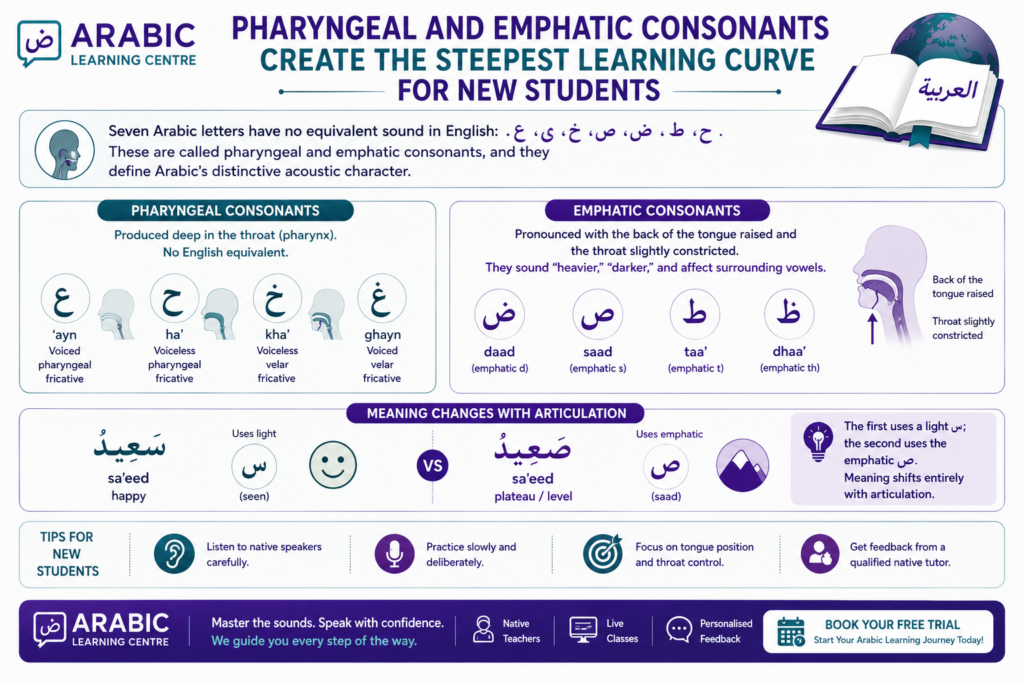
Seven Arabic letters have no equivalent sound in English: ع، ح، خ، ض، ص، ط، ظ. These are called pharyngeal and emphatic consonants, and they define Arabic’s distinctive acoustic character. Emphatic letters (ض، ص، ط، ظ) are pronounced with the back of the tongue raised and the throat slightly constricted. This gives words a heavier, darker resonance than their non-emphatic counterparts.
Compare سَعِيد (sa’eed, happy) with صَعِيد (sa’eed, plateau/level). The first uses a light س; the second uses the emphatic ص. Meaning shifts entirely with articulation.
This single-letter contrast is why grammar and phonetics cannot be separated in serious Arabic study. The Arabic Learning Centre’s Arabic Grammar Course pairs every new consonant with minimal-pair drills like this one.
Book Your Free Trial for Arabic Grammar Course Now!

Practicing The Letter Dad Builds Confidence With The Sound Historically Called Unique To Arabic
Classical scholars referred to Arabic as “lughat ad-dad” (the language of Dad), since no other Semitic or European language was believed to contain this precise emphatic sound.
The letter ض requires pressing the flat of the tongue against the upper molars while raising the tongue root toward the throat. Most learners initially substitute it with a plain د or ل.
A useful test word is ضَوْء (daw’, meaning light). Say it beside دَوّ to feel the difference between the emphatic and plain articulation points.
Consistent daily repetition of ten to fifteen minutes, ideally with a native speaker correcting in real time, resolves this issue within a few weeks for most adult learners.
Consecutive Consonant Clusters Without Vowels Trip Up Beginners Reading Unvowelled Text
Modern Arabic text, especially newspapers and books, is printed without harakat (short vowel diacritics). This means readers must infer vowels from context, root patterns, and grammatical position.
Words like اِسْتِكْشَاف (istikshaf, exploration) or مُسْتَشْفَى (mustashfa, hospital) look deceptively dense on the page because four or five consonants appear with only the root vowels marked.
Recognizing the underlying root and pattern system solves this instantly. اِسْتِكْشَاف derives from the root ك-ش-ف (to uncover) placed in the istif’al pattern common to verbal nouns.
Learners who master roughly 20 recurring morphological patterns can decode thousands of otherwise unfamiliar words without memorizing each one individually. This is a core skill taught progressively rather than left to guesswork.
Structured Daily Practice Routines Improve Pronunciation Of Difficult Arabic Words Faster
Isolated word drills rarely transfer to natural speech. Effective pronunciation training embeds hard words inside short phrases, then inside full sentences, then inside spontaneous conversation.
A practical routine: record yourself saying five target words daily, compare against a native model, then use each word in one original sentence before moving to the next batch.
Shadowing exercises, where learners repeat immediately after a native speaker with minimal delay, train muscle memory faster than reading transliteration alone ever will.
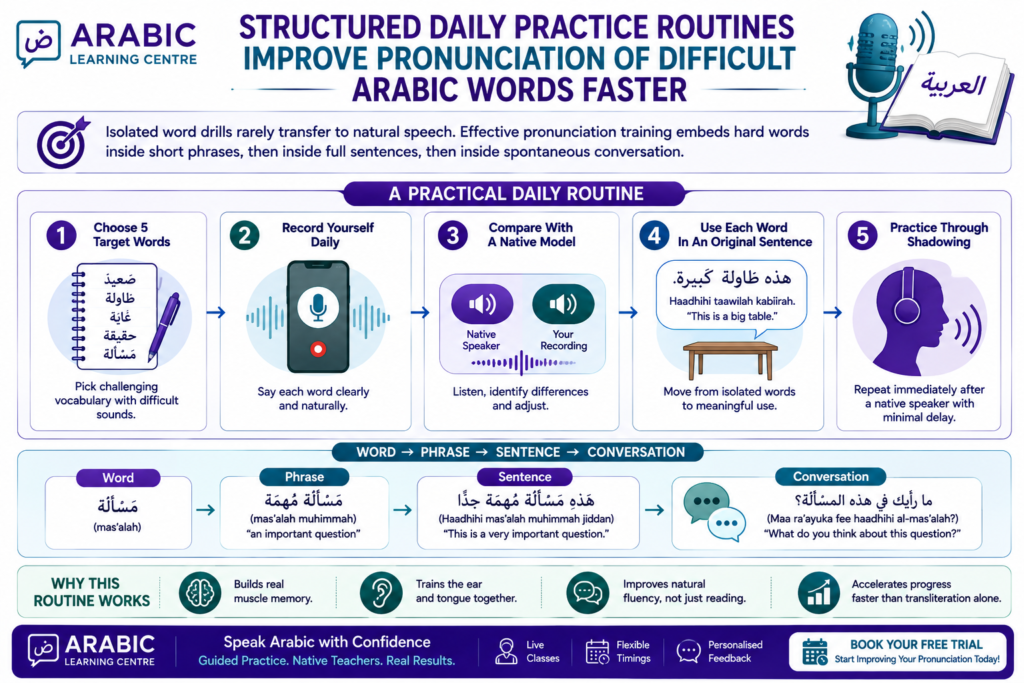
This exact progression, from isolated sound to spontaneous use, is the backbone of The Arabic Learning Centre’s Arabic Speaking Course, which pairs learners with native tutors for weekly live correction sessions.
Book Your Free Trial for Arabic Speaking Course Now!

Read Also: 7 Famous Arabic Quotes and Their Meaning for Non-Native Arabic Learners
Quranic Recitation Introduces Additional Pronunciation Precision Through Tajweed Rules
Students moving from conversational Arabic into Quranic study encounter an added layer of precision called tajweed, which governs exact articulation points, elongation, and letter interaction rules during recitation.
Tajweed does not introduce new letters, but it demands stricter accuracy than everyday speech. A misplaced emphatic sound can alter meaning within a verse.
بِسْمِ ٱللَّهِ ٱلرَّحْمَـٰنِ ٱلرَّحِيمِ
Bismillahir-Rahmanir-Raheem
“In the name of Allah, the Entirely Merciful, the Especially Merciful.” (Al-Fatihah 1:1)
Note the emphatic ر in الرَّحْمَـٰن, pronounced with a heavier, rounded articulation than a plain ر elsewhere in Arabic. Tajweed training makes this distinction automatic.
Learners focused specifically on Islamic studies will find that The Arabic Learning Centre’s Arabic Course for Islamic Studies provides a structured linguistic foundation for engaging directly with classical Islamic texts.
Book Your Free Trial for Arabic Course for Islamic Studies Now!

Read Also: Body Parts in Arabic for Kids
Common Pronunciation Mistakes Non-Native Speakers Make And How To Correct Them
Three mistakes appear consistently across English-speaking learners, regardless of nationality or prior language background. Recognizing them early prevents years of habitual error.
Mistake one: collapsing emphatic and non-emphatic pairs (س/ص, د/ض, ت/ط) into a single sound. Correction: practice minimal pairs daily until the throat constriction becomes automatic.
Mistake two: dropping the glottal stop (ء) entirely, since English has no letter for it. Correction: treat it as a genuine consonant, not silence, especially word-medially.
Mistake three: rushing consonant clusters by inserting extra English-style vowels. Correction: slow recitation paired with root-pattern awareness removes the impulse to over-vowel.
Read Also: Beautiful Arabic Words With Meaning
Don’t Just Take Our Word For It
Take a look inside our vibrant classes and see our students and teachers in action. Click below to watch our classroom experience:
Begin Your Arabic Pronunciation Journey With Expert Guidance At The Arabic Learning Centre!
Mastering the hardest words in Arabic takes structured practice, native correction, and a clear grammar foundation, not memorization alone. Expert guidance shortens that path considerably.
The Arabic Learning Centre offers:
- Native Arabic tutors trained in classical and modern methodology
- Structured curricula from absolute beginner through advanced levels
- Live sessions plus recorded materials for flexible review
- Scheduling across global time zones
- Affordable, transparent pricing
Courses We Offer:
- Quranic Arabic Course
- Arabic Course for Islamic Studies
- Learn Arabic for New Muslims
- Learn Arabic Letters for Tajweed
- Al Azhar Arabic Course
- Madinah Arabic Course
- Online Arabic Classes for Kids
- Arabic Words Course for Kids
- Arabic Lessons for Kindergarten
- Arabic Elementary School
- Arabic Intermediate School
- Arabic High School
Ready to pronounce even the hardest Arabic words with confidence? Book your free trial today and start training with a native tutor this week.
Book your free trial lesson today!

Frequently Asked Questions
Which word is considered the hardest word in Arabic to pronounce?
Most instructors point to اِسْتِقْلَال (istiqlal, independence) or غُضْرُوف (ghudrouf, cartilage), since both combine an emphatic consonant with a dense, unvowelled cluster in a single word.
Why do emphatic letters like dad and ta feel physically difficult?
Emphatic letters require raising the tongue root while constricting the throat slightly, a coordination English never trains. Most learners need several weeks of guided minimal-pair practice to produce them reliably.
Can pronunciation improve without a native tutor correcting in real time?
Self-study alone rarely fixes emphatic and pharyngeal sounds, since learners cannot hear their own errors accurately. Real-time correction from a native speaker shortens this process considerably compared to solo practice.
Do Quranic Arabic and Modern Standard Arabic share the same hard sounds?
Yes, tajweed rules apply to the same seven pharyngeal and emphatic letters used in everyday Modern Standard Arabic, but recitation demands stricter precision, particularly around elongation and emphatic weight.
How long does it typically take to master these difficult sounds?
Most committed adult learners notice reliable improvement within four to eight weeks of daily fifteen-minute drills, provided the practice includes native-speaker feedback rather than isolated self-repetition.
Related Articles
Arabic Vocabulary & Speaking