 Arabic Vocabulary & Speaking
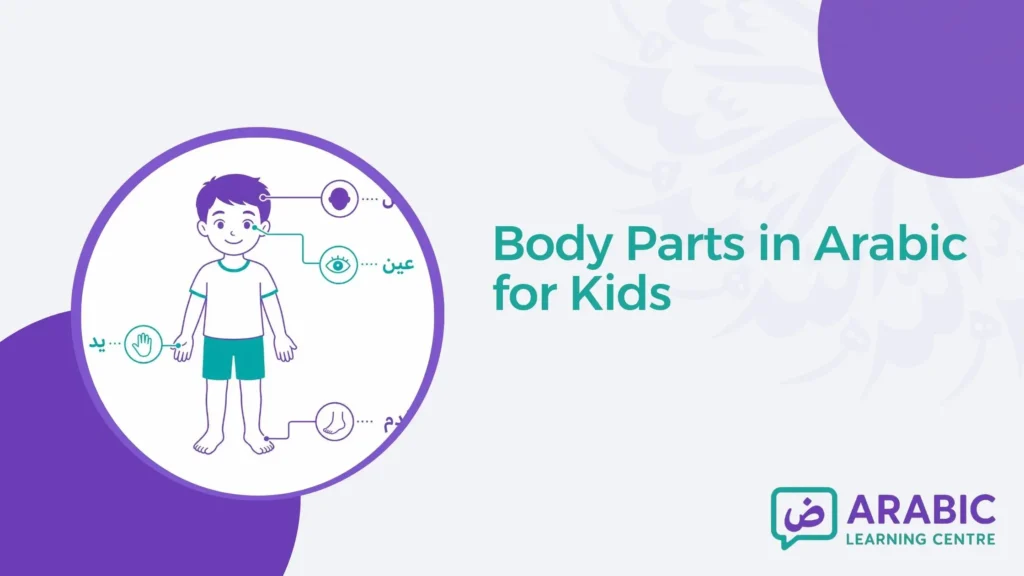
A toddler pointing at her nose and waiting for its name in Arabic is often a parent’s first real test in home language teaching. Body parts rank among the very first words children absorb in any language, because they are visible, touchable, and endlessly repeatable throughout an ordinary day.
Arabic body parts vocabulary holds a few surprises for young learners and the parents guiding them. Several organs are grammatically feminine with no visible ending to signal it, and paired parts like eyes and hands take a special dual form. This guide walks through the full list of body parts in Arabic, pronunciation for kids, and practical ways to reinforce the words at home.
Essential Body Parts in Arabic Vocabulary for Beginners
The core body parts in Arabic for kids include head, eyes, nose, mouth, ears, hands, and legs, each carrying its own gender and pronunciation pattern. Mastering these seven words first gives a child a working vocabulary for daily routines like washing, dressing, and playful body-part games.
Below is a starter table covering body parts in Arabic for kids, with meaning, transliteration, and gender marked for each word.
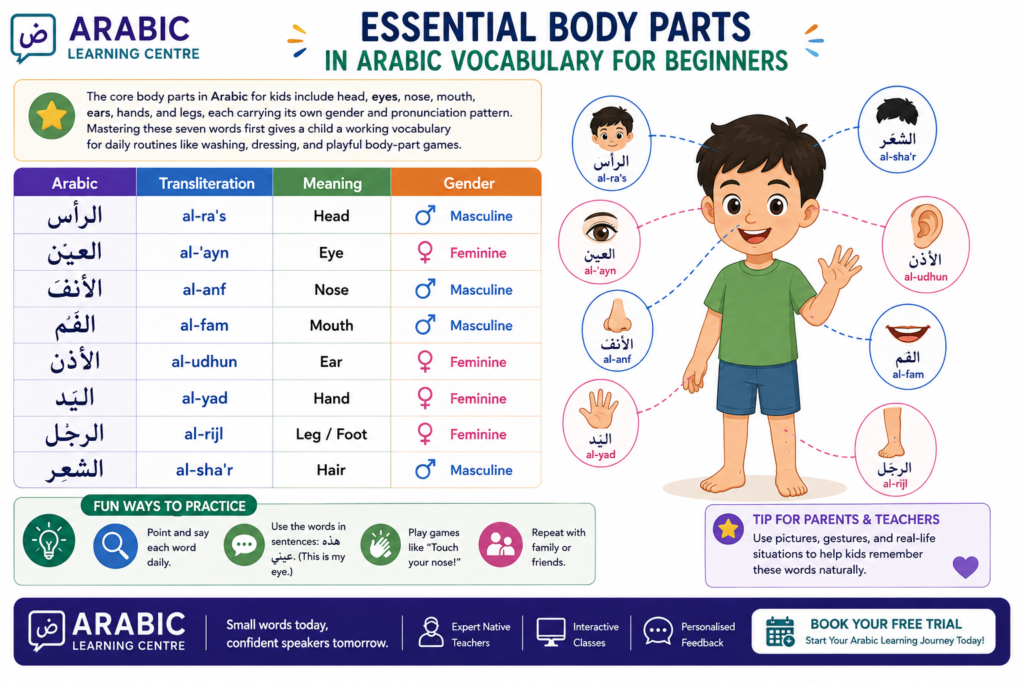
Instructors at The Arabic Learning Centre introduce this exact seven-word set in the opening unit of the Arabic Course for Kids, pairing each word with a picture and a physical gesture so children anchor meaning through movement rather than memorization alone.
Book Your Free Trial for Arabic Course for kids Now!

Gender Rules for Body Parts in Arabic
Arabic nouns are either masculine or feminine, and most feminine nouns end in a distinctive taa marbuta. Body parts break this pattern in a well-known exception that every instructor flags early, since several are feminine despite having no feminine ending at all.
Paired organs on the human body follow this exception consistently. العين (eye), الأذن (ear), اليد (hand), and الرجل (leg or foot) are all feminine, even though none of them carries the expected taa marbuta ending.
Why Paired Body Parts Take Feminine Gender
Classical Arabic grammarians grouped naturally paired body organs under a fixed feminine category, alongside a short list of other exceptions like الشمس (the sun) and النار (fire). Children do not need the historical reasoning, but they do need the pattern drilled through repetition and correction.
Adjective Agreement with Body Parts in Arabic
Because العين is feminine, a describing word must also take the feminine form: عين كبيرة (a big eye) rather than the masculine كبير. This single rule trips up more intermediate learners than almost any other body-vocabulary point, so early, patient correction pays off.
Inside Our Classrooms
See how we make learning interactive and engaging! Watch a quick snippet of our live, conversational classes in action:
Learning the Dual Form for Paired Body Parts in Arabic
Arabic grammar includes a dual number in addition to singular and plural, used specifically for exactly two of something, and the human body supplies its most natural teaching ground. Eyes, ears, hands, legs, and shoulders each shift into a distinct dual ending once a child learns to count past one.
The dual is formed by adding ان in the subject position or ين in the object position to the singular noun. This structural shift appears nowhere else so frequently in everyday speech, which makes body vocabulary an efficient entry point for the whole grammatical concept.
Eyes, Ears, Hands and Legs in Dual Form
| Singular | Dual | Meaning |
| عين | عينان / عينين | two eyes |
| أذن | أذنان / أذنين | two ears |
| يد | يدان / يدين | two hands |
| رجل | رجلان / رجلين | two legs |
A simple, everyday sentence brings the pattern to life for a child: عندي عينان زرقاوان — ‘indi ‘aynan zarqawan — “I have two blue eyes.” Notice how the describing word زرقاوان also shifts into its own dual, feminine form to match.
Grammar patterns like this dual shift form a core building block inside the Arabic Grammar Course, where the rule is practiced across dozens of everyday nouns beyond the body until it becomes automatic rather than memorized.
Book Your Free Trial for Arabic Grammar Course Now!

Pronunciation Guidance for Body Parts in Arabic for Kids
Several body-part words contain sounds that do not exist in English, and getting ahead of these early prevents fossilized mispronunciation later. The letter ع in عين (eye) is a voiced pharyngeal sound produced deep in the throat, unlike anything in the English alphabet.
Mastering the Ain Sound in Eye and Related Words
Have a child gently squeeze their throat while humming to locate the muscle used for ع, then practice عين slowly before speeding up. This tactile trick works especially well with younger learners who cannot yet process an abstract phonetic description.
Distinguishing the Ha and Kha Sounds
الرأس (head) opens with a glottal stop, while a related word for chest, الصدر, uses the emphatic ص. Recording a child’s attempt and comparing it against a native model remains the fastest correction method, which is exactly the format used in live sessions of the Arabic Speaking Course.
Book Your Free Trial for Arabic Speaking Course Now!

Teaching Body Parts in Arabic for Kids Through Songs and Videos
Searches for body parts in Arabic for kids YouTube content spike heavily among parents building a home curriculum, and music-based videos remain one of the most effective reinforcement tools available. A short, repetitive song activates both auditory memory and physical movement simultaneously.
Choosing Reliable Video Content for Home Practice
Look for videos that use Modern Standard Arabic rather than a regional dialect, since dialect-specific words for body parts can differ noticeably from the vocabulary taught in a structured curriculum. Videos featuring a native speaker’s mouth clearly visible also help children mimic articulation accurately.
Combining Video Exposure with Active Recall
Pause the video after each new word and ask the child to point to the matching body part on themselves before resuming playback. This active-recall step converts passive viewing into genuine vocabulary retention far more reliably than watching alone.
Simple Practice Activities for Body Parts in Arabic for Kids with Meaning
Repetition through play cements body-part vocabulary far more effectively than flashcard drilling alone, particularly for children under age eight. Three short activities cover listening, speaking, and physical response within a single ten-minute session.
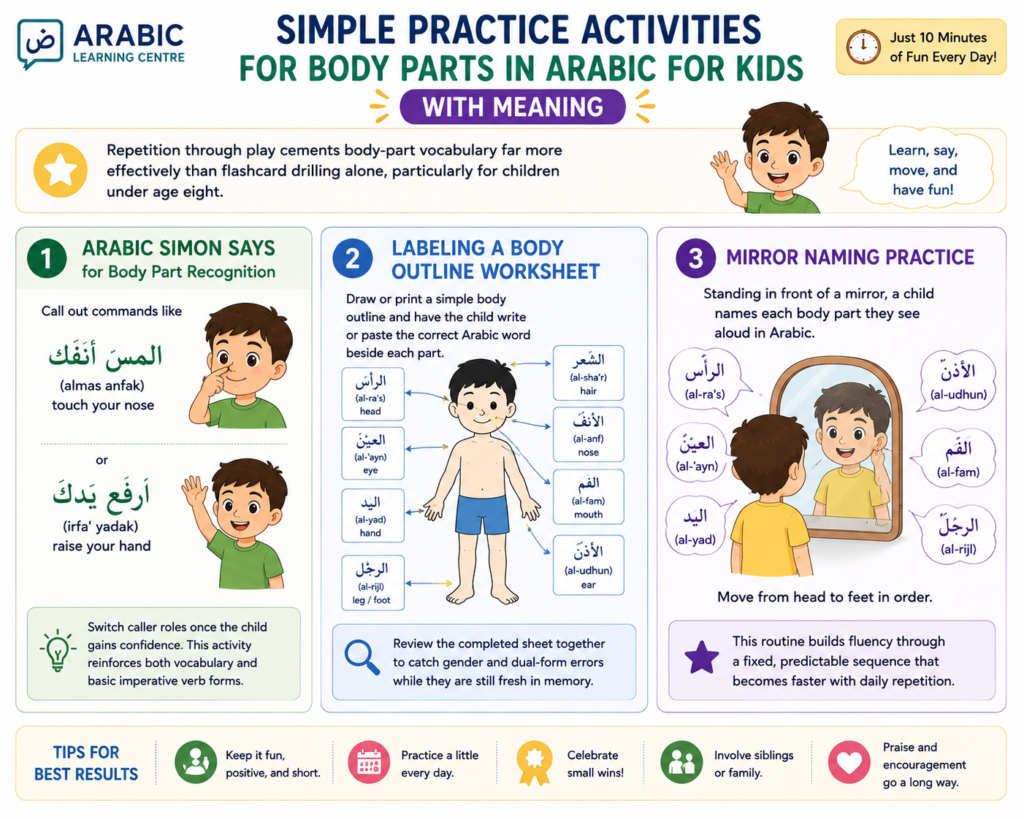
1. Arabic Simon Says for Body Part Recognition
Call out commands like المس أنفك (touch your nose) or ارفع يدك (raise your hand), switching caller roles once the child gains confidence. This activity reinforces both the vocabulary and basic imperative verb forms simultaneously.
2. Labeling a Body Outline Worksheet
Draw or print a simple body outline and have the child write or paste the correct Arabic word beside each part. Reviewing the completed sheet together catches gender and dual-form errors while they are still fresh in memory.
Read Also: 7 Famous Arabic Quotes and Their Meaning for Non-Native Arabic Learners
3. Mirror Naming Practice
Standing in front of a mirror, a child names each body part they see aloud in Arabic, moving from head to feet in order. This routine builds fluency through a fixed, predictable sequence that becomes faster with daily repetition.
Read Also: Hard Arabic Words to Pronounce and How Serious Learners Master Them
Common Mistakes Non-Native Learners Make with Body Parts in Arabic
Learners consistently default to masculine adjective forms with feminine body parts, producing errors like يد كبير instead of the correct يد كبيرة. Flagging this exception explicitly during the first vocabulary lesson prevents the mistake from hardening into habit.
A second frequent error is using the plural form where the dual is grammatically required, since English has no equivalent structure to signal the distinction. Saying عيون (eyes, three or more) instead of عينان (two eyes) is grammatically wrong even though the meaning is understood.
A third mistake involves mixing regional dialect words for body parts into Modern Standard Arabic sentences, particularly around words for stomach, cheek, and chin, where dialect variation is highest. Sticking to one consistent register, especially in the early stages, keeps a child’s foundation stable before dialect exposure begins.
Read Also: Beautiful Arabic Words With Meaning
Don’t Just Take Our Word For It
Take a look inside our vibrant classes and see our students and teachers in action. Click below to watch our classroom experience:
Begin Your Child’s Arabic Language Journey with Expert Guidance at The Arabic Learning Centre
Learning body parts in Arabic for kids is a natural, engaging entry point into gender rules, the dual form, and authentic pronunciation all at once. The Arabic Learning Centre builds on exactly this foundation with a structured, age-appropriate curriculum.
- Native Arabic tutors trained specifically in teaching young, non-native learners
- A structured curriculum progressing from single words to full sentences
- Live sessions combined with recorded materials for flexible home review
- Scheduling across time zones with globally accessible, affordable pricing
Courses We Offer:
- Business Arabic Course
- Learn Arabic from Zero
- Medical Arabic Course
- Learning Arabic for Non Arabic Speakers
- Learn Arabic in Saudi Arabia
- Learn to Read Arabic Course
- Arabic Grammar Course
- Arabic Speaking Course
- Arabic Script writing course
- Arabic Vocabulary Course
- Arabic Pronunciation Course
Book a free trial lesson today and give your child a confident, correctly grounded start in Arabic.
Book your free trial lesson today!

Conclusion
Core body parts in Arabic for kids include head, eyes, nose, mouth, ears, hands, and legs, each requiring attention to gender from the very first lesson. Paired organs like eyes and ears are feminine and shift into a distinct dual form.
Songs, mirror practice, and active-recall video watching turn passive vocabulary exposure into lasting retention for young learners. Consistent correction of gender agreement and dual-form errors early on prevents these mistakes from becoming permanent habits.
A structured, native-tutor-guided curriculum gives children the consistent feedback that self-study or video content alone cannot replicate. Small, steady daily practice remains the most reliable path toward confident, accurate Arabic body-part vocabulary.
Frequently Asked Questions About Body Parts in Arabic for Kids
What Is the Arabic Word for Eye Ear Hand and Leg?
The core paired body parts in Arabic are العين (eye), الأذن (ear), اليد (hand), and الرجل (leg or foot). All four are grammatically feminine, despite carrying no visible feminine ending.
Why Are Some Body Parts in Arabic Feminine Without a Taa Marbuta?
Classical Arabic grammar places naturally paired body organs into a small, fixed feminine category, alongside a short list of other exceptions like الشمس (the sun). Children learn the pattern through repetition rather than the underlying historical reasoning.
What Is the Dual Form of Body Parts in Arabic?
The dual form marks exactly two of something by adding ان or ين to the singular noun, as in عينان (two eyes) or يدين (two hands). English has no equivalent structure, so this pattern needs dedicated practice.
Do Spoken Arabic Dialects Use Different Words for Body Parts?
Yes, several body parts shift noticeably between Modern Standard Arabic and regional dialects, particularly words for stomach, cheek, and chin. Sticking to one consistent register during early lessons keeps a child’s foundation stable before dialect exposure begins.
What Age Should a Child Start Learning Body Parts in Arabic?
Children as young as three or four can begin with body-part vocabulary, since the words are concrete, physical, and easy to reinforce through daily routines. Structured grammar points like gender and the dual form are best introduced gradually from around age six onward.
Related Articles
Arabic Vocabulary & Speaking