 Arabic Vocabulary & Speaking
Most adult beginners ask this question expecting a fixed number. The honest answer is more useful than a single figure: with consistent daily practice and structured instruction, most learners can read basic Arabic script within two to three months, and reach comfortable reading fluency, including foundational Tajweed, within six to twelve months.
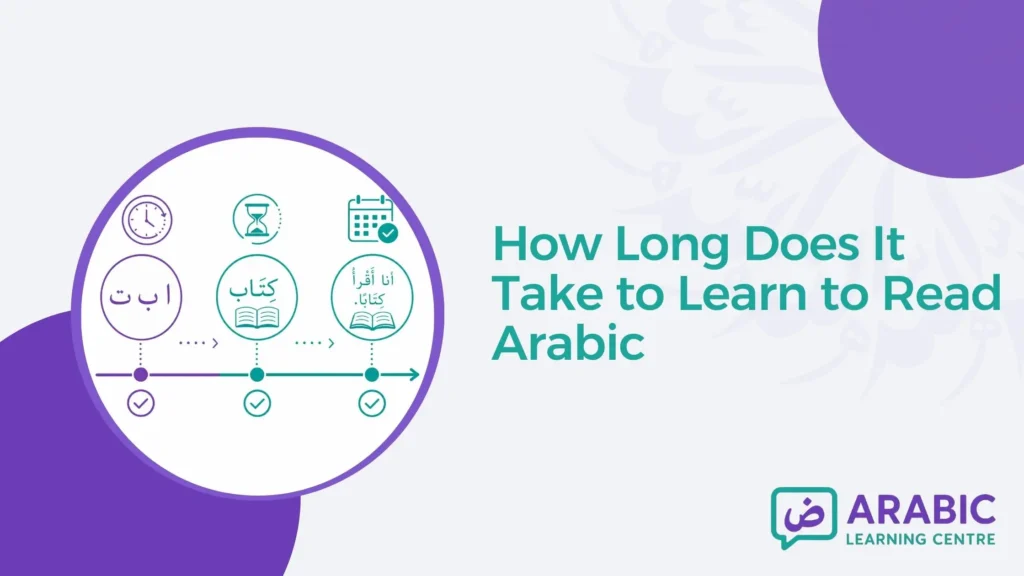
That range exists because reading Arabic is not one skill; it is a sequence of three compounding skills: letter recognition, vowel decoding, and reading fluency under connected script. Each stage has its own timeline, and each builds on the one before it.
How Long Does It Take to Learn to Read Arabic?
Most complete beginners can learn to read basic Arabic script within two to three months with structured instruction and around 20–25 minutes of daily practice. During this period, learners typically progress from recognizing the 28 Arabic letters and their different forms to decoding words and sentences using Harakat (short vowels).
Reaching comfortable reading fluency usually takes around six to twelve months, depending on consistency, previous exposure to Arabic, and the type of Arabic being studied. Quranic Arabic can often be read with basic fluency within three to six months because it is fully vowelled, while reading unvowelled Modern Standard Arabic generally requires considerably more time and stronger grammatical knowledge.
The Three Stages Every Arabic Reader Must Pass Through
Understanding the stages and their realistic durations is the most practical answer to the question of how to get better at reading Arabic. Progress that feels slow is almost always progress that is stuck at the wrong stage for too long.
Stage 1: Arabic Alphabet Recognition (Weeks 1–4)
The 28 Arabic letters each carry up to four positional forms depending on their placement within a word. Most adult learners with daily 20-minute sessions recognise all 28 letters and their positional shapes within three to four weeks.
Stage 2: Vowel Decoding with Harakat (Weeks 4–8)
The short vowel marks, Fatha (َ), Kasra (ِ), and Damma (ُ), determine how every Arabic letter is pronounced. Reading with full diacritics (as the Quran is printed) is achievable within six to eight weeks.
This is the stage where The Arabic Learning Centre’s Arabic Script Writing Course consistently produces breakthroughs; the course pairs visual recognition with pronunciation from the first lesson, compressing this stage significantly.
Book Your Free Trial for Arabic Script Course Now!

Stage 3: Fluent Reading Without Full Diacritics (Months 3–12)
Unvowelled Arabic, the script used in newspapers, books, and most non-Quranic text, requires the reader to infer vowels from context. This stage separates functional literacy from genuine fluency and is where most self-study learners stall. Structured course progression through an intermediate programme is what moves learners through this plateau reliably.
Inside Our Classrooms
See how we make learning interactive and engaging! Watch a quick snippet of our live, conversational classes in action:
How Long Does It Take to Learn to Read Arabic for Complete Beginners?
A complete beginner with zero prior exposure to Arabic script can expect to read simple vowelled Arabic sentences within eight to ten weeks of daily structured study.
That figure assumes 20–25 minutes of daily practice with guided instruction. Learners studying only on weekends or relying solely on apps typically take three to four times longer to reach the same point, because the brain requires daily exposure to consolidate a new script’s recognition patterns.
| Study Format | Time to Basic Reading | Time to Fluent Reading |
| Daily 20 min + qualified teacher | 8–10 weeks | 6–9 months |
| Daily 20 min, self-study only | 16–20 weeks | 12–18 months |
| Weekend-only sessions | 6–9 months | 2+ years |
| Apps without live correction | Highly variable | Rarely achieved alone |
The table above reflects one of the clearest findings in Arabic pedagogy: the gap between a learner with a qualified teacher and one without is not marginal; it is measured in months.
Daily Consistency for Reading Arabic Matters More Than Session Length
This is the single most underestimated variable in how to get better at reading Arabic. Twenty minutes every day produces faster, more durable results than two-hour sessions twice a week.
Arabic reading is a pattern-recognition skill. The brain consolidates new scripts during the rest periods between sessions, not during the sessions themselves. A learner who studies daily is allowing that consolidation to happen twelve times in a fortnight; a twice-weekly learner allows it twice.
A sustainable daily structure for beginners:
| Time of Day | Activity | Duration |
| Morning | Review yesterday’s letters or words | 5 min |
| Main session | New material with teacher or course | 15 min |
| Evening | Read a short vowelled passage aloud | 5 min |
This 25-minute structure is achievable alongside work and family commitments.
For learners who want structured guidance built around this kind of realistic schedule, The Arabic Learning Centre’s Arabic Classes for Adults is designed precisely for adult learners with limited daily windows.
Book Your Free Trial for Arabic Classes for Adults Now!
The Most Common Mistake That Slows Arabic Reading Progress
The single most frequent error made by adult beginners is skipping the phonetic foundation and jumping directly into reading full words or Quranic text.
Arabic letters are not phonetically intuitive for English speakers. The letter ع (Ayn) has no English equivalent; it is a voiced pharyngeal fricative produced by constricting the throat, not the lips or teeth.
Attempting to read words before this sound is correctly placed in the mouth produces a persistent mispronunciation that becomes progressively harder to correct.
The correct sequence is always: correct sound production → letter shape recognition → vowel marking → connected reading.
Learners who skip directly to step three and later return to fix pronunciation errors typically spend more total time reaching fluency than learners who moved through all four stages in order from the beginning.
How Arabic Script Differs from What English Readers Expect
Understanding why Arabic reading feels difficult accelerates the process of getting better at it. English speakers carry four unconscious assumptions into Arabic that the language immediately breaks.
First, Arabic is written right to left. The directionality itself must be retrained at a muscular level, not just understood intellectually.
Second, most Arabic text does not show short vowels. The sentence قَرَأَ الرَّجُلُ (the man read) carries all its vowel marks in Quranic text, but is written as قرأ الرجل in everyday script. Fluent reading requires the reader to supply the missing vowels from grammatical and contextual knowledge.
Third, letters connect. Unlike printed English, Arabic letters within a word are joined, and each letter changes shape depending on its neighbours. The letter ك (Kaf) appears differently in كَتَبَ (kataba, he wrote) at the start, middle, and end of different words.
Fourth, Arabic has sounds with no English equivalent. Beyond Ayn, learners must accurately produce ح (Ha), خ (Kha), ص (Sad), ض (Dad), ط (Ta), and ظ (Dha) — all requiring deliberate articulation training.
Learners who work through The Arabic Learning Centre’s Fusha Arabic Course receive dedicated phonetics instruction for exactly these sounds in the early weeks of the programme.
Book Your Free Trial for Fusha Arabic Course Now!

Read Also: How to Learn Arabic in 6 Months?
Reading Quranic Arabic vs. Reading Modern Standard Arabic
These two reading goals have different timelines and require different approaches, and conflating them is a common source of confusion about how long learning Arabic reading actually takes.
| Text Type | Vowelled? | Reading Skill Required | Estimated Timeline (Daily Study) |
| Quranic Arabic | Fully vowelled | Phonetics + Tajweed | 3–6 months to basic fluency |
| Graded Arabic readers | Partially vowelled | Phonetics + basic grammar | 4–8 months |
| Modern Standard Arabic text | Rarely vowelled | Full grammatical literacy | 12–24+ months |
Learners focused specifically on Islamic studies will find that The Arabic Learning Centre’s Arabic Course for Islamic Studies provides a structured linguistic foundation for engaging directly with classical Islamic texts.
Book Your Free Trial for Arabic Course for Islamic Studies Now!

Read Also: How to Learn Arabic in 5 Minutes?
How Age, Language Background, and Reading Speed Affect Arabic Learning
Age is a frequently cited concern, and the research is more encouraging than most adult learners expect.
Adults learn Arabic reading faster than children in the early stages. The adult brain’s existing literacy skills transfer directly to script recognition. An adult who already reads two or three languages can recognise Arabic letter shapes meaningfully faster than a child encountering their first alphabet.
Children often overtake adults in the consolidation phase, because their long-term retention of phonetic sounds is stronger. But the learning rate in the first three months typically favours adults.
Prior Arabic exposure, even passively through prayer or Quranic recitation without understanding, shortens the alphabet recognition phase considerably. Learners who have been reciting Surah Al-Fatiha from memory for years are not starting from zero when they begin reading instruction.
Read Also: How to Get Better at Reading Arabic?
Don’t Just Take Our Word For It
Take a look inside our vibrant classes and see our students and teachers in action. Click below to watch our classroom experience:
Begin Reading Arabic with Expert Guidance at The Arabic Learning Centre!
Reading Arabic accurately requires more than motivation; it requires the right sequence, a qualified instructor, and consistent daily practice over realistic timelines.
The Arabic Learning Centre offers native Arabic tutors, a structured curriculum from absolute beginner to advanced, flexible scheduling across all time zones, live sessions and recorded materials, and competitive pricing.
- Native Arabic tutors with deep experience teaching non-native speakers
- Structured curriculum from alphabet to advanced fluency
- Live sessions with real-time correction, plus recorded materials
- Flexible scheduling across all time zones
- Affordable pricing with a free trial to start
Courses We Offer:
- Business Arabic Course
- Learn Arabic from Zero
- Medical Arabic Course
- Learning Arabic for Non Arabic Speakers
- Learn Arabic in Saudi Arabia
- Learn to Read Arabic Course
- Arabic Grammar Course
- Arabic Speaking Course
- Arabic Script writing course
- Arabic Vocabulary Course
- Arabic Pronunciation Course
Book your free trial lesson today!

Conclusion
Learning to read Arabic is a gradual process, but most beginners can develop basic reading skills within two to three months through consistent daily practice. Comfortable fluency takes longer, as learners progress from letter recognition to vowel decoding and connected reading.
The most effective approach is to build skills in the correct sequence: master Arabic sounds and letter forms, practice reading with Harakat, and gradually move toward unvowelled text. Short, consistent daily sessions are more effective than longer, irregular study periods.
The timeline ultimately depends on the learner’s goals and background. Quranic reading can develop within a few months because the text is fully vowelled, while fluent MSA reading requires stronger grammar and context-based vowel recognition. Structured instruction can make this progression more efficient.
Frequently Asked Questions
Can You Learn To Read Arabic In Three Months
Basic vowelled reading is realistic within two to three months of daily 20-minute practice. Full comfortable fluency, including reading without diacritics, generally takes six to twelve months beyond that point.
How Many Hours A Day Should You Study To Read Arabic Fluently
Twenty to twenty-five minutes of daily, structured practice outperforms longer, infrequent sessions, since the brain consolidates new script recognition during the rest periods between study sessions, not during the session itself.
Is It Faster To Learn Arabic Reading As An Adult Or A Child
Adults generally learn Arabic letter and script recognition faster than children in the first few months, since existing literacy in another language transfers directly to decoding a new alphabet.
Children tend to catch up and often overtake adults during longer-term consolidation, thanks to stronger phonetic retention. The early advantage still belongs to adult learners in most cases.
How Long Does It Take To Read The Quran Fluently
Quranic Arabic is fully vowelled, which makes it more accessible to beginners than unvowelled text. Most learners reach basic Quranic reading fluency within three to six months of consistent daily study.
The remaining challenge at that point is usually Tajweed, the precise articulation rules for recitation, rather than decoding the letters and vowels themselves.
Do Language Apps Work As Well As A Live Teacher For Learning To Read Arabic
No, apps without live correction produce highly variable and often stalled results, since mispronounced sounds and misread letters go uncorrected and can become difficult habits to reverse later.
A qualified teacher catches these errors in real time. That gap between guided and unguided study is measured in months, not days, according to consistent patterns in Arabic reading pedagogy.
What Is The Biggest Mistake That Slows Down Arabic Reading Progress
The most common mistake is skipping correct sound production and jumping straight into reading full words or Quranic text before the phonetic foundation is properly in place.
Related Articles
Arabic Vocabulary & Speaking