 Arabic Alphabet & Writing

You don’t need hours free each day to start learning Arabic. Most people who give up on Arabic aren’t lazy — they’re just using the wrong approach. They sit down for a 45-minute study session, get overwhelmed, and quit. The learners who actually make progress do something different: they build small, consistent habits that take five minutes or less and do them every single day.
This guide gives you 10 practical micro-habits you can start today, even If you’re wondering how to learn Arabic in 5 minutes, you’re not alone. Many people believe they need hours of daily study, but the truth is that consistent five-minute habits can build real progress over time. Most learners who quit aren’t lazy—they simply rely on study methods that are difficult to maintain.
1. Learn One Word of the Day
Start with a single Arabic word. Look it up, say it aloud three times, read it in a sentence, then move on. One word, done.
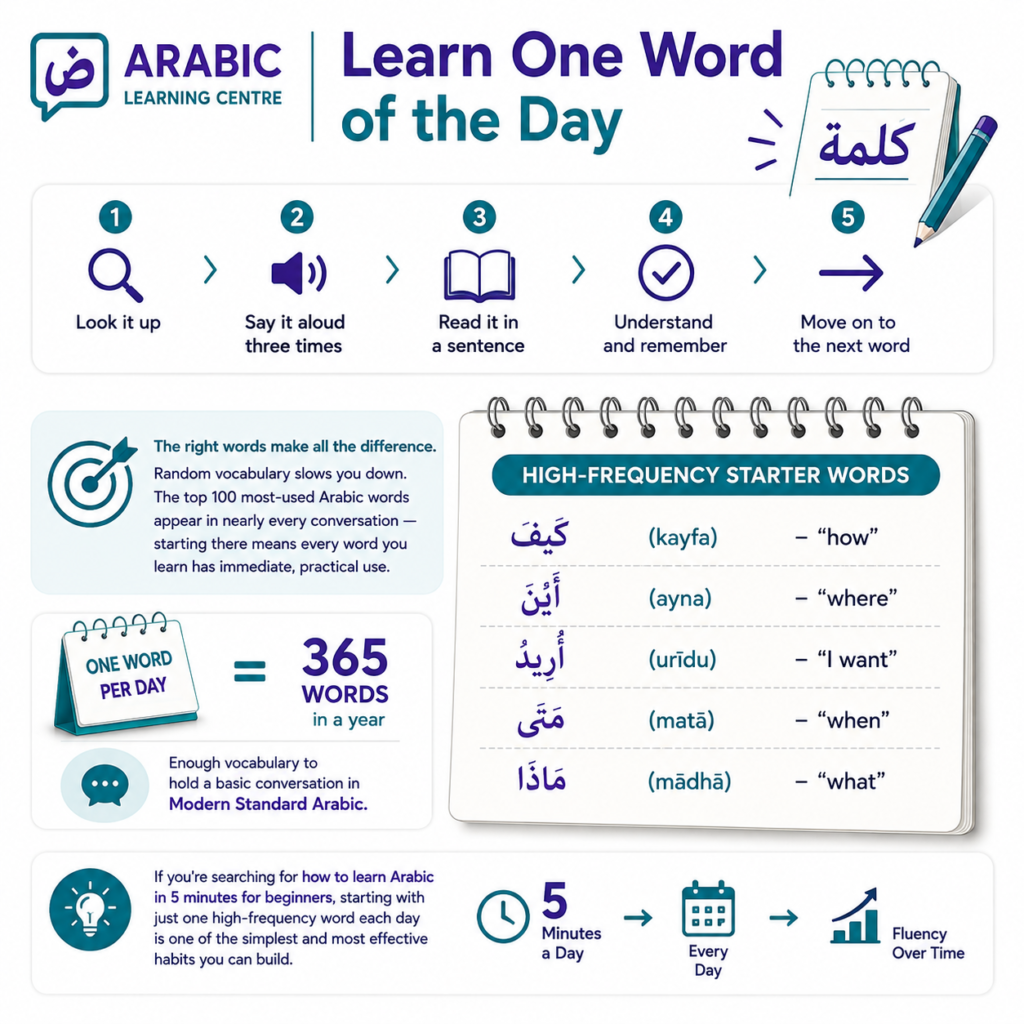
The critical detail is which words you choose. Random vocabulary slows you down. The top 100 most-used Arabic words appear in nearly every conversation — starting there means every word you learn has immediate, practical use.
High-frequency starter words to prioritise first:
- كَيْفَ (kayfa) — “how”
- أَيْنَ (ayna) — “where”
- أُرِيدُ (urīdu) — “I want”
- مَتَى (matā) — “when”
- مَاذَا (mādhā) — “what”
One word per day is 365 words in a year — enough vocabulary to hold a basic conversation in Modern Standard Arabic.
If you’re searching for how to learn Arabic in 5 minutes for beginners, starting with just one high-frequency word each day is one of the simplest and most effective habits you can build.
2. Memorize a Complete Sentence, Not Just a Word
A single sentence like أَيْنَ الْمَحَطَّةُ؟ (Where is the station?) teaches three things simultaneously: the word for “where,” the word for “station,” and the structural pattern Arabic uses to ask a location question. That is three times the return on the same two minutes.
Phrase-based learning activates language use faster than vocabulary lists because your mouth already knows how the sentence sounds — you can produce it in a real conversation without translating inside your head first.
Beginner sentence starters that pack in multiple skills:
- أَنَا أَشْرَبُ الْقَهْوَةَ — I am drinking coffee
- أُرِيدُ مَاءً، مِنْ فَضْلِكَ — I want water, please
- هَذَا كَثِيرٌ — This is too much
- لَا أَفْهَمُ — I don’t understand
- هَلْ تَتَكَلَّمُ الْعَرَبِيَّةَ؟ — Do you speak Arabic?
Arabic Learning Centre’s courses for adults are structured around exactly this principle — usable language from the first session, not abstract grammar rules.

3. Use a Smart App for 2 Minutes of Vocabulary Drilling
Apps like Duolingo and Drops are most effective when used as a daily warm-up tool — not as your entire learning strategy. Two minutes of vocabulary drilling in the morning primes your brain for Arabic before your day starts.
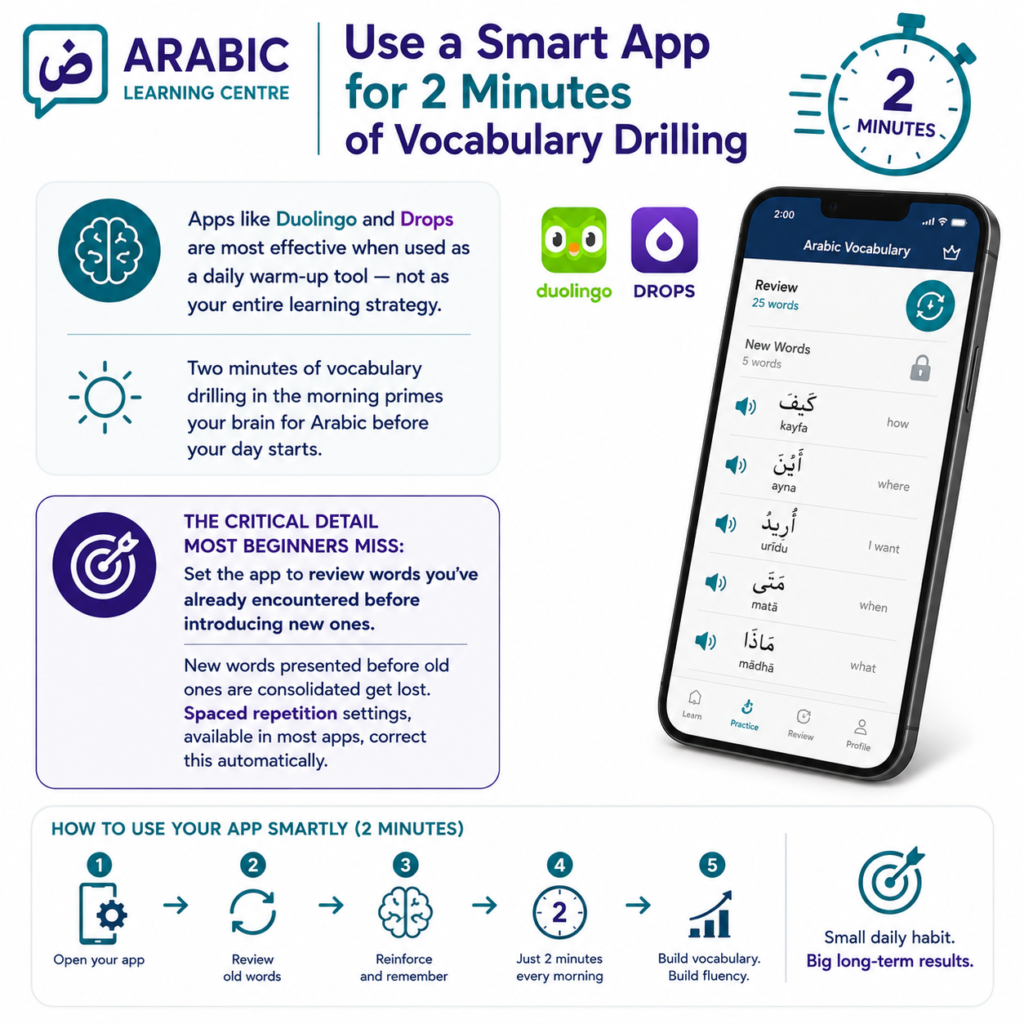
The critical detail most beginners miss: set the app to review words you’ve already encountered before introducing new ones. New words presented before old ones are consolidated and get lost. Spaced repetition settings, available in most apps, correct this automatically.
Inside Our Classrooms
See how we make learning interactive and engaging! Watch a quick snippet of our live, conversational classes in action:
4. Link Words to Images, Not Translations
When you learn the word بَابٌ (bāb), don’t think of the English word “door.” Instead, picture a real door in your mind. Your goal is to connect the Arabic word directly to the object, without going through English first.
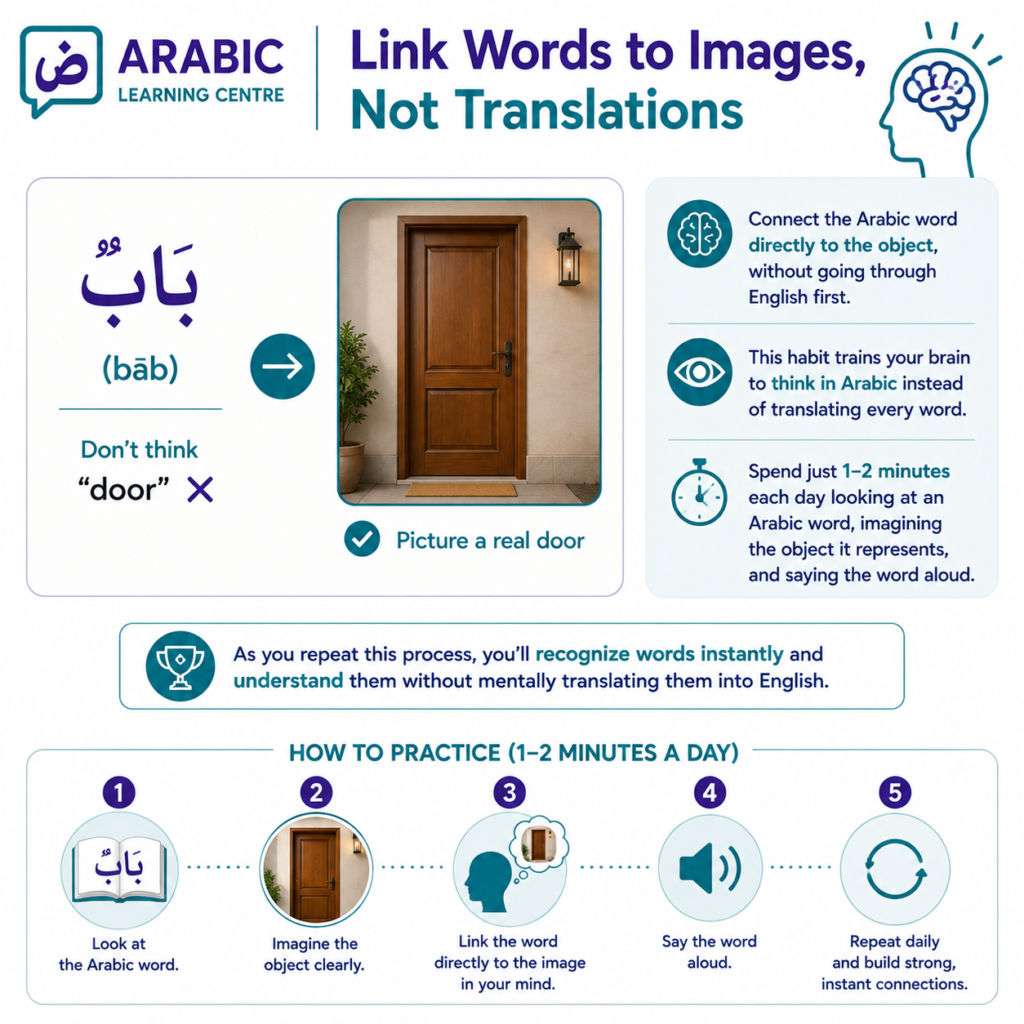
This habit trains your brain to think in Arabic instead of translating every word. Spend just one or two minutes each day looking at an Arabic word, imagining the object it represents, and saying the word aloud. As you repeat this process, you’ll recognize words instantly and understand them without mentally translating them into English.
5. Listen to 3 Minutes of Arabic Audio During Your Commute
Passive audio exposure during low-attention activities — commuting, cooking, walking — is one of the most underused free Arabic learning methods available. Short, simplified Modern Standard Arabic podcasts train your ear to recognize word boundaries, rhythm, and pronunciation patterns before you need to produce them yourself.
This is also why many learners searching for how to learn Arabic in 5 minutes online combine short listening exercises with digital learning platforms. Even a few minutes of guided audio each day can improve pronunciation and listening comprehension.
Learners who skip audio and study only text consistently struggle with comprehension and speaking when they encounter real Arabic. Your ear needs separate training from your reading eye.
What to look for in beginner Arabic audio:
| Criterion | What to Choose | What to Avoid |
|---|---|---|
| Variety | Modern Standard Arabic (الفصحى) | Regional dialects at the beginner stage |
| Difficulty | Slow, clear speech with pauses | Native-speed news or drama |
| Length | 3–10 minute episodes | Full lecture series |
| Content | Simple daily topics, phrases | Advanced grammar explanations |
Three minutes of Arabic audio daily, five days a week, produces measurable improvement in listening comprehension within four to six weeks.
If you’d prefer to learn with a female Arabic teacher specifically, Arabic Learning Centre has qualified instructors available to match your preference.

6. Talk to Yourself in Arabic for 2 Minutes
This is the habit most beginners skip — and the one that makes the biggest single difference. Speaking Arabic, even alone, activates different neural pathways than reading or listening. Your mouth muscles need to learn Arabic sounds through physical repetition, the same way a musician’s fingers learn chord positions.
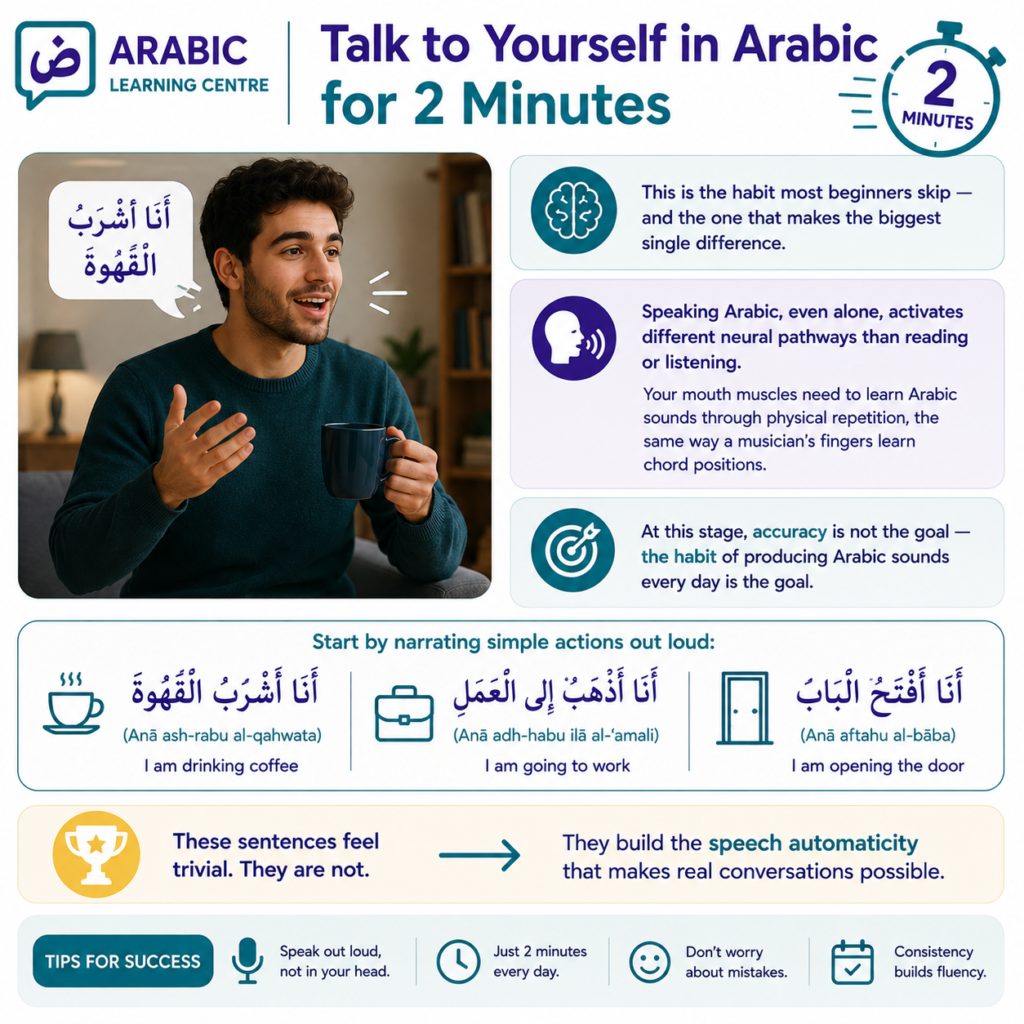
Start by narrating simple actions out loud:
- أَنَا أَشْرَبُ الْقَهْوَةَ — I am drinking coffee
- أَنَا أَذْهَبُ إِلَى الْعَمَلِ — I am going to work
- أَنَا أَفْتَحُ الْبَابَ — I am opening the door
These sentences feel trivial. They are not. They build the speech automaticity that makes real conversations possible. At this stage, accuracy is not the goal — the habit of producing Arabic sounds every day is the goal.
7. Change Your Phone Language to Arabic
This costs zero minutes per day and delivers constant Arabic exposure. Every time you check a notification, send a message, or open an app, you read Arabic words. Initially this feels disorienting. Within a week, most learners report recognizing 10–15 common interface words automatically.
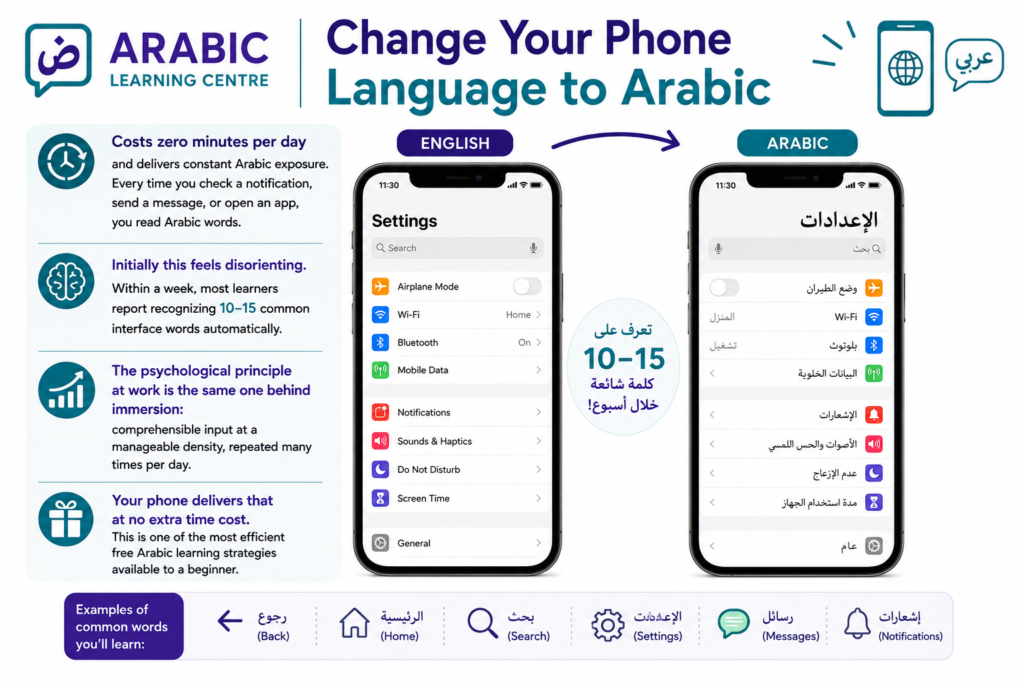
The psychological principle at work is the same one behind immersion: comprehensible input at a manageable density, repeated many times per day. Your phone delivers that at no extra time cost. This is one of the most efficient free Arabic learning strategies available to a beginner.
8. Label Objects Around Your Home
Write Arabic labels on sticky notes and place them directly on the objects they name. Every time you walk past a labelled item, your brain registers a brief Arabic reinforcement — without any deliberate study effort.
Common household labels to start with:
| Arabic | Transliteration | English |
| بَابٌ | bāb | door |
| نَافِذَةٌ | nāfidhah | window |
| ثَلَّاجَةٌ | thallājah | refrigerator |
| مِفْتَاحٌ | miftāḥ | key |
| كُرْسِيٌّ | kursī | chair |
| طَاوِلَةٌ | ṭāwilah | table |
Over a full day, you might pass a labelled door fifteen to twenty times. That is fifteen free vocabulary repetitions — zero minutes of study time required.
9. Watch One Short Educational Arabic Video
Sixty-second Arabic teaching videos on platforms like Instagram Reels or YouTube Shorts deliver a word, a phrase, or a grammar rule in a format your brain processes as entertainment, not study. The production value and energy of short video content triggers attention in a way that text flashcards do not.
The selection criterion matters: choose content in Modern Standard Arabic (الفصحى) at beginner level, not regional dialects, if your goal is either conversation or Quranic Arabic. Regional dialects are valuable later — but mixing them too early with MSA creates confusion about how the language actually works. For learners interested in progressing to advanced Arabic, a clear MSA foundation prevents the habit corrections that slow down advanced study.

Read Also: How Long Does It Take to Learn to Read Arabic?
10. Anchor Your Practice to a Fixed Daily Habit
The single most reliable predictor of Arabic learning success is not intelligence, prior language experience, or available time. It is consistency. And consistency is a design problem, not a willpower problem.
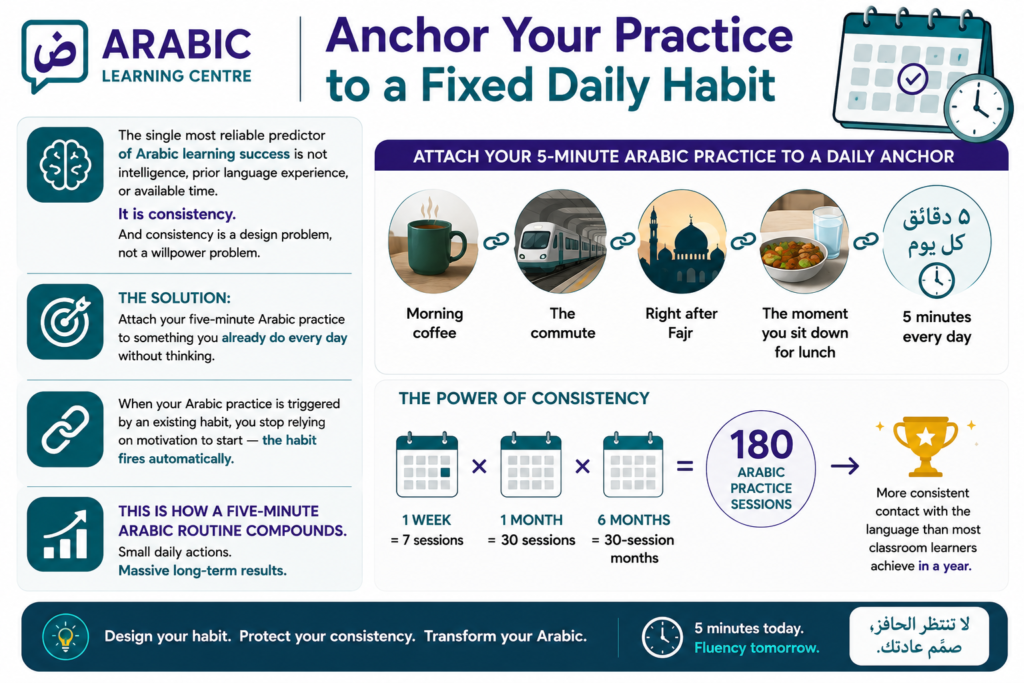
The solution: attach your five-minute Arabic practice to something you already do every day without thinking. Morning coffee. The commute. Right after Fajr. The moment you sit down for lunch. When your Arabic practice is triggered by an existing habit, you stop relying on motivation to start — the habit fires automatically.
This is how a five-minute Arabic routine compounds. One week is seven sessions. One month is thirty. Six months of thirty-session months is 180 Arabic practice sessions — more consistent contact with the language than most classroom learners achieve in a year.
Read Also: How to Get Better at Reading Arabic?
Why Learning Arabic in 5 Minutes a Day Actually Works?
How to learn Arabic in 5 minutes isn’t about finding a shortcut. It’s about using short, repeatable study sessions that your brain can retain consistently over time.
The biggest myth in language learning is that you need long, uninterrupted study sessions to make progress. Language acquisition research consistently shows the opposite: short, frequent exposure outperforms long, occasional sessions for both vocabulary retention and pronunciation development.
The mechanism is straightforward. Every time you encounter an Arabic word or phrase, your brain begins building a neural connection. Revisiting that word the next day, before the connection fades, strengthens it. This is the principle behind spaced repetition — and five minutes of daily contact with Arabic is enough to keep those connections alive and growing.
The goal of these 10 steps is not to replace a full Arabic course. It is to give you a learning routine that you will actually sustain, so that when you work with an Arabic teacher or take a structured course, you arrive primed — not starting from zero.
Read Also: How to Learn Arabic in 6 Months?

Don’t Just Take Our Word For It
Take a look inside our vibrant classes and see our students and teachers in action. Click below to watch our classroom experience:
Start Learning Arabic with Expert Guidance at Arabic Learning Centre
Five-minute daily habits will give you a foundation. Structured guidance will take you from that foundation to genuine Arabic fluency.
Arabic Learning Centre connects you with expert Arabic teachers for adults, beginners, and advanced learners — available online, at times that fit your schedule. Whether you’re a complete beginner building your first words or an intermediate learner ready to move beyond basics, the right teacher shortens your path significantly.
Courses We Offer:
- Business Arabic Course
- Learn Arabic from Zero
- Medical Arabic Course
- Learning Arabic for Non Arabic Speakers
- Learn Arabic in Saudi Arabia
- Learn to Read Arabic Course
- Arabic Grammar Course
- Arabic Speaking Course
- Arabic Script writing course
- Arabic Vocabulary Course
- Arabic Pronunciation Course
Book a Free Trial Lesson Today

Conclusion
Learning Arabic in five minutes a day is not about shortcuts — it is about designing a habit you will actually maintain. The 10 steps in this guide each take five minutes or less, each target a specific skill, and each compounds over time. Start with the two or three that fit your current routine most naturally, build consistency, then add more.
The learners who become fluent in Arabic are not the ones who studied the most on a single day. They are the ones who showed up every day, even for just five minutes.
Frequently Asked Questions About Learning Arabic in 5 Minutes
Can you actually learn Arabic in 5 minutes a day?
You can build a strong Arabic learning routine in five minutes a day. Five daily minutes will not make you fluent on their own, but they establish vocabulary, pronunciation habits, and language recognition that compound significantly over weeks and months. Consistency at five minutes beats sporadic two-hour sessions every time.
What is the fastest way to learn Arabic for beginners?
The fastest approach for beginners combines three elements: high-frequency vocabulary (the 100 most common words), complete sentences rather than isolated words, and daily audio exposure to train your ear. Starting with these three alongside a qualified teacher produces usable Arabic faster than any single method alone.
How do I learn Arabic online for free?
Free Arabic learning resources include vocabulary apps like Duolingo and Drops, Arabic teaching videos on YouTube and Instagram, phone language settings, and printable vocabulary worksheets. These tools work best as supplements to structured instruction rather than standalone study plans.
How long does it take to learn Arabic from scratch?
Most dedicated learners reach conversational Modern Standard Arabic within 12–18 months of consistent daily practice. The timeline shortens significantly with structured guidance from a qualified teacher versus self-study alone. Five minutes a day gives you a foundation; adding a weekly lesson accelerates the timeline substantially.
Is Modern Standard Arabic the best variety to learn first?
Yes, for most learners. Modern Standard Arabic is used across Arabic media, formal writing, and professional contexts in all Arab countries. It is also the closest form to Classical Arabic and Quranic Arabic. Learning MSA first gives you a base that transfers to regional dialects and Quranic study — learning a dialect first often requires significant correction when transitioning to MSA later.
Related Articles
Arabic Alphabet & Writing