 Learn Arabic
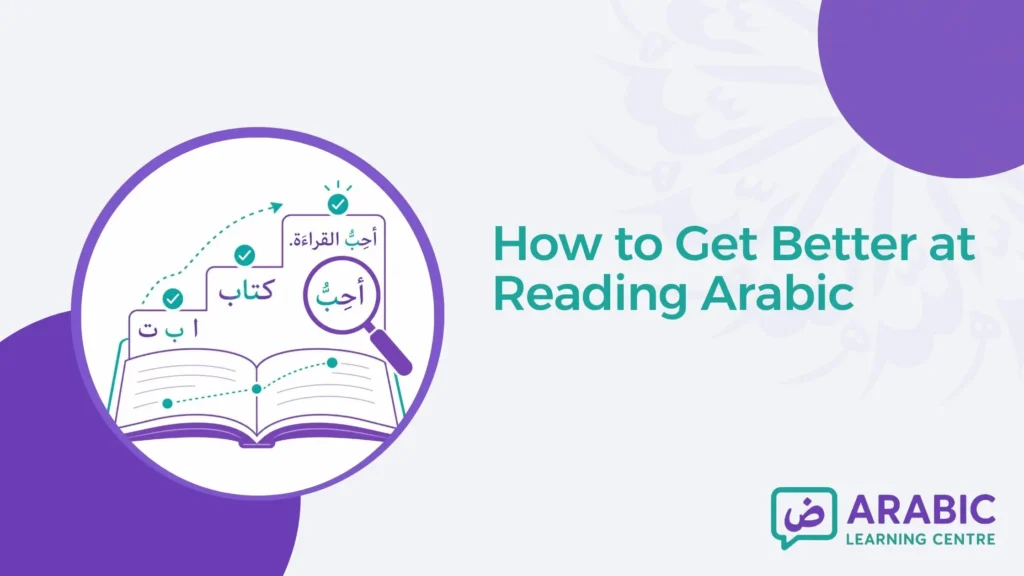
Reading Arabic fluently is not a talent; it is a skill built in layers. Millions of non-native learners worldwide recognise Arabic letters but still struggle to read connected text at a natural pace. The gap is almost always technical, not intellectual, and it is fully closeable with the right method.
To get better at reading Arabic, you need three things working together: solid letter-recognition at speed, a reliable command of short vowel marks (Harakat), and consistent daily exposure to connected Arabic text with expert correction at every stage. Most learners are missing at least one.
1. Mastering the Arabic Letter Forms Is the Non-Negotiable Starting Point
If you want to know how to get better at reading Arabic, start here: every Arabic letter has four positional forms: isolated, initial, medial, and final. A learner who has not drilled all four forms for all 28 letters will hesitate at every word. That hesitation compounds into slow, exhausting reading that discourages practice.
Drilling positional forms is not glamorous work. But it is the single highest-return investment a beginner can make. Once the 28 letters and their forms are automatic, your reading speed increases measurably within weeks.
| Letter | Isolated | Initial | Medial | Final |
| Ba (ب) | ب | بـ | ـبـ | ـب |
| Ayn (ع) | ع | عـ | ـعـ | ـع |
| Meem (م) | م | مـ | ـمـ | ـم |
| Lam (ل) | ل | لـ | ـلـ | ـل |
At the Arabic Learning Centre, the Arabic Script Writing Course dedicates focused attention to positional letter recognition, because reading fluency begins with seeing letters correctly, not guessing from context.
Book Your Free Trial for Arabic Script Course Now!
2. Reading Arabic with Harakat (Short Vowel Marks) Before Reading Unvowelled Text
Harakat, the small diacritical marks written above and below Arabic letters, are the pronunciation key of the Arabic script. The three core marks are Fatha (short “a”), Kasra (short “i”), and Damma (short “u”). Together with Sukoon (no vowel) and Shadda (doubled consonant), they make every word fully pronounceable.
Most beginners understand this in theory. The expert insight is the sequence: you must reach genuine reading fluency on fully vowelled text before you ever attempt unvowelled Arabic. Learners who rush to newspapers and unvowelled books before this threshold create a reading habit based on guessing, and guessing becomes a deeply embedded crutch that slows long-term progress dramatically.
| Harakat | Symbol | Sound | Example |
| Fatha | َ | Short “a” | كَتَبَ = “kataba” (he wrote) |
| Kasra | ِ | Short “i” | كِتَاب = “kitaab” (book) |
| Damma | ُ | Short “u” | كُتُب = “kutub” (books) |
| Sukoon | ْ | No vowel | بْ = “b” (stopped) |
| Shadda | ّ | Doubled | كَتَّبَ = “kattaba” |
Spend the first phase of your improvement exclusively on Harakat-marked texts. Progress to partially vowelled and then unvowelled text only once fluency on the first level is confirmed by a qualified teacher.
3. Building Reading Fluency Through the Noorani Qaida Method
The Noorani Qaida is a structured Arabic phonetic primer used by effective teachers worldwide to build reading fluency from the ground up. It introduces Arabic sounds in a carefully sequenced progression: single letters, then consonant-vowel combinations, then connected letter clusters, and finally short words, all before the student approaches any full text.
The pedagogical value of this method is precision. Every level targets one skill before introducing complexity. This prevents the most common reading problem among self-taught learners: recognising individual letters but failing to decode them at reading speed when connected in words.
If you are an adult learner who can identify Arabic letters but reads slowly and laboriously, revisiting the Noorani Qaida framework, even briefly, under a teacher’s supervision will often break the fluency ceiling within weeks.
The Arabic Course for kids at The Arabic Learning Centre uses this structured phonetic approach, ensuring every student builds accurate reading habits before moving to vocabulary and grammar work.
Book Your Free Trial for Arabic Course for kids Now!

4. Correct Pronunciation of Arabic Sounds That Do Not Exist in English
One underrated obstacle to reading Arabic fluently is the relationship between reading and sound. Non-native learners who have not correctly acquired Arabic’s unique phonemes will read text but produce incorrect sounds, and this error quietly reinforces itself every practice session.
Several Arabic letters have no English equivalent:
The Throat Sounds: ع (Ayn) and غ (Ghayn)
ع (Ayn) is produced by constricting the throat above the larynx, a voiced pharyngeal fricative. غ is a voiced velar fricative, similar to the French r. English speakers habitually substitute a glottal stop or a hard “g” for both. This changes word meanings entirely.
The Emphatic Consonants: ص، ض، ط، ظ
These four emphatic letters, Saad, Daad, Taa, and Dhaa, are pronounced with the back of the tongue raised toward the velum, giving the surrounding vowels a deeper, “darker” quality. Pronouncing them as their non-emphatic counterparts (س، د، ت، ذ) produces completely different words.
A qualified native tutor at The Arabic Learning Centre will identify and correct these phonetic substitution errors in real time, something no app or textbook can replicate.
Inside Our Classrooms
See how we make learning interactive and engaging! Watch a quick snippet of our live, conversational classes in action:
5. Reading Connected Arabic Text Daily with a Structured Progression Plan
Knowing how to get better at reading Arabic is ultimately an answer about volume and sequence. The brain builds reading fluency through repeated exposure to connected text, but that exposure must be structured, not random.
A practitioner-tested sequence used by experienced Arabic instructors runs as follows:
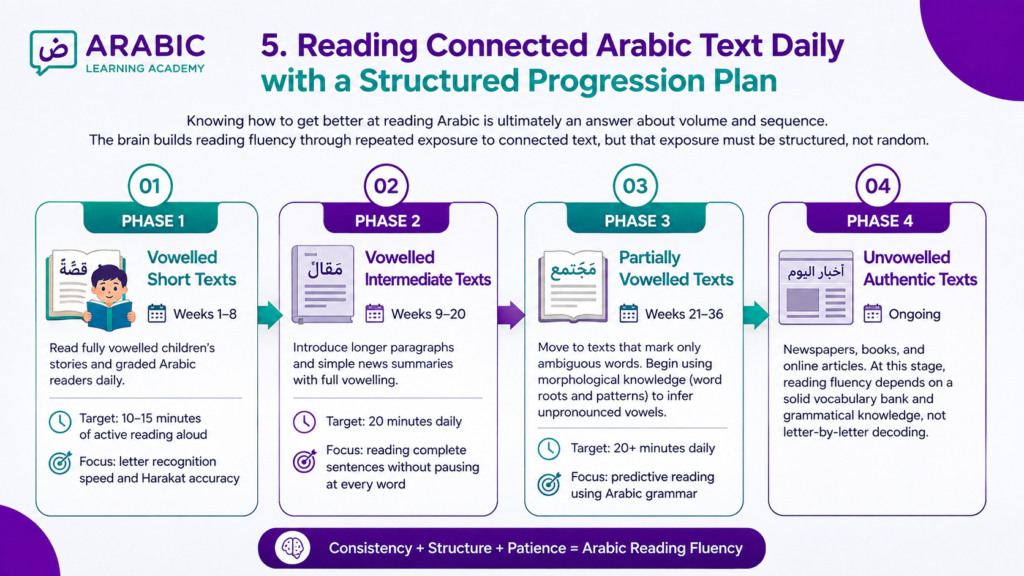
Phase 1: Vowelled Short Texts (Weeks 1–8)
Read fully vowelled children’s stories and graded Arabic readers daily. Target 10–15 minutes of active reading aloud. Focus: letter recognition speed and Harakat accuracy.
Phase 2: Vowelled Intermediate Texts (Weeks 9–20)
Introduce longer paragraphs and simple news summaries with full vowelling. Target 20 minutes daily. Focus: reading complete sentences without pausing at every word.
Phase 3: Partially Vowelled Texts (Weeks 21–36)
Move to texts that mark only ambiguous words. Begin using morphological knowledge (word roots and patterns) to infer unpronounced vowels. Focus: predictive reading using Arabic grammar.
Phase 4: Unvowelled Authentic Texts
Newspapers, books, and online articles. At this stage, reading fluency depends on a solid vocabulary bank and grammatical knowledge, not letter-by-letter decoding.
The Fusha Arabic Course at The Arabic Learning Centre maps precisely to this four-phase progression, with live sessions and recorded materials that allow learners to advance at their own pace.
Book Your Free Trial for Fusha Arabic Course Now!

6. Arabic Root and Pattern Recognition as a Reading Acceleration Tool
Arabic is a root-based language. The vast majority of Arabic words derive from three-letter (or occasionally four-letter) roots that carry a core semantic meaning. Patterns, fixed templates applied to roots, generate families of related words with predictable meanings and pronunciation.
For example, the root ك-ت-ب (k-t-b) relates to writing:
- كَتَبَ (kataba) — he wrote
- كِتَاب (kitaab) — book
- كَاتِب (kaatib) — writer
- مَكْتَبَة (maktaba) — library
- كِتَابَة (kitaaba) — writing (the act)
A learner who recognises this root will read all five words with confidence, even when encountering them for the first time. Root-pattern recognition is therefore not merely a vocabulary strategy. It is a reading strategy: it allows you to decode unfamiliar words without stopping.
Read Also: How Long Does It Take to Learn to Read Arabic?
7. Active Reading Aloud with a Native Teacher Providing Real-Time Correction
The most common mistake among self-study Arabic readers is silent reading practice. Silent reading does not develop the phonetic accuracy or the reading-aloud fluency required for real-world Arabic use. Reading aloud activates your articulatory system, trains your ear, and forces your brain to process text at a communicative pace rather than a decoding pace.
Reading aloud with a teacher present is categorically more effective than reading aloud alone. A qualified instructor catches mispronunciations the student cannot hear in themselves, particularly incorrect vowel lengths, substituted emphatic consonants, and missed Hamzas.
In the Arabic Classes for Adults at The Arabic Learning Centre, native tutors run structured reading-aloud sessions with immediate, constructive correction, so errors are addressed before they become entrenched habits.
Book Your Free Trial for Arabic Classes for Adults Now!
Read Also: How to Learn Arabic in 6 Months?
8. Building a Sustainable Daily Arabic Reading Habit
How to get better at reading Arabic comes down, in the end, to consistency over intensity. Daily reading of 15–20 minutes produces faster, more durable fluency gains than a two-hour weekend session, because phonetic skill consolidation happens during rest between practice sessions.
A sustainable daily reading habit for adult learners:
- Morning (10 min): Read one paragraph aloud from your current level text, recording yourself.
- Evening (10 min): Listen to the recording. Note any word you stumbled on. Look it up.
- Weekly (30 min with teacher): Cover new material and receive correction on accumulated errors.
The habit needs a fixed time slot, a fixed text level, and a fixed correction mechanism. Remove any one of these and consistency degrades within weeks.
Read Also: How to Learn Arabic in 5 Minutes?
Don’t Just Take Our Word For It
Take a look inside our vibrant classes and see our students and teachers in action. Click below to watch our classroom experience:
Start Improving Your Arabic Reading with Expert Guidance at The Arabic Learning Centre Today!
The Arabic Learning Centre has spent over a decade helping non-native Arabic learners build genuine reading fluency, from complete beginners who cannot identify a single letter, to intermediate readers ready to tackle unvowelled texts.
The method works because it is structured, sequenced, and taught by native tutors who understand exactly where international learners struggle.
- Native Arabic tutors with deep experience teaching non-native speakers
- Structured curriculum from alphabet to advanced fluency
- Live sessions with real-time correction, plus recorded materials
- Flexible scheduling across all time zones
- Affordable pricing with a free trial to start
Courses We Offer:
- Quranic Arabic Course
- Arabic Course for Islamic Studies
- Learn Arabic for New Muslims
- Learn Arabic Letters for Tajweed
- Al Azhar Arabic Course
- Madinah Arabic Course
- Online Arabic Classes for Kids
- Arabic Words Course for Kids
- Arabic Lessons for Kindergarten
- Arabic Elementary School
- Arabic Intermediate School
- Arabic High School
Book your free trial lesson today!

Conclusion
Improving Arabic reading is a gradual process that depends on building the right skills in sequence. Mastering positional letter forms, Harakat, pronunciation, and connected text provides the foundation needed to move from slow decoding toward confident, fluent reading.
Consistent practice is more important than occasional long study sessions. Daily reading aloud, structured progression from vowelled to unvowelled texts, and regular feedback help strengthen recognition, pronunciation, and reading speed while preventing incorrect habits from becoming established.
As learners progress, Arabic root-and-pattern recognition, grammatical knowledge, and contextual understanding make unfamiliar words easier to decode. Whether the goal is Quranic reading, Modern Standard Arabic, or general literacy, a structured approach and sustainable daily routine can accelerate long-term progress.
Frequently Asked Questions
How Long Does It Take To Learn To Read Arabic Fluently
Most learners recognize letters and read simple vocalized text within two to three months of consistent daily practice. Comfortable, unvocalized reading typically takes twelve to eighteen months with regular study.
Progress depends heavily on frequency rather than intensity. Fifteen minutes daily for a year outperforms occasional long sessions, since letter and vowel recognition rely on repeated, spaced exposure.
What Is The Fastest Way To Learn The Arabic Alphabet
The fastest route pairs letter-shape drills with immediate handwriting practice, since writing a letter reinforces its recognition far more than passive reading of a chart alone.
Focus on one letter’s four positional forms per session rather than trying to absorb the full alphabet at once. Slower, focused sessions produce faster long-term recognition than rushed overviews.
Should Beginners Learn Arabic Without Vowel Marks
No, beginners should stay with fully vocalized text for at least several months. Removing harakat too early encourages guessing rather than genuine decoding, and that habit is difficult to reverse later.
Unvocalized reading depends on grammar knowledge that beginners have not yet built. Introducing it too soon replaces one skill gap with another, slowing overall progress rather than accelerating it.
Is Quranic Arabic Or Modern Standard Arabic Better For Reading Practice
Either works well as a starting point, since both use full vocalization and share the same letter forms. The right choice depends on whether a learner’s primary goal is religious text or everyday material.
Learners aiming to read the Quran often benefit from starting directly with it, while those pursuing news, media, or conversation typically progress faster with Modern Standard Arabic readers instead.
Can Adults Learn To Read Arabic As Effectively As Children
Yes, adults often progress faster than children in the early stages, since they can apply grammar logic and pattern recognition that young children have not yet developed.
Adults do need more deliberate practice to offset reduced natural language absorption. Structured lessons with a tutor tend to close that gap quickly, keeping adult progress steady and measurable.