 Quran
Quran
Learning Arabic in 7 days will not make you fluent. Anyone who tells you otherwise is selling you something.
What 7 focused, well-structured days can give you is genuinely valuable: the Arabic alphabet locked in memory, 100–150 essential words at your fingertips, a working feel for how Arabic sentences are built, and — perhaps most importantly — the confidence and momentum to keep going.
Arabic rewards effort in ways that few languages do. It is the language of the Quran, of over 400 million speakers, and of a literary tradition spanning more than 1,500 years. This 7-day plan is not about shortcuts. It is about making every day count so that Day 8 is not an ending but a launchpad.
Day 1: Master the Arabic Alphabet
The Arabic alphabet is the non-negotiable starting point. Anyone researching how to learn Arabic in 7 days should begin with the alphabet, because every other language skill depends on it.
You cannot learn any Arabic — not a single word — until you can read and write its 28 letters. Skipping or rushing this step is the most expensive mistake a beginner can make, because every hour of vocabulary and grammar study built on an unstable alphabet foundation costs more time later to correct.
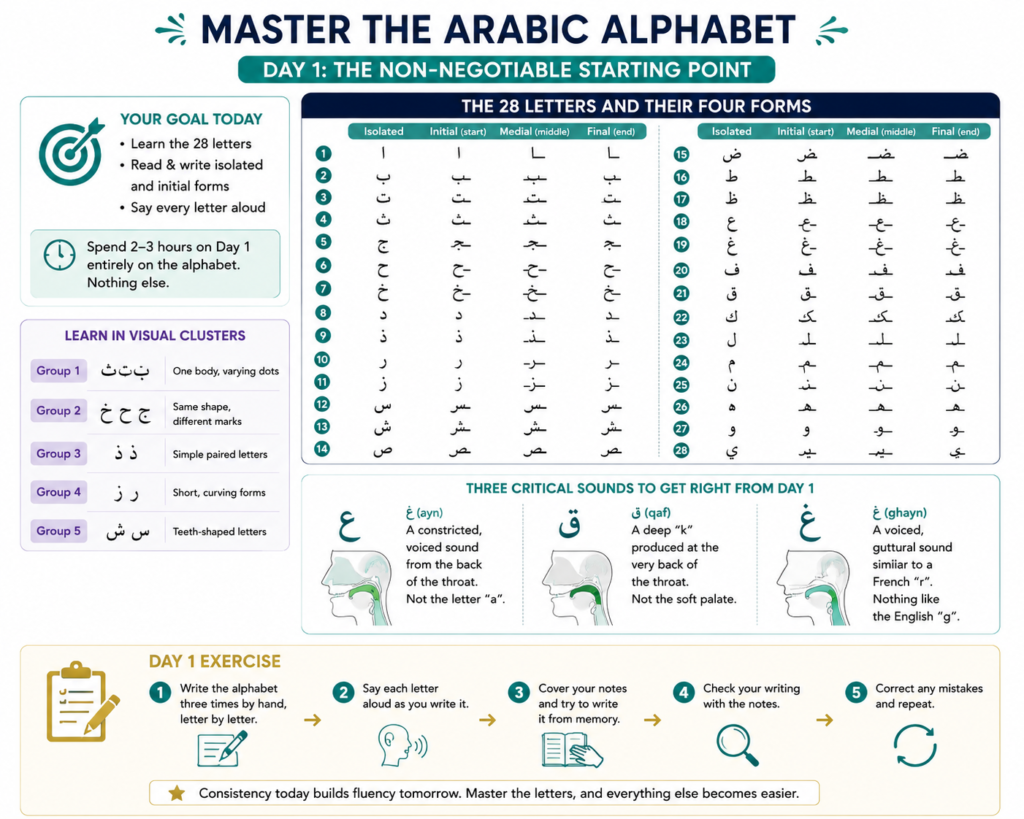
Spend 2–3 hours on Day 1 entirely on the alphabet. Nothing else.
The 28 Letters and Their Four Forms
Each Arabic letter has up to four forms depending on its position in a word: isolated, initial (start of word), medial (middle), and final (end of word). You do not need to memorize all four forms for every letter today — but you need to be aware they exist. Day 1 targets isolated and initial forms.
Learn letters in visually similar clusters, not alphabetical order. Grouping similar-looking letters together — ب، ت، ث or ج، ح، خ — prevents the confusion that slows most beginners down in the first week.
| Letter Group | Letters | Shared Feature |
| Group 1 | ب ت ث | One body, varying dots |
| Group 2 | ج ح خ | Same shape, different marks |
| Group 3 | د ذ | Simple paired letters |
| Group 4 | ر ز | Short, curving forms |
| Group 5 | س ش | Teeth-shaped letters |
Arabic has several sounds with no English equivalent. Three deserve immediate attention on Day 1, because mispronouncing them early becomes a habit that is genuinely difficult to break later:
- ع (ayn) — a constricted, voiced sound produced in the back of the throat; not the letter “a”
- ق (qaf) — a deep “k” produced at the very back of the throat, not the soft palate
- غ (ghayn) — a voiced, guttural sound similar to a French “r” — nothing like the English “g”
Say every letter aloud as you write it. The Arabic speaking apparatus — the muscles, breath, and coordination required — needs time to develop. Start on Day 1, not Day 6.
Day 1 Exercise: Write the alphabet three times by hand, letter by letter, saying each one aloud. Then cover your notes and try to write it from memory. Check, correct, repeat.
Day 2: Essential Arabic Phrases for Real Conversations
With the alphabet started, Day 2 introduces the phrases a beginner needs to navigate their first real-world Arabic exchange. These are not arbitrary vocabulary — they are the phrases that open doors to practice partners, tutors, and immersion.
| Arabic | Transliteration | Meaning |
| مرحبا | Marhaba | Hello |
| السلام عليكم | As-salamu alaykum | Peace be upon you |
| وعليكم السلام | Wa alaykum as-salam | And upon you peace |
| شكراً | Shukran | Thank you |
| من فضلك | Min fadlak | Please |
| وداعاً | Wadaa’an | Goodbye |
| نعم | Na’am | Yes |
| لا | La | No |
| اسمي… | Ismi… | My name is… |
| أنا من… | Ana min… | I am from… |
A common beginner mistake on Day 2: treating phrases as isolated vocabulary to memorize rather than as tools to use. Speak every phrase out loud immediately. Better still, use them in a short live session with a native speaker or language partner — even 20 minutes of real exchange will consolidate these phrases more effectively than two hours of silent review.
Working with a qualified Arabic teacher at this stage — even for a single session — provides the pronunciation correction that no app or video can replicate.
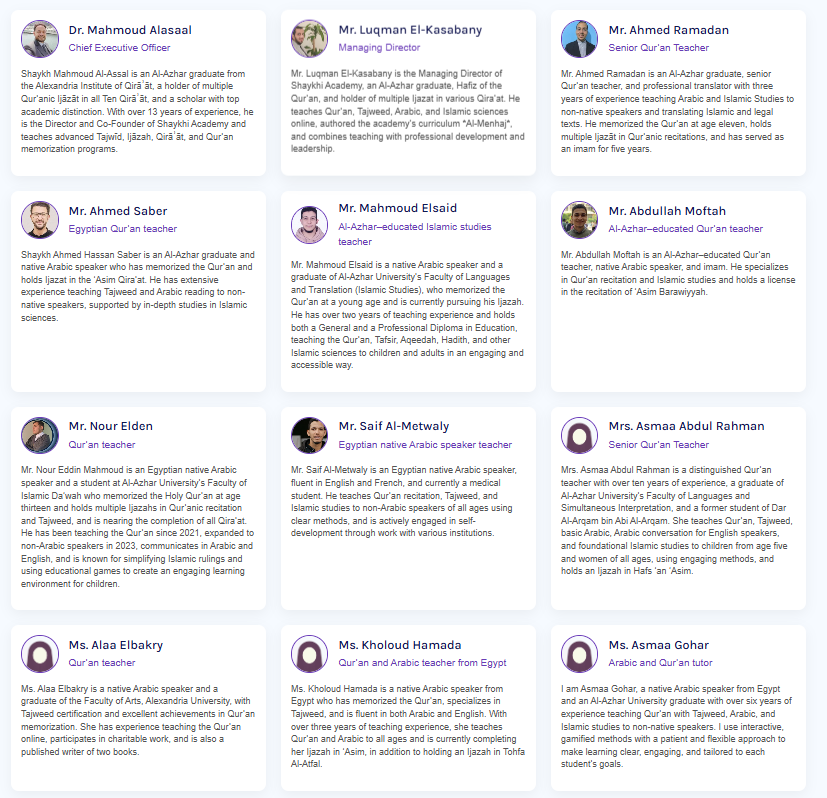
Our Teachers
Day 2 Exercise: Write 5 sentences introducing yourself using what you have learned. Then say them aloud into a voice recorder and listen back.
Day 3: Learn Numbers, Dates, and Time Expressions
Day 3 introduces two vocabulary domains Learning numbers and time expressions is an important milestone for anyone following a plan on how to learn Arabic in 7 days. that carry enormous practical value for a beginner: numbers and time expressions. These are the building blocks of scheduling, shopping, travel, and basic conversation.
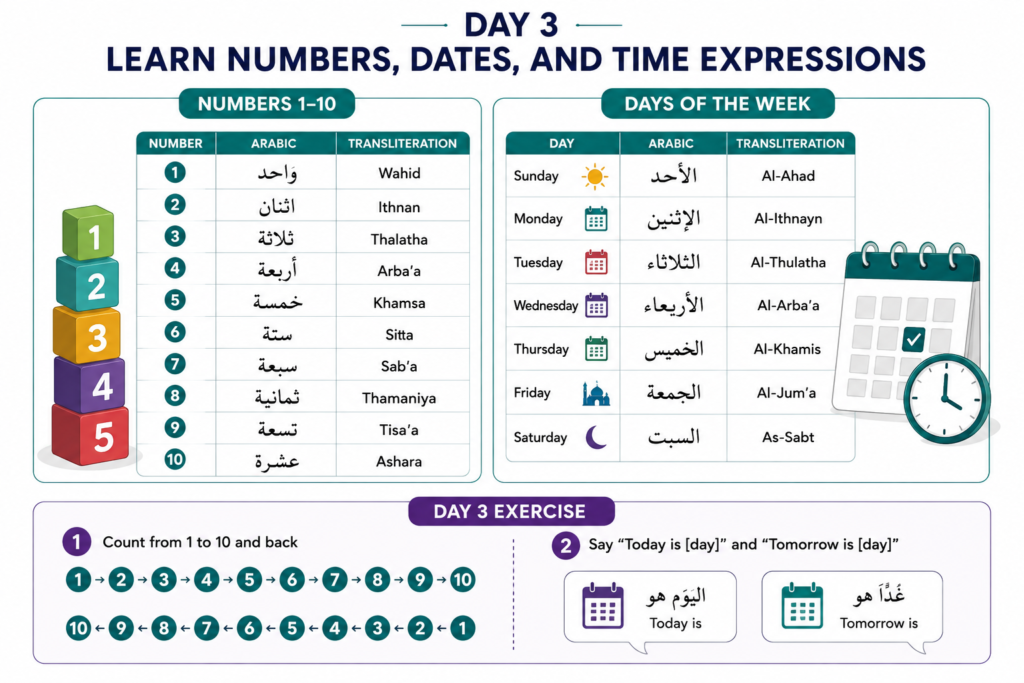
Numbers 1–10
Learning numbers is one of the fastest ways to start using Arabic in everyday situations. Begin with the numbers from 1 to 10, as they form the foundation for counting, telling time, shopping, and many common conversations.
| Number | Arabic | Transliteration |
| 1 | واحد | Wahid |
| 2 | اثنان | Ithnan |
| 3 | ثلاثة | Thalatha |
| 4 | أربعة | Arba’a |
| 5 | خمسة | Khamsa |
| 6 | ستة | Sitta |
| 7 | سبعة | Sab’a |
| 8 | ثمانية | Thamaniya |
| 9 | تسعة | Tisa’a |
| 10 | عشرة | Ashara |
Days of the Week
Once you’ve learned the basic numbers, move on to the days of the week. These words are used frequently when discussing schedules, appointments, travel plans, and everyday activities, making them essential vocabulary for beginners.
| Day | Arabic | Transliteration |
| Sunday | الأحد | Al-Ahad |
| Monday | الإثنين | Al-Ithnayn |
| Tuesday | الثلاثاء | Al-Thulatha |
| Wednesday | الأربعاء | Al-Arba’a |
| Thursday | الخميس | Al-Khamis |
| Friday | الجمعة | Al-Jum’a |
| Saturday | السبت | As-Sabt |
Day 3 Exercise: Practice counting from 1 to 10 and back. Then practice saying “Today is [day]” and “Tomorrow is [day]” for every day of the week.
Inside Our Classrooms
See how we make learning interactive and engaging! Watch a quick snippet of our live, conversational classes in action:
Day 4: Arabic Grammar Fundamentals — Pronouns and Sentence Structure
Arabic grammar has a reputation for being difficult — and in its full classical form, it is. But the foundational layer you need for basic communication is more accessible than most learners expect. Day 4 focuses on three building blocks: pronouns, basic verbs, and sentence structure.
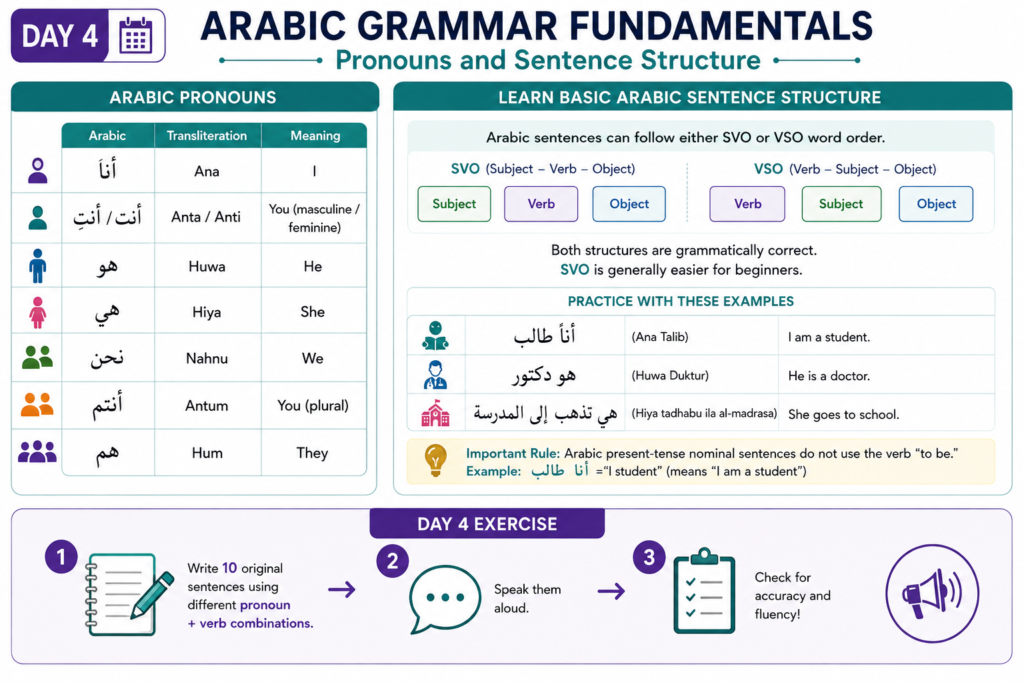
Arabic Pronouns
Start by learning the essential Arabic personal pronouns below. These words form the foundation of simple sentence building and everyday communication.
| Arabic | Transliteration | Meaning |
| أنا | Ana | I |
| أنتَ / أنتِ | Anta / Anti | You (masculine / feminine) |
| هو | Huwa | He |
| هي | Hiya | She |
| نحن | Nahnu | We |
| أنتم | Antum | You (plural) |
| هم | Hum | They |
Learn Basic Arabic Sentence Structure
Arabic sentences can follow either Subject–Verb–Object (SVO) or Verb–Subject–Object (VSO) word order. Both structures are grammatically correct, but SVO is generally easier for beginners because it follows a pattern similar to English.
Practice with these simple examples:
- أنا طالب (Ana Talib) — I am a student.
- هو دكتور (Huwa Duktur) — He is a doctor.
- هي تذهب إلى المدرسة (Hiya tadhabu ila al-madrasa) — She goes to school.
One important rule to remember is that Arabic present-tense nominal sentences do not use the verb “to be.” For example, أنا طالب literally means “I student,” yet it is the correct way to say “I am a student.” Understanding this concept early will make reading and building Arabic sentences much easier.
Day 4 Exercise: Write 10 original sentences using different pronoun + verb combinations, then speak them aloud.
Day 5: Build Your First 100–150 Arabic Words
Vocabulary is the fuel of communication. A strong vocabulary is one of the biggest factors in how to learn Arabic in 7 days successfully, as it supports reading, listening, and speaking from the very beginning. Without it, grammar is an engine with nothing to run on. Day 5 builds the word bank that will make your listening, speaking, and reading practice on Days 6 and 7 actually productive.
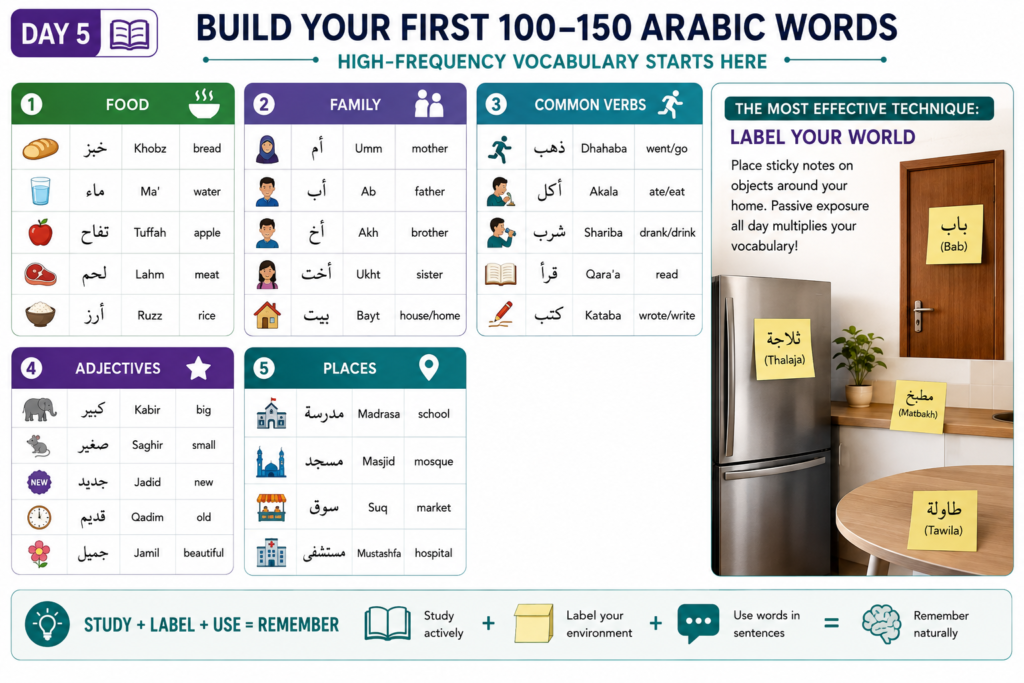
Focus vocabulary learning on five high-frequency domains:
Food: خبز (Khobz – bread), ماء (Ma’ – water), تفاح (Tuffah – apple), لحم (Lahm – meat), أرز (Ruzz – rice)
Family: أم (Umm – mother), أب (Ab – father), أخ (Akh – brother), أخت (Ukht – sister), بيت (Bayt – house/home)
Common verbs: ذهب (Dhahaba – went/go), أكل (Akala – ate/eat), شرب (Shariba – drank/drink), قرأ (Qara’a – read), كتب (Kataba – wrote/write)
Adjectives: كبير (Kabir – big), صغير (Saghir – small), جديد (Jadid – new), قديم (Qadim – old), جميل (Jamil – beautiful)
Places: مدرسة (Madrasa – school), مسجد (Masjid – mosque), سوق (Suq – market), مستشفى (Mustashfa – hospital)
The most effective technique for this volume of vocabulary in a single day is not reading lists — it is labelling. Place sticky notes on objects around your home. Every time you see your kitchen door, you see “باب.” Every time you open the fridge, you see “ثلاجة.” Passive exposure throughout the day multiplies the effect of active study sessions.
Structured Arabic courses for adults are built precisely around vocabulary sequencing — introducing words in the order that makes them immediately usable, not alphabetically or randomly.
Start Your Arabic Classes for Adults with a Free Trial

Day 5 Exercise: Create flashcards (physical or digital) for all 100–150 words. Drill them using a spaced repetition cycle: see, cover, recall, check.
Day 6: Listening and Speaking Practice
Day 6 shifts from input to application. Your ear needs to adjust to Arabic before your brain can process it efficiently, and your mouth needs to start producing the language — because the muscles involved in Arabic pronunciation require training that only speaking provides.
A. Active Listening (60–90 Minutes)
Listen to short Arabic audio clips designed for beginners, such as children’s content, beginner podcasts, or simple YouTube lessons. Focus on identifying the words and phrases you already know, then replay the audio to see how much more you can understand each time.
B. Speaking Practice (45–60 Minutes)
Arrange a 30-minute session with a native Arabic speaker, tutor, or language exchange partner. Use only what you have learned in Days 1–5. The constraint is intentional: it forces you to construct meaning from a limited toolkit, which builds the improvisational fluency that app-based learning cannot produce.
C. Passive Listening (1–2 Hours, Alongside Other Tasks)
Play Arabic audio in the background while cooking, exercising, or commuting. Your brain will begin to absorb Arabic prosody — its rhythm, stress patterns, and sound combinations — without conscious effort. This is not a substitute for active listening. It is a complement to it.
Day 7: Review Your Progress and Put Everything into Practice
The final day is about bringing together everything you’ve learned throughout the week. Instead of studying new material, focus on reviewing, practicing, and identifying the areas that still need improvement.
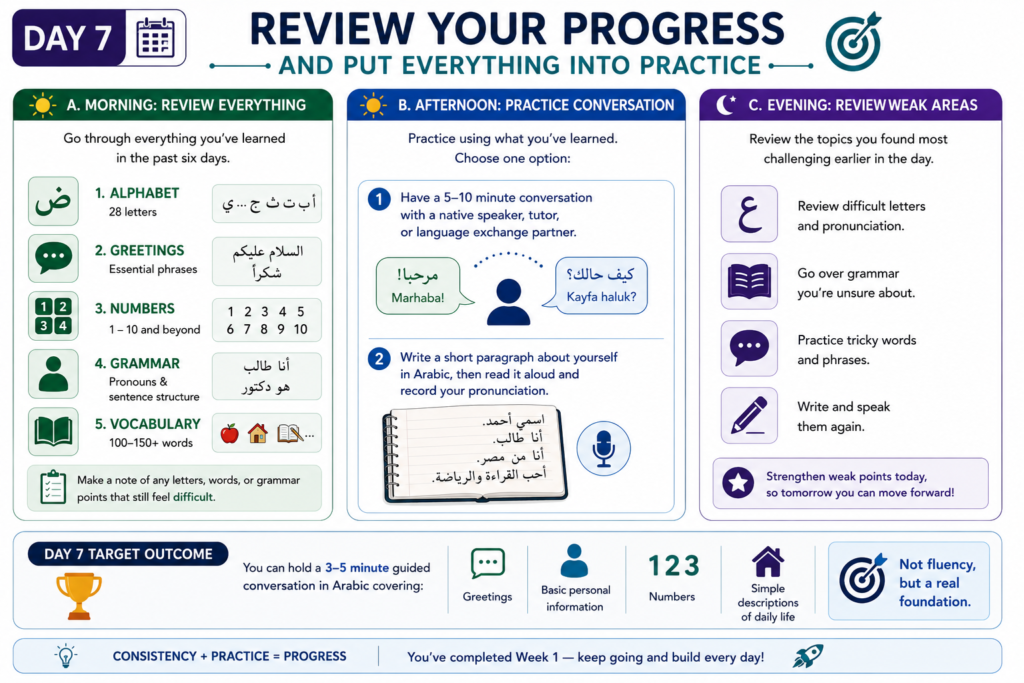
A. Morning: Review Everything You’ve Learned
Go through the alphabet, greetings, numbers, grammar, and vocabulary you’ve studied during the past six days. Make a note of any letters, words, or grammar points that still feel difficult so you can review them later.
B. Afternoon: Practice a Real Conversation
Have a 5–10 minute conversation with a native speaker, tutor, or language exchange partner using the vocabulary and grammar you’ve learned. If that’s not possible, write a short paragraph about yourself in Arabic, then read it aloud and record your pronunciation.
C. Evening: Review Your Weak Areas
Spend the final study session reviewing the topics you found most challenging earlier in the day. Strengthening weak points before moving on will help you retain what you’ve learned and prepare you for the next stage of your Arabic journey.
Day 7 target outcome: you can hold a 3–5 minute guided conversation in Arabic covering greetings, basic personal information, numbers, and simple descriptions of daily life. That is a genuine, measurable achievement — not fluency, but a real foundation.
What Can You Realistically Achieve in 7 Days?
Seven days of focused Arabic study can help you build a strong foundation, but it’s important to have realistic expectations. By the end of this plan, you should be able to recognize and write the Arabic alphabet, learn around 100–150 essential words, understand basic sentence structure, introduce yourself, ask simple questions, and develop an initial familiarity with Arabic pronunciation. Just as importantly, you’ll have established a consistent daily study habit that you can continue beyond the first week.
Many learners searching for how to learn Arabic in 7 days expect fluency, but building a strong foundation is the realistic and far more valuable outcome.
At the same time, don’t expect to become fluent in seven days. Reading newspapers, watching Arabic movies without difficulty, or mastering advanced grammar requires months of consistent practice. The purpose of this roadmap is not to achieve fluency in a week, but to give you the skills, confidence, and momentum needed to continue learning Arabic successfully.
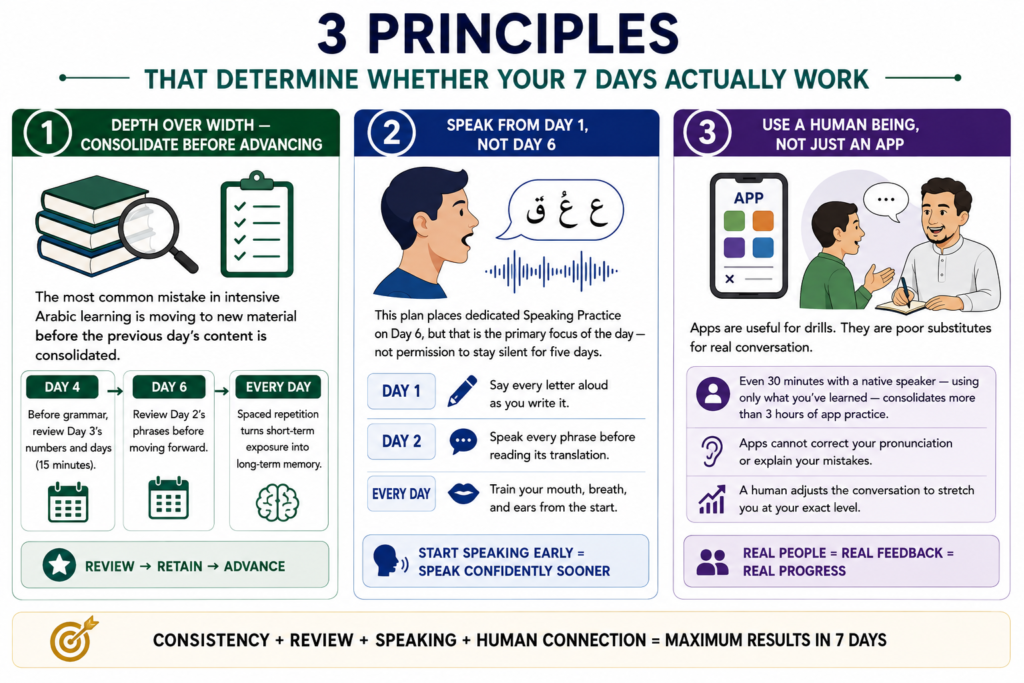
3 Principles That Determine Whether Your 7 Days Actually Work
After working with Arabic learners at various levels, three factors consistently separate those who make real progress in a short intensive period from those who don’t.
Read Also: How to Read Arabic Books?
1. Depth Over Width — Consolidate Before Advancing
The most common mistake in intensive Arabic learning is moving to new material before the previous day’s content is consolidated. On Day 4, before you start grammar, spend 15 minutes reviewing Day 3’s numbers and days. On Day 6, review Day 2’s phrases. Spaced repetition is not optional — it is the mechanism by which short-term exposure becomes long-term memory.
Read Also: How to Learn to Read Arabic Online for Free?
2. Speak From Day 1, Not Day 6
This plan places dedicated Speaking Practice on Day 6, but that is a label for the primary focus of the day — not permission to stay silent for five days. From Day 1, say every letter aloud as you write it. From Day 2, speak every phrase before reading its translation. The Arabic speaking apparatus — the muscles, breath, and coordination required for sounds like ع (ayn) and غ (ghayn) — needs time to develop. Give it time by starting immediately.
Read Also: How to Learn Arabic in One Month?
3. Use a Human Being, Not Just an App
Apps are useful for vocabulary drilling and alphabet recognition. They are poor substitutes for real conversation. Even a single 30-minute session with a native Arabic speaker — during which you use only what you have learned — will consolidate more than three hours of app-based practice. The reason is straightforward: apps cannot tell you why your pronunciation is wrong or adjust their sentence complexity to stretch you precisely at your current level. A teacher can.
Don’t Just Take Our Word For It
Take a look inside our vibrant classes and see our students and teachers in action. Click below to watch our classroom experience:
Start Learning Arabic with Expert Guidance
Seven days of honest, structured effort builds something real. But the learners who sustain that progress and reach genuine fluency are almost always those who pair independent study with structured, expert-led instruction.
Arabic Learning Centre’s Arabic course for adults is designed for exactly this transition: from motivated beginner to confident, progressing learner. Courses are led by qualified instructors who have taught non-native speakers at every level, with personalized progression plans that pick up wherever your 7-day foundation leaves off.
Courses We Offer:
- Quranic Arabic Course
- Arabic Course for Islamic Studies
- Learn Arabic for New Muslims
- Learn Arabic Letters for Tajweed
- Al Azhar Arabic Course
- Madinah Arabic Course
- Online Arabic Classes for Kids
- Arabic Words Course for Kids
- Arabic Lessons for Kindergarten
- Arabic Elementary School
- Arabic Intermediate School
- Arabic High School
[Book Your Free Trial Lesson →]

Conclusion
Ten hours of focused Arabic study over 7 days — spent on the right things, in the right order — will give you something genuinely valuable: a working alphabet, a starter vocabulary, basic grammatical intuition, and proof to yourself that Arabic is learnable.
That last part matters more than most learners expect. The greatest barrier to Arabic learning is not linguistic difficulty — it is the widespread belief that the language is impossibly hard. Seven days of honest, structured effort dismantles that belief permanently.
What you do on Day 8 determines everything that follows. Keep the daily habit alive, even for just 20 minutes. Add structured learning through a levelled course. Find a conversation partner. The foundation built in 7 days will support everything you build on top of it — but only if you keep building.
FAQs About How to Learn Arabic in 7 Days
Can you really learn Arabic in 7 days?
Not to any level of fluency — but you can make meaningful, measurable progress. In 7 focused days, a beginner can realistically master the Arabic alphabet, learn 100–150 high-frequency words, understand basic sentence structure, and hold a simple guided conversation. Think of it as building the foundation, not reaching the destination.
How many hours a day do I need to follow this plan?
Aim for 2–3 hours of focused study per day, broken into sessions of 25–30 minutes with short breaks. Passive immersion — listening to Arabic while commuting or doing other tasks — can add another 1–2 hours without significant effort, and meaningfully accelerates ear training.
Which Arabic should I learn first — Modern Standard Arabic, a dialect, or Quranic Arabic?
For a 7-day foundation plan, Modern Standard Arabic (MSA) is the correct starting point. It provides the grammatical structure that transfers to both Quranic Arabic and most spoken dialects. If your specific goal is Quran comprehension, MSA grammar is nearly identical — with vocabulary differences addressable in later, more specialized study such as an Al-Azhar Arabic course.
What are the best free resources for a 7-day Arabic intensive?
The most effective free resources for this kind of intensive include: ArabicPod101 on YouTube (structured, level-appropriate lessons), Madinah Arabic Book 1 (free online — widely considered the best structured MSA entry point), Forvo.com (native pronunciation for any Arabic word), Anki (free spaced repetition flashcard app), and iTalki or equivalent for finding an affordable native tutor.
What should I do after the 7 days are finished?
The 7-day plan is a launchpad, not a destination. The most effective next step is structured enrollment in a levelled Arabic course that builds directly on your foundation — expanding vocabulary to 500+ words, introducing the Arabic root system (which unlocks entire word families rapidly), and establishing regular conversation practice with a native speaker. Consistent daily practice of even 20–30 minutes will produce more long-term progress than occasional intensive sessions.
Is it harder to learn Arabic than other languages?
Arabic is classified by the US Foreign Service Institute as a Category IV language — among the most challenging for native English speakers — requiring an estimated 2,200 classroom hours for professional proficiency. That number reflects full professional fluency, not basic communication. For practical conversational ability, the timeline is significantly shorter with consistent, structured study and qualified instruction.