 Learn Arabic
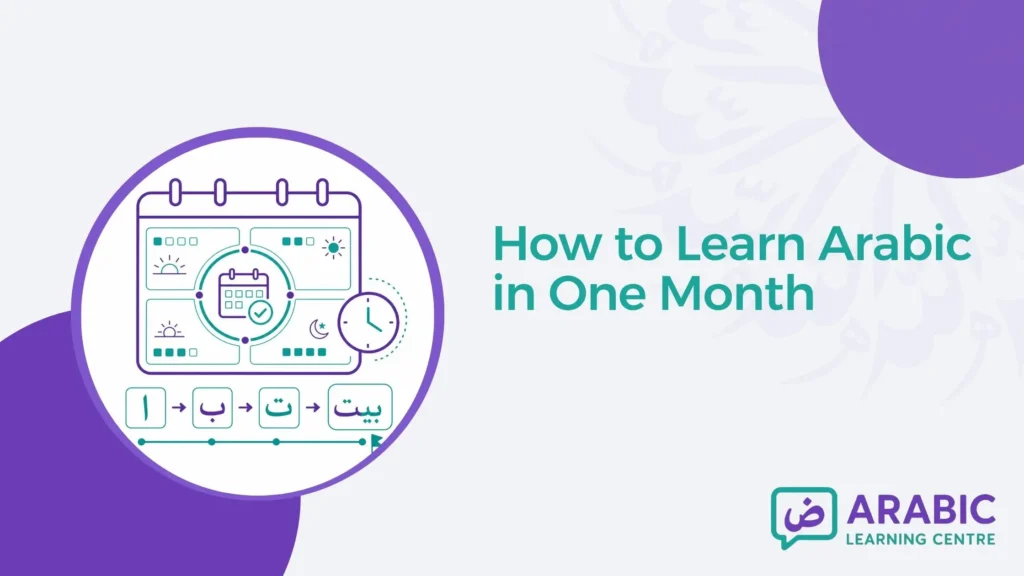
Learning Arabic in one month is possible — not fluency, but a real, working foundation. In 30 structured days, you can master all 28 letters, build 150–200 vocabulary words, grasp essential grammar, and hold a basic conversation. This step-by-step plan breaks that goal into four focused weekly phases so you know exactly what to do every single day.
Learning Arabic in one month works when you commit to a single principle: one skill at a time, in the right order. The four-week structure below is built on that principle — each week has a specific focus, and each day has a specific task. Jumping between topics without a sequence is the most common reason beginners stall.
The plan requires 30–45 minutes of focused daily study. Consistency matters far more than session length. A learner who studies 30 minutes every day for 30 days will outpace someone who studies two hours on weekends.If you’re wondering how to learn Arabic in one month, this roadmap gives you a clear day-by-day plan to build the essential skills in a logical order.
1. Master the Arabic Alphabet and Basic Expressions (Days 1–7)
The first week has one job: make the Arabic script readable. Without this, every subsequent step becomes harder. Do not rush past it.
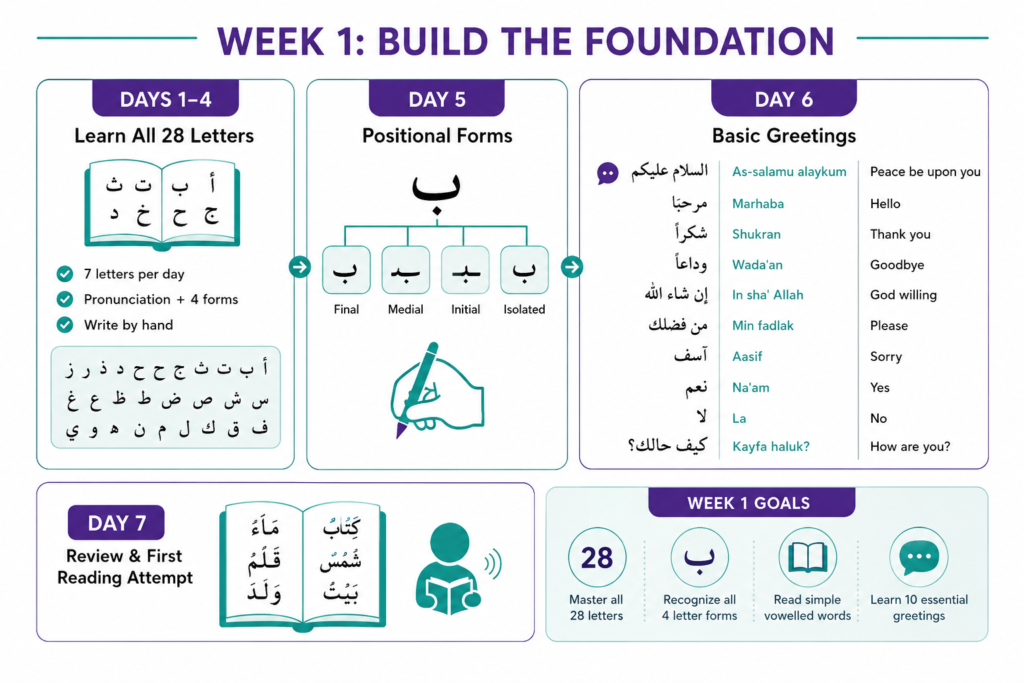
Days 1–4: Learn All 28 Letters
Arabic has 28 letters, written right to left. Each letter changes shape depending on its position in a word — isolated, initial, medial, or final. Work through seven letters per day:
- Days 1–4 cover the full alphabet in four daily sessions
- Focus on recognition, pronunciation, and the four positional forms
- Write each letter by hand — kinesthetic practice accelerates retention
The letters in order: أ ب ت ث ج ح خ د ذ ر ز س ش ص ض ط ظ ع غ ف ق ك ل م ن ه و ي
The most common beginner mistake at this stage is treating Arabic letters as decorative shapes to memorize rather than sounds to pronounce. Link each letter to its sound from Day 1 — connected script will become readable far faster.
Days 5–6: Positional Forms and Basic Greetings
On Day 5, write every letter in all four positions. This single exercise is worth more than three extra days of passive reading, because it forces you to recognize connected Arabic text — the form in which you will encounter almost everything.
On Day 6, learn 10 essential greetings:
| Arabic | Pronunciation | Meaning |
| السلام عليكم | As-salamu alaykum | Peace be upon you |
| مرحبا | Marhaba | Hello |
| شكراً | Shukran | Thank you |
| وداعاً | Wada’an | Goodbye |
| إن شاء الله | In sha’ Allah | God willing |
| من فضلك | Min fadlak | Please |
| آسف | Aasif | Sorry |
| نعم | Na’am | Yes |
| لا | La | No |
| كيف حالك؟ | Kayfa haluk? | How are you? |
Day 7: Review and First Reading Attempt
Read simple vowelled Arabic words aloud. If you can recognize all 28 letters in connected text, Week 1 is complete.
Week 1 Goals
By the end of Week 1, you should have a strong foundation in the Arabic alphabet and be ready to begin reading simple words. Aim to achieve the following milestones:
- Master all 28 Arabic letters.
- Recognize all four letter forms (isolated, initial, medial, and final).
- Read simple vowelled Arabic words.
- Learn 10 essential Arabic greetings and everyday phrases.
Anyone searching for how to learn Arabic in one month should master these foundations before moving on to grammar and conversation practice.
If you want to move faster, an intensive Arabic course with structured daily sessions and a native instructor can compress what takes months of self-study into a matter of weeks.
Join Our Intensive Arabic Course with a Free Trial

2. Build Grammar and Vocabulary (Days 8–14)
Week 2 introduces the grammatical skeleton of Arabic. You are not trying to master grammar — you are building enough structure to construct simple, meaningful sentences.
A structured grammar and vocabulary routine is one of the most important parts of how to learn Arabic in one month successfully.
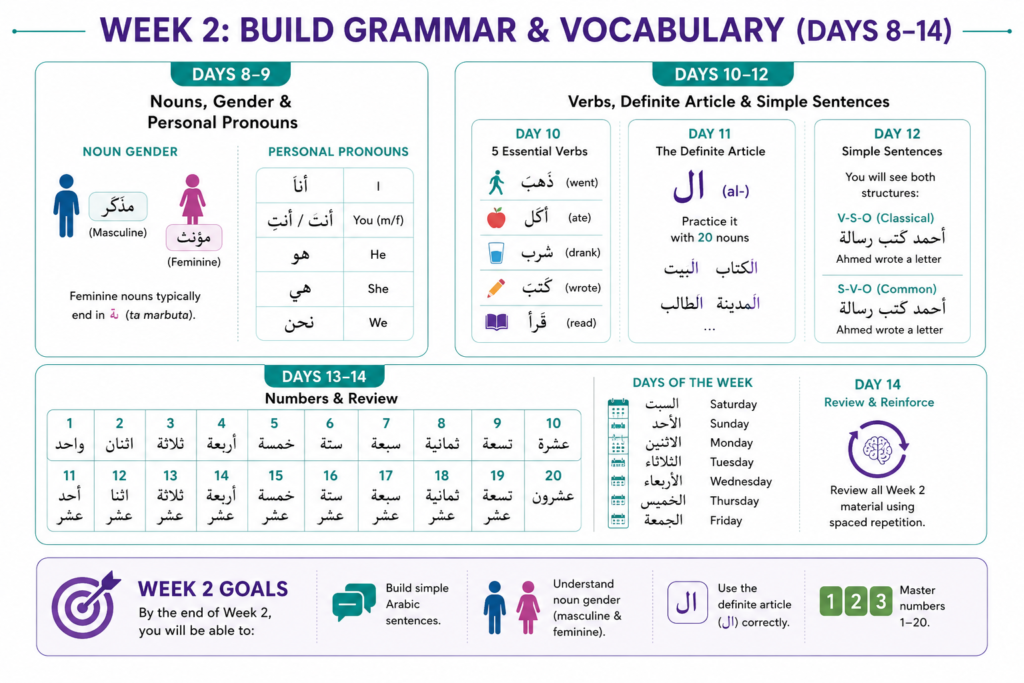
Days 8–9: Nouns, Gender, and Personal Pronouns
Arabic nouns are either masculine or feminine — there is no neutral gender. Feminine nouns typically end in ـة (ta marbuta). Learning this rule on Day 8 prevents a confusion that most self-study learners carry for months.
Personal pronouns on Day 9:
| Arabic | Meaning |
| أنا | I |
| أنتَ / أنتِ | You (m/f) |
| هو | He |
| هي | She |
| نحن | We |
Days 10–12: Verbs, the Definite Article, and Simple Sentences
Learn five essential verbs on Day 10: ذهب (went), أكل (ate), شرب (drank), كتب (wrote), قرأ (read). These five roots will appear in almost every exercise you encounter at beginner level.
Day 11 covers the definite article ال (al-). Practice it with 20 nouns. Arabic basic sentence structure is Verb-Subject-Object in classical use, though Subject-Verb-Object is common in spoken Modern Standard Arabic — both are correct, and you will encounter both.
By Day 12, you should be constructing simple sentences: “Ahmad wrote a letter” / أحمد كتب رسالة.
Days 13–14: Numbers and Review
Learn numbers 1–20 and the seven days of the week. Numbers are essential for shopping, time-telling, and dates — three categories that dominate Week 3. Spend Day 14 reviewing all Week 2 material using spaced repetition.
Week 2 Goals
By the end of Week 2, you should have a solid understanding of the building blocks needed to form simple Arabic sentences. Aim to achieve the following milestones before moving on to Week 3:
- Build simple Arabic sentences.
- Understand noun gender (masculine and feminine).
- Use the definite article (ال) correctly.
- Master numbers 1–20.
Inside Our Classrooms
See how we make learning interactive and engaging! Watch a quick snippet of our live, conversational classes in action:
3. Practice Practical Conversations (Days 15–21)
Week 3 is where the language becomes usable. Every day focuses on a real-world situation you will encounter as an Arabic speaker.
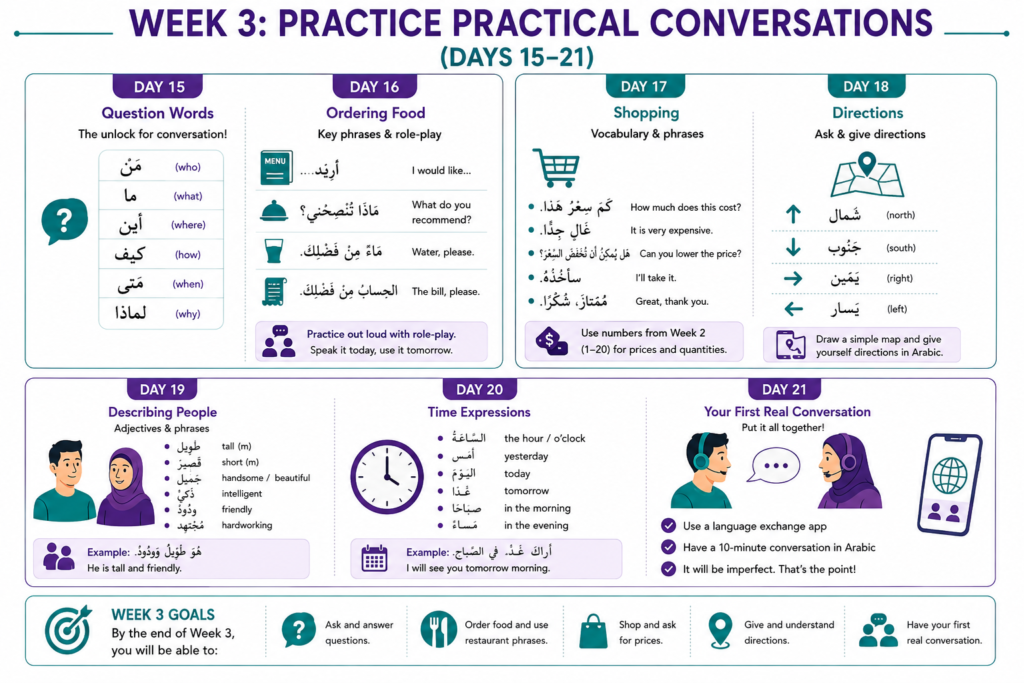
Days 15–16: Question Words and Ordering Food
Question words are the unlock for conversational Arabic. Learn all six on Day 15:
- من (who) · ما (what) · أين (where) · كيف (how) · متى (when) · لماذا (why)
Day 16 covers food and restaurant vocabulary — menu items, ordering phrases, asking for the bill. Pair each phrase with a short role-play exercise. Saying a phrase aloud, even alone, activates the neural pathways that make it retrievable in real conversation.
Days 17–18: Shopping and Directions
Shopping vocabulary builds directly on your Week 2 numbers. Practice prices, bargaining phrases, and “How much does this cost?” (كم سعر هذا؟).
Directions on Day 18: أين (where) + شمال (north) / جنوب (south) / يمين (right) / يسار (left). Draw a simple map and give yourself directions in Arabic — this exercise turns abstract vocabulary into spatial, memorable knowledge.
Days 19–21: Describing People, Time, and First Real Conversation
Days 19–20 cover adjectives for describing people and time expressions (الساعة, أمس, اليوم, غداً). Day 21 is your first live practice attempt — use a language exchange app for a 10-minute Arabic conversation. It will be imperfect. That is exactly the point.
Working with a female Arabic teacher at this stage provides real-time pronunciation correction that no app can replicate — particularly valuable for learners whose errors have not yet become habits.
Start Learning Arabic with a Female Arabic Teacher with a Free Trial
Week 3 Goals
By the end of Week 3, you should feel comfortable using Arabic in simple everyday situations. Use the following milestones to measure your progress before moving on to the final week:
- Learn 50 new vocabulary words.
- Master Arabic question words.
- Practice time expressions and adjective-noun agreement.
- Hold your first short Arabic conversation.
4. Apply Your Skills in Real-Life Situations (Days 22–30)
For learners who want to learn Arabic in one month online, this stage focuses on applying everything you’ve learned through authentic online content and daily practice. By Day 22, you have a vocabulary of 150+ words, a readable script, and basic grammar. Now you expose yourself to natural Arabic.
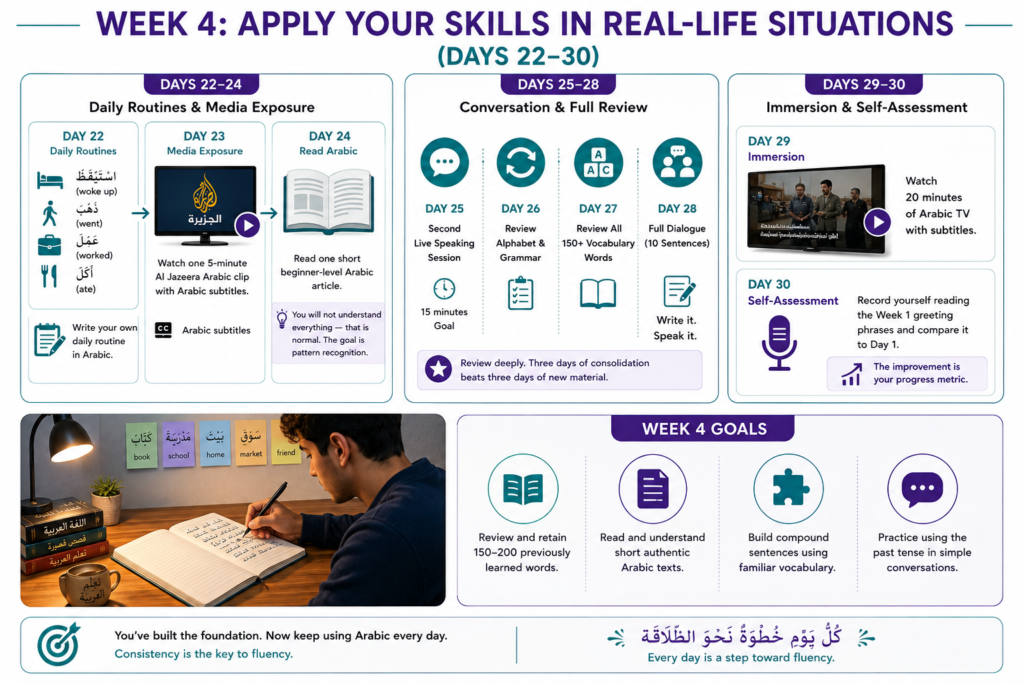
Days 22–24: Daily Routines and Media Exposure
Learn daily routine vocabulary on Day 22: اِسْتَيْقَظَ (woke up), ذَهَبَ (went), عَمِلَ (worked), أَكَلَ (ate). Write your own daily routine in Arabic — this exercise forces you to deploy everything you have learned in Week 4.
Days 23–24 introduce media exposure. Watch one 5-minute Al Jazeera Arabic clip with Arabic subtitles on Day 23. Read one short beginner-level Arabic article on Day 24. You will not understand everything — that is normal and expected at Day 24. The goal is pattern recognition, not comprehension.
Read Also: How to Learn Arabic in 7 Days?
Days 25–28: Conversation and Full Review
Day 25 is your second live speaking session — aim for 15 minutes. Days 26–28 are dedicated review: alphabet and grammar (Day 26), all 150+ vocabulary words (Day 27), and a full 10-sentence written and spoken dialogue (Day 28).
The review phase is where most self-study learners underinvest. Spending three days consolidating beats three days of new material at this stage — the goal is depth on what you know, not breadth of what you’ve skimmed.
Read Also: How to Read Arabic Books?
Days 29–30: Immersion and Self-Assessment
Day 29: watch 20 minutes of Arabic TV with subtitles. Day 30: record yourself reading the Week 1 greeting phrases and compare it to Day 1. The improvement is your progress metric.
Read Also: How to Learn to Read Arabic Online for Free?
Week 4 Goals
By the end of the final week, you should be able to apply everything you’ve learned with greater confidence. Aim to achieve the following goals:
- Review and retain 150–200 previously learned words.
- Read and understand short authentic Arabic texts.
- Build compound sentences using familiar vocabulary.
- Practice using the past tense in simple conversations.
Don’t Just Take Our Word For It
Take a look inside our vibrant classes and see our students and teachers in action. Click below to watch our classroom experience:
Continue Your Arabic Learning with Expert Guidance
This 30-day roadmap gives you a practical foundation to start learning Arabic with confidence. As your skills grow, personalized feedback and a structured curriculum can help you overcome challenges more quickly, improve your pronunciation, and build stronger speaking, reading, and writing skills.
At Arabic Learning Centre, our one-to-one online Arabic courses are designed for learners at every level, from complete beginners to advanced students. With experienced native teachers, personalized lesson plans, and flexible scheduling, you’ll receive the guidance and support needed to continue making steady progress beyond your first 30 days.
Even if your goal is to learn Arabic in one month free, following a structured study plan first will help you build a solid foundation before deciding whether you need additional guidance from a teacher.
Courses We Offer:
- Business Arabic Course
- Learn Arabic from Zero
- Medical Arabic Course
- Learning Arabic for Non Arabic Speakers
- Learn Arabic in Saudi Arabia
- Learn to Read Arabic Course
- Arabic Grammar Course
- Arabic Speaking Course
- Arabic Script writing course
- Arabic Vocabulary Course
- Arabic Pronunciation Course
Explore our online Arabic courses and book your free trial lesson to take the next step in your learning journey.

Conclusion
If you’re wondering how to learn Arabic in one month, the answer is to follow the right sequence: alphabet first, then grammar, practical conversation, and finally immersion and review: alphabet first, then grammar, then practical conversation, then immersion and review. The four steps in this article give you a day-by-day path from zero to a working foundation — 28 letters, 150–200 vocabulary words, essential grammar, and real conversational practice.
Day 30 is not the finish line. It is the starting line for real Arabic progress. The habit and foundation built in 30 days are what intermediate and advanced fluency are built on — and with consistent daily practice and the right instruction, that progress compounds quickly.
Whether you searched for how to learn Arabic in 30 days or learning Arabic in one month, the habits you build during these four weeks will determine how quickly you continue progressing after the first month.
Frequently Asked Questions
Before you begin, here are answers to some of the most common questions about learning Arabic in one month.
Can I really learn Arabic in one month?
You can learn the foundations of Arabic in one month: all 28 letters with positional forms, essential phrases and greetings, basic grammar including gender and definite article, numbers, days of the week, and approximately 150–200 vocabulary words. Fluency takes years of consistent study. A motivated beginner who follows the four-step plan in this article will be able to read simple vowelled Arabic text, use basic phrases in conversation, and have a solid base to continue from.
How many hours per day do I need to learn Arabic in one month?
The plan requires 30–45 minutes of focused daily study, structured as 15 minutes of new learning, 10 minutes of review using spaced repetition, and 5–15 minutes of speaking or writing practice. If you can invest 60 minutes daily you will reach further by Day 30. Consistency matters more than session length — a 30-minute daily habit is more effective than occasional two-hour sessions.
How can I learn Arabic in one month online for free?
Free resources that support this plan include ArabicPod101 (alphabet series), Language Transfer Arabic (grammar audio), the Madinah Arabic Reader app, Anki (flashcards for vocabulary review), and HelloTalk (language exchange for speaking practice). These free tools cover all four weeks of the plan above. A structured course with a live instructor accelerates progress significantly, but the self-study path is fully achievable with free resources.
What type of Arabic should I learn in the first 30 days?
Modern Standard Arabic (MSA) is the recommended starting point for a 30-day foundation plan. MSA provides the grammatical framework that transfers directly to both Quranic Arabic and any spoken dialect. Learners who start with a dialect in the first 30 days typically pick up conversational phrases without the grammatical foundation that makes intermediate Arabic learnable. After Day 30, you can move into Egyptian, Levantine, Gulf, or Quranic Arabic based on your goals.
What should I do after the 30 days?
Continue Anki vocabulary reviews daily (15 minutes), work through a structured curriculum such as Madinah Arabic Book 1 or Language Transfer, begin regular speaking practice two to three times per week, and consider enrolling in a structured course with a native teacher. The first 30 days build the habit and foundation. The months that follow build the fluency.
Is it better to learn Arabic alone or with a teacher?
Both work, but they produce different results at different speeds. Self-study with a good plan is viable — the four steps in this article are designed for independent learners. A qualified teacher, however, identifies pronunciation errors and grammar misconceptions before they become habits, adapts lessons to your specific gaps, and provides accountability that keeps the daily commitment on track. Most learners who combine the self-study plan with instructor guidance progress significantly faster than those who use either approach alone.