 Arabic Vocabulary & Speaking
Most Arabic learners can handle vocabulary and grammar until a date shows up in a sentence. Then they read it in English in their head and hope nobody notices. If you want to know how to read Arabic dates properly, the good news is that the system is more consistent than English — once you see the pattern, it never changes.
This guide breaks down how to read Arabic dates in eight clear steps: the writing format, the number system, the days of the week, the three calendar systems in use across the Arab world, and how to combine everything into one full spoken date. Each step builds on the last, so by the end you’ll be able to read any date you come across, in any Arabic-speaking country.
1. Understand the Arabic Date Format
Arabic dates are written in day/month/year order, the same format used in most of the world outside North America. February 15, 2025 is written as 15/2/2025 — no rearranging needed when you move from the written date to reading it aloud.
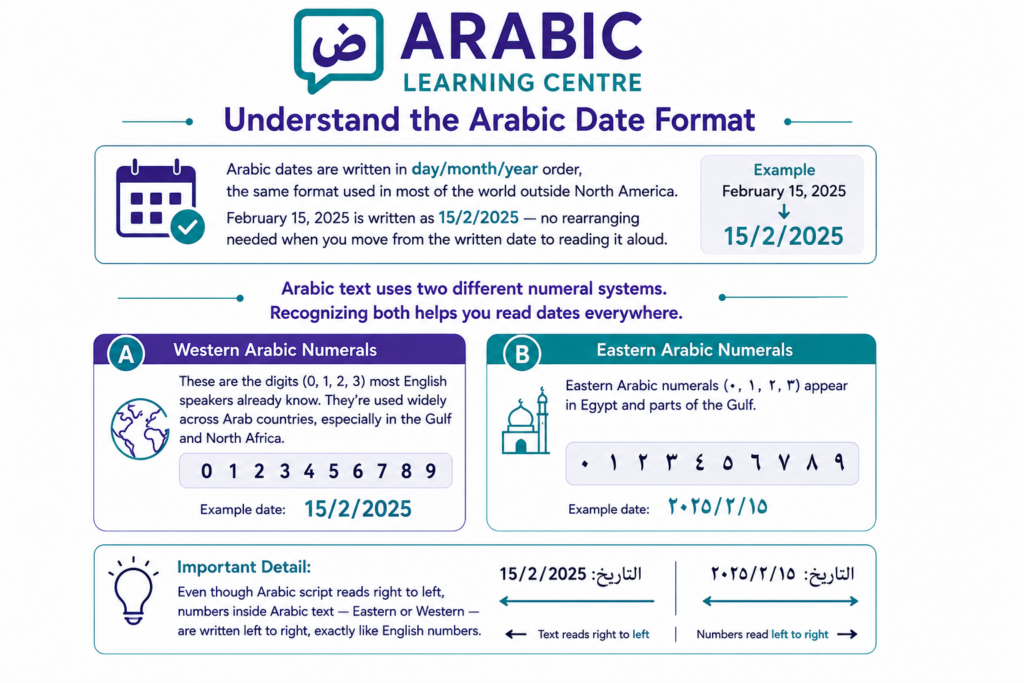
Arabic text uses two different numeral systems, and recognizing both matters if you want to read Arabic dates in English contexts as well as Arabic ones.
A. Western Arabic Numerals
These are the digits (0, 1, 2, 3) most English speakers already know. They’re used widely across Arab countries, especially in the Gulf and North Africa.
B. Eastern Arabic Numerals
Eastern Arabic numerals (٠، ١، ٢، ٣) appear in Egypt and parts of the Gulf. The same date above would read ٢٠٢٥/٢/١٥. One detail that trips up beginners: even though Arabic script reads right to left, numbers inside Arabic text — Eastern or Western — are written left to right, exactly like English numbers.
Getting comfortable with the writing system first makes every later step easier, because you’re no longer decoding symbols while also trying to work out grammar. Structured lessons in Arabic writing build this recognition early, so numerals and letters stop competing for attention.
Begin Your Arabic Script Writing Journey with a Free Trial

2. Learn Ordinal Numbers for Reading Day Values
Arabic dates use ordinal numbers — “the first,” “the third,” “the fifteenth” — rather than plain counting numbers. This is one of the most common places people get stuck when learning how to read Arabic dates in English translation, because English sometimes uses cardinals instead (“May 17” instead of “the seventeenth of May”).
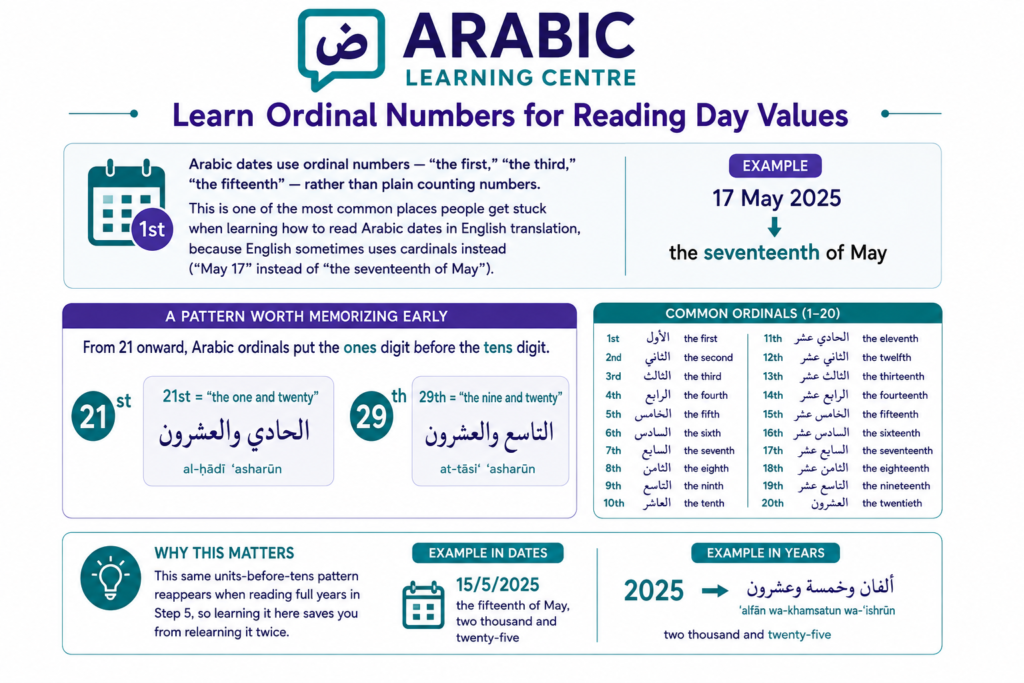
A pattern worth memorizing early: from 21 onward, Arabic ordinals put the ones digit before the tens digit.
- 21st = “the one and twenty” (الحادي والعشرون)
- 29th = “the nine and twenty” (التاسع والعشرون)
This same units-before-tens pattern reappears when reading full years in Step 5, so learning it here saves you from relearning it twice.
3. Learn the Arabic Days of the Week
The Arabic week starts on Sunday. The first five days follow a simple numbering logic, while Friday and Saturday carry their own distinct names.
| Day | Arabic | Meaning |
| Sunday | الأحد | “the first” |
| Monday | الاثنين | “the second” |
| Tuesday | الثلاثاء | “the third” |
| Wednesday | الأربعاء | “the fourth” |
| Thursday | الخميس | “the fifth” |
| Friday | الجمعة | day of gathering |
| Saturday | السبت | rest |
الجمعة (al-jumuʿah) refers to the Friday congregational prayer, and السبت (al-sabt) shares a root with the English word “sabbath.” Weekend days differ by country: most Arab countries observe Friday–Saturday as the weekend, while some Muslim-majority countries use Saturday–Sunday. The phrase نهاية الأسبوع (nihāyatu al-usbūʿ) means “the weekend,” but which two days it covers depends on where you are.
Inside Our Classrooms
See how we make learning interactive and engaging! Watch a quick snippet of our live, conversational classes in action:
4. Use Dates in Everyday Arabic Conversation
Reading a date correctly is different from using it naturally in conversation. These phrases cover the situations that come up most often.
| Situation | Arabic | Meaning |
| Asking today’s date | ما هو تاريخ اليوم؟ | What is today’s date? |
| Stating today’s date | اليوم هو الثالث والعشرون من فبراير | Today is February 23 |
| Talking about next Tuesday | هل يمكننا اللقاء يوم الثلاثاء المقبل؟ | Can we meet next Tuesday? |
| Talking about last month | ذهبت إلى روما الشهر الماضي | I went to Rome last month |
| Asking about Ramadan’s start | في أي يوم يبدأ رمضان هذه السنة؟ | What day does Ramadan start this year? |
Two words worth memorizing on their own: المقبل (al-muqbil, “upcoming/next”) and الماضي (al-māḍī, “past/previous”). Both attach after the noun they modify, which is why “next Tuesday” is يوم الثلاثاء المقبل rather than المقبل يوم الثلاثاء.
One more distinction that trips learners up: تاريخ (tārīkh) means both “date” and “history,” while تمر (tamr) is the sweet fruit eaten during Ramadan. Context always makes clear which one is meant, but it’s worth knowing they’re unrelated words that happen to sound similar to a beginner’s ear. Building this kind of conversational vocabulary — asking about dates, scheduling, talking about “last week” versus “next month” — is core material in speaking-focused Arabic classes, since dates come up constantly in real conversation, not just in reading exercises.
Build Confidence in Speaking Arabic with a Free Trial

5. Read Arabic Years Using the Units-Before-Tens Pattern
Arabic years are read as one connected number, moving from thousands to hundreds to tens and units, joined by و (wa, “and”).
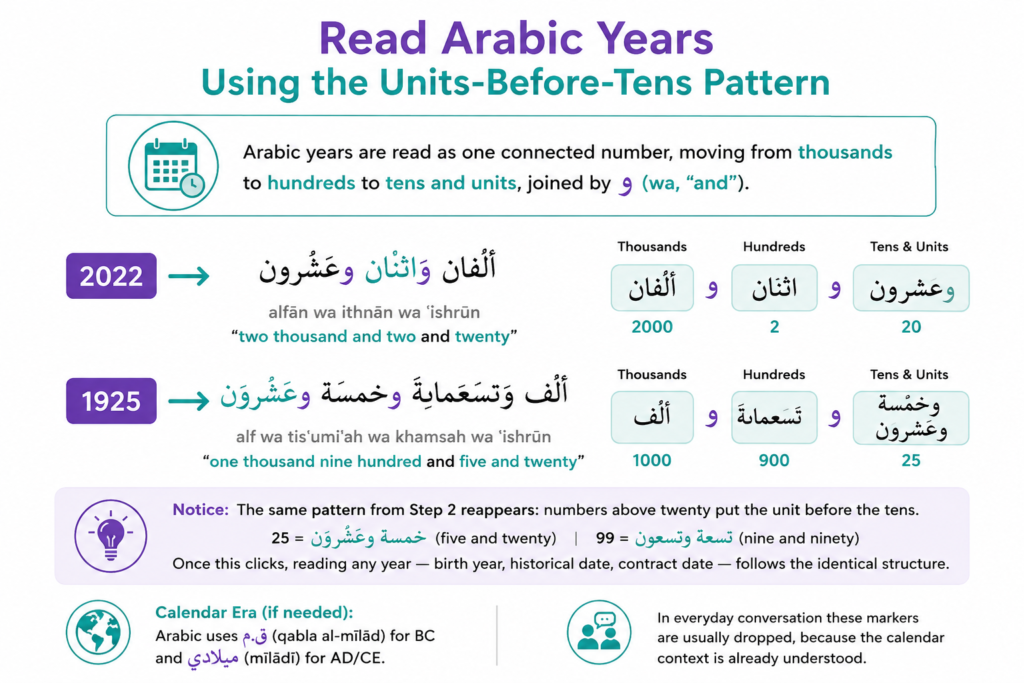
- 2022 → ألفان واثنان وعشرون (alfān wa ithnān wa ʿishrūn) = “two thousand and two and twenty”
- 1925 → ألف وتسعمائة وخمسة وعشرون (alf wa tisʿumiʾah wa khamsah wa ʿishrūn) = “one thousand nine hundred and five and twenty”
Notice the same pattern from Step 2 reappears: numbers above twenty put the unit before the tens (25 = خمسة وعشرون, “five and twenty”; 99 = تسعة وتسعون, “nine and ninety”). Once this clicks, reading any year — birth year, historical date, contract date — follows the identical structure.
If you need to mark the calendar era explicitly, Arabic uses ق.
م (qabla al-mīlād) for BC and ميلادي (mīlādī) for AD/CE. In everyday conversation these markers are usually dropped, because the calendar context is already understood from the setting.
6. Combine Day, Month, and Year Into One Full Date
This is where reading Arabic dates in English actually becomes easier than English itself.
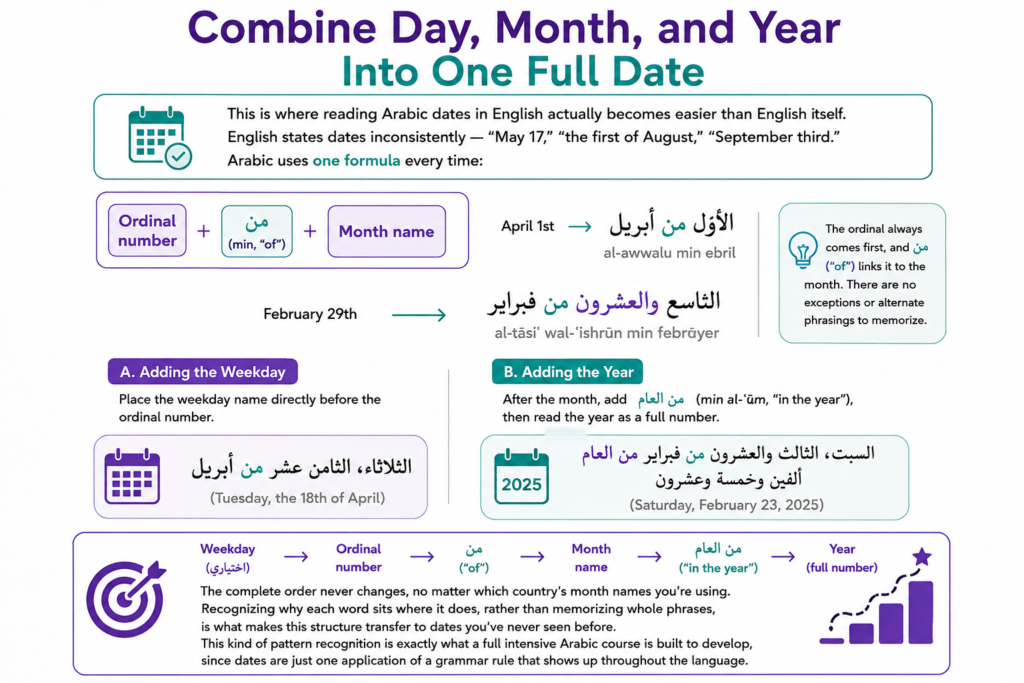
English states dates inconsistently — “May 17,” “the first of August,” “September third.” Arabic uses one formula every time:
[Ordinal number] + من (min) + [month name]
- April 1st → الأول من أبريل (al-awwalu min ebrīl)
- February 29th → التاسع والعشرون من فبراير (al-tāsiʿ wal-ʿishrūn min febrāyer)
The ordinal always comes first, and من (“of”) links it to the month. There are no exceptions or alternate phrasings to memorize.
A. Adding the Weekday
Place the weekday name directly before the ordinal number: الثلاثاء، الثامن عشر من أبريل (Tuesday, the 18th of April).
B. Adding the Year
After the month, add من العام (min al-ʿām, “in the year”), then read the year as a full number: السبت، الثالث والعشرون من فبراير من العام ألفين وخمسة وعشرون (Saturday, February 23, 2025).
The complete order — weekday → ordinal → من → month → من العام → year — never changes, no matter which country’s month names you’re using. Recognizing why each word sits where it does, rather than memorizing whole phrases, is what makes this structure transfer to dates you’ve never seen before. This kind of pattern recognition is exactly what a full intensive Arabic course is built to develop, since dates are just one application of a grammar rule that shows up throughout the language.
Start Your Intensive Arabic Course with a Free Trial

7. Identify Which Calendar System Is Being Used
Before you can read an Arabic date correctly, you need to know which of three systems it belongs to — this is a step most guides on how to read Arabic dates skip, and it’s the reason learners get confused reading dates from different countries.
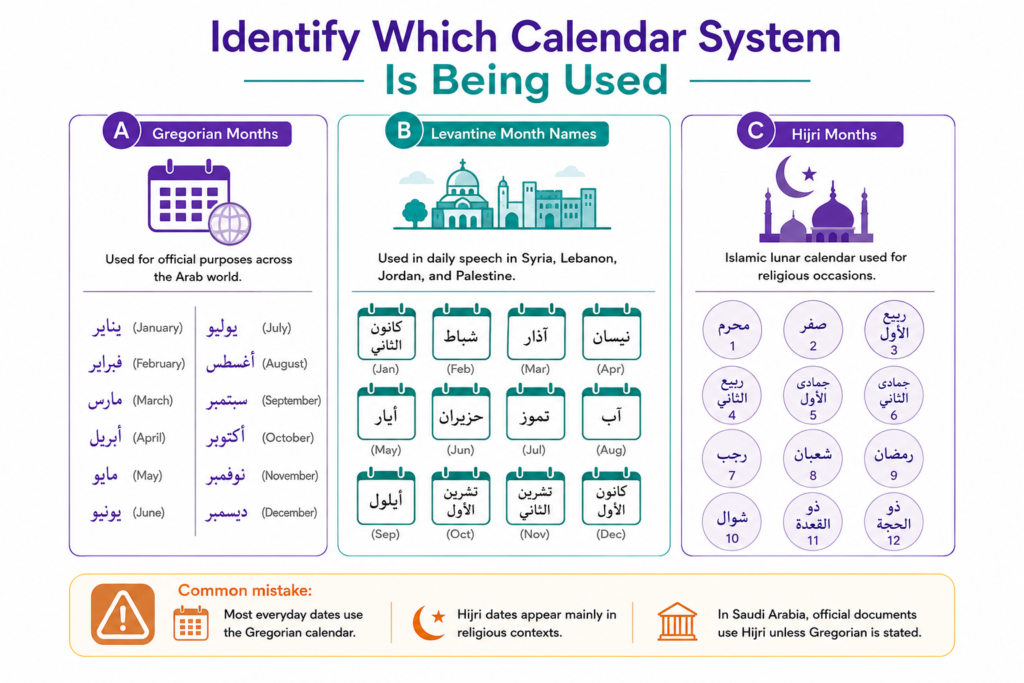
A. Gregorian Months
Used for official purposes across the Arab world. Names are close transliterations of the English months: يناير (January), فبراير (February), مارس (March), and so on through ديسمبر (December).
B. Levantine Month Names
Syria, Lebanon, Jordan, and Palestine often use Aramaic-derived names in daily speech instead of the Gregorian transliterations: كانون الثاني (January), شباط (February), آذار (March), نيسان (April), أيار (May), حزيران (June), تموز (July), آب (August), أيلول (September), تشرين الأول (October), تشرين الثاني (November), كانون الأول (December). These refer to the exact same Gregorian months — only the vocabulary changes.
Read Also: How to Read Arabic Calligraphy
C. Hijri Months
The Islamic calendar is lunar, used for religious occasions such as Ramadan, Eid, and Hajj, and it does not line up with Gregorian months on a fixed schedule — each Hijri year is roughly 11 days shorter than a solar year, so the same Hijri date shifts earlier each Gregorian year. The twelve months are محرم، صفر، ربيع الأول، ربيع الثاني، جمادى الأول، جمادى الثاني، رجب، شعبان، رمضان، شوال، ذو القعدة، and ذو الحجة.
Common mistake: assuming every Arabic date you see uses the Hijri calendar because it’s the “Islamic” one. In practice, most day-to-day written material — newspapers, invoices, school schedules — uses the Gregorian calendar. Hijri dates show up mainly in religious contexts and, in Saudi Arabia, in official government documents unless the Gregorian calendar is explicitly stated.
Read Also: How to Read Arabic for Beginners?
8. Build Daily Habits That Make Dates Automatic
Rules only become fluency through repetition.
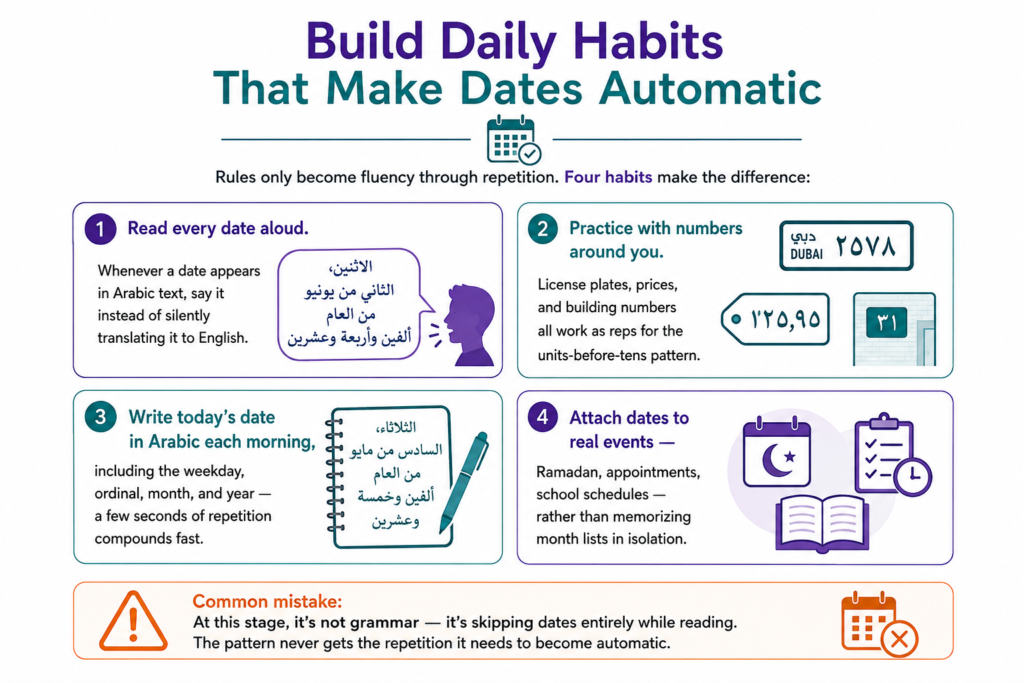
Four habits make the difference:
- Read every date aloud. Whenever a date appears in Arabic text, say it instead of silently translating it to English.
- Practice with numbers around you. License plates, prices, and building numbers all work as reps for the units-before-tens pattern.
- Write today’s date in Arabic each morning, including the weekday, ordinal, month, and year — a few seconds of repetition compounds fast.
- Attach dates to real events — Ramadan, appointments, school schedules — rather than memorizing month lists in isolation.
The most common mistake at this stage isn’t grammar — it’s skipping dates entirely while reading, which means the pattern never gets the repetition it needs to become automatic.
Read Also: How to Read Arabic Without Harakat?
Don’t Just Take Our Word For It
Take a look inside our vibrant classes and see our students and teachers in action. Click below to watch our classroom experience:
Start Reading Arabic Dates With Confidence
Reading a date without pausing to translate it is one of the clearest signs that Arabic has moved from something you study to something you actually use. Arabic Learning Centre’s courses are structured to take you from the alphabet through grammar, reading, and real conversation — the exact sequence that turns a rule like “ordinal + من + month” into something you read on sight.
Whether you’re starting from the basics or filling in a specific gap like dates and numbers, there’s a course level built for where you are.
Courses We Offer:
- Quranic Arabic Course
- Arabic Course for Islamic Studies
- Learn Arabic for New Muslims
- Learn Arabic Letters for Tajweed
- Al Azhar Arabic Course
- Madinah Arabic Course
- Online Arabic Classes for Kids
- Arabic Words Course for Kids
- Arabic Lessons for Kindergarten
- Arabic Elementary School
- Arabic Intermediate School
- Arabic High School

Conclusion
Learning how to read Arabic dates comes down to working through the sequence in order: understand the day/month/year written format, express day numbers as ordinals, learn the weekday names and where the week starts, identify which of the three calendar systems you’re looking at, apply the units-before-tens pattern to read years, combine everything with the fixed ordinal + من + month structure, and practice the phrases people actually use to talk about dates. The last step — daily repetition — is what turns that sequence into fluency.
Compared to English, Arabic dates are remarkably consistent. There’s one structure, it doesn’t change by context, and once it clicks, it applies to every date you’ll ever read — from a text message to a historical document.
Frequently Asked Questions
Learning how to read and say dates in Arabic can seem confusing at first, especially with different calendar systems, number patterns, and regional variations. Below are answers to some of the most common questions to help you understand Arabic dates with confidence.
What format are Arabic dates written in?
Arabic dates follow the day/month/year format. February 15, 2025 appears as 15/2/2025. Both Western Arabic (0, 1, 2) and Eastern Arabic (٠، ١، ٢) numerals are used across the Arab world, and both are written left to right within the date itself.
How do you say a day number when reading Arabic dates in English pronunciation?
Day numbers use ordinal forms — “the first,” “the third,” “the fifteenth.” From 21 onward, they follow the units-before-tens pattern: the 22nd is الثاني والعشرون (“the two and twenty”). The ordinal always comes before the month name, connected by من (min).
What is the fixed pattern for saying a full date in Arabic?
The pattern is weekday → ordinal number → من (min) → month → من العام (min al-ʿām) → year. The ordinal and month are the only required elements; everything else can be added or dropped, but the order never changes when they’re present.
What is the difference between the three Arabic calendar systems?
The Gregorian calendar uses transliterated month names (يناير، فبراير) and is the official civil calendar everywhere in the Arab world. The Levantine calendar uses Aramaic-derived names (شباط، آذار) for the same Gregorian months, common in Syria, Lebanon, Jordan, and Palestine. The Hijri calendar is a separate lunar system used for Islamic religious occasions and, in Saudi Arabia, official documents — its dates shift against the Gregorian calendar each year.
How do you say “next” or “last” when talking about dates in Arabic?
“Next” is المقبل (al-muqbil) and “last/previous” is الماضي (al-māḍī), both placed after the noun. “Next Tuesday” is يوم الثلاثاء المقبل. “Last month” is الشهر الماضي.
What day does the Arabic week start on, and how does that affect reading dates?
The Arabic week starts on Sunday — الأحد (al-aḥad), literally “the first.” Monday through Thursday continue as the second through fifth days, which is why their names are number-based rather than unique words. Friday (الجمعة) and Saturday (السبت) are the only two days with standalone names.
Related Articles
Arabic Vocabulary & Speaking