 Arabic Grammar
| Key Takeaways |
| Arabic object pronouns are suffixed directly onto verbs and prepositions, never written as separate words in classical grammar. |
| There are twelve Arabic object pronoun suffixes, varying by person, number, and gender, covering singular, dual, and plural forms. |
| Object pronouns in Arabic attach to the end of a verb and cause predictable phonological changes, particularly when the verb ends in a vowel. |
| Unlike English, Arabic object pronouns encode the gender of the person being spoken to or about, requiring learners to master masculine and feminine forms separately. |
Arabic object pronouns are suffixed pronouns attached to the end of a verb to indicate who receives the action. In Arabic grammar (Nahw), they are called ضَمَائِرُ النَّصْبِ وَالْجَرِّ الْمُتَّصِلَة (damā’ir al-naṣb wa-l-jarr al-muttaṣila) — the attached accusative and genitive pronouns.
They are identical in form to the possessive pronoun suffixes you may already know, but they function differently based on what they are attached to.
What Are Arabic Object Pronouns?
Arabic object pronouns are single-syllable suffixes that attach directly to a verb to show the direct object — the person or thing receiving the action. Unlike English, which places the object pronoun after the verb as a separate word (“he saw him“), Arabic fuses the pronoun onto the verb itself, producing a single combined word. For example, رَأَيْتُهُ (ra’aytuhu) means “I saw him,” with the object ـهُ (-hu) directly suffixed to the verb.
This fusion is a defining feature of Semitic language grammar, and it is consistent across all Arabic verb forms, tenses, and conjugations. Understanding it unlocks your ability to read and interpret Arabic sentences with confidence.
Arabic object pronouns belong to a broader family of ضَمَائِرٌ مُتَّصِلَة (damā’ir muttaṣila) — attached pronouns. If you have already studied Arabic possessive suffixes, you will recognize most of these forms, since the forms overlap significantly.
For a deeper look at the full family of attached pronouns in Arabic, see our guide on Arabic attached pronouns.
The Complete Table of Arabic Object Pronoun Suffixes
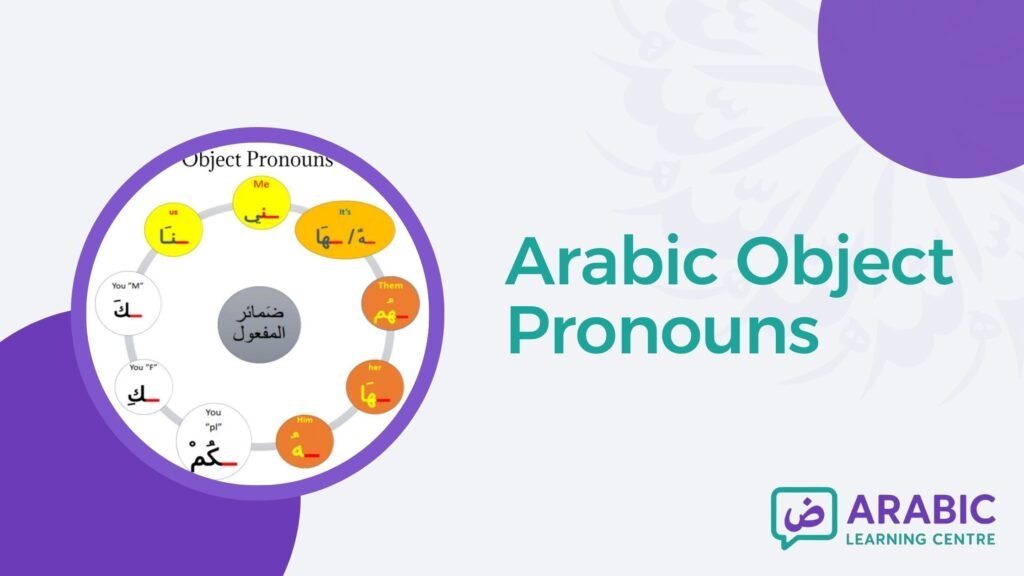
Arabic object pronouns cover twelve distinct forms, organized by person (first, second, third), number (singular, dual, plural), and gender (masculine, feminine). The table below presents each pronoun in its suffix form as it appears when attached to a verb.
| Person | Number | Gender | Arabic Suffix | Transliteration | Meaning |
| 1st | Singular | —— | ـنِي / ـِي | -nī / -ī | me |
| 1st | Plural | —— | ـنَا | -nā | us |
| 2nd | Singular | Masculine | ـكَ | -ka | you (m.) |
| 2nd | Singular | Feminine | ـكِ | -ki | you (f.) |
| 2nd | Dual | Masculine/Feminine | ـكُمَا | -kumā | you two |
| 2nd | Plural | Masculine | ـكُمْ | -kum | you (pl. m.) |
| 2nd | Plural | Feminine | ـكُنَّ | -kunna | you (pl. f.) |
| 3rd | Singular | Masculine | ـهُ | -hu | him / it (m.) |
| 3rd | Singular | Feminine | ـهَا | -hā | her / it (f.) |
| 3rd | Dual | Masculine/Feminine | ـهُمَا | -humā | them two |
| 3rd | Plural | Masculine | ـهُمْ | -hum | them (m.) |
| 3rd | Plural | Feminine | ـهُنَّ | -hunna | them (f.) |
This table is drawn directly from the classical Nahw tradition, consistent with foundational texts such as Al-Ajurrūmiyya and Qaṭr al-Nadā. These are the forms every Arabic grammar student must commit to memory.
If you are working on understanding conjugating verbs in Arabic, you will find that object pronoun attachment follows the same verb-stem logic you are already learning.
Shots Videos from Our Courses
How to Attach Arabic Object Pronouns to Verbs Correctly?
Attaching Arabic object pronouns to verbs follows a clear and regular system in the majority of cases. You take the conjugated verb, drop any final vowel change that would be affected, and add the pronoun suffix directly to the end. The verb’s original meaning and conjugation are preserved — only the object is added.
Let us take the verb كَتَبَ (kataba, “he wrote”) and the verb ضرب (daraba, “he hit”) and attach different object pronouns to it:
كَتَبَهُ
katabaahu
He wrote it (m.)
كَتَبَهَا
katabahā
He wrote it (f.)
ضربنِي
Darabanī
He hit me
ضربكَ
Darabaka
He hit you (m.)”
Notice that the verb stem كَتَبَ (kataba) and ضرب (daraba, “he hit”) remain unchanged. The suffix simply appends after the final consonant. This regularity makes the system very learnable with structured practice.
What Happens When the Verb Ends in a Long Vowel?
Some verb forms end in long vowels, which requires a small phonological adjustment. The first-person object pronoun ـنِي (-nī) is used instead of ـِي (-ī) when attaching to verbs — the nūn (نْ) acts as a buffer consonant (nūn al-wiqāya, نُونُ الْوِقَايَةِ) to protect the final vowel of the verb.
أَكَلَنِي
akalanī
He ate me (or, in non-literal contexts: “it consumed me”)
This nūn al-wiqāya is a well-documented rule in classical Arabic grammar and is non-negotiable in formal Arabic.
Students who skip this rule frequently produce malformed verb-pronoun combinations that no native speaker would accept as correct.
At The Arabic Learning Centre, our Arabic Grammar Course covers this rule in dedicated sessions, with drilling exercises to ensure it becomes second nature rather than a recurring mistake.
Start Learning Arabic Grammar with a Free Trial

Read also: Arabic Demonstrative Pronouns
How Do Arabic Object Pronouns Differ from Possessive Pronouns?
Arabic object pronouns share the same suffix forms as possessive pronouns, but their grammatical function differs based on what they are attached to. When a pronoun suffix attaches to a verb, it functions as an object pronoun (maf’ūl bihi, مَفْعُولٌ بِهِ). When the same suffix attaches to a noun, it functions as a possessive pronoun.
| Suffix | Attached to Verb | Attached to Noun |
| ـهُ (-hu) | ضَرَبَهُ — “he hit him” | كِتَابُهُ — “his book” |
| ـكَ (-ka) | أَحَبَّكَ — “he loved you” | بَيْتُكَ — “your house” |
| ـنَا (-nā) | نَصَرَنَا — “he helped us” | رَبُّنَا — “our Lord” |
The form is identical. The function changes entirely based on the word class it attaches to. This is a point of real confusion for beginners, and it is worth taking time to understand the distinction clearly.
For a complete guide to how these suffixes work across all word types, visit our detailed article on Arabic attached pronouns.
Arabic Object Pronouns Attached to Prepositions
When an Arabic object pronoun attaches to a preposition, it continues to use the same suffix forms — but in grammatical terms, it is now functioning as a genitive pronoun (ḍamīr al-jarr, ضَمِيرُ الْجَرِّ) rather than an accusative object pronoun. The form remains the same; only the syntactic role changes.
Examples with the preposition لِـ (li-, “for/to”):
لَهُ lahu “For him / to him”
لَكَ laka “For you (m.)”
لَنَا lanā “For us”
لَهُنَّ lahunna “For them (f.)”
This construction appears constantly in the Quran. لَهُ مَا فِي السَّمَاوَاتِ وَمَا فِي الْأَرْضِ (Lahu mā fī al-samāwāti wa-mā fī al-arḍ) — “To Him belongs whatever is in the heavens and whatever is in the earth” (Al-Baqarah 2:255) — is one of the most recognizable examples.
Understanding preposition-pronoun combinations is also key to reading verbal sentences in Arabic correctly, since many Arabic sentences build their meaning through verb-preposition-pronoun chains.
Common Mistakes Learners Make with Arabic Object Pronouns
The most frequent mistake learners make with Arabic object pronouns is using the wrong gender suffix. Because Arabic grammatical gender applies to both people and inanimate objects, learners must determine the gender of the noun they are referring to before selecting the correct pronoun. A masculine noun requires ـهُ (-hu); a feminine noun requires ـهَا (-hā).
In our instructors’ experience at The Arabic Learning Centre, the second most common error is omitting the nūn al-wiqāya entirely — particularly with first-person conjugations.
A student will write أَعْطَيْتِي instead of the correct أَعْطَيْتَنِي (a’ṭaytanī, “you gave me”), producing an ungrammatical form that signals a gap in foundational pronoun knowledge.
Mistaking the Object Pronoun for the Possessive Pronoun
A third common error involves misreading كَتَبَهُ as “his writing” (possessive) rather than “he wrote it” (object). This confusion disappears when learners understand that the word class determines the function.
Train yourself to identify whether the suffix is attached to a verb or a noun before interpreting its meaning.
Incorrect Pronoun with Dual Forms
Dual pronouns — ـكُمَا (-kumā) for “you two” and ـهُمَا (-humā) for “them two” — are consistently underused or replaced with plural forms in student writing.
These forms are grammatically mandatory in formal Arabic when referring to exactly two people or things. Dropping them is a grammatical error, not a stylistic choice.
Practical Exercises for Mastering Arabic Object Pronouns
The most effective way to solidify Arabic object pronouns is through attachment drills combined with sentence-building practice. Below are three structured exercise types that our certified instructors use in sessions at The Arabic Learning Centre.
Exercise 1: Attachment Drill
Take each verb below and attach the indicated pronoun:
- أَرْسَلَ (arsala, “he sent”) + “me” → أَرْسَلَنِي (arsalanī)
- سَأَلَ (sa’ala, “he asked”) + “her” → سَأَلَهَا (sa’alahā)
- نَصَرَ (naṣara, “he helped”) + “us” → نَصَرَنَا (naṣaranā)
- أَحَبَّ (aḥabba, “he loved”) + “you (m.)” → أَحَبَّكَ (aḥabbaka)
Exercise 2: Identify the Pronoun Function
Read each word and identify whether the suffix is acting as an object pronoun (attached to a verb) or a possessive pronoun (attached to a noun):
- رَبُّهُمْ (rabbuhum) — “their Lord” → Possessive
- نَصَرَهُمْ (naṣarahum) — “He helped them” → Object pronoun
- كِتَابُكَ (kitābuka) — “your book” → Possessive
- أَرَاكَ (arāka) — “He sees you” → Object pronoun
Exercise 3: Sentence Translation
Translate the following Arabic sentences into English, paying attention to which object pronoun is used:
- سَمِعْتُهَا (sami’tuhā) → “I heard her / I heard it (f.)”
- أَعْطَيْنَاكُمْ (a’ṭaynākum) → “We gave you (pl. m.)”
- يُحِبُّنَا (yuḥibbuhnā) → “He loves us”
- رَأَيْتُكُنَّ (ra’aytukuna) → “I saw you (pl. f.)”
If you want a certified Arabic teacher to guide you through these exercises with immediate feedback, our Arabic Course for Beginners provides exactly that through 1-on-1 live sessions with flexible 24/7 scheduling.
Join Our Arabic Course for Beginners With a Free Trial
Understanding how harakat (short vowels) affect these pronoun endings is also important. Review our articles on harakat in Arabic and how many harakat are in Arabic to ensure your pronunciation is accurate.
Our Students Reviews
Read also: Arabic Subject Pronouns
Start Your Arabic Grammar Journey with The Arabic Learning Centre
Arabic object pronouns are one of the most rewarding grammar topics to master — once you understand the system, your reading and listening comprehension opens up in ways that feel genuinely transformative.
The Arabic Learning Centre offers:
- Certified native Arabic instructors with years of experience teaching non-native speakers
- 1-on-1 personalized sessions tailored to your level and goals
- Flexible scheduling available 24/7 — learn at a time that suits your life
- Structured curriculum with tracked progress
- Free trial lesson — no commitment required
Whether you are a complete beginner or looking to deepen your grammar knowledge, our Arabic Grammar Course and Arabic Course for Beginners are designed to take you from confusion to clarity with expert guidance.
Book your free trial lesson today and start reading Arabic the way it was meant to be read.
Check out our top courses in Arabic and choose the course you need to start learning Arabic today:
- Arabic Course for Beginners
- Arabic Script Writing Course
- Arabic Speaking Course
- Learn Arabic Letters for Tajweed
- Learning Arabic Grammar
- Arabic Vocabulary Course
- Fusha Arabic Course
- Classical Arabic Course
- Arabic Course for Islamic Studies
- Quranic Arabic Course
- Learn Arabic for New Muslims
Start with a FREE trial class and enhance your Arabic language skills

Conclusion
Arabic object pronouns are a system of twelve suffixed forms that attach directly to verbs and prepositions, encoding the gender, number, and person of the object within a single word. Mastering them requires learning the forms, understanding the nūn al-wiqāya rule, and distinguishing object from possessive functions through careful attention to the word class being suffixed.
The distinction between object pronouns and possessive pronouns lies not in the suffix itself, but in what that suffix is attached to — a verb creates an object reading, while a noun creates a possessive reading. This is a foundational principle of Arabic attached-pronoun grammar.
Frequently Asked Questions About Arabic Object Pronouns
What Is an Arabic Object Pronoun?
An Arabic object pronoun is a suffix attached to a verb to indicate who or what receives the action. Known in Arabic grammar as ضَمِيرُ الْمَفْعُولِ بِهِ (ḍamīr al-maf’ūl bihi), it fuses onto the verb rather than appearing as a separate word. There are twelve such suffixes in Arabic, varying by person, number, and gender.
Are Arabic Object Pronouns the Same as Possessive Pronouns?
The suffix forms are largely identical, but their grammatical function differs. Attached to a verb, the suffix is an object pronoun meaning “him,” “her,” “us,” and so on. Attached to a noun, the same suffix becomes a possessive pronoun meaning “his,” “her,” “our.” Context — specifically the word class — determines the reading.
What Is the Nūn al-Wiqāyain Arabic Grammar?
The nūn al-wiqāya (نُونُ الْوِقَايَةِ) is a protective nūn inserted between a verb and the first-person object pronoun ـِي (-ī) to prevent a clash of vowels. It produces the form ـنِي (-nī), meaning “me.” For example, أَكَلَنِي (akalanī) — “it ate me” — uses nūn al-wiqāya before the pronoun suffix.
Related Articles
Arabic Grammar