 Arabic Grammar
| Key Takeaways |
| Arabic attached pronouns (الضمائر المتصلة) are suffixes joined directly to nouns, verbs, and prepositions to indicate possession or object relationships. |
| There are 12 attached pronouns in Arabic, each varying in form depending on the word they attach to and the grammatical context. |
| Attached pronouns function differently from detached pronouns (الضمائر المنفصلة) — they cannot stand alone and always modify another word. |
| Mastering attached pronouns dramatically accelerates Quranic Arabic reading comprehension, as they appear in nearly every verse. |
| Errors in attaching pronouns to verbs versus nouns are among the most consistent mistakes certified Arabic instructors observe in beginner students. |
Arabic attached pronouns are suffixes added directly to the end of nouns, verbs, or prepositions to express possession, direct objects, or pronominal reference. Unlike English, where pronouns stand separately (“his book,” “she saw him”), Arabic fuses these meanings into the word itself — making attached pronouns one of the most structurally important building blocks in the entire language.
Once you understand how the 12 attached pronouns work — and why each one changes slightly depending on what it connects to — reading Arabic sentences, recognizing Quranic phrases, and building natural speech become far more intuitive.
That transformation happens faster than most learners expect, especially with structured guidance.
What Are Arabic Attached Pronouns?
Arabic attached pronouns (الضمائر المتصلة, ad-ḍamā’ir al-muttaṣila) are pronoun suffixes bonded to a host word — a noun, verb, or preposition — to express who possesses something, who receives an action, or who is referenced. They carry the same meaning as full pronouns but exist only as suffixes, never as standalone words. This fusion is a defining feature of Arabic morphology.
These pronouns appear everywhere in Arabic: in classical poetry, everyday conversation, and throughout the Quran. Students who recognize them instinctively unlock the ability to read Arabic words not as isolated units, but as complete meaning packages.
If you are working through your early Arabic foundations, the Arabic Grammar for Beginners guide on our blog provides an excellent starting framework before studying pronouns in depth.
At The Arabic Learning Centre, our Arabic Grammar Course teaches attached pronouns systematically alongside their grammatical context — so students understand not just what each pronoun is, but when and why each form is used. This distinction prevents the errors most self-study learners make.
Start Learning Arabic Grammar with a Free Trial

The Full Arabic Attached Pronouns Chart
All 12 Arabic attached pronouns attach to words as suffixes, each corresponding to a specific person, number, and gender. The table below presents each pronoun with its standard form when attached to a noun — the most foundational usage for beginners to learn first.
| Pronoun | Arabic Suffix | Transliteration | Meaning | Example with كِتَاب (book) |
| 1st person singular | ـي | -ī | my | كِتَابِي (kitābī) — my book |
| 2nd person masc. singular | ـكَ | -ka | your (m.) | كِتَابُكَ (kitābuka) — your book |
| 2nd person fem. singular | ـكِ | -ki | your (f.) | كِتَابُكِ (kitābuki) — your book |
| 3rd person masc. singular | ـهُ | -hu | his | كِتَابُهُ (kitābuhu) — his book |
| 3rd person fem. singular | ـهَا | -hā | her | كِتَابُهَا (kitābuhā) — her book |
| 2nd person masc. dual | ـكُمَا | -kumā | your (two, m.) | كِتَابُكُمَا (kitābukumā) |
| 2nd person fem. dual | ـكُمَا | -kumā | your (two, f.) | كِتَابُكُمَا (kitābukumā) |
| 3rd person dual | ـهُمَا | -humā | their (two) | كِتَابُهُمَا (kitābuhuma) |
| 2nd person masc. plural | ـكُمْ | -kum | your (m. pl.) | كِتَابُكُمْ (kitābukum) |
| 2nd person fem. plural | ـكُنَّ | -kunna | your (f. pl.) | كِتَابُكُنَّ (kitābukunna) |
| 3rd person masc. plural | ـهُمْ | -hum | their (m.) | كِتَابُهُمْ (kitābuhum) |
| 3rd person fem. plural | ـهُنَّ | -hunna | their (f.) | كِتَابُهُنَّ (kitābuhunna) |
| 1st person plural | ـنَا | -nā | our | كِتَابُنَا (kitābanā) — our book |
Notice that the 1st person singular suffix ـي (-ī) differs from the plural ـنَا (-nā). That distinction is simple — but the 2nd and 3rd person dual forms often confuse beginners because masculine and feminine share the same written suffix ـكُمَا / ـهُمَا. Context clarifies the gender.
What Are the Types of the Arabic Attached Pronouns?
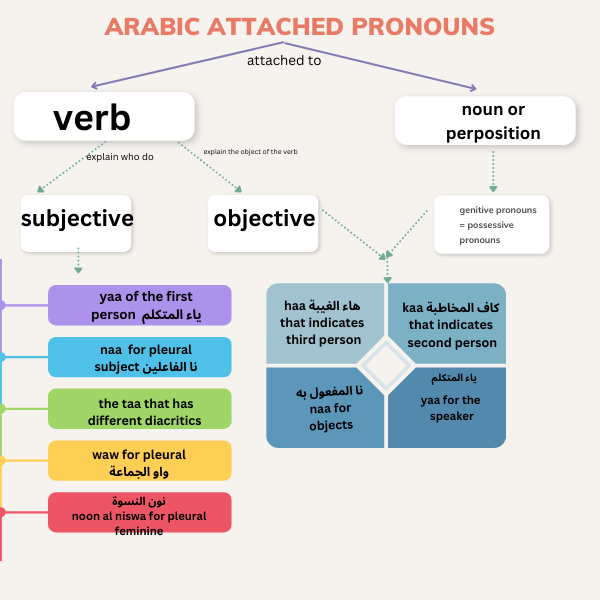
The attached pronouns are in 3 categories:
1. Arabic subjective attached pronouns:
Subjective attached pronouns are found either attached to a verb to explain who did that verb or attached to Kan wa Akhwataha كان وأخواتها. In the second case, they will be Ism kanاسم كان.they are 5 cases
- تاء الفاعل “taa that indicates the doer it has Damma to mean ( I ), Fatha to mean You ”masculine singular” or Kassra to mean you “feminine singular”
For example, the verb read means قرأ
| قرأ | قرأتُ | قرأتِ | قرأتَ |
| The infinitive verb | First person singular | Second person feminine | Second person masculine |
- نا الفاعلين “naa for doers” used for pleural first person.
- واو الجماعة waw indicates pleural third person
- ا ألف الاثنين alif al ethnin that is used for dual
- ي yaa al mokhataba used for the singular feminine second person.
2. Arabic objective attached pronouns:
Objective-attached pronouns are found either attached to a verb to tell the object or attached to أن وأحواتها which makes the noun in the accusative case. There are 4 main cases:
- ي المتكلم Yaa for the first person
- ك المخاطبة The letter ك indicates the second-person pronoun. it has different suffixes or diacritics according to the number, and gender as follows:
| Singular masculine | Singular Feminine | dual | Pleural feminine | Pleural masculine |
| كَ | كِ | كما | كن | كم |
- هاء الغيبةThe letter” ه” indicates the third-person pronouns. It has different suffixes according to the number, gender
| Singular masculine | Singular Feminine | dual | Pleural feminine | Pleural masculine |
| ه | ها | هما | هن | هم |
- نا المفعولين
This means that the attached pronoun نا can be objective or subjective. You can determine from the context. See these two examples to clarify this.
| example | translation | Type of نا | Explanation |
| رأيتنا | you Saw us | Objective | It refers to the person that is seen. |
| قرأنا | We read | subjective | It refers to person who read |
3. Genitive attached pronouns in Arabic:
When the previous four attached pronouns are attached to a noun or a preposition, they become possessive or genitive pronouns.
See the following example
| The pronoun | Example for objective | Example for genitive |
| هاء الغيبة | كتبه | له |
| نا المفعولين | كلمنا | لنا |
| ك المخاطبة | رأيتكِ | لكِ |
| ي المتكلم | أعطاني | لي |
Shots Videos from Our Courses
Arabic Attached pronouns chart
To simplify the categorization of the Arabic attached pronouns, you can draw this chart in your mind to identify them with their meaning and their grammatical case.
All Arabic Attached Pronouns Meaning
The attached pronouns have many functions. They can express singular, dual, or pleural persons. They also express first-person, second-person, or third-person in the conversation at the same time. This table clarifies their meanings with examples
| Pronoun (Transliteration) | Meaning | Example (Transliteration) |
| Yā’ al-Mutakallim (ياء المتكلم) | First-person singular (masculine and feminine) | كتابي Kitābī (my book) |
| Yā’ al-Mukhāṭabah (ياء المخاطَبة) | Second-person singular (feminine) | كتبتيUktubī (write, feminine) |
| Alif al-Ithnayn (ألف الاثنين) | Dual (masculine) | خرجاKharajā (they (dual) left) |
| Tā’ al-Mutakallim/ al-Mutakallimah (تاء المتكلم/ المتكلمة) | First-person singular (masculine and feminine) | كتبتُKatabtُ (I wrote) |
| Tā’ al-Mukhāṭab (تاء المخاطَب) | Second-person singular (masculine) | كتبتَKatabta (you (masculine) wrote) |
| Tā’ al-Mukhāṭabah (تاء المخاطَبة) | Second-person singular (feminine) | كتبتِKatabti (you (feminine) wrote) |
| Tā’ al-Mukhāṭabayn (تاء المخاطَبَيْن) | Second-person dual (masculine) | كتباKatabtumā (you (dual, masculine) wrote) |
| Tā’ al-Mukhāṭabatayn (تاء المخاطَبَتَين) | Second-person dual (feminine) | كتبتماKatabtumā (you (dual, feminine) wrote) |
| Nā’ al-Mutakallimayn (نا المتكلمَيْنِ) | First-person dual and plural (masculine) | كتابناKitābnā (our book) |
| Hā’ al-Ghā’ib (هاء الغائب) | Third-person singular (masculine) | عنه‘Anhu (about him) |
| Hā’ al-Ghā’ibah (هاء الغائبة) | Third-person singular (feminine) | عنها‘Anhā (about her) |
| Hā’ al-Ghā’ibayn (هاء الغائبَين) | Third-person dual (masculine) | عنهما‘Anhumā (about them (dual, masculine)) |
| Hā’ al-Ghā’ibatayn (هاء الغائبتين) | Third-person dual (feminine) | عنهما‘Anhumā (about them (dual, feminine)) |
| Hā’ al-Ghā’ibīn (هاء الغائِبينَ) | Third-person plural (masculine) | عنهم‘Anhum (about them (masculine plural)) |
| Hā’ al-Ghā’ibāt (هاء الغائِبات) | Third-person plural (feminine) | عنهن‘Anhunna (about them (feminine plural)) |
| Kāf al-Mukhāṭab (كاف المخاطَب) | Second-person singular (masculine) | أخبرتكَAkhbartuka (I told you (masculine)) |
| Kāf al-Mukhāṭabah (كاف المخاطَبة) | Second-person singular (feminine) | أخبرتكِAkhbartuki (I told you (feminine)) |
| Kāf al-Mukhāṭabayn/ al-Mukhāṭabatayn (كاف المخاطَبَيْن/ المخاطَبتَين) | Second-person dual (masculine and feminine) | أخبرتكماAkhbartukumā (I told you (dual)) |
| Kāf al-Mukhāṭabīn (كاف المخاطَبينَ) | Second-person plural (masculine) | أخبرتكمAkhbartukum (I told you (plural, masculine)) |
| Kāf al-Mukhāṭabāt (كاف المخاطَبات) | Second-person plural (feminine) | أخبرتكنAkhbartukunna (I told you (plural, feminine)) |
| Wāw al-Jamā‘ah (واو الجماعة) | Third-person plural (masculine) | عرفوا‘Arifū (they (masculine plural) knew) |
| Nūn al-Niswah (نون النسوة) | Third-person plural (feminine) | عرفن‘Arifna (they (feminine plural) knew) |
You need to read more examples to familiarize yourself with all attached pronouns. You can practice reading with our Arabic reading course.
Start Reading Arabic with a FREE Trial

Characteristics of Arabic Attached Pronouns:
Although there are many types of Arabic Attached pronouns, they all have the following characteristics.
1. They can not serve as a separate word:
Unlike English, not all Arabic pronouns can serve as separate words. In this instance, the Arabic attached pronouns do not come at the start of a sentence or after the particle إلا.
You can learn more details about إلا and other particles in our Arabic grammar course.
2. Arabic Attached pronouns are fixed nouns “asmaa gamdaa”اسماء جامدة :
The main characteristic of the attached Arabic pronouns in all cases is that they are all fixed, unchanging nouns that are attached to the end of a word. They are fixed since they are not derived from another word.
3. Attached pronouns are Mabniyyah nouns:
The Arabic word Mabniyyah in grammar refers to nouns that do not change their diacritics “At-tashkeel” in different grammatical cases.
Exercises For Arabic Attached Pronouns
This grammatical rule is not difficult but you need to practice many times to deepen your understanding and differentiate different types. Here are some exercises.
1. Differentiate the type of the attached Tā’ in the following sentences:
Read the following sentences and identify the type of the attached Tā’ (ت) based on the subject and role in the sentence.
| Sentence | Tā’ Attached To | Type of Tā’ | Explanation |
| استمتعتُ بالقراءة | Verb (استمتعتُ) | First-person singular (I) | The Tā’ refers to the speaker (I). It is attached to the verb for a first-person subject. |
| استمتعتْ سعاد بالقراءة | Verb (استمتعتْ) | Third-person singular feminine (she) | The Tā’ refers to Soad, a third-person singular feminine subject. |
| هل علمتِ بما حدث؟ | Verb (علمتِ) | Second-person singular feminine (you) | The Tā’ refers to a second-person singular feminine subject. |
Notes:
- The letter Tā’ (ت) with a sukoon (ْ) is not a pronoun but a marker for femininity.
- It changes according to the grammatical role (first person, second person, or third person) and gender (masculine or feminine).
2. Differentiate the grammatical position of the first-person plural pronoun “نا” in the following sentences:
Analyze the following sentences and determine the grammatical position of the first-person plural pronoun “نا” (which means “we”).
| Sentence | Pronoun “نا” Position | Grammatical Role | Explanation |
| لقد شاهدْنا الفارس وهو يجري | Verb (شاهدْنا) | Subject | The pronoun “نا” is attached to the verb “شاهدْنا” and acts as the subject, meaning “we saw.” |
| لقد شاهدَنا الفارس ونحن نجري | Subject (نحن) | Object | The pronoun “نا” is attached to the verb “شاهدَنا” and functions as the object of the verb, referring to the action done by “we.” |
Notes:
- In the first sentence, “نا” functions as part of the verb in the past tense, indicating that we performed the action of watching.
- In the second sentence, “نا” is part of the verb again, showing we as the object performing the watching action, and it is connected with the subject “نحن” (we).
3. Extract the attached pronouns and determine their meaning:
For each sentence, identify the attached pronoun and explain its meaning in the context of the sentence.
| Sentence | Attached Pronoun | Meaning of the Pronoun | Explanation |
| رَبَّنَا لا تُؤَاخِذْنَا إِنْ نَسِينَا | نا (attached to رَبَّنَا and تُؤَاخِذْنَا) | Our (referring to “our Lord”) / us (referring to “us”) | The pronoun “نا” in “رَبَّنَا” means “our,” and in “تُؤَاخِذْنَا” means “us” (as the object of the verb). |
| سرتُ ميلًا | تُ (attached to سرت) | I (referring to the speaker) | The pronoun “تُ” indicates that the subject of the verb is “I” (first-person singular). |
| شكر الله لكم حسن استماعكم | كم (attached to استماعكم) | You (referring to the audience) | The pronoun “كم” is used to indicate possession, meaning “your” in this case. |
| السلام عليكم ورحمة الله وبركاته | كم (attached to السلام) | You (referring to the audience) | The pronoun “كم” here means “you” in the context of a greeting. |
| مر أحدهم أمامي | هم (attached to أحدهم) | They (referring to a group of people) | The pronoun “هم” means “they” and refers to the people in the sentence. |
| حررنا بلادنا | نا (attached to حررنا) | We (referring to the speakers) | The pronoun “نا” means “we” and refers to the subject performing the action of freeing the country. |
| تقرأون الدرس | ون (attached to تقرأون) | You (referring to plural, masculine or mixed) | The pronoun “ون” indicates the second-person plural masculine or mixed group, meaning “you.” |
| ذهبن إلى المدرسة | ن (attached to ذهبن) | They (referring to a group of females) | The pronoun “ن” means “they” (feminine plural) and refers to a group of females. |
Notes:
- Attached pronouns in Arabic are closely linked with verbs, nouns, and possessives to indicate subject, object, or possession.
- Pay attention to the context in order to correctly identify the meaning of the pronoun, as it can vary depending on whether it’s referring to a singular, dual, or plural subject.
Read Also: Types of Verbs in Arabic
What Are the Key Characteristics of Arabic Attached Pronouns?
Arabic attached pronouns are defined by five core characteristics: they are suffixes (never standalone), they indicate person and gender, they cause the preceding word to lose its tanwīn, they may alter voweling on the host word, and their vowel pattern shifts based on phonological context. These features make them fundamentally different from Western pronoun systems.
Characteristics at a Glance
| Characteristic | Description |
| Position | Always suffixed — written and spoken as part of the host word |
| Gender-marking | Distinct forms for masculine, feminine, singular, dual, plural |
| Tanwīn removal | Any noun accepting a pronoun suffix loses its final tanwīn (ـٌ / ـٍ / ـً) |
| Vowel assimilation | ـهُ shifts to ـهِ after kasra — e.g., بِهِ (bihi, “with him”) |
| Grammatical weight | Carries full case weight — behaves as a genitive noun in iḍāfa or an accusative object on verbs |
In our instructors’ experience at The Arabic Learning Centre, the characteristic most likely to be overlooked by self-study learners is the tanwīn removal rule.
Beginners frequently write كِتَابٌهُ — which is grammatically impossible. The attached pronoun terminates the noun’s indefiniteness entirely.
Read Also: Arabic Broken Plurals
Our Students Reviews
How Do Arabic Attached Pronouns Compare to Detached Pronouns?
Arabic attached pronouns (الضمائر المتصلة) differ from detached pronouns (الضمائر المنفصلة) in that they cannot stand alone — they must bond to a host word. Detached pronouns, such as هُوَ (huwa, “he”) and هِيَ (hiya, “she”), function as independent subject pronouns and appear at the start of nominal sentences. The two types serve entirely different grammatical roles.
| Feature | Attached Pronouns (المتصلة) | Detached Pronouns (المنفصلة) |
| Can stand alone? | ❌ No | ✅ Yes |
| Position | Suffix on noun/verb/preposition | Sentence-initial subject position |
| Function | Possession, object, pronominal object | Grammatical subject of sentence |
| Example | كِتَابُهُ (his book) | هُوَ طَالِبٌ (He is a student) |
| Appear in iḍāfa? | ✅ Yes | ❌ No |
A second comparison worth noting: attached pronouns also differ from hidden pronouns (الضمائر المستترة — ad-ḍamā’ir al-mustatira), which are implied within verb conjugations. كَتَبَ (kataba, “he wrote”) contains a hidden 3rd person masculine singular pronoun — invisible but grammatically present. Unlike attached pronouns, hidden pronouns leave no visible suffix at all.
For learners building overall Arabic fluency, understanding these three pronoun categories together — attached, detached, and hidden — forms one of the most productive units of Arabic grammar study. Our Arabic Grammar Course covers all three within a structured, instructor-led curriculum.
Start Learning Arabic Grammar with a Free Trial

Read Also: Connecting Arabic Letters Practice
Begin Your Arabic Grammar Study with Certified Instructors at The Arabic Learning Centre
Arabic attached pronouns are foundational — and learning them correctly the first time saves significant rework later. The patterns covered here form the backbone of Arabic sentence construction, Quranic reading, and conversational fluency alike.
The Arabic Learning Centre offers:
- 1-on-1 sessions with certified native Arabic instructors
- Flexible scheduling available 24/7
- Structured progression from alphabet through grammar mastery
- Dedicated Arabic Grammar Course covering pronouns, iḍāfa, verb conjugation, and beyond
- Arabic Course for Beginners for those building their foundations
Book your free trial lesson today and start learning attached pronouns — and the grammar that surrounds them — the right way, from day one.
Check out our top courses in Arabic and choose the course you need to start learning Arabic today:
- Arabic Course for Beginners
- Arabic Script Writing Course
- Arabic Speaking Course
- Learn Arabic Letters for Tajweed
- Learning Arabic Grammar
- Arabic Vocabulary Course
- Fusha Arabic Course
- Classical Arabic Course
- Arabic Course for Islamic Studies
- Quranic Arabic Course
- Learn Arabic for New Muslims
Start with a FREE trial class and enhance your Arabic language skills

Conclusion
Attached pronouns are not a grammar footnote — they are embedded in virtually every Arabic sentence you will ever read, hear, or speak. The 12 suffixes covered here encode possession, object relationships, and pronominal reference all in one compact form.
The phonological rules — kasra assimilation, tanwīn removal, nūn doubling — follow consistent patterns. Once those patterns are internalized through structured practice, they become invisible to the reader and natural to the writer.
Arabic grammar rewards systematic study, and attached pronouns are precisely the kind of high-frequency, high-leverage topic where investment pays off immediately across reading, writing, and listening comprehension alike.
Read Also: Tenses in Arabic
Frequently Asked Questions About Arabic Attached Pronouns
What are Arabic attached pronouns used for?
Arabic attached pronouns are used to express possession when suffixed to nouns, to indicate direct objects when suffixed to verbs, and to show pronominal objects when suffixed to prepositions. They are the Arabic equivalent of English possessive adjectives (“my,” “his,” “their”) and object pronouns (“him,” “her,” “them”) — but written as part of the same word.
How many Arabic attached pronouns are there?
There are 12 Arabic attached pronouns, covering 1st, 2nd, and 3rd person in singular, dual, and plural forms, with gender distinctions for 2nd and 3rd person forms. The 1st person plural ـنَا (-nā) and singular ـي (-ī) are the most common in both spoken and Quranic Arabic.
Why does the pronoun ـهُ sometimes become ـهِ in Arabic?
The pronoun ـهُ (-hu, “his/him”) shifts to ـهِ (-hi) when it follows a kasra vowel (ِ) or a long ī sound. This is a phonological assimilation rule — the pronoun harmonizes with the preceding vowel. For example, بِهِ (bihi, “with him”) — because بِـ carries a kasra. This rule applies consistently throughout Arabic and is documented in classical Nahw scholarship.
What is the difference between attached and detached pronouns in Arabic?
Attached pronouns (الضمائر المتصلة) are suffixes that cannot stand alone — they bond to nouns, verbs, or prepositions. Detached pronouns (الضمائر المنفصلة) such as هُوَ (huwa) and أَنْتَ (anta) are independent words that function as the grammatical subject of nominal sentences. The two types are never interchangeable within the same grammatical slot.
Are Arabic attached pronouns important for reading the Quran?
Yes — Arabic attached pronouns are essential for Quranic reading comprehension. They appear in nearly every verse, most frequently as ـهُ referring to Allah and ـنَا in divine first-person speech. Learners who master attached pronouns report a significant improvement in their ability to follow Quranic meaning in real time, rather than relying solely on translations. See our How to Learn Arabic for Quran guide for a full learning path.