 Arabic Grammar

Learning Arabic grammar becomes much easier once you understand who is doing the action in a sentence. In Arabic, that role is usually expressed by the subject (الفاعل / al-fāʿil), one of the most important elements of the verbal sentence.
The subject may look simple at first, but Arabic handles it differently from English. It often comes after the verb, it must be nominative (مرفوع), and it does not always appear as a separate noun.
Sometimes the subject is attached to the verb, hidden within its conjugation, or expressed through another grammatical structure. These differences can make identifying the fāʿil confusing for beginners.
In this guide, you will learn what the subject in Arabic grammar is, where it appears in a sentence, how to recognize its Iʿrāb, the different forms it can take, and how it agrees with the verb in gender and number.
With clear Arabic examples and practical rules, you will be able to identify the fāʿil more confidently and avoid some of the most common mistakes Arabic learners make.
What Is the Subject in Arabic Grammar?
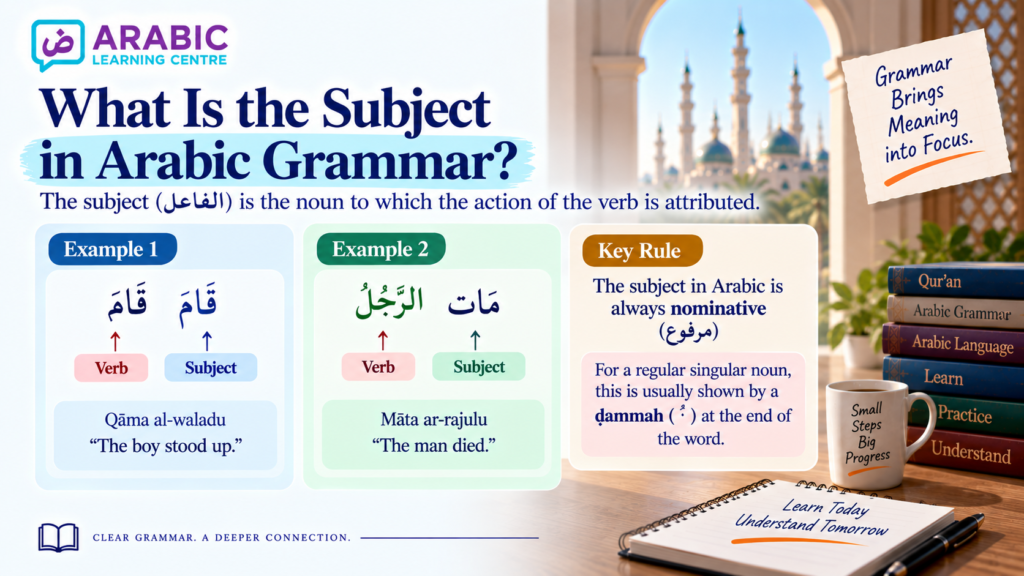
In Arabic grammar, the subject (الفاعل) is the noun to which the action of the verb is attributed. In a standard verbal sentence, it usually comes after the verb, following the common pattern verb + subject.
For example:
قَامَ الوَلَدُ
Qāma al-waladu — “The boy stood up.”
Here, قَامَ is the verb, while الوَلَدُ is the subject because the action is attributed to the boy.
The subject does not always perform an intentional action. In مَاتَ الرَّجُلُ (Māta ar-rajulu — “The man died”), الرَّجُلُ is still the grammatical subject because the verb describes what happened to him.
The key rule to remember is that the subject in Arabic is always nominative (مرفوع). For a regular singular noun, this is usually shown by a ḍammah (ـُ) at the end of the word.
Read also: I’rab Arabic Grammar – A Simple Guide for Beginners
Word Order and the Subject in Arabic Sentences
Word order plays an important role in identifying the subject in Arabic.
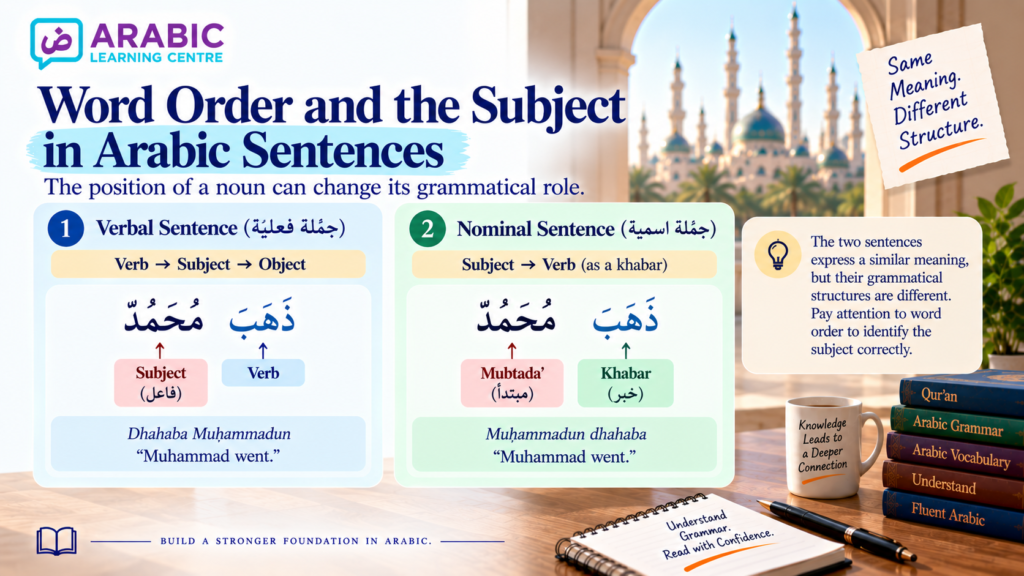
In a standard verbal sentence (جملة فعلية), the usual structure is:
Verb → Subject → Object
When the noun comes after the verb, it functions as the fā’il (فاعل):
ذَهَبَ مُحَمَّدٌ
Dhahaba Muḥammadun — “Muhammad went.”
Here, مُحَمَّدٌ is the fā’il because it follows the verb ذَهَبَ.
When the noun comes before the verb, traditional grammatical analysis treats the structure differently:
مُحَمَّدٌ ذَهَبَ
Muḥammadun dhahaba — “Muhammad went.”
Here, مُحَمَّدٌ is the mubtada’ (مبتدأ), while the verbal sentence ذَهَبَ functions as its khabar (خبر) and contains an implied subject referring back to Muhammad.
The two sentences express a similar basic meaning, but their grammatical structures are different. This is why paying attention to word order is essential when identifying the fā’il in Arabic.
Read also: Most Common Arabic Verbs – The Complete List and How to Actually Learn Them
How the Subject Is Marked (I’rab of the Subject)?
Since the subject is always nominative, its ending changes depending on its form:
| Subject Type | Nominative Marker | Example |
| Singular noun | Ḍammah ( ُ ) | قَامَ الوَلَدُ — the boy stood |
| Dual noun | Alif (ا) instead of ḍammah | جَاءَ الرَّجُلَانِ — the two men came |
| Sound masculine plural | Wāw (و) instead of ḍammah | صَلَّى المُؤْمِنُونَ — the believers prayed |
| One of the “Five Nouns” (أب، أخ، حم، فو، ذو) | Wāw (و) instead of ḍammah | جَاءَ أَبُوهُ — his father came |
This pattern should feel familiar if you’ve studied I’rab before: the ending changes shape depending on the word’s grammatical form, but its underlying role — being the subject — stays exactly the same.
Different Forms of the Subject in Arabic Grammar
The subject (الفاعل) in Arabic does not always appear as a separate, visible noun. Depending on the sentence, it may be a noun, a pronoun, a demonstrative, a relative noun, or even an entire clause functioning like a noun.
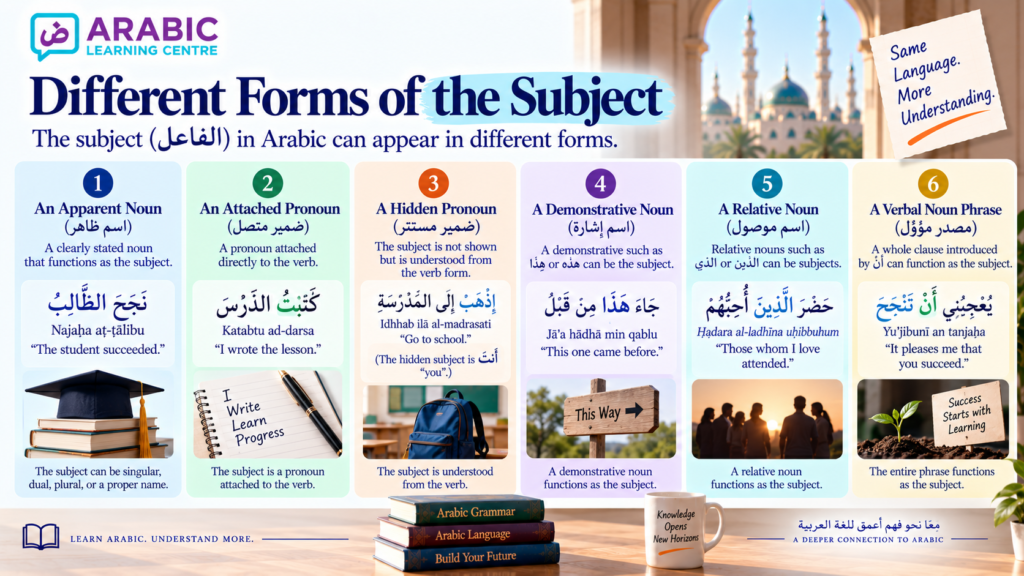
1. An Apparent Noun (اسم ظاهر)
The simplest form is a clearly stated noun that functions as the subject. It may be singular, dual, plural, or a proper name.
نَجَحَ الطَّالِبُ
Najaḥa aṭ-ṭālibu — “The student succeeded.”
عَادَ أَبَوَايَ إِلَى البَيْتِ
ʿĀda abawāya ilā al-bayti — “My two parents returned home.”
In both examples, the subject appears explicitly after the verb and carries the appropriate nominative marker.
2. An Attached Pronoun (ضمير متصل)
The subject can also be a pronoun attached directly to the verb rather than a separate word.
كَتَبْتُ الدَّرْسَ
Katabtu ad-darsa — “I wrote the lesson.”
المُجْتَهِدُونَ يُفْلِحُونَ
Al-mujtahidūna yufliḥūna — “The diligent succeed.”
In كَتَبْتُ, the attached ـتُ represents “I,” while the wāw in يُفْلِحُونَ represents the plural subject “they.”
3. A Hidden Pronoun (ضمير مستتر)
Sometimes the subject does not appear explicitly at all. Instead, it is understood from the form of the verb.
اِذْهَبْ إِلَى المَدْرَسَةِ
Idhhab ilā al-madrasati — “Go to school.”
اِبْتَعَدَ عَنِ الحَقِيقَةِ
Ibtaʿada ʿani al-ḥaqīqati — “He moved away from the truth.”
In the first example, the hidden subject is أنتَ (“you”), while in the second it is هو (“he”).
4. A Demonstrative Noun (اسم إشارة)
A demonstrative such as هذا or هذه can also function as the subject.
جَاءَ هَذَا مِن قَبْلُ
Jā’a hādhā min qablu — “This one came before.”
Here, هَذَا is the subject of the verb جَاءَ.
5. A Relative Noun (اسم موصول)
Relative nouns such as الذي، الذين، and اللذان can function as subjects as well.
حَضَرَ الَّذِينَ أُحِبُّهُمْ
Ḥaḍara al-ladhīna uḥibbuhum — “Those whom I love attended.”
حَضَرَ اللَّذَانِ فَازَا فِي المُسَابَقَةِ
Ḥaḍara al-ladhāni fāzā fī al-musābaqati — “The two who won the competition attended.”
In both sentences, the relative noun functions as the subject of حَضَرَ.
6. A Verbal Noun Phrase (مصدر مؤوّل)
An entire clause introduced by أنْ can sometimes function grammatically like a noun and take the position of the subject.
يُعْجِبُنِي أَنْ تَنْجَحَ
Yuʿjibunī an tanjaḥa — “It pleases me that you succeed.”
Here, أَنْ تَنْجَحَ functions as a single grammatical unit and can be understood in the sense of نَجَاحُكَ (“your success”). This whole phrase therefore occupies the grammatical position of the subject.
Recognizing these six forms is genuinely one of the more advanced skills in Arabic reading comprehension, and it takes exposure to a wide range of vocabulary before the patterns start to feel automatic.
Working steadily through a structured vocabulary-building course can help you build the word bank you need to recognize these subject types quickly, instead of pausing on every sentence to work out the grammar from scratch.
Read also: 15 Common Mistakes New Arabic Learners Make and How to Avoid Them

The Subject of Verb-Like Words in Arabic Grammar
The subject (الفاعل) does not only appear with ordinary verbs. In Arabic grammar, certain words can function like verbs and therefore take a subject, even though they are not conjugated verbs themselves.

These are often described as words that carry or perform the meaning of a verb.
The main forms include:
1. The Noun of the Verb (اسم الفعل)
An ism al-fiʿl carries the meaning of a verb without having the normal form of one.
هَيْهَاتَ السَّفَرُ
Hayhāta as-safaru — “Travel is far off.”
Here, هَيْهَاتَ carries the meaning of “is far,” while السَّفَرُ functions as its subject.
2. The Active Participle (اسم الفاعل)
An active participle can function like a verb and raise a subject.
أَقَائِمٌ الزَّيْدَانِ؟
A-qā’imun az-Zaydāni? — “Are the two Zayds standing?”
Here, قَائِمٌ carries the meaning of يَقُومُ (“stands/is standing”), while الزَّيْدَانِ functions as its subject.
Another example is:
هَذَا هُوَ النَّاجِحُ وَلَدُهُ
Hādhā huwa an-nājiḥu waladuhu — “This is the one whose son succeeded.”
Here, وَلَدُهُ is the subject connected grammatically to the active participle النَّاجِحُ.
3. The Verbal Noun (المصدر)
A verbal noun (maṣdar) can sometimes carry the meaning and grammatical function of its corresponding verb and therefore have a subject.
For example, a maṣdar may function like the verb from which it is derived, allowing another noun or expression to be connected to it as the performer of its verbal meaning.
4. The Assimilated Adjective (الصفة المشبهة)
The ṣifah mushabbahah is an adjective that expresses a relatively stable quality but can also behave grammatically like a verb.
عَاشِرْ امْرَأً حَسَنًا خُلُقُهُ
ʿĀshir imra’an ḥasanan khuluquhu — “Keep company with a man of good character.”
Here, خُلُقُهُ functions as the subject related to the adjective حَسَنًا.
5. The Elative or Comparative Form (اسم التفضيل)
An ism al-tafḍīl, such as a word following the pattern أَفْعَل, can also take a subject in certain grammatical structures.
مَرَرْتُ بِالأَفْضَلِ أَبُوهُ
Marartu bil-afḍali abūhu — “I passed by the one whose father is more excellent.”
Here, أَبُوهُ functions as the subject associated with الأَفْضَلِ.
6. Forms of Exaggeration (صيغ المبالغة)
Forms of exaggeration (ṣiyagh al-mubālaghah) can also function like active participles when they carry a strong verbal meaning. In such cases, they may take a subject just as a verb or active participle does.
You do not need to memorize all of these forms when first learning the Arabic subject. The important point is to recognize that a fāʿil can be associated not only with a true verb, but also with certain words that function like verbs.
This explains why you may sometimes find a grammatical subject even when there is no obvious conjugated verb in the sentence.
Key Rules for the Subject in Arabic Grammar
Once you know how to identify the subject (الفاعل), there are several important rules that explain how it behaves within an Arabic sentence.
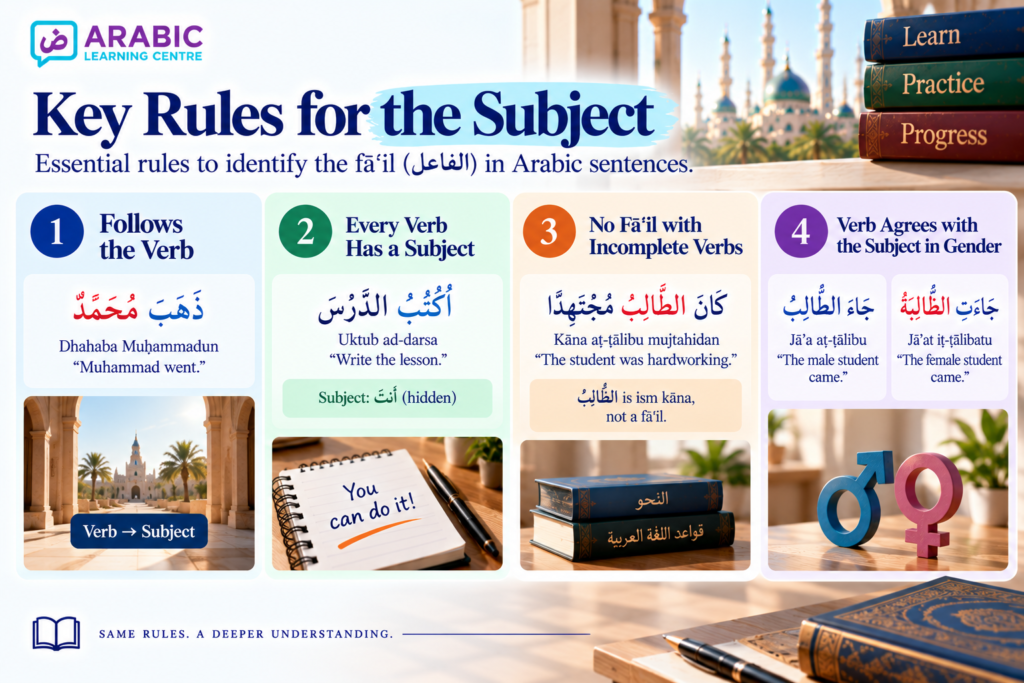
1. The Subject Follows the Verb
In a standard verbal sentence, the fāʿil comes after its verb:
ذَهَبَ مُحَمَّدٌ
Dhahaba Muḥammadun — “Muhammad went.”
If the noun comes before the verb, traditional grammatical analysis treats it as a mubtada’ (مبتدأ) rather than a fāʿil, and the structure becomes a nominal sentence.
2. Every Verb Has a Subject
The subject may be visible, attached to the verb, or understood as a hidden pronoun, but it is always grammatically present.
اُكْتُبِ الدَّرْسَ
Uktub ad-darsa — “Write the lesson.”
Here, the subject is the hidden pronoun أنتَ (“you”).
3. The Fāʿil Is Associated With Complete Verbs
Incomplete verbs such as كَانَ وأخواتها do not take a fāʿil in the usual sense. Instead, they take an ism (اسم كان) and a khabar (خبر كان).
For example:
كَانَ الطَّالِبُ مُجْتَهِدًا
Kāna aṭ-ṭālibu mujtahidan — “The student was hardworking.”
Here, الطَّالِبُ is ism kāna, not a fāʿil.
4. The Verb Agrees With the Subject in Gender
The verb generally agrees with its subject in gender, although the exact agreement depends on factors such as the subject’s position and whether the feminine noun is naturally or grammatically feminine.
For example:
جَاءَ الطَّالِبُ — “The male student came.”
جَاءَتِ الطَّالِبَةُ — “The female student came.”
These rules help distinguish the fāʿil from other nominative nouns and make it easier to analyze Arabic verbal sentences correctly.
Don’t Just Take Our Word For It
Take a look inside our vibrant classes and see our students and teachers in action. Click below to watch our classroom experience:
Gender and Number Agreement Between the Verb and Subject
Agreement between the verb and the subject (الفاعل) can be confusing for beginners because Arabic treats number and gender differently in a standard verbal sentence.

Number Agreement
When a visible subject comes after the verb, the verb normally remains singular, even when the subject is dual or plural.
جَاءَ الرَّجُلَانِ
Jā’a ar-rajulāni — “The two men came.”
نَجَحَ الطُّلَّابُ
Najaḥa aṭ-ṭullābu — “The students succeeded.”
So we normally do not say جَاءَا الرَّجُلَانِ or نَجَحُوا الطُّلَّابُ in standard grammatical analysis. Forms such as نَجَحُوا already contain an attached pronoun functioning as the subject: “They succeeded.”
Gender Agreement
The verb also reflects the gender of its subject. With a feminine subject, the verb generally takes the appropriate feminine marker:
ذَهَبَتِ الفَتَاةُ
Dhahabat al-fatātu — “The girl went.”
ذَهَبَ الوَلَدُ
Dhahaba al-waladu — “The boy went.”
Gender agreement has additional rules when the subject is separated from the verb or when dealing with certain types of feminine and plural nouns. Beginners do not need to memorize all of these details immediately; the key is to first recognize the basic pattern and become familiar with the variations through regular reading and practice.
Common Mistakes When Identifying the Subject in Arabic
The Arabic subject (الفاعل) follows rules that may feel unfamiliar to English speakers, so beginners often make a few predictable mistakes when identifying or using it.
1. Assuming the Subject Always Comes First
English commonly places the subject before the verb, but a standard Arabic verbal sentence usually follows the pattern verb + subject.
ذَهَبَ مُحَمَّدٌ — “Muhammad went.”
Here, مُحَمَّدٌ is the fāʿil even though it comes after the verb.
2. Forgetting That the Subject Is Nominative
The fāʿil is always nominative (مرفوع). For regular singular nouns, this is usually indicated by a ḍammah (ـُ).
نَجَحَ الطَّالِبُ — “The student succeeded.”
3. Overlooking Hidden Pronouns
Not every subject appears as a separate word. Sometimes it is understood from the verb itself.
اُكْتُبْ — “Write!”
The subject here is a hidden أنتَ (“you”).
4. Confusing the Subject With the Object
Do not identify the subject only by its position. Instead, determine who or what the verb is attributed to and distinguish that from the object receiving the action.
كَتَبَ الطَّالِبُ الدَّرْسَ
Here, الطَّالِبُ is the subject, while الدَّرْسَ is the object.
5. Making the Verb Plural With a Visible Plural Subject
When a visible dual or plural subject follows the verb, the verb normally remains singular.
نَجَحَ الطُّلَّابُ — “The students succeeded.”
The standard form is not نَجَحُوا الطُّلَّابُ, because the plural noun الطُّلَّابُ itself functions as the subject.
6. Treating the Ism of Kāna as a Fāʿil
كَانَ and its sisters do not take a fāʿil in the usual sense. Instead, they take an ism and a khabar.
كَانَ الطَّالِبُ مُجْتَهِدًا — “The student was hardworking.”
Here, الطَّالِبُ is ism kāna (اسم كان), not the fāʿil.
Recognizing these common mistakes makes it much easier to identify the subject correctly and understand the structure of Arabic sentences.
Working through short sentences and consciously writing out the subject of each one is one of the best ways to catch these habits early.
Regular guided writing practice — where you build your own simple verbal sentences and check the subject’s case ending yourself — turns this from a rule you’ve read about into a skill you actually use.

How to Practice Identifying the Subject in Arabic Sentences?
The best way to become confident with the subject (الفاعل) is to practice identifying it in short verbal sentences. Instead of memorizing rules separately, use the following process each time you analyze a sentence:
1. Find the Verb Before Looking for the Subject
Start by identifying the verb in the sentence. This gives you the action or event and makes it easier to determine which noun or pronoun functions as its subject.
2. Ask Who or What the Verb Is Attributed To
Once you find the verb, ask who or what the verb is attributed to. The answer will usually help you identify the fāʿil (فاعل).
3. Check That the Subject Has a Nominative I’rab Marker
The subject must be nominative (مرفوع). Depending on its form, its nominative marker may be a ḍammah, alif, or wāw.
4. Determine Which Form of the Subject Is Being Used
Check whether the subject is an apparent noun, attached pronoun, hidden pronoun, or another form such as a relative noun. This is especially important when no separate subject appears after the verb.
5. Check Gender and Number Agreement Between the Verb and Subject
Make sure the verb agrees correctly with the subject in gender. Also remember that when a visible dual or plural subject follows the verb, the verb normally remains singular.
6. Practice Identifying the Subject by Writing Your Own Sentences
Write short sentences using different verbs and subjects, then identify the fāʿil and its nominative marker. Comparing your analysis with reliable examples or reviewing it with a teacher can help you catch mistakes early.
Repeating this process with simple Arabic sentences gradually makes identifying the subject more natural and effective than relying on definitions alone.
Inside Our Classrooms
See how we make learning interactive and engaging! Watch a quick snippet of our live, conversational classes in action:
Turn Arabic Grammar Rules Into Real Language Skills
Understanding the subject (الفاعل) is an important step toward reading and building Arabic sentences correctly, but grammar becomes truly useful when you can recognize these patterns naturally in real Arabic.
At Arabic Learning Centre, structured Arabic courses help learners move beyond memorizing rules and develop the vocabulary, reading, writing, and grammar skills needed to use them with confidence.
Whether you are still learning how to identify the fāʿil or want to understand more advanced Arabic sentence structures, guided lessons and regular practice can help you turn concepts like I’rab, verb-subject agreement, and sentence structure into practical language skills.
Start your free trial with Arabic Learning Centre and build a stronger foundation in Arabic grammar step by step.
Courses We Offer:
- Business Arabic Course
- Learn Arabic from Zero
- Medical Arabic Course
- Learning Arabic for Non Arabic Speakers
- Learn Arabic in Saudi Arabia
- Learn to Read Arabic Course

Conclusion
The subject in Arabic grammar — الفاعل — is one of the two essential building blocks of every verbal sentence, sitting right after the verb and always carrying the nominative case.
Whether it appears as a clear noun, an attached pronoun, a hidden pronoun, or something more advanced like a relative clause or a verbal noun phrase, its underlying role never changes: it’s always the one performing — or being described by — the action.
Learning to spot the subject quickly, in all its different forms, and understanding how it agrees with its verb in gender and number, is a skill that grows naturally with exposure to real sentences.
Keep reading short texts, keep writing your own examples, and keep asking that one simple question — “who is doing this?” — and the subject will start to stand out clearly in almost everything you read.
Frequently Asked Questions About the Subject in Arabic Grammar
What Is the Subject Called in Arabic Grammar?
The subject is called الفاعل (al-fāʿil). It is the noun, pronoun, or equivalent grammatical element to which the action or meaning of a verb or verb-like word is attributed.
What Case Does the Subject Take in Arabic?
The subject is always nominative (مرفوع). Its nominative marker depends on its form and may be a ḍammah, alif, or wāw.
Can the Subject in Arabic Be a Hidden Pronoun?
Yes. The subject may be a hidden pronoun (ضمير مستتر) understood from the form and conjugation of the verb, even though it does not appear as a separate word.
Is the Fāʿil the Same as the Mubtada’?
No. The fāʿil (فاعل) is associated with a verb or verb-like word, while the mubtada’ (مبتدأ) is the starting element of a nominal sentence. Although both are normally nominative, they perform different grammatical functions.
Why Does the Fāʿil Come After the Verb?
In the standard Arabic verbal sentence, the usual structure is verb + subject + object. If the noun that performs the action appears before the verb, traditional grammatical analysis normally treats it as a mubtada’, with the following verbal sentence functioning as its predicate.
Does the Verb Become Plural When the Subject Is Plural?
When a visible plural subject follows the verb, the verb normally remains singular:
نَجَحَ الطُّلَّابُ — “The students succeeded.”
When the subject is expressed through an attached plural pronoun, however, plurality appears on the verb itself:
نَجَحُوا — “They succeeded.”
Do Kāna and Its Sisters Take a Fāʿil?
No. كَانَ وأخواتها are incomplete verbs (أفعال ناقصة) and do not take a fāʿil in the usual sense. Instead, they take an ism (اسم كان), which is nominative, and a khabar (خبر كان), which is accusative.
Related Articles
Arabic Grammar