 Arabic Vocabulary & Speaking
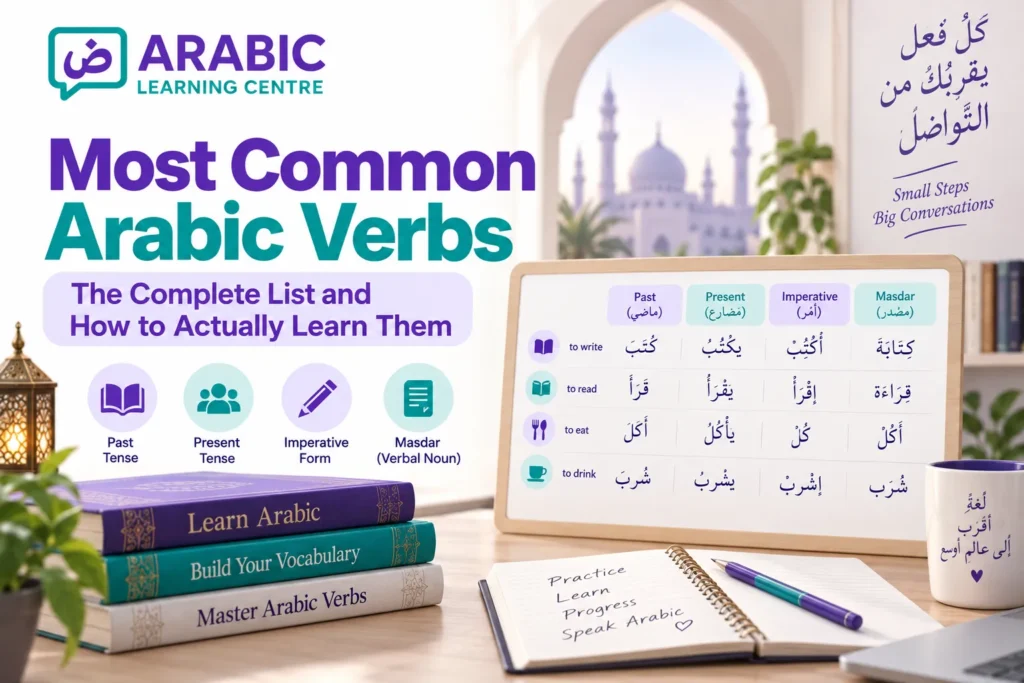
Arabic verbs are at the heart of everyday communication. Whether you want to describe what you did yesterday, explain what you are doing now, ask someone to do something, or understand Arabic conversations and texts, verbs appear everywhere.
The challenge for beginners is that learning an Arabic verb involves more than memorizing a single translation.
A verb can appear in several forms depending on tense and use, which means recognizing only one form may not be enough when you encounter the same verb in a sentence or conversation.
Learning the main forms together — while paying attention to the root and recurring verb patterns — makes it much easier to recognize familiar vocabulary in different contexts.
This guide brings together 100 of the most common Arabic verbs with their meanings in English and their essential forms: past, present, imperative, and masdar.
You will also learn how Arabic verb patterns work, which verbs are worth learning first, and practical ways to remember them so you can move beyond memorizing an Arabic verbs list and start using these verbs with greater confidence.
Why Do You Need All Four Verb Forms From Day One?
Arabic is built around a root-based system, where a single three-letter root can generate an entire family of related words. For example, the root ك-ت-ب gives you كَتَبَ (wrote), كِتَاب (book), كَاتِب (writer), مَكْتَبَة (library), and مَكْتُوب (written).
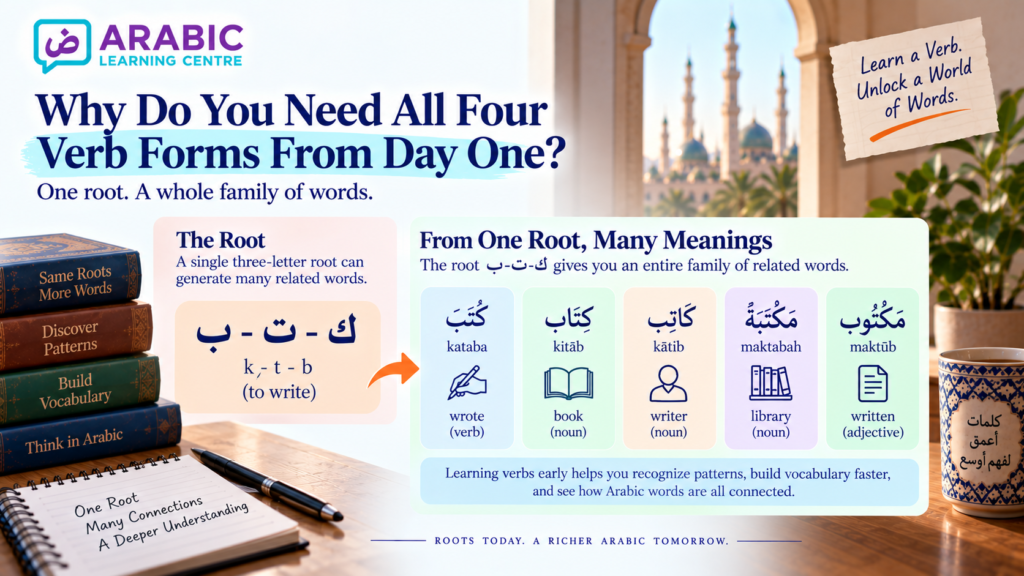
This is why learning verbs early is so useful. When you learn a verb and recognize its root, you are not simply memorizing one word; you are gaining a pattern that can help you recognize related nouns, adjectives, and other derived forms.
Over time, this makes Arabic vocabulary feel less like a collection of unrelated words and more like an interconnected system built around familiar roots.
The Four Forms Every Arabic Verb Takes
Every Arabic verb appears in four core forms, and you need all four to actually use the language — recognizing the past tense alone won’t help you understand a sentence spoken in the present.
| Form | Arabic Term | Example (to write) |
| Past (ماضي) | الفعل الماضي | كَتَبَ |
| Present (مضارع) | الفعل المضارع | يَكْتُبُ |
| Imperative (أمر) | فعل الأمر | اُكْتُبْ |
| Verbal Noun (مصدر) | المصدر | كِتَابَة |
The Mistake Most Learners Make
Many beginners memorize only the past-tense form of an Arabic verb because this is often the form they encounter first in dictionaries and vocabulary lists. The problem appears when the same verb occurs in a different form during reading or conversation.
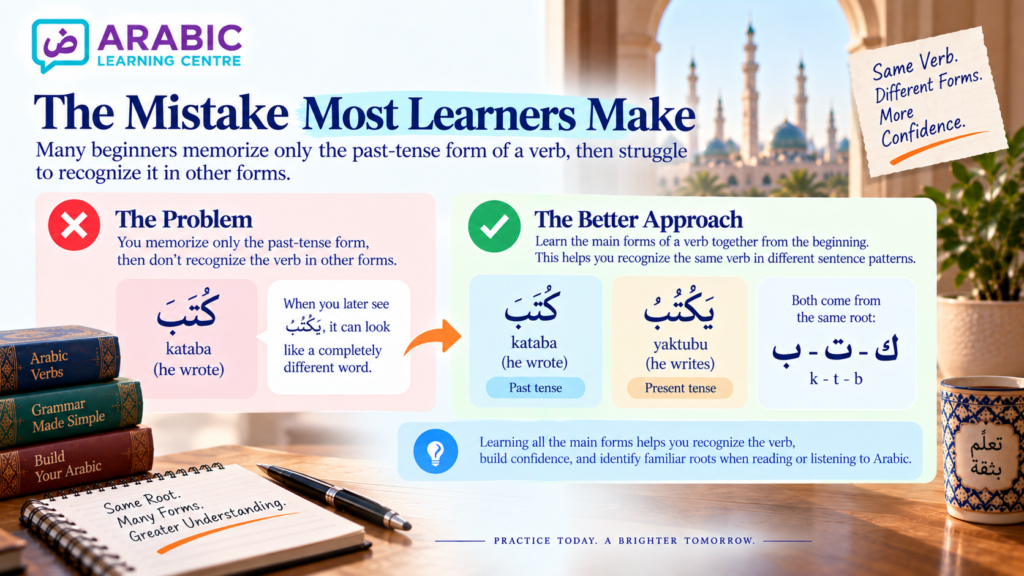
For example:
- كَتَبَ — he wrote
- يَكْتُبُ — he writes
Both come from the same root, ك-ت-ب, but the present tense introduces a prefix and a different vowel pattern. For a beginner who has memorized only كَتَبَ, these changes can make يَكْتُبُ look like an entirely different word.
This is why it is more useful to learn the main forms of a verb together from the beginning. Doing so helps you recognize the same verb across different sentence patterns and makes it easier to identify familiar roots when reading or listening to Arabic.
The 100 Most Common Arabic Verbs, Organized by Category
The 100 most common Arabic verbs below are organized by theme so related words reinforce each other as you learn them.
Each entry includes the English meaning and four essential Arabic forms — past, present, imperative, and masdar — with full tashkeel (vowel markings) to support accurate pronunciation.
Rather than trying to memorize the entire Arabic verbs list at once, work through one category at a time. Start with everyday actions and communication verbs, then gradually move to movement, thinking, work, relationships, and other common situations.
Daily Life & Action Verbs
These are some of the highest-frequency verbs in everyday Arabic. For beginners looking for 20 verbs in Arabic with meaning, this section is a practical place to start.
| English | Past (ماضي) | Present (مضارع) | Imperative (أمر) | Masdar (مصدر) |
| to write | كَتَبَ | يَكْتُبُ | اُكْتُبْ | كِتَابَة |
| to read | قَرَأَ | يَقْرَأُ | اِقْرَأْ | قِرَاءَة |
| to eat | أَكَلَ | يَأْكُلُ | كُلْ | أَكْل |
| to drink | شَرِبَ | يَشْرَبُ | اِشْرَبْ | شُرْب |
| to sleep | نَامَ | يَنَامُ | نَمْ | نَوْم |
| to wake up | صَحَا | يَصْحُو | اِصْحُ | صَحْو |
| to sit | جَلَسَ | يَجْلِسُ | اِجْلِسْ | جُلُوس |
| to stand | وَقَفَ | يَقِفُ | قِفْ | وُقُوف |
| to open | فَتَحَ | يَفْتَحُ | اِفْتَحْ | فَتْح |
| to close | أَغْلَقَ | يُغْلِقُ | أَغْلِقْ | إِغْلَاق |
| to enter | دَخَلَ | يَدْخُلُ | اُدْخُلْ | دُخُول |
| to exit | خَرَجَ | يَخْرُجُ | اُخْرُجْ | خُرُوج |
| to use | اِسْتَخْدَمَ | يَسْتَخْدِمُ | اِسْتَخْدِمْ | اِسْتِخْدَام |
| to work | عَمِلَ | يَعْمَلُ | اِعْمَلْ | عَمَل |
| to study | دَرَسَ | يَدْرُسُ | اُدْرُسْ | دِرَاسَة |
| to teach | عَلَّمَ | يُعَلِّمُ | عَلِّمْ | تَعْلِيم |
| to clean | نَظَّفَ | يُنَظِّفُ | نَظِّفْ | تَنْظِيف |
| to cook | طَبَخَ | يَطْبُخُ | اُطْبُخْ | طَبْخ |
| to buy | اِشْتَرَى | يَشْتَرِي | اِشْتَرِ | شِرَاء |
| to sell | بَاعَ | يَبِيعُ | بِعْ | بَيْع |
Learning verbs such as كَتَبَ (to write) and قَرَأَ (to read) becomes more useful when you practise them in complete sentences rather than memorizing them in isolation. If you want to develop this skill further, the Arabic Writing Course at Arabic Learning Centre helps learners practise written Arabic while improving vocabulary, sentence structure, and accurate expression.

Movement & Travel Verbs
These verbs describe going somewhere, arriving, leaving, or moving through space, making them especially useful for directions, travel, and everyday conversation.
| English | Past (ماضي) | Present (مضارع) | Imperative (أمر) | Masdar (مصدر) |
| to go | ذَهَبَ | يَذْهَبُ | اِذْهَبْ | ذَهَاب |
| to come | جَاءَ | يَجِيءُ | تَعَالَ | مَجِيء |
| to travel | سَافَرَ | يُسَافِرُ | سَافِرْ | سَفَر |
| to return | رَجَعَ | يَرْجِعُ | اِرْجِعْ | رُجُوع |
| to walk | مَشَى | يَمْشِي | اِمْشِ | مَشْي |
| to run | رَكَضَ | يَرْكُضُ | اُرْكُضْ | رَكْض |
| to arrive | وَصَلَ | يَصِلُ | صِلْ | وُصُول |
| to leave | غَادَرَ | يُغَادِرُ | غَادِرْ | مُغَادَرَة |
| to carry | حَمَلَ | يَحْمِلُ | اِحْمِلْ | حَمْل |
| to send | أَرْسَلَ | يُرْسِلُ | أَرْسِلْ | إِرْسَال |
| to receive | اِسْتَقْبَلَ | يَسْتَقْبِلُ | اِسْتَقْبِلْ | اِسْتِقْبَال |
| to cross | عَبَرَ | يَعْبُرُ | اُعْبُرْ | عُبُور |
| to climb | صَعِدَ | يَصْعَدُ | اِصْعَدْ | صُعُود |
| to descend | نَزَلَ | يَنْزِلُ | اِنْزِلْ | نُزُول |
| to ride | رَكِبَ | يَرْكَبُ | اِرْكَبْ | رُكُوب |
Communication & Speech Verbs
These verbs carry everyday conversations, from speaking and listening to asking questions, answering, and explaining ideas.
| English | Past (ماضي) | Present (مضارع) | Imperative (أمر) | Masdar (مصدر) |
| to speak | تَكَلَّمَ | يَتَكَلَّمُ | تَكَلَّمْ | كَلَام |
| to say | قَالَ | يَقُولُ | قُلْ | قَوْل |
| to ask | سَأَلَ | يَسْأَلُ | اِسْأَلْ | سُؤَال |
| to answer | أَجَابَ | يُجِيبُ | أَجِبْ | إِجَابَة |
| to listen | اِسْتَمَعَ | يَسْتَمِعُ | اِسْتَمِعْ | اِسْتِمَاع |
| to hear | سَمِعَ | يَسْمَعُ | اِسْمَعْ | سَمَاع |
| to tell | أَخْبَرَ | يُخْبِرُ | أَخْبِرْ | إِخْبَار |
| to call | نَادَى | يُنَادِي | نَادِ | نِدَاء |
| to translate | تَرْجَمَ | يُتَرْجِمُ | تَرْجِمْ | تَرْجَمَة |
| to explain | شَرَحَ | يَشْرَحُ | اُشْرَحْ | شَرْح |
| to describe | وَصَفَ | يَصِفُ | صِفْ | وَصْف |
| to confirm | أَكَّدَ | يُؤَكِّدُ | أَكِّدْ | تَأْكِيد |
| to promise | وَعَدَ | يَعِدُ | عِدْ | وَعْد |
| to greet | سَلَّمَ | يُسَلِّمُ | سَلِّمْ | تَسْلِيم |
| to congratulate | هَنَّأَ | يُهَنِّئُ | هَنِّئْ | تَهْنِئَة |
Thinking, Feeling & Mental Verbs
These are among the most common Arabic verbs with meaning connected to thoughts, emotions, memory, decisions, and personal preferences.
| English | Past (ماضي) | Present (مضارع) | Imperative (أمر) | Masdar (مصدر) |
| to know | عَرَفَ | يَعْرِفُ | اِعْرِفْ | مَعْرِفَة |
| to understand | فَهِمَ | يَفْهَمُ | اِفْهَمْ | فَهْم |
| to think | فَكَّرَ | يُفَكِّرُ | فَكِّرْ | تَفْكِير |
| to believe | اِعْتَقَدَ | يَعْتَقِدُ | اِعْتَقِدْ | اِعْتِقَاد |
| to remember | تَذَكَّرَ | يَتَذَكَّرُ | تَذَكَّرْ | تَذَكُّر |
| to forget | نَسِيَ | يَنْسَى | اِنْسَ | نِسْيَان |
| to learn | تَعَلَّمَ | يَتَعَلَّمُ | تَعَلَّمْ | تَعَلُّم |
| to decide | قَرَّرَ | يُقَرِّرُ | قَرِّرْ | تَقْرِير |
| to choose | اِخْتَارَ | يَخْتَارُ | اِخْتَرْ | اِخْتِيَار |
| to want | أَرَادَ | يُرِيدُ | أَرِدْ | إِرَادَة |
| to love | أَحَبَّ | يُحِبُّ | أَحِبَّ | حُبّ |
| to hate | كَرِهَ | يَكْرَهُ | اِكْرَهْ | كَرَاهِيَة |
| to fear | خَافَ | يَخَافُ | خَفْ | خَوْف |
| to hope | أَمَلَ | يَأْمَلُ | أَمِلْ | أَمَل |
| to feel | أَحَسَّ | يُحِسُّ | أَحِسَّ | إِحْسَاس |
| to enjoy | اِسْتَمْتَعَ | يَسْتَمْتِعُ | اِسْتَمْتِعْ | اِسْتِمْتَاع |
| to trust | وَثِقَ | يَثِقُ | ثِقْ | ثِقَة |
| to doubt | شَكَّ | يَشُكُّ | شُكَّ | شَكّ |
| to expect | تَوَقَّعَ | يَتَوَقَّعُ | تَوَقَّعْ | تَوَقُّع |
| to surprise | فَاجَأَ | يُفَاجِئُ | فَاجِئْ | مُفَاجَأَة |
Work, Creation & Achievement Verbs
These verbs are useful for discussing work, study, projects, goals, and everyday tasks.
| English | Past (ماضي) | Present (مضارع) | Imperative (أمر) | Masdar (مصدر) |
| to create | خَلَقَ | يَخْلُقُ | اُخْلُقْ | خَلْق |
| to make / do | فَعَلَ | يَفْعَلُ | اِفْعَلْ | فِعْل |
| to build | بَنَى | يَبْنِي | اِبْنِ | بِنَاء |
| to design | صَمَّمَ | يُصَمِّمُ | صَمِّمْ | تَصْمِيم |
| to produce | أَنْتَجَ | يُنْتِجُ | أَنْتِجْ | إِنْتَاج |
| to develop | طَوَّرَ | يُطَوِّرُ | طَوِّرْ | تَطْوِير |
| to organize | نَظَّمَ | يُنَظِّمُ | نَظِّمْ | تَنْظِيم |
| to manage | أَدَارَ | يُدِيرُ | أَدِرْ | إِدَارَة |
| to achieve | حَقَّقَ | يُحَقِّقُ | حَقِّقْ | تَحْقِيق |
| to complete | أَكْمَلَ | يُكْمِلُ | أَكْمِلْ | إِكْمَال |
| to start | بَدَأَ | يَبْدَأُ | اِبْدَأْ | بِدَايَة |
| to finish | أَنْهَى | يُنْهِي | أَنْهِ | إِنْهَاء |
| to try | حَاوَلَ | يُحَاوِلُ | حَاوِلْ | مُحَاوَلَة |
| to succeed | نَجَحَ | يَنْجَحُ | اِنْجَحْ | نَجَاح |
| to improve | حَسَّنَ | يُحَسِّنُ | حَسِّنْ | تَحْسِين |
Social & Relational Verbs
The final group covers actions you regularly use when interacting with other people, including meeting, helping, giving, agreeing, and thanking.
| English | Past (ماضي) | Present (مضارع) | Imperative (أمر) | Masdar (مصدر) |
| to meet | قَابَلَ | يُقَابِلُ | قَابِلْ | مُقَابَلَة |
| to visit | زَارَ | يَزُورُ | زُرْ | زِيَارَة |
| to invite | دَعَا | يَدْعُو | اُدْعُ | دَعْوَة |
| to help | سَاعَدَ | يُسَاعِدُ | سَاعِدْ | مُسَاعَدَة |
| to support | دَعَمَ | يَدْعَمُ | اُدْعَمْ | دَعْم |
| to protect | حَمَى | يَحْمِي | اِحْمِ | حِمَايَة |
| to give | أَعْطَى | يُعْطِي | أَعْطِ | إِعْطَاء |
| to take | أَخَذَ | يَأْخُذُ | خُذْ | أَخْذ |
| to share | شَارَكَ | يُشَارِكُ | شَارِكْ | مُشَارَكَة |
| to cooperate | تَعَاوَنَ | يَتَعَاوَنُ | تَعَاوَنْ | تَعَاوُن |
| to agree | وَافَقَ | يُوَافِقُ | وَافِقْ | مُوَافَقَة |
| to disagree | اِخْتَلَفَ | يَخْتَلِفُ | اِخْتَلِفْ | اِخْتِلَاف |
| to forgive | غَفَرَ | يَغْفِرُ | اِغْفِرْ | مَغْفِرَة |
| to thank | شَكَرَ | يَشْكُرُ | اُشْكُرْ | شُكْر |
| to apologize | اِعْتَذَرَ | يَعْتَذِرُ | اِعْتَذِرْ | اِعْتِذَار |
Don’t Just Take Our Word For It
Take a look inside our vibrant classes and see our students and teachers in action. Click below to watch our classroom experience:
How Arabic Verb Patterns (Awzān) Multiply Your Vocabulary?
Arabic verbs follow a finite set of patterns called أوزان (awzān — literally “weights” or molds). Once you recognize a pattern, you can predict the conjugation of a brand-new verb without memorizing it from scratch — this is the multiplier most vocabulary lists never mention.
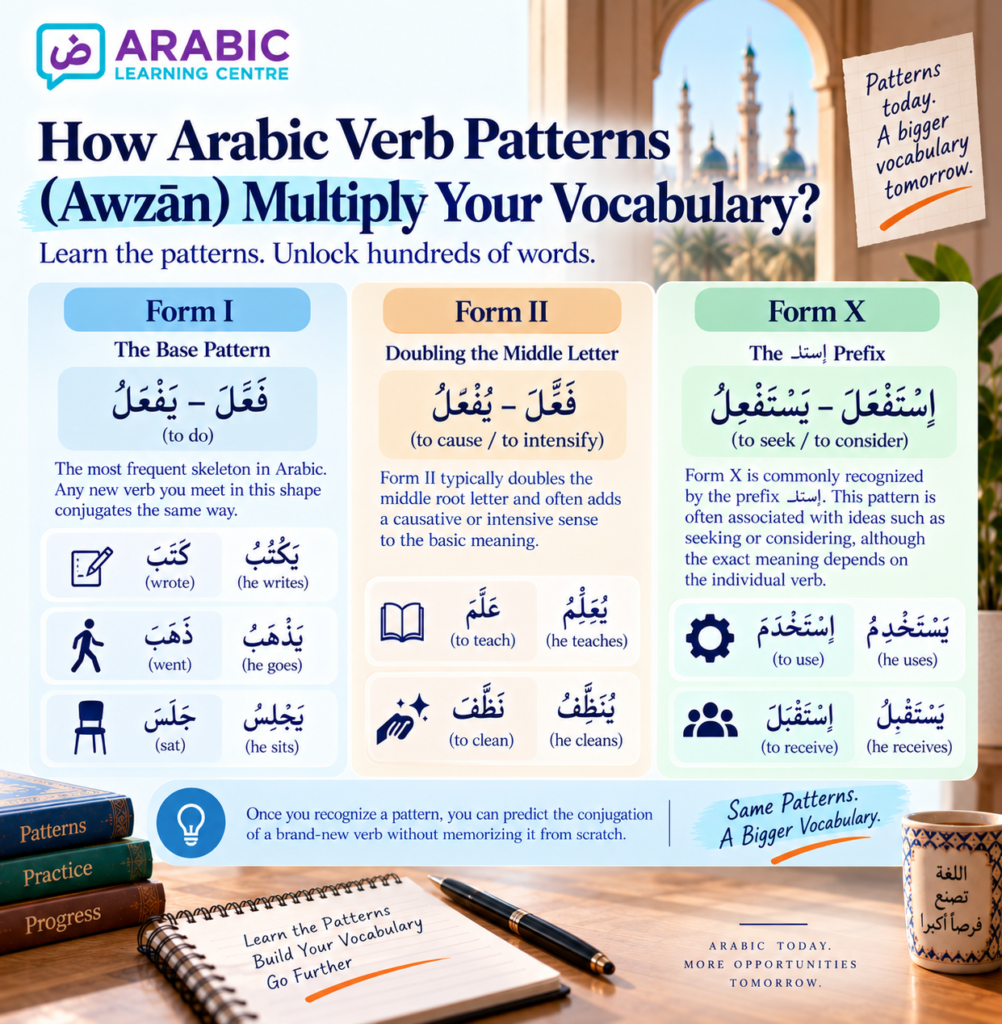
The Base Pattern: فَعَلَ – يَفْعَلُ
This is the Form I verb, the most frequent skeleton in Arabic.
كَتَبَ (wrote), ذَهَبَ (went), and جَلَسَ (sat) all follow it. Any new verb you meet in this same shape conjugates the same way — you already know the rule before you’ve seen the word.
Recognizing Form II and Form X
Other verb forms add recognizable features to the root. Form II typically doubles the middle root letter, as in عَلَّمَ (to teach) and نَظَّفَ (to clean), and often adds a causative or intensive sense to the basic meaning.
Form X is commonly recognized by the prefix اِسْتَـ, as in اِسْتَخْدَمَ (to use) and اِسْتَقْبَلَ (to receive). Historically and morphologically, this pattern is often associated with ideas such as seeking or considering, although the exact meaning depends on the individual verb.
Learners who want to build this foundation systematically can explore the Fusha Arabic Course at Arabic Learning Centre, which develops vocabulary and grammar alongside the practical language skills needed to use Arabic with greater confidence.

The Top 10 Arabic Verbs to Learn First
If you’re starting from zero, these ten verbs appear in nearly every Arabic conversation and text. Learn them completely — all four forms — before moving to the rest of the list.
| # | English | Past | Present | Imperative | Masdar |
| 1 | to be | كَانَ | يَكُونُ | كُنْ | كَوْن |
| 2 | to say | قَالَ | يَقُولُ | قُلْ | قَوْل |
| 3 | to go | ذَهَبَ | يَذْهَبُ | اِذْهَبْ | ذَهَاب |
| 4 | to come | جَاءَ | يَجِيءُ | تَعَالَ | مَجِيء |
| 5 | to want | أَرَادَ | يُرِيدُ | أَرِدْ | إِرَادَة |
| 6 | to know | عَرَفَ | يَعْرِفُ | اِعْرِفْ | مَعْرِفَة |
| 7 | to see | رَأَى | يَرَى | رَ | رُؤْيَة |
| 8 | to do / make | فَعَلَ | يَفْعَلُ | اِفْعَلْ | فِعْل |
| 9 | to give | أَعْطَى | يُعْطِي | أَعْطِ | إِعْطَاء |
| 10 | to understand | فَهِمَ | يَفْهَمُ | اِفْهَمْ | فَهْم |
How to Remember Arabic Verb Forms More Easily?
Memorizing an Arabic verb becomes easier when you connect both its sound and meaning instead of treating each form as a separate vocabulary item.
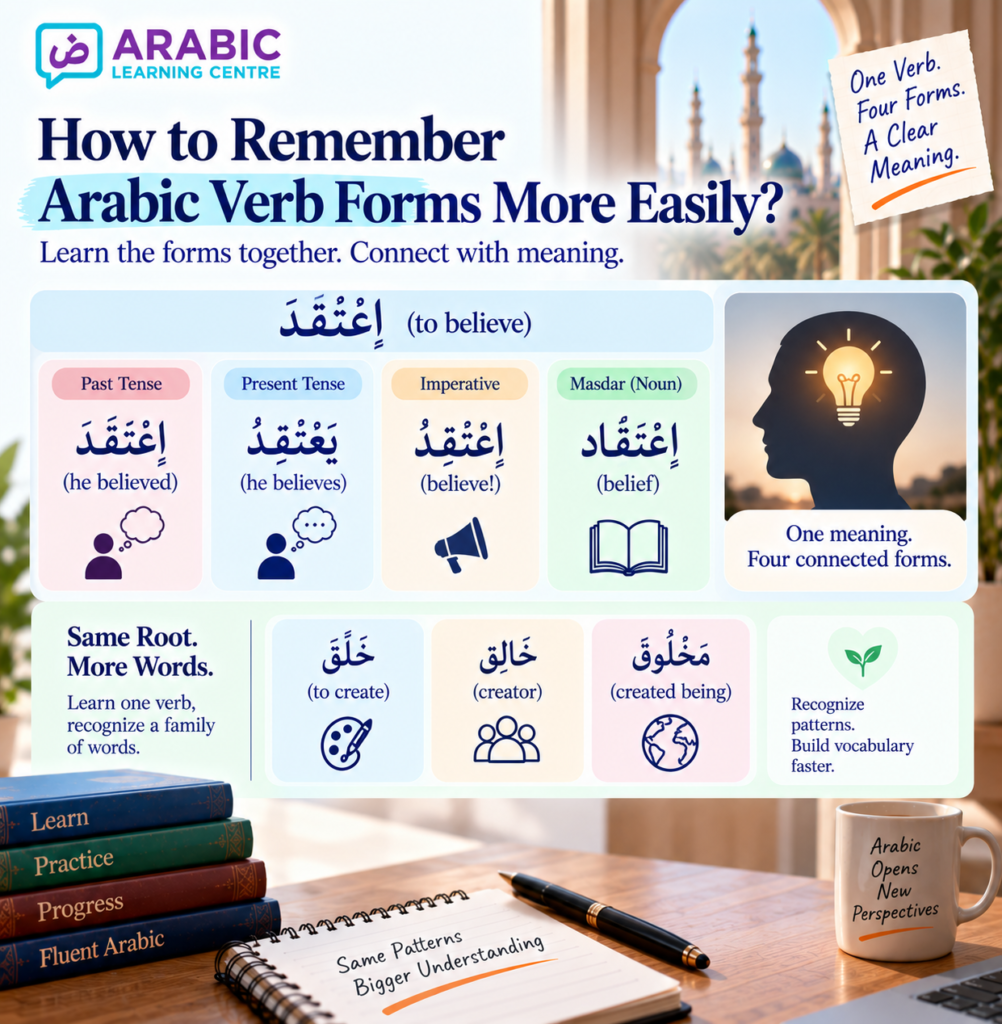
A useful approach is to learn the past, present, imperative, and masdar together, then connect those forms to one clear meaning or mental image.
Learn the Four Forms as One Sound Pattern
Say all four forms aloud as a single sequence. For example, with اِعْتَقَدَ (to believe), practise:
اِعْتَقَدَ – يَعْتَقِدُ – اِعْتَقِدْ – اِعْتِقَاد
Repeating the forms together helps you notice the shared root and recurring sounds. Instead of memorizing four unrelated words, you begin to recognize them as different forms of the same verb.
Connect the Verb to a Clear Meaning
Next, associate the verb with a simple idea, situation, or image rather than relying only on its English translation. The stronger the connection between the Arabic word and its meaning, the easier it becomes to recall without translating mentally from English.
This approach also helps you recognize related vocabulary. For example, learning خَلَقَ (to create) can make words built from the same root easier to identify, such as خَالِق (creator) and مَخْلُوق (created being).
Inside Our Classrooms
See how we make learning interactive and engaging! Watch a quick snippet of our live, conversational classes in action:
Turn Arabic Vocabulary Into Real Communication
Learning the 100 most common Arabic verbs gives you a strong vocabulary foundation, but memorizing a list is only the beginning.
To use these verbs confidently, you need to hear them pronounced correctly, understand how their forms change, build sentences with them, and practise using them in real conversations.
At Arabic Learning Centre, structured Arabic courses help you develop these skills with guidance from experienced teachers. Instead of studying vocabulary, grammar, pronunciation, and speaking as separate subjects, you learn how they work together in practical Arabic.
Whether you are starting from the basics or want to become more confident using the Arabic you already know, guided lessons can help you turn memorized vocabulary into language you can actually understand and use.
Start your free trial with Arabic Learning Centre and begin building practical Arabic skills with structured, teacher-led learning.
Courses We Offer:
- Arabic Course for Beginners
- Arabic Classes for Adults
- Arabic Classes for Ladies
- Advanced Arabic Course
- Intensive Arabic Course

Conclusion
The most common Arabic verbs aren’t just vocabulary items — they’re the structural core of the language. Every sentence you want to read or produce runs through this list. Learning all four forms for each verb from the start isn’t extra work; it’s the more efficient path, because you learn the word completely the first time instead of revisiting it three more times later.
The pattern system (أوزان) is your multiplier: once you notice that اِسْتَخْدَمَ, اِسْتَمَعَ, and اِسْتَقْبَلَ all share the Form X اِسْتَ structure, you have a predictive tool that unlocks hundreds of verbs beyond this list. Start with the top 10, work through the 200 by category, and use the sound-and-meaning method to make each one genuinely retrievable rather than vaguely familiar.
Frequently Asked Questions
How many Arabic verbs do I need to know to hold a basic conversation?
A working vocabulary of 200–300 verbs covers most everyday Arabic communication, since high-frequency words like the ones on this list make up the bulk of natural speech and text. Start with the top 20 from this guide and expand from there in order of frequency.
What is the difference between the masdar and the verbal noun in Arabic?
The masdar (مصدر) is the Arabic verbal noun — the two terms describe the same grammatical form. It works like the English infinitive-as-noun: كِتَابَة means “writing” as a concept or action, and it’s used after prepositions and as a subject in structures where English would use “to + verb.”
Why do Arabic verbs look so different in the past and present tense?
Arabic changes verbs by adding prefixes and suffixes to the root rather than inserting helper words the way English does. The root ك-ت-ب carries the meaning “write,” but كَتَبَ (past) adds suffixes only, while يَكْتُبُ (present) adds a prefix (يـ) and a suffix (ـُ). Learning the root and all four forms together is what makes both versions recognizable at once.
Is Quranic Arabic the same as the verbs in this list?
Most high-frequency verbs in this list appear in the Quran, since classical and Modern Standard Arabic share the same core verb stock. Some Quranic verbs do appear in less common conjugations with specific theological meanings, such as تَدَبَّرَ (to reflect deeply) — a dedicated Quranic Arabic vocabulary course builds on this same foundation with those additional usages.
How long does it take to memorize 200 Arabic verbs?
At a pace of ten new verbs a day with active review, covering all 200 takes roughly three to four weeks. Retention is the harder part: spaced repetition — reviewing a verb one day later, then three days later, then a week later — is what converts short-term recognition into long-term recall, especially when you review all four forms each time rather than just the past tense.
What is the best way to practice Arabic verbs beyond memorization?
Using verbs in original sentences is the step most learners skip, and it’s the one that matters most. Write five sentences a day using that day’s new verbs, then have a teacher or speaking partner confirm whether they’re grammatically correct. Recognizing a word on a list and producing it correctly in context are different skills, and you need both.
Related Articles
Arabic Vocabulary & Speaking