 Arabic Grammar
Pronouns are everywhere in Arabic. They allow you to say “I,” “you,” “he,” “she,” “our,” “their,” “this,” and “who” without repeating the same nouns again and again. Once you begin forming real Arabic sentences, it becomes almost impossible to avoid them.
For beginners, however, pronouns in Arabic grammar can initially feel more complicated than their English equivalents. Arabic distinguishes between masculine and feminine forms, has special forms for exactly two people, and often attaches pronouns directly to nouns, verbs, and prepositions.
The good news is that the system becomes much easier once you understand the basic patterns.
In this guide, you will learn the main types of Arabic pronouns, how detached and attached pronouns work, how they interact with verbs and possession, and how to avoid the most common mistakes learners make.
What Are Pronouns in Arabic Grammar?
A pronoun is a word that refers to a person, thing, or previously mentioned noun without repeating that noun every time. In Arabic, the general word for pronoun is ضَمِير (ḍamīr), with the plural ضَمَائِر (ḍamāʾir).
Consider the difference:
مُحَمَّدٌ ذَهَبَ إِلَى مَدْرَسَةِ مُحَمَّدٍ “Muhammad went to Muhammad’s school.”
Repeating مُحَمَّد sounds unnatural. Arabic can replace the repeated noun with a pronoun:
مُحَمَّدٌ ذَهَبَ إِلَى مَدْرَسَتِهِ Muḥammadun dhahaba ilā madrasatihi — “Muhammad went to his school.”
The suffix ـهِ replaces “Muhammad’s” and expresses possession.
Arabic pronouns are especially important because they can indicate:
- Person — first, second, or third person
- Number — singular, dual, or plural
- Gender — masculine or feminine
- Function — subject, object, possession, or the object of a preposition
Understanding these distinctions makes it much easier to build accurate Arabic sentences
The Main Types of Pronouns in Arabic Grammar
For practical learning, Arabic pronouns can be discussed through several major groups:
| Type | Examples |
| Personal pronouns | أنا، أنتَ، هو، هي |
| Attached pronouns | ـي، ـكَ، ـهُ، ـها |
| Demonstrative forms | هذا، هذه، ذلك، تلك |
| Relative pronouns | الذي، التي، الذين |
| Interrogative forms | من، ما، أي |
Some words commonly called “pronouns” in English-language Arabic courses — such as demonstratives and relative pronouns — are traditionally classified as types of nouns (أسماء) in Arabic grammar.
For beginners, grouping them together is still useful because they perform many of the same reference functions that English pronouns do.
Arabic Personal Pronouns for Person, Gender, and Number
Personal pronouns identify the speaker, the person being addressed, or another person or thing being discussed. Unlike English, Arabic personal pronouns change according to person, gender, and number.
| Person | Arabic | Transliteration | Meaning |
| 1st singular | أَنَا | anā | I |
| 1st plural | نَحْنُ | naḥnu | We |
| 2nd masc. singular | أَنْتَ | anta | You |
| 2nd fem. singular | أَنْتِ | anti | You |
| 2nd dual | أَنْتُمَا | antumā | You two |
| 2nd masc. plural | أَنْتُمْ | antum | You all |
| 2nd fem. plural | أَنْتُنَّ | antunna | You all |
| 3rd masc. singular | هُوَ | huwa | He / it |
| 3rd fem. singular | هِيَ | hiya | She / it |
| 3rd dual | هُمَا | humā | They two |
| 3rd masc. plural | هُمْ | hum | They |
| 3rd fem. plural | هُنَّ | hunna | They |
These pronouns stand independently rather than attaching to another word:
- أَنَا طَالِبٌ — Anā ṭālibun — “I am a student.”
- أَنْتِ مُعَلِّمَةٌ — Anti muʿallimatun — “You are a teacher.”
- هُوَ طَبِيبٌ — Huwa ṭabībun — “He is a doctor.”
- نَحْنُ فِي المَدْرَسَةِ — Naḥnu fī al-madrasati — “We are at school.”
These detached forms are especially common in nominal sentences and when the speaker wants to emphasize who is being discussed.
Why Arabic Has Five Different Words for English “You”
English uses the same word “you” for one person, two people, or an entire group. Arabic distinguishes between them:
- أَنْتَ — you, one male
- أَنْتِ — you, one female
- أَنْتُمَا — you two
- أَنْتُمْ — you, masculine or mixed plural
- أَنْتُنَّ — you, feminine plural
Arabic also has a special dual (المثنى) category for exactly two people:
- هُمَا طَالِبَانِ — Humā ṭālibāni — “They are two students.”
- هُمْ طُلَّابٌ — Hum ṭullābun — “They are students.”
The distinction matters: هُمَا refers specifically to two, while هُمْ refers to a plural group.
Detached vs. Attached Pronouns in Arabic
One of the most important distinctions in pronouns in Arabic grammar is between detached pronouns (الضمائر المنفصلة) and attached pronouns (الضمائر المتصلة).
Detached Pronouns
Detached pronouns function as independent words:
أَنَا — I
هُوَ — he
هِيَ — she
نَحْنُ — we
For example:
هِيَ مُعَلِّمَةٌ
Hiya muʿallimatun — “She is a teacher.”
Here, هِيَ stands by itself.
Attached Pronouns
Attached pronouns cannot normally stand alone. Instead, they are added as suffixes to another word.
| Meaning | Attached Form |
| My / me | ـي / ـنِي |
| Our / us | ـنَا |
| Your, masculine | ـكَ |
| Your, feminine | ـكِ |
| Your, dual | ـكُمَا |
| Your, masculine plural | ـكُمْ |
| Your, feminine plural | ـكُنَّ |
| His / him | ـهُ |
| Her | ـهَا |
| Their, dual | ـهُمَا |
| Their, masculine plural | ـهُمْ |
| Their, feminine plural | ـهُنَّ |
Their exact meaning depends on what they are attached to — this distinction is essential.
How Attached Pronouns Show Possession in Arabic?
Arabic does not normally need a separate word equivalent to English “my” or “his” — ownership is attached directly to the noun:
- هَذَا كِتَابِي — Hādhā kitābī — “This is my book.”
- بَيْتُهَا كَبِيرٌ — Baytuhā kabīrun — “Her house is big.”
| Arabic | Transliteration | Meaning |
| كِتَابِي | Kitābī | my book |
| كِتَابُكَ | Kitābuka | your book |
| كِتَابُهُ | Kitābuhu | his book |
| كِتَابُهَا | Kitābuhā | her book |
| كِتَابُنَا | Kitābunā | our book |
| كِتَابُهُمْ | Kitābuhum | their book |
How Attached Pronouns Show Possession in Arabic
An attached pronoun added to a verb often represents the person receiving the action:
- رَأَيْتُهُ — Raʾaytuhu — “I saw him.” (رَأَيْتُ = I saw, ـهُ = him)
- سَاعَدْتُهَا — Sāʿadtuhā — “I helped her.”
- أَعْطَانِي الكِتَابَ — Aʿṭānī al-kitāba — “He gave me the book.”
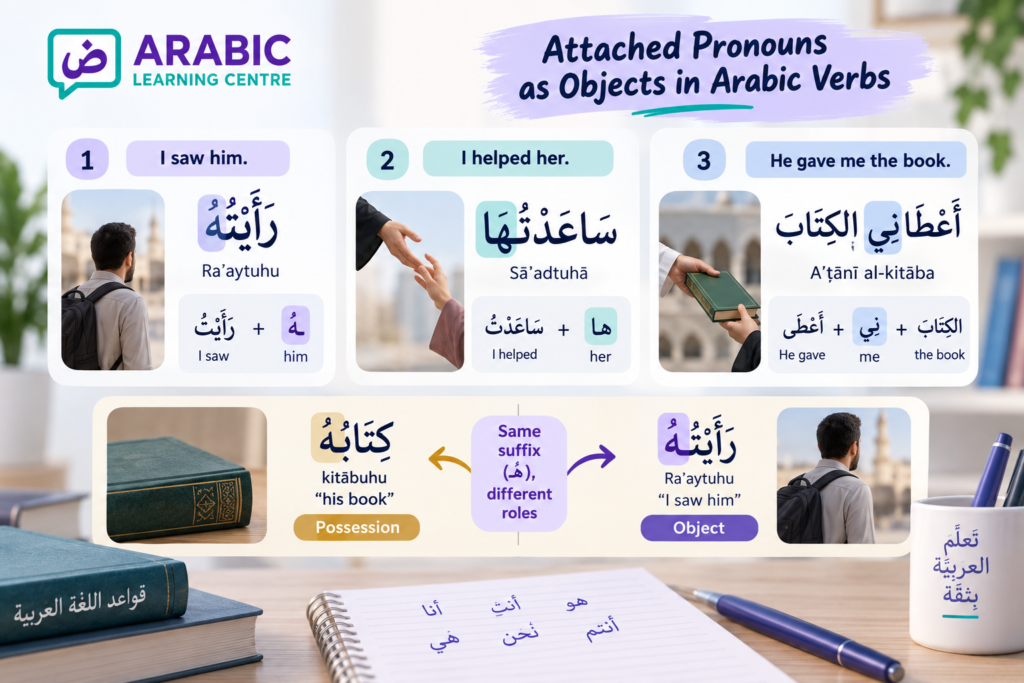
Compare the same suffix in two roles:
- كِتَابُهُ — his book (possession)
- رَأَيْتُهُ — I saw him (object)
How Attached Pronouns Work as Verb Objects
In Arabic, attached pronouns can be added directly to prepositions to show who or what the preposition refers to.
- مَعِي — Maʿī — “with me”
- مَعَكَ — Maʿaka — “with you”
- مَعَهُ — Maʿahu — “with him”
- عَلَيْهَا — ʿAlayhā — “on her / on it”
- مِنْهُمْ — Minhum — “from them”
Unlike English, which normally uses a preposition followed by a separate pronoun, Arabic often combines them into a single form. For example, مَعَ + ي = مَعِي (“with me”) and مِنْ + هُمْ = مِنْهُمْ (“from them”).
Practising common combinations such as مَعِي، مَعَكَ، لَهُ، مِنْهَا in complete sentences and everyday dialogues can help learners recognize and use these forms naturally without translating them word by word.
Learning these combinations is particularly useful for conversation. In a structured Arabic speaking course, practising forms such as معي، معك، له، منها inside real dialogues can help them become automatic rather than something you have to consciously translate word by word.

Subject Pronouns vs. Attached Pronouns in Arabic
Subject pronouns and attached pronouns can refer to the same person, but their grammatical roles and meanings change depending on how they are used.
Consider هُوَ and ـهُ:
- هُوَ يَقْرَأُ الكِتَابَ — Huwa yaqraʾu al-kitāba — “He reads the book.” (independent subject)
- كِتَابُهُ عَلَى الطَّاوِلَةِ — Kitābuhu ʿalā aṭ-ṭāwilati — “His book is on the table.” (possession)
- رَأَيْتُهُ — Raʾaytuhu — “I saw him.” (object)
So, although هُوَ and ـهُ refer to the same person, their function—and therefore their English translation—depends on the grammatical structure in which they appear.
How Arabic Pronouns Affect Verb Conjugation
Arabic pronouns are closely connected to verb conjugation because the verb form often tells you who is performing the action.
Take يَكْتُبُ — “to write”:
| Arabic | Transliteration | Meaning |
| أَنَا أَكْتُبُ | Anā aktubu | I write |
| نَحْنُ نَكْتُبُ | Naḥnu naktubu | We write |
| هُوَ يَكْتُبُ | Huwa yaktubu | He writes |
| هِيَ تَكْتُبُ | Hiya taktubu | She writes |
| أَنْتَ تَكْتُبُ | Anta taktubu | You write |
The beginning and ending of the verb often indicate the subject, so Arabic sometimes does not need an explicitly stated subject pronoun:
- أَكْتُبُ can already mean “I write.”
- Adding أَنَا (أَنَا أَكْتُبُ) may add emphasis rather than being grammatically necessary.
How Hidden Pronouns Work Inside Arabic Verbs
In Arabic, the subject pronoun does not always appear as a separate word because the verb form itself can indicate who is performing the action.
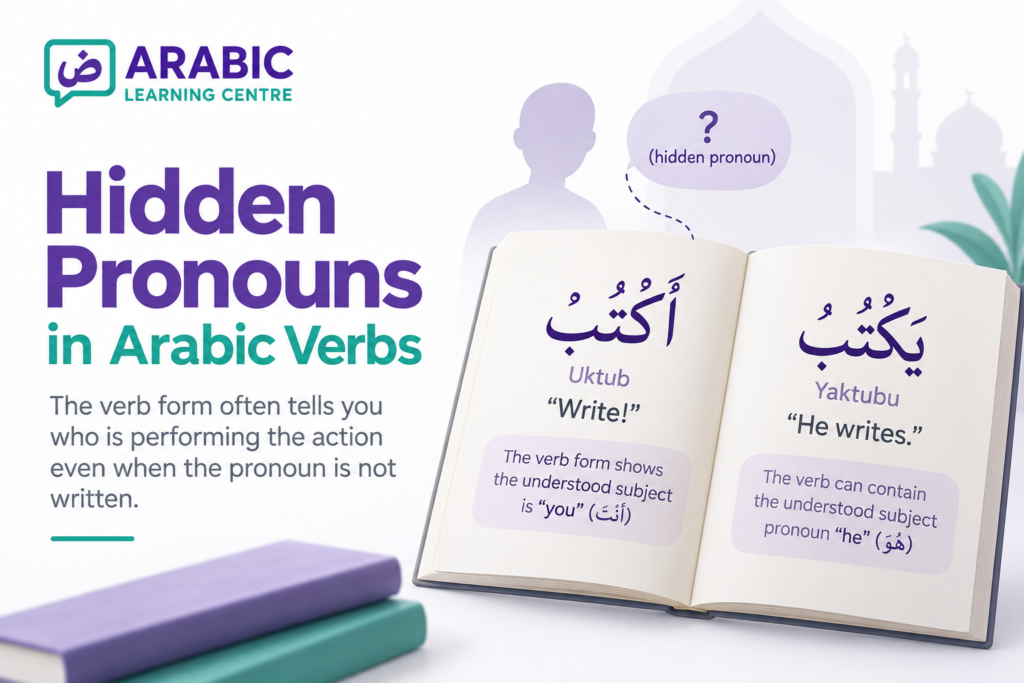
Traditional Arabic grammar calls this a hidden pronoun (ضَمِير مُسْتَتِر).
For example:
- اُكْتُبْ
Uktub — “Write!”
Although أَنْتَ (“you”) does not appear separately, the command form indicates that the understood subject is “you.” - يَكْتُبُ
Yaktubu — “He writes.”
When no explicit subject follows, the verb can contain an understood subject pronoun, هُوَ (“he”).
This shows why learning Arabic pronouns alongside verb conjugation is important: the form of the verb can often tell you who is performing the action even when no separate subject pronoun is written.
Read also: Detached Pronouns in Arabic – Complete Guide With Examples
Demonstrative Pronouns for “This,” “That,” and “These”
Demonstratives point to a specific person or thing. In Arabic grammar, they are called أَسْمَاءُ الإِشَارَة (asmāʾ al-ishārah).
The most common forms distinguish between near and far, as well as gender and number.
| Meaning | Masculine | Feminine |
| This | هَذَا | هَذِهِ |
| These two | هَذَانِ | هَاتَانِ |
| These | هَؤُلَاءِ | هَؤُلَاءِ |
| That | ذَلِكَ | تِلْكَ |
| Those two | ذَانِكَ | تَانِكَ |
| Those | أُولَئِكَ | أُولَئِكَ |
Examples:
- هَذَا كِتَابٌ — Hādhā kitābun — “This is a book.”
- هَذِهِ سَيَّارَةٌ — Hādhihi sayyāratun — “This is a car.”
- ذَلِكَ بَيْتٌ — Dhālika baytun — “That is a house.”
- تِلْكَ شَجَرَةٌ — Tilka shajaratun — “That is a tree.”
Relative Pronouns for “Who,” “Which,” and “That”
Relative pronouns introduce a clause that gives more information about a noun.
The most common forms include:
| Arabic | Transliteration | Use |
| الَّذِي | alladhī | masculine singular |
| الَّتِي | allatī | feminine singular |
| اللَّذَانِ | alladhāni | masculine dual |
| اللَّتَانِ | allatāni | feminine dual |
| الَّذِينَ | alladhīna | masculine plural |
| اللَّاتِي / اللَّوَاتِي | allātī / allawātī | feminine plural |
Examples:
- الرَّجُلُ الَّذِي جَاءَ — Ar-rajulu alladhī jāʾa — “The man who came.”
- الفَتَاةُ الَّتِي تَدْرُسُ العَرَبِيَّةَ — Al-fatātu allatī tadrusu al-ʿarabiyyata — “The girl who studies Arabic.”
The relative pronoun agrees with the noun it refers to: الرَّجُلُ (masc. sing.) → الَّذِي; الفَتَاةُ (fem. sing.) → الَّتِي.
Arabic Question Words and Interrogative Pronouns
Arabic uses several question words to ask about people, things, choices, places, and circumstances.
Some of the most common are:
| Arabic | Meaning |
| مَنْ | who? |
| مَا | what? |
| مَاذَا | what? |
| أَيّ | which? |
| أَيْنَ | where? |
| مَتَى | when? |
| كَيْفَ | how? |
Examples:
- مَنْ هَذَا؟ — Man hādhā? — “Who is this?”
- مَا هَذَا؟ — Mā hādhā? — “What is this?”
- مَاذَا تُرِيدُ؟ — Mādhā turīdu? — “What do you want?”
- أَيُّ كِتَابٍ تُرِيدُ؟ — Ayyu kitābin turīdu? — “Which book do you want?”
Inside Our Classrooms
See how we make learning interactive and engaging! Watch a quick snippet of our live, conversational classes in action:
How Pronouns Agree With Masculine and Feminine Nouns
Arabic has no gender-neutral equivalent of English “it” — non-human nouns carry grammatical gender.
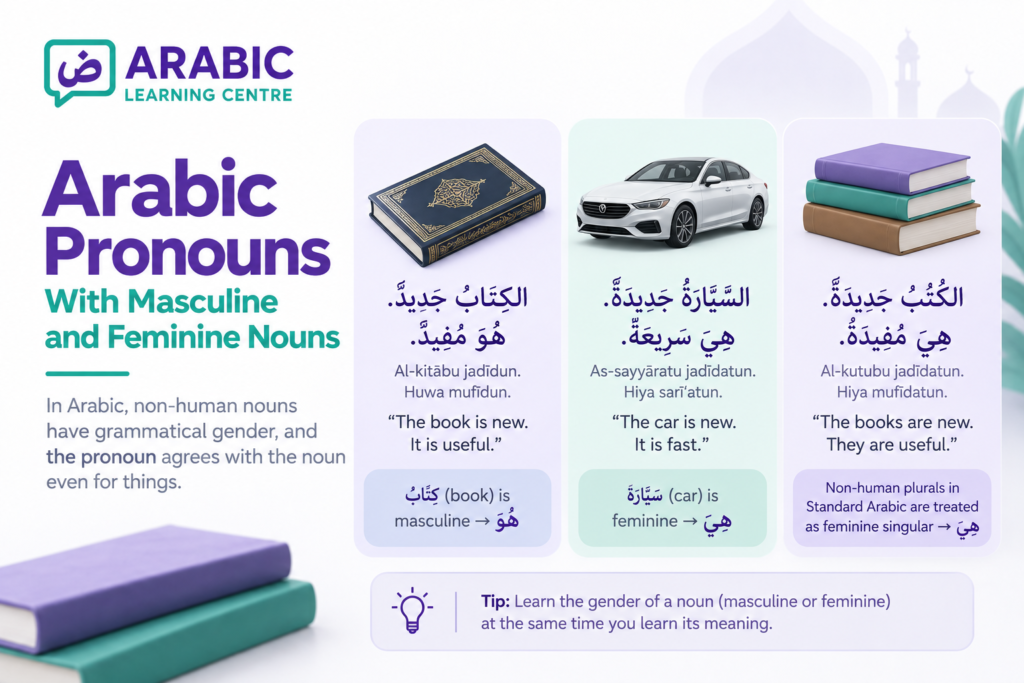
- الكِتَابُ جَدِيدٌ.
هُوَ مُفِيدٌ. — “The book is new. It is useful.” (كِتَاب is masculine → هُوَ) - السَّيَّارَةُ جَدِيدَةٌ.
هِيَ سَرِيعَةٌ. — “The car is new. It is fast.” (سَيَّارَة is feminine → هِيَ)
Learners should ideally learn the gender of a noun at the same time they learn its meaning.
Non-Human Plurals
In Standard Arabic, non-human plurals are generally treated grammatically as feminine singular for agreement:
الكُتُبُ جَدِيدَةٌ.
هِيَ مُفِيدَةٌ. Al-kutubu jadīdatun. Hiya mufīdatun. “The books are new. They are useful.”
Even though الكُتُب is plural, the pronoun هِيَ and adjective مُفِيدَة appear in the feminine singular. This rule often surprises English-speaking learners.
Read also: Hamza Arabic Letter – Pronunciation, Forms, and Writing Rules
How Pronouns Work With Non-Human Plurals
Another important rule appears with non-human plural nouns.
In Standard Arabic, non-human plurals are generally treated grammatically as feminine singular for agreement.
For example:
الكُتُبُ جَدِيدَةٌ.
هِيَ مُفِيدَةٌ.
Al-kutubu jadīdatun. Hiya mufīdatun.
“The books are new. They are useful.”
Even though الكُتُب means “books” and is plural, the pronoun هِيَ and adjective مُفِيدَة appear in the feminine singular.
This rule often surprises English-speaking learners, so it is worth noticing early.
Common Arabic Pronoun Mistakes and How to Avoid Them
Pronouns become much easier once you recognize the mistakes that beginners make repeatedly.
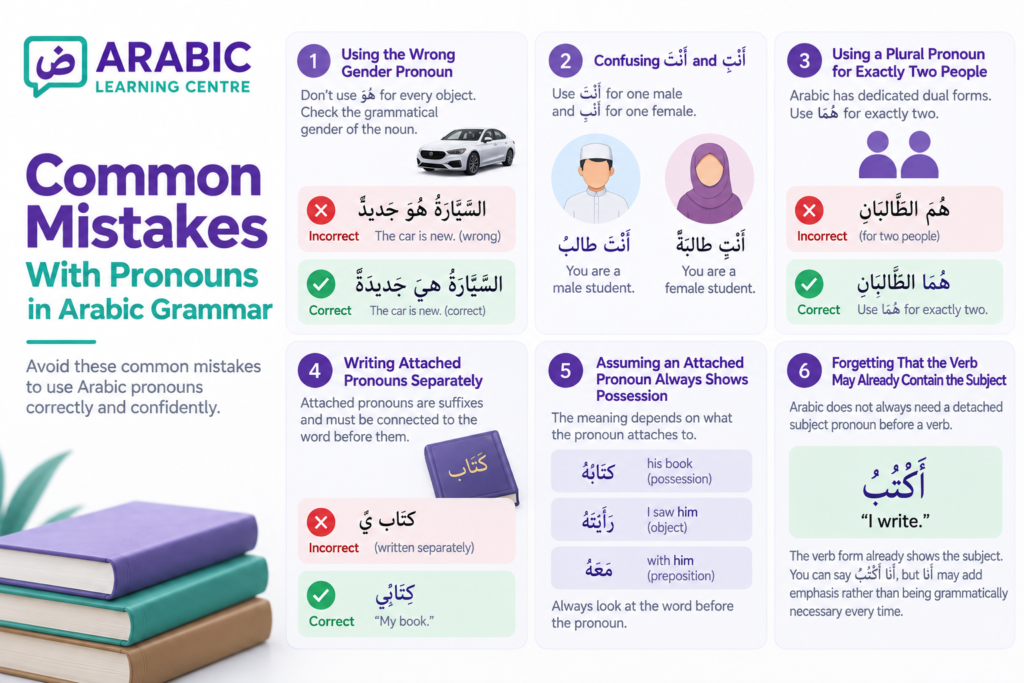
1. Using the Wrong Gender Pronoun
A common mistake is using هُوَ for every object because English uses “it.”
Incorrect:
السَّيَّارَةُ هُوَ جَدِيدٌ
Correct:
السَّيَّارَةُ هِيَ جَدِيدَةٌ
Always check the grammatical gender of the noun.
2. Confusing أَنْتَ and أَنْتِ
Use:
أَنْتَ when addressing one male.
أَنْتِ when addressing one female.
For example:
أَنْتَ طَالِبٌ — You are a male student.
أَنْتِ طَالِبَةٌ — You are a female student.
This distinction is especially important in conversation. Female learners who want more focused opportunities to practise addressing and responding to other women can also benefit from structured Arabic courses for ladies, where grammar patterns can be reinforced through guided reading, speaking, and sentence practice.

3. Using a Plural Pronoun for Exactly Two People
Arabic has dedicated dual forms.
Incorrect:
هُمْ الطَّالِبَانِ
Correct:
هُمَا الطَّالِبَانِ
Use هُمَا for exactly two and هُمْ for three or more masculine or mixed members.
4. Writing Attached Pronouns Separately
Attached pronouns are suffixes and must be connected to the word before them.
Incorrect: كِتَاب ي
Correct: كِتَابِي “My book.”
5. Assuming an Attached Pronoun Always Shows Possession
The meaning depends on what the pronoun attaches to.
كِتَابُهُ — his book
رَأَيْتُهُ — I saw him
مَعَهُ — with him
Always look at the word before the pronoun.
6. Forgetting That the Verb May Already Contain the Subject
Arabic does not always need a detached subject pronoun before a verb.
أَكْتُبُ
already communicates “I write.”
You can say أَنَا أَكْتُبُ, but أَنَا may add emphasis rather than being grammatically necessary every time.
How to Practice Arabic Pronouns Effectively?
Memorizing a pronoun chart is a good starting point, but real progress comes from using pronouns repeatedly with nouns, verbs, and prepositions in complete sentences.
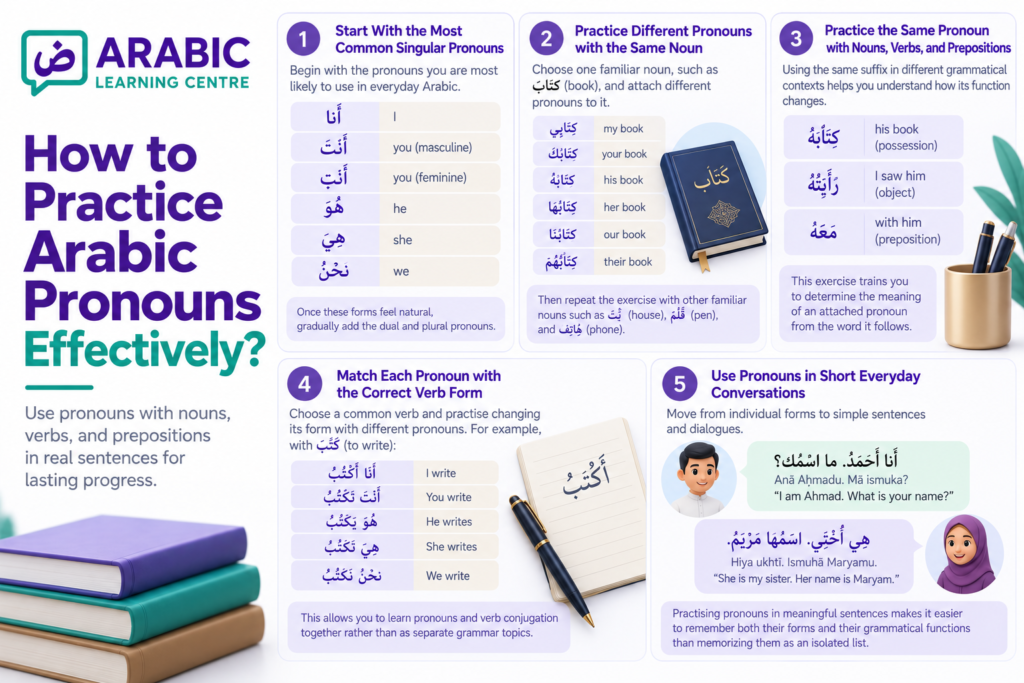
1. Start With the Most Common Singular Pronouns
Begin with the pronouns you are most likely to use in everyday Arabic:
- أَنَا — I
- أَنْتَ — you (masculine)
- أَنْتِ — you (feminine)
- هُوَ — he
- هِيَ — she
- نَحْنُ — we
Once these forms feel natural, gradually add the dual and plural pronouns.
2. Practice Different Pronouns with the Same Noun
Choose one familiar noun, such as كِتَاب (“book”), and attach different pronouns to it:
- كِتَابِي — my book
- كِتَابُكَ — your book
- كِتَابُهُ — his book
- كِتَابُهَا — her book
- كِتَابُنَا — our book
- كِتَابُهُمْ — their book
Then repeat the exercise with familiar nouns such as بَيْت (house), قَلَم (pen), and هَاتِف (phone).
3. Practice the Same Pronoun with Nouns, Verbs, and Prepositions
Using the same suffix in different grammatical contexts helps you understand how its function changes:
- كِتَابُهُ — his book
- رَأَيْتُهُ — I saw him
- مَعَهُ — with him
This exercise trains you to determine the meaning of an attached pronoun from the word it follows.
4. Match Each Pronoun with the Correct Verb Form
Choose a common verb and practise changing its form with different pronouns. For example, with كَتَبَ (to write):
- أَنَا أَكْتُبُ — I write
- أَنْتَ تَكْتُبُ — You write
- هُوَ يَكْتُبُ — He writes
- هِيَ تَكْتُبُ — She writes
- نَحْنُ نَكْتُبُ — We write
This allows you to learn pronouns and verb conjugation together rather than as separate grammar topics.
5. Use Pronouns in Short Everyday Conversations
Move from individual forms to simple sentences and dialogues:
أَنَا أَحْمَدُ.
مَا اسْمُكَ؟
Anā Aḥmadu. Mā ismuka?
“I am Ahmad. What is your name?”
هِيَ أُخْتِي.
اسْمُهَا مَرْيَمُ.
Hiya ukhtī. Ismuhā Maryamu.
“She is my sister. Her name is Maryam.”
Practising pronouns in meaningful sentences makes it easier to remember both their forms and their grammatical functions than memorizing them as an isolated list.
Read also: Makhraj of Arabic Letters – Complete Guide to Articulation Points
Don’t Just Take Our Word For It
Take a look inside our vibrant classes and see our students and teachers in action. Click below to watch our classroom experience:
Build Real Confidence With Arabic Pronouns
Understanding pronouns in Arabic grammar is an important foundation, but knowing a chart is not the same as being able to use the correct pronoun naturally while speaking, reading, or writing.
At Arabic Learning Centre, structured Arabic lessons help learners practise grammar inside real sentences rather than treating rules as isolated facts.
As your vocabulary and speaking ability grow, patterns such as أنا أكتب, كتابها, رأيته, and معكم begin to feel natural because you encounter and use them repeatedly in context.
Whether your goal is to speak Arabic more confidently, strengthen your grammar, or build a solid foundation for more advanced study, regular guided practice can help turn Arabic pronouns from something you memorize into something you use automatically.
Take the next step today and join thousands of students learning Arabic the right way.
Courses We Offer:
- Online Arabic Course
- Classical arabic course
- Modern Standard Arabic Course
- Fusha Arabic Course
- Learn Saudi Arabic
- Arabic Course for Beginners
- Arabic Classes for Adults
- Arabic Classes for Ladies
- Advanced Arabic Course
- Intensive Arabic Course

Conclusion
Pronouns are one of the most important building blocks of Arabic grammar. They replace nouns, indicate who is speaking or being addressed, show possession, function as objects, and connect closely with Arabic verb conjugation.
The central distinction to remember is between detached pronouns, such as أنا، أنتَ، هو، هي, and attached pronouns, such as ـي، ـكَ، ـهُ، ـها. Attached forms may express possession when added to nouns, objects when added to verbs, or the objects of prepositions when attached to words such as مع or على.
Once you are comfortable with these forms, you can gradually add dual and plural pronouns, demonstratives, relative pronouns, and more complex agreement patterns. Focus on understanding each pronoun inside a sentence, and Arabic grammar will begin to feel much more systematic.
Frequently Asked Questions About Pronouns in Arabic Grammar
What Are Pronouns Called in Arabic Grammar?
Pronouns are called الضَّمَائِر (al-ḍamāʾir) in Arabic, with the singular ضَمِير (ḍamīr). They refer to people or things without repeatedly naming the original noun.
What Are the Main Personal Pronouns in Arabic?
Common personal pronouns include أنا (I), أنتَ (you, masculine), أنتِ (you, feminine), هو (he), هي (she), نحن (we), هم (they, masculine), and هنَّ (they, feminine). Arabic also has special dual forms such as أنتما and هما.
What Is the Difference Between Attached and Detached Pronouns in Arabic?
Detached pronouns stand alone, such as أنا and هو. Attached pronouns are suffixes connected to nouns, verbs, or prepositions, such as ـي in كتابي (“my book”) or ـهُ in رأيته (“I saw him”).
How Do Possessive Pronouns Work in Arabic?
Arabic normally expresses possession by attaching a pronoun directly to a noun. For example, كتابي means “my book,” كتابه means “his book,” and كتابنا means “our book.”
Why Does Arabic Have Different Forms of “You”?
Arabic distinguishes gender and number. أنتَ addresses one male, أنتِ one female, أنتما exactly two people, أنتم a masculine or mixed plural group, and أنتنَّ a feminine plural group.
Can Arabic Pronouns Refer to Objects?
Yes. Arabic nouns have grammatical gender, so هو may refer to a masculine object and هي to a feminine object. For example, كتاب is masculine and may be referred to with هو, while سيارة is feminine and may be referred to with هي.
Do Arabic Verbs Always Need a Separate Subject Pronoun?
No. The verb form itself often identifies the subject. For example, أكتبُ already means “I write.” A detached pronoun such as أنا can be added for clarity or emphasis, but it is not always necessary.
Related Articles
Arabic Grammar