 Arabic Grammar
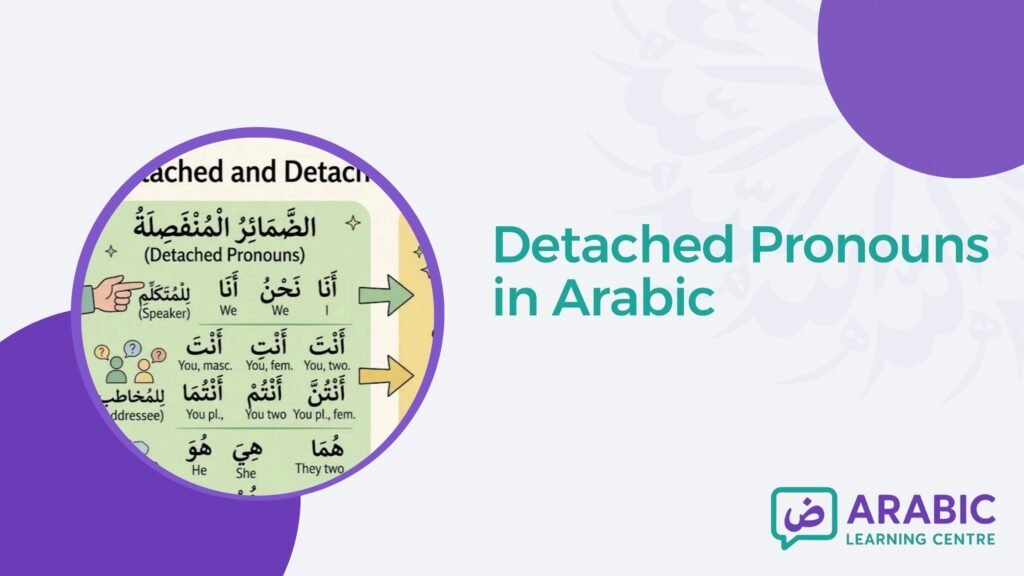
Detached pronouns in Arabic are independent pronouns that are written as separate words rather than being attached to a noun, verb, or preposition. In Arabic, they are called الضَّمَائِر المُنْفَصِلَة (al-ḍamāʾir al-munfaṣilah).
Some of the first Arabic detached pronouns a learner encounters are أَنَا (anā), meaning “I,” أَنْتَ (anta), meaning “you” when speaking to one male, and هُوَ (huwa), meaning “he.” Although these words look simple, they are part of a precise grammatical system that distinguishes between the speaker, the person being addressed, and the person being spoken about.
Arabic also distinguishes singular, dual, and plural, as well as masculine and feminine forms in the second and third persons. This means that English words such as “you” and “they” can correspond to several different pronouns in Arabic.
In this guide, you will learn the main detached pronouns in Arabic, their meanings, how gender and number affect them, how they function in sentences, and how they differ from attached pronouns.
What Are Detached Pronouns in Arabic?
Detached pronouns are known in Arabic as: الضَّمَائِر المُنْفَصِلَة — al-ḍamāʾir al-munfaṣilah
The word مُنْفَصِلَة (munfaṣilah) means “separate” or “detached.” The name describes their most obvious feature: these pronouns appear independently rather than being joined to another word.
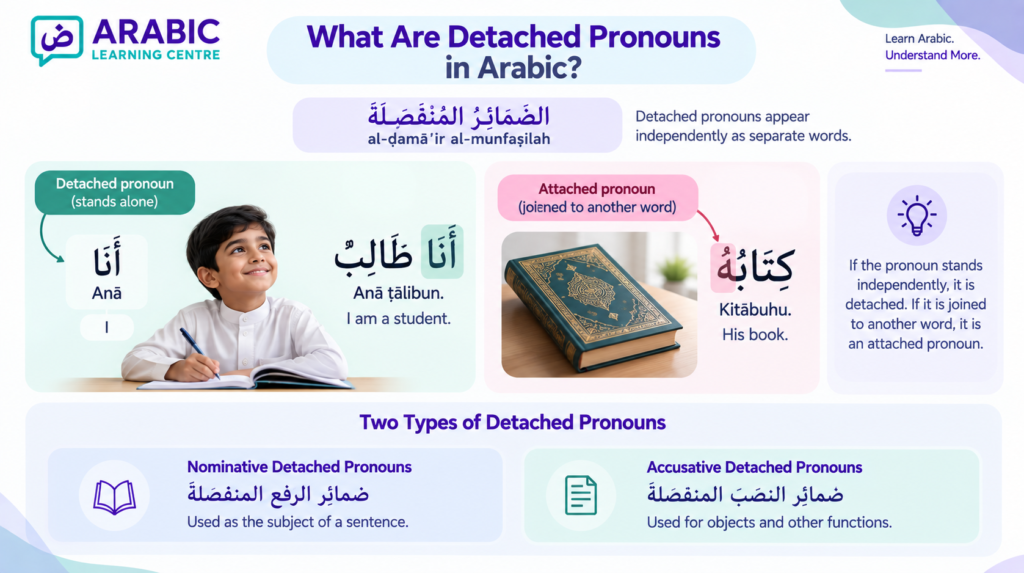
For example: أَنَا طَالِبٌ Anā ṭālibun. “I am a student.”
Here, أَنَا (anā) is written as a complete word. It refers to the speaker and functions as the subject of the sentence.
Compare that with: كِتَابُهُ Kitābuhu. “His book.” The ـهُ (-hu), meaning “his,” is attached directly to كِتَاب (kitāb), “book.” It therefore belongs to the system of attached pronouns rather than detached pronouns.
This gives learners a useful starting rule: If the pronoun stands independently as its own word, it can be a detached pronoun. If it is joined directly to another word, it is an attached pronoun.
Arabic grammar generally discusses two important groups of detached pronouns: nominative detached pronouns (ضمائر الرفع المنفصلة) and accusative detached pronouns (ضمائر النصب المنفصلة).
What Are the Nominative Detached Pronouns in Arabic?
The forms beginners usually learn first are the nominative detached pronouns, or: ضَمَائِر الرَّفْع المُنْفَصِلَة
These forms commonly function as subjects, especially in nominal sentences. They change according to three important grammatical ideas:
- Person: first, second, or third person
- Number: singular, dual, or plural
- Gender: masculine or feminine, where Arabic makes the distinction
Here is the complete set:
| Arabic Pronoun | Transliteration | English Meaning | Person / Number / Gender |
| أَنَا | anā | I | First person singular |
| نَحْنُ | naḥnu | We | First person plural |
| أَنْتَ | anta | You | Second person masculine singular |
| أَنْتِ | anti | You | Second person feminine singular |
| أَنْتُمَا | antumā | You two | Second person dual |
| أَنْتُمْ | antum | You | Second person masculine plural |
| أَنْتُنَّ | antunna | You | Second person feminine plural |
| هُوَ | huwa | He | Third person masculine singular |
| هِيَ | hiya | She | Third person feminine singular |
| هُمَا | humā | They two | Third person dual |
| هُمْ | hum | They | Third person masculine plural |
| هُنَّ | hunna | They | Third person feminine plural |
A major difference from English becomes immediately clear from this table. English has one general pronoun “you,” but Arabic distinguishes أنتَ، أنتِ، أنتما، أنتم، and أنتنَّ depending on who is being addressed.
The same applies to “they.” Arabic uses هُمَا for exactly two people, هُمْ for a masculine plural group, and هُنَّ for a feminine plural group.
For younger learners, pronouns are often easier to remember when they are introduced through short sentences, repetition, and age-appropriate activities.
A structured Arabic course for kindergarten can help children become familiar with basic Arabic vocabulary and sentence patterns gradually.

First-Person Detached Pronouns in Arabic
First-person pronouns refer to the person or people who are speaking.
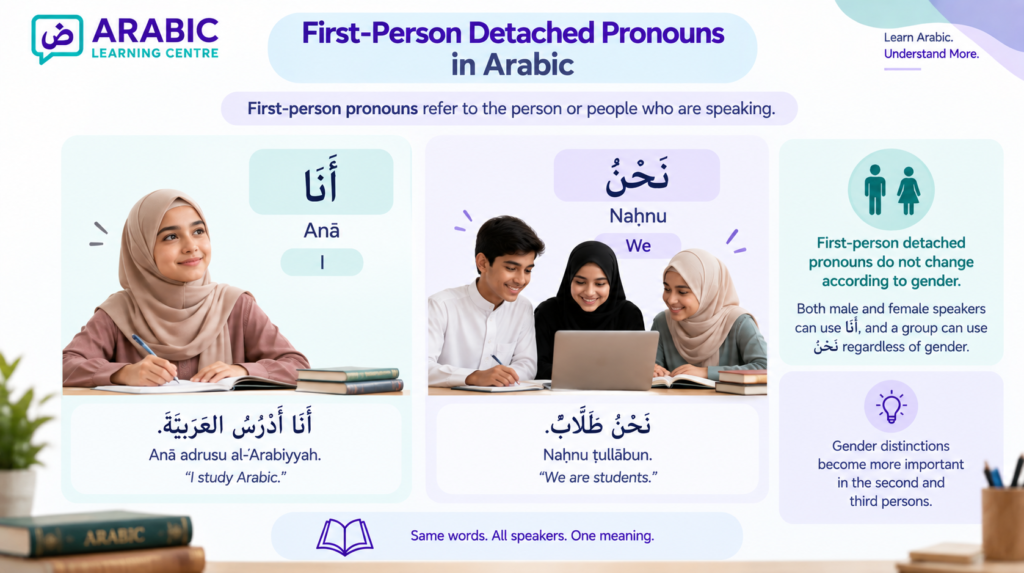
Arabic has two main detached forms:
- أَنَا (anā) — I
- نَحْنُ (naḥnu) — We
For example: أَنَا أَدْرُسُ العَرَبِيَّةَ. Anā adrusu al-ʿArabiyyah. “I study Arabic.”
And: نَحْنُ طُلَّابٌ. Naḥnu ṭullābun. “We are students.”
One helpful feature for beginners is that first-person detached pronouns do not change according to gender.
A male and a female speaker can both use أَنَا, while a group can use نَحْنُ regardless of the speakers’ gender.Gender distinctions become more important when we move to the second and third persons.
Second-Person Arabic Detached Pronouns
Second-person pronouns refer to the person or people being addressed. Arabic distinguishes between gender and number.
| Pronoun | Meaning | Use |
| أَنْتَ (Anta) | You | Masculine singular |
| أَنْتِ (Anti) | You | Feminine singular |
| أَنْتُمَا (Antumā) | You two | Dual |
| أَنْتُمْ (Antum) | You | Masculine plural |
| أَنْتُنَّ (Antunna) | You | Feminine plural |
أَنْتَ (Anta) — You, Masculine Singular
Use أَنْتَ when speaking directly to one male.
أَنْتَ طَالِبٌ. Anta ṭālibun. “You are a student.”
أَنْتِ (Anti) — You, Feminine Singular
Use أَنْتِ when speaking directly to one female.
أَنْتِ طَالِبَةٌ. Anti ṭālibatun. “You are a student.”
The difference between أَنْتَ and أَنْتِ is especially important for beginners. With vowel marks, the final fatḥah in أَنْتَ indicates the masculine form, while the final kasrah in أَنْتِ indicates the feminine form.
أَنْتُمَا (Antumā) — You Two
Arabic has a special grammatical category called the dual, used when referring to exactly two people. When directly addressing two people, use أَنْتُمَا.
أَنْتُمَا طَالِبَانِ. Antumā ṭālibāni. “You two are students.”
This form can be used when addressing two males, two females, or a male and a female.
أَنْتُمْ (Antum) — You, Masculine Plural
Use أَنْتُمْ when addressing a masculine plural group.
أَنْتُمْ مُجْتَهِدُونَ. Antum mujtahidūna. “You are hardworking.”
أَنْتُنَّ (Antunna) — You, Feminine Plural
When addressing a group of females, Arabic uses أَنْتُنَّ.
أَنْتُنَّ طَالِبَاتٌ. Antunna ṭālibātun. “You are students.”
These distinctions are essential because the pronoun often affects other elements of the sentence, including adjectives and verb conjugations.
Read also: Pronouns in Arabic Grammar – Types, Rules, and Examples
Third-Person Detached Pronouns in Arabic
Third-person pronouns refer to someone being spoken about rather than directly addressed. Arabic distinguishes between gender and number.
| Pronoun | Meaning | Use |
| هُوَ (Huwa) | He | Masculine singular |
| هِيَ (Hiya) | She | Feminine singular |
| هُمَا (Humā) | They two | Dual |
| هُمْ (Hum) | They | Masculine plural |
| هُنَّ (Hunna) | They | Feminine plural |
هُوَ (Huwa) — He
هُوَ مُعَلِّمٌ. Huwa muʿallimun. “He is a teacher.”
هِيَ (Hiya) — She
هِيَ مُعَلِّمَةٌ. Hiya muʿallimatun. “She is a teacher.”
Notice how both the pronoun and the predicate reflect gender:
هُوَ + مُعَلِّمٌ but هِيَ + مُعَلِّمَةٌ
This type of agreement is one of the patterns learners should begin recognizing early.
هُمَا (Humā) — They Two
To talk about exactly two people, Arabic uses هُمَا.
هُمَا طَالِبَانِ. Humā ṭālibāni. “They two are students.”
هُمْ (Hum) — They, Masculine Plural
هُمْ مُعَلِّمُونَ. Hum muʿallimūna. “They are teachers.”
هُنَّ (Hunna) — They, Feminine Plural
هُنَّ مُعَلِّمَاتٌ. Hunna muʿallimātun. “They are teachers.”
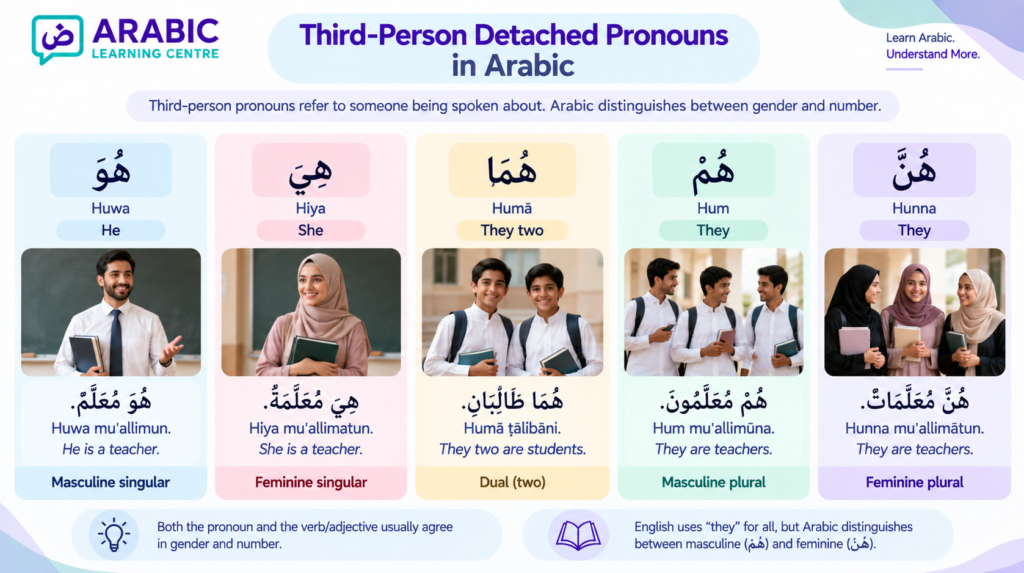
For English-speaking learners, هُمْ and هُنَّ deserve special attention because English normally uses the same word, “they,” regardless of gender.
Inside Our Classrooms
See how we make learning interactive and engaging! Watch a quick snippet of our live, conversational classes in action:
What Are Accusative Detached Pronouns in Arabic?
Not every detached pronoun functions as a subject. Arabic also has accusative detached pronouns, known as: ضَمَائِر النَّصْب المُنْفَصِلَة
These forms are built around إِيَّا (iyyā) and function as objects, particularly when the object is placed separately for emphasis.
Some important forms include:
| Arabic | Transliteration | Meaning |
| إِيَّايَ | iyyāya | Me |
| إِيَّاكَ | iyyāka | You – masculine singular |
| إِيَّاكِ | iyyāki | You – feminine singular |
| إِيَّاهُ | iyyāhu | Him |
| إِيَّاهَا | iyyāhā | Her |
| إِيَّانَا | iyyānā | Us |
| إِيَّاكُمْ | iyyākum | You – masculine plural |
| إِيَّاكُنَّ | iyyākunna | You – feminine plural |
| إِيَّاهُمْ | iyyāhum | Them – masculine plural |
| إِيَّاهُنَّ | iyyāhunna | Them – feminine plural |
A famous example appears in Surah Al-Fatihah:
إِيَّاكَ نَعْبُدُ وَإِيَّاكَ نَسْتَعِينُ
Iyyāka naʿbudu wa iyyāka nastaʿīn. “You alone we worship, and You alone we ask for help.”
Here, إِيَّاكَ is a detached object pronoun. Placing the object before the verb gives the expression particular emphasis.
For beginners, the easiest way to distinguish these forms from the familiar subject pronouns is to notice that detached object pronouns are formed with إِيَّا.
Read also: Makhraj of Arabic Letters – Complete Guide to Articulation Points
How Do Detached Pronouns Work in Arabic Nominal Sentences?
One of the most important uses of Arabic detached pronouns appears in the nominal sentence (الجملة الاسمية).
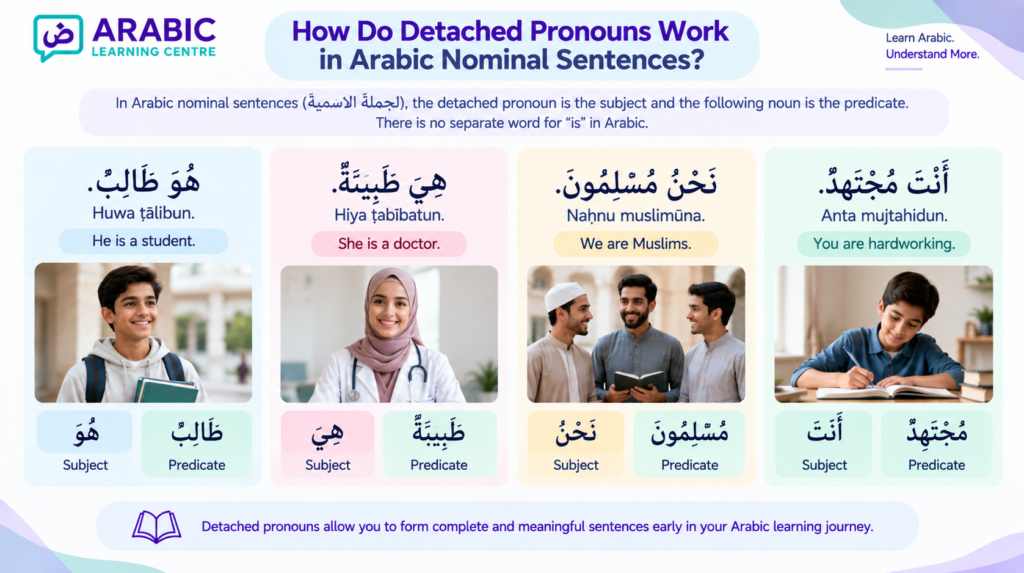
Consider: هُوَ طَالِبٌ. Huwa ṭālibun. “He is a student.”
There is no separate Arabic word corresponding to the English present-tense “is.” The sentence consists essentially of:
- هُوَ — subject
- طَالِبٌ — predicate
Together, they communicate the complete meaning “He is a student.”
The same structure appears in:
هِيَ طَبِيبَةٌ. — Hiya ṭabībatun. — “She is a doctor.” نَحْنُ مُسْلِمُونَ. — Naḥnu muslimūna. — “We are Muslims.” أَنْتَ مُجْتَهِدٌ. — Anta mujtahidun. — “You are hardworking.”
Recognizing this pattern makes detached pronouns especially useful for beginners because they allow learners to construct meaningful sentences before mastering more complex verb structures.
Can Detached Pronouns Be Used With Arabic Verbs?
Yes. However, there is an important feature of Arabic verbs to understand Arabic verb conjugation frequently tells you who performs an action even when a separate subject pronoun is not stated.
For example: أَكْتُبُ. Aktubu. “I write.”
The form of the verb itself already indicates the first-person singular. Therefore, Arabic does not always require أَنَا before it. You can nevertheless say: أَنَا أَكْتُبُ. Anā aktubu. “I write.”
When the detached pronoun is explicitly included, it may make the subject clearer or add emphasis or contrast depending on context.
Compare several forms:
| Pronoun | Verb | Meaning |
| أَنَا | أَكْتُبُ | I write |
| أَنْتَ | تَكْتُبُ | You (m.) write |
| هُوَ | يَكْتُبُ | He writes |
| هِيَ | تَكْتُبُ | She writes |
| نَحْنُ | نَكْتُبُ | We write |
| هُمْ | يَكْتُبُونَ | They write |
This relationship between pronouns and verb conjugation is one reason learners benefit from mastering detached pronouns before moving deeply into Arabic verbs. Learners who want to develop these skills within a broader understanding of Modern Standard Arabic can continue through a structured Fusha Arabic course, where grammar is practiced alongside reading, speaking, and comprehension.

Detached Pronouns vs Attached Pronouns in Arabic
The difference between detached and attached pronouns in Arabic becomes easier when you compare them directly.
| Feature | Detached Pronouns | Attached Pronouns |
| Arabic term | الضمائر المنفصلة | الضمائر المتصلة |
| Can stand alone? | Yes | No |
| Written separately? | Yes | No |
| Example | هُوَ | ـهُ |
| Basic meaning | He | His / him |
| Typical roles | Subject or emphatic object | Possession, object, or complement of a preposition |
For example: هُوَ طَالِبٌ. Huwa ṭālibun. “He is a student.”Here هُوَ is detached. But: كِتَابُهُ. Kitābuhu. “His book.” Here ـهُ is attached to the noun.
Another example is: رَأَيْتُهُ. Raʾaytuhu. “I saw him.”The same attached form ـهُ is now connected to a verb and functions as its object.
The main principle is therefore not simply the English meaning of the pronoun. Learners need to look at how the pronoun functions and whether it stands alone or attaches to another Arabic word.
Read also: Hamza Arabic Letter – Pronunciation, Forms, and Writing Rules
Don’t Just Take Our Word For It
Take a look inside our vibrant classes and see our students and teachers in action. Click below to watch our classroom experience:
Build a Stronger Foundation in Arabic Grammar
Learning Arabic detached pronouns is an important first step, but real progress comes from seeing how pronouns work with verbs, nouns, adjectives, gender, and number in complete sentences.
With structured practice, these grammar patterns become easier to recognize and use naturally instead of feeling like separate rules to memorize.
At Arabic Learning Centre, students can strengthen their grammar step by step while developing practical reading, listening, speaking, and sentence-building skills.
Courses We Offer:
- Business Arabic Course
- Learn Arabic from Zero
- Medical Arabic Course
- Learning Arabic for Non Arabic Speakers
- Learn Arabic in Saudi Arabia
- Learn to Read Arabic Course
- Arabic Grammar Course
- Arabic Speaking Course
- Arabic Script writing course
- Arabic Vocabulary Course
- Arabic Pronunciation Course
Conclusion
Detached pronouns in Arabic (الضمائر المنفصلة) are independent pronouns that stand as separate words. The main subject forms include أَنَا، نَحْنُ، أَنْتَ، أَنْتِ، أَنْتُمَا، أَنْتُمْ، أَنْتُنَّ، هُوَ، هِيَ، هُمَا، هُمْ, and هُنَّ.
Unlike English, Arabic distinguishes not only between first, second, and third person but also between singular, dual, and plural, with additional masculine and feminine distinctions in the second and third persons.
Learners should also recognize that Arabic has detached object forms built around إِيَّا, such as إِيَّاكَ. Understanding the difference between these forms and attached pronouns helps prevent many common grammar mistakes.
Rather than memorizing the pronouns as an isolated table, practice them inside short Arabic sentences. Once these forms become familiar, topics such as nominal sentences, gender agreement, verb conjugation, and more advanced Arabic grammar become much easier to understand.
FAQs About Detached Pronouns in Arabic
What are detached pronouns in Arabic?
Detached pronouns in Arabic are independent pronouns called الضمائر المنفصلة (al-ḍamāʾir al-munfaṣilah). They are written as separate words rather than being attached to nouns, verbs, or prepositions. Examples include أَنَا (I), أَنْتَ (you), هُوَ (he), and هِيَ (she).
How many nominative detached pronouns are there in Arabic?
There are 12 commonly taught nominative detached pronoun forms: أنا، نحن، أنتَ، أنتِ، أنتما، أنتم، أنتنَّ، هو، هي، هما، هم، and هنَّ. They are organized according to person, number, and, where relevant, gender.
What is the difference between attached and detached pronouns in Arabic?
A detached pronoun stands independently, such as هُوَ (huwa), “he.” An attached pronoun joins another word and cannot normally stand alone in that function. For example, ـهُ in كِتَابُهُ (kitābuhu) means “his” and is attached directly to the noun.
What are the dual detached pronouns in Arabic?
Two important dual detached pronouns are أَنْتُمَا (antumā), meaning “you two,” and هُمَا (humā), meaning “they two.” Arabic uses special dual forms when referring to exactly two people.
What is “they” in Arabic?
Arabic has more than one equivalent of “they.” هُمَا (humā) refers to exactly two people, هُمْ (hum) is used for the masculine plural, and هُنَّ (hunna) is the feminine plural form.
Can detached pronouns in Arabic function as objects?
Yes. Arabic has a specialized group of accusative detached pronouns formed with إِيَّا, such as إِيَّاكَ (iyyāka), “you.” These forms can function as detached objects, particularly in emphatic constructions.
Related Articles
Arabic Grammar