 Quran
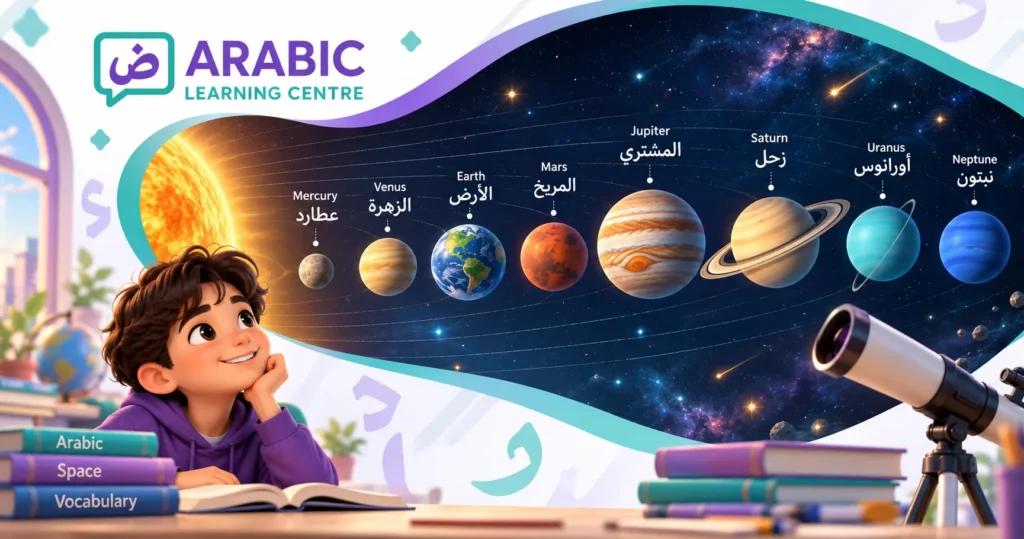
Learning the planets names in Arabic is a fun way to expand your vocabulary and explore how Arabic describes the universe. From Mercury to Neptune, each planet has a unique Arabic name, pronunciation, and meaning that can help you understand the language more deeply.
In this guide, you will discover all 8 planets in order from the Sun, with their Arabic spellings, English meanings, and pronunciation guides. You will also learn useful example sentences and essential space vocabulary to help you use each word in everyday Arabic learning.
Whether you are a beginner or an intermediate learner, this guide will help you memorize the planets more easily and understand the grammar behind their names. By practicing the examples and vocabulary, you can build your Arabic skills while exploring the solar system.
1. Mercury in Arabic: عطارد (ʿUṭārid)
Mercury in Arabic is عطارد (ʿUṭārid), the first planet from the Sun and the smallest in the solar system. The name begins with ع, a deep sound from the throat that English doesn’t have. If you can’t produce it yet, say a clear “u-ṭā-rid” for now and practice the ع later.
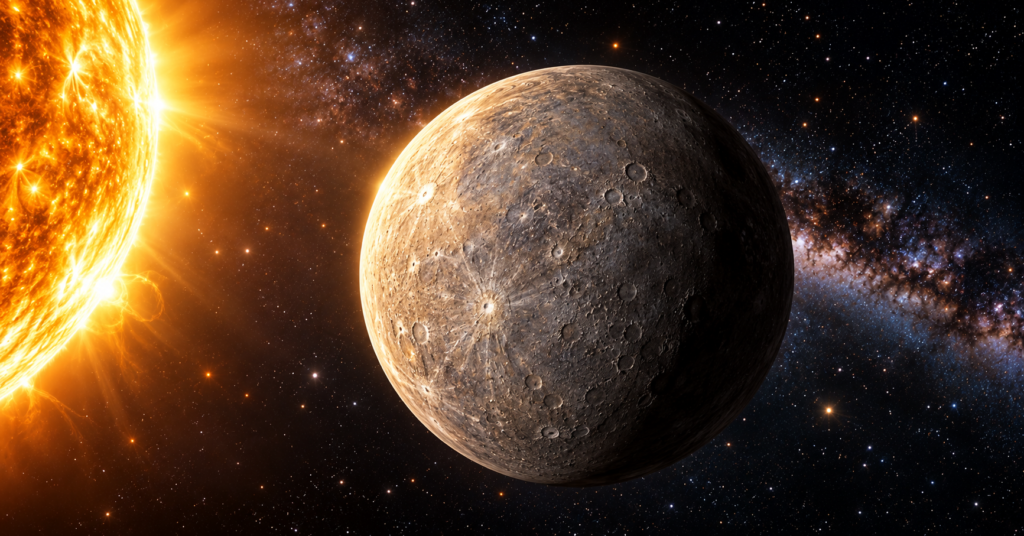
Most Arabic sources connect the name to the root ط-ر-د (ṭ-r-d), meaning to chase or to follow in steady succession. That describes Mercury well: it goes around the Sun in only 88 Earth days, faster than any other planet. Like زحل, the name is used without “al-,” so you never say al-ʿUṭārid.
عطارد أقرب كوكب إلى الشمس.
ʿUṭāridu aqrabu kawkabin ilā ash-shams. Mercury is the closest planet to the Sun.
Read also: Months Names in Arabic – The 12 Months of the Year With Pronunciation and Examples
2. Venus in Arabic: الزهرة (az-Zuhara)
Venus in Arabic is الزهرة (az-Zuhara), often shortened in speech to az-Zuhra. The classical dictionary Lisān al-ʿArab defines zuhra as bright whiteness and beauty, which suits the brightest object in the night sky after the Moon.
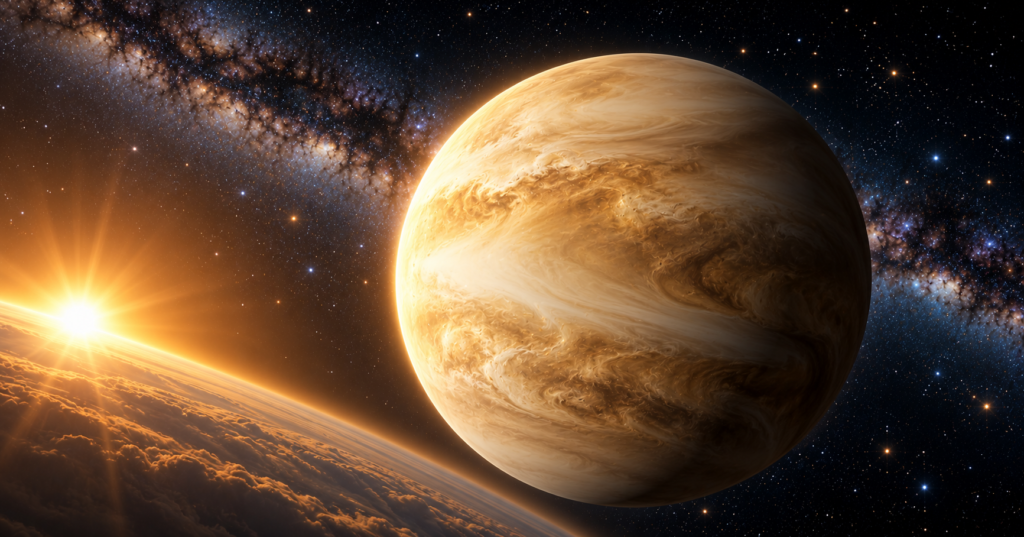
Venus shines so brightly because its thick clouds reflect most of the sunlight that reaches it. Watch the pronunciation.
ز is a sun letter, so the “l” in “al-” disappears and you say az-Zuhara. Venus is also feminine, so verbs that describe it take the feminine form, as in the sentence below.
Venus appears either just before sunrise or just after sunset, so Arabic speakers also call it نجمة الصبح (najmat aṣ-ṣubḥ, “the morning star”) or نجمة المساء (najmat al-masāʾ, “the evening star”). Classical Arabic texts sometimes call it السعد الأصغر, “the lesser fortune.”
تظهر الزهرة بعد غروب الشمس.
Taẓharu az-Zuharatu baʿda ghurūbi ash-shams. Venus appears after sunset.
Read also: Days Name In Arabic – All 7 Day Names Explained
3. Earth in Arabic: الأرض (al-Arḍ)
You probably know this one already. Earth in Arabic is الأرض (al-Arḍ), the same word Arabic uses for ground and land. It’s the only planet with an everyday word as its Arabic name. English is similar here: “Earth” also comes from old words meaning “ground.”
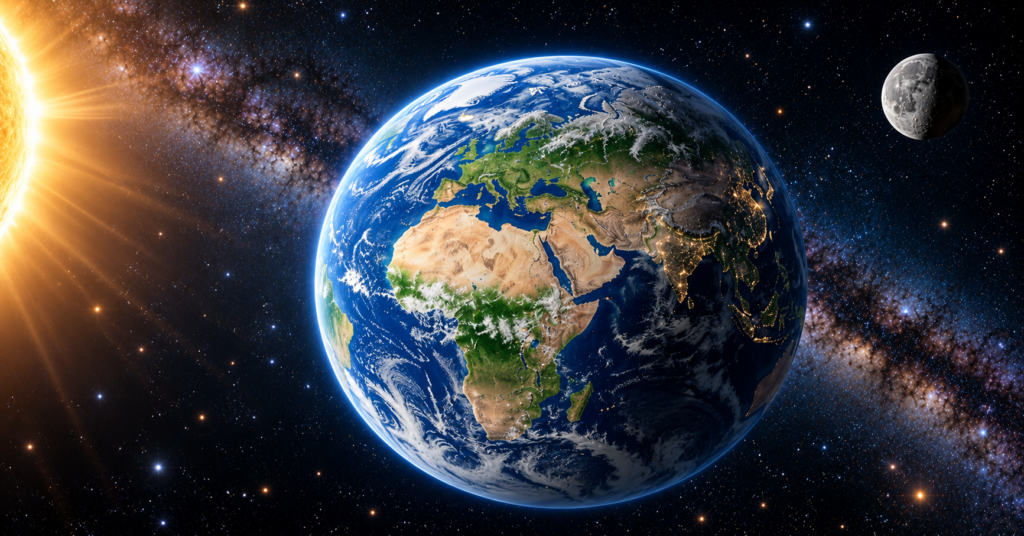
The last letter, ض, is a heavy, emphatic “d,” often called the signature sound of Arabic. Grammatically, الأرض is feminine, so you refer to it with هي (hiya), not هو.
الأرض هي الكوكب الثالث من الشمس.
Al-Arḍu hiya al-kawkabu ath-thālithu min ash-shams. Earth is the third planet from the Sun.
4. Mars in Arabic: المريخ (al-Marrīkh)
Mars in Arabic is المريخ (al-Marrīkh). In everyday Arabic it’s just as often called الكوكب الأحمر (al-kawkab al-aḥmar), “the red planet.” The final خ sounds like the “ch” in the Scottish word “loch.” Because م is a moon letter, you pronounce the “l” clearly: al-Marrīkh.
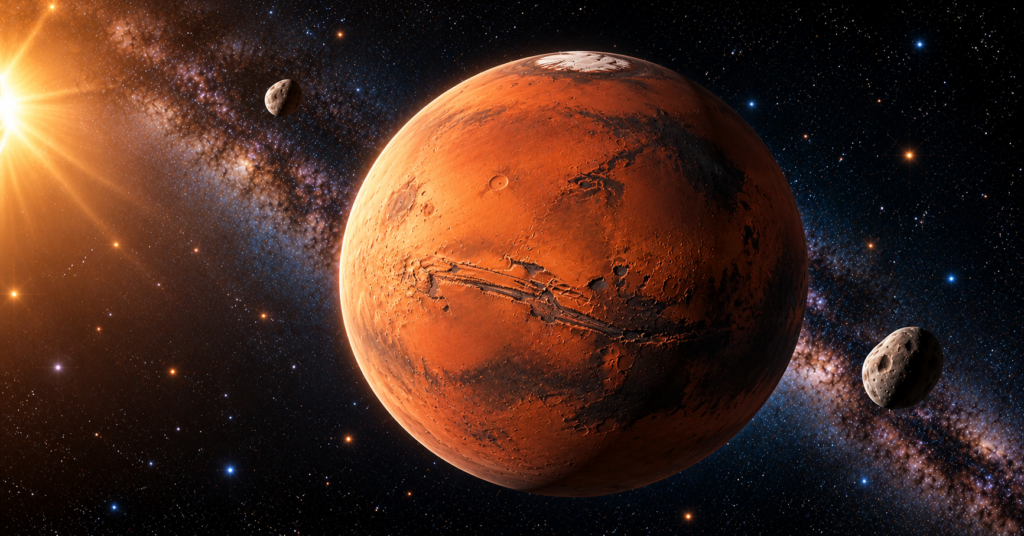
No one is completely sure where the name comes from. One explanation links it to markh, a desert tree whose wood people rubbed together to start fires. Another links it to a word for something covered in red spots. Both explanations point to the planet’s color, which comes from iron oxide dust on its surface.
Mars has two small moons, فوبوس (Phobos) and دايموس (Deimos). Classical Arabic astronomy grouped Mars with Saturn as the two “misfortunes” and called Mars النحس الأصغر, “the lesser misfortune.”
يُسمّى المريخ الكوكبَ الأحمر.
Yusammā al-Marrīkhu al-kawkaba al-aḥmar. Mars is called the red planet.
5. Jupiter in Arabic: المشتري (al-Mushtarī)
Jupiter, the largest planet in the solar system, is المشتري (al-Mushtarī) in Arabic. This name surprises learners more than any other, because in modern Arabic مشتري also means “buyer.” Most linguists think that’s a coincidence.
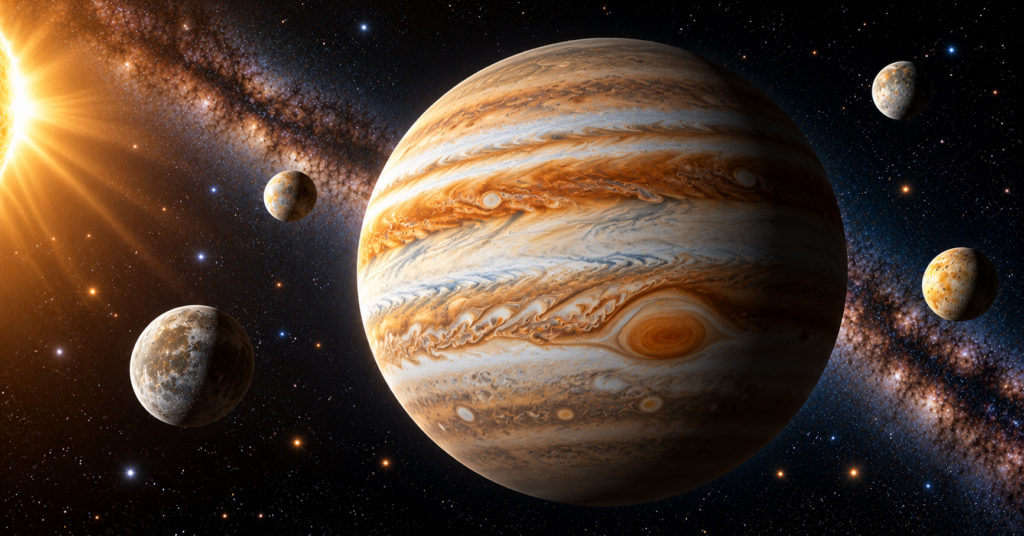
So what does the name really mean? Classical Arab lexicographers said Jupiter “moves on steadily without slowing,” from the verb istashrā. The German orientalist Wilhelm Eilers suggested a link to an old root meaning “to shine.” Neither explanation is settled, so be careful with any source that offers a single confident answer.
Classical astronomers saw Jupiter as the luckiest of the planets and called it السعد الأكبر, “the greater fortune.” Like Mars, its name starts with the moon letter م, so you pronounce the “l.”
المشتري أكبر كواكب المجموعة الشمسية.
Al-Mushtarī akbaru kawākibi al-majmūʿa ash-shamsiyya. Jupiter is the largest planet in the solar system.
6. Saturn in Arabic: زحل (Zuḥal)
Saturn in Arabic is زحل (Zuḥal), from the root ز-ح-ل (z-ḥ-l), meaning to withdraw or keep one’s distance. Of the planets people could see without a telescope, Saturn was the farthest away and the slowest, and its Arabic name describes exactly that. The ح in the middle is a breathy “h” from the throat, lighter than خ.
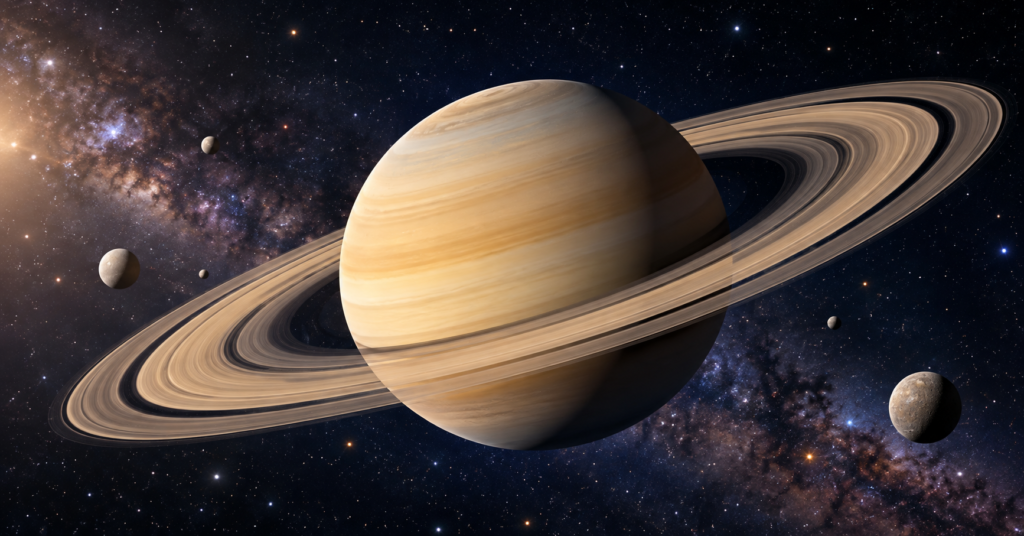
Saturn also has an older Arabic name, كيوان (Kaywān), which you’ll still find in classical poetry. Astronomers of that period called Saturn النحس الأكبر, “the greater misfortune,” the counterpart to Mars.
If you’re studying grammar, note one detail.
زحل is a diptote (ممنوع من الصرف). It never takes tanwīn, and after a preposition it takes a fatḥa, not a kasra. That’s why the example below says li-Zuḥala, not li-Zuḥalin.
لِزُحَلَ حلقاتٌ جميلة.
Li-Zuḥala ḥalaqātun jamīla. Saturn has beautiful rings.
Inside Our Classrooms
See how we make learning interactive and engaging! Watch a quick snippet of our live, conversational classes in action:
7. Uranus in Arabic: أورانوس (Ūrānūs)
With Uranus, the native Arabic names come to an end. The Arabic name أورانوس (Ūrānūs) is just the Greek name written in Arabic letters. Ouranos was the Greek god of the sky.
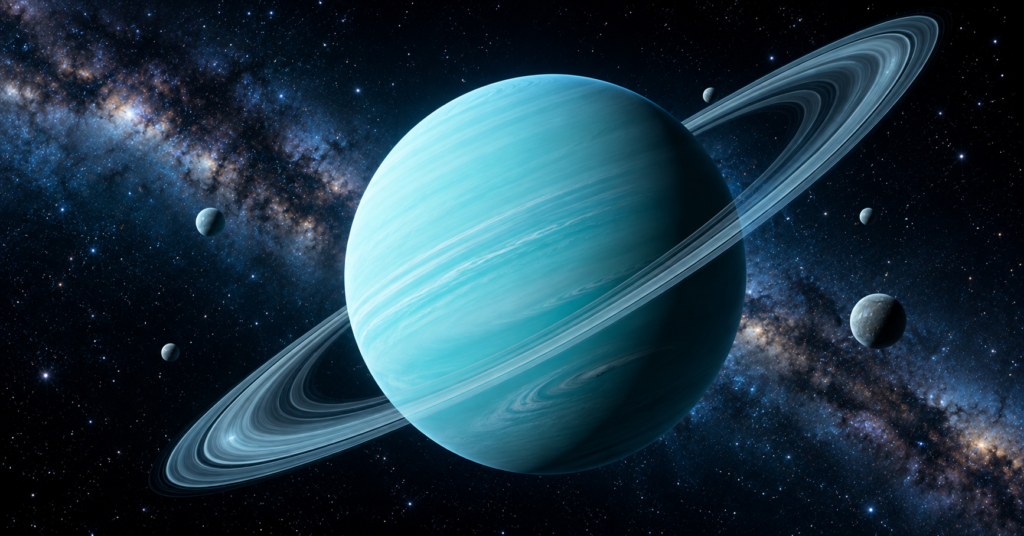
William Herschel discovered Uranus with a telescope in 1781. By that time, new objects in the sky were named in Europe, and Arabic adopted the name unchanged. Astronomers classify Uranus as an ice giant (عملاق جليدي). It’s also unusual because it spins tipped over on its side.
أورانوس عملاقٌ جليدي.
Ūrānūs ʿimlāqun jalīdī. Uranus is an ice giant.
Arabic Learning Centre’s Arabic course for non-Arabic speakers takes you from the alphabet to confident reading and speaking. You learn with qualified teachers, at your own pace, from anywhere in the world. Book your first lesson today and turn word lists into real Arabic.

8. Neptune in Arabic: نبتون (Nibtūn)
The planet farthest from the Sun is نبتون (Nibtūn) in Arabic. On TV and online you’ll also hear Neptūn, and both pronunciations are fine.
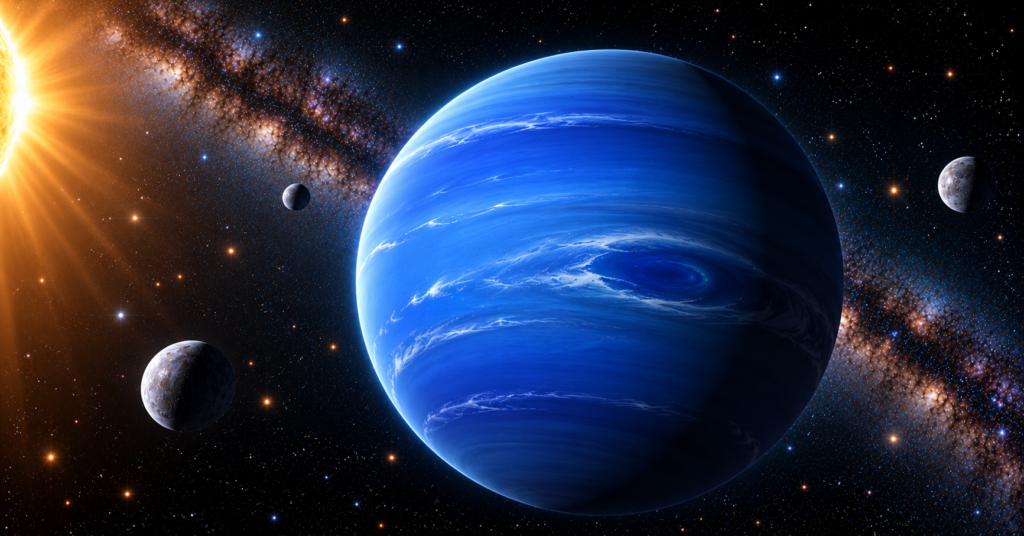
Neptune is the Roman god of the sea, and astronomers chose the name partly because of the planet’s deep blue color. Neptune was first observed in 1846. Like Uranus, it’s an ice giant, and like all the borrowed names, نبتون is used without “al-.”
نبتون أبعد كوكب عن الشمس.
Nibtūn abʿadu kawkabin ʿan ash-shams. Neptune is the farthest planet from the Sun.
Planets names in Arabic: quick reference table
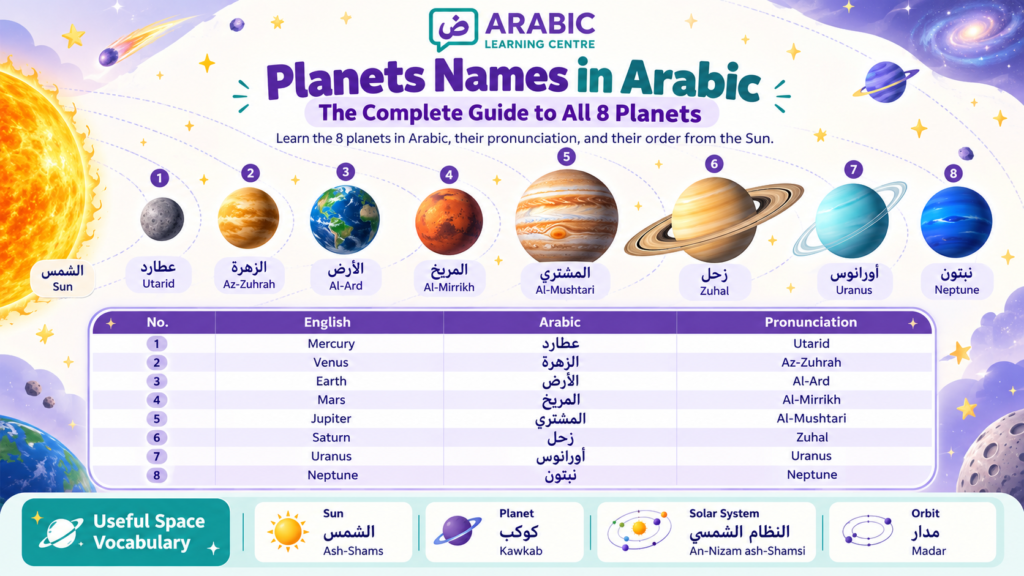
Arabic has a name for each of the 8 planets in the solar system. In order from the Sun, they are عطارد (Mercury), الزهرة (Venus), الأرض (Earth), المريخ (Mars), المشتري (Jupiter), زحل (Saturn), أورانوس (Uranus), and نبتون (Neptune). The word for “planet” is كوكب (kawkab), and its plural is كواكب (kawākib).
| # | English | Arabic | Pronunciation | Meaning of the name | Gender | Takes “al-“? |
| 1 | Mercury | عطارد | ʿUṭārid | The swift one | Masculine | No |
| 2 | Venus | الزهرة | az-Zuhara | Brightness | Feminine | Yes (sun letter) |
| 3 | Earth | الأرض | al-Arḍ | Ground, land | Feminine | Yes |
| 4 | Mars | المريخ | al-Marrīkh | Linked to fire and redness | Masculine | Yes |
| 5 | Jupiter | المشتري | al-Mushtarī | Debated: “steady” or “shining” | Masculine | Yes |
| 6 | Saturn | زحل | Zuḥal | The distant one | Masculine | No |
| 7 | Uranus | أورانوس | Ūrānūs | Borrowed from Greek | Masculine | No |
| 8 | Neptune | نبتون | Nibtūn | Borrowed from Latin | Masculine | No |
Essential space vocabulary in Arabic
To talk about the planets in full sentences, you need a small set of core words. You’ll see them again and again in Arabic textbooks, documentaries, and science news.
| English | Arabic | Pronunciation |
| Planet / planets | كوكب / كواكب | kawkab / kawākib |
| Solar system | المجموعة الشمسية | al-majmūʿa ash-shamsiyya |
| Star | نجم | najm |
| Moon (satellite) / moons | قمر / أقمار | qamar / aqmār |
| Orbit | مدار | madār |
| Rocky planet | كوكب صخري | kawkab ṣakhrī |
| Gas giant | عملاق غازي | ʿimlāq ghāzī |
| Ice giant | عملاق جليدي | ʿimlāq jalīdī |
| Dwarf planet | كوكب قزم | kawkab qazam |
| Rings | حلقات | ḥalaqāt |
| Galaxy / Milky Way | مجرة / درب التبانة | majarra / darb at-tabbāna |
Words are easier to remember when you learn them in groups by topic instead of from random lists. The Arabic vocabulary course is built this way, so each new word joins a set you already know.
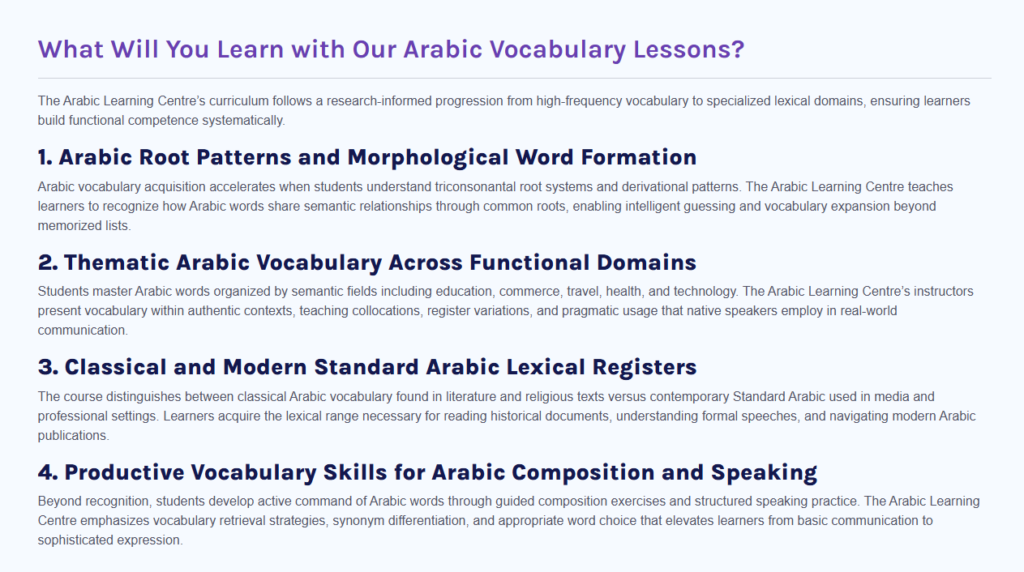
More Space Words in Arabic: Pluto, the Sun, and the Moon
Learners usually look up three more names along with the 8 planets: one dwarf planet and the two brightest bodies in the sky.
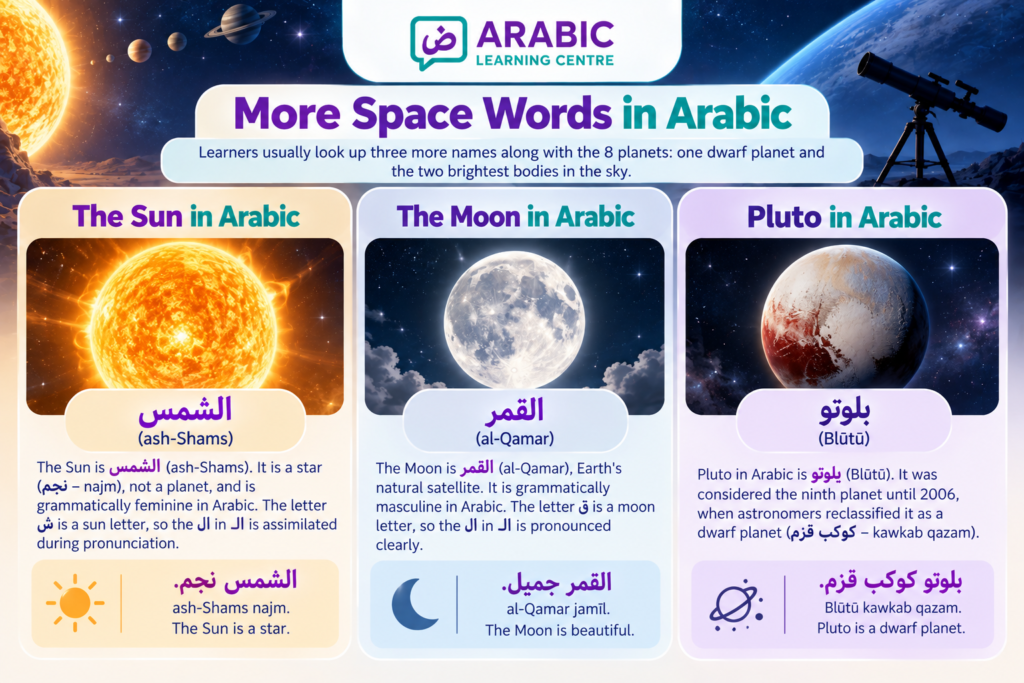
Pluto in Arabic: بلوتو (Blūtū)
Pluto in Arabic is بلوتو (Blūtū). It was considered the ninth planet until 2006, when astronomers reclassified it as a dwarf planet (كوكب قزم – kawkab qazam).
Example: بلوتو كوكب قزم.
Pluto is a dwarf planet.
The Sun in Arabic: الشمس (ash-Shams)
The Sun is الشمس (ash-Shams). It is a star (نجم – najm), not a planet, and is grammatically feminine in Arabic. The letter ش is a sun letter, so the ل in الـ is assimilated during pronunciation.
Example: الشمس نجم.
The Sun is a star.
The Moon in Arabic: القمر (al-Qamar)
The Moon is القمر (al-Qamar), Earth’s natural satellite. It is grammatically masculine in Arabic. The letter ق is a moon letter, so the ل in الـ is pronounced clearly.
Example: القمر جميل.
The Moon is beautiful.
Why Mercury to Saturn Have Native Arabic Names, but Uranus and Neptune Do Not?
A single rule tells you which planets have Arabic names. If people could see the planet with the naked eye, it has a native Arabic name. If it was discovered with a telescope, Arabic borrowed its European name.
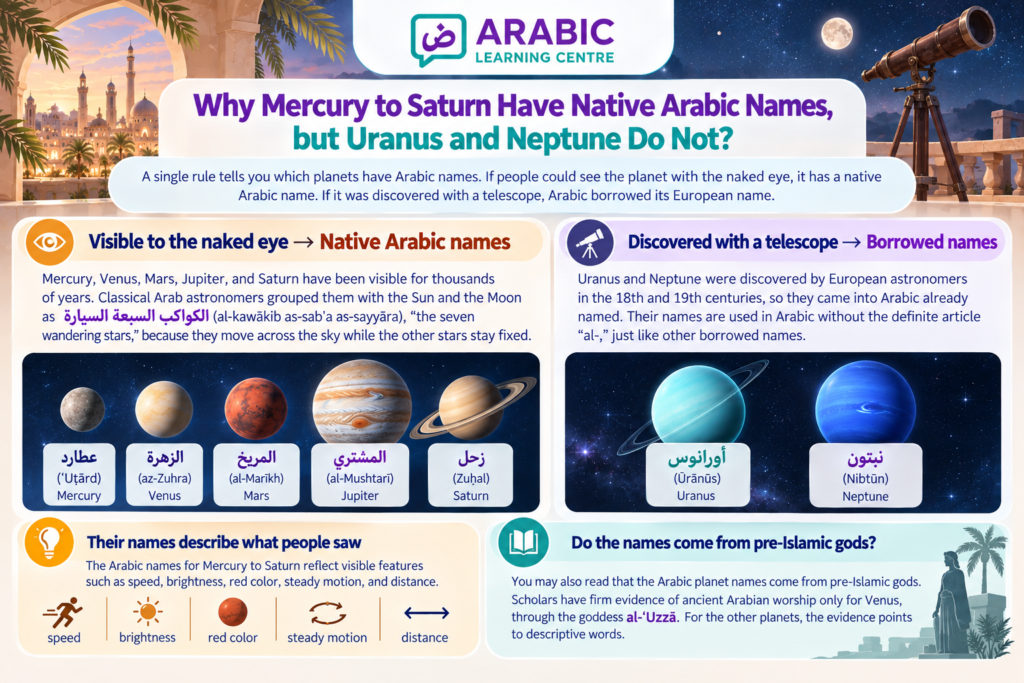
Mercury, Venus, Mars, Jupiter, and Saturn have been visible for thousands of years. Classical Arab astronomers grouped them with the Sun and the Moon as الكواكب السبعة السيارة (al-kawākib as-sabʿa as-sayyāra), “the seven wandering stars,” because they move across the sky while the other stars stay fixed.
Their names describe what people saw: speed, brightness, red color, steady motion, and distance. Uranus and Neptune were discovered by European astronomers in the 18th and 19th centuries, so they came into Arabic already named. You may also read that the Arabic planet names come from pre-Islamic gods.
Scholars have firm evidence of ancient Arabian worship only for Venus, through the goddess al-ʿUzzā. For the other planets, the evidence points to descriptive words.
Common Mistakes When Learning Planet Names in Arabic
Arabic planet names can be confusing because short vowels are often omitted, and some names use the definite article الـ (al-) while others do not.
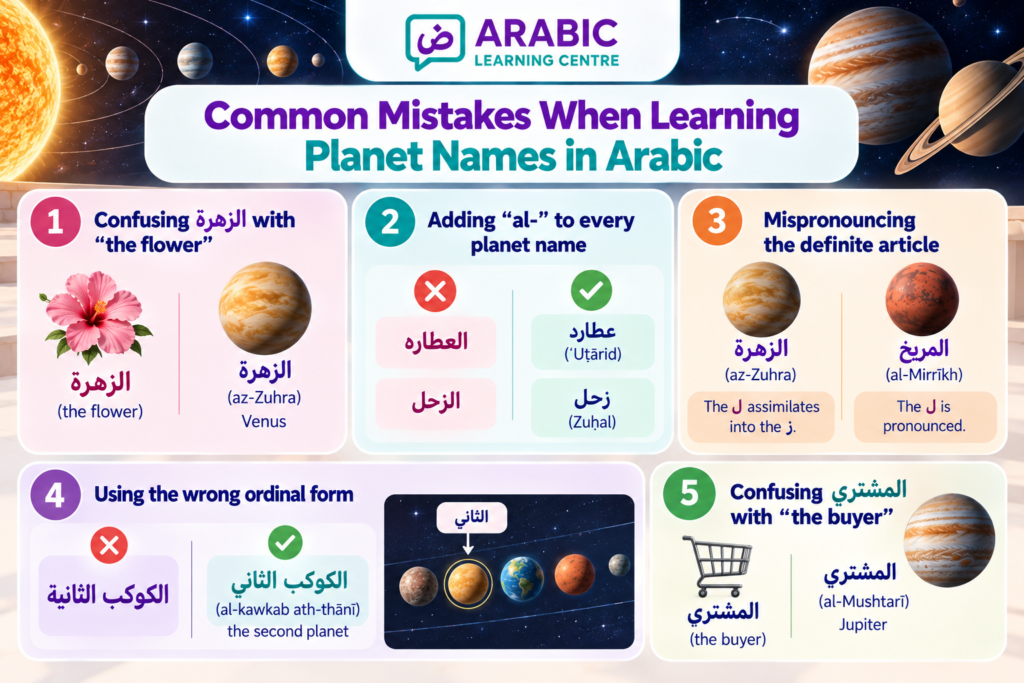
- Confusing الزهرة with “the flower”: The word الزهرة can mean “the flower,” but in astronomy, it refers to Venus. Its pronunciation is az-Zuhra.
- Adding “al-” to every planet name: Not every planet name takes the definite article. For example, say عطارد (ʿUṭārid) and زحل (Zuḥal), not العطارد or الزحل.
- Mispronouncing the definite article: In الزهرة (az-Zuhra), the ل sound assimilates into the ز. However, in المريخ (al-Mirrīkh), the ل remains pronounced.
- Using the wrong ordinal form: The correct expression is الكوكب الثاني (al-kawkab ath-thānī), meaning “the second planet.” The ordinal agrees with كوكب, which is masculine.
- Confusing المشتري with “the buyer”: Although المشتري (al-Mushtarī) can mean “the buyer” in other contexts, in astronomy it is the Arabic name for Jupiter. The intended meaning depends on the context.
These mistakes all come down to a few grammar rules: gender, the definite article, sun and moon letters, agreement, and diptotes. The Arabic grammar course teaches these rules one at a time, so you can apply them to any noun you learn, not only the planets.

How to memorize the planets in Arabic faster?
The fastest method is to learn the planets in two groups, not as eight unrelated words.
- Learn the five native names with their meanings: Connect each name to what it describes: ʿUṭārid is the swift one, az-Zuhara the bright one, al-Marrīkh the fiery red one, al-Mushtarī the steady one, and Zuḥal the distant one. A word with a meaning attached is much easier to remember than a sound on its own.
- Add the borrowed names and Earth: Ūrānūs and Nibtūn sound almost like their English names, and al-Arḍ is a word you’ll use every day anyway. This group takes very little effort.
- Practice every name inside a sentence: Say the example sentences above out loud. Each one trains the name, its gender, and its article together, which a flashcard with a single word can’t do.
Don’t Just Take Our Word For It
Take a look inside our vibrant classes and see our students and teachers in action. Click below to watch our classroom experience:
Learn Arabic with Arabic Learning Centre
Learning the planets names in Arabic is just the beginning of your language journey. To use new vocabulary confidently, you also need to understand Arabic pronunciation, grammar, and sentence structure through regular practice.
At Arabic Learning Centre, non-native speakers can learn Arabic with qualified teachers through structured lessons tailored to their levels and learning goals. The courses help learners develop essential skills, from reading the Arabic alphabet to improving speaking and understanding grammar.
Whether you are a beginner or looking to advance your Arabic skills, Arabic Learning Centre provides guidance to help you progress at your own pace. Turn your interest in Arabic vocabulary into practical language skills you can use in everyday conversations.
Start learning Arabic today with a free trial lesson!
Courses We Offer:
- Business Arabic Course
- Learn Arabic from Zero
- Medical Arabic Course
- Learning Arabic for Non Arabic Speakers
- Learn Arabic in Saudi Arabia
- Learn to Read Arabic Course
- Arabic Grammar Course

Conclusion
Learning the planets names in Arabic introduces you to useful vocabulary, pronunciation patterns, and fascinating details about the language. The eight planets are عطارد, الزهرة, الأرض, المريخ, المشتري, زحل, أورانوس, and نبتون, each with its own name and characteristics.
To remember these names, practice saying them in order, review their meanings, and use them in simple Arabic sentences. Understanding grammatical gender, the definite article, and sun and moon letters will also help you pronounce the names correctly and use them with confidence.
With regular practice, you can expand your Arabic vocabulary beyond the planets and begin discussing the Sun, Moon, stars, and other objects in space. Join Arabic Learning Centre to learn with qualified teachers, strengthen your grammar, and develop your reading and speaking skills at your own pace.
Frequently asked questions
How many planets are there in Arabic?
Arabic counts 8 planets, the same as English: عطارد, الزهرة, الأرض, المريخ, المشتري, زحل, أورانوس, and نبتون. Pluto (بلوتو) is classed as a dwarf planet (كوكب قزم).
What is the Arabic word for planet?
The Arabic word for planet is كوكب (kawkab), and its plural is كواكب (kawākib). The solar system is المجموعة الشمسية (al-majmūʿa ash-shamsiyya).
What are the planets in order in Arabic?
In order from the Sun, the planets are عطارد, الزهرة, الأرض, المريخ, المشتري, زحل, أورانوس, and نبتون. To give a position, you say الكوكب الأول, الكوكب الثاني, and so on.
Why is Jupiter called المشتري in Arabic?
The origin of المشتري (al-Mushtarī) is still debated. Classical lexicographers connected it to steady, unbroken movement, and some modern scholars connect it to a root meaning “to shine.” Its modern meaning, “buyer,” is most likely a coincidence.
Which planets have original Arabic names?
Mercury, Venus, Mars, Jupiter, and Saturn have original Arabic names because people could see them without telescopes. Earth uses the everyday word الأرض, and Uranus and Neptune use borrowed European names.
Which planet names are feminine in Arabic?
Venus (الزهرة) and Earth (الأرض) are feminine, and so is the Sun (الشمس). The other planets, and the Moon (القمر), are masculine.