 Arabic Vocabulary & Speaking
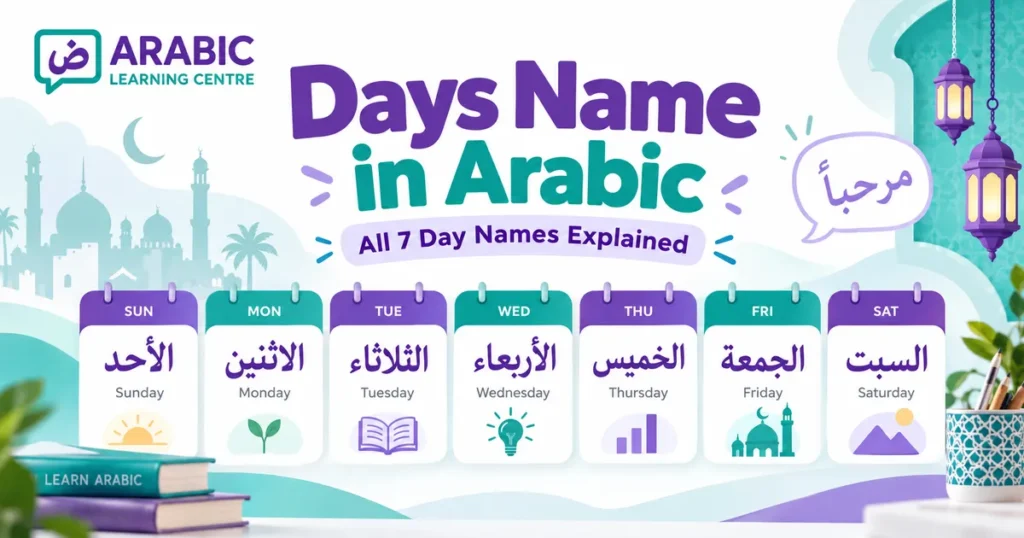
The seven days of the week in Arabic are al-Ahad (Sunday), al-Ithnayn (Monday), ath-Thulatha’ (Tuesday), al-Arbi’a’ (Wednesday), al-Khamis (Thursday), al-Jumu’ah (Friday) and as-Sabt (Saturday).
Five of these names come straight from the numbers one to five. The other two, Friday and Saturday, carry meanings rooted in culture and faith. Once you see that pattern, learning the days name in Arabic takes minutes, not weeks.
Below, each day is numbered in order with its Arabic spelling, pronunciation, literal meaning, example sentences and its Egyptian form. All forms are in Modern Standard Arabic (Fusha), the shared written and formal language across the Arab world.
The list starts on Sunday, the first working day in most Arab countries and the day whose name literally means “one.”

1. Sunday – الأحد (al-Ahad)
Sunday is al-Ahad, which literally means “one.” In full, Arabs say يَوْمُ الأَحَد (yawm al-Ahad), “the day of one,” because Sunday is counted as the first day of the week.
If you only learn one day today, make it this one. Once you know that Sunday is “one,” the next four days fall into place.
Example Sentences with al-Ahad
- أبدأ عملي يوم الأحد. (abda’ ‘amali yawm al-Ahad) – I start work on Sunday.
- اليوم الأحد، أول أيام الأسبوع. (al-yawm al-Ahad, awwal ayyam al-usbu’) – Today is Sunday, the first day of the week.
- سنلتقي الأحد القادم. (sanaltaqi al-Ahad al-qadim) – We will meet next Sunday.
Read also: Fruit Names in Arabic – 15 Common Fruits with Pronunciation and Examples
2. Monday – الاثنين (al-Ithnayn)
Monday comes next as al-Ithnayn, from ithnan, the word for “two.” Its full form is يَوْمُ الاثْنَيْن (yawm al-Ithnayn). The “th” here is the soft sound in “thin,” not the hard one in “this,” so keep your tongue light between your teeth.
Example Sentences with al-Ithnayn
- عندي درس عربي يوم الاثنين. (‘indi dars ‘arabi yawm al-Ithnayn) – I have an Arabic lesson on Monday.
- ذهبت إلى الطبيب الاثنين الماضي. (dhahabtu ila at-tabib al-Ithnayn al-madi) – I went to the doctor last Monday.
- الاجتماع يوم الاثنين صباحًا. (al-ijtima’ yawm al-Ithnayn sabahan) – The meeting is on Monday morning.
3. Tuesday – الثلاثاء (ath-Thulatha’)
Tuesday, ath-Thulatha’, is built on thalatha, “three,” and in full you will hear يَوْمُ الثُّلاثَاء (yawm ath-Thulatha’). Learners often trip over the double “th” at the start. Say “ath” first, then “thu-la-tha’,” and run them together. The word closes with a short catch in the throat, the hamza.
Example Sentences with ath-Thulatha’
- يبدأ الامتحان يوم الثلاثاء. (yabda’ al-imtihan yawm ath-Thulatha’) – The exam starts on Tuesday.
- أذهب إلى النادي كل ثلاثاء. (adhhabu ila an-nadi kull Thulatha’) – I go to the club every Tuesday.
- سافر أخي الثلاثاء الماضي. (safara akhi ath-Thulatha’ al-madi) – My brother travelled last Tuesday.
4. Wednesday – الأربعاء (al-Arbi’a’)
Wednesday is al-Arbi’a’, from arba’a, “four,” or يَوْمُ الأَرْبِعَاء (yawm al-Arbi’a’) in full. This is the first day name with the letter ع (‘ayn), a sound made deep in the throat that English does not have. Take it slowly here, because you will meet ‘ayn in hundreds of other Arabic words.
Example Sentences with al-Arbi’a’
- أعمل من البيت يوم الأربعاء. (a’malu min al-bayt yawm al-Arbi’a’) – I work from home on Wednesday.
- الأربعاء منتصف الأسبوع. (al-Arbi’a’ muntasaf al-usbu’) – Wednesday is the middle of the week.
- سأرسل التقرير الأربعاء القادم. (sa-ursilu at-taqrir al-Arbi’a’ al-qadim) – I will send the report next Wednesday.
If you want to move from single words to real conversation quickly, our intensive Arabic course packs vocabulary, grammar and speaking practice into a focused schedule.
Read also: Particles in Arabic – 12 types with meanings, rules, and examples

5. Thursday – الخميس (al-Khamis)
Thursday, al-Khamis, takes its name from khamsa, “five,” and its full form is يَوْمُ الخَمِيس (yawm al-Khamis). The “kh” is the rough sound at the end of the Scottish “loch.”
Thursday is also the last working day in most Arab countries, so for many people Thursday evening is when the weekend really begins.
Example Sentences with al-Khamis
- الخميس آخر يوم عمل في الأسبوع. (al-Khamis akhir yawm ‘amal fi al-usbu’) – Thursday is the last working day of the week.
- نخرج مع الأصدقاء مساء الخميس. (nakhruju ma’a al-asdiqa’ masa’ al-Khamis) – We go out with friends on Thursday evening.
- وصلت الشحنة يوم الخميس. (wasalat ash-shuhna yawm al-Khamis) – The shipment arrived on Thursday.
6. Friday – الجمعة (al-Jumu’ah)
Friday breaks the counting pattern. Al-Jumu’ah, or يَوْمُ الجُمُعَة (yawm al-Jumu’ah) in full, comes from the verb jama’a, “to gather,” because it is the day Muslims gather for the weekly congregational prayer.
A whole chapter of the Quran, Surah Al-Jumu’ah, carries its name, and in most Arab countries Friday is the heart of the weekend.
Example Sentences with al-Jumu’ah
- نصلي الجمعة في المسجد. (nusalli al-Jumu’ah fi al-masjid) – We pray the Friday prayer at the mosque.
- نزور جدتي كل جمعة. (nazuru jaddati kull Jumu’ah) – We visit my grandmother every Friday.
- السوق مغلق يوم الجمعة. (as-suq mughlaq yawm al-Jumu’ah) – The market is closed on Friday.
7. Saturday – السبت (as-Sabt)
Saturday, as-Sabt, or يَوْمُ السَّبْت (yawm as-Sabt) in full, means “rest.” It shares its root with the Hebrew Shabbat and the English “Sabbath.”
That link makes it one of the easiest names to remember: Sabt, Sabbath, rest day. In many Arab countries, Saturday is still a day off.
Example Sentences with as-Sabt
- أرتاح يوم السبت. (artahu yawm as-Sabt) – I rest on Saturday.
- تبدأ الدراسة السبت القادم. (tabda’ ad-dirasa as-Sabt al-qadim) – School starts next Saturday.
- اشتريت هذا الكتاب السبت الماضي. (ishtaraytu hadha al-kitab as-Sabt al-madi) – I bought this book last Saturday.
Don’t Just Take Our Word For It
Take a look inside our vibrant classes and see our students and teachers in action. Click below to watch our classroom experience:
The Days of the Week in Arabic at a Glance
Save this table as a one-glance summary of all seven days.
| # | English | Arabic | Transliteration | Literal meaning |
| 1 | Sunday | الأحد | al-Ahad | One |
| 2 | Monday | الاثنين | al-Ithnayn | Two |
| 3 | Tuesday | الثلاثاء | ath-Thulatha’ | Three |
| 4 | Wednesday | الأربعاء | al-Arbi’a’ | Four |
| 5 | Thursday | الخميس | al-Khamis | Five |
| 6 | Friday | الجمعة | al-Jumu’ah | The gathering |
| 7 | Saturday | السبت | as-Sabt | Rest |
The word for “week” is أسبوع (usbu’), and “day” is يوم (yawm).
Why Most Arabic Day Names Come from Numbers?
Five of the seven Arabic day names are simply counted, which makes them the easiest vocabulary set for beginners.

Before Islam, Arabs used older day names such as Awwal for Sunday and ‘Aruba for Friday. Over time, the counted names replaced them because they were clearer and easier to remember.
The pattern works because each day name is built from the root of its number:
- Ahad (one) gives al-Ahad, Sunday.
- Ithnan (two) gives al-Ithnayn, Monday.
- Thalatha (three) gives ath-Thulatha’, Tuesday.
- Arba’a (four) gives al-Arbi’a’, Wednesday.
- Khamsa (five) gives al-Khamis, Thursday.
So if you already count from one to five in Arabic, you know most of the week. Friday and Saturday break the pattern because they were named for what happens on them: gathering for prayer and resting.
The same roots appear in many other everyday words. Khamsa also gives us khums (one fifth), and arba’a gives rub’ (a quarter). Spotting these root links is a core skill in our Fusha Arabic course, where vocabulary is built around patterns rather than isolated word lists.

How to Use the Days in Arabic Sentences?
To say “on” a day, put يوم (yawm) before its name: يوم الجمعة (yawm al-Jumu’ah) means “on Friday.” You can also use في يوم (fi yawm) for a slightly more formal tone.
| English | Arabic | Transliteration |
| Today is Sunday | اليوم الأحد | al-yawm al-Ahad |
| On Monday | يوم الاثنين | yawm al-Ithnayn |
| Every Friday | كل جمعة | kull Jumu’ah |
| Every day | كل يوم | kull yawm |
| Next week | الأسبوع القادم | al-usbu’ al-qadim |
| Last week | الأسبوع الماضي | al-usbu’ al-madi |
| Which day is today? | أي يوم اليوم؟ | ayy yawm al-yawm? |
How to Add “Last” and “Next” to Any Arabic Day?
Add الماضي (al-madi, last) or القادم (al-qadim, next) after the day. Friday is grammatically feminine, so it takes الماضية (al-madiya) and القادمة (al-qadima).

Try it: “Last Friday I visited my aunt, and next Friday I will stay home” becomes: زرت عمتي الجمعة الماضية، وسأبقى في البيت الجمعة القادمة.
Writing the days by hand is one of the fastest ways to lock in their spelling. Our Arabic Script Writing Course builds exactly this skill, from letter forms to full sentences.

Tips to Memorise the Arabic Days of the Week
The fastest route is to learn the numbers one to five first, then attach each to its day.

- Group by pattern: Learn Sunday to Thursday as one numbered block, then Friday and Saturday as the two “meaning” days.
- Use flashcards: Put the Arabic name on one side and the English day on the other, and shuffle them daily.
- Say today’s day aloud: Each morning, answer أي يوم اليوم؟ with a full sentence such as اليوم الخميس.
- Label your calendar: Write the Arabic day names on your planner so you read them every time you check a date.
- Listen and repeat: Short audio clips or songs help with tricky sounds like ث, ع and خ.
Inside Our Classrooms
See how we make learning interactive and engaging! Watch a quick snippet of our live, conversational classes in action:
Go Beyond the Days of the Week with The Arabic Learning Centre
Learning the seven day names is a great first win, but it is only the beginning. At The Arabic Learning Centre, we help you turn small steps like this into steady, real progress. Every lesson builds on what you already know, so new words never feel random.
The Arabic Learning Centre’s teachers are specialists in Arabic linguistics with years of experience teaching international learners. In live online classes, they guide you from everyday vocabulary to grammar, writing and confident conversation. You get personal feedback at every stage, so mistakes are fixed early instead of becoming habits.
Whether you want strong Modern Standard Arabic, clear handwriting or fast results, The Arabic Learning Centre has a course built around your goals. Lessons fit your schedule, and the pace matches your level. You focus on learning, and we take care of the plan.
Ready to start? Book your free trial lesson today.
Courses We Offer:
- Quranic Arabic Course
- Arabic Course for Islamic Studies
- Learn Arabic for New Muslims
- Learn Arabic Letters for Tajweed
- Al Azhar Arabic Course
- Madinah Arabic Course

Conclusion
The Arabic days of the week are easier than they look. Sunday to Thursday are simply the numbers one to five, from al-Ahad to al-Khamis. Friday and Saturday break the pattern, with al-Jumu’ah meaning “the gathering” and as-Sabt meaning “rest.”
What makes the names stick is using them in real sentences. Put yawm before a day to say “on,” and add al-madi or al-qadim after it for “last” and “next.” Small details, like Egyptians saying el-Had for Sunday, help you understand people in everyday conversation.
To start, say today’s day aloud in Arabic each morning and add one short sentence about your plans. Write the seven names on your calendar so you see them every day. Within a week or two, they will come to you without thinking.
Frequently Asked Questions
Which day does the Arabic week start on?
The day names themselves treat Sunday as the first day: al-Ahad literally means “one.” That is also how the working week runs in most Arab countries today. Some classical scholars, however, counted the week from Saturday, so you may see that view in older Islamic texts.
Which days are the weekend in Arab countries?
Most Arab countries take Friday and Saturday off. Some, such as the UAE, Morocco, Tunisia and Lebanon, follow a Saturday–Sunday weekend.
Do Arabic dialects use different day names?
The names are almost the same everywhere; only pronunciation shifts. For example, Egyptians say el-Had for Sunday and et-Talat for Tuesday, while the written Standard Arabic forms stay the same.
Why do Friday and Saturday not follow the number pattern?
Both carry older meanings. Friday (al-Jumu’ah) is named for the weekly gathering for prayer, and Saturday (as-Sabt) means rest, linked to the Sabbath tradition.
Do I need to say “yawm” before every day?
No. The day name alone is correct, such as اليوم الأحد (today is Sunday). Adding yawm, as in يوم الأحد, is the natural way to say “on Sunday.”
One response to “Days Name In Arabic – All 7 Day Names Explained”
Related Articles
Arabic Vocabulary & Speaking








[…] Read also: Days Name In Arabic – All 7 Day Names Explained […]