 Arabic Alphabet & Writing
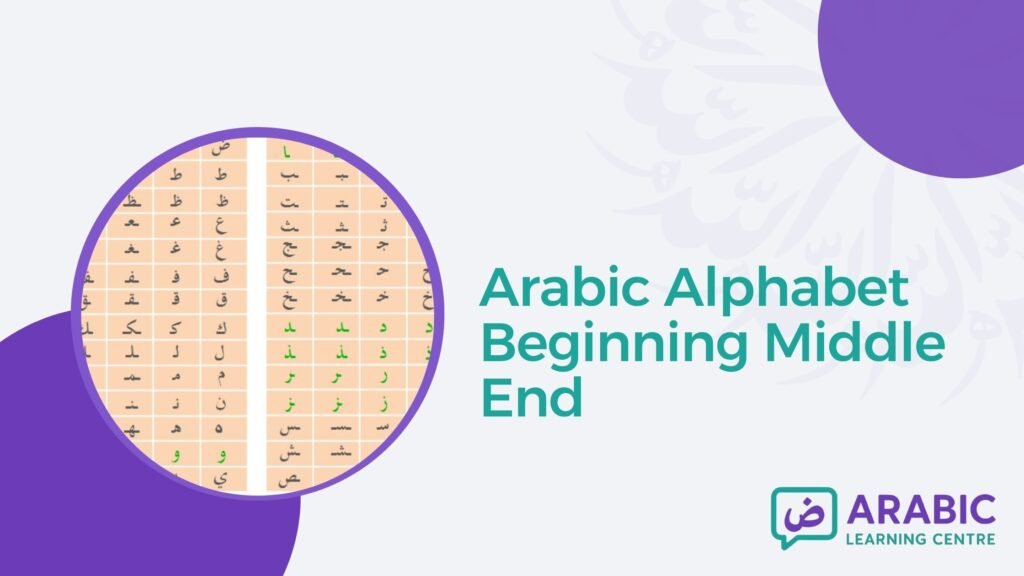
Learning the Arabic alphabet is more than memorizing 28 individual letters. Arabic letters often change their shape depending on where they appear in a word, which can initially make connected Arabic look unfamiliar to beginners.
Understanding the Arabic alphabet beginning middle end forms helps you recognize the same letter whether it appears independently or at the beginning, middle, or end of a word. Once you understand these patterns, reading connected Arabic becomes much easier.
In this guide, you will learn the different forms of all 28 Arabic letters, how letters connect together, which letters do not connect to the next letter, and how to recognize these forms in real Arabic words.
What Are the Arabic Alphabet Beginning, Middle, and End Forms?
Arabic is written from right to left, and its script is naturally connected. This means that letters within a word often join together rather than appearing as separate characters.
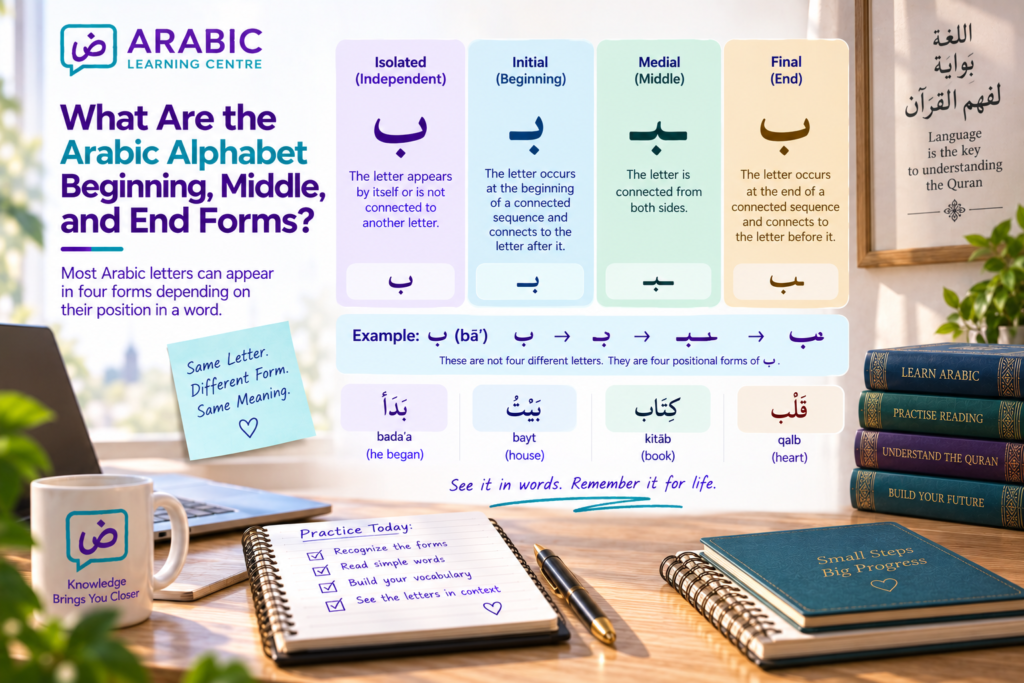
Most Arabic letters can therefore appear in four forms:
- Independent/Isolated: the letter appears by itself or is not connected to another letter.
- Initial: the letter occurs at the beginning of a connected sequence and connects to the letter after it.
- Medial: the letter is connected from both sides.
- Final: the letter occurs at the end of a connected sequence and connects to the letter before it.
Take ب (bāʾ) as a simple example: ب → بـ → ـبـ → ـب
These are not four different letters. They are four positional forms of ب.
This is why beginners should avoid memorizing Arabic letters only as isolated shapes. You need to train your eyes to recognize each letter inside actual words.
If your goal is to develop a broader foundation in formal Arabic alongside alphabet recognition, the Fusha Arabic Course can help you progress from basic script recognition toward reading and using Modern Standard Arabic.

Arabic Alphabet Beginning, Middle, and End Forms for All 28 Letters
The following Arabic alphabet beginning middle end chart gives you all 28 Arabic letters and their main positional forms.
| Name | Independent | Initial | Medial | Final |
| ʾAlif | ا | ا | ـا | ـا |
| Bāʾ | ب | بـ | ـبـ | ـب |
| Tāʾ | ت | تـ | ـتـ | ـت |
| Thāʾ | ث | ثـ | ـثـ | ـث |
| Jīm | ج | جـ | ـجـ | ـج |
| Ḥāʾ | ح | حـ | ـحـ | ـح |
| Khāʾ | خ | خـ | ـخـ | ـخ |
| Dāl | د | د | ـد | ـد |
| Dhāl | ذ | ذ | ـذ | ـذ |
| Rāʾ | ر | ر | ـر | ـر |
| Zāy | ز | ز | ـز | ـز |
| Sīn | س | سـ | ـسـ | ـس |
| Shīn | ش | شـ | ـشـ | ـش |
| Ṣād | ص | صـ | ـصـ | ـص |
| Ḍād | ض | ضـ | ـضـ | ـض |
| Ṭāʾ | ط | طـ | ـطـ | ـط |
| Ẓāʾ | ظ | ظـ | ـظـ | ـظ |
| ʿAyn | ع | عـ | ـعـ | ـع |
| Ghayn | غ | غـ | ـغـ | ـغ |
| Fāʾ | ف | فـ | ـفـ | ـف |
| Qāf | ق | قـ | ـقـ | ـق |
| Kāf | ك | كـ | ـكـ | ـك |
| Lām | ل | لـ | ـلـ | ـل |
| Mīm | م | مـ | ـمـ | ـم |
| Nūn | ن | نـ | ـنـ | ـن |
| Hāʾ | ه | هـ | ـهـ | ـه |
| Wāw | و | و | ـو | ـو |
| Yāʾ | ي | يـ | ـيـ | ـي |
The table may seem large when you first see it, but you do not actually need to memorize 112 unrelated shapes. Many forms are closely related, and several groups of Arabic letters share the same basic structure.
The more useful goal is to understand how connections work. Once that principle becomes familiar, the changes in shape become much easier to predict.
Why Do Arabic Letters Change Shape?
Arabic is a cursive writing system, which means many letters connect naturally to the letters around them.
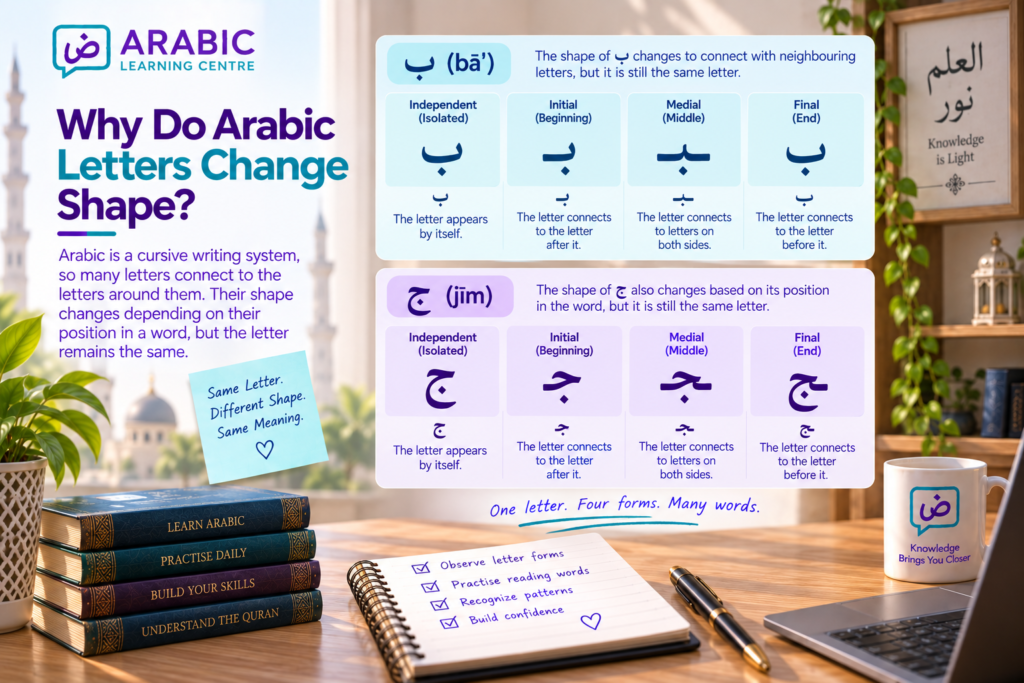
Because of this, the shape of a letter may change depending on whether it appears independently, at the beginning, in the middle, or at the end of a connected word.
For example, look at ب (bāʾ):
- ب — Independent form
- بـ — Initial form
- ـبـ — Medial form
- ـب — Final form
Although the shape changes slightly, the letter is still ب. Its dot remains below the letter, while the joining strokes change to connect it correctly with neighbouring letters.
The same happens with ج (jīm):
ج → جـ → ـجـ → ـج
Here, too, the basic identity of the letter remains the same. Only the connected form changes according to its position in the word.
Once you understand this pattern, recognizing Arabic alphabet beginning middle end forms becomes much easier, because you start seeing them as variations of the same letter rather than completely different symbols.
Practising these transitions is particularly important for writing. Learners who want structured help developing correct letter formation can explore the Arabic Writing Course, where writing can be developed as a practical skill rather than simply memorizing a chart.

The 6 Arabic Letters That Do Not Connect to the Next Letter
One important rule makes Arabic letters beginning middle end forms much easier to understand: not every Arabic letter connects on both sides.
There are six letters that do not connect to the letter that follows them:
ا — د — ذ — ر — ز — و
- ا — Alif
- د — Dāl
- ذ — Dhāl
- ر — Rāʾ
- ز — Zāy
- و — Wāw
These letters can connect to a compatible letter before them, but they cannot connect to the next letter. As a result, they create a visible break in the writing even when all the letters still belong to the same word.
This is also why their positional forms are simpler. For example:
- Dāl: د → د → ـد → ـد
- Wāw: و → و → ـو → ـو
Their independent and initial forms look the same, while their medial and final forms look the same.
Example: كِتَاب (Kitāb)
The Arabic word كِتَاب (kitāb) means “book.” It consists of four letters:
ك + ت + ا + ب
The ك (kāf) connects to ت (tāʾ), and ت connects to ا (alif):
كـتـا
However, ا (alif) is one of the six non-connecting letters, so it cannot connect to the following ب (bāʾ):
كِتَاب
The ب still belongs to the same word; the connection simply stops after ا.
Recognizing ا، د، ذ، ر، ز، و helps beginners read connected Arabic correctly and prevents them from mistaking every visual break for a space between two separate words.
How Arabic Alphabet Connected Forms Work?
To understand Arabic alphabet connected forms, it helps to stop thinking only in terms of “beginning, middle, and end of a word” and start noticing actual connections.
A letter’s form depends on what can connect around it.
For most connecting letters:
ب + ي + ت → بيت
The shapes adapt as the letters join.
But when a non-connecting letter appears, the chain is interrupted.
For example:
و + ل + د → ولد
The و does not connect forward to ل, even though both letters belong to the same word.
The more words you read, the more naturally your eyes begin to recognize these connection patterns. Eventually, you stop consciously asking whether a letter is initial, medial, or final; you simply recognize it as part of the word.
Arabic Alphabet Beginning Middle End A to Z
English-speaking learners sometimes search for the Arabic alphabet beginning middle end A to Z, but Arabic does not have a direct A-to-Z equivalent.
Arabic has its own traditional order:
ا ب ت ث ج ح خ د ذ ر ز س ش ص ض ط ظ ع غ ف ق ك ل م ن ه و ي
The system contains 28 basic letters, and several Arabic sounds do not have exact English equivalents. Similarly, English letters should not be treated as one-to-one substitutes for Arabic letters.
For that reason, transliteration can be helpful at the very beginning, but it should not replace learning the actual Arabic script.
A stronger approach is:
Arabic shape → Arabic sound → positional forms → connected word
rather than:
Arabic shape → English letter
This helps you build direct recognition instead of depending permanently on English spelling.
Read also: How Do U Say No in Arabic? – 15 Ways to Say No Naturally
Similar Arabic Letter Shapes and How to Tell Them Apart
Learning all the Arabic alphabet beginning middle end forms can seem difficult at first, but many Arabic letters are built from the same basic shapes.
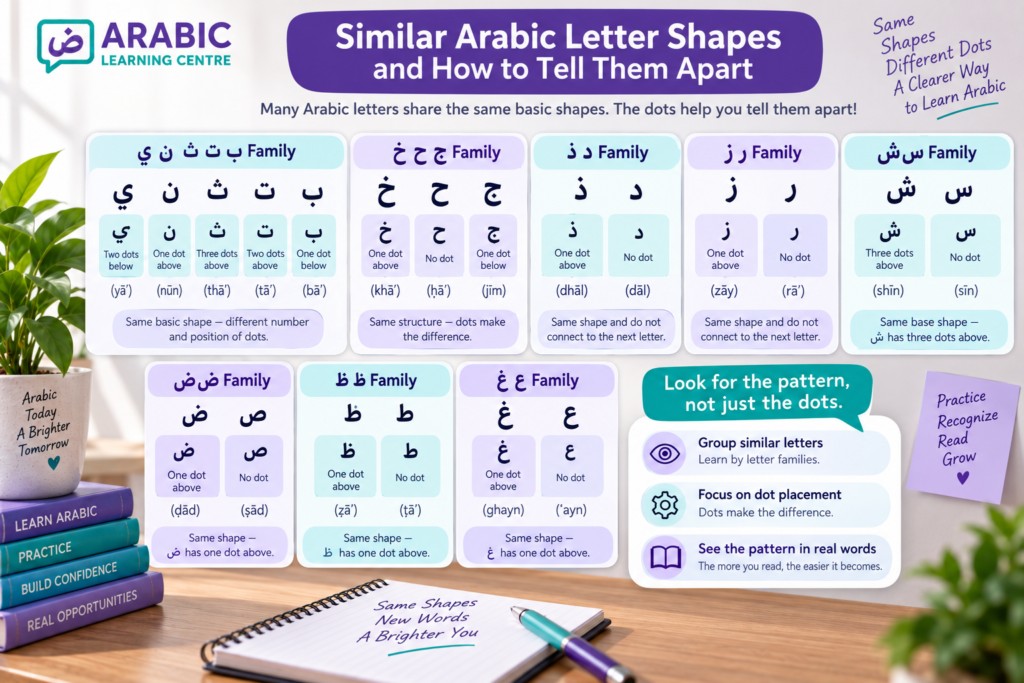
Instead of memorizing every letter separately, you can group visually similar letters into letter families and focus on the small details that distinguish them.
In many of these families, the main difference is simply the number or position of the dots. Recognizing these patterns makes it easier to identify letters when their shapes change inside connected words.
1. The ب ت ث ن ي Family
These letters have closely related shapes, especially when they appear in connected positions:
بـ — تـ — ثـ — نـ — يـ
The dots help you tell them apart:
- ب (bāʾ) — one dot below
- ت (tāʾ) — two dots above
- ث (thāʾ) — three dots above
- ن (nūn) — one dot above
- ي (yāʾ) — two dots below in its standard independent and final forms
Practising these letters side by side helps you focus on dot placement rather than treating each form as an entirely new shape.
2. The ج ح خ Family
ج، ح، and خ share the same basic structure. Their dots are the easiest way to distinguish them:
- ج (jīm) — one dot below
- ح (ḥāʾ) — no dot
- خ (khāʾ) — one dot above
Their connected forms also follow the same visual pattern:
Initial: جـ — حـ — خـ
Medial: ـجـ — ـحـ — ـخـ
Final: ـج — ـح — ـخ
3. The د ذ Family
د and ذ have the same basic shape:
د — ذ
The difference is simple: ذ (dhāl) has one dot above, while د (dāl) has no dot.
Both are also among the six letters that do not connect to the following letter, making their positional forms relatively easy to recognize.
Inside Our Classrooms
See how we make learning interactive and engaging! Watch a quick snippet of our live, conversational classes in action:
4. The ر ز Family
Another closely related pair is:
ر — ز
ر (rāʾ) has no dot, while ز (zāy) has one dot above. Like د and ذ, both letters do not connect to the letter that follows them.
5. The س ش Family
س (sīn) and ش (shīn) share the same base shape, but ش is distinguished by three dots above:
Independent: س — ش
Initial: سـ — شـ
Medial: ـسـ — ـشـ
Final: ـس — ـش
Once you recognize the underlying shape, the dots make it much easier to identify which letter you are reading.
6. The ص ض Family
The letters ص (ṣād) and ض (ḍād) also form a visual pair:
ص — ض
They share the same basic structure, but ض has one dot above while ص has none.
7. The ط ظ Family
Another useful pair to learn together is:
ط — ظ
ط (ṭāʾ) has no dot, while ظ (ẓāʾ) has one dot above. Their overall shapes remain closely related in their connected forms.
8. The ع غ Family
Finally, ع (ʿayn) and غ (ghayn) share the same fundamental shape:
ع — غ
The distinguishing feature is the dot: غ has one dot above, while ع has no dot.
Studying Arabic letters in these visual families makes the writing system feel much more systematic.
Instead of trying to memorize dozens of unrelated Arabic alphabet connected forms, you learn a smaller number of recurring shapes and then use dots and joining patterns to identify individual letters.
Read also: Best Arabic Grammar Books for Beginners – 10 Picks to Start Learning
What Happens to Hamza at the Beginning, Middle, and End?
Hamza ء requires separate attention because it does not behave exactly like an ordinary connecting letter.
At the beginning of words, you will commonly encounter forms such as:
أ — إ
In medial positions, hamza may appear in forms including:
ء — أ — ؤ — ئ
At the end of a word, you may similarly encounter:
ء — أ — ؤ — ئ
Which form is used depends on Arabic spelling rules and the surrounding vowels. Beginners do not need to master every hamza rule before learning the alphabet, but they should recognize these shapes so they do not mistake them for completely different letters.
You may also encounter آ, known as alif with maddah. For complete beginners who need guided instruction rather than independent chart study, the Arabic Course for Non-Arabic Speakers provides a structured path for building Arabic skills from the foundations.

Getting the Most Out of Your Arabic Letter Forms Worksheet”
An Arabic letters beginning middle end worksheet should do more than ask you to copy a letter repeatedly. A useful worksheet trains you to recognize, produce, and connect each positional form.
A simple worksheet can contain four columns:
| Independent | Beginning | Middle | End |
| ب | بـ | ـبـ | ـب |
| ج | جـ | ـجـ | ـج |
| س | سـ | ـسـ | ـس |
| ع | عـ | ـعـ | ـع |
| م | مـ | ـمـ | ـم |
Common Mistakes When Learning Arabic Alphabet Connected Forms
Learning Arabic alphabet connected forms becomes much easier when you know which habits can cause confusion.
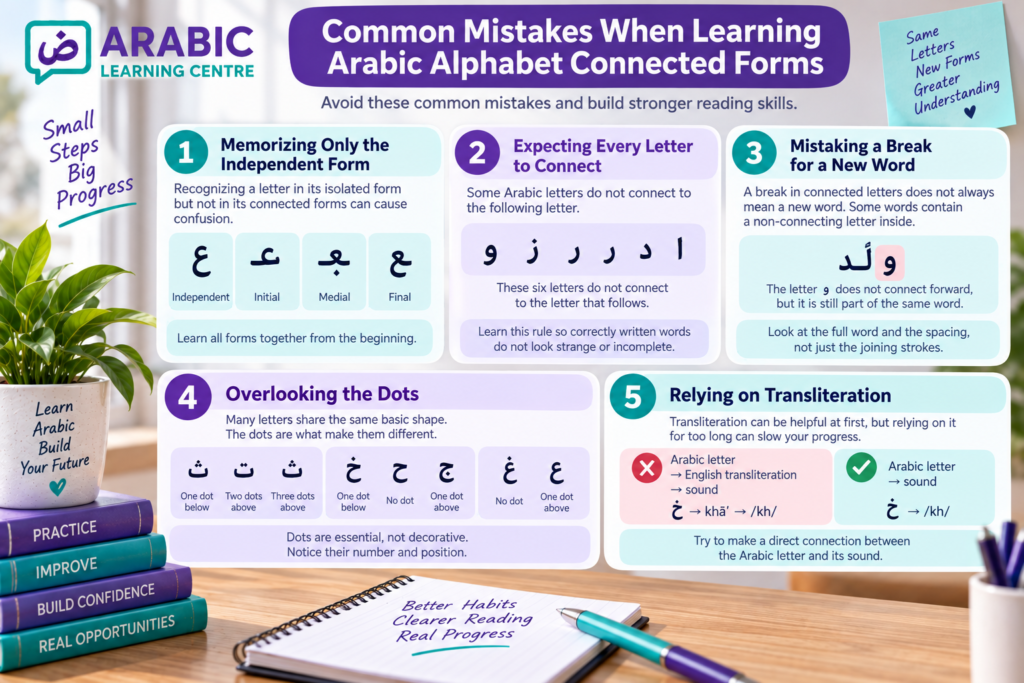
Most beginner mistakes come from treating Arabic letters as fixed shapes instead of learning how they change and connect inside real words.
a. Memorizing Only the Independent Form of Each Arabic Letter
A beginner may easily recognize ع when it appears alone but struggle to identify the same letter in its connected forms:
عـ — ـعـ — ـع
This happens when the independent form is memorized as a separate symbol rather than as one version of the same letter. To avoid this problem, learn the independent, initial, medial, and final forms together from the beginning.
b. Expecting Every Arabic Letter to Connect on Both Sides
Not every Arabic letter connects to the letter that follows it. The six letters:
ا — د — ذ — ر — ز — و
do not connect to the following letter. Forgetting this rule can make correctly written Arabic words look incomplete or incorrectly separated.
c. Mistaking a Break in Connected Letters for a New Word
A visible break between letters does not always mean that a new word has started. Some Arabic words contain disconnected sections because one of the six non-connecting letters appears inside the word.
Instead of judging word boundaries only by the joining strokes, pay attention to the actual spacing between words and the complete sequence of letters.
d. Overlooking the Dots That Distinguish Similar Arabic Letters
Many Arabic letters share the same or very similar basic shapes, with dots being the main feature that distinguishes them.
For example:
ب — ت — ث
ج — ح — خ
ع — غ
Dots are not decorative marks. Their number and position are essential to the identity of the letter, so beginners should learn to notice them immediately when reading.
e. Relying on Transliteration Instead of Reading Arabic Letters Directly
Transliterations such as bāʾ, jīm, and khāʾ can be useful when first learning letter names and sounds, but relying on them for too long can slow down Arabic reading development.
The goal should be to build a direct connection between:
Arabic letter → sound
rather than depending on:
Arabic letter → English transliteration → sound
As you become familiar with Arabic letters beginning middle end forms, gradually reduce your reliance on English spellings and practise recognizing and pronouncing the Arabic letters directly.
How Teachers Can Teach Arabic Letter Forms to Children?
For children, positional forms are easier to understand when the lesson is visual and interactive.
A teacher can begin with visually similar letters and show how dots change their identity. For example, use the shared shape of:
بـ — تـ — ثـ — نـ — يـ
Ask the child to identify how the number or location of the dots changes.
Next, introduce one letter in its positional forms:
بـ — ـبـ — ـب
Have the child compare what stays the same and what changes.
Teachers can then move from isolated examples to short words, asking the child to circle a target letter whenever it appears at the beginning, middle, or end.
This approach teaches children that Arabic letters are flexible shapes with recognizable features, rather than forcing them to memorize every connected form as a completely new symbol.
How Long Does It Take to Learn Arabic Connected Letter Forms?
There is no single timeline that applies to every learner. Progress depends on your familiarity with Arabic script, how frequently you practise, whether you write as well as read, and how quickly you become comfortable with the six non-connecting letters.
The important milestone is not being able to recite a table from memory. It is being able to see a letter such as ـعـ, ـهـ, or ـج inside a word and recognize it without hesitation.
That skill develops through repeated exposure to real Arabic words.
Once you begin seeing positional forms as variations of familiar letters rather than separate symbols, reading becomes significantly more natural.
Don’t Just Take Our Word For It
Take a look inside our vibrant classes and see our students and teachers in action. Click below to watch our classroom experience:
Start Learning Arabic With Arabic Learning Centre
Mastering the Arabic alphabet beginning middle end forms is an important first step toward reading and writing Arabic with confidence.
Once you understand how letters change according to their position and how they connect inside words, recognizing Arabic text becomes much easier.
Arabic Learning Centre provides a supportive learning environment for students who want to build a strong foundation in Arabic and develop their skills gradually.
Instead of simply memorizing individual letter shapes, learners can work toward understanding how Arabic is actually read, written, and used.
A strong understanding of Arabic alphabet connected forms will make it easier to recognize words, read sentences, and write Arabic more confidently.
Start your journey with Arabic Learning Centre and book your free trial today to experience Arabic learning for yourself.
Courses We Offer:
- Online Arabic Course
- Classical arabic course
- Modern Standard Arabic Course
- Fusha Arabic Course
- Learn Saudi Arabic
- Arabic Course for Beginners
- Arabic Classes for Adults
- Arabic Classes for Ladies
- Advanced Arabic Course
- Intensive Arabic Course
Conclusion
Mastering the Arabic alphabet beginning middle end forms is one of the most important steps between recognizing individual letters and actually reading Arabic.
Start by learning each independent letter, but introduce its connected forms early. Pay special attention to the six non-connecting letters ا، د، ذ، ر، ز، و, study similar shapes together, and practise the letters inside real words instead of memorizing them only from a chart.
With consistent writing and reading practice, forms such as بـ, ـبـ, and ـب stop looking like separate symbols. You begin to recognize them automatically as the same letter ب adapting to its position.
That is the key to understanding Arabic alphabet connected forms: the shape may change, but the letter remains the same.
Frequently Asked Questions
Do All Arabic Letters Have Beginning, Middle, and End Forms?
Arabic letters are commonly presented in independent, initial, medial, and final forms, but not every letter connects in all directions. The six letters ا، د، ذ، ر، ز، و do not connect to the letter that follows them, so their positional behaviour differs from fully connecting letters.
What Are the Four Forms of Arabic Letters?
The four commonly taught forms are independent (isolated), initial, medial, and final. For example, bāʾ appears as ب, بـ, ـبـ, and ـب.
Which Arabic Letters Do Not Connect to the Next Letter?
The six letters are:
ا د ذ ر ز و
They can connect to a preceding compatible letter but do not connect to the letter that follows them.
Why Do Arabic Letters Look Different in Words?
Arabic uses a cursive writing system, so many letters adjust their shapes according to how they connect with neighbouring letters. The underlying letter remains the same even when its initial, medial, or final shape changes.
How Can I Memorize Arabic Letters in Beginning, Middle, and End Forms?
Practise the four forms side by side, group visually similar letters together, memorize the six non-connecting letters, write the forms by hand, and apply them immediately to real words. This helps you learn the connection system instead of memorizing dozens of shapes independently.
Is There an Arabic Alphabet Beginning Middle End A to Z?
Not literally. Arabic has 28 letters in its own alphabetical order rather than the English A-to-Z system. Beginners sometimes use English transliteration as a pronunciation aid, but the best long-term approach is to learn each Arabic letter directly with its sound and connected forms.
Related Articles
Arabic Alphabet & Writing