 Learn Arabic
If you are looking for a convenient way to study Arabic, you may be wondering: can you learn Arabic on Babbel? The short answer is no, not currently. Babbel offers courses for a range of languages, but Arabic is not among the languages available to English-speaking learners.
That means you cannot currently use Babbel for a complete Arabic learning path covering the alphabet, reading, vocabulary, grammar, listening, speaking, and writing.
However, that does not mean you need to delay learning Arabic. There are other ways to study the language, from structured Arabic courses to apps, audio resources, writing practice, and lessons focused on either formal Arabic or regional dialects.
This guide explains what Babbel currently offers, what to look for in an alternative, and how to choose an Arabic learning path that matches your goals.
Does Babbel Have an Arabic Course?
No. Babbel does not currently offer a dedicated Arabic course for English-speaking learners.
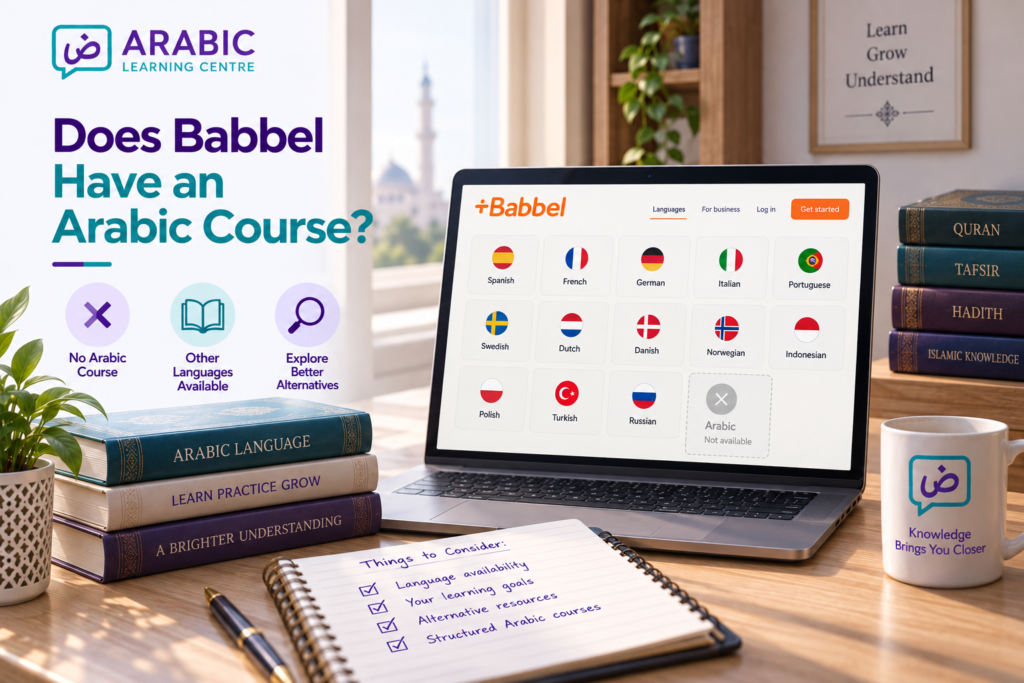
Babbel provides courses in languages including Spanish, French, German, Italian, Brazilian Portuguese, Swedish, Dutch, Danish, Norwegian, Indonesian, Polish, Turkish, and Russian. Arabic, however, is not currently included.
This means there is no Babbel Arabic programme that takes you from learning the Arabic alphabet through vocabulary, grammar, reading, listening, speaking, and writing.
Babbel has not provided a specific public explanation for why Arabic is absent from its current language selection. It is therefore better not to assume that the reason is the writing system, grammar, difficulty of Arabic, or another particular feature of the language.
What Can You Use Instead of Babbel for Arabic?
The right Babbel alternative depends largely on why you want to learn Arabic.
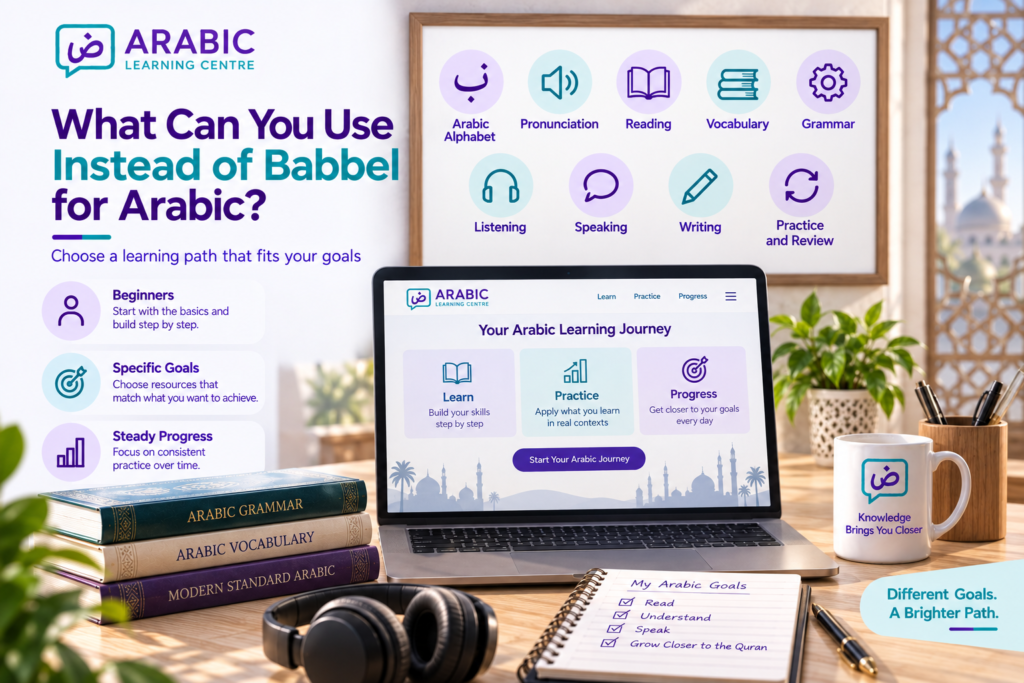
A learner who wants to read formal Arabic may need a different learning path from someone preparing for everyday conversations in Egypt, Saudi Arabia, Morocco, or another Arabic-speaking country.
Similarly, a complete beginner who cannot yet read the Arabic alphabet has different needs from someone who can read but struggles with grammar.
Rather than looking for an exact copy of Babbel, consider the skills you actually want an Arabic learning resource to provide.
A well-rounded learning path may include:
- Arabic alphabet and letter recognition
- Pronunciation
- Reading
- Vocabulary
- Grammar
- Listening
- Speaking
- Writing
- Regular review and practice
You do not necessarily need to develop all of these skills at exactly the same pace. Your priorities should reflect what you eventually want to do with Arabic.
What Should a Good Babbel Arabic Alternative Include?
One reason people use language apps is structure. Instead of deciding what to study every day, learners can follow lessons in a planned sequence.
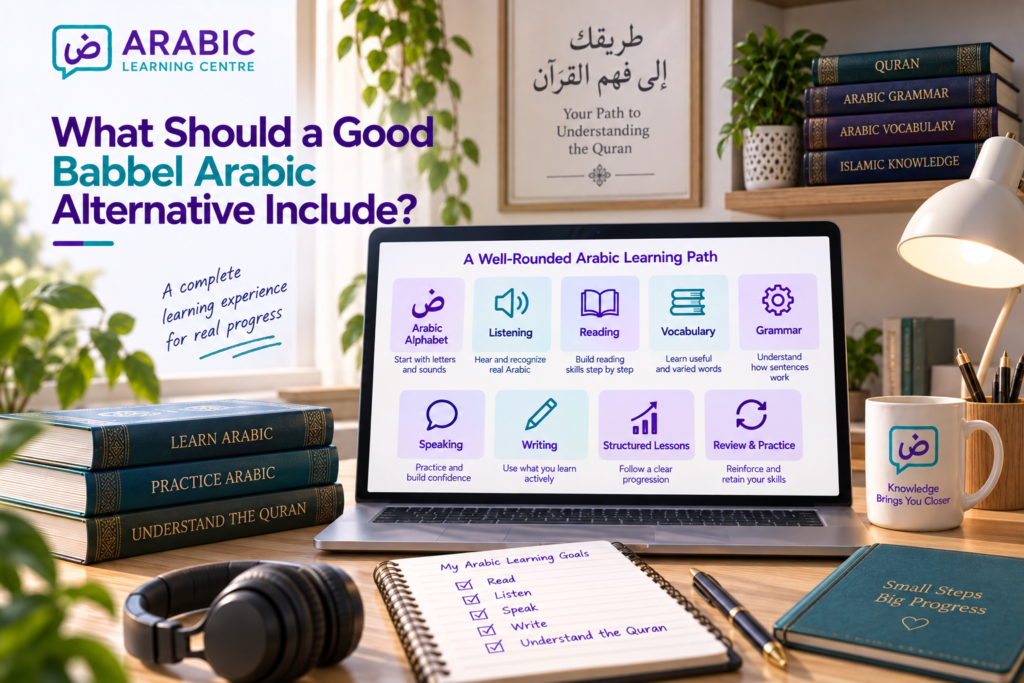
When choosing an alternative for Arabic, look for the same sense of progression. For complete beginners, lessons should introduce Arabic letters and sounds before expecting learners to read complex sentences.
Vocabulary should gradually become more useful and varied, while grammar should be introduced in a way that helps learners understand sentences rather than simply memorize terminology.
Listening is also important because Arabic contains sounds that may be unfamiliar to English speakers. Hearing Arabic regularly can help you distinguish sounds and become more familiar with natural pronunciation and rhythm.
Speaking and writing provide opportunities to actively produce the language rather than simply recognize correct answers. Ideally, your learning method should therefore combine both receptive skills—reading and listening—and productive skills—speaking and writing.
Should You Learn Fusha or an Arabic Dialect?
This is one of the most important decisions to consider when looking for an alternative to Babbel Arabic.
Arabic exists in different varieties. Fusha, often associated with Modern Standard Arabic in contemporary learning contexts, is used widely in formal writing, education, news, official communication, and other formal settings. Regional dialects are commonly used in everyday conversation and vary significantly between countries and regions.
Your reason for learning Arabic can help determine where to begin. If you want to read formal texts, follow Arabic-language media, study in Arabic, or build a foundation that can be understood across different Arabic-speaking countries, studying Fusha Arabic may fit your goals.

If your main goal is everyday conversation in a particular country, learning the relevant regional dialect can be particularly useful.
The two approaches are not mutually exclusive. Some learners build a foundation in Fusha and later add a dialect, while others begin with the spoken variety most relevant to their daily lives and study formal Arabic separately.
Can You Learn the Arabic Alphabet on Babbel?
Not through a dedicated Arabic course. Since Babbel does not currently offer Arabic, it does not provide a complete learning path for mastering the Arabic alphabet.
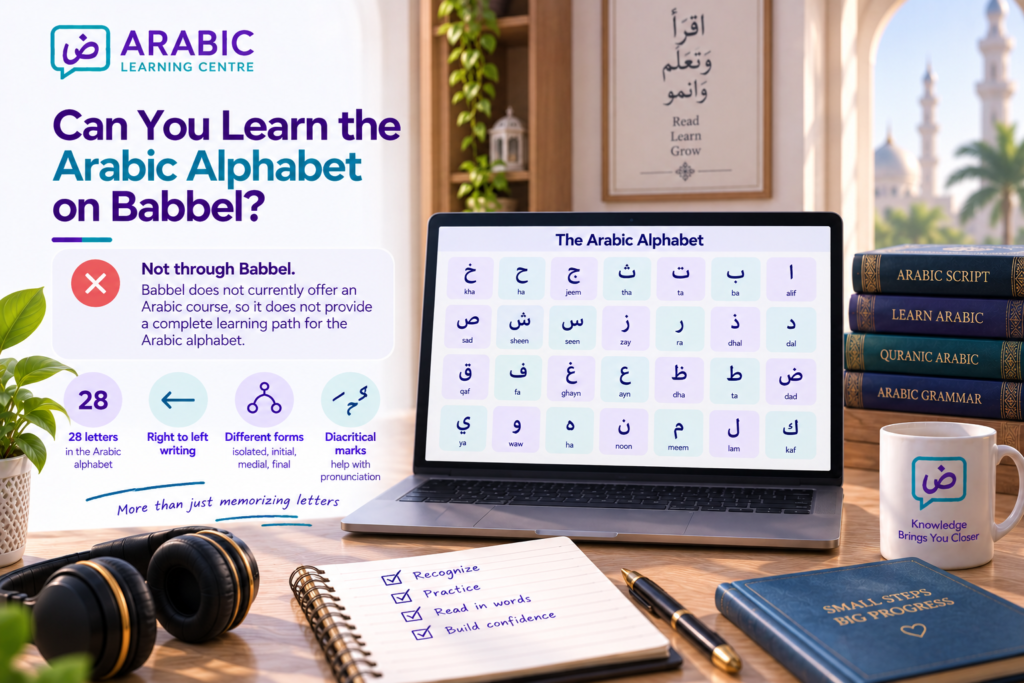
For English-speaking beginners, learning Arabic script involves several new concepts.
Arabic has 28 basic letters and is written from right to left. Many letters also change their appearance according to their position within a word. A letter may have an isolated, initial, medial, or final form.
Learners also need to understand which letters connect to the letters that follow them and which do not. Diacritical marks can provide additional information about pronunciation, particularly in beginner materials and fully vocalized texts.
Because of these features, simply memorizing the names of the 28 letters is not enough. You need practice recognizing them inside actual words.
Writing can reinforce this process. Practising Arabic script writing helps you become familiar with letter shapes, connections, positional forms, and right-to-left movement.

Once letter recognition becomes more automatic, reading short Arabic words becomes considerably easier.
Read also: The Importance of Arabic Language in Quran – 10 Reasons
Can You Learn Arabic Grammar on Babbel?
Not currently. Because there is no dedicated Arabic course on Babbel, you cannot use the platform as a complete programme for studying Arabic grammar.
Grammar becomes increasingly important once you move beyond isolated words and basic expressions.
Arabic learners may encounter nominal and verbal sentences, masculine and feminine forms, singular and plural patterns, verb conjugation, agreement, pronouns, grammatical cases, and morphological patterns.
You do not need to master all of these concepts before you start communicating. However, understanding grammar gradually helps explain why words change and how complete sentences are constructed.
If grammar becomes a major part of your learning goals, following a structured Arabic grammar course can be more useful than collecting unrelated rules from multiple resources.
The goal should not be to memorize grammatical terminology alone. Try to connect each new rule to real sentences so you can recognize and eventually use the structure yourself.
Inside Our Classrooms
See how we make learning interactive and engaging! Watch a quick snippet of our live, conversational classes in action:
Can You Learn to Speak Arabic Without Babbel?
Yes. Babbel is only one language-learning platform, and its lack of an Arabic course does not prevent you from developing speaking skills elsewhere.
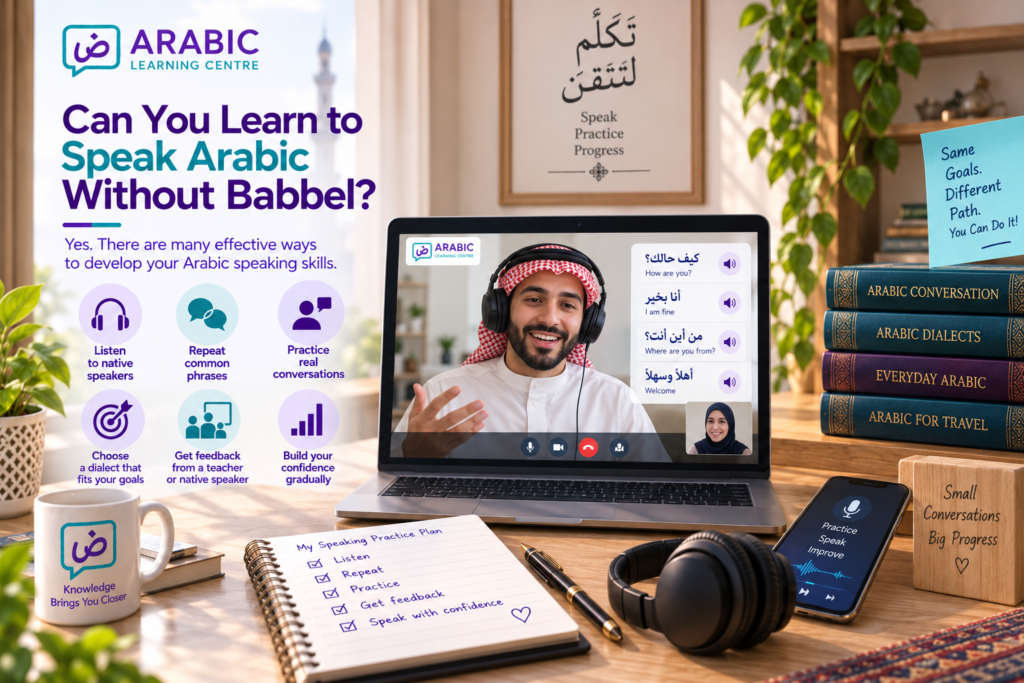
Regular listening and speaking practice are particularly important if conversation is your main goal. You can listen to native Arabic speakers, repeat short phrases, practise common exchanges, and gradually begin producing your own sentences.
It is also useful to decide which variety of spoken Arabic you want to practise. Egyptian, Levantine, Gulf, Moroccan, and other dialects differ in pronunciation, vocabulary, and some grammatical features.
If you have a particular travel, work, family, or communication goal, choosing a relevant dialect can make your speaking practice more focused.
Feedback can also be valuable. A teacher or proficient speaker can identify pronunciation or sentence-building mistakes that may be difficult to notice when studying entirely on your own.
Read also: Preposition in Arabic – A Complete Guide
Can You Learn Arabic With an App?
Yes, and an app can be a useful part of your Arabic study routine even though Babbel itself does not currently teach Arabic.
Different apps focus on different skills. Some emphasize vocabulary and short exercises, while others concentrate on listening, pronunciation, reading, flashcards, or conversations.
Before choosing one, consider what you actually need.
For example, if you already know the Arabic alphabet but lack vocabulary, a vocabulary-focused app may be useful. If you recognize written Arabic but struggle to understand native speakers, listening resources deserve more attention.
Apps can also be helpful for maintaining consistency because short lessons are easier to fit into a busy schedule.
However, you do not necessarily need one resource to do everything. An app can be combined with lessons, textbooks, listening materials, handwriting practice, or conversations with Arabic speakers.
How Long Does It Take to Learn Arabic?
There is no single amount of time that applies to every Arabic learner Your progress depends on factors such as your starting point, previous language-learning experience, the variety of Arabic you are studying, how frequently you practise, the skills you want to develop, and the level you hope to reach.
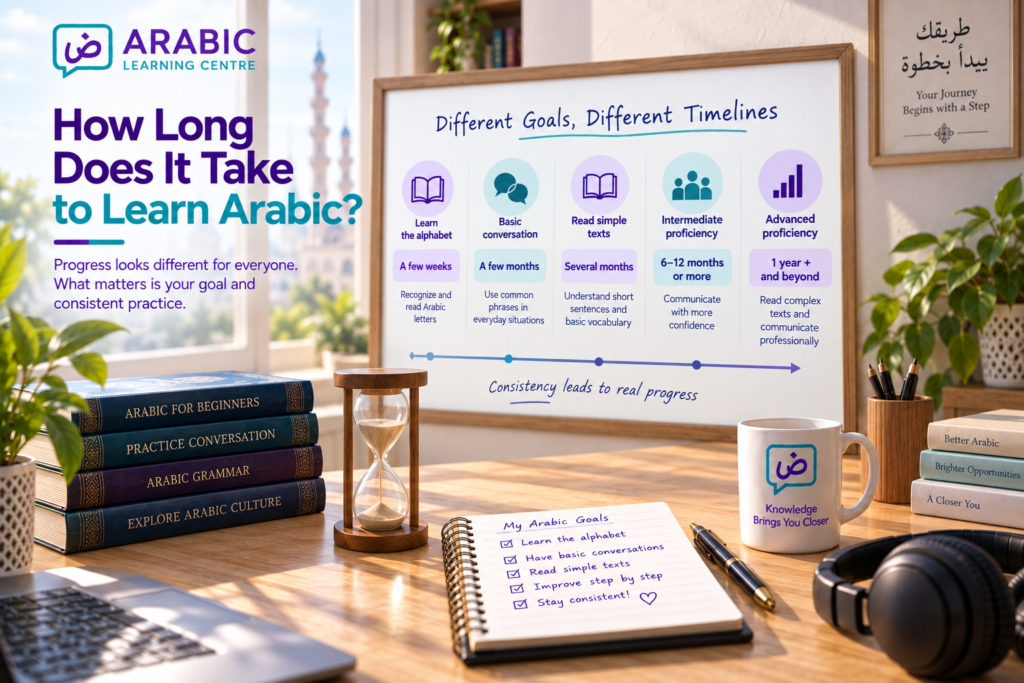
Someone who wants basic conversational phrases for a trip has a very different goal from someone who wants to read complex formal texts or communicate professionally in Arabic.
Your study method matters as well. Regular contact with the language helps reinforce what you learn and reduces the amount of material you need to relearn after long breaks.
Instead of focusing only on how many months or years Arabic will take, set smaller milestones. Your first goals might be recognizing the alphabet, reading simple words, introducing yourself, understanding common phrases, or constructing basic sentences These milestones make progress easier to see.
How to Start Learning Arabic Without Babbel?
If Babbel was going to be your starting point, you can replace it with a simple structured plan.
1. Decide Why You Want to Learn Arabic
Define your main goal first. Do you want to speak with Arabic-speaking friends or family, travel, read formal Arabic, use the language professionally, or study it for academic purposes?
Your answer will influence whether you prioritize Fusha, a dialect, reading, writing, or conversation.
2. Learn the Alphabet and Basic Sounds
If you cannot read Arabic yet, become familiar with the 28 letters, their different forms, and their sounds.
Do not spend too long studying letters only in isolation. Begin recognizing them in short words as soon as you are comfortable with the basics.
3. Build Useful Vocabulary
Start with vocabulary that you are likely to encounter frequently.
Greetings, numbers, family words, everyday objects, common verbs, question words, and basic expressions can give you enough material to begin understanding and producing simple sentences.
4. Introduce Grammar Gradually
You do not need to memorize an entire grammar book before using Arabic.
Learn basic sentence structures alongside vocabulary and reading. Add more advanced grammar as you encounter structures that require explanation.
5. Listen to Arabic Regularly
Listening helps connect the written language with actual pronunciation.
Use material appropriate to your level and listen repeatedly when necessary. Beginners do not need to understand every word; recognizing familiar sounds and vocabulary is already useful practice.
6. Practise Producing Arabic
Reading and listening alone are not enough if your goal includes communication.
Write simple sentences, read aloud, repeat useful expressions, and practise speaking whenever possible. Active use helps reveal gaps in your knowledge that passive study may not expose.
7. Stay Consistent
Regular practice is more important than trying to complete large amounts of material at once.
Even a relatively short daily session can include several skills: a few minutes of vocabulary review, a short reading passage, some listening, and one or two sentences of writing or speaking.
Read also: Arabic Alphabet with Fatha Kasra and Damma
Don’t Just Take Our Word For It
Take a look inside our vibrant classes and see our students and teachers in action. Click below to watch our classroom experience:
Start Your Arabic Learning Journey With Arabic Learning Centre
If you would rather follow a structured learning path than piece together lessons from different apps and resources, Arabic Learning Centre offers dedicated Arabic programmes for learners at different levels.
You can follow a clearer learning path that helps you understand what to study next while developing your Arabic skills progressively.
Whether you are starting from the basics or already have some knowledge of Arabic, you can focus on the areas that matter most to your goals.
This may include improving reading and writing, strengthening grammar, developing your understanding of Fusha, expanding vocabulary, or building greater confidence in using Arabic.
With structured lessons and consistent practice, you can gradually turn what you learn into practical language skills instead of moving randomly between unrelated resources.
Arabic Learning Centre gives you a dedicated place to continue your Arabic journey without having to wait for Babbel to introduce an Arabic course.
Start with a free trial and discover the Arabic learning path that best matches your level and goals.
Courses We Offer:
- Online Arabic Course
- Classical arabic course
- Modern Standard Arabic Course
- Fusha Arabic Course
- Learn Saudi Arabic
- Arabic Course for Beginners
- Arabic Classes for Adults
- Arabic Classes for Ladies
- Advanced Arabic Course
- Intensive Arabic Course

Conclusion
So, can you learn Arabic on Babbel? At the moment, the answer is no. Babbel does not currently offer Arabic, but this does not mean you need to delay your learning journey.
There are many other Arabic-specific courses, apps, tutors, and resources that can help you start learning effectively.
The key is to choose a learning path that matches your current level and personal goals. You may want to begin with the Arabic alphabet and pronunciation, develop your knowledge of Fusha, improve your grammar and writing, or focus on a regional dialect for everyday communication. Having a clear goal makes choosing the right resources much easier.
Whatever learning method you choose, consistency will make the biggest difference over time. Regular practice with reading, listening, speaking, writing, and vocabulary can help you gradually turn what you study into practical language skills.
With the right resources and a structured approach, you can continue making progress in Arabic without relying on Babbel.
Read also: Best Arabic Grammar Books for Beginners – 10 Picks to Start Learning
Frequently Asked Questions
Can You Learn Arabic on Babbel?
No. Babbel does not currently offer Arabic as one of its languages for English-speaking learners. You will need to use another course, app, or Arabic learning resource.
Will Babbel Add Arabic?
Babbel does not currently offer Arabic, and learners should rely on official Babbel announcements for any future additions to its language catalogue. Until Arabic is officially added, it is better to choose an existing Arabic learning resource rather than plan around a possible future course.
Can You Learn the Arabic Alphabet on Babbel?
Not through a dedicated Arabic programme. Since Babbel does not offer Arabic, learners who want to study the alphabet, connected letters, positional forms, and Arabic writing need another resource.
What Should I Use Instead of Babbel for Arabic?
That depends on your goal. You can use Arabic-specific apps, structured online courses, textbooks, audio resources, tutors, or a combination of several methods. Look for resources that match whether you want to learn Fusha, a regional dialect, reading and writing, grammar, or conversational Arabic.
Should I Learn Fusha or a Dialect First?
It depends on why you are learning Arabic. Fusha can be useful for formal reading, writing, education, and media, while a regional dialect may be more relevant for everyday conversation in a particular Arabic-speaking community. Some learners eventually study both.
Can I Learn Arabic Online?
Yes. Arabic can be studied online through courses, tutoring, apps, listening materials, reading resources, and writing practice. A structured learning plan can help you combine these resources instead of studying unrelated topics randomly.