 Learn Arabic
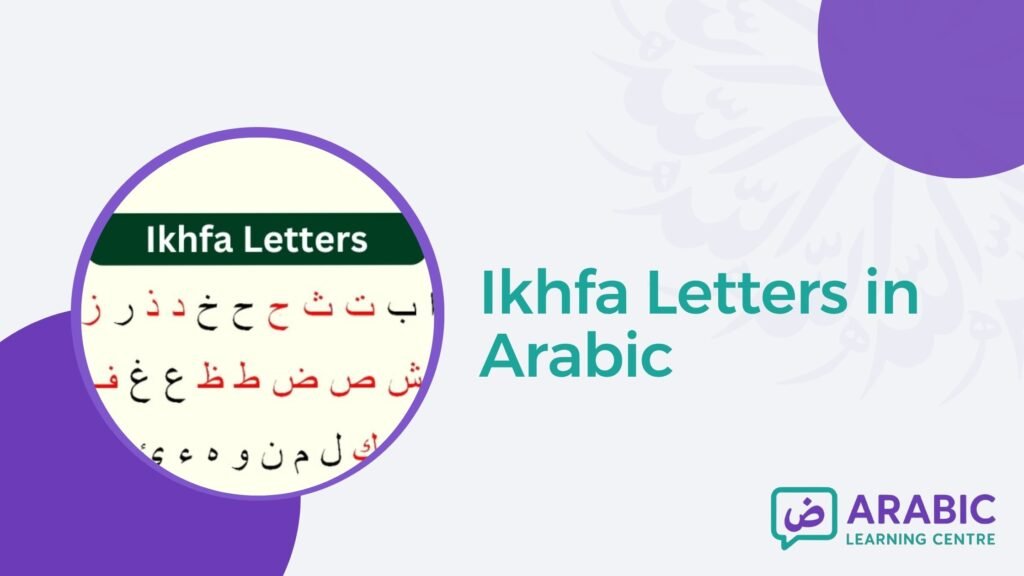
The Ikhfa letters in Arabic are an essential part of the Tajweed rules that govern Noon Sakinah and Tanween. Ikhfa means “concealment,” and in recitation it describes a sound that falls between clear pronunciation and complete merging.
There are 15 Ikhfa letters:
ت، ث، ج، د، ذ، ز، س، ش، ص، ض، ط، ظ، ف، ق، ك
When Noon Sakinah (نْ) or Tanween (ـً ـٍ ـٌ) is followed by one of these letters, the clear Noon sound is concealed while Ghunnah remains for approximately two counts. Classical Tajweed texts describe this pronunciation as a middle state between Izhar and Idgham.
In this guide, you will learn what are the 15 letters of Ikhfa, how to pronounce them, how to remember them, the different levels of Ikhfa, and practical Ikhfa examples from Quran.
What Is Ikhfa in Tajweed?
The Arabic word Ikhfa (إخفاء) means “to hide” or “to conceal.” In Tajweed, it refers to concealing the clear sound of Noon Sakinah or Tanween without merging it completely into the following letter.
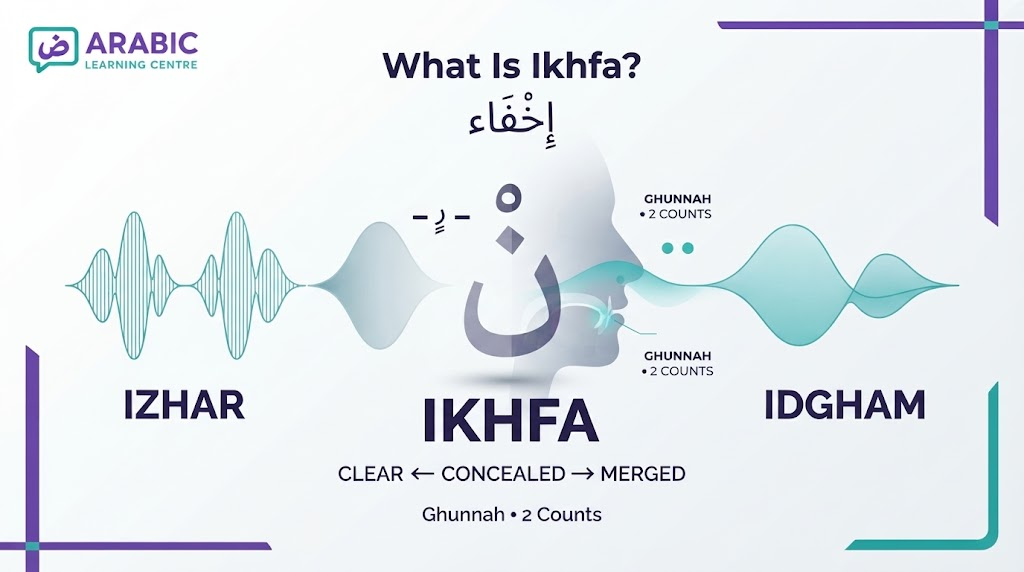
The pronunciation should remain between two other Tajweed rules:
- Izhar, where the Noon is pronounced clearly.
- Idgham, where the Noon merges into the following letter.
With Ikhfa, the Noon is neither completely clear nor fully merged. Instead, the tongue avoids making full contact with the normal articulation point of Noon, while a nasal Ghunnah continues for approximately two counts before the following letter is pronounced.
This middle position is one of the main features that distinguishes Ikhfa from the other rules of Noon Sakinah and Tanween.
Learners studying Arabic more broadly may also benefit from improving their understanding of classical pronunciation and written structures through Classical Arabic learning.

What Are the 15 Letters of Ikhfa?
The 15 Ikhfa letters in Arabic are:
ص – ذ – ث – ك – ج – ش – ق – س – د – ط – ز – ف – ت – ض – ظ
They are the letters that trigger Ikhfa Haqiqi when they come after Noon Sakinah or Tanween.
A useful way to understand the system is to remember that the Arabic letters are divided among the four main rules of Noon Sakinah and Tanween:
- Six letters belong to Izhar.
- Six letters belong to Idgham.
- One letter, Baa (ب), belongs to Iqlab.
- The remaining fifteen letters belong to Ikhfa.
This makes Ikhfa the largest of the four letter groups.
The 15 letters are also preserved in a classical mnemonic line:
صِفْ ذَا ثَنَا كَمْ جَادَ شَخْصٌ قَدْ سَمَا
دُمْ طَيِّبًا زِدْ فِي تُقًى ضَعْ ظَالِمًا
The first letter of every word gives one of the fifteen Ikhfa letters in order.
How to Remember the Ikhfa Letters?
Memorizing fifteen letters can feel difficult at first, but using a clear pattern makes them much easier to recall.
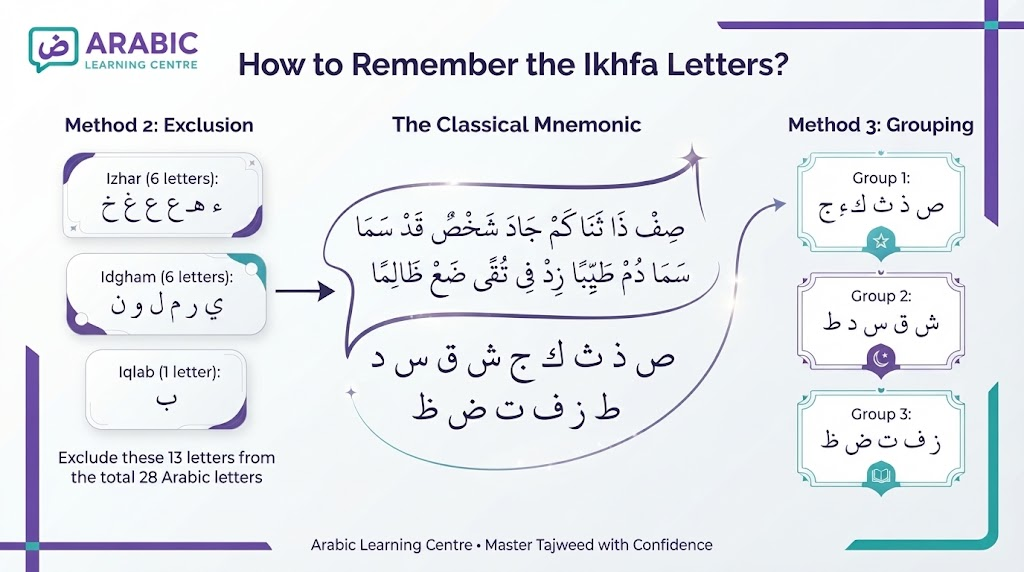
1. Use the Classical Mnemonic to Memorize All 15 Ikhfa Letters
The most traditional method is to memorize:
صِفْ ذَا ثَنَا كَمْ جَادَ شَخْصٌ قَدْ سَمَا
دُمْ طَيِّبًا زِدْ فِي تُقًى ضَعْ ظَالِمًا
Take the first letter of each word:
ص، ذ، ث، ك، ج، ش، ق، س، د، ط، ز، ف، ت، ض، ظ
This mnemonic remains one of the easiest ways to remember the complete group.
2. Identify the Ikhfa Letters by Excluding Izhar, Idgham, and Iqlab Letters
Another method is to first memorize the letters of the other Noon Sakinah and Tanween rules:
Izhar: ء، هـ، ع، ح، غ، خ
Idgham: ي، ر، م، ل، و، ن
Iqlab: ب
The remaining fifteen Arabic letters are the Ikhfa letters.
This method works especially well for students who already know the other Tajweed rules.
3. Divide the 15 Ikhfa Letters Into Smaller Groups for Easier Review
Instead of memorizing all fifteen letters as one long sequence, divide them into smaller groups:
ص، ذ، ث، ك، ج
ش، ق، س، د، ط
ز، ف، ت، ض، ظ
Reviewing the letters in smaller groups makes daily practice easier and reduces the need to depend completely on the mnemonic.
When Does Ikhfa Occur?
Ikhfa occurs when Noon Sakinah or Tanween is followed by one of the fifteen Ikhfa letters. The rule may appear within a single word or across two words, depending on whether the recitation contains Noon Sakinah or Tanween.
1. Ikhfa With Noon Sakinah Can Occur Within a Single Word
Noon Sakinah can be followed by an Ikhfa letter within the same word.
For example: مِنْكُمْ
In مِنْكُمْ, Noon Sakinah is followed by Kaf (ك), one of the fifteen Ikhfa letters. The Noon is therefore concealed with Ghunnah before the Kaf.
Another example is: يَنْطِقُونَ
Here, Noon Sakinah is followed by Taa (ط), so Ikhfa is applied within the word.
2. Ikhfa With Noon Sakinah Can Also Occur Between Two Words
The rule can also appear when one word ends with Noon Sakinah and the following word begins with an Ikhfa letter.
For example: مِنْ قَبْلِ
The first word ends with Noon Sakinah, while the next begins with Qaf (ق). The Noon is concealed with Ghunnah before moving to the Qaf.
3. Ikhfa With Tanween Always Occurs Between Two Words
Unlike Noon Sakinah, Tanween appears at the end of a word. Therefore, its Ikhfa relationship is always formed with the first letter of the following word.
For example: رِزْقٌ كَرِيمٌ
In رِزْقٌ كَرِيمٌ, the Tanween is followed by Kaf (ك), so Ikhfa is applied across the two words.
In all three cases, the basic pronunciation remains the same: the Noon Sakinah or Tanween is concealed while Ghunnah is maintained for approximately two counts.
How Should Ikhfa Be Pronounced?
Correct Ikhfa requires a balance between concealing the clear Noon sound and preserving the Ghunnah.
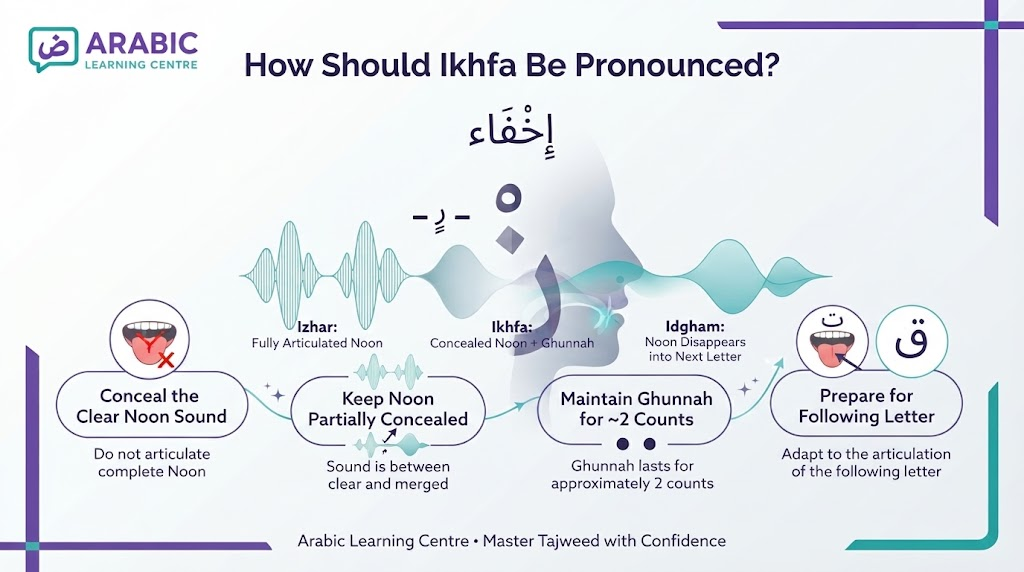
The Noon Sakinah or Tanween should not be fully articulated as in Izhar, nor completely merged into the following letter as in Idgham. Instead, the reciter maintains the nasal sound while preparing to pronounce the next Ikhfa letter.
1. Conceal the Clear Noon Sound Instead of Pronouncing It Fully
During Ikhfa, avoid articulating a complete Noon from its normal articulation point. The tongue should not make firm contact with the area behind the upper front teeth as it normally would when pronouncing a clear Noon.
If the Noon is pronounced fully before the following letter, the sound becomes closer to Izhar rather than Ikhfa.
2. Keep the Noon Partially Concealed Without Merging It Into the Next Letter
Ikhfa should also not become a complete merger. Unlike Idgham, the Noon Sakinah or Tanween does not disappear entirely into the following letter, and the next letter does not become doubled with a Shaddah.
The correct sound remains between clear pronunciation and complete merging, with the Noon concealed while its Ghunnah remains audible.
3. Maintain the Ghunnah for Approximately Two Counts
Ghunnah is one of the defining features of Ikhfa. Once the Noon Sakinah or Tanween is concealed, maintain the nasal resonance for approximately two counts before completing the transition to the following letter.
The Ghunnah should be balanced and controlled. Avoid cutting it too short or extending it longer than necessary.
4. Prepare the Tongue and Mouth for the Following Ikhfa Letter
While maintaining the Ghunnah, begin preparing the tongue and mouth for the articulation point of the letter that follows.
This is important because Ikhfa does not have exactly the same sound before all fifteen letters. Its pronunciation is influenced by the articulation and characteristics of the following letter, which is why Ikhfa before ت or د, for example, differs slightly from Ikhfa before ق or ك.
What Are the Three Levels of Ikhfa?
The three levels of Ikhfa are determined by how close the articulation point of the following letter is to the articulation point of Noon.
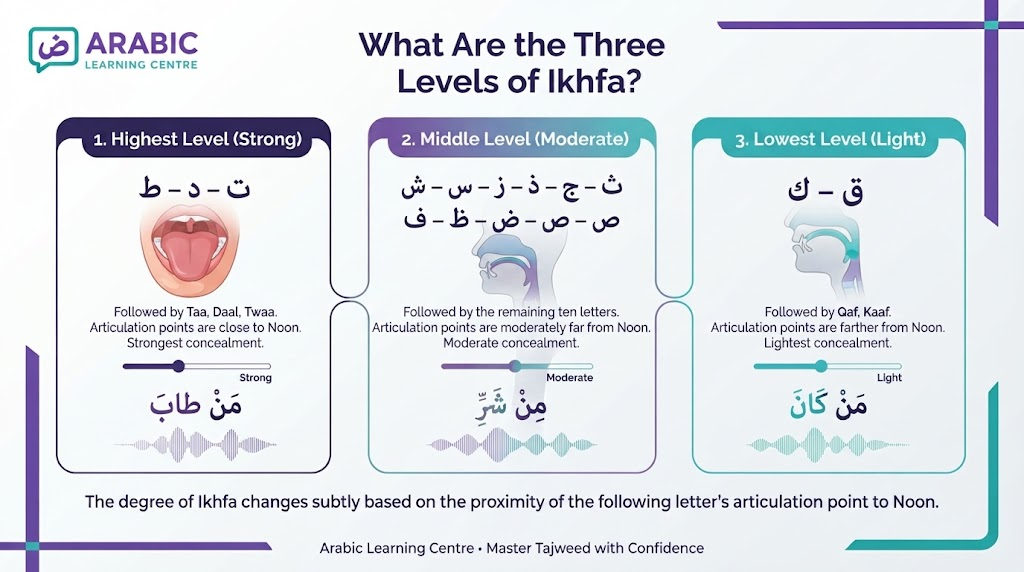
The closer the two articulation points are, the stronger the concealment; the farther apart they are, the lighter it becomes.
1. Highest Level of Ikhfa: Before ت، د، and ط
The highest or strongest level of Ikhfa occurs when Noon Sakinah or Tanween is followed by:
ت – د – ط
These letters are close to the articulation point of Noon. As a result, the Noon is concealed more strongly, and the pronunciation comes closer to Idgham without becoming a complete merger.
2. Lowest Level of Ikhfa: Before ق and ك
The lowest or lightest level of Ikhfa occurs before:
ق – ك
The articulation points of Qaf and Kaf are farther from that of Noon. Therefore, the Noon is less strongly concealed, making the pronunciation closer to Izhar while still remaining Ikhfa with Ghunnah.
3. Middle Level of Ikhfa: Before the Remaining Ten Letters
The middle level applies when Noon Sakinah or Tanween is followed by the remaining ten Ikhfa letters:
ث – ج – ذ – ز – س – ش – ص – ض – ظ – ف
Their articulation points fall between the two previous groups in relation to Noon, so the degree of concealment is moderate.
Understanding these three levels helps learners recognize that Ikhfa is not pronounced with exactly the same degree of concealment before every letter. The sound changes subtly according to the articulation point of the letter that follows.
Read also: Iqlab Letters In Arabic – Rule, Pronunciation
How Heavy and Light Letters Affect the Ghunnah of Ikhfa?
The quality of Ghunnah also changes according to the letter that follows.
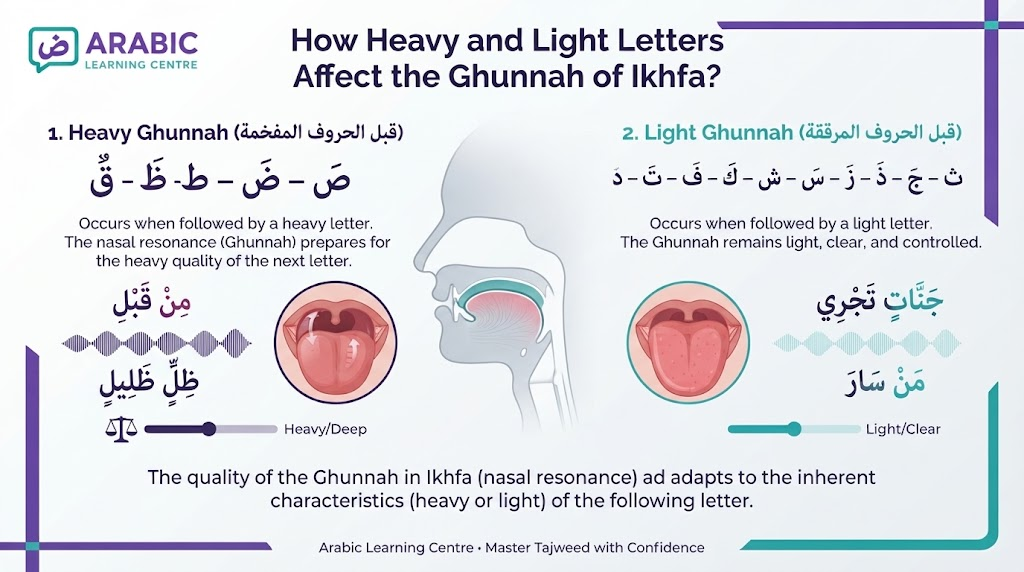
Ikhfa Ghunnah Is Heavy Before ص، ض، ط، ظ، and ق
These five Ikhfa letters are heavy:
ص – ض – ط – ظ – ق
When one of them follows Noon Sakinah or Tanween, the Ghunnah should prepare naturally for the heavy quality of the next letter.
For example:
مِنْ قَبْلِ
The Qaf is heavy, so the nasal resonance leading into it also has a fuller quality.
Ikhfa Ghunnah Is Light Before the Remaining Ten Letters
When the following Ikhfa letter is light, the Ghunnah remains light as well.
For example:
جَنَّاتٍ تَجْرِي
The Taa is light, so the Ghunnah before it should remain light and controlled.
The supplied Tajweed sources likewise distinguish the heavy Ikhfa letters ص، ض، ط، ظ، ق from the remaining light letters.
Inside Our Classrooms
See how we make learning interactive and engaging! Watch a quick snippet of our live, conversational classes in action:
10 Ikhfa Examples From the Quran
Studying Ikhfa examples from Quran is one of the easiest ways to understand how the rule actually sounds. The following examples show Noon Sakinah and Tanween before different Ikhfa letters.
1. Noon Sakinah Followed by Taa (ت)
A clear example appears in Surah Al-Anfal:
إِنْ تَسْتَفْتِحُوا فَقَدْ جَاءَكُمُ الْفَتْحُ
“If you sought a judgment, the judgment has already come to you.”
In إِنْ تَسْتَفْتِحُوا, Noon Sakinah is followed by Taa. The Noon is concealed while the Ghunnah remains before the Taa.
2. Noon Sakinah Followed by Taa (ط)
Surah Al-Mursalat provides an example of the stronger level of Ikhfa:
هَذَا يَوْمُ لَا يَنطِقُونَ
“This is a Day when they will not be able to speak.”
In يَنطِقُونَ, Noon Sakinah is followed by Taa (ط). Because Taa is close to the Noon’s makhraj, this is among the strongest levels of Ikhfa.
3. Noon Sakinah Followed by Sad (ص)
A clear example can be found in Surah Al-Isra:
إِنَّهُ كَانَ مَنْصُورًا
“For they are truly supported.”
In مَنْصُورًا, Noon Sakinah is followed by Sad. The Noon is hidden with a heavy Ghunnah because Sad is one of the heavy Ikhfa letters.
4. Noon Sakinah Followed by Kaf (ك)
A common example of Ikhfa within one word is:
مِنْكُمْ
The Quran contains this construction in many places. One example appears in Surah Aal ‘Imran:
وَلْتَكُن مِّنكُمْ أُمَّةٌ يَدْعُونَ إِلَى الْخَيْرِ
“Let there be a group among you who call others to goodness.”
In مِنْكُمْ, Noon Sakinah is followed by Kaf. The Noon is concealed with Ghunnah before moving to the Kaf.
5. Noon Sakinah Followed by Qaf (ق)
A well-known Quranic combination is:
مِنْ قَبْلِ
It appears, for example, in Surah Al-Baqarah:
وَإِن كُنتُم مِّن قَبْلِهِ لَمِنَ الضَّالِّينَ
“Although before this you were certainly among those astray.”
In مِن قَبْلِ, Noon Sakinah is followed by Qaf. This is one of the lighter levels of Ikhfa because Qaf is farther from the Noon’s articulation point.
6. Noon Sakinah Followed by Daal (د)
Ikhfa can also occur entirely within one word:
أَندَادًا
A clear example appears in Surah Al-Baqarah:
فَلَا تَجْعَلُوا لِلَّهِ أَندَادًا وَأَنتُمْ تَعْلَمُونَ
“So do not knowingly set up equals to Allah.”
In أَندَادًا, Noon Sakinah is followed by Daal. Because Daal is close to the makhraj of Noon, the concealment is strong.
7. Noon Sakinah Followed by Faa (ف)
Surah Aal ‘Imran contains an example of Noon followed by Faa:
لَن تَنَالُوا الْبِرَّ حَتَّىٰ تُنفِقُوا مِمَّا تُحِبُّونَ
“You will never achieve righteousness until you donate some of what you cherish.”
In تُنفِقُوا, Noon Sakinah is followed by Faa. The Noon is concealed while a light Ghunnah is maintained.
8. Noon Sakinah Followed by Zaa (ز)
A clear example of Ikhfa with Zaa appears in:
يَنزَغَنَّكَ
For example, Allah says:
وَإِمَّا يَنزَغَنَّكَ مِنَ الشَّيْطَانِ نَزْغٌ فَاسْتَعِذْ بِاللَّهِ
“If you are tempted by Satan, then seek refuge with Allah.”
In يَنزَغَنَّكَ, Noon Sakinah is followed by Zaa, so Ikhfa is applied.
9. Tanween Followed by Kaf (ك)
Surah Al-Ahzab gives an example of Tanween followed by Kaf:
رِزْقًا كَرِيمًا
“And a generous provision.”
In رِزْقًا كَرِيمًا, the Tanween is followed by Kaf. The Tanween sound is concealed with Ghunnah before the Kaf.
10. Tanween Followed by Sad (ص)
A clear example appears in Surah Al-Haqqah:
بِرِيحٍ صَرْصَرٍ عَاتِيَةٍ
“With a furious, bitter wind.”
In بِرِيحٍ صَرْصَرٍ, the Kasr Tanween is followed by Sad. The Tanween is concealed with a heavy Ghunnah because Sad is a heavy letter.
These Ikhfa letters examples show why the rule is easier to master through actual Quranic recitation than through memorizing letters alone.
Read also: Arabic Compound Letters – How Joined Arabic Letters Change Their Shape?
The Difference Between Ikhfa Haqiqi and Ikhfa Shafawi
The word Ikhfa is used for two different Tajweed rules, so learners should distinguish them clearly.
| Feature | Ikhfa Haqiqi | Ikhfa Shafawi |
| Main letter involved | Noon Sakinah or Tanween | Meem Sakinah |
| Trigger letters | 15 letters | Baa (ب) only |
| Ghunnah | Yes | Yes |
| Main articulation | Tongue/nasal transition | Lips/nasal transition |
Ikhfa Haqiqi is the rule usually meant when learners ask about the 15 Ikhfa letters in Arabic.
Ikhfa Shafawi, on the other hand, occurs when Meem Sakinah is followed by Baa.
For example:
تَرْمِيهِم بِحِجَارَةٍ
“Striking them with stones of baked clay.”
In تَرْمِيهِم بِحِجَارَةٍ, the Meem Sakinah is followed by Baa, so the rule is Ikhfa Shafawi rather than Ikhfa Haqiqi.
The source material likewise separates Ikhfa Haqiqi for Noon Sakinah/Tanween from Ikhfa Shafawi for Meem Sakinah before Baa.
How Is Ikhfa Different From Izhar and Idgham?
The easiest way to understand Ikhfa is to place it between the other two rules.
| Rule | Noon Sound | Ghunnah | Result |
| Izhar | Clear | No extended Ghunnah | Noon remains distinct |
| Ikhfa | Concealed | About two counts | Between clarity and merging |
| Idgham | Merged | Depends on letter | Noon enters following letter |
With Izhar, the Noon remains fully clear.
With Idgham, the Noon merges into the next letter.
With Ikhfa, the Noon sits between those two states. It loses its full articulation but does not merge completely into the following letter.
This middle position is the defining feature of Ikhfa.
How to Recognize Ikhfa in the Mushaf?
Recognizing Ikhfa in the Mushaf becomes much easier once you develop the habit of checking the letter that follows Noon Sakinah or Tanween.
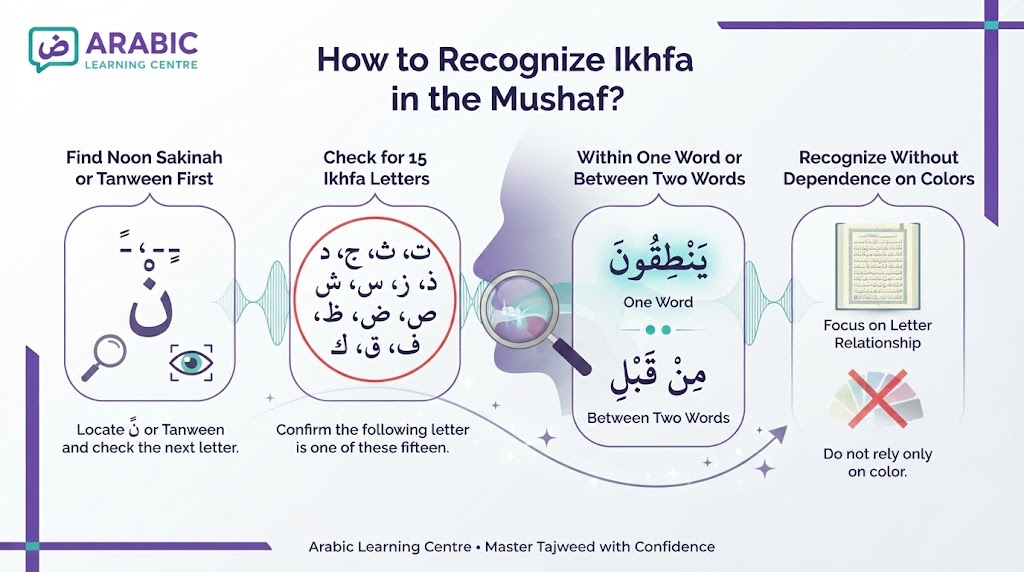
Instead of depending only on visual Tajweed markings, learn to identify the relationship between the letters themselves.
1. Find Noon Sakinah or Tanween First
Begin by looking for Noon Sakinah (نْ) or one of the three forms of Tanween (ـً، ـٍ، ـٌ). Once you find one, check the letter that comes immediately after it.
This next letter determines which rule of Noon Sakinah and Tanween should be applied.
2. Check Whether the Next Letter Is One of the 15 Ikhfa Letters
Ikhfa Haqiqi applies when Noon Sakinah or Tanween is followed by one of these fifteen letters:
ت، ث، ج، د، ذ، ز، س، ش، ص، ض، ط، ظ، ف، ق، ك
If you recognize one of these letters immediately after Noon Sakinah or Tanween, you know that Ikhfa should be applied.
3. Look for Ikhfa Within One Word or Between Two Words
With Noon Sakinah, Ikhfa can occur within a single word. For example:
يَنْطِقُونَ
Here, نْ is followed by ط, so Ikhfa applies within the word.
It can also occur between two words, as in:
مِنْ قَبْلِ
Here, the first word ends with Noon Sakinah and the following word begins with ق.
Tanween is different because it occurs at the end of a word. Therefore, when Tanween produces Ikhfa, the Ikhfa letter appears at the beginning of the following word.
4. Learn to Recognize Ikhfa Without Depending on Tajweed Colors
Color-coded Mushafs can make Tajweed rules easier to notice, especially for beginners, but colors should remain a learning aid rather than the only way you identify Ikhfa.
Learning the actual Arabic letters and their sounds allows you to recognize the rule in any Mushaf, including copies without Tajweed color coding.
For younger learners, Arabic learning for kindergarten children can also help build early familiarity with Arabic letter shapes, sounds, and basic pronunciation patterns.

How to Practice the 15 Ikhfa Letters?
Practice Ikhfa gradually, starting with recognizing the letters, then practicing short examples, and finally applying the rule naturally in Quranic verses.
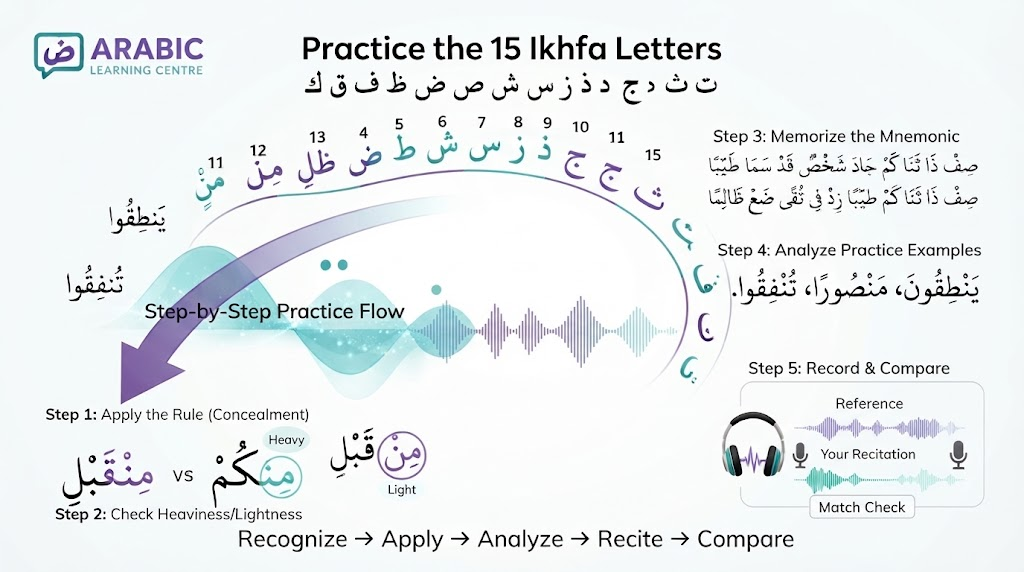
1. Memorize and Recognize All 15 Ikhfa Letters
Start with the classical mnemonic:
صِفْ ذَا ثَنَا كَمْ جَادَ شَخْصٌ قَدْ سَمَا
دُمْ طَيِّبًا زِدْ فِي تُقًى ضَعْ ظَالِمًا
Repeat it until you can recognize each Ikhfa letter quickly without recalling the entire mnemonic.
2. Practice Noon Sakinah Before Different Ikhfa Letters
Use short Quranic examples such as:
مِنْ قَبْلِ
مِنْكُمْ
مَنْصُورًا
يَنْطِقُونَ
تُنفِقُوا
Focus on concealing the Noon while maintaining the Ghunnah for approximately two counts.
3. Compare Ikhfa Before Heavy and Light Letters
Compare:
مِنْ قَبْلِ — heavier Ghunnah before ق
مِنْكُمْ — lighter Ghunnah before ك
Practice similar examples to hear how the following letter affects the quality of the Ghunnah.
4. Practice Ikhfa While Reading Complete Quranic Verses
Once short examples become easy, practice complete verses containing Noon Sakinah and Tanween. The goal is to recognize and pronounce Ikhfa naturally without interrupting your recitation.
5. Listen to Skilled Reciters and Get Direct Correction
Listen carefully to accurate Quran recitation and compare it with your own pronunciation. A qualified Tajweed teacher can correct problems with concealment, Ghunnah length, and heavy or light pronunciation that may be difficult to notice on your own.
Read also: Arabic Root Words – A Complete Guide
Common Mistakes When Pronouncing Ikhfa Letters
Most mistakes in Ikhfa happen when the learner moves too far toward one of the neighboring rules: either pronouncing the Noon too clearly, as in Izhar, or merging it too completely, as in Idgham. Correct Ikhfa stays between these two extremes while maintaining a controlled Ghunnah.
1. Pronouncing a Full Noon Instead of Concealing It
One of the most common mistakes is pronouncing Noon Sakinah as a complete, distinct Noon before the following Ikhfa letter. If the tongue makes firm contact with the normal articulation point of Noon, the pronunciation becomes closer to Izhar.
During Ikhfa, the clear Noon articulation is concealed while the Ghunnah remains, and the mouth prepares for the letter that follows.
2. Merging the Noon Completely Into the Following Letter
The opposite mistake is allowing Noon Sakinah or Tanween to merge completely into the next letter as though the rule were Idgham.
Ikhfa must remain between clear pronunciation and complete merging. The Noon itself is concealed, but its Ghunnah remains audible before the following Ikhfa letter is fully articulated.
3. Making the Ghunnah Too Short or Too Long
The Ghunnah of Ikhfa is generally maintained for approximately two counts. Rushing it can make the Ikhfa incomplete, while extending it excessively can disturb the natural rhythm of the recitation.
Learners should practice keeping the Ghunnah controlled and consistent rather than measuring it by speed alone.
4. Using the Same Ghunnah Quality Before All 15 Ikhfa Letters
Another common mistake is giving the Ghunnah exactly the same quality before every Ikhfa letter. Its quality is influenced by the letter that follows.
Before the heavy letters ص، ض، ط، ظ، ق, the Ghunnah takes on a heavier quality. Before the remaining ten Ikhfa letters, it remains light. Learning this distinction helps make the pronunciation more precise.
5. Adding a Vowel Sound to the Ghunnah
Ghunnah is a nasal resonance, not an additional vowel. Beginners may accidentally introduce or lengthen an “oo,” “ee,” or another vowel-like sound while holding the Ghunnah.
For example, when reciting كُنتُمْ, the existing vowel sounds should retain their proper lengths. The Ghunnah on the concealed Noon should be produced nasally without inserting an extra vowel between the Noon and ت.
Don’t Just Take Our Word For It
Take a look inside our vibrant classes and see our students and teachers in action. Click below to watch our classroom experience:
Build Stronger Arabic Skills With Arabic Learning Centre
Understanding the Ikhfa letters in Arabic becomes much easier when you already have a strong foundation in Arabic letters, vowels, Tanween, and pronunciation. Instead of learning Tajweed rules as isolated concepts, you can recognize how Arabic sounds work together naturally.
Arabic Learning Centre helps learners strengthen their Arabic through structured practice in reading, pronunciation, listening, vocabulary, and comprehension.
Its learning options are designed for different ages and backgrounds, from children and beginners to adults and non-native Arabic speakers.
Start your free trial with Arabic Learning Centre today and take the first step toward clearer, more confident Arabic.
Courses We Offer:
- Online Arabic Course
- Classical arabic course
- Modern Standard Arabic Course
- Fusha Arabic Course
- Learn Saudi Arabic
- Arabic Course for Beginners
- Arabic Classes for Adults
- Arabic Classes for Ladies
- Advanced Arabic Course
- Intensive Arabic Course

Conclusion
Learning the Ikhfa letters in Arabic is an important step toward more accurate Quran recitation. The fifteen letters are ت، ث، ج، د، ذ، ز، س، ش، ص، ض، ط، ظ، ف، ق، ك, and when one of them follows Noon Sakinah or Tanween, Ikhfa is applied with a Ghunnah of approximately two counts.
Correct Ikhfa, however, is about more than memorizing these letters. Learners need to hear the balance between clear pronunciation and complete merging, recognize the different levels of concealment, and understand how the following letter affects the quality of the Ghunnah.
The best way to master the rule is through consistent practice with authentic Ikhfa examples from Quran, careful listening, and correction from a qualified Tajweed teacher. With repetition, identifying and applying Ikhfa can gradually become a natural part of Quran recitation.
Frequently Asked Questions About Ikhfa Letters in Arabic
What Are the 15 Letters of Ikhfa?
The fifteen letters are ت، ث، ج، د، ذ، ز، س، ش، ص، ض، ط، ظ، ف، ق، ك. When any of them follows Noon Sakinah or Tanween, Ikhfa Haqiqi is applied.
What Does Ikhfa Mean in Tajweed?
Ikhfa means “concealment.” In Tajweed, it refers to hiding the clear sound of Noon Sakinah or Tanween while preserving a nasal Ghunnah before one of the fifteen Ikhfa letters.
How Long Is the Ghunnah in Ikhfa?
The Ghunnah is generally maintained for approximately two counts. The timing remains consistent even though the depth and quality of the concealment can vary according to the following letter.
How Can I Remember the Ikhfa Letters?
One of the easiest ways is to memorize:
صِفْ ذَا ثَنَا كَمْ جَادَ شَخْصٌ قَدْ سَمَادُمْ طَيِّبًا زِدْ فِي تُقًى ضَعْ ظَالِمًا
The first letter of each word represents one of the fifteen Ikhfa letters.
Can Ikhfa Occur Within a Single Word?
Yes. Noon Sakinah can be followed by an Ikhfa letter inside the same word, as in مِنْكُمْ, يَنْطِقُونَ, and أَندَادًا.
It can also occur across two words, such as مِنْ قَبْلِ.
What Is the Difference Between Ikhfa and Idgham?
In Ikhfa, the Noon is concealed but does not completely merge into the following letter. Ghunnah remains for approximately two counts.
In Idgham, the Noon merges into the following Idgham letter, producing a more complete assimilation.
Related Articles
Learn Arabic