 Learn Arabic

The Izhar letters in Arabic are an essential part of the Tajweed rules governing Noon Sakinah and Tanween. Izhar teaches you when the Noon sound should remain clear instead of being merged, concealed, or changed as you continue reciting.
There are six letters of Izhar Halqi: ء، هـ، ع، ح، غ، خ. Because all six originate from different areas of the throat, they are known as the throat letters. Once you can recognize them, identifying Izhar in Quranic verses becomes much more straightforward.
In this guide, you will learn what Izhar means, why these six letters cause it, how to pronounce the rule correctly, and 10 examples of Izhar in the Quran that show how it works in actual recitation.
What Is Izhar in Tajweed?
Izhar (إِظْهَار) literally carries the meaning of making something clear or apparent. In Tajweed, it refers to pronouncing a letter clearly from its proper point of articulation without merging or concealing it in the sound that follows.
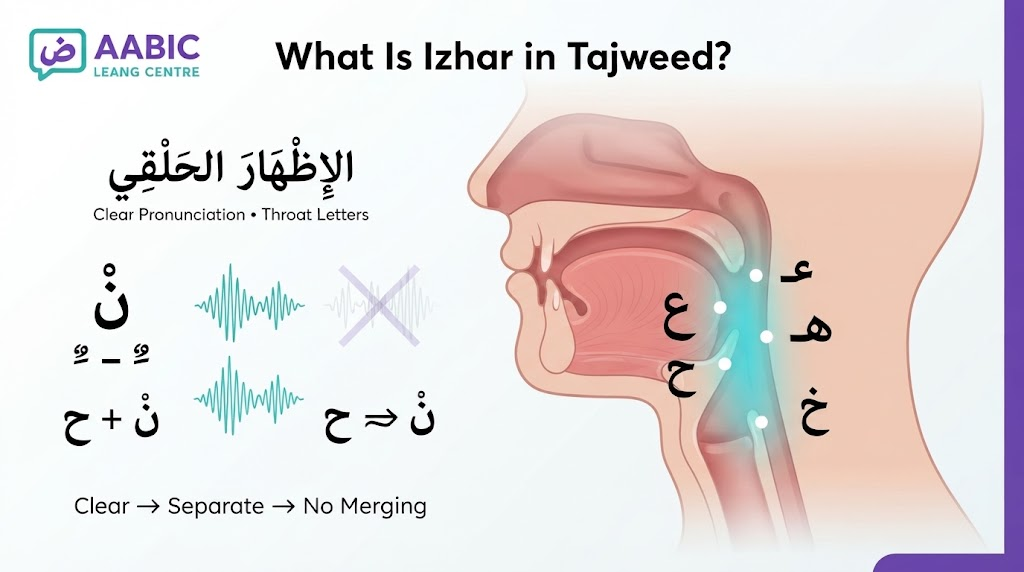
For the rule of Noon Sakinah (نْ) and Tanween (ـً ـٍ ـٌ), Izhar occurs when either is followed by one of the six throat letters. The Noon sound is articulated clearly before moving directly to the next letter, without merging the two sounds or extending Ghunnah into the following letter.
This rule is specifically called Izhar Halqi (الإظهار الحلقي). Halqi relates to the throat because all six letters that trigger this form of Izhar originate there.
Learners who are still developing their wider Arabic foundations can also benefit from building a stronger understanding of words and letter patterns through structured Arabic vocabulary learning.

What Are the Six Izhar Letters in Arabic?
The six Izhar letters in Arabic are:
ء – هـ – ع – ح – غ – خ
They are:
| Letter | Name | General Makhraj Area |
| ء | Hamzah | Deepest part of the throat |
| هـ | Haa | Deepest part of the throat |
| ع | ‘Ayn | Middle of the throat |
| ح | Haa | Middle of the throat |
| غ | Ghayn | Upper part of the throat, nearer the mouth |
| خ | Khaa | Upper part of the throat, nearer the mouth |
These six letters are collectively called Huruf Al-Halq (حروف الحلق) because their articulation points are located in the throat. The throat is divided into three general articulation areas, with each area producing two of the Izhar letters.
A traditional mnemonic used to remember them is:
أَخِي هَاكَ عِلْمًا حَازَهُ غَيْرُ خَاسِرٍ
The opening letters of the words help learners recall the six throat letters.
When Does Izhar Halqi Occur?
Izhar Halqi occurs when Noon Sakinah (نْ) or Tanween is followed by ء، هـ، ع، ح، غ، or خ. Instead of merging or hiding the Noon sound, the reciter pronounces it clearly before moving to the throat letter.
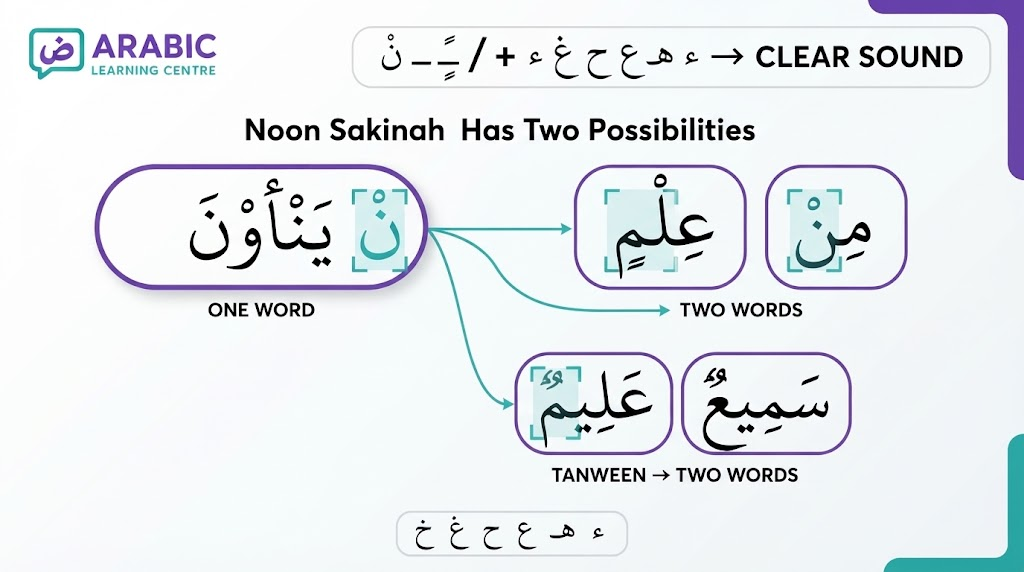
There are two important patterns to recognize.
Noon Sakinah Can Produce Izhar Within One Word or Across Two Words
Noon Sakinah can meet an Izhar letter inside the same word or across the boundary between two separate words.
For example: يَنْأَوْنَ
Here, Noon Sakinah is followed by Hamzah within the same word, so the Noon remains clearly articulated.
Izhar can also occur across two words, as in: مِنْ عِلْمٍ
Here, the first word ends with Noon Sakinah and the following word begins with ‘Ayn.
Tanween Produces Izhar Across Two Words
Tanween occurs at the end of a word, so the Izhar letter necessarily appears at the beginning of the following word.
For example: سَمِيعٌ عَلِيمٌ
The Damm Tanween at the end of سَمِيعٌ is followed by ‘Ayn at the beginning of عَلِيمٌ, producing Izhar.
This distinction between Noon Sakinah and Tanween is useful when learning to recognize the rule directly from Quranic text.
Why Are the Six Izhar Letters Pronounced Clearly?
The reason behind Izhar becomes easier to understand when you consider the Makharij, or articulation points.
The Noon is articulated with the tongue, while the six Izhar letters originate from different areas of the throat. Because their articulation points are relatively distant from one another, the Noon does not naturally merge into these throat sounds.
Instead, each sound retains its clarity: the Noon Sakinah or Tanween is articulated correctly, and then the reciter moves smoothly to the throat letter.
This is why learning Tajweed becomes easier when learners understand pronunciation rather than memorizing lists alone. Students developing broader formal Arabic may also find Modern Standard Arabic (Fusha) lessons useful for strengthening their familiarity with Arabic sounds, vocabulary, and structures.

How Do You Pronounce Izhar Halqi Correctly?
Correct Izhar requires clarity without separation. You want the Noon Sakinah or Tanween to be clearly recognizable, but you should not insert an artificial pause between it and the following throat letter.
Pronounce the Noon Sakinah or Tanween Clearly Before the Throat Letter
Give the Noon its proper articulation rather than allowing it to disappear into the next sound.
For example: مِنْ عِلْمٍ
The Noon in مِنْ should remain clearly recognizable before you move to the ‘Ayn of عِلْمٍ.
Do Not Extend Ghunnah Into the Following Izhar Letter
Noon naturally has an inherent nasal quality, but Izhar does not involve the extended Ghunnah associated with rules such as Ikhfa or some forms of Idgham.
The goal is therefore not to artificially remove every trace of the natural quality of Noon. Rather, you should avoid prolonging or emphasizing nasalization as you move into the throat letter.
Do Not Insert a Pause Between the Two Sounds
Clear pronunciation does not mean stopping.
The transition should remain continuous: pronounce the Noon or Tanween clearly, release it from its proper articulation point, and then move directly to the Izhar letter.
Keep the Original Makhraj of the Throat Letter
After completing the Noon sound, pronounce the following throat letter from its own correct articulation point. Do not allow your effort to clarify the Noon to weaken or distort the Hamzah, Haa, ‘Ayn, Haa, Ghayn, or Khaa that follows.
10 Examples of Izhar in the Quran
Studying 10 examples of Izhar in the Quran helps you move from memorizing the six letters to recognizing them in actual recitation.
The examples below include both Noon Sakinah and Tanween followed by different Izhar letters.
1. Noon Sakinah Followed by Hamzah (ء)
A clear example of Noon Sakinah followed by Hamzah appears in Surah Taha:
وَمَنْ أَعْرَضَ عَن ذِكْرِي فَإِنَّ لَهُ مَعِيشَةً ضَنكًا
“But whoever turns away from My Reminder will certainly have a miserable life.”
In مَنْ أَعْرَضَ, Noon Sakinah is followed by Hamzah. The Noon is pronounced clearly before moving to the Hamzah.
2. Tanween Followed by Hamzah (ء)
Surah An-Naba contains an example of Tanween followed by Hamzah:
وَجَنَّاتٍ أَلْفَافًا
“And dense orchards.”
In جَنَّاتٍ أَلْفَافًا, the Kasr Tanween is followed by Hamzah, so the Tanween is pronounced clearly rather than merged or concealed.
3. Noon Sakinah Followed by Haa (هـ)
An example of Noon Sakinah followed by Haa can be found in Surah Al-A‘raf:
وَمِنْهُم دُونَ ذَٰلِكَ
“And some of them are otherwise.”
In مِنْهُم, Noon Sakinah and Haa occur within the same word. The Noon remains clear before the Haa.
4. Tanween Followed by Haa (هـ)
Surah Ar-Ra‘d provides an example of Tanween followed by Haa:
وَلِكُلِّ قَوْمٍ هَادٍ
“And for every people there is a guide.”
In قَوْمٍ هَادٍ, the Tanween is followed by Haa. The Tanween is articulated clearly before the throat letter begins.
5. Noon Sakinah Followed by ‘Ayn (ع)
A clear example involving ‘Ayn appears in Surah Yunus:
مَّا لَهُم مِّنَ اللَّهِ مِنْ عَاصِمٍ
“They will have no protector from Allah.”
In مِنْ عَاصِمٍ, Noon Sakinah is followed by ‘Ayn, requiring clear pronunciation of the Noon.
6. Tanween Followed by ‘Ayn (ع)
Surah Al-Baqarah contains a familiar example of Tanween followed by ‘Ayn:
وَهُوَ بِكُلِّ شَيْءٍ عَلِيمٌ
“And He has perfect knowledge of all things.”
In شَيْءٍ عَلِيمٌ, the Tanween is followed by ‘Ayn. The Tanween remains distinct before the ‘Ayn is articulated.
7. Noon Sakinah Followed by Haa (ح)
Surah Al-Hijr provides an example where Noon Sakinah and Haa occur inside one word:
وَكَانُوا يَنْحِتُونَ مِنَ الْجِبَالِ بُيُوتًا آمِنِينَ
“They carved homes in the mountains, feeling secure.”
In يَنْحِتُونَ, Noon Sakinah is followed directly by Haa (ح). The Noon must remain clear before the Haa is pronounced.
Read also: Soft Letters in Arabic – Leen Letters, Rules, Examples, and Pronunciation
8. Tanween Followed by Haa (ح)
An example of Tanween followed by Haa appears in Surah Al-Baqarah:
إِنَّ اللَّهَ عَزِيزٌ حَكِيمٌ
“Surely Allah is Almighty, All-Wise.”
In عَزِيزٌ حَكِيمٌ, Tanween is followed by Haa (ح), so it is pronounced clearly without being concealed or merged.
9. Noon Sakinah Followed by Ghayn (غ)
Surah Al-Haqqah contains a clear example involving Ghayn:
وَلَا طَعَامٌ إِلَّا مِنْ غِسْلِينٍ
“Nor any food except the discharge of wounds.”
In مِنْ غِسْلِينٍ, Noon Sakinah is followed by Ghayn. The Noon is clearly articulated before moving to the deeper Ghayn sound.
10. Noon Sakinah Followed by Khaa (خ)
A useful example of Noon Sakinah followed by Khaa appears in Surah Al-Baqarah:
وَإِنَّ مِنْهَا لَمَا يَهْبِطُ مِنْ خَشْيَةِ اللَّهِ
“And indeed, there are some which fall down for fear of Allah.”
In مِنْ خَشْيَةِ, Noon Sakinah is followed by Khaa, so the Noon is pronounced distinctly before the Khaa.
Together, these 10 examples of Izhar in the Quran show that the key is not simply spotting Noon Sakinah or Tanween. You must always examine the letter that comes immediately afterward.
Inside Our Classrooms
See how we make learning interactive and engaging! Watch a quick snippet of our live, conversational classes in action:
What Is the Difference Between Izhar Halqi and Izhar Shafawi?
Although both rules use the term Izhar, they apply to different letters and should not be confused.
| Feature | Izhar Halqi | Izhar Shafawi |
| Main letter involved | Noon Sakinah or Tanween | Meem Sakinah |
| Trigger letters | ء، هـ، ع، ح، غ، خ | All Arabic letters except م and ب |
| Main articulation relationship | Noon + throat letters | Meem + following letter |
| Meaning of name | Throat clarity | Lip clarity |
Izhar Halqi is the rule discussed when learners refer to the six Izhar letters in Arabic. Izhar Shafawi, by contrast, belongs to the rules of Meem Sakinah and requires the Meem to remain clear when followed by any letter other than Meem or Baa.
What Is Izhar Mutlaq?
Izhar Mutlaq (الإظهار المطلق) is a separate exception involving Noon Sakinah before Yaa (ي) or Waw (و) within the same word.
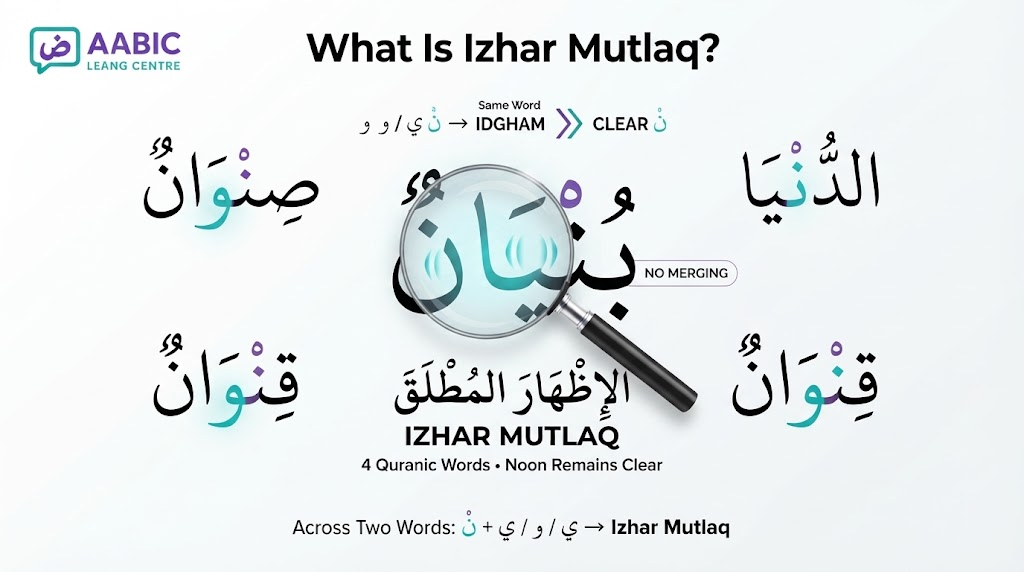
Normally, Yaa and Waw are Idgham letters when they follow Noon Sakinah across two words. However, in four well-known Quranic words, the Noon is kept clear:
الدُّنْيَا – بُنْيَانٌ – صِنْوَانٌ – قِنْوَانٌ
For example:
إِنَّ اللَّهَ يُحِبُّ الَّذِينَ يُقَاتِلُونَ فِي سَبِيلِهِ صَفًّا كَأَنَّهُم بُنْيَانٌ مَّرْصُوصٌ
“Surely Allah loves those who fight in His cause in solid ranks as if they were one concrete structure.”
In بُنْيَانٌ, Noon Sakinah is followed by Yaa within the same word, but the Noon remains clearly pronounced rather than merging into the Yaa. The reference material identifies الدنيا، بنيان، صنوان، and قنوان as the four words associated with this rule.
Read also: Hams Letters in Arabic – Meaning, Examples, and the Difference Between Hams and Jahr
How Is Izhar Different From Idgham, Ikhfa, and Iqlab?
All four rules describe what happens when Noon Sakinah or Tanween encounters particular letters, but the resulting pronunciation is different.
| Rule | Trigger Letters | What Happens to Noon Sakinah/Tanween? |
| Izhar | ء، هـ، ع، ح، غ، خ | Pronounced clearly |
| Idgham | ي، ر، م، ل، و، ن | Merged into the following letter |
| Iqlab | ب | Changed toward a concealed Meem sound with Ghunnah |
| Ikhfa | 15 remaining letters | Concealed between clear pronunciation and merging, with Ghunnah |
Izhar therefore represents clarity. Unlike Idgham, the Noon does not merge; unlike Ikhfa, it is not concealed; and unlike Iqlab, it is not changed into another sound.
The source material similarly distinguishes Izhar as full clarity from the merging of Idgham, transformation of Iqlab, and partial concealment of Ikhfa.
How to Recognize Izhar Letters in the Mushaf?
Recognizing Izhar becomes much easier when you follow the same sequence each time you encounter Noon Sakinah or Tanween.
1. Start by Finding Noon Sakinah (نْ) or Tanween
When you see نْ or ـً ـٍ ـٌ, check what comes immediately after it. With Noon Sakinah, the next letter may be in the same word or the following word. With Tanween, you need to look at the beginning of the next word.
2. Izhar Halqi Applies When the Next Letter Is ء، هـ، ع، ح، غ، or خ
Memorize these six letters until you can recognize them without stopping:
ء – هـ – ع – ح – غ – خ
If one of them immediately follows Noon Sakinah or Tanween, you have identified Izhar Halqi.
3. Keep the Noon Clear Instead of Merging or Concealing It
Once you recognize the combination, pronounce the Noon clearly. Do not turn the transition into Idgham by merging it with the throat letter, and do not conceal it as you would in Ikhfa.
4. Read the Two Sounds Continuously Without Adding a Pause
Izhar means clarity, not separation by silence. The Noon or Tanween should be distinct, but the recitation should continue naturally into the following throat letter.
For non-native learners, becoming comfortable with Arabic script and sound patterns can make Tajweed rules easier to recognize.
Structured Arabic lessons for non-Arabic speakers can help build the broader language foundation needed to recognize Arabic letters and word structures more confidently.

Common Mistakes When Pronouncing the Izhar Letters
Knowing the rule does not automatically guarantee correct pronunciation. Most mistakes happen when learners either overemphasize clarity or allow the Noon to lose its independence.
1. Extending Ghunnah Into the Throat Letter Changes the Izhar Sound
One common mistake is carrying an exaggerated nasal sound from the Noon into the following letter.
In Izhar, the Noon is pronounced naturally and clearly without extending Ghunnah into the throat letter.
2. Merging the Noon Into the Following Letter Turns Izhar Into Another Sound
If the Noon loses its clear articulation and blends into the following throat letter, the defining feature of Izhar has disappeared. Give the Noon its proper articulation before beginning the next letter.
3. Pausing Between the Noon and the Izhar Letter Breaks the Natural Flow
Some learners interpret “clear” as “separate” and insert a small pause after the Noon. This is unnecessary. The sounds remain distinct, but they should still flow together as part of continuous recitation.
4. Weak Throat-Letter Pronunciation Can Make Correct Izhar Difficult
Recognizing the rule is not enough if the learner cannot distinguish هـ from ح, or pronounce ع، غ، and خ from their correct throat positions.
Practice the Makharij of the six letters separately before applying them after Noon Sakinah and Tanween.
5. Reading Too Quickly Can Hide the Noon Sakinah or Tanween
Fast recitation often causes beginners to swallow the Noon or move prematurely into the next sound.
Practice slowly enough to hear both the clear Noon and the following throat letter, then increase your speed gradually.
How to Practice the Six Izhar Letters?
Effective practice should move from recognizing the letters to applying them naturally inside Quranic recitation.
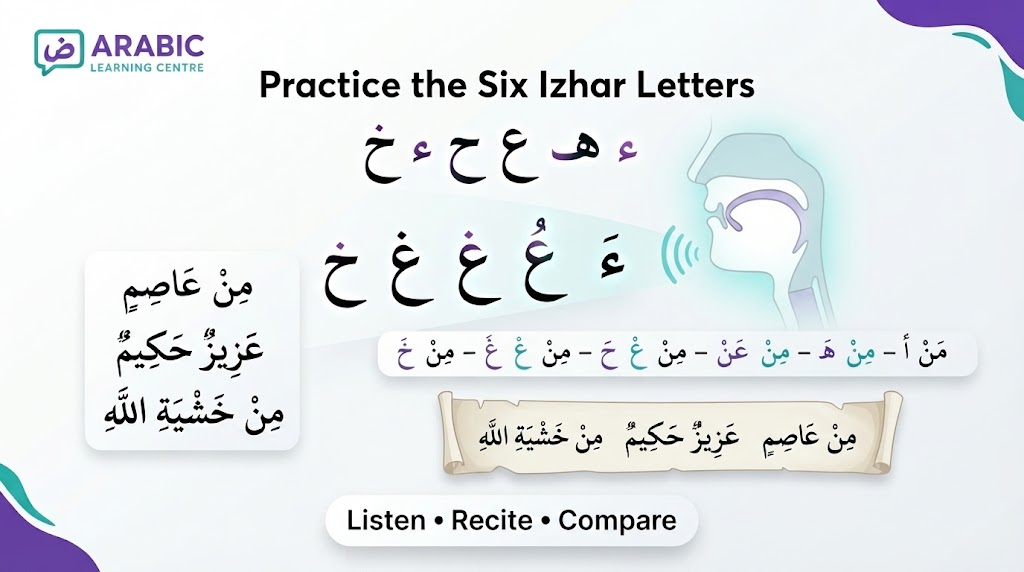
1. Memorize ء، هـ، ع، ح، غ، and خ as the Six Izhar Halqi Letters
Begin with recognition. You should be able to see any of the six letters and immediately identify it as a possible Izhar trigger after Noon Sakinah or Tanween.
2. Practice Each Izhar Letter With Noon Sakinah
Use short combinations such as:
مَنْ أَ – مِنْ هَ – مِنْ عَ – مِنْ حَ – مِنْ غَ – مِنْ خَ
The purpose is not to memorize artificial phrases, but to train yourself to keep the Noon clear before changing to a throat articulation.
3. Practice Izhar With Both Noon Sakinah and Tanween
Do not limit practice to Noon Sakinah. Train your ear to recognize Tanween combinations as well, since the same six letters trigger Izhar.
4. Move From Short Combinations to Complete Quranic Verses
Once the sound is stable, return to authentic Quranic examples such as مِنْ عَاصِمٍ, عَزِيزٌ حَكِيمٌ, and مِنْ خَشْيَةِ اللَّهِ. Read the complete verse so that the rule becomes part of natural recitation rather than an isolated exercise.
5. Compare Your Recitation With Accurate Quran Recitation
Listen carefully to a qualified reciter and focus specifically on the transition between the Noon or Tanween and the throat letter. Teacher feedback is particularly valuable because subtle nasalization or accidental concealment can be difficult to notice in your own voice.
Read also: Idgham Letters in Arabic – Rules, Types, and 10 Examples from the Quran
Don’t Just Take Our Word For It
Take a look inside our vibrant classes and see our students and teachers in action. Click below to watch our classroom experience:
Build Stronger Arabic Foundations With Arabic Learning Centre
Understanding the Izhar letters in Arabic becomes easier when Arabic letters, vowel signs, Tanween, and connected word patterns already feel familiar.
Instead of seeing Tajweed as a collection of disconnected symbols, a stronger Arabic foundation helps you recognize how sounds and written structures interact.
Arabic Learning Centre supports learners in developing their Arabic systematically, including students approaching the language from a non-Arabic-speaking background.
Regular exposure to reading, vocabulary, listening, pronunciation, and sentence structures can make Arabic texts less intimidating and help learners become more confident in recognizing the patterns they encounter.
Whether your goal is to understand Arabic more deeply, become more comfortable reading it, or strengthen the language skills that support accurate pronunciation, consistent guided learning can provide a foundation that develops beyond memorizing individual rules.
Start your Arabic learning journey with Arabic Learning Centre and build the confidence to recognize, understand, and use Arabic more naturally.
Courses We Offer:
- Quranic Arabic Course
- Arabic Course for Islamic Studies
- Learn Arabic for New Muslims
- Learn Arabic Letters for Tajweed
- Al Azhar Arabic Course
- Madinah Arabic Course
- Online Arabic Classes for Kids
- Arabic Words Course for Kids
- Arabic Lessons for Kindergarten
- Arabic Elementary School
- Arabic Intermediate School
- Arabic High School

Conclusion
The six Izhar letters in Arabic are ء، هـ، ع، ح، غ، and خ. When one of these throat letters follows Noon Sakinah or Tanween, the Noon sound remains clearly articulated instead of being merged, concealed, or changed.
The key to mastering Izhar is not simply memorizing six letters. Learn where they are articulated, recognize how they interact with Noon Sakinah and Tanween, avoid extending Ghunnah or inserting unnecessary pauses, and practice real examples of Izhar in the Quran until the correct pronunciation becomes natural.
With repeated listening, careful recitation, and correction, Izhar becomes one of the easiest Noon Sakinah and Tanween rules to recognize and apply confidently.
Frequently Asked Questions About Izhar Letters in Arabic
How Many Izhar Letters Are There in Arabic?
There are six Izhar Halqi letters: ء، هـ، ع، ح، غ، and خ. They are known as throat letters because their articulation points are located in different parts of the throat.
What Are the Six Letters of Izhar Halqi?
The six letters are Hamzah (ء), Haa (هـ), ‘Ayn (ع), Haa (ح), Ghayn (غ), and Khaa (خ). When one follows Noon Sakinah or Tanween, the Noon sound is pronounced clearly.
What Does Izhar Mean in Tajweed?
Izhar means clarity or making something apparent. In the rule of Noon Sakinah and Tanween, it means pronouncing the Noon clearly from its articulation point without merging or concealing it in the following letter.
Does Izhar Have Ghunnah?
The Noon naturally has an inherent nasal quality, but Izhar does not involve an extended or emphasized Ghunnah. The Noon or Tanween should remain clear without carrying prolonged nasalization into the following throat letter.
Can Izhar Occur Within One Word?
Yes. Noon Sakinah can produce Izhar within the same word, such as in يَنْأَوْنَ and يَنْحِتُونَ, as well as across two words. Tanween, however, occurs at a word ending, so its Izhar relationship is recognized across two words.
What Is the Difference Between Izhar and Idgham?
In Izhar, Noon Sakinah or Tanween remains clearly pronounced. In Idgham, it merges into one of the following Idgham letters. The two rules therefore produce opposite relationships: Izhar preserves the clarity of the Noon, while Idgham combines it with the following sound.