 Learn Arabic
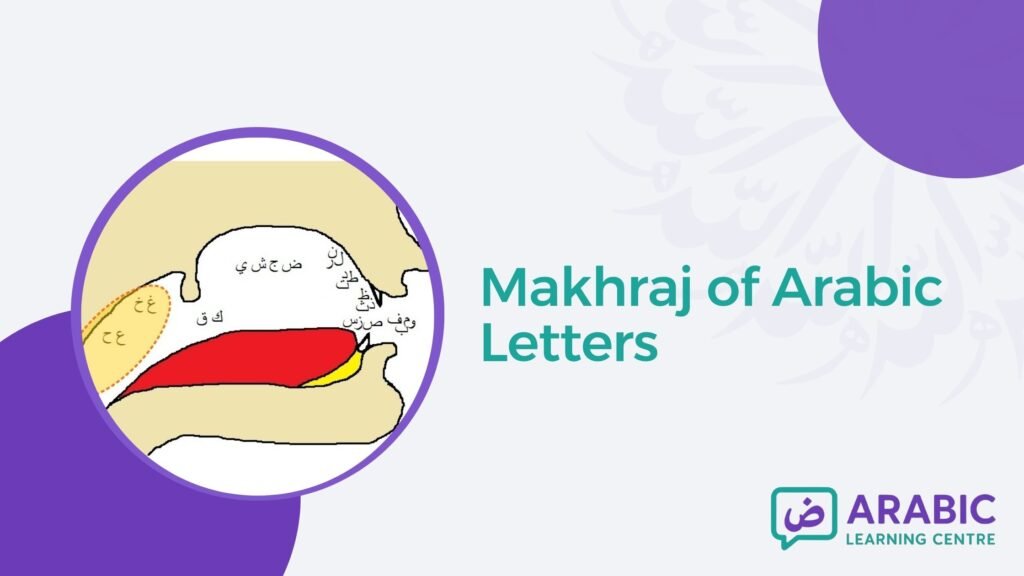
The makhraj of Arabic letters refers to the exact place in the mouth, throat, lips, or nasal passage from which an Arabic sound is produced. Learning these articulation points is essential for anyone who wants to pronounce Arabic letters accurately, particularly students learning Quranic Arabic and Tajweed.
The Arabic term is مَخَارِجُ الحُرُوف (Makharij al-Huruf). Makhraj is singular and makharij is plural. The word مَخْرَج (makhraj) literally means an “exit” or “place of exit,” because it describes the point from which the sound of a letter comes out.
Traditional Tajweed instruction commonly teaches 17 specific articulation points grouped into five main areas: the empty space of the mouth and throat, the throat, the tongue, the lips, and the nasal cavity.
Understanding these areas makes Arabic pronunciation much easier because learners stop depending only on imitation and begin to understand physically how every sound is formed.
What Does Makhraj Mean in Arabic?
The Arabic word مَخْرَج (makhraj) means an exit, way out, or point from which something emerges. In Arabic pronunciation, it refers to the specific place in the vocal tract from which a letter’s sound is produced.
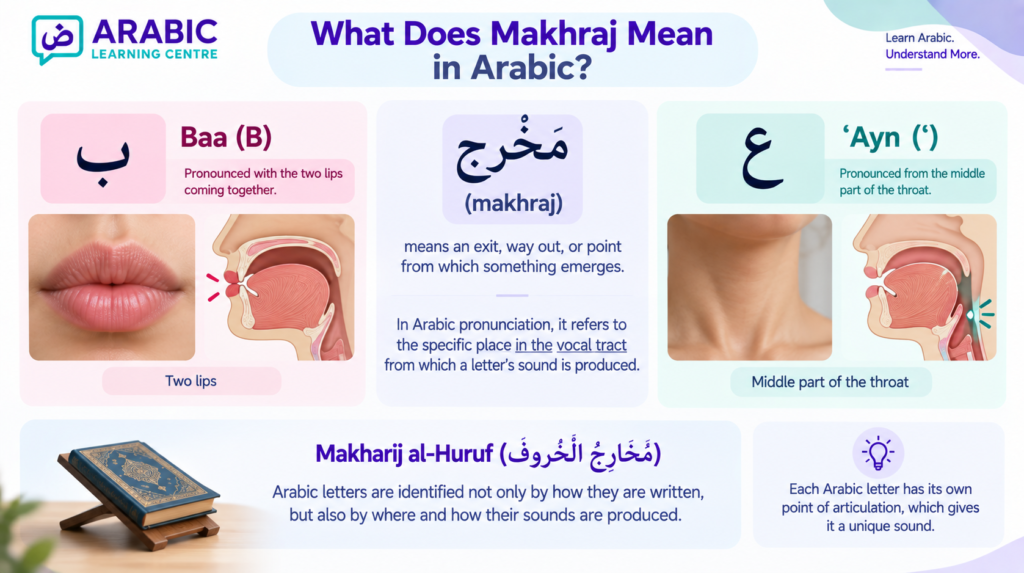
Each Arabic letter has its own point of articulation. For example:
- ب — Baa is pronounced by bringing the two lips together.
- ع — ʿAyn is pronounced from the middle part of the throat.
Although both are Arabic letters, they sound very different because they are produced from different areas of the vocal tract.
This is the central idea behind Makharij al-Huruf (مَخَارِجُ الْحُرُوف): Arabic letters are identified not only by how they are written, but also by where and how their sounds are produced.
What Are Makharij Al-Huruf?
Makharij al-Huruf (مَخَارِجُ الحُرُوف) means the articulation points of Arabic letters. It explains exactly where each Arabic sound is produced within the vocal system.
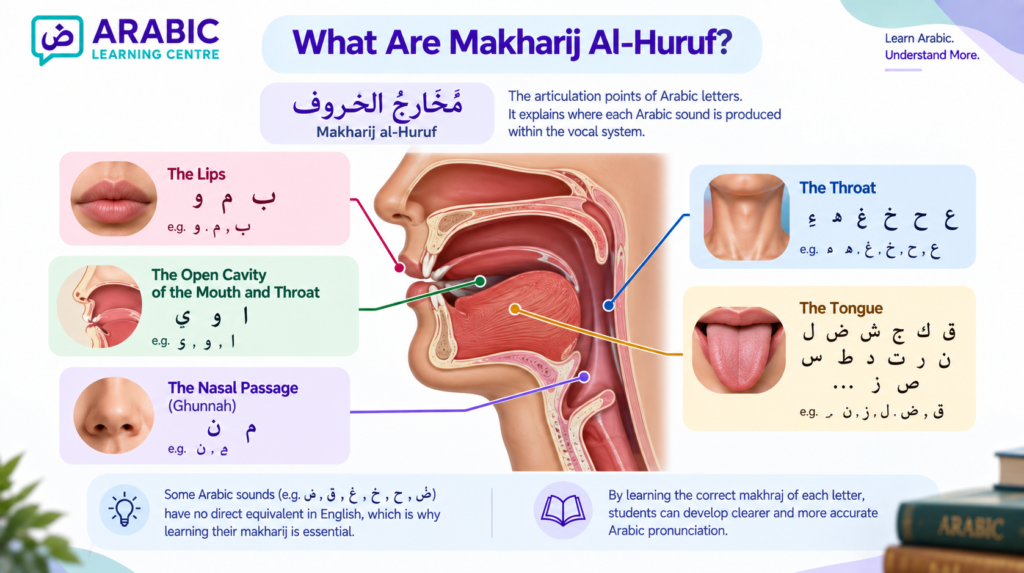
Arabic letters are articulated from several main areas, including:
- The throat
- The tongue
- The lips
- The open cavity of the mouth and throat
- The nasal passage
Understanding these articulation points is especially important for non-native speakers because some Arabic sounds have no direct equivalent in English. Letters such as ع، ح، خ، غ، ق، and ض can therefore be difficult to pronounce correctly through imitation alone.
By learning the correct makhraj of each letter, students can understand which part of the tongue, throat, or lips should be used, helping them develop clearer and more accurate Arabic pronunciation.
How Many Makharij Are There in Arabic?
In the commonly taught Tajweed system, Arabic letters are articulated from 17 specific Makharij, which are organized into five main articulation areas. These five regions provide a simple framework for understanding where Arabic sounds originate.
| Main Articulation Area | Arabic | Main Function |
| The empty cavity | الجوف — Al-Jawf | Produces the long vowel sounds |
| The throat | الحلق — Al-Halq | Produces the six throat letters |
| The tongue | اللسان — Al-Lisan | Produces most Arabic consonants |
| The lips | الشفتان — Ash-Shafatan | Produces the main lip letters |
| The nasal passage | الخيشوم — Al-Khayshum | Produces the Ghunnah sound |
For beginners, it is usually easier to learn these five main regions first. Once they are familiar, learners can move on to the 17 detailed articulation points and the specific letters associated with each one.
The 5 Main Makharij of Arabic Letters
The five main articulation areas give learners a map of the Arabic vocal system.
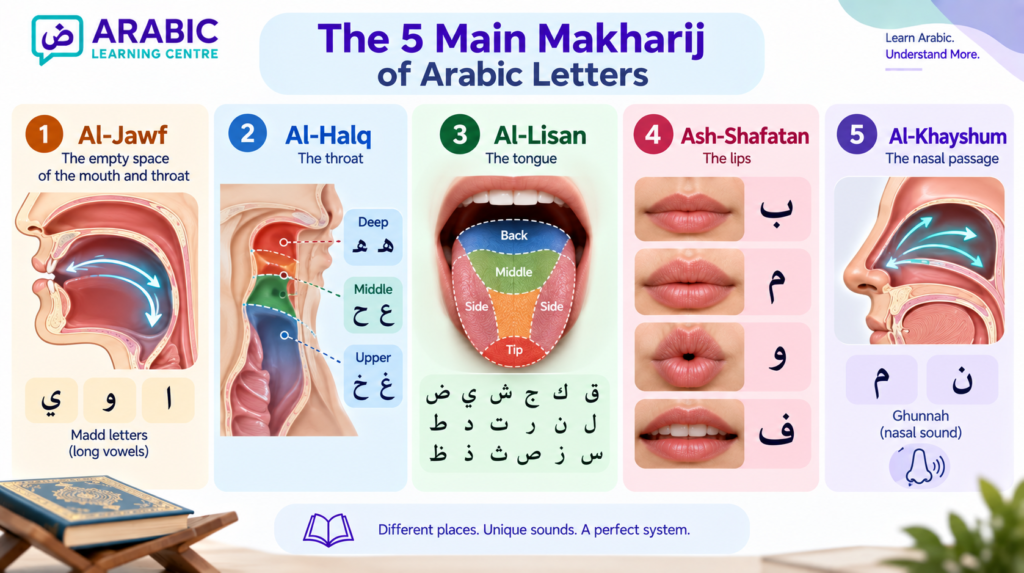
Each area contains either specific Arabic letters or, in the case of the nasal passage, an important sound quality.
1. Al-Jawf: The Empty Space of the Mouth and Throat
Al-Jawf is the open cavity through which sound flows freely, without the tongue or lips touching a specific point. It produces the three Madd letters (long vowels):
| Letter | Condition | Example | Meaning |
| ا (Alif Madd) | Silent Alif after Fatha | قَالَ (qāla) | “He said” |
| و (Waw Madd) | Silent Waw after Damma | يَقُولُ (yaqūlu) | “He says” |
| ي (Ya Madd) | Silent Ya after Kasra | قِيلَ (qīla) | “It was said” |
Practice tip: Sustain ā — ī — ū and notice there is no precise point where the tongue or lips stop the sound.
2. Al-Halq: The Makhraj of the Throat Letters
Six letters originate from the throat, divided into three regions:
| Throat Area | Letters | Notes |
| Deep throat | ء (Hamza), هـ (Haa) | Hamza = brief glottal stop; Haa = light, breathy |
| Middle throat | ع (ʿAyn), ح (Haa) | No English equivalent; ʿAyn is voiced, Haa is breathier |
| Upper throat | غ (Ghayn), خ (Khaa) | Both involve friction closer to the mouth |
Practice sequence: ء — هـ — ع — ح — غ — خ (say slowly, feel the point move from deep in the throat toward the mouth).
3. Al-Lisan: The Makhraj of the Tongue Letters
The tongue produces the largest number of Arabic sounds, using its back, middle, sides, tip, and the area near the teeth/gums.
| Letter | Name | Articulation | Example |
| ق | Qaaf | Back of tongue, rising to soft palate | قَلْبٌ (qalbun) — “heart” |
| ك | Kaaf | Back of tongue, slightly forward of Qaaf | كِتَابٌ (kitābun) — “book” |
| ج | Jeem | Middle of tongue | جَمَلٌ (jamalun) — “camel” |
| ش | Sheen | Middle of tongue | شَمْسٌ (shamsun) — “sun” |
| ي | Ya (consonant) | Middle of tongue | يَدٌ (yadun) — “hand” |
| ض | Daad | Side of tongue against upper molars | ضَرَبَ (ḍaraba) — “he struck” |
| ل | Laam | Front of tongue at gum ridge | لَيْلٌ (laylun) — “night” |
| ن | Noon | Front of tongue near upper gums | نُورٌ (nūrun) — “light” |
| ر | Raa | Tip of tongue near gum ridge | رَسُولٌ (rasūlun) — “messenger” |
| ت / د / ط | Taa / Daal / emphatic Taa | Tip of tongue near upper front teeth | تَمْرٌ، دَرْسٌ، طِفْلٌ |
| س / ز / ص | Seen / Zay / Saad | Front of tongue near teeth | سَمَاءٌ، زَهْرَةٌ، صَبْرٌ |
| ث / ذ / ظ | Thaa / Dhaal / Dhaa | Tongue tip at edge of upper teeth | ثَوْبٌ، ذَهَبٌ، ظِلٌّ |
Key contrast — Qaaf vs Kaaf: قَلْب (qalb, “heart”) vs كَلْب (kalb, “dog”) — moving the articulation point forward changes the entire word.
This is a clear example of how the sound of a letter connects to its correct written form, since mastering both writing and pronunciation together prevents this kind of mix-up.

4. Ash-Shafatan: Makhraj of the Lips
Four letters are produced mainly with the lips:
| Letter | Name | Articulation | Example |
| ب | Baa | Both lips close fully | بَيْتٌ (baytun) — “house” |
| م | Meem | Both lips close (also nasal) | مَاءٌ (māʾun) — “water” |
| و | Waw (consonant) | Lips rounded, not closed | وَلَدٌ (waladun) — “boy” |
| ف | Faa | Inner lower lip touches upper front teeth | فِيلٌ (fīlun) — “elephant” |
Mirror check: ب/م → both lips meet · ف → lower lip + upper teeth · و → rounded lips.
5. Al-Khayshum: The Nasal Passage
Not an independent letter’s makhraj, but the source of غُنَّة (Ghunnah) — nasal resonance — associated with ن (Noon) and م (Meem), especially when they carry a Shaddah.
Test: Sustain مّمّم or نّنّن while gently pinching your nose — you’ll feel the resonance change.
Read also: Detached Pronouns in Arabic – Complete Guide With Examples
Makhraj of All Arabic Letters in English
The following chart gives a simplified English reference for the makhraj of all Arabic letters discussed through the major articulation areas.
| Letter | Name | Main Articulation Area |
| ء | Hamza | Deep throat |
| ه | Haa | Deep throat |
| ع | ʿAyn | Middle throat |
| ح | Haa | Middle throat |
| غ | Ghayn | Upper throat |
| خ | Khaa | Upper throat |
| ق | Qaaf | Back of tongue |
| ك | Kaaf | Back of tongue, slightly forward of Qaaf |
| ج | Jeem | Middle of tongue |
| ش | Sheen | Middle of tongue |
| ي | Ya | Middle of tongue when consonantal |
| ض | Daad | Side of tongue against upper molars |
| ل | Laam | Front/edge of tongue near upper gums |
| ن | Noon | Tip/front of tongue near upper gums |
| ر | Raa | Tip of tongue near upper gum ridge |
| ط | Taa emphatic | Tip of tongue near upper teeth/gums |
| د | Daal | Tip of tongue near upper teeth/gums |
| ت | Taa | Tip of tongue near upper teeth/gums |
| ص | Saad | Front of tongue near lower/upper teeth area |
| ز | Zay | Front of tongue near teeth |
| س | Seen | Front of tongue near teeth |
| ظ | Dhaa | Tongue tip with upper teeth |
| ذ | Dhaal | Tongue tip with upper teeth |
| ث | Thaa | Tongue tip with upper teeth |
| ف | Faa | Lower lip with upper teeth |
| ب | Baa | Both lips |
| م | Meem | Both lips |
| و | Waw | Rounded lips when consonantal |
| ا و ي | Madd letters | Al-Jawf when functioning as long vowels |
The final line is important because Alif, Waw, and Ya do not always use the same makhraj.
When they function as Madd letters, their long vowel sounds come from Al-Jawf. When Waw or Ya functions as a consonant, it has its own physical articulation.
Inside Our Classrooms
See how we make learning interactive and engaging! Watch a quick snippet of our live, conversational classes in action:
How Do You Determine the Makhraj of an Arabic Letter?
A traditional way to identify the makhraj of an Arabic letter is to pronounce the letter with Sukoon and observe where its sound stops or emerges.
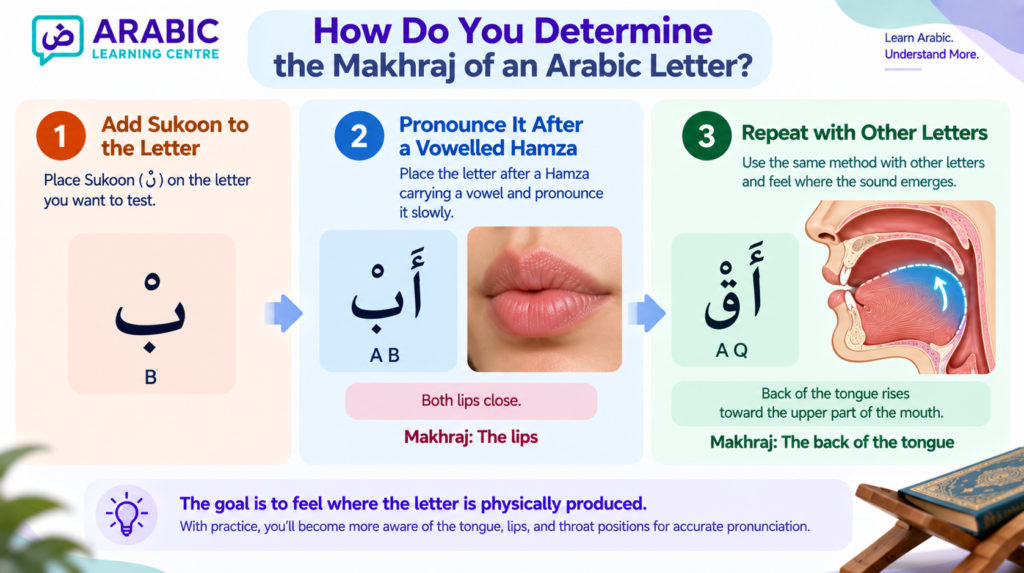
- Add Sukoon to the Letter: Place Sukoon (ْ) on the letter you want to test. For example: بْ
- Pronounce It After a Vowelled Hamza: Place the letter after a Hamza carrying a vowel: أَبْ
- Pronounce the combination slowly and pay attention to where the sound ends. With بْ, both lips close, showing that its makhraj is at the lips.
- Repeat the Test with Other Letters: The same method can help identify other articulation points. For example: أَقْ. When pronouncing قْ, you can feel the back of the tongue rise toward the upper part of the mouth, revealing the articulation point of ق.
The goal of this exercise is not simply to hear each letter, but to feel where it is physically produced. With repeated practice, learners can become more aware of the tongue, lips, and throat positions required for accurate Arabic pronunciation.
Read also: Hamza Arabic Letter – Pronunciation, Forms, and Writing Rules
Why Is Learning the Makhraj of Arabic Letters Important?
Learning the Makharij of Arabic letters helps learners pronounce each sound clearly and prevents similar letters from being confused with one another. This is important because even a small change in articulation can change the meaning of a word.
A clear example is:
قَلْبٌ — qalbun — “Heart”
كَلْبٌ — kalbun — “Dog”
The difference lies mainly between ق and ك. Both are produced using the back of the tongue, but their exact articulation points are different. If ق — Qaaf is pronounced too far forward, it may begin to sound like ك — Kaaf, changing the word completely.
Learning the correct Makhraj therefore helps students:
- Distinguish similar Arabic letters more accurately.
- Improve pronunciation when reading and speaking Arabic.
- Avoid pronunciation errors that may change the meaning of words.
- Recite the Quran more accurately by giving each letter its correct articulation.
For Quran learners in particular, Makharij provide an essential foundation for Tajweed, because correct recitation begins with producing each Arabic letter clearly from its proper articulation point.
How to Learn Makharij of Arabic Letters With Pictures?
Searching for the makhraj of Arabic letters with pictures can be particularly helpful because Makharij is a physical subject.
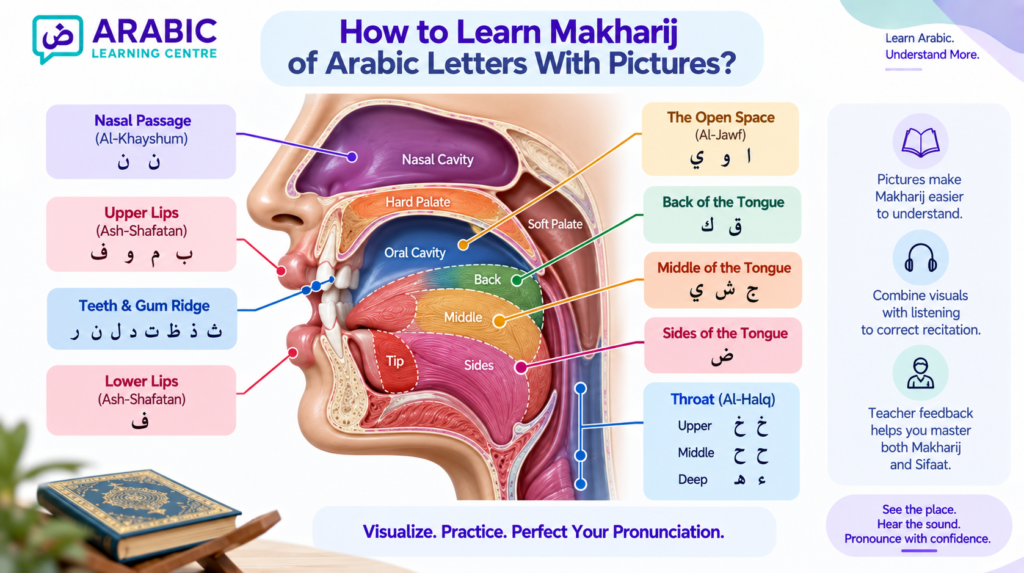
A useful visual diagram should show:
- the throat and its three divisions
- the back, middle, sides, and tip of the tongue
- the hard and soft palate
- the teeth and gum ridge
- the upper and lower lips
- the nasal cavity
- the open space of the mouth
Images are especially helpful when studying letters such as ض, because written descriptions such as “the side of the tongue against the upper molars” are much easier to understand when the placement is shown visually.
However, pictures should support listening and teacher feedback rather than replace them. A learner may place the tongue approximately where the diagram indicates but still produce an inaccurate sound if the letter’s Sifaat are incorrect.
Can You Learn Makharij From a PDF in English?
Yes. A makhraj of Arabic letters PDF in English can be a useful study and revision tool, especially for learners who want a visual reference for the different articulation points.
A useful Makharij PDF or printable chart may include:
- The five main Makharij
- The Arabic letters associated with each area
- The detailed divisions of the tongue and throat
- Clear explanations in English
- Mouth and throat diagrams
- Example Arabic words
- Simple pronunciation exercises
PDFs are particularly helpful for memorizing the structure and locations of the Makharij. However, correct pronunciation cannot be learned from written explanations alone. Makharij involve hearing the sound and physically training the tongue, lips, and throat to produce it correctly.
For this reason, the most effective approach combines:
Visual guide + Audio examples + Physical practice + Teacher correction
A PDF can therefore provide a strong reference, but listening and receiving pronunciation feedback are essential for developing accurate Makharij.
Read also: Pronouns in Arabic Grammar – Types, Rules, and Examples
Don’t Just Take Our Word For It
Take a look inside our vibrant classes and see our students and teachers in action. Click below to watch our classroom experience:
Learn Arabic Pronunciation With Arabic Learning Centre
Learning vocabulary and grammar is not enough if Arabic sounds are consistently produced from the wrong articulation points.
Structured pronunciation training helps learners understand how the Arabic sound system actually works and prevents incorrect habits from becoming permanent.
At Arabic Learning Centre, learners can develop their Arabic pronunciation step by step while studying letters, reading, vocabulary, and language structure in context.
Learning the makhraj of Arabic letters with guided correction can be particularly valuable for non-native speakers who need help recognizing subtle differences between sounds that do not exist in English.
Start learning with Arabic Learning Centre.
Take the next step today and join thousands of students learning Arabic the right way.
Courses We Offer:
- Online Arabic Course
- Classical arabic course
- Modern Standard Arabic Course
- Fusha Arabic Course
- Learn Saudi Arabic
- Arabic Course for Beginners
- Arabic Classes for Adults
- Arabic Classes for Ladies
- Advanced Arabic Course
- Intensive Arabic Course

Conclusion
Understanding the makhraj of Arabic letters gives learners a clear physical framework for correct pronunciation. Rather than relying only on imitation, students learn exactly where each sound originates and how the tongue, throat, lips, and nasal passage contribute to producing it.
The Makharij are commonly organized into five main areas: Al-Jawf, Al-Halq, Al-Lisan, Ash-Shafatan, and Al-Khayshum. Together, these areas cover the articulation of Arabic letters, long Madd sounds, and the nasal quality of Ghunnah.
For learners of Arabic and Quran recitation, mastering these articulation points takes consistent listening and practice. Once you understand where a letter should be produced, it becomes much easier to recognize pronunciation mistakes, distinguish similar letters, and gradually develop clearer and more accurate recitation.
FAQs About the Makhraj of Arabic Letters
What does Makhraj mean?
Makhraj (مَخْرَج) literally means an exit or way out. In Arabic pronunciation, it refers to the specific point in the vocal tract from which a letter’s sound is produced.
What is Makharij al-Huruf?
Makharij al-Huruf (مخارج الحروف) means the articulation points of Arabic letters. It explains where each Arabic sound originates in the throat, tongue, lips, mouth cavity, or nasal passage.
How many Makharij are there in Arabic?
A commonly taught Tajweed classification has 17 detailed articulation points grouped under five major regions: Al-Jawf, Al-Halq, Al-Lisan, Ash-Shafatan, and Al-Khayshum.
What are the five main Makharij?
The five main Makharij are Al-Jawf (the empty cavity), Al-Halq (the throat), Al-Lisan (the tongue), Ash-Shafatan (the lips), and Al-Khayshum (the nasal passage).
Which letters come from Al-Jawf?
Al-Jawf is associated with the three Madd sounds: Alif Madd, Waw Madd, and Ya Madd, when each meets its required vowel condition.
What is the Makhraj of Qaaf?
ق — Qaaf comes from the very back of the tongue as it approaches or contacts the soft palate. Its articulation is farther back than Kaaf.