 Arabic Grammar

The Hamza Arabic letter (ء) is one of the most distinctive characters learners encounter when studying Arabic. It represents a brief stop in the voice known linguistically as a glottal stop, and it can appear in several written forms depending on its position in a word and the vowels surrounding it.
You may see the Arabic letter Hamza written alone as ء, above or below an Alif as أ or إ, above a Waw as ؤ, or on a dotless Ya-shaped seat as ئ.
This variety often makes Hamza look more complicated than ordinary Arabic letters. However, the basic idea is straightforward: the Hamza itself represents the sound, while Alif, Waw, or Ya may sometimes serve only as its seat or “chair.”
This guide covers what Hamza is, how it sounds, whether Hamza is considered a letter in Arabic, its main forms, how its seat is chosen, and the important difference between Hamza and Alif.
What Is the Hamza Arabic Letter?
The Hamza Arabic letter is written ء, and its Arabic name is هَمْزَة (Hamzah / Hamza).Hamza represents a glottal stop, written in the International Phonetic Alphabet as /ʔ/. A glottal stop is produced when the vocal cords briefly close, stop the airflow, and then release it.
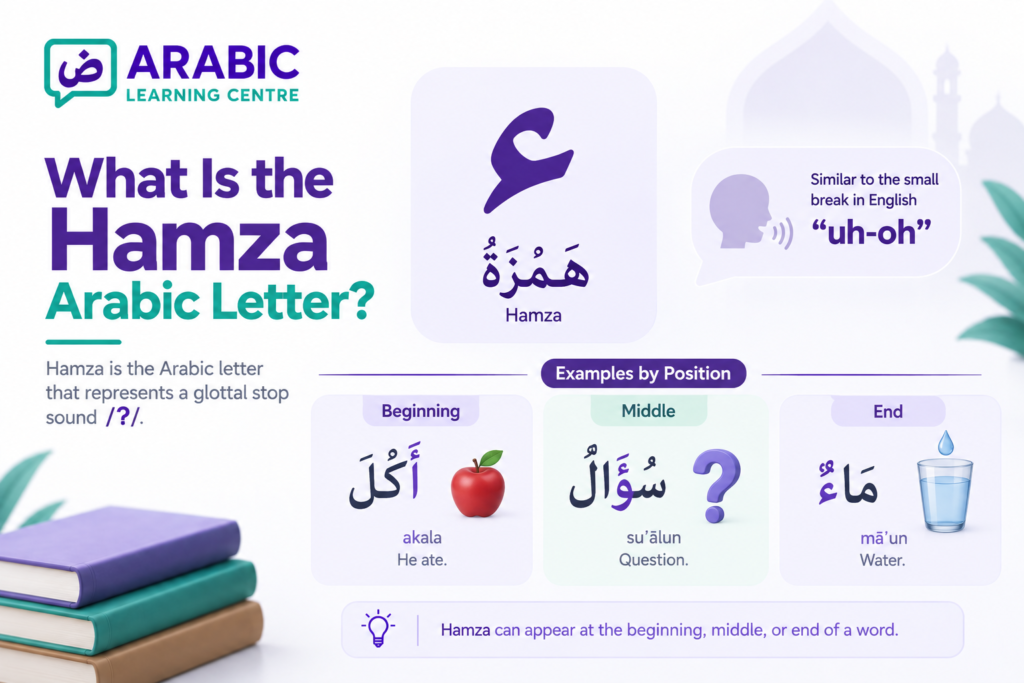
English speakers already produce a similar sound naturally — the small break between the two parts of “uh-oh” resembles the sound of Hamza.
Examples by position:
| Position | Word | Transliteration | Meaning |
| Beginning | أَكَلَ | akala | “He ate.” |
| Middle | سُؤَالٌ | suʾālun | “Question.” |
| End | مَاءٌ | māʾun | “Water.” |
This ability to occur at the beginning, middle, or end of a word makes Hamza an important part of both Arabic pronunciation and spelling.
Is Hamza a Letter in Arabic?
Hamza functions as a genuine consonantal sound and is extremely important for Arabic reading and pronunciation. However, it is generally not counted among the traditional 28 letters of the Arabic alphabet.
Some descriptions call it an additional character or symbol rather than one of the standard 28 letters. Other teaching traditions informally describe it as a “29th letter,” since it represents an independent consonant sound with its own spelling rules.
From a learner’s point of view, it is best to treat Hamza as an essential Arabic consonant that must be learned just as carefully as the regular letters. It is also represented separately in Unicode as U+0621 ARABIC LETTER HAMZA.
If you’d like structured, guided practice with rules like these, our Arabic writing course walks learners through spelling and letter-form rules step by step.

How Do You Pronounce the Arabic Letter Hamza?
Hamza is pronounced by momentarily closing the vocal cords and then releasing them. Unlike a long vowel, it does not carry the voice smoothly forward — it creates a short interruption.
Examples:
- سَأَلَ — saʾala — “He asked.” (a clear stop between syllables)
- قَرَأَ — qaraʾa — “He read.”
- دِفْءٌ — difʾun — “Warmth.”
Practice tip: say “uh‑oh” slowly and notice the small closure in the throat between the two parts.
Hamza vs. ʿAyn (ع): Beginners sometimes confuse the two because both are associated with the throat, but the sounds are very different. Hamza is a brief closure, while ʿAyn is a continuous voiced pharyngeal sound.
The Forms of Hamza
Hamza appears in several common written forms: ء أ إ ؤ ئ
It may also combine with vowel marks (أَ — أُ — إِ) or tanween (أً — أٌ — إٍ).
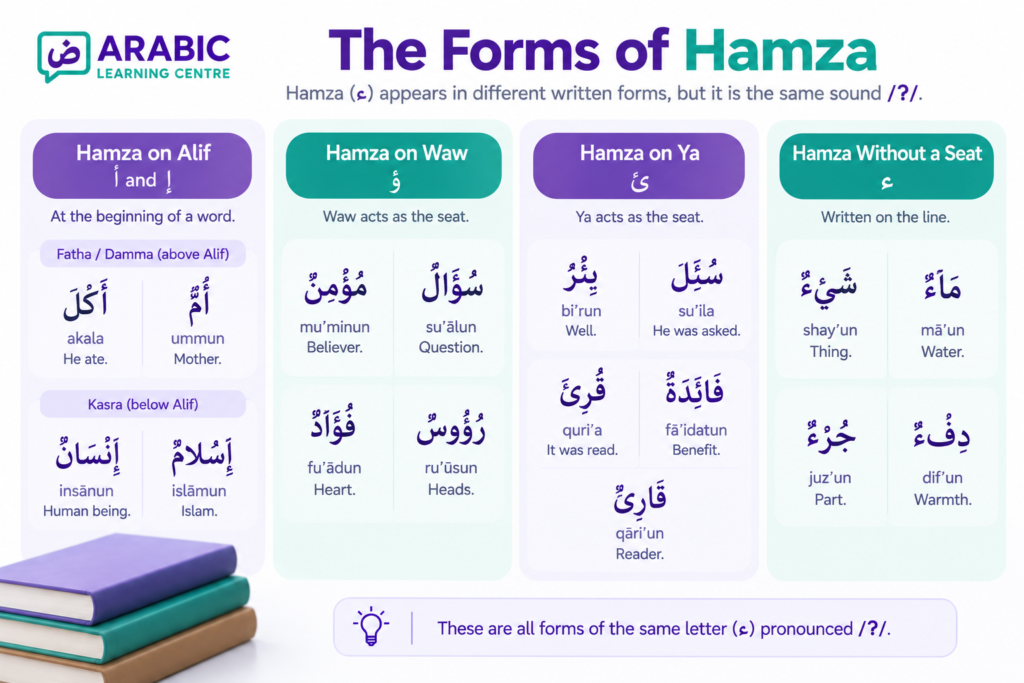
These shapes do not represent different letters — they are different orthographic forms of the same consonantal sound. The letter underneath Hamza is called its kursi (كرسي), meaning “chair” or “seat.” Hamza remains the consonantal sound; the seat only helps determine how the word is written.
Hamza on Alif: أ and إ
At the beginning of a word, Hamza is generally written with Alif:
- Fatha or Damma → written above the Alif: أَ / أُ
- أَكَلَ — akala — “He ate.”
- أُمٌّ — ummun — “Mother.”
- Kasra → written below the Alif: إِ
- إِنْسَانٌ — insānun — “Human being.”
- إِسْلَامٌ — islāmun — “Islam.”
Key rule: At the beginning of a word, Fatha and Damma place Hamza above Alif, while Kasra places it below Alif (supported by standard orthography: initial ʾa-/ʾu- use أ, while ʾi- uses إ).
Hamza on Waw: ؤ
The Waw acts as the seat; the pronounced consonant is still Hamza.
- مُؤْمِنٌ — muʾminun — “Believer.”
- سُؤَالٌ — suʾālun — “Question.”
- فُؤَادٌ — fuʾādun — “Heart.”
- رُؤُوسٌ — ruʾūsun — “Heads.”
This form commonly appears where the relevant vowel pattern favors Damma. Students should avoid reading ؤ as an ordinary Waw — the Waw is the seat, while the Hamza produces the glottal stop.
Hamza on Ya: ئ
The Ya-shaped seat does not carry the usual two dots underneath.
- بِئْرٌ — biʾrun — “Well.”
- سُئِلَ — suʾila — “He was asked.”
- قُرِئَ — quriʾa — “It was read.”
- فَائِدَةٌ — fāʾidatun — “Benefit.”
- قَارِئٌ — qāriʾun — “Reader.”
This seat is especially associated with Kasra, which has the strongest priority in the common system used to determine the seat of medial Hamza. This form is sometimes called Hamza ʿalā nabrah (همزة على نبرة), “Hamza on a seat.”
Hamza Without a Seat: ء
Hamza can appear independently, standing on the line:
- شَيْءٌ — shayʾun — “Thing.”
- مَاءٌ — māʾun — “Water.”
- جُزْءٌ — juzʾun — “Part.”
- دِفْءٌ — difʾun — “Warmth.”
Final Hamza is commonly written on the line when it follows a long vowel or a consonant with Sukoon.
How Is the Writing Position of Hamza Determined?
For a medial Hamza, the surrounding vowels determine the seat, following this priority order:
Kasra → Damma → Fatha
| Strongest Nearby Vowel | Hamza Seat |
| Kasra ـِ | ئ |
| Damma ـُ | ؤ |
| Fatha ـَ | أ |
| No relevant short vowel | ء |
Kasra generally takes priority over Damma, and Damma over Fatha.
Examples:
- بِئْرٌ → Kasra favors the Ya-shaped seat: ئ
- مُؤْمِنٌ → Damma favors Waw: ؤ
- رَأْسٌ → Fatha favors Alif: أ
These rules become more detailed near long vowels and diphthongs, so learners should master the basic hierarchy before tackling the exceptions.
Hamza by Position in the Word
The way Hamza is written changes depending on where it appears in the word. Medial and final Hamza follow different spelling patterns, mainly based on the vowels surrounding the Hamza.
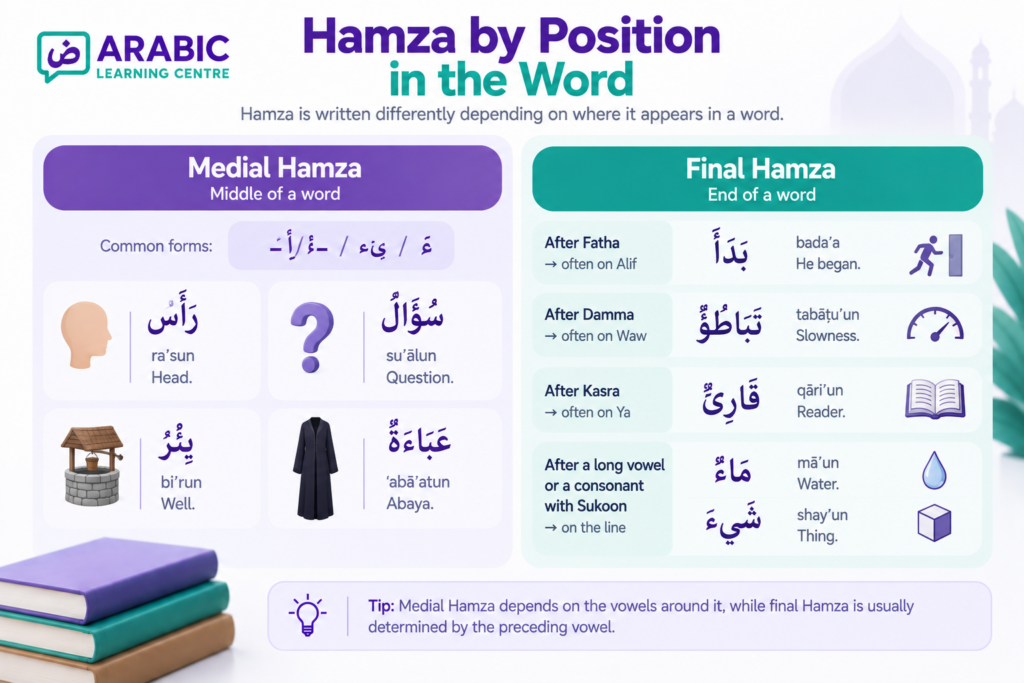
Medial Hamza (middle of a word)
Common forms: ـأـ / ـؤ / ـئـ / ء
| Word | Transliteration | Meaning |
| رَأْسٌ | raʾsun | “Head.” |
| سُؤَالٌ | suʾālun | “Question.” |
| بِئْرٌ | biʾrun | “Well.” |
| عَبَاءَةٌ | ʿabāʾatun | “Abaya.” |
For medial Hamza, both the vowel on Hamza and the vowel before it can affect the spelling. When two vowels conflict, the stronger one (per the Kasra > Damma > Fatha hierarchy) usually determines the seat — memorizing only one rule (e.g., “Damma means Waw”) is not enough for advanced spelling.
Read also: Makhraj of Arabic Letters – Complete Guide to Articulation Points
Final Hamza (end of a word)
The rule here depends heavily on the letter and vowel immediately before it:
- Preceding Fatha → often sits on Alif: بَدَأَ — badaʾa — “He began.”
- Preceding vowel favors Damma → often sits on Waw: تَبَاطُؤٌ — tabāṭuʾun — “Slowness.”
- Preceding Kasra → often sits on Ya: قَارِئٌ — qāriʾun — “Reader.”
- Following a long vowel or a consonant with Sukoon → stands independently: مَاءٌ، شَيْءٌ، مِلْءٌ
Final Hamza is generally easier than medial Hamza, since the preceding vowel is usually the main deciding factor.
Hamza with Fatha, Damma, Kasra, and Sukoon
Hamza is a consonant and can carry Arabic short vowels:
- ءَ — Hamza with Fatha
- ءُ — Hamza with Damma
- ءِ — Hamza with Kasra
- ءْ — Hamza with Sukoon
- ءً / ءٌ / ءٍ — Hamza with Tanween
Carrying Harakat this way is one key difference between Hamza and a true long-vowel Alif.
Hamzat al-Qaṭʿ vs. Hamzat al-Waṣl
The key difference between Hamzat al-Qaṭʿ and Hamzat al-Waṣl is whether the Hamza remains pronounced when the word is connected to what comes before it.
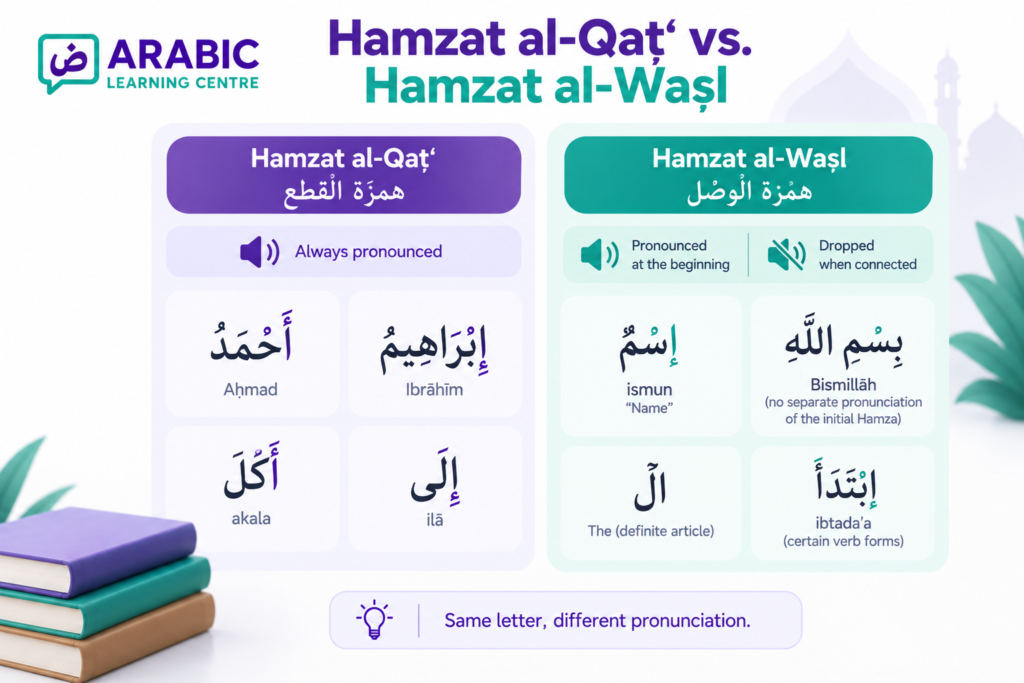
Hamzat al-Qaṭʿ (هَمْزَةُ الْقَطْع)
Pronounced whether you begin with the word or connect it to what comes before it — its sound stays present in connected speech.
- أَحْمَد
- إِبْرَاهِيم
- أَكَلَ
- إِلَى
Hamzat al-Waṣl (هَمْزَةُ الْوَصْل)
Pronounced only when beginning with the word; normally dropped when the word is connected to something before it.
- اِسْمٌ — ismun — “Name” (pronounced when starting the word)
- بِسْمِ اللهِ — here, the initial Hamzat al-Waṣl of اسم is not pronounced separately
Hamzat al-Waṣl is also associated with the definite article الـ and with certain noun and verb patterns.
Inside Our Classrooms
See how we make learning interactive and engaging! Watch a quick snippet of our live, conversational classes in action:
Alif Maddah: آ
Alif Maddah (آ) combines a Hamza sound followed by a long ā vowel. A simple way for learners to remember it is:
آ = Hamza + long ā
Unlike a regular Alif ا, the sound begins with the glottal stop of Hamza and then continues into a long ā sound. For this reason, آ is pronounced approximately as /ʔaː/.
Examples:
| Word | Transliteration | Meaning |
| آمَنَ | āmana | “He believed.” |
| آدَم | Ādam | “Adam.” |
| آخِر | ākhir | “Last / other.” |
| قُرْآن | Qurʾān | “Quran.” |
Why Is Maddah Used?
Alif Maddah often appears where the spelling would otherwise involve two Alif-like elements together, typically a Hamza on Alif followed by another Alif representing the long ā vowel.
Instead of writing them separately, Arabic combines them into the single form آ.
For example: أ + ا → آ
So, Maddah is not a separate consonant. It is a special written form that represents Hamza followed by a long ā sound, helping make Arabic spelling more compact and easier to read.
Read also: Pronouns in Arabic Grammar – Types, Rules, and Examples
Summary Table of Examples
The table below brings together the main forms of Hamza in common Arabic words, showing how each form appears alongside its pronunciation and meaning.
| Arabic | Transliteration | Meaning | Hamza Form |
| أَكَلَ | akala | He ate | أ |
| إِنْسَان | insān | Human | إ |
| رَأْس | raʾs | Head | أ |
| مُؤْمِن | muʾmin | Believer | ؤ |
| سُؤَال | suʾāl | Question | ؤ |
| بِئْر | biʾr | Well | ئ |
| قَارِئ | qāriʾ | Reader | ئ |
| شَيْء | shayʾ | Thing | ء |
| مَاء | māʾ | Water | ء |
| جُزْء | juzʾ | Part | ء |
Words like these are a great starting point for building a working Arabic vocabulary — our Arabic vocabulary course expands on lists like this with everyday, practical words and phrases.

Common Mistakes When Learning Hamza
Hamza can be challenging at first because its pronunciation, written form, and position do not always follow the same pattern. Avoiding these common mistakes can make both reading and spelling much easier.
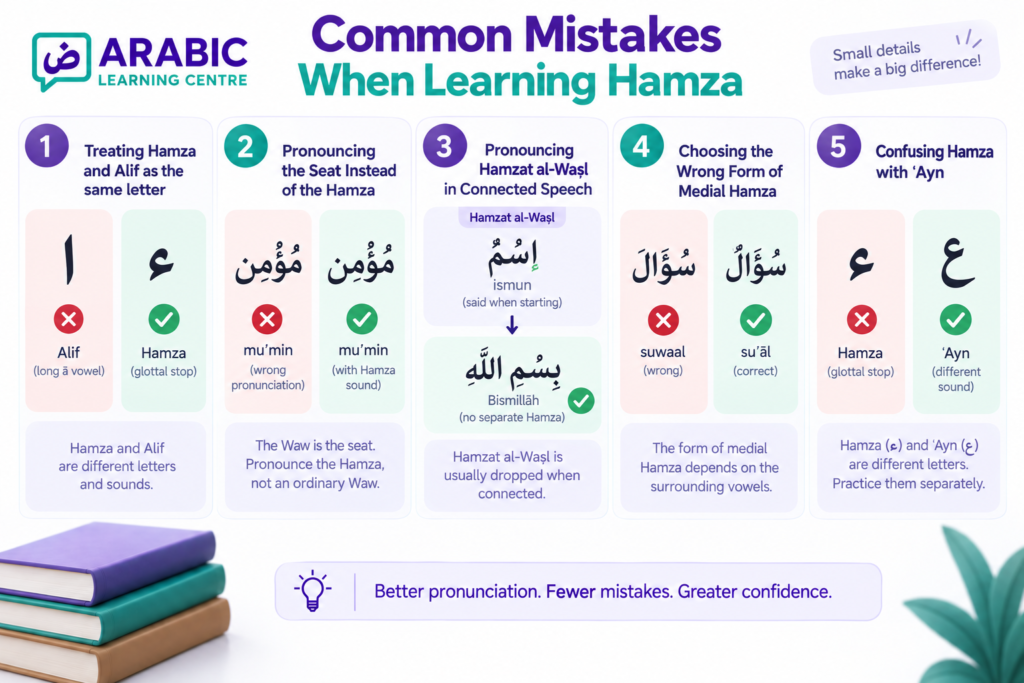
1. Treating Hamza and Alif as the same letter
Hamza ء represents a consonantal glottal stop, while plain Alif ا commonly represents the long ā vowel. They may appear together in forms such as أ and إ, but they are not the same.
2. Pronouncing the Seat Instead of the Hamza
In a word such as مُؤْمِن, the Waw serves as the seat of Hamza. The form ؤ should not be pronounced as an ordinary independent و.
3. Pronouncing Hamzat al-Waṣl in Connected Speech
Hamzat al-Waṣl is pronounced when beginning with the word but normally drops when the word is connected to what comes before it. This distinguishes it from Hamzat al-Qaṭʿ, which remains pronounced.
4. Choosing the Wrong Form of Medial Hamza
The spelling of a medial Hamza depends on the surrounding vowels and their relative strength. Looking only at the vowel on Hamza can therefore lead to spelling mistakes.
5. Confusing Hamza with ʿAyn
Hamza (ء) and ʿAyn (ع) represent different Arabic sounds. Learners should practice them separately rather than treating them as interchangeable.
How to Learn Hamza More Easily?
Hamza becomes easier when learners study it step by step instead of trying to memorize every spelling rule and exception at once.
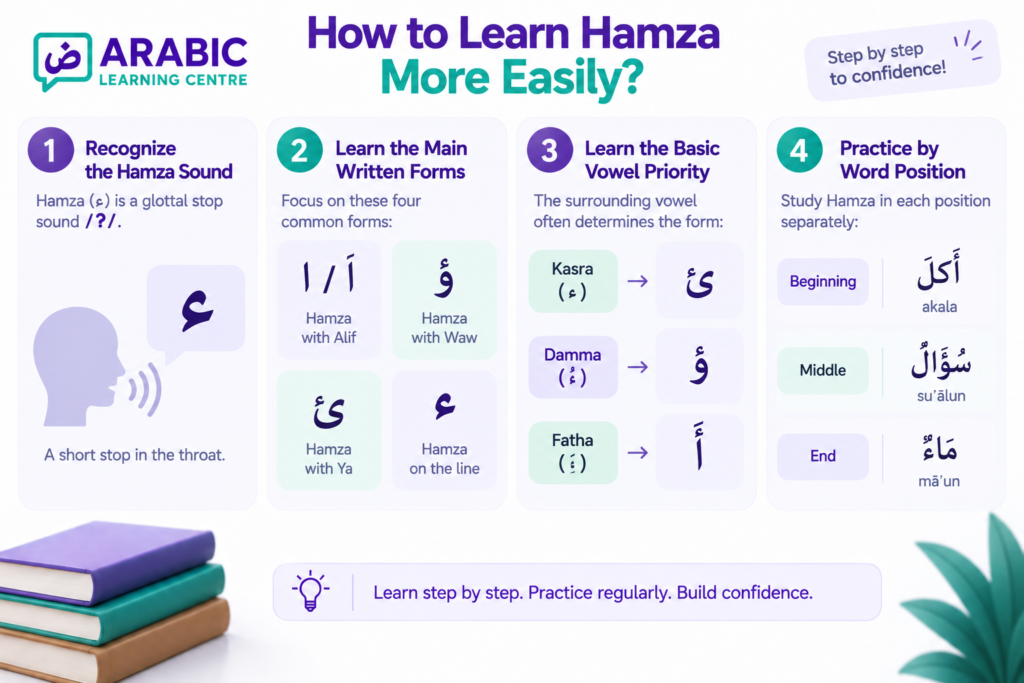
1. Recognize the Hamza Sound
Start by remembering that ء represents a glottal stop. Learning to recognize this sound makes the written forms easier to understand.
2. Learn the Main Written Forms
Focus first on the four common forms:
- أ / إ — Hamza with Alif
- ؤ — Hamza with Waw
- ئ — Hamza with a Ya-shaped seat
- ء — Hamza on the line
3. Learn the Basic Vowel Priority
A useful starting pattern is:
Kasra → ئ · Damma → ؤ · Fatha → أ
This helps learners understand why Hamza takes different written forms.
4. Practice Hamza by Word Position
Study Hamza according to where it appears:
Beginning → Middle → End
Each position follows its own spelling patterns, so learning them separately makes the rules easier to remember.
Studying Hamza in these stages is usually more effective than trying to memorize many unrelated spellings at once.
Read also: Detached Pronouns in Arabic – Complete Guide With Examples
Don’t Just Take Our Word For It
Take a look inside our vibrant classes and see our students and teachers in action. Click below to watch our classroom experience:
Master Hamza and Build Stronger Arabic Skills
Understanding Hamza is an important step toward reading and writing Arabic with greater accuracy. Once you understand its forms, vowel patterns, and spelling rules, many words that once seemed difficult become much easier to recognize and pronounce.
At Arabic Learning Centre, learners build these skills through structured, step-by-step lessons covering Arabic reading, writing, pronunciation, grammar, and Tajweed. With guidance from live instructors, you can understand why Arabic rules work, rather than simply memorizing them.
Whether you are learning the Arabic alphabet for the first time or working toward more confident reading, structured instruction can help you progress with clarity and consistency.
Book your free trial class today and start building a stronger foundation in Arabic.
Take the next step today and join thousands of students learning Arabic the right way.
Courses We Offer:
- Business Arabic Course
- Learn Arabic from Zero
- Medical Arabic Course
- Learning Arabic for Non Arabic Speakers
- Learn Arabic in Saudi Arabia
- Learn to Read Arabic Course
- Arabic Grammar Course
- Arabic Speaking Course
- Arabic Script writing course
- Arabic Vocabulary Course
- Arabic Pronunciation Course

Conclusion
The Hamza Arabic letter (ء) represents the glottal stop and can occur at the beginning, middle, or end of Arabic words. Unlike most Arabic letters, Hamza can be written in several ways — independently (ء), above or below Alif (أ / إ), on Waw (ؤ), or on a dotless Ya-shaped seat (ئ).
Its form often depends on surrounding vowels, with Kasra generally taking priority over Damma, and Damma over Fatha, in medial spelling. Hamza and Alif are not the same thing: Hamza is a consonantal glottal stop, whereas plain Alif can function as a long vowel.
Once you understand the Hamza sound, its main seats, and the difference between Hamzat al-Qaṭʿ and Hamzat al-Waṣl, many Arabic words that initially seem difficult to read become much more predictable.
Frequently Asked Questions
Is Hamza a letter in Arabic?
Hamza represents the glottal stop /ʔ/ but is generally not counted among the traditional 28 Arabic letters. It is sometimes informally called an additional or “29th letter.”
What sound does Hamza make in Arabic?
Hamza represents a glottal stop, similar to the brief break between the two parts of the English expression “uh-oh.”
What is the difference between Hamza and Alif?
Hamza (ء) represents a consonantal glottal stop, while Alif (ا) can represent the long ā vowel. In أ and إ, Alif serves as the seat for Hamza.
What is the kursi of Hamza?
The kursi (كرسي), or “seat,” is the letter that carries Hamza in certain spellings. It may be Alif, Waw, or a dotless Ya-shaped form: أ/إ، ؤ، ئ.
Why is Hamza sometimes written on Waw?
Hamza is commonly written on Waw (ؤ) when the relevant vowel pattern favors Damma, as in مُؤْمِن and سُؤَال.
When is Hamza written by itself?
Hamza can stand alone as ء in certain medial cases and at the end of words after a long vowel or a consonant with Sukoon, as in مَاء، شَيْء، مِلْء.
What are Hamzat al-Waṣl and Hamzat al-Qaṭʿ?
Hamzat al-Qaṭʿ remains pronounced whether starting or connecting speech. Hamzat al-Waṣl is pronounced when beginning with the word but normally drops in connected speech.
Related Articles
Arabic Grammar