 Arabic Vocabulary & Speaking
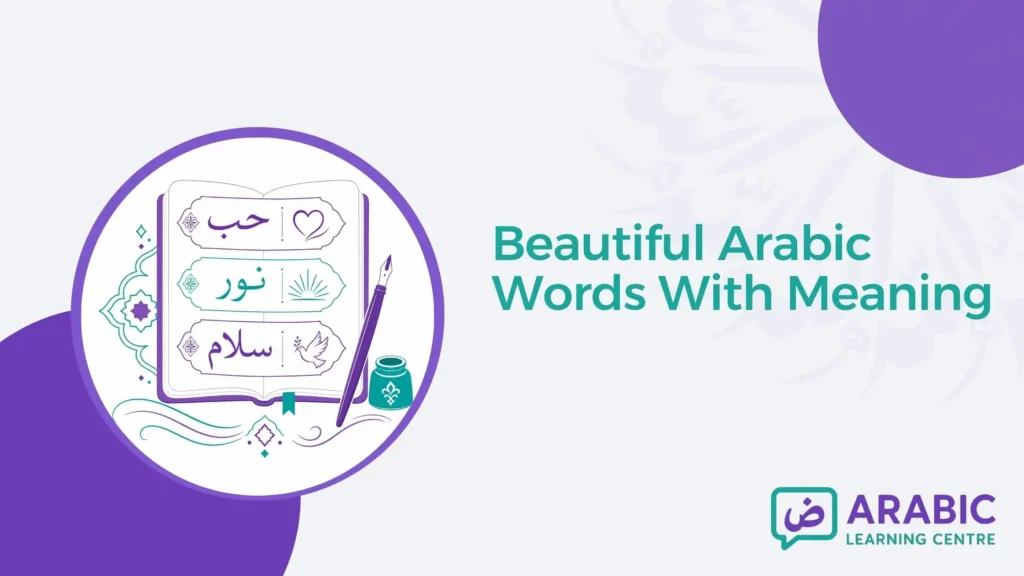
A single Arabic word can carry the weight of a whole sentence. Ask any student who has sat with a root like ر-ح-م and watched mercy, womb, and kinship unfold from the same three letters. That density is why so many learners fall in love with the language before they can even read it fluently.
This guide brings together some of the most beautiful Arabic words for love, spirituality, nature, and daily life, explained the way a certified Arabic instructor would teach them. You will find pronunciation guidance, root breakdowns, curated vocabulary tables, and Quranic examples that show exactly why these words resonate so deeply with learners worldwide.
Why Certain Arabic Words Carry Such Emotional and Linguistic Depth
Arabic words feel beautiful because of the root and pattern system, where three or four consonants generate an entire family of related meanings. A single root can produce a noun, a verb, an adjective, and an abstract concept, all recognisably connected.
This structure is what makes beautiful Arabic words with meaning so layered compared to their English equivalents. English borrows and stacks words; Arabic grows them from a shared linguistic seed, so meaning and sound reinforce each other.
The Arabic Learning Centre‘s Arabic Elementary School Programme dedicates its opening unit entirely to letter shapes, since this foundation determines every reading skill that follows.
Book Your Free Trial for Arabic Elementary School Programme Now!
How Root Letters Shape Meaning Across Word Families
Take the root ج-م-ل (j-m-l), associated with beauty and completeness. From it come جميل (jameel, “beautiful”), جمال (jamaal, “beauty”), and جملة (jumlah, “sentence,” something complete in itself). Recognising this pattern turns vocabulary memorisation into pattern recognition.
Comparing Word Categories Commonly Searched by Learners
| Category | Example Focus | Typical Learner Goal |
| Love and emotion | قلب، حب، شوق | Personal expression, poetry, relationships |
| Quranic and spiritual | نور، رحمة، سكينة | Religious study, reflection, Quranic Arabic |
| Nature and imagery | قمر، نسيم، فجر | Descriptive vocabulary, creative writing |
| Short beginner words | نور، سلام، حب | Early pronunciation practice |
Beautiful Arabic Words for Love and Their Emotional Range
Beautiful Arabic words for love rarely translate into a single English term because Arabic distinguishes between stages and intensities of affection that English compresses into one word. This precision is part of what draws learners to the language in the first place.
Where English has “love,” Arabic offers a spectrum.
حب (hubb) is general affection, عشق (ishq) is passionate, consuming love, and وله (walah) describes a love so deep it borders on bewilderment.
| Arabic Word | Transliteration | Meaning |
| حب | Hubb | Love, general affection |
| عشق | Ishq | Passionate, romantic love |
| غرام | Gharaam | Infatuation, intense longing |
| شوق | Shawq | Yearning, longing for someone absent |
| وله | Walah | Love bordering on bewilderment |
| هيام | Hiyaam | All-consuming love |
Recognising Why These Distinctions Matter for Fluent Expression
Native Arabic literature and poetry lean heavily on this precision, so learners who only know حب miss the emotional register a text is aiming for. Building this vocabulary range is a core focus of the Arabic Vocabulary Course, which groups words by emotional intensity rather than alphabetical order.
Book Your Free Trial for Arabic Vocabulary Course Now!
Practicing Pronunciation of Emotionally Loaded Vocabulary
The letter ع (ain) in عشق is a voiced pharyngeal sound with no English equivalent, produced by constricting the throat. Most non-native speakers approximate it as a glottal stop at first, which is an acceptable starting point before refining the sound.
Refining sounds like ع is exactly the kind of detail covered inside the Arabic Speaking Course, where guided audio drills correct common substitutions before they become habits.
Beautiful Arabic Words From Quran and Their Spiritual Weight
Beautiful Arabic words from the Quran often carry meanings that expand the more a student studies tafsir and classical commentary. A single word can anchor an entire theological concept, which is why Quranic vocabulary is studied differently from everyday conversational Arabic.
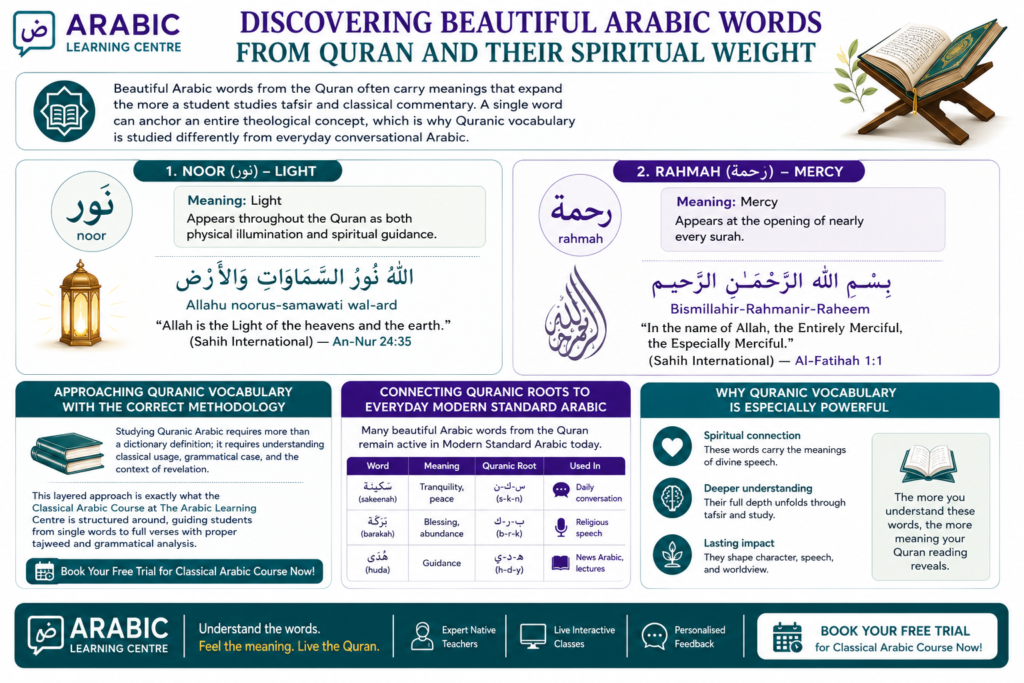
Consider the word نور (noor), meaning light, which appears throughout the Quran as both physical illumination and spiritual guidance.
اللَّهُ نُورُ السَّمَاوَاتِ وَالْأَرْضِ
Allahu noorus-samawati wal-ard
“Allah is the Light of the heavens and the earth.” (Sahih International) — An-Nur 24:35
Another frequently studied example is رحمة (rahmah), mercy, appearing at the opening of nearly every surah.
بِسْمِ ٱللَّهِ ٱلرَّحْمَـٰنِ ٱلرَّحِيمِ
Bismillahir-Rahmanir-Raheem
“In the name of Allah, the Entirely Merciful, the Especially Merciful.” (Sahih International) — Al-Fatihah 1:1
Approaching Quranic Vocabulary With the Correct Methodology
Studying Quranic Arabic requires more than a dictionary definition; it requires understanding classical usage, grammatical case, and the context of revelation.
This layered approach is exactly what the Classical Arabic Course at The Arabic Learning Centre is structured around, guiding students from single words to full verses with proper tajweed and grammatical analysis.
Book Your Free Trial for Classical Arabic Course Now!

Connecting Quranic Roots to Everyday Modern Standard Arabic
Many beautiful Arabic words from the Quran remain active in Modern Standard Arabic today.
سكينة (sakeenah, tranquility) and بركة (barakah, blessing) appear in daily conversation, news Arabic, and religious speech alike, making them valuable for both spiritual study and general fluency.
Inside Our Classrooms
See how we make learning interactive and engaging! Watch a quick snippet of our live, conversational classes in action:
Translating Beautiful Arabic Words Into English Without Losing Their Meaning
Beautiful Arabic words in English translation often lose a layer of meaning because Arabic roots encode grammatical relationships that English simply does not mark. A good translation approximates the sense; it rarely captures the full semantic field.
Take طرب (tarab), often translated as “ecstasy” or “musical rapture.” English needs an entire phrase to approximate what Arabic communicates in two syllables, because tarab specifically describes the emotional state induced by music.
| Arabic Word | Closest English Rendering | What Gets Lost in Translation |
| طرب (Tarab) | Musical ecstasy | The specific music-induced trigger |
| يقين (Yaqeen) | Certainty | The spiritual, unshakeable quality of the certainty |
| فرح (Farah) | Joy | The outward, expressive nature of the emotion |
Recognising When a Direct English Equivalent Does Not Exist
When no direct equivalent exists, instructors teach students to explain the root and context rather than force a translation.
This method is taught explicitly inside the Fusha Arabic Course, where students build the habit of thinking in Arabic concepts before reaching for an English word.
Book Your Free Trial for Fusha Arabic Course Now!

Building a Personal List of 100 Beautiful Arabic Words With Meaning
A structured list of 100 beautiful Arabic words with meaning works best when organised by theme rather than alphabet, since thematic grouping mirrors how the brain naturally stores related vocabulary. Random alphabetical lists are harder to retain long-term.
Below is a representative sample from a full 100 beautiful Arabic words collection, grouped by theme to demonstrate the method.
| Arabic Word | Transliteration | Meaning | Theme |
| قمر | Qamar | Moon | Nature |
| نسيم | Naseem | Gentle breeze | Nature |
| فجر | Fajr | Dawn | Nature |
| أمل | Amal | Hope | Emotion |
| صبر | Sabr | Patience | Emotion |
| حكمة | Hikmah | Wisdom | Character |
| كرم | Karam | Generosity | Character |
| سلام | Salaam | Peace | Values |
| إخلاص | Ikhlaas | Sincerity | Values |
| بهجة | Bahjah | Delight | Emotion |
Applying Spaced Repetition to Long Vocabulary Lists
Reviewing a set of 100 beautiful Arabic words works best on a spaced schedule: new words on day one, review on day three, then day seven, then day twenty-one. This interval pattern matches how long-term memory actually consolidates vocabulary.
Structuring a Themed Vocabulary Journal for Retention
Instructors at The Arabic Learning Centre recommend a themed notebook divided by category rather than a flat list, since thematic recall is faster during real conversation. The Arabic Vocabulary Course provides pre-built themed sheets so students can skip this setup step entirely.
Selecting Short Beautiful Arabic Words With Meaning for Absolute Beginners
Short, beautiful Arabic words with meaning are the best entry point for beginners because shorter words carry fewer unfamiliar letter combinations and simpler vowel patterns. Starting short builds pronunciation confidence before tackling longer vocabulary.
| Arabic Word | Transliteration | Meaning | Letters |
| نور | Noor | Light | 3 |
| حب | Hubb | Love | 2 |
| سلام | Salaam | Peace | 4 |
| صدق | Sidq | Honesty | 4 |
| فجر | Fajr | Dawn | 3 |
Mastering the Vowel Sounds Inside Short Words First
Short words like نور isolate a single long vowel sound, the extended “oo,” which is a useful drill before moving to words with multiple vowel changes. Getting this vowel length correct prevents a common beginner mistake of shortening it into “nur.”
Avoiding Common Beginner Pronunciation Errors With Short Words
English speakers often insert a vowel between the ح and ب in حب, saying “ha-bub” instead of the correct single-syllable “hubb.”
Read Also: 7 Famous Arabic Quotes and Their Meaning for Non-Native Arabic Learners
Identifying Unique Arabic Words With Meaning That Resist Direct Translation
Unique Arabic words with meaning are words whose root carries a cultural or emotional concept that simply has no single-word English counterpart, forcing translators to use an entire explanatory phrase instead.
تنفس الصعداء (tanaffas as-su’ada), literally “to breathe the breath of relief,” describes the exact physical sensation of exhaling after prolonged worry lifts. English has no equivalent single phrase for this precise feeling.
Understanding the Grammar Behind Compound Meaning Words
These expressions often combine a verb with a noun in a fixed idiomatic pattern, which is a feature of Arabic morphology students encounter once they move past basic sentence structure.
The Arabic Grammar Course covers these idiomatic verb-noun combinations directly, since they rarely appear in beginner textbooks.
Book Your Free Trial for Arabic Grammar Course Now!
Read Also: Body Parts in Arabic for Kids
Collecting Unique Words as Part of Advanced Study
Advanced students benefit from maintaining a running list of unique Arabic words with meaning encountered in native texts, since these expressions rarely surface in structured coursework but appear constantly in native literature and film.
Read Also: Hard Arabic Words to Pronounce and How Serious Learners Master Them
Don’t Just Take Our Word For It
Take a look inside our vibrant classes and see our students and teachers in action. Click below to watch our classroom experience:
Begin Your Arabic Language Journey with Expert Guidance at The Arabic Learning Centre!
Learning beautiful Arabic words with meaning becomes lasting fluency when guided by structured, expert instruction rather than scattered vocabulary lists alone.
The Arabic Learning Centre offers:
- Native Arabic tutors with structured, level-appropriate curricula
- Live sessions combined with recorded materials for flexible review
- Scheduling across global time zones
- Affordable pricing with a genuinely free trial
Courses We Offer:
- Online Arabic Course
- Classical arabic course
- Modern Standard Arabic Course
- Fusha Arabic Course
- Learn Saudi Arabic
- Arabic Course for Beginners
- Arabic Classes for Adults
- Arabic Classes for Ladies
- Advanced Arabic Course
- Intensive Arabic Course
Start with a free trial lesson and begin turning these words into real, confident fluency.
Book your free trial lesson today!

Conclusion
Beautiful Arabic words for love, nature, and spirituality reward learners who study the root and pattern system rather than isolated translations, since meaning and pronunciation reinforce each other throughout every related word family.
Quranic vocabulary, short beginner words, and unique idiomatic phrases all fit into one coherent learning system once this root-based approach becomes familiar: structured daily practice rather than scattered memorisation.
Whichever category draws you in first, consistent guided instruction turns these word lists into genuine, confident Arabic fluency that lasts well beyond a single study session.
Frequently Asked Questions
What are the most beautiful Arabic words for love?
The most cited beautiful Arabic words for love are حب (hubb, general love), عشق (ishq, passionate love), and شوق (shawq, longing). Each marks a different emotional intensity that English usually compresses into a single word.
What is the most beautiful Arabic word from the Quran?
نور (noor, “light”) and رحمة (rahmah, “mercy”) are among the most frequently studied beautiful Arabic words from the Quran, appearing across multiple surahs as both literal and spiritual concepts central to Islamic theology.
How do beautiful Arabic words translate into English accurately?
Beautiful Arabic words in English translation often need a full phrase rather than one word, since Arabic roots encode nuances of intensity, context, and grammar that English does not mark on a single term.
What are good short, beautiful Arabic words with meaning for beginners
Strong starting choices include نور (noor, light), حب (hubb, love), and سلام (salaam, peace). These short, beautiful Arabic words with meaning use simple letter combinations, making them ideal first-week pronunciation practice.
Where can I find a reliable list of 100 beautiful Arabic words with meaning
Reputable Arabic-learning platforms, dictionaries, and structured courses group a list of 100 beautiful Arabic words with meaning by theme, such as love, nature, and character, which supports faster memorisation than an alphabetical list.
Related Articles
Arabic Vocabulary & Speaking