 Arabic Vocabulary & Speaking
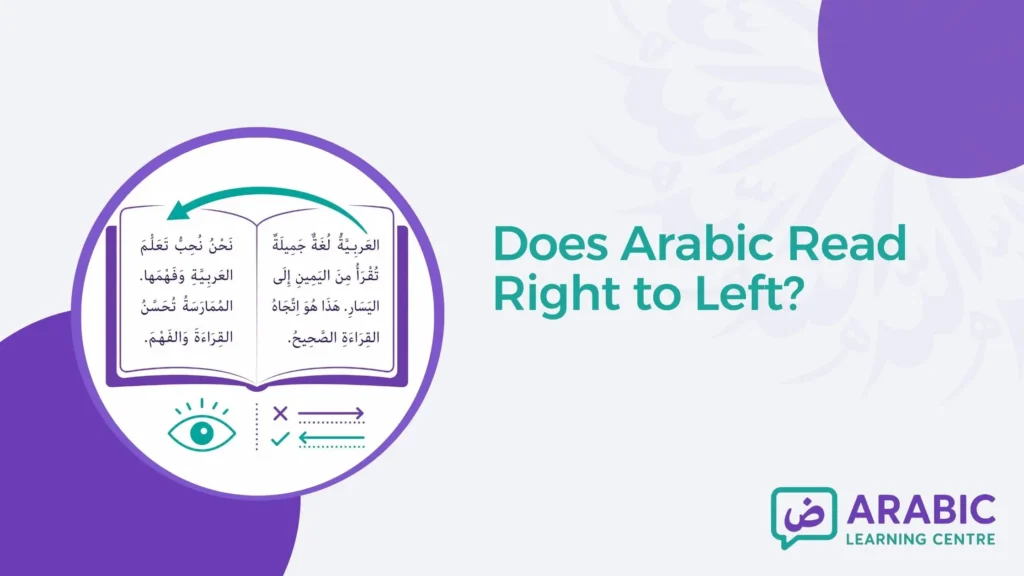
Arabic reads right to left, and always has. Every letter, every word, every line moves from the right side of the page toward the left. This directionality is one of the most distinctive features of the Arabic writing system, and understanding it is the first practical step for any new learner.
Arabic belongs to a family of Semitic scripts that developed in the ancient Near East. The direction of writing was likely influenced by the tools and surfaces early scribes used; carving right to left with a stylus on clay or stone felt natural for right-handed writers working inward.
That convention became permanent, passed through Aramaic into Arabic script, and has remained unchanged across fourteen centuries of Quranic transmission.
Does Arabic Read Right to Left?
Yes, Arabic is read and written from right to left. This applies to individual words, complete sentences, books, websites, messages, and Quranic text. Arabic letters also connect within words from right to left, with the rightmost letter being the first one read.
One important exception is numbers. Arabic-Indic numerals such as ١٢٣٤٥ are read in a left-to-right sequence even when they appear within an Arabic sentence. For beginners coming from English, reading right to left may initially feel unfamiliar, but the attached material notes that many adult learners adapt to the new direction within two to four weeks of consistent practice.
Arabic Right-to-Left Letters and How They Connect
Arabic script does not read right to left in isolated letters alone; entire words flow in that direction, and individual letters connect within a word from right to left as well.
Most Arabic letters have four positional forms: initial, medial, final, and isolated. When you write the word كِتَابٌ (kitābun, “a book”), the letters connect in a continuous line moving rightward on the page, with the reader’s eye tracking from the rightmost letter toward the left.
The Six Non-Connecting Letters
Six Arabic letters — و، ز، ر، ذ، د، ا — do not connect to the letter following them (i.e., to their left). This means a word may contain an internal break without indicating a space. Recognizing this rule early prevents a very common beginner mistake: assuming that every internal gap marks a new word.
| Letter | Name | Connects to right? | Connects to left? |
| ا | Alif | Yes | No |
| د | Dal | Yes | No |
| ذ | Dhal | Yes | No |
| ر | Ra | Yes | No |
| ز | Zay | Yes | No |
| و | Waw | Yes | No |
Understanding letter connectivity in the right-to-left flow is precisely the kind of foundational knowledge the Arabic Script Writing Course at The Arabic Learning Centre covers in its early modules.
Book Your Free Trial for Arabic Script Course Now!

Why Does Arabic Read Right to Left Letters
Arabic reads right to left because it inherits that directionality from the ancient Semitic writing tradition, specifically through the Nabataean script from which modern Arabic letterforms directly descend.
The earliest Semitic scripts, Phoenician, Aramaic, and Hebrew, were consistently written right to left. When Arabic script developed from Nabataean Aramaic around the 4th and 5th centuries CE, it retained that direction without modification. The arrival of Quranic revelation in the 7th century CE, recorded in this same script, then made right-to-left Arabic writing permanently sacred and immovable for Muslim communities worldwide.
Directionality and the Quran
The manuscript tradition of the Quran reinforced right-to-left reading as a religious as well as linguistic norm. Every Mushaf (copy of the Quran) opens from what a Western reader would call the “back” of the book. The title page is on the right, and pages turn leftward.
The opening verse of Al-Fatihah reads:
بِسْمِ ٱللَّهِ ٱلرَّحْمَـٰنِ ٱلرَّحِيمِ
Bismillāhir-Raḥmānir-Raḥīm
“In the name of Allah, the Entirely Merciful, the Especially Merciful.” (Al-Fatihah 1:1)
The Ba (ب) of Bismi is the rightmost character on the line, the entry point for the reader’s eye in every copy of the Quran ever produced.
Inside Our Classrooms
See how we make learning interactive and engaging! Watch a quick snippet of our live, conversational classes in action:
How Many Languages Read Right to Left
Arabic is not alone in its right-to-left directionality. Several major living languages share this script direction, and understanding which ones helps contextualize Arabic within its broader writing-system family.
| Language | Script | Direction |
| Arabic | Arabic | Right to left |
| Hebrew | Hebrew | Right to left |
| Persian (Farsi) | Perso-Arabic | Right to left |
| Urdu | Nastaliq (Arabic-based) | Right to left |
| Pashto | Arabic-based | Right to left |
| Yiddish | Hebrew | Right to left |
Today, approximately twelve to fifteen scripts worldwide are written right to left, though Arabic and Hebrew are by far the most widely used among living languages.
Arabic alone is the script used by over 400 million native speakers and is read by an estimated 1.8 billion Muslims as the language of Quranic recitation.
Bidirectional Text in the Modern World
A practical challenge arises when Arabic appears alongside English in the same document or digital interface, a situation linguists and software engineers call “bidirectional text” (often shortened to “bidi”). A sentence like “The word كِتَاب means book” requires two simultaneous script directions in one line.
Unicode’s bidirectional algorithm handles this automatically in most modern applications, but learners editing mixed-language documents should know that text alignment settings and cursor movement behave differently in Arabic word processors than in English ones.
Reading Arabic Right to Left as a New Learner
Adapting to right-to-left reading is a genuine cognitive adjustment for anyone whose native language uses a left-to-right script. Most adult learners report that the directional shift feels automatic within two to four weeks of consistent practice, but only when the learning method is correct from the start.
The most common mistake is treating Arabic letters as isolated symbols read right to left rather than understanding the connected, flowing nature of the script. Arabic is a cursive script by default, even in print. Training your eye to trace the rightward anchor of each word and follow the connective chain leftward is a skill, not an instinct.
Practical Techniques for Reading Arabic from Right-to-Left
Learning to read Arabic from right to left becomes easier when learners build directional awareness gradually and practice with increasingly complex text. The following techniques can help develop accuracy, recognition, and reading fluency:
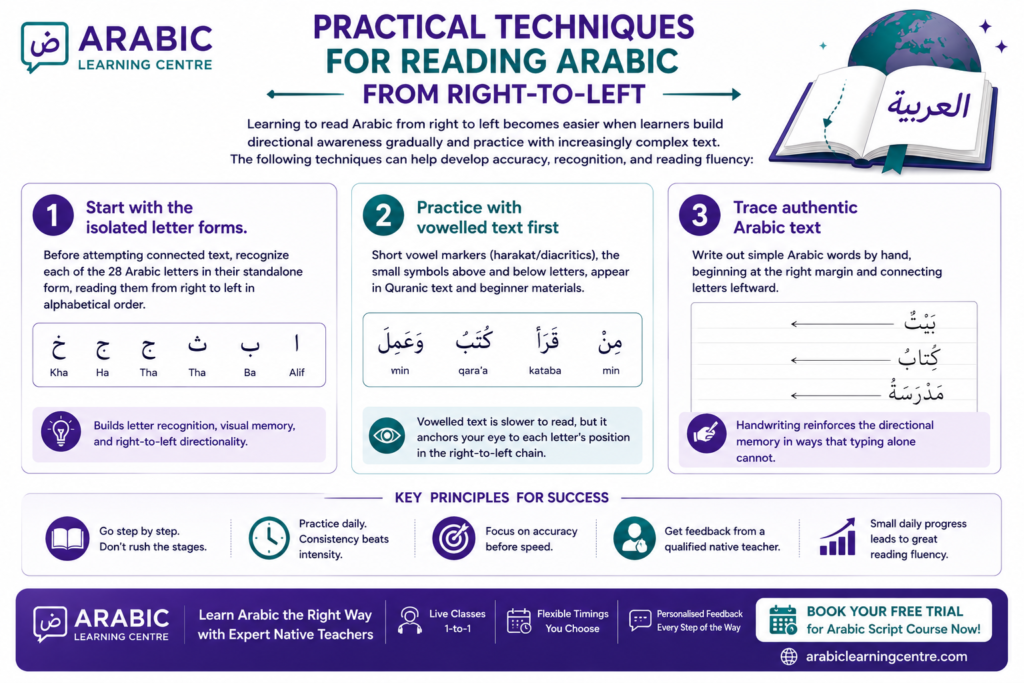
1. Start with the isolated letter forms.
Before attempting connected text, recognize each of the 28 Arabic letters in their standalone form, reading them from right to left in alphabetical order.
2. Practice with vowelled text first
Short vowel markers (harakat/diacritics), the small symbols above and below letters, appear in Quranic text and beginner materials. Vowelled text is slower to read, but it anchors your eye to each letter’s position in the right-to-left chain.
Read Also: How Hard Is It to Read Arabic?
3. Trace authentic Arabic text
Write out simple Arabic words by hand, beginning at the right margin and connecting letters leftward. Handwriting reinforces the directional memory in ways that typing alone cannot.
Learners who work through The Arabic Learning Centre’s Fusha Arabic Course receive dedicated phonetics instruction for exactly these sounds in the early weeks of the programme.
Book Your Free Trial for Fusha Arabic Course Now!

Read Also: Can I Learn Arabic in 3 Months?
Does Arabic Read Right to Left in All Contexts
Arabic reads right to left in every authentic written context: books, newspapers, websites, WhatsApp messages, academic papers, government documents, and the Quran. There is no formal register in which Arabic switches to left-to-right.
Numbers, however, behave differently. When Arabic-Indic numerals (٠١٢٣٤٥٦٧٨٩) are used, they read left to right within a right-to-left line, the same direction as Western numerals. This is one of the few directional exceptions built into the script.
Read Also: Basic Arabic Reading Practice For Beginners
Digital Arabic: Keyboards, Interfaces, and Fonts
Typing Arabic on a keyboard switches the cursor’s movement from left to right to right to left. Standard Arabic keyboards are available on all major operating systems. In word processors, setting the text direction to “right to left” (usually through a paragraph or page layout setting) ensures the text anchors correctly. A common beginner error is typing Arabic in a left-to-right text field and finding that letters appear in reverse connection order, the result of a direction setting, not a font problem.
Don’t Just Take Our Word For It
Take a look inside our vibrant classes and see our students and teachers in action. Click below to watch our classroom experience:
Begin Reading Arabic with a Structured Foundation at The Arabic Learning Centre
Arabic reads right to left, and mastering that direction is only the beginning. Behind it lies one of the world’s most elegant, precise, and historically consequential writing systems.
The Arabic Learning Centre offers expert-led courses for every stage of this process:
- Native Arabic tutors with structured pedagogical training
- Arabic Course for Beginners and Arabic Script Writing Course for foundational literacy
- Quranic Arabic Course for learners focused on Quranic recitation and comprehension
- Live sessions plus recorded materials, globally accessible, flexible scheduling across time zones
- Competitive pricing with a free trial lesson to experience the method before committing
Courses We Offer:
- Online Arabic Course
- Classical arabic course
- Modern Standard Arabic Course
- Fusha Arabic Course
- Learn Saudi Arabic
- Arabic Course for Beginners
- Arabic Classes for Adults
- Arabic Classes for Ladies
- Advanced Arabic Course
- Intensive Arabic Course
Start reading Arabic correctly, right to left, letter by letter, with native guidance from day one.
Book your free trial lesson today!

Conclusion
Arabic reads right to left because it inherits a directionality established by ancient Semitic scribes, codified through Nabataean script, and preserved without interruption by the Quranic manuscript tradition. That single directional fact shapes everything: letter connection, word structure, page layout, and digital text behaviour.
For learners, the adjustment is real but brief. The critical variable is whether the foundational method is correct from day one, starting with isolated letter forms, training the eye on vowelled text, and reinforcing direction through handwriting before moving to connected, unvowelled script.
Arabic’s right-to-left script is shared by Hebrew, Persian, Urdu, and several other living languages, placing it within one of the oldest continuous writing traditions in human history. Reading it fluently is an achievable goal, and a structured course with a qualified native tutor is the most direct route to that outcome.
Frequently Asked Questions
Does Arabic always read right to left, even in informal writing?
Yes. Arabic reads right to left in every context: formal documents, handwritten notes, text messages, websites, and printed books. There is no informal register in which Arabic switches to left-to-right. The only exception is numerals, which follow a left-to-right sequence within a right-to-left line.
Is it difficult for English speakers to adapt to right-to-left Arabic reading?
The directional shift is a genuine adjustment, but most adult learners find it becomes automatic within two to four weeks of consistent, method-driven practice. The greater challenge is not the direction itself but the connected nature of Arabic script; learning which letters connect and which do not is a separate skill that takes longer to internalize.
Do Arabic letters read right to left within a single word?
Yes. Within a word, letters connect and sequence from right to left. The rightmost letter is always the first letter of the word. The six non-connecting letters, Alif, Dal, Dhal, Ra, Zay, and Waw, do not attach to the letter on their left, which can create internal gaps inside a single word that beginners sometimes mistake for a space between two words.
How many languages read right to left in the world today?
Approximately twelve to fifteen scripts worldwide are written right to left, with Arabic and Hebrew being the most widely spoken. Arabic is read daily by over 400 million native speakers and by an estimated 1.8 billion Muslims worldwide for Quranic recitation, making it the most widely read right-to-left script in the world.
Does the Quran read right to left?
Yes. The Quran is written entirely in Arabic script and reads right to left on every page. A Mushaf (physical copy of the Quran) opens from what a Western reader would recognize as the back of the book, with the first Surah — Al-Fatihah — beginning on the right-hand page. Every line of Quranic text proceeds from right to left without exception.
Can I learn to read Arabic right to left without knowing spoken Arabic first?
Yes. Reading Arabic script and speaking Arabic are separate skills that can be developed independently. Many learners, particularly those studying Quranic recitation, learn to read the Arabic script accurately, including correct right-to-left tracking, before acquiring significant spoken vocabulary. The Arabic Learning Centre‘s Arabic Course for Beginners and Arabic Script Writing Course both offer structured pathways into script literacy, with or without a prior speaking foundation.
Related Articles
Arabic Vocabulary & Speaking