 Arabic Grammar
| Key Takeaways |
| Arabic weak verbs contain a و, ي, or ا as one of their three root letters, causing spelling changes during conjugation. |
| There are four main types: Mithal, Ajwaf, Naqis, and Lafeef, each with distinct conjugation behaviour. |
| Weak verbs account for a significant portion of everyday Arabic vocabulary, making mastery essential for functional fluency. |
| The letter changes in weak verbs follow predictable rules from classical Arabic grammar (Nahw), not random exceptions. |
Arabic weak verbs are verbs whose three-letter root contains at least one of the weak letters — و (waw), ي (ya’), or ء (hamza). These letters change, drop, or transform during conjugation based on precise rules from classical Arabic grammar (Nahw).
Unlike strong verbs, where all three root letters remain stable, weak verbs require learners to track how the weak letter behaves across different tenses and pronouns.
This matters practically. Weak verbs are not rare exceptions — they include some of the most frequently used Arabic words: قَالَ (he said), جَاءَ (he came), رَأَى (he saw), and مَشَى (he walked). Before mastering weak verbs, it helps to have a firm grasp of how to conjugate verbs in Arabic and the tenses in Arabic.
What Are Arabic Weak Verbs?
Arabic weak verbs are tri-literal verbs that contain و, ي, or ا as one of their root letters. These letters are called “weak” because they are phonologically unstable — they cannot carry certain vowel combinations without changing shape.
The rules governing these changes come directly from classical Nahw scholarship, specifically the study of إعلال (i’lal) — the science of phonological modifications to weak letters.
When a weak letter sits adjacent to certain short vowels or sukoon, it either drops entirely, converts to a long vowel, or substitutes for another weak letter. This is not arbitrary.
Every change follows a rule, and once a learner recognises the pattern for each verb type, conjugation becomes systematic.
Students at The Arabic Learning Centre who struggle with weak verbs almost always have the same underlying issue — they are trying to memorise individual conjugated forms instead of learning the root and the phonological rule that governs it.
If you are building your foundation from scratch, our Arabic Grammar Course teaches these patterns systematically with qualified certified instructors using structured 1-on-1 sessions tailored to your pace.
Start Learning Arabic Grammar with a Free Trial

What Are the Types of Arabic Weak Verbs?
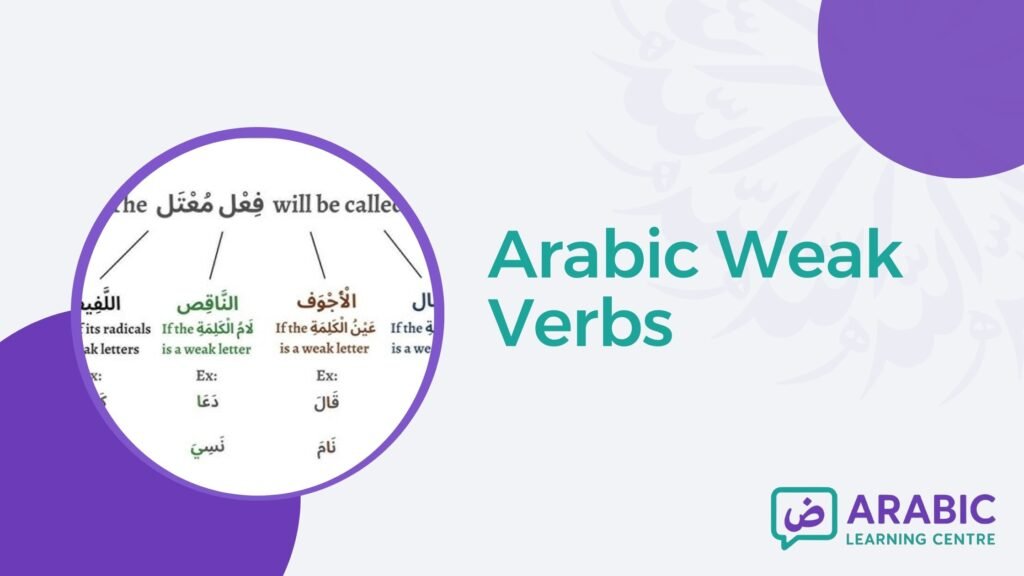
Arabic weak verbs are categorised into four main types based on where the weak letter sits within the three-letter root (فَاء الفعل, عَيْن الفعل, لَام الفعل):
| Type | Arabic Name | Weak Letter Position | Example Root | Meaning |
| Mithal | مِثَال | First root letter (فَاء) | و-ج-د | to find |
| Ajwaf | أَجْوَف | Middle root letter (عَيْن) | ق-و-ل | to say |
| Naqis | نَاقِص | Final root letter (لَام) | م-ش-ي | to walk |
| Lafeef | لَفِيف | Two weak letters | و-ق-ي | to protect |
Lafeef verbs are further divided into Lafeef Maqroon (both weak letters adjacent) and Lafeef Mafrooq (weak letters separated by a strong letter). Each type has its own conjugation rules, and each is worth studying individually.
Shots Videos from Our Courses
Arabic Weak Verbs List with Meaning and Examples
The following are commonly used Arabic weak verbs, organised by type with their meanings in English. This list prioritises verbs that appear frequently in the Quran and Modern Standard Arabic.
1. Mithal Verbs (First Letter Weak)
In Mithal verbs, the و at the beginning of the root frequently drops in the present tense (المضارع) because it sits between a kasra and another vowel — a phonologically impermissible combination.
| Verb (Past) | Root | Meaning | Present Tense |
| وَجَدَ | و-ج-د | to find | يَجِدُ |
| وَضَعَ | و-ض-ع | to place/put | يَضَعُ |
| وَصَلَ | و-ص-ل | to arrive/connect | يَصِلُ |
| وَلَدَ | و-ل-د | to give birth | يَلِدُ |
Notice how و disappears in every present tense form above. This is not a coincidence — it is إعلال بالحذف (i’lal bil-hadhf), deletion of the weak letter due to phonological conflict.
Example sentence:
وَجَدَ الطَّالِبُ الكِتَابَ
Wajada al-ṭālibu al-kitāba
The student found the book.
2. Ajwaf Verbs (Middle Letter Weak)
Ajwaf verbs are the most common type learners encounter. The weak middle letter typically lengthens into a long vowel in the past tense and may contract or drop in certain conjugated forms.
| Verb (Past) | Root | Meaning | Present Tense |
| قَالَ | ق-و-ل | to say | يَقُولُ |
| نَامَ | ن-و-م | to sleep | يَنَامُ |
| سَارَ | س-ي-ر | to travel/walk | يَسِيرُ |
| بَاعَ | ب-ي-ع | to sell | يَبِيعُ |
| جَاءَ | ج-ي-ء | to come | يَجِيءُ |
Example sentence:
قَالَ المُعَلِّمُ الحَقَّ
Qāla al-muʿallimu al-ḥaqqa
The teacher said the truth.
3. Naqis Verbs (Final Letter Weak)
Naqis verbs are particularly challenging because the final weak letter interacts with both the vowel endings of Arabic case/mood markers and the suffixes for different pronouns.
In our instructors’ experience, this is where learners make the most persistent errors — especially when adding the ت of the feminine or the وا of the masculine plural.
| Verb (Past) | Root | Meaning | Present Tense |
| مَشَى | م-ش-ي | to walk | يَمْشِي |
| دَعَا | د-ع-و | to call/invite | يَدْعُو |
| رَأَى | ر-أ-ي | to see | يَرَى |
| نَسِيَ | ن-س-ي | to forget | يَنْسَى |
| بَنَى | ب-ن-ي | to build | يَبْنِي |
Example sentence:
دَعَا إِبْرَاهِيمُ رَبَّهُ
Daʿā Ibrāhīmu rabbahu
Ibrahim called upon his Lord.
Read also: The Arabic Verb “To Be”
4. Lafeef Verbs (Two Weak Letters)
Lafeef verbs carry two weak letters and therefore undergo two sets of phonological changes simultaneously. They are less common but include some of the most theologically important verbs in Classical Arabic.
| Verb (Past) | Root | Type | Meaning |
| وَقَى | و-ق-ي | Mafrooq | to protect/guard |
| وَلِيَ | و-ل-ي | Mafrooq | to be in charge |
| روَى | ر-و-ي | Maqroon | to narrate |
These verbs appear frequently in Quranic Arabic, which is why students in our Arabic Course for Beginners encounter them early when studying texts of spiritual significance.
Join Our Arabic Course for Beginners With a Free Trial
Arabic Weak Verbs Conjugation
Arabic weak verb conjugation follows the same pronoun framework as strong verbs — the difference lies in what happens to the weak letter at each step. Below is a full conjugation of the Ajwaf verb قَالَ (to say) in the past tense (الماضي) and present tense (المضارع).
Conjugation Table: قَالَ (to say) — Root: ق-و-ل
| Pronoun | Past Tense (الماضي) | Present Tense (المضارع) |
| هُوَ (he) | قَالَ | يَقُولُ |
| هِيَ (she) | قَالَتْ | تَقُولُ |
| هُمَا (they two m.) | قَالَا | يَقُولَانِ |
| هُمْ (they m. pl.) | قَالُوا | يَقُولُونَ |
| هُنَّ (they f. pl.) | قُلْنَ | يَقُلْنَ |
| أَنْتَ (you m. sg.) | قُلْتَ | تَقُولُ |
| أَنَا (I) | قُلْتُ | أَقُولُ |
| نَحْنُ (we) | قُلْنَا | نَقُولُ |
Notice the critical pattern: when a pronoun suffix beginning with a consonant is added (like تَ, نَا, تُمْ), the middle و contracts and a sukoon falls on the ق. This is called إعلال بالتسكين (i’lal bil-taskeen).
For a deeper understanding of sukoon’s role, see our guide on what sukoon is in Arabic.
Conjugation Table: مَشَى (to walk) — Root: م-ش-ي (Naqis)
| Pronoun | Past Tense | Present Tense |
| هُوَ (he) | مَشَى | يَمْشِي |
| هِيَ (she) | مَشَتْ | تَمْشِي |
| هُمْ (they m. pl.) | مَشَوْا | يَمْشُونَ |
| أَنْتَ (you m. sg.) | مَشَيْتَ | تَمْشِي |
| أَنَا (I) | مَشَيْتُ | أَمْشِي |
In the past tense, when a suffix starting with ت is added, the final ي is preserved as يْ (with sukoon).
When no suffix follows — as in the third-person masculine singular مَشَى — the ي appears as a shortened form written as ى (alif maqsura).
What Are Defective Verbs in Arabic?
Defective verbs in Arabic — called أفعال ناقصة (af’al naqisa) — are another name commonly used for Naqis verbs, those whose final root letter is weak. The term “defective” refers to the phonological incompleteness that arises when case vowel endings are added to a final weak letter.
In Classical Arabic grammar, the term ناقص (naqis) means literally “lacking” or “incomplete” — not in the sense that the verb is inferior, but that the final letter undergoes reduction or deletion in many conjugated forms.
This terminology is used extensively in traditional Nahw texts such as the Ajurrumiyyah and Alfiyya ibn Malik, foundational references in Arabic grammar scholarship.
Students who encounter the term “defective verbs” in English-language Arabic textbooks are always referring to this same Naqis category.
Practice Exercises of Arabic Weak Verbs
Working through these exercises solidifies the patterns. Try each one before checking the answers below.
Exercise 1 — Identify the Type: Classify each verb as Mithal, Ajwaf, Naqis, or Lafeef.
- نَامَ (to sleep)
- وَصَلَ (to arrive)
- بَنَى (to build)
- وَقَى (to protect)
Exercise 2 — Conjugate in the Present Tense: Conjugate دَعَا (to call/invite — root: د-ع-و) for:
- هُوَ (he)
- هِيَ (she)
- هُمْ (they, masculine plural)
- أَنَا (I)
Exercise 3 — Sentence Formation: Translate into Arabic using the correct verb form:
- “She walked to the masjid.” (مَشَى)
- “They said the truth.” (قَالَ)
- “I found the key.” (وَجَدَ)
Answers — Exercise 1:
- نَامَ → Ajwaf
- وَصَلَ → Mithal
- بَنَى → Naqis
- وَقَى → Lafeef Mafrooq
Answers — Exercise 2:
- يَدْعُو
- تَدْعُو
- يَدْعُونَ
- أَدْعُو
Answers — Exercise 3:
- مَشَتْ إِلَى المَسْجِدِ
- قَالُوا الحَقَّ
- وَجَدْتُ المِفْتَاحَ
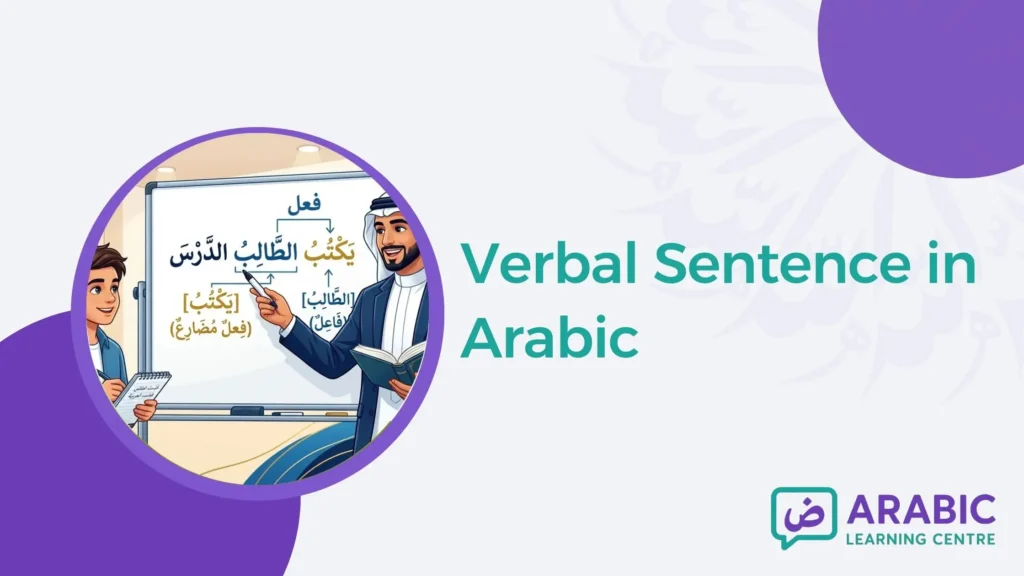
Working with a verbal sentence in Arabic framework helps make these exercises more intuitive, as weak verbs appear most naturally in the verb-subject-object structure.
Our Students Reviews
Read also: Ten Measures of Arabic Verbs
Start Learning Arabic Weak Verbs with Certified Instructors at The Arabic Learning Centre
Arabic weak verbs are manageable when the rules are taught correctly — not as arbitrary exceptions, but as logical phonological patterns. Mastering them opens the door to accurate reading, confident speaking, and a genuine understanding of Quranic Arabic.
At The Arabic Learning Centre, our Arabic Grammar Course is designed specifically for non-native Arabic speakers who want structured, expert guidance through exactly these kinds of topics. You’ll work 1-on-1 with certified Arabic instructors at a schedule that works for you, 24/7.
- Expert-qualified, native-speaking certified instructors
- Flexible 1-on-1 personalised sessions
- Structured curriculum covering all verb types
- Free trial lesson available — no commitment required
Book your free trial lesson today and take the first systematic step toward Arabic grammar confidence.
Check out our top courses in Arabic and choose the course you need to start learning Arabic today:
- Arabic Course for Beginners
- Arabic Script Writing Course
- Arabic Speaking Course
- Learn Arabic Letters for Tajweed
- Learning Arabic Grammar
- Arabic Vocabulary Course
- Fusha Arabic Course
- Classical Arabic Course
- Arabic Course for Islamic Studies
- Quranic Arabic Course
- Learn Arabic for New Muslims
Start with a FREE trial class and enhance your Arabic language skills

Conclusion
Arabic weak verbs are not a wall — they are a gate. Once a learner understands the four root types (Mithal, Ajwaf, Naqis, Lafeef) and the phonological principle of إعلال governing each, the changes in conjugation become predictable rather than puzzling.
The vocabulary unlocked by mastering these verbs is enormous — verbs of saying, seeing, walking, calling, finding, and sleeping form the core of everyday Arabic expression. They appear on virtually every page of the Quran and in every Arabic conversation.
Pairing weak verb study with a solid understanding of harakat in Arabic — the short vowel markings that drive these phonological changes — ensures learners see the full system working together rather than memorising forms in isolation.
Frequently Asked Questions About Arabic Weak Verbs
What Are Arabic Weak Verbs?
Arabic weak verbs are tri-literal verbs containing one or more weak letters — و (waw), ي (ya’), or ا (alif) — as part of their root. These letters are phonologically unstable and undergo changes, deletions, or substitutions during conjugation according to the classical Nahw rules of إعلال (i’lal). They include some of the most common verbs in Arabic.
What Is the Difference Between Ajwaf and Naqis Verbs?
Ajwaf verbs carry the weak letter in the middle root position (عَيْن الفعل), such as قَالَ (to say) with root ق-و-ل. Naqis verbs carry the weak letter in the final root position (لَام الفعل), such as مَشَى (to walk) with root م-ش-ي. Both types change in conjugation but follow different phonological rules depending on the position of the weak letter.
Are Defective Verbs the Same as Weak Verbs in Arabic?
The term “defective verbs” in English-language Arabic grammar resources typically refers to Naqis verbs specifically — those with a final weak letter. In classical Arabic grammar (Nahw), all four types (Mithal, Ajwaf, Naqis, Lafeef) fall under the broader category of الأفعال المعتلة (al-af’al al-mu’talla) — weak verbs. So defective verbs are a subset of the wider category of weak verbs.