 Arabic Grammar
| Key Takeaways |
| Arabic has three plural types: sound masculine plural, sound feminine plural, and broken plural, each formed differently. |
| Sound masculine plural adds ون (nominative) or ين (accusative/genitive) to masculine nouns and adjectives. |
| Sound feminine plural replaces the تاء مربوطة (tā’ marbūṭa) with ات and applies to most feminine nouns. |
| Broken plurals change a word’s internal vowel pattern entirely and must be memorized individually for each noun. |
| Arabic nouns also have a dual form (مثنى), distinct from the plural, used exclusively for exactly two of something. |
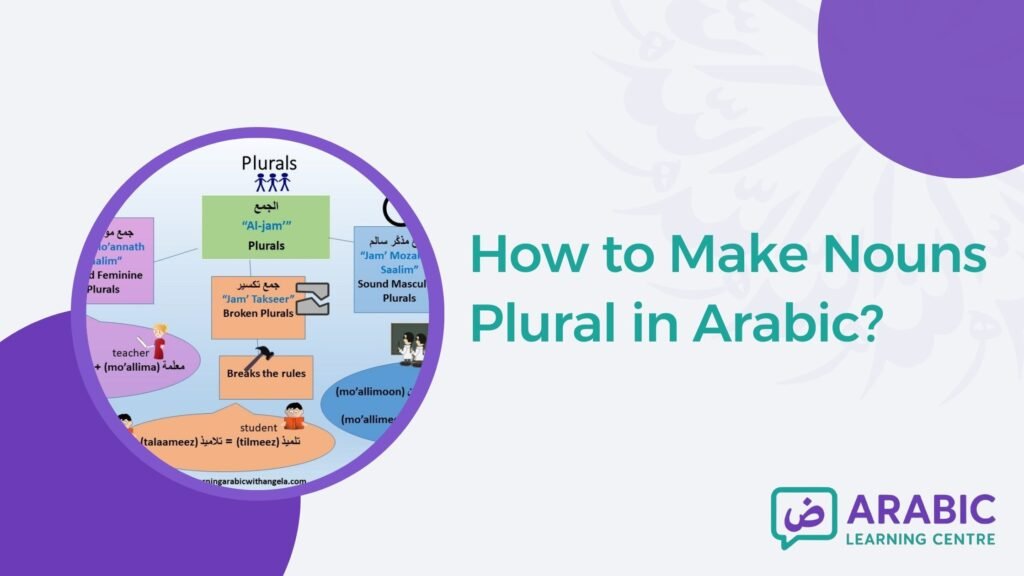
To make nouns plural in Arabic, you use one of three systems: the sound masculine plural (جمع المذكر السالم), the sound feminine plural (جمع المؤنث السالم), or the broken plural (جمع التكسير). Sound plurals add a suffix to the noun without changing its root letters. Broken plurals restructure the word’s internal pattern entirely. Knowing which system applies to which noun is one of the most important skills in Arabic grammar.
Most beginners expect Arabic plurals to follow a single consistent rule — the way English simply adds “-s.” They quickly discover otherwise. Arabic plurals are systematic, but the system is more nuanced than a single suffix.
Once you understand the three types and the logic behind each, forming and recognizing plurals becomes significantly more predictable — and far less overwhelming.
What Are the 3 Types of Plural in Arabic?
Arabic grammar recognizes three distinct plural categories, and understanding them is foundational to reading, writing, and speaking correctly. The three types are: جمع المذكر السالم (the sound masculine plural), جمع المؤنث السالم (the sound feminine plural), and جمع التكسير (the broken plural).
Each type applies to different categories of nouns, and each behaves differently in terms of case endings and iʿrāb (إعراب).
The word سالم (sālim) means “sound” or “intact” — meaning the root letters of the word remain unchanged. تكسير (taksīr) means “breaking,” referring to the internal restructuring of the word’s consonant-vowel pattern. This distinction is not merely academic — it shapes how every plural noun functions in a sentence.
If you are working through Arabic grammar for the first time, The Arabic Learning Centre’s Arabic Grammar Course provides structured, instructor-led lessons on exactly this topic, with personalized feedback on every exercise.
Start Learning Arabic Grammar with a Free Trial

How to Form the Sound Masculine Plural in Arabic?
The جمع المذكر السالم (jamʿ al-mudhakkar al-sālim) is formed by adding ون to the nominative case or ين to the accusative and genitive cases, directly to the singular noun’s base — without altering any of its root letters.
This plural type applies to a specific and limited category of words: human masculine nouns (primarily rational beings), certain adjectives, and active participles. It does not apply freely to all masculine nouns.
Formation table:
| Singular | Nominative Plural | Accusative/Genitive Plural |
| مُعَلِّم (muʿallim — teacher) | مُعَلِّمُون | مُعَلِّمِين |
| مُهَنْدِس (muhandis — engineer) | مُهَنْدِسُون | مُهَنْدِسِين |
| مُسْلِم (muslim — Muslim) | مُسْلِمُون | مُسْلِمِين |
Example in a sentence:
الْمُعَلِّمُونَ فِي الْفَصْلِ
Al-muʿallimūna fī al-faṣl
The teachers are in the classroom.
Notice that the ن at the end drops when the noun enters an إضافة (iḍāfa) construction — a rule many beginners miss.
At The Arabic Learning Centre, students in our Arabic Grammar Course regularly make one consistent error here: they apply ون/ين endings to non-human masculine nouns like كِتَاب (book) or بَيْت (house). These nouns never take this plural form — they use broken plurals instead.
Shots Videos from Our Courses
How to Form the Sound Feminine Plural in Arabic?
The جمع المؤنث السالم (jamʿ al-muʾannath al-sālim) is formed by replacing the تاء مربوطة (ة) at the end of a feminine noun with ات. If the noun has no tā’ marbūṭa, the suffix ات is simply appended to the noun’s base form.
How the Sound Feminine Plural Behaves in Case Endings
Unlike the sound masculine plural which uses ون/ين, the sound feminine plural uses ات in the nominative and ات with a kasra on the tā’ in the accusative and genitive. Specifically:
| Case | Ending | Example |
| Nominative | ـَاتٌ | مُعَلِّمَاتٌ |
| Accusative | ـَاتٍ | مُعَلِّمَاتٍ |
| Genitive | ـَاتٍ | مُعَلِّمَاتٍ |
Example:
الْمُعَلِّمَاتُ فِي الْمَدْرَسَةِ Al-muʿallimātu fī al-madrasah “The female teachers are in the school.”
Understanding harakat in Arabic — the short vowel markings — is essential for reading these case endings correctly. Without accurate harakat recognition, distinguishing nominative from genitive plural forms becomes very difficult.
Read also: Noun in Arabic
What Is the Broken Plural in Arabic?
The جمع التكسير (jamʿ al-taksīr), or broken plural, is formed by changing the internal vowel pattern of the singular noun — not by adding a suffix. The root consonants remain, but the pattern (وزن) around them is restructured entirely.
This is the most common plural type in Arabic and applies to the vast majority of nouns — including most masculine nouns, many feminine nouns, and non-human plurals of all genders. It is also the type that presents the greatest challenge for learners, because each noun’s broken plural must be learned individually.
Common Broken Plural Patterns
Classical Arabic grammar (Nahw) scholars have documented dozens of broken plural patterns. The most frequent ones beginners encounter are:
| Singular Pattern | Plural Pattern | Example Singular | Example Plural |
| فَعَل | أَفْعَال | سَبَب (reason) | أَسْبَاب |
| فَعِيل | فُعَلَاء | كَبِير (great) | كُبَرَاء |
| فَاعِل | فُعَّال | تَاجِر (merchant) | تُجَّار |
| فَعْل | فُعُول | قَلْب (heart) | قُلُوب |
Example:
قُلُوبُ الْمُؤْمِنِينَ مُطْمَئِنَّةٌ
Qulūbu al-muʾminīna muṭmaʾinnah
The hearts of the believers are at peace.
For a detailed breakdown of broken plural patterns and their morphological logic, our dedicated guide on Arabic broken plurals covers each pattern with examples and exercises.
In the instructors’ experience at The Arabic Learning Centre, learners who try to guess broken plurals based on the singular alone make errors in roughly 60–70% of cases.
The most reliable method is to learn the plural alongside the singular when you first encounter any new noun — treating both as one vocabulary unit, not two separate items.
Arabic Singular and Plural Words List
Seeing a concrete Arabic singular and plural words list helps learners internalize how the three plural types appear in real vocabulary. Below is a structured reference:
| Singular | Meaning | Plural | Plural Type |
| مُعَلِّم | Teacher (m.) | مُعَلِّمُون | Sound masculine |
| مُعَلِّمَة | Teacher (f.) | مُعَلِّمَات | Sound feminine |
| كِتَاب | Book | كُتُب | Broken |
| بَيْت | House | بُيُوت | Broken |
| وَلَد | Boy/child | أَوْلَاد | Broken |
| مَدِينَة | City | مُدُن | Broken |
| طَالِب | Student (m.) | طُلَّاب | Broken |
| طَالِبَة | Student (f.) | طَالِبَات | Sound feminine |
| مُهَنْدِس | Engineer | مُهَنْدِسُون | Sound masculine |
| قَلَم | Pen | أَقْلَام | Broken |
Notice how طَالِب (student, masculine) uses a broken plural, while طَالِبَة (student, feminine) uses the sound feminine plural. This contrast illustrates why the gender and category of a noun both determine its plural system.
Understanding how these plurals interact with definite articles in Arabic — specifically how ال attaches to plural forms — is the next logical step after mastering plural formation itself.
How to Make Nouns Plural in Arabic with Examples in Sentences?
Learning plurals in isolation is useful, but understanding how they function grammatically inside sentences gives you real communicative competence.
Plurals in Arabic affect verb agreement, adjective agreement, and pronoun reference — so the plural form you choose has grammatical consequences throughout the sentence.
Key agreement rule: Non-human plurals (things, animals, abstract concepts) are treated grammatically as feminine singular for the purposes of verb and adjective agreement. This is one of the most counterintuitive rules for English speakers.
Example:
الْكُتُبُ مُفِيدَةٌ
Al-kutub mufīdah
The books are useful.
Here, كُتُب (books) is a non-human plural, so the adjective مُفِيدَة takes the feminine singular form — not a plural form.
Human plurals, by contrast, do trigger plural agreement:
الطُّلَّابُ مُجْتَهِدُونَ
Al-ṭullābu mujtahidūn
The students are hardworking.
This distinction between human and non-human plural agreement is grounded in classical Nahw scholarship and is consistently applied across Modern Standard Arabic (MSA).
For learners interested in how plurals connect with conjugating verbs in Arabic, this agreement rule is particularly important to internalize early.
What Is the Dual Form in Arabic and How Does It Differ from the Plural?
The Arabic dual (المثنى — al-muthannā) is a separate grammatical number used exclusively when referring to exactly two of something. It is distinct from both the singular and the plural and is formed differently.
The dual is formed by adding ان (nominative) or ين (accusative/genitive) to the singular noun. If the noun ends in ة, it is written out as ت before adding the dual suffix.
| Singular | Dual (Nominative) | Dual (Accusative/Genitive) |
| كِتَاب (book) | كِتَابَان | كِتَابَيْن |
| مُعَلِّمَة (teacher, f.) | مُعَلِّمَتَان | مُعَلِّمَتَيْن |
| وَلَد (boy) | وَلَدَان | وَلَدَيْن |
Example:
عِنْدِي كِتَابَانِ
ʿIndī kitābāni
I have two books.
The dual is not optional in Arabic — using a plural form to refer to exactly two items is grammatically incorrect in MSA.
For new learners, this is one of the earlier grammar points to address, and our Arabic Course for Beginners introduces it in the appropriate sequence within the broader noun system.
Join Our Arabic Course for Beginners With a Free Trial
Read also: Relative Pronouns in Arabic
How to Make Nouns Plural in Arabic Letters?
Recognizing plural forms in written Arabic script requires familiarity with the suffixes and internal patterns that signal plurality. Sound plurals are visually distinctive: the ون/ين ending on masculine plurals and the ات ending on feminine plurals are consistent and identifiable once learned.
Broken plurals are more challenging in script because you must recognize the changed vowel pattern — and in unvowelled Arabic text (without tashkeel), this requires knowledge of the pattern itself.
This is one of the main reasons learners are advised to read vowelled Arabic text extensively before transitioning to unvowelled text.
Practical reading tip: When you encounter an unfamiliar plural in Arabic script, look for these signals:
- Ends in ون or ين → likely sound masculine plural
- Ends in ات → likely sound feminine plural
- Neither suffix present, and vowel pattern differs from a known singular → likely broken plural
Mastery of harakat in Arabic and the short vowel system is what makes these distinctions readable in practice.
Our Students Reviews
Begin Learning Arabic Grammar with Certified Instructors at The Arabic Learning Centre
Arabic plurals — whether sound or broken — become manageable with the right structured approach and expert guidance.
The Arabic Learning Centre offers:
- Arabic Grammar Course — covering nouns, plurals, verb conjugation, and sentence structure with certified instructors
- Arabic Course for Beginners — a structured foundation covering vocabulary, grammar, and script from the start
- 1-on-1 personalized sessions with flexible 24/7 scheduling
- Free trial lesson — experience the teaching method before committing
Book your free trial lesson today and start building genuine Arabic competence under certified expert guidance.
Check out our top courses in Arabic and choose the course you need to start learning Arabic today:
- Arabic Course for Beginners
- Arabic Script Writing Course
- Arabic Speaking Course
- Learn Arabic Letters for Tajweed
- Learning Arabic Grammar
- Arabic Vocabulary Course
- Fusha Arabic Course
- Classical Arabic Course
- Arabic Course for Islamic Studies
- Quranic Arabic Course
- Learn Arabic for New Muslims
Start with a FREE trial class and enhance your Arabic language skills

Conclusion
Arabic plurals follow three distinct systems — sound masculine, sound feminine, and broken — each governed by clear grammatical rules rooted in classical Nahw scholarship.
Sound plurals preserve the word’s root letters while adding a suffix; broken plurals restructure the word’s internal pattern entirely. Non-human plurals, regardless of their type, take feminine singular agreement for verbs and adjectives — a rule that applies consistently across MSA.
Frequently Asked Questions About How to Make Nouns Plural in Arabic
How many types of plural are there in Arabic?
There are three types of plural in Arabic: the sound masculine plural (جمع المذكر السالم), the sound feminine plural (جمع المؤنث السالم), and the broken plural (جمع التكسير). Sound plurals add a suffix without altering the root; broken plurals restructure the word’s internal vowel pattern. Most Arabic nouns use the broken plural.
What is the difference between sound plural and broken plural in Arabic?
A sound plural keeps the singular noun’s root letters intact and adds a suffix — ون/ين for masculine or ات for feminine. A broken plural changes the internal vowel pattern of the word, altering how the root consonants are arranged. Broken plurals must be memorized individually; sound plurals follow predictable suffix rules.
How does the non-human plural rule work in Arabic grammar?
In Arabic, non-human plurals — things, animals, and abstract concepts — are treated as grammatically feminine singular for verb and adjective agreement. This means an adjective modifying كُتُب (books) takes the feminine singular form, not a plural form. Human plurals follow standard plural agreement rules for both verbs and adjectives.
Related Articles
Arabic Grammar