 Arabic Grammar
| Key Takeaways |
| Arabic relative pronouns, called الأسماء الموصولة (al-asmāʾ al-mawṣūla), are words that connect a noun to a descriptive clause. |
| The most common Arabic relative pronoun is الَّذِي (alladhī) for masculine singular nouns and الَّتِي (allatī) for feminine singular nouns. |
| Every Arabic relative clause contains a returning pronoun that refers back to the noun being described. |
| Arabic relative pronouns change form based on the gender, number, and grammatical case of the noun they describe — unlike English “who” or “which.” |
Relative pronouns in Arabic are a defined, rule-governed set of words that function as connectors between a noun and the clause describing it. In Modern Standard Arabic (Fusha), this system follows precise agreements of gender and number — something English learners find unfamiliar at first, since English uses only “who,” “which,” and “that” regardless of gender.
What makes Arabic relative pronouns genuinely rewarding to master is how they reveal the grammar’s internal architecture. These structures appear constantly in Quranic Arabic, classical texts, and everyday Modern Standard Arabic — meaning every learner who wants real fluency, whether for conversation, reading, or religious study, will encounter them within weeks.
What Are Relative Pronouns in Arabic (الأسماء الموصولة)?
الأسماء الموصولة (al-asmāʾ al-mawṣūla), translated as “relative pronouns” or more literally “connected nouns,” are a category of Arabic words that introduce a صِلَةٌ (ṣila) — a relative clause — which provides more information about a preceding noun. This noun is called the مَوْصُوف (mawṣūf), the described noun.
The relative pronoun must match the mawṣūf in gender and number, making agreement the central skill to develop.
The الأسماء الموصولة are definite by nature in Arabic grammar — they carry definiteness within themselves. This is why they can only follow definite nouns.
If you want to understand definiteness more broadly first, our guide on definite articles in Arabic covers the foundation you need.
The Complete Table of Arabic Relative Pronouns
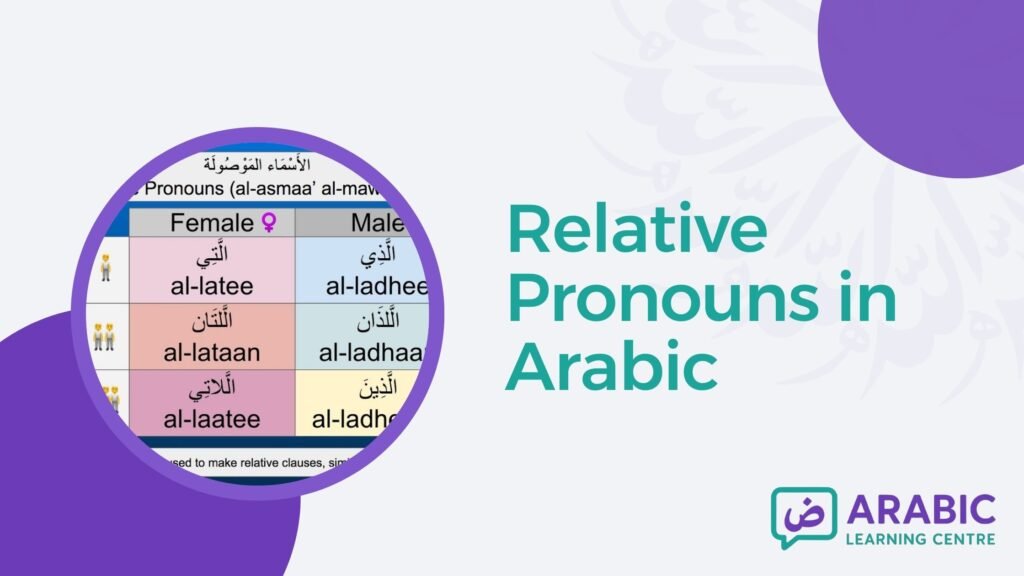
Before examining each form in context, it helps to see the full set at once. Arabic الأسماء الموصولة vary by gender and number — the two grammatical categories that govern agreement.
| Number / Gender | Arabic | Transliteration | Meaning |
| Masculine Singular | الَّذِي | alladhī | who / which / that (m. sg.) |
| Feminine Singular | الَّتِي | allatī | who / which / that (f. sg.) |
| Masculine Dual | اللَّذَانِ / اللَّذَيْنِ | alladhāni / alladhayn | who / which (m. dual) |
| Feminine Dual | اللَّتَانِ / اللَّتَيْنِ | allatāni / allatayn | who / which (f. dual) |
| Masculine Plural | الَّذِينَ | alladhīna | who / which / those who (m. pl.) |
| Feminine Plural | اللَّاتِي / اللَّوَاتِي | allātī / allawātī | who / which (f. pl.) |
| General (non-human) | مَا | mā | what / that which |
| General (human) | مَنْ | man | whoever / the one who |
The dual forms change their ending based on grammatical case: اللَّذَانِ is used when the noun is in the nominative case (marfūʿ), and اللَّذَيْنِ when it is in the accusative or genitive (manṣūb/majrūr).
This mirrors exactly how Arabic nouns and adjectives behave — if you have studied harakat in Arabic, the case-ending logic will already be familiar to you.
The patterns you’ll learn here are the same ones our certified instructors at The Arabic Learning Centre teach in our Arabic Grammar Course — systematically, with plenty of real-sentence practice.
Start Learning Arabic Grammar with a Free Trial

How Does the Arabic Relative Pronoun Agree with Its Noun?
The Arabic relative pronoun agrees with the noun it describes in gender and number — not in grammatical case. This is one of the first key observations our certified instructors share with students, because learners often assume the pronoun must match the case of the noun. It does not.
The مَوْصُوف (described noun) determines the form of the اسم موصول. If the noun is masculine singular, use الَّذِي. If it is feminine plural, use اللَّاتِي.
The grammatical position of the relative pronoun within the sentence — whether it is a subject, object, or follows a preposition — does not change its written form (with the exception of the dual).
Example with masculine singular:
الطَّالِبُ الَّذِي يَدْرُسُ كَثِيرًا يَنْجَحُ
aṭ-ṭālibu alladhī yadrusu kathīran yanjaḥ.
The student who studies a lot succeeds.
Here, الطَّالِبُ is masculine singular, so the relative pronoun is الَّذِي.
Example with feminine singular:
الطَّالِبَةُ الَّتِي تَجْتَهِدُ تَنْجَحُ
aṭ-ṭālibatu allatī tajtahidu tanjaḥ.
The female student who works hard succeeds.
Shots Videos from Our Courses
What Is the Returning Pronoun?
الضَّمِيرُ الْعَائِدُ (aḍ-ḍamīr al-ʿāʾid) — the “returning pronoun” — is the pronoun inside the relative clause that refers back to the noun being described. In Arabic grammar, this pronoun is obligatory in most relative clauses.
This is one of the most common structural errors students make when first writing relative clauses: they translate directly from English and omit this returning reference.
In English, you say: “The book that I read.” In Arabic, the logic is: “The book that I read it.” That “it” is the returning pronoun.
الكِتَابُ الَّذِي قَرَأْتُهُ مُفِيدٌ
al-kitābu alladhī qaraʾtuhu mufīd.
The book that I read is beneficial.
Notice ـهُ (-hu) attached to قَرَأْتُ (qaraʾtu, “I read”). That suffix is the returning pronoun — it is the ضَمِيرٌ مُتَّصِل (ḍamīr muttaṣil), an Arabic attached pronoun referring back to الْكِتَابُ. Our students who have studied attached pronouns find this structure clicks immediately.
When Is the Returning Pronoun Omitted?
There is one well-documented exception in classical Nahw: when the relative clause subject is itself the described noun — i.e., when the noun is the subject of the relative clause verb — the returning pronoun is understood and does not need to be stated explicitly.
الرَّجُلُ الَّذِي جَاءَ أَخِي
ar-rajulu alladhī jāʾa akhī.
The man who is my brother came. (Literally: the man who came is my brother.)
Here, الرَّجُلُ is the subject of جَاءَ (jāʾa, “came”) — so no separate returning pronoun is needed inside the clause.
Read also: Noun in Arabic
How Do Arabic Relative Pronouns Work with Indefinite Nouns?
When the noun being described is indefinite — meaning it does not carry the definite article ال and is not otherwise definite — Arabic grammar does not use a relative pronoun. The descriptive clause follows the noun directly.
This clause is then called a جُمْلَةٌ نَعْتِيَّة (jumla naʿtiyya) — an adjectival sentence — functioning as a direct adjective rather than a relative clause proper.
رَأَيْتُ رَجُلًا يَقْرَأُ الْقُرْآنَ. raʾaytu rajulan yaqraʾu al-Qurʾān. “I saw a man reading the Quran.”
No relative pronoun appears between رَجُلًا (rajulan, “a man”) and يَقْرَأُ (yaqraʾu, “reads/reading”). The clause connects directly because the noun is indefinite.
This rule has no parallel in English, and it surprises many learners — but it is consistent across all classical Arabic grammar scholarship.
At The Arabic Learning Centre, our certified instructors in the Arabic Course for Beginners address this distinction in the first week of teaching relative clauses, because conflating definite and indefinite patterns is one of the most persistent errors we observe across intermediate students.
Join Our Arabic Course for Beginners With a Free Trial
How Are مَا and مَنْ Used as Relative Pronouns in Arabic?
مَا (mā) and مَنْ (man) function as general relative pronouns — they do not mark gender or number, and they are used when the antecedent is either absent, general, or unspecified.
Using مَنْ for Human Referents
مَنْ is used for human beings in general or unspecified statements — it corresponds roughly to “whoever” or “the one who.”
مَنْ يَعْمَلْ خَيْرًا يَجِدْهُ
man yaʿmal khayran yajidhu.
Whoever does good will find it.
This construction is common in proverbial Arabic and appears extensively in Quranic Arabic.
Using مَا for Non-Human Referents
مَا refers to things, ideas, or unspecified objects — corresponding to “what,” “whatever,” or “that which.”
خُذْ مَا تُرِيدُ
khudh mā turīdu.
Take what you want.
Both مَنْ and مَا still require a returning pronoun inside the relative clause where appropriate, following the same rules that govern الَّذِي and الَّتِي.
Practical Examples of Arabic Relative Pronouns in Full Sentences
Seeing these pronouns in complete, meaningful sentences is how learners move from rule-memorization to genuine understanding. The table below presents a range of forms across different grammatical structures.
| Arabic Sentence | Transliteration | English Meaning | Relative Pronoun Used |
| الْمُعَلِّمُ الَّذِي شَرَحَ الدَّرْسَ مُتَمَيِّزٌ. | al-muʿallimu alladhī sharaḥa ad-darsa mutamayyiz | The teacher who explained the lesson is excellent. | الَّذِي (m. sg.) |
| الْمَدْرَسَةُ الَّتِي ذَهَبْتُ إِلَيْهَا بَعِيدَةٌ. | al-madrasa allatī dhahabtu ilayhā baʿīda | The school that I went to is far. | الَّتِي (f. sg.) |
| الطُّلَّابُ الَّذِينَ نَجَحُوا سُعَدَاءُ. | aṭ-ṭullābu alladhīna najaḥū suʿadāʾ | The students who passed are happy. | الَّذِينَ (m. pl.) |
| الْكُتُبُ الَّتِي اشْتَرَيْتُهَا مُفِيدَةٌ. | al-kutubu allatī ishtaraytuhā mufīda | The books that I bought are useful. | الَّتِي (f. pl. non-human) |
Notice the fourth example: الْكُتُبُ (al-kutub, “books”) is a non-human plural. A key rule in Arabic grammar, sourced from classical Nahw scholarship, is that non-human plurals are treated grammatically as feminine singular.
Therefore, even though “books” is plural, the relative pronoun used is الَّتِي — the feminine singular form.
This rule trips up almost every intermediate learner. Understanding Arabic broken plurals alongside this feminine-singular agreement rule is one of the points where students at The Arabic Learning Centre consistently report a significant grammar breakthrough.
Our Students Reviews
Read also: How to Make Nouns Plural in Arabic?
Begin Mastering Arabic Grammar with Certified Instructors at The Arabic Learning Centre
Relative pronouns are a turning point in Arabic grammar study — once learners master them, complex sentences become readable and writable. If you want to reach that level systematically, working with qualified guidance accelerates progress significantly.
The Arabic Learning Centre offers:
- One-on-one sessions with certified Arabic instructors
- Flexible scheduling, available 24/7 to suit your timezone
- A structured Arabic Grammar Course covering all core Nahw topics including relative clauses
- A dedicated Arabic Course for Beginners for those starting from scratch
- Free trial lesson — book yours today and experience the difference expert instruction makes
Check out our top courses in Arabic and choose the course you need to start learning Arabic today:
- Arabic Course for Beginners
- Arabic Script Writing Course
- Arabic Speaking Course
- Learn Arabic Letters for Tajweed
- Learning Arabic Grammar
- Arabic Vocabulary Course
- Fusha Arabic Course
- Classical Arabic Course
- Arabic Course for Islamic Studies
- Quranic Arabic Course
- Learn Arabic for New Muslims
Start with a FREE trial class and enhance your Arabic language skills

Conclusion
Relative pronouns in Arabic are not exceptions to learn individually — they are a coherent, logical system governed by gender, number, definiteness, and the returning pronoun requirement. Every form follows from a small set of rules that apply consistently across Modern Standard Arabic and Classical Arabic alike.
The non-human plural rule — that inanimate plurals take feminine singular agreement, including in their relative pronoun — is the detail that separates intermediate learners from those who write Arabic with real accuracy. Internalise that rule alongside the returning pronoun requirement, and the rest of the system falls into place.
Frequently Asked Questions About Relative Pronouns in Arabic
What is the Arabic relative pronoun for “who” when referring to a group of men?
For a group of male humans (masculine plural), the correct relative pronoun is الَّذِينَ (alladhīna). For example: الرِّجَالُ الَّذِينَ جَاؤُوا (ar-rijālu alladhīna jāʾū) — “The men who came.” This form is used exclusively for masculine human plurals and should not be applied to non-human plural nouns, which take feminine singular agreement instead.
Do Arabic relative pronouns change based on grammatical case?
Most Arabic relative pronouns do not change form based on case. The primary exception is the dual forms: اللَّذَانِ / اللَّتَانِ are used in the nominative case, while اللَّذَيْنِ / اللَّتَيْنِ are used in the accusative and genitive. All other forms — الَّذِي, الَّتِي, الَّذِينَ, اللَّاتِي — remain unchanged regardless of their grammatical position.
Why doesn’t Arabic use a relative pronoun after indefinite nouns?
In classical Arabic grammar, الأسماء الموصولة are inherently definite — they carry definiteness within themselves. Because they are definite, they cannot logically introduce a clause modifying an indefinite noun. The descriptive clause after an indefinite noun functions instead as a جُمْلَةٌ نَعْتِيَّة — a direct adjectival sentence — with no connecting relative pronoun.
Related Articles
Arabic Grammar