 Arabic Grammar
| Key Takeaways |
| Arabic is written right to left using 28 letters, each with up to four positional forms depending on word placement. |
| Most Arabic letters connect to adjacent letters within a word, making letter-joining rules foundational to correct Arabic writing. |
| Arabic short vowels (harakat) are written as diacritical marks above or below letters, not as separate letters in the alphabet. |
| Adult learners typically achieve basic Arabic handwriting fluency within 6–8 weeks of structured daily practice using correct stroke sequences. |
| Learning to write Arabic words correctly requires mastering isolated letter forms first, then initial, medial, and final positional variants. |
To write in Arabic, you begin by learning 28 letters written from right to left, each of which changes shape depending on its position within a word. This is not as complex as it first appears — most positional changes follow predictable patterns, and with the right step-by-step method, you can begin forming real Arabic words within your first few weeks of practice.
Arabic writing is a skill built in layers: script direction, letter forms, connection rules, and vowel markers each add a dimension of accuracy. Master each layer in the correct sequence, and the script begins to feel natural far sooner than most beginners expect.
1. Understand That Arabic Is Written Right to Left
To write in Arabic correctly from the very beginning, you must internalize one foundational reality: Arabic flows from right to left across the page.
This affects everything — where you start a word, how letters connect, and how lines of text progress downward through a page.
This directional shift is the first genuine adjustment for English speakers. In our instructors’ experience at The Arabic Learning Centre, students who consciously practice right-to-left pen movement from day one — rather than trying to retroactively unlearn left-to-right habits — progress significantly faster in handwriting fluency.
How Does Right-to-Left Writing Affect Pen Technique?
When writing Arabic by hand, your starting point on any line is the far right. Each letter is written, and the pen moves leftward to the next letter.
Pages fill from right to left as well, meaning the first page of an Arabic book is what an English reader would consider the back cover.
This also affects how you hold and move the pen — many Arabic letters are formed with strokes that naturally pull rightward or curve upward, which suits right-to-left movement naturally once the muscle memory forms.
2. Learn the 28 Arabic Letters in Isolated Form First
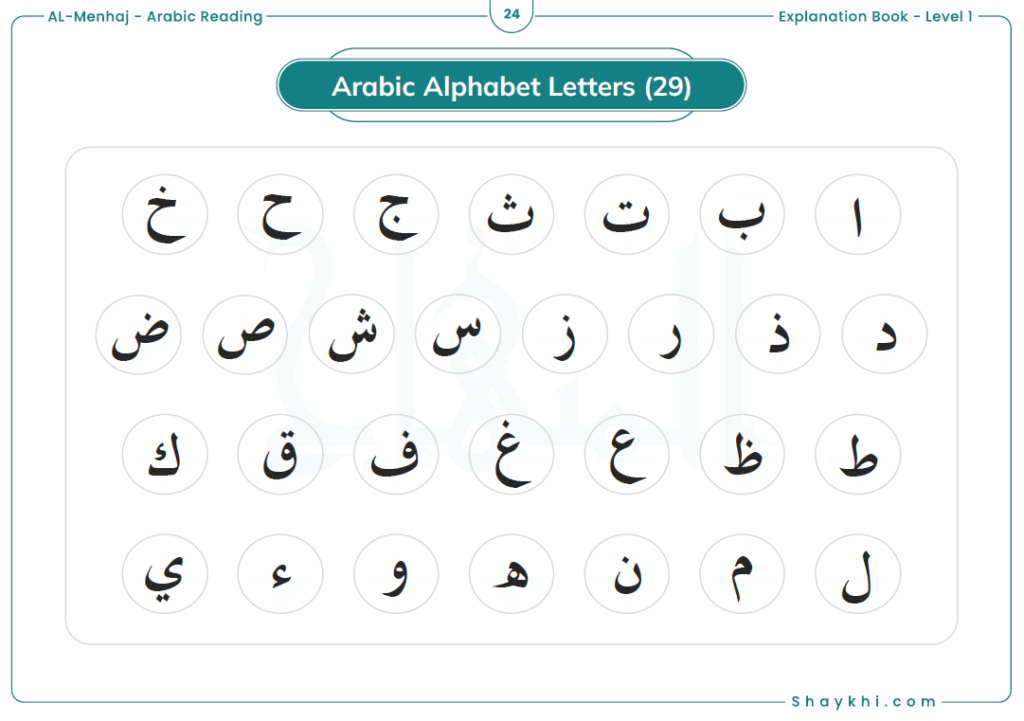
Before attempting to write Arabic words, learn each of the 28 Arabic letters (Al-Huroof Al-Hijaa’iyyah) in their isolated form. The isolated form is the base shape of each letter as it appears standing alone, before any connection rules apply.
This foundational step is non-negotiable. Skipping to word-level writing before mastering isolated forms is the single most common error beginners make — and it produces sloppy, unreadable handwriting that is difficult to correct later.
| Letter Name | Isolated Form | Sound Equivalent |
| Alif | ا | “a” / glottal stop |
| Baa | ب | “b” |
| Taa | ت | “t” |
| Tha | ث | “th” (as in think) |
| Jiim | ج | “j” |
| Haa | ح | deep pharyngeal “h” |
| Khaa | خ | “kh” (as in Bach) |
| Daal | د | “d” |
| Dhaal | ذ | “th” (as in this) |
| Raa | ر | rolled “r” |
This is a partial reference — all 28 letters follow similar tabular documentation. Our full Arabic alphabet guidecovers every letter with stroke-by-stroke formation guidance.
At The Arabic Learning Centre, our Arabic Course for Beginners introduces all 28 letters systematically through structured writing exercises with certified instructors, building correct pen habits from the first lesson.
Join Our Arabic Course for Beginners With a Free Trial

3. Master the Four Positional Forms of Each Letter
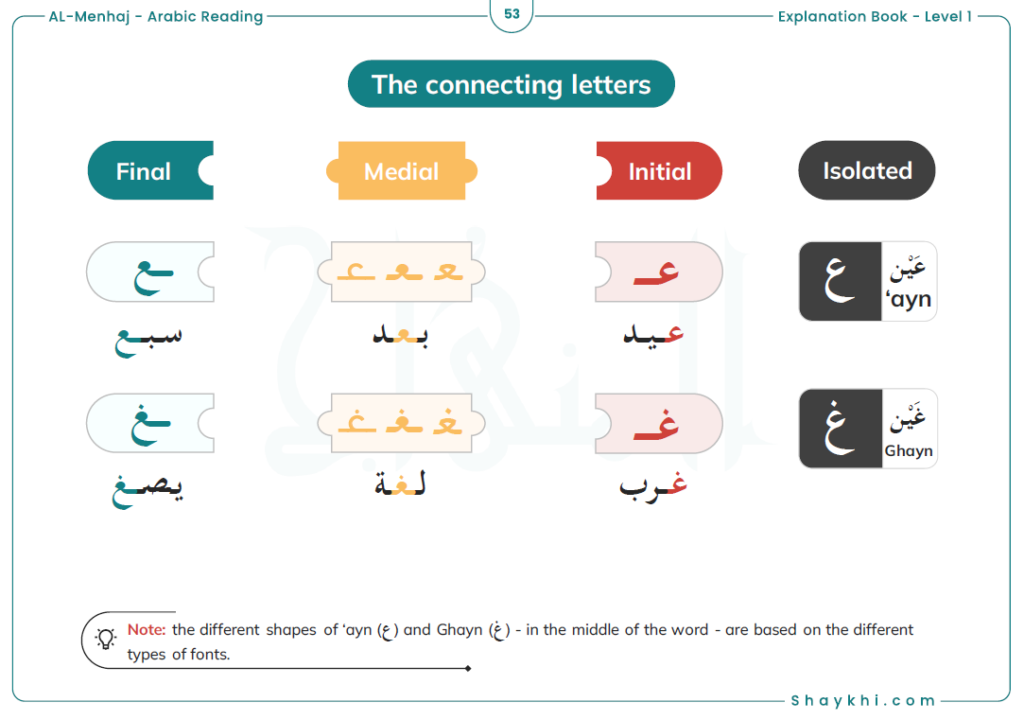
To write Arabic words correctly, you must understand that most Arabic letters take one of four distinct shapes depending on where they appear in a word: isolated, initial (beginning), medial (middle), or final (end). This is perhaps the most technically demanding aspect of learning Arabic script — and the most rewarding once mastered.
The shape changes are not arbitrary. They follow consistent visual logic: the core identifying feature of each letter (its dots, curves, or unique stroke) is preserved across all four forms, while the connecting “tail” adjusts to join with surrounding letters.
| Letter | Isolated | Initial | Medial | Final |
| Baa (ب) | ب | بـ | ـبـ | ـب |
| Ain (ع) | ع | عـ | ـعـ | ـع |
| Miim (م) | م | مـ | ـمـ | ـم |
| Waw (و) | و | و | ـو | ـو |
Notice that Waw (و) and Alif (ا) do not connect to the letter following them — they belong to a group of six non-connecting letters.
This means a word containing these letters will have a visible gap on their left side, which is grammatically correct, not a writing error.
For a complete breakdown of all positional forms, our guide on mastering the Arabic alphabet walks through each letter with visual examples.
4. Learn Arabic Letter Connection Rules
To write Arabic words, you need to understand exactly which letters connect to their neighbours and which do not. In Arabic, most letters connect to both the letter before and after them within a word — but six letters only connect to the preceding letter, never to the following one.
Explore and Study Al-Menhaj Book for Free
The six non-connecting letters are: ا (Alif), د (Daal), ذ (Dhaal), ر (Raa), ز (Zayn), و (Waw). When any of these letters appears mid-word, the next letter begins in its initial form rather than its medial form — effectively restarting the connection sequence.
What Does a Connected Arabic Word Look Like in Practice?
Consider the word كَتَبَ (kataba, “he wrote”):
كَتَبَ
kataba
“He wrote”
Here, كـ (Kaaf) takes its initial form, ـتـ (Taa) takes its medial form, and ـبَ (Baa) takes its final form — three distinct shapes from one letter’s family, joined seamlessly. This is the connection system in action.
Students at The Arabic Learning Centre regularly find that practicing connection rules with common three-letter verb roots accelerates handwriting fluency far faster than practicing isolated letters indefinitely.
Shots Videos from Our Courses
5. Understand Arabic Vowel Markers (Harakat)
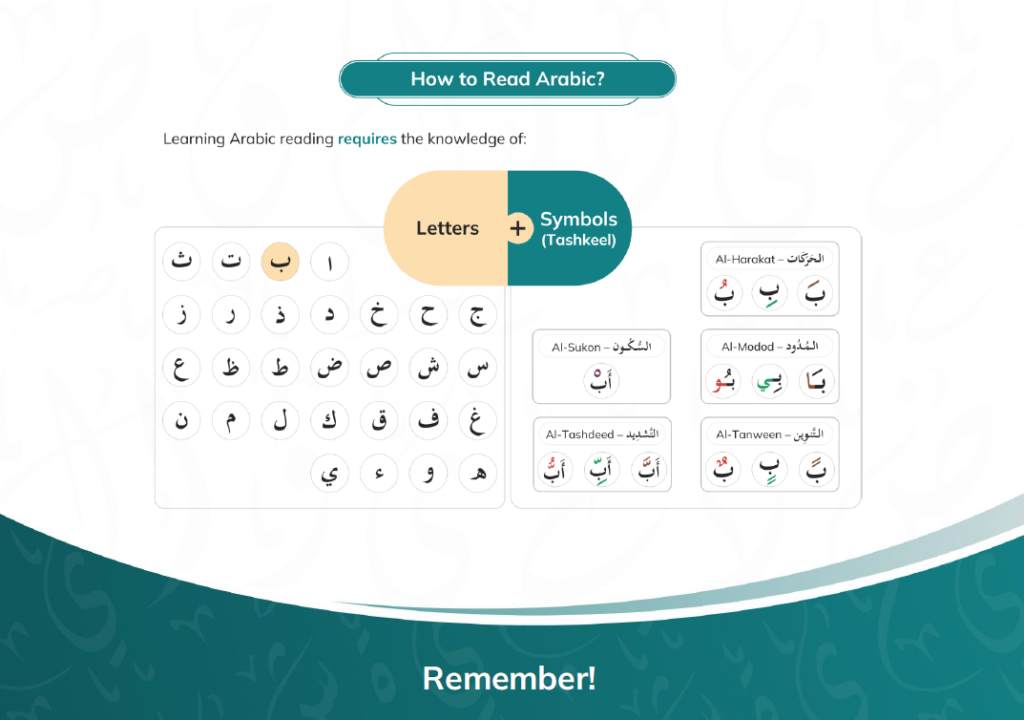
Arabic short vowels are not written as letters — they appear as small diacritical marks called harakat (حَرَكَات) placed above or below the consonant letter they modify. The three primary short vowels are Fatha (فَتْحَة), Kasra (كَسْرَة), and Damma (ضَمَّة).
| Vowel Mark | Name | Placement | Sound |
| َ | Fatha | Above letter | Short “a” |
| ِ | Kasra | Below letter | Short “i” |
| ُ | Damma | Above letter | Short “u” |
| ْ | Sukoon | Above letter | No vowel (consonant closes) |
| ّ | Shadda | Above letter | Doubles the consonant |
Explore and Study Al-Menhaj Book for Free
In everyday written Arabic — newspapers, books, most text — short vowels are omitted entirely, and readers infer them from context and vocabulary knowledge. However, the Quran, children’s books, and beginner learning materials include full harakat to support correct reading and pronunciation.
At The Arabic Learning Centre, our Arabic pronunciation course specifically trains learners to internalize correct vowel sounds so they can read un-vowelled text confidently — a milestone that typically arrives after 3–4 months of structured practice.
Begin Pronouncing Arabic Fluently with a Free Trial

6. Practice Correct Stroke Sequences for Each Letter
Writing Arabic letters with the correct stroke order is not a stylistic preference — it directly determines whether your handwriting is legible and whether you can write at natural speed. Arabic calligraphy and standard handwriting both follow established stroke sequences that have been refined over centuries of written tradition.
In our instructors’ experience at The Arabic Learning Centre, adult beginners who learn correct stroke order from the start achieve readable handwriting within 4–5 weeks.
Those who develop incorrect habits early typically require an additional 3–4 weeks of deliberate correction — time that is entirely avoidable.
Which Letters Require the Most Attention to Stroke Order?
Letters with multiple components — particularly those with dots like ب (Baa), ت (Taa), ث (Tha), ي (Yaa) — require that the main body be drawn first, then the dots added afterward. Similarly, ع (Ain) and غ (Ghain) have a distinctive eye-shaped stroke that beginners frequently distort by starting from the wrong point.
Proper guidance on Arabic pronunciation and phonetics pairs naturally with handwriting practice. Our article on how to pronounce Arabic is a useful complement at this stage, as connecting sound to written form accelerates retention significantly.
7. Begin Writing Complete Arabic Words
Once you can form all 28 letters in their four positional variants and understand the connection system, begin writing full Arabic words. Start with common, short vocabulary — three-letter roots (الجذر الثلاثي, Al-Jidhr Al-Thulathi) are the structural backbone of Arabic and provide the most pedagogical return for practice time.
Begin with words you already know from everyday context:
بَيْت bayt “House”
كِتَاب kitaab “Book”
مَدْرَسَة madrasa “School”
Write each word slowly, identifying which positional form each letter takes. Then rewrite it from memory without reference. This active recall loop is what builds real handwriting fluency — passive copying alone does not produce durable skill.
Our Arabic vocabulary course is structured around exactly this principle — building writing practice through high-frequency vocabulary organized by semantic theme, which accelerates both retention and script fluency simultaneously.
Enroll in Our Arabic Vocabulary Course to Get Your Free Trial

8. Progress to Writing Arabic Sentences with Correct Grammar
Writing individual words is one skill; writing grammatically correct Arabic sentences is another. Arabic grammar (النَّحْو, An-Nahw) governs how words connect, how verbs agree with their subjects, and how case endings (الإعراب, Al-I’raab) signal grammatical function through vowel changes on word endings.
For learners at this stage, the most important structural concept is the الجملة الاسمية (Al-Jumla Al-Ismiyya) — the nominal sentence, which places the subject before a predicate without requiring a verb:
الْكِتَابُ جَمِيلٌ Al-kitaabu jamiilun “The book is beautiful”
Notice the Damma (ُ) on كِتَابُ (nominative case marker for the subject) and the Tanwin Damma (ٌ) on جَمِيلٌ (indefinite nominative predicate). These grammatical endings are written as part of the Arabic script in fully vowelled text.
Our Arabic grammar for beginners resource covers these foundational sentence structures in detail, and our Arabic Grammar Course provides live instruction with a certified Arabic instructor who can correct grammatical writing errors in real time.
Start Learning Arabic Grammar with a Free Trial

9. Develop Consistent Daily Handwriting Practice
Consistent daily practice is what separates learners who achieve Arabic handwriting fluency from those who plateau. The neuroscience of motor learning confirms what experienced language instructors observe: short, daily practice sessions outperform longer, infrequent sessions for script acquisition.
In our instructors’ experience, 15–20 minutes of focused daily handwriting practice produces measurably better results than 90-minute weekly sessions.
Most adult learners who follow this pattern gain functional handwriting confidence — meaning they can write short sentences legibly without reference — within 6–8 weeks.
Structure daily practice in this sequence: (1) warm up by rewriting known letters, (2) practice the target letter or word set for that session, (3) write one complete sentence incorporating recent vocabulary. This three-part structure ensures both consolidation and forward progress in every session.
Our Students Reviews
Read Also: How to Read and Write Arabic Numbers?
Begin Your Arabic Writing Journey with Certified Instructors at The Arabic Learning Centre
Learning to write Arabic words correctly requires a structured approach — and the right guidance makes an enormous difference in how quickly you progress.
At The Arabic Learning Centre, our Arabic Course for Beginners is taught by certified native Arabic instructors in live, 1-on-1 sessions designed around your pace and goals.
What sets us apart:
- Certified instructors with years of experience teaching non-Arabic speakers
- Flexible 24/7 scheduling to fit your lifestyle
- Structured curriculum from letter formation through sentence-level writing
- Personalized feedback on handwriting, grammar, and pronunciation
- Free trial lesson available — no commitment required
Book your free trial lesson today and write your first Arabic sentence with expert guidance from day one.
Check out our top courses in Arabic and choose the course you need to start learning Arabic today:
- Arabic Course for Beginners
- Arabic Script Writing Course
- Arabic Speaking Course
- Learn Arabic Letters for Tajweed
- Learning Arabic Grammar
- Arabic Vocabulary Course
- Fusha Arabic Course
- Classical Arabic Course
- Arabic Course for Islamic Studies
- Quranic Arabic Course
- Learn Arabic for New Muslims
Start with a FREE trial class and enhance your Arabic language skills

Conclusion
Correct Arabic writing begins with the right foundation: 28 letters, four positional forms each, and a consistent right-to-left pen direction that quickly becomes second nature with daily practice. The connection system and vowel markers then build naturally on top of this base.
The most durable Arabic handwriting skills develop through short, daily structured sessions — not occasional long study blocks. Learners who practice with real Arabic words from the beginning, rather than isolated letters, develop fluency and vocabulary simultaneously.
Arabic writing is entirely achievable for adult non-native speakers. With the correct sequence of instruction and consistent effort, functional handwriting confidence is typically within reach within two months — often much sooner with qualified guidance.
Read Also: How Many Letters Are in the Arabic Alphabet?
Frequently Asked Questions About How to Write in Arabic
How Long Does It Take to Learn How to Write Arabic for Beginners?
Most adult beginners can write all 28 Arabic letters in their isolated forms within 2–3 weeks of daily 15-minute practice. Reaching functional sentence-level handwriting typically takes 6–8 weeks of structured practice. Learners working with a certified instructor in live sessions often reach this milestone faster due to immediate correction of stroke errors.
Is It Hard to Write Arabic Words When Letters Change Shape?
The four positional forms of Arabic letters are challenging at first but follow consistent visual logic — each letter retains its identifying feature (dots, curves, unique strokes) across all forms. Most learners find that after actively practicing all four forms for 2–3 weeks, the changes become intuitive rather than requiring conscious recall each time.
Do I Need to Learn Harakat (Arabic Vowel Marks) to Write Correctly?
For beginner learners and Quranic Arabic study, yes — harakat are essential to write and read accurately. In standard Modern Standard Arabic texts, short vowels are typically omitted, and readers rely on vocabulary knowledge to infer them. Beginners should practice with full harakat first to internalize correct pronunciation and spelling before moving to un-vowelled text.
What Is the Difference Between Writing Modern Standard Arabic and Arabic Script for the Quran?
The Arabic script itself is identical — both use the same 28 letters and the same positional forms. The differences lie in vocabulary, grammar formality, and the consistent use of full harakat in Quranic text to preserve exact pronunciation. Our Quranic Arabic course is specifically designed for learners whose primary goal is reading and writing Quranic Arabic accurately.
Can Children Learn to Write Arabic Using the Same Method as Adults?
Children can learn Arabic writing using the same foundational sequence, though the pacing and materials differ. Younger learners benefit from visual, game-based reinforcement and shorter practice sessions of 10–12 minutes. The Arabic Learning Centre’s online Arabic classes for kids are taught by certified instructors trained in child-appropriate Arabic literacy instruction, using curricula specifically designed for young non-native learners.
Related Articles
Arabic Grammar