 Arabic Grammar
| Key Takeaways |
| Harakat are short vowel diacritical marks placed above or below Arabic letters to indicate exact pronunciation of each word. |
| Arabic has three main harakat — Fatha (a), Kasra (i), and Damma (u) — plus markers for doubled sounds and sukun (no vowel). |
| Most modern Arabic texts omit harakat entirely; proficient readers infer vowels from grammar, context, and vocabulary knowledge. |
| The Quran is written with full harakat, making it one of the most important contexts where mastering diacritics is practically essential. |
| Beginners who study harakat systematically from the start build pronunciation accuracy that is far harder to correct after the fact. |
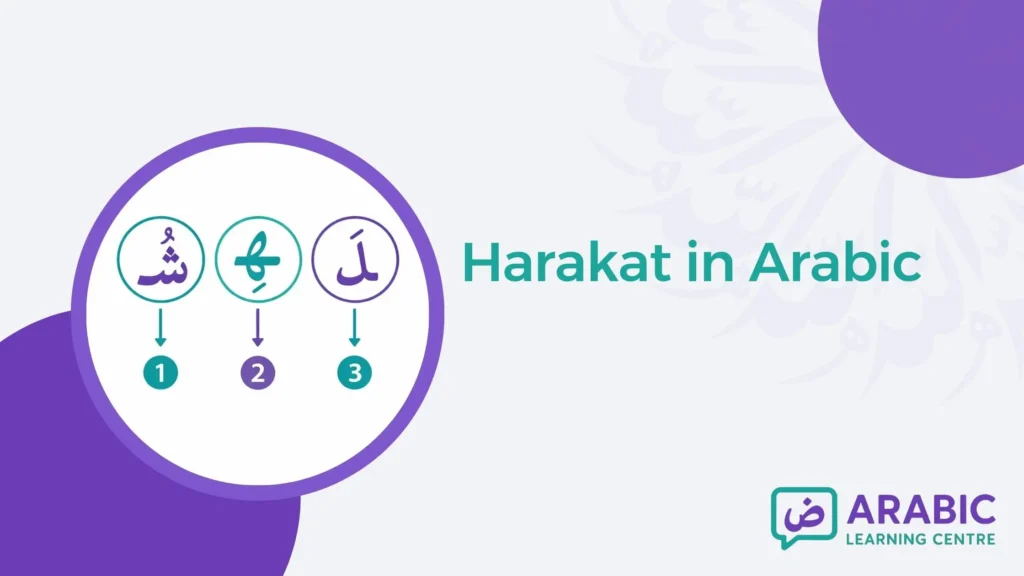
Harakat are the short vowel signs written above and below Arabic letters that tell you exactly how to pronounce each word. Without them, the consonant skeleton of an Arabic word looks identical regardless of how it is actually read — harakat are what bring the word to life phonetically. They are not decorative. They are functional pronunciation instructions embedded directly into the script.
This matters enormously for learners. Arabic’s writing system natively omits these signs in most everyday texts — newspapers, novels, websites, business documents.
Beginners who understand harakat from the start develop accurate pronunciation habits and a meaningful framework for reading. Those who skip them often spend months mispronouncing words they believe they know.
What Is Harakat in Arabic?
Harakat (حَرَكَات), literally meaning “movements” in Arabic, is the collective term for the short vowel diacritical marks used in Arabic script. Each mark sits above or below a consonant and instructs the reader on which short vowel sound follows that letter.
Why Does Harakat Exist in Arabic?
The Arabic script was originally written for native speakers who instinctively knew the correct vowels — harakat were added later, primarily to preserve the precise recitation of the Quran and to support non-native learners of classical texts.
Arabic is a consonantal writing system. This means the core letters represent consonants, and short vowels are typically inferred rather than written. In Classical Arabic (Fusha) texts, especially the Quran, full diacritical marking — known as tashkeel (تشكيل) — is applied to eliminate ambiguity.
Understanding what harakat mean in Arabic begins with recognizing this distinction: harakat are not letters. They are pronunciation guides that sit on top of the alphabet.
At The Arabic Learning Centre, our Learn to Read Arabic Course introduces harakat from lesson one — because building correct pronunciation from the outset is always more efficient than retraining ingrained errors later.
Start Reading Arabic with a FREE Trial

What Are the Main Types of Harakat in Arabic?
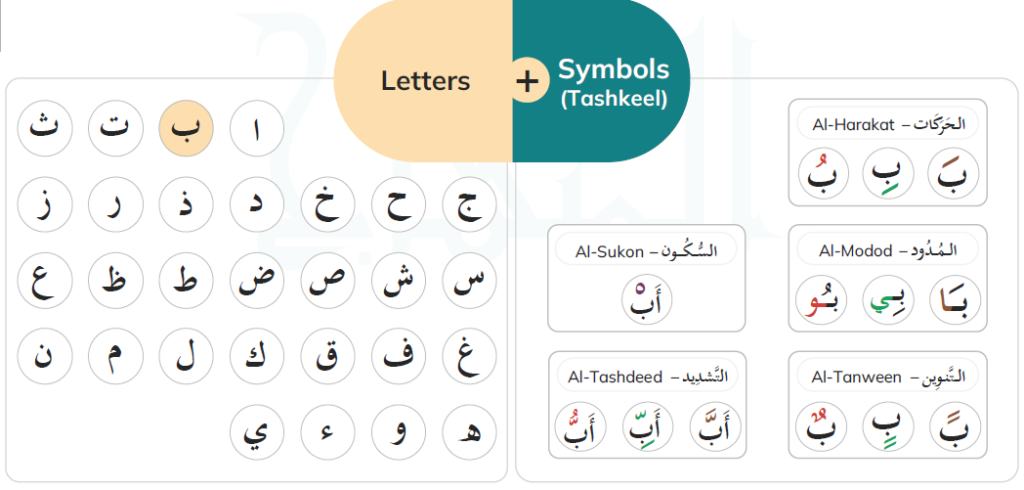
The Arabic harakat system consists of six core diacritical marks. Each governs a specific vowel sound or phonological state.
| Harakat | Arabic Symbol | Name | Sound Produced |
| َ | above the letter | Fatha (فَتْحَة) | Short “a” — like “cat” |
| ِ | below the letter | Kasra (كَسْرَة) | Short “i” — like “sit” |
| ُ | above the letter | Damma (ضَمَّة) | Short “u” — like “put” |
| ً | above the letter | Tanwin al-Fath | “-an” ending (nunation) |
| ٍ | below the letter | Tanwin al-Kasr | “-in” ending (nunation) |
| ٌ | above the letter | Tanwin al-Damm | “-un” ending (nunation) |
| ْ | above the letter | Sukun (سُكُون) | No vowel follows — consonant is “resting” |
| ّ | above the letter | Shadda (شَدَّة) | Letter is doubled/geminated |
Tanwin (التنوين) refers to the nunation endings — they add an “n” sound after the vowel and are particularly important in Nahw (Arabic grammar) for indicating grammatical case in indefinite nouns.
Shadda deserves special attention: it does not indicate a vowel but rather doubles the consonant. It is almost always written with a fatha, kasra, or damma on top of it to complete the syllable.
Explore and Study Al-Menhaj Book for Free
Here is the dedicated section with all four subsections, formatted to match the article’s existing structure and standards:
Shots Videos from Our Courses
The Essential Harakat with Examples
The four most foundational harakat in Arabic are Fatha, Kasra, Damma, and Tanween. Every Arabic word you will ever read depends on at least one of them.
Mastering their shapes, sounds, and positions on the letter is the single most practical investment a beginner can make — before vocabulary, before grammar, before anything else.
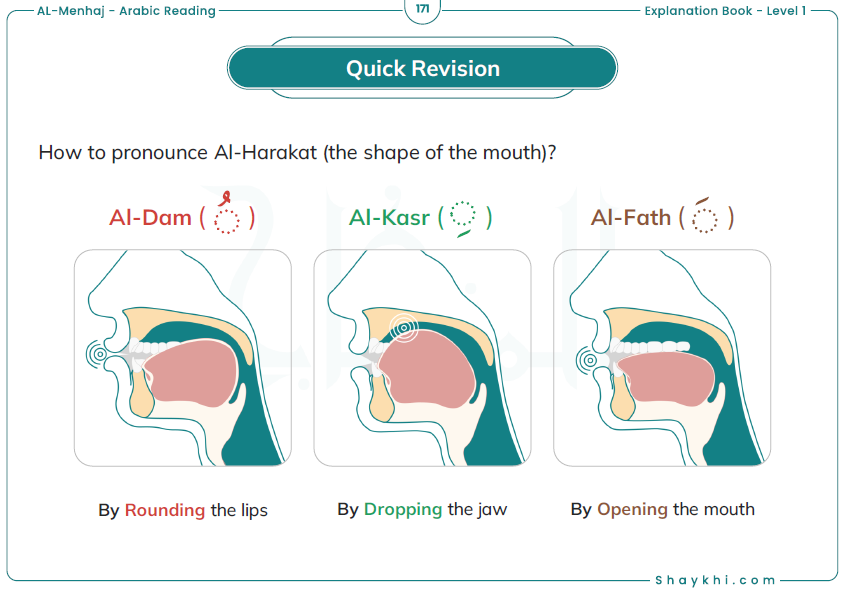
Explore and Study Al-Menhaj Book for FREE
What Is the Fatha (فَتْحَة)?
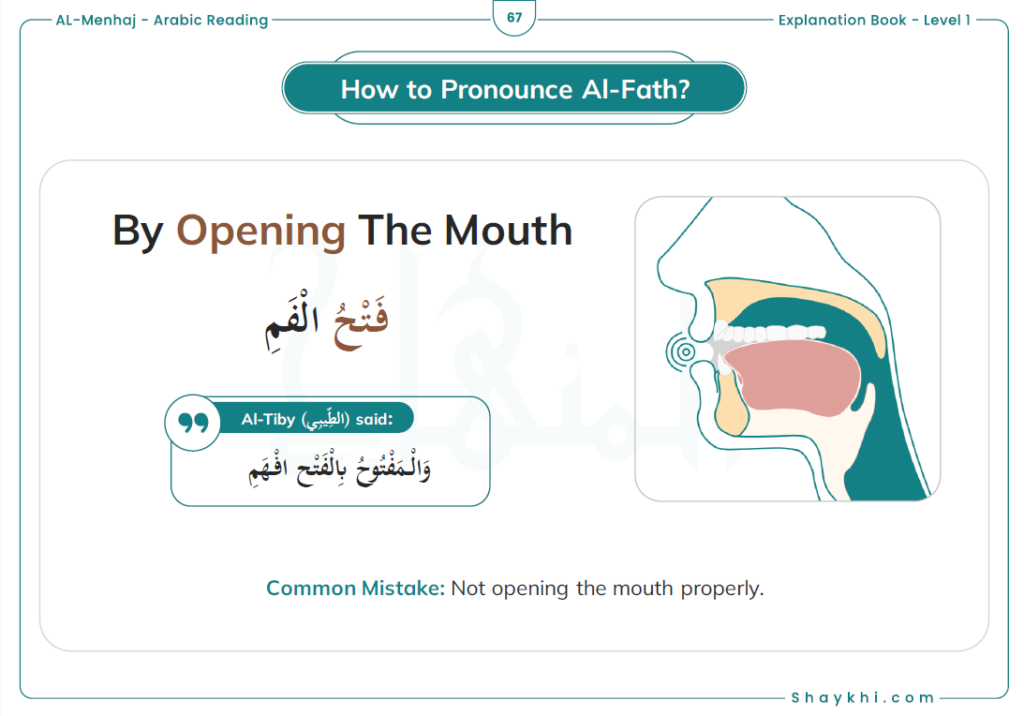
The Fatha (فَتْحَة) is a small diagonal stroke written above a letter. It produces a short “a” vowel sound — similar to the “a” in the English word “cat,” though positioned slightly further back in the mouth in Arabic. It is the most frequently occurring haraka in Arabic speech and text.
The name itself comes from the Arabic root ف – ت – ح (f-t-h), meaning “to open” — a reference to the open mouth position required to produce the sound correctly.
Practical Examples:
| Arabic | Transliteration | Meaning |
| بَيْت | bayt | House |
| كَتَبَ | kataba | He wrote |
| فَتَحَ | fataha | He opened |
| وَلَد | walad | Boy / Child |
بَيْتٌ كَبِيرٌ baytun kabīrun “A big house” — fatha on بَ gives the opening “ba” sound
One important nuance: when a fatha appears on or near an emphatic letter — ص, ض, ط, or ظ — its sound deepens noticeably, shifting toward a back “o”-like quality. This is called tafkheem (تَفْخِيم), or “heaviness.”
Students at The Arabic Learning Centre consistently find this the trickiest fatha behaviour to internalise, because English has no direct equivalent for this vowel colouring effect.
What Is the Kasra (كَسْرَة)?
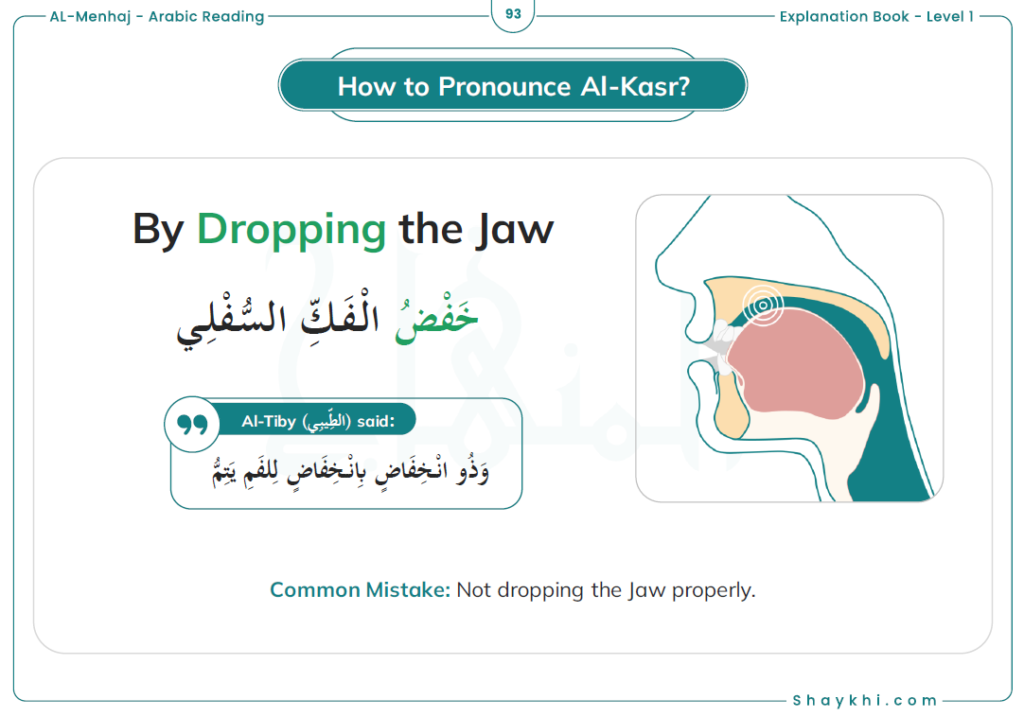
The Kasra (كَسْرَة) is a small diagonal stroke written below a letter. It produces a short “i” vowel — similar to the “i” in “sit.” Its name derives from the root ك – س – ر (k-s-r), meaning “to break” — a reference to the slightly lowered jaw position that produces the sound.
The kasra is also the haraka that signals the genitive case (مَجْرُور, majrūr) in Arabic grammar — so recognising it quickly has both phonetic and grammatical value for learners.
Practical Examples:
| Arabic | Transliteration | Meaning |
| بِسْم | bism | In the name of |
| كِتَاب | kitāb | Book |
| مِفْتَاح | miftāḥ | Key |
| فِي الْبَيْت | fi l-bayt | In the house |
فِي الْمَدْرَسَةِ fi l-madrasati “In the school” — kasra on فِ and on the final ةِ shows both the preposition and the genitive case
In our instructors’ experience at The Arabic Learning Centre, beginners most frequently confuse the kasra with the fatha in the first two weeks of study — almost always because they are reading the letter shape and overlooking where the diacritic is positioned relative to it.
A focused drill distinguishing above-letter versus below-letter marks typically resolves this within a single session.
What Is the Damma (ضَمَّة)?
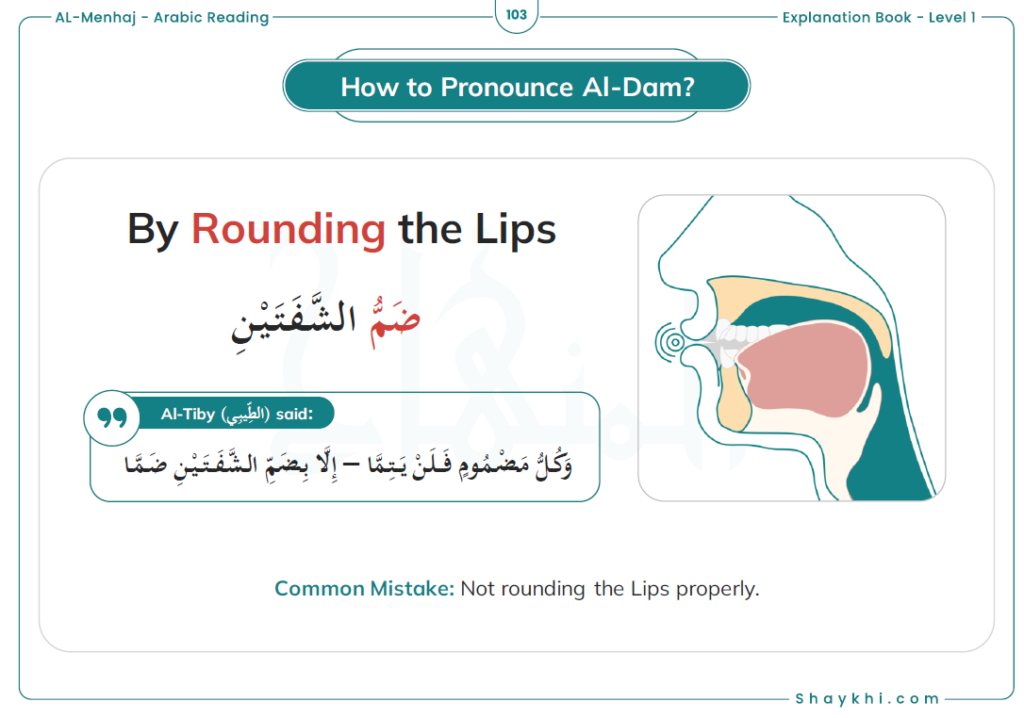
The Damma (ضَمَّة) is a small curl or hook shape written above a letter. It produces a short “u” vowel — similar to the “u” in “put,” but with more deliberate lip rounding than most English speakers naturally apply.
Its name comes from the root ض – م – م (ḍ-m-m), meaning “to join” or “to draw together” — reflecting the rounded, closed lip position the sound requires.
Grammatically, the damma signals the nominative case (مَرْفُوع, marfūʿ) — meaning it often appears on the subject of a sentence in Classical Arabic.
Practical Examples:
| Arabic | Transliteration | Meaning |
| كُتُب | kutub | Books (plural) |
| مُدَرِّس | mudarris | Teacher |
| يُكْتَب | yuktabu | It is written |
| الطَّالِبُ | aṭ-ṭālibu | The student (nominative) |
الطَّالِبُ يَكْتُبُ aṭ-ṭālibu yaktubu “The student writes” — damma on الطَّالِبُ marks it as the subject; damma on يَكْتُبُ marks the imperfect verb in its default form
English-speaking learners almost universally under-round the damma in early practice, producing a flat schwa instead of a proper rounded “u.” The correction is simple — consciously pursing the lips as if saying “oo” very briefly — but it requires deliberate attention during the first weeks of Arabic pronunciation training.
What Is Tanween (تَنْوِين)?
Tanween (تَنْوِين), often called “nunation” in English-language grammar references, is the addition of a final “n” sound to an Arabic word. It is written as a doubled haraka at the end of a word and appears in three forms — one for each of the three short vowels — each carrying a distinct grammatical meaning for indefinite nouns and adjectives.
The term tanween comes from the root related to نون (nūn) — because the added sound is essentially an “n” (ن) that is heard but not written as a full letter.
| Tanween Type | Symbol | Sound | Grammatical Role |
| Tanwin al-Fath (تَنْوِين الفَتْح) | ً | “-an” | Accusative indefinite (مَنْصُوب) |
| Tanwin al-Kasr (تَنْوِين الكَسْر) | ٍ | “-in” | Genitive indefinite (مَجْرُور) |
| Tanwin al-Damm (تَنْوِين الضَّمّ) | ٌ | “-un” | Nominative indefinite (مَرْفُوع) |
Practical Examples:
| Arabic | Transliteration | Meaning | Case |
| كِتَابٌ | kitābun | A book (subject) | Nominative |
| كِتَابًا | kitāban | A book (object) | Accusative |
| كِتَابٍ | kitābin | Of a book | Genitive |
| طَالِبٌ مُجْتَهِدٌ | ṭālibun mujtahidun | A diligent student | Both nominative indefinite |
قَرَأْتُ كِتَابًا مُفِيدًا qaraʾtu kitāban mufīdan “I read a beneficial book” — tanwin fath on both كِتَابًا and مُفِيدًا marks them as indefinite accusative
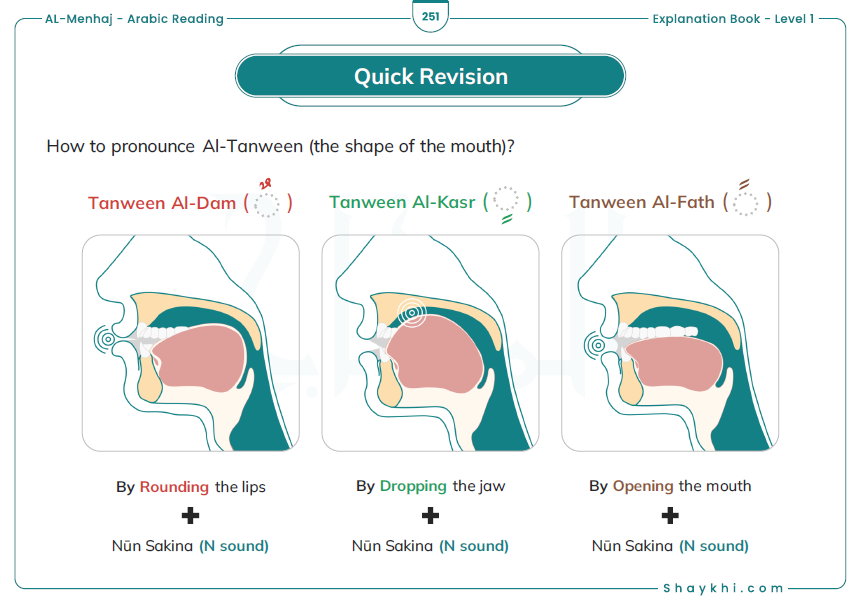
A critical orthographic rule: Tanwin al-Fath is almost always written on an Alif (ا) that is added to the end of the word — for example, كِتَابًا rather than كِتَابً. This alif is purely orthographic — it is not pronounced. The exceptions are words ending in ة (ta marbuta) or ء (hamza), which take tanwin fath without the additional alif.
Students working through Quranic vocabulary encounter tanween constantly, and understanding its three forms is one of the clearest early milestones in Arabic grammar literacy.
Our certified instructors at The Arabic Learning Centre introduce tanween alongside basic noun case rules in our Arabic Grammar Course — so learners build pronunciation accuracy and grammatical understanding simultaneously, rather than treating them as separate skills.
Start Learning Arabic Grammar with a Free Trial

How Does the Arabic Alphabet With Harakat Actually Work?
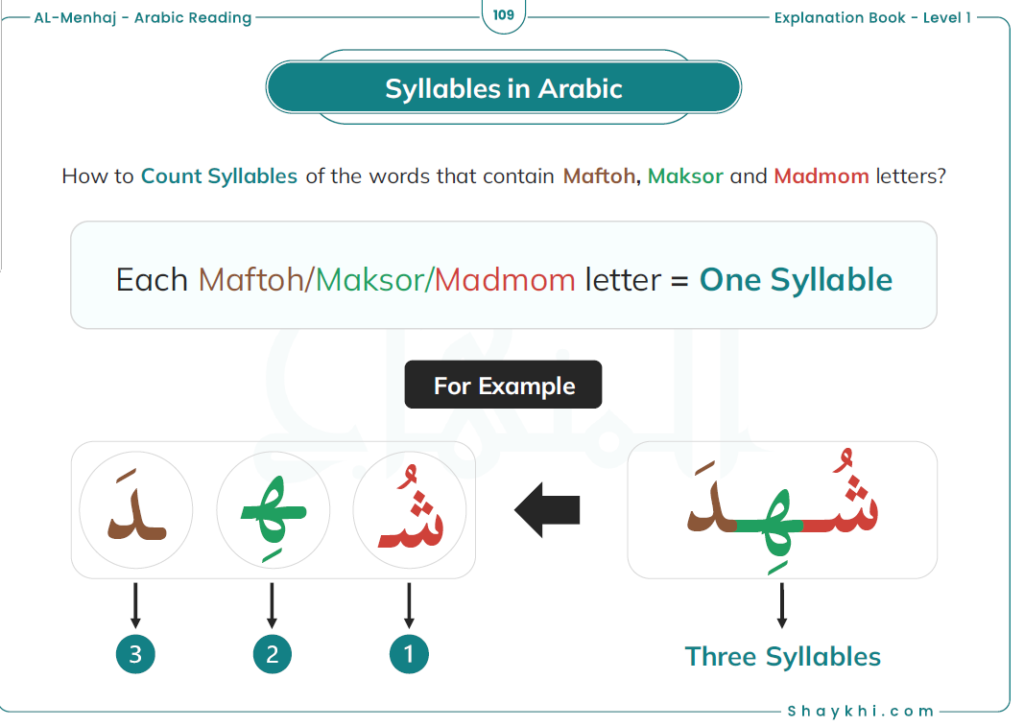
The Arabic alphabet with harakat functions as a complete pronunciation map for any word. Take the three-letter root ك – ت – ب (k-t-b), which relates to writing.
كَتَبَ kataba “He wrote” — past tense verb, three fatha marks
كِتَابٌ kitābun “A book” — noun with kasra on first letter, long alif, tanwin damma at end
كُتِبَ kutiba “It was written” — passive voice, damma then kasra
Same three root letters. Three entirely different words. The harakat are the only difference visible in fully vowelled text — and in unvowelled text, context and grammatical knowledge do that work.
This is why learners who study Arabic grammar fundamentals alongside harakat progress far more efficiently. Grammar and diacritics inform each other directly.
How to Read Arabic Without Harakat?
Reading Arabic without harakat is a skill that develops through vocabulary depth, grammatical pattern recognition, and contextual reading — not guesswork.
Native and advanced readers process unvowelled Arabic by matching consonant patterns against internalized knowledge of how those patterns behave grammatically and semantically.
Three mechanisms work together in competent unvowelled reading:
1. Root-pattern recognition
Arabic words are built on trilateral roots following predictable morphological patterns (أَوْزَان, awzān). A reader who knows the root د – ر – س (d-r-s, related to study) immediately recognizes مَدْرَسَة (school) and مُدَرِّس (teacher) from their consonant skeletons because the patterns are deeply familiar.
2. Grammatical position
In a sentence, the grammatical role of a word — subject, object, predicate — limits which vowel endings are possible. A native-level reader uses case endings they have internalized to assign the correct harakah.
3. Contextual probability
A word surrounded by specific semantic vocabulary is highly constrained. If the surrounding words discuss books and libraries, the reader assigns different probabilities to ambiguous consonant clusters.
At The Arabic Learning Centre, students in our Arabic Grammar Course begin practising unvowelled reading after approximately eight weeks of structured grammar study — because the grammatical framework is what makes gapless reading cognitively possible.
Start Learning Arabic Grammar with a Free Trial

Why Beginners Should Not Skip Harakat Study
In our instructors’ experience at The Arabic Learning Centre, learners who attempt to bypass harakat and move directly to unvowelled texts consistently develop pronunciation errors that calcify quickly.
The most common pattern: beginners memorize word shapes without internalizing vowel sounds, then mispronounce those words in conversation — sometimes for years. Correcting fossilized mispronunciation at intermediate level requires far more effort than building accuracy from the beginning.
Six to eight weeks of disciplined harakat study is the correct foundation for almost every adult beginner. It is not a slow path. It is the faster one.
What Does Harakat Mean in Arabic Grammar?
Beyond pronunciation, harakat carry grammatical weight in Classical Arabic (Fusha). The short vowel endings of nouns and adjectives indicate إعراب (i’rāb) — the case system that shows a word’s grammatical role in the sentence.
| Case | Arabic Term | Typical Ending | Function |
| Nominative | مَرْفُوع (marfūʿ) | Damma (ُ) | Subject of sentence |
| Accusative | مَنْصُوب (manṣūb) | Fatha (َ) | Object of verb |
| Genitive | مَجْرُور (majrūr) | Kasra (ِ) | After prepositions or in إضافة |
This grammatical harakat system — called i’rāb — is one of the defining features of Classical and Modern Standard Arabic. It is largely absent in spoken dialects, which is one reason Fusha and dialect reading feel so different to learners.
Understanding i’rāb through harakat is foundational for Quranic Arabic study and for understanding why a sentence means what it means — not just how to pronounce it.
How to Type Arabic With Harakat on a Keyboard
Typing Arabic with harakat is straightforward once you know the keyboard shortcuts. Most operating systems support Arabic keyboard input natively, and harakat are accessible through modifier key combinations.
On Windows with an Arabic keyboard layout:
| Harakat | Key Combination |
| Fatha (َ) | Shift + Q |
| Kasra (ِ) | Shift + A |
| Damma (ُ) | Shift + E |
| Sukun (ْ) | Shift + X |
| Shadda (ّ) | Shift + ~ |
| Tanwin Fath (ً) | Shift + W |
| Tanwin Kasr (ٍ) | Shift + R |
| Tanwin Damm (ٌ) | Shift + S |
On Mac: Enable the Arabic keyboard in System Preferences → Keyboard → Input Sources. Harakat are accessed via the Option key combined with specific letter keys, which vary slightly by Arabic keyboard variant (Arabic, Arabic-PC, etc.).
For learners practising tashkeel in typed exercises, the Arabic-PC layout on both Windows and Mac tends to be the most intuitive for non-native speakers.
Practising typing with harakat simultaneously reinforces their visual recognition — a technique our certified instructors at The Arabic Learning Centre regularly recommend.
Book a FREE session with one of our native Arabic-certified teachers
Read Also: Arabic Language – Full Guide
Harakat in the Quran — Why Quranic Arabic Is Fully Vowelled
The Quran is one of the very few Arabic texts written with complete tashkeel — full harakat on every word. This is not coincidental. When the Quran was first transcribed widely across non-Arab populations, the risk of mispronunciation was significant. Incorrect vowelling changes meaning. In religious recitation, precision is obligatory.
The harakat in the Quran were systematically standardized by scholars of the early Islamic period, most notably through the work of Abu al-Aswad al-Du’ali and later al-Khalil ibn Ahmad al-Farahidi, who formalized the diacritical system used today.
بِسْمِ اللَّهِ الرَّحْمَٰنِ الرَّحِيمِ
Bismi -llāhi r-raḥmāni r-raḥīm
In the name of Allah, the Most Gracious, the Most Merciful
Every mark in this opening phrase — from the kasra under the ب to the shadda on الرَّحْمَٰن — reflects centuries of scholarly consensus on exact pronunciation.
For Muslims learning to recite correctly, understanding harakat is not optional. Our Quranic Arabic Course at The Arabic Learning Centre addresses both the reading mechanics of harakat and the Tajweed rules that govern their phonetic application in recitation.
Join Our Quranic Arabic Course With a Free Trial

For beginners approaching Quranic reading, The Arabic Learning Centre also offers Al-Menhaj Book — a structured resource developed by certified instructors with over 25 years of teaching experience, specifically designed to walk non-native speakers through Arabic alphabet fundamentals and harakat reading step by step.
Read Also: The Difference Between Sukoon and Jazm in Arabic Grammar
What is The Relationship Between Harakat and Arabic Pronunciation?
Harakat are inseparable from correct Arabic pronunciation. Each of the three short vowels — fatha, kasra, and damma — has a precise phonetic target that differs meaningfully from their approximate English equivalents.
The fatha (short “a”) in Arabic is produced further back in the mouth than the English “a” in “cat.” When it follows an emphatic letter such as ص, ض, ط, or ظ, it shifts to a deeper, back-rounded quality — closer to “o” — due to the pharyngeal quality of those letters.
The kasra (short “i”) is a clean, front-of-mouth vowel but can become elongated before certain letter combinations in ways that catch learners off guard.
The damma (short “u”) is a rounded back vowel. Learners from English backgrounds often under-round it, producing something closer to a schwa.
Understanding the physical articulation points — makhraj (مَخَارِج) — of letters alongside their harakat is essential for accurate pronunciation. Our Arabic Pronunciation Course at The Arabic Learning Centre covers exactly this relationship, ensuring learners develop accurate sound production, not just visual recognition of the diacritical marks.
Our Students Reviews
Begin Pronouncing Arabic Fluently with a Free Trial

Read Also: What Is Sukoon in Arabic?
Start Reading Arabic Correctly with The Arabic Learning Centre
Harakat are the foundation of Arabic literacy. Mastering them early is the difference between reading with confidence and reading with uncertainty at every word.
The Arabic Learning Centre offers:
- Certified native Arabic instructors with years of experience teaching non-Arabic speakers
- Fully structured curriculum from harakat fundamentals through advanced Fusha grammar
- Flexible 1-on-1 sessions available 24/7 — tailored to your pace and goals
- Free trial lesson — no commitment required
Whether your goal is Quranic recitation, Modern Standard Arabic reading, or conversational fluency, structured harakat training is where every successful learner begins. Explore our Arabic Course for Beginners orbook a free trial lesson today.
Check out our top courses in Arabic and choose the course you need to start learning Arabic today:
- Arabic Course for Beginners
- Arabic Script Writing Course
- Arabic Speaking Course
- Learn Arabic Letters for Tajweed
- Learning Arabic Grammar
- Arabic Vocabulary Course
- Fusha Arabic Course
- Classical Arabic Course
- Arabic Course for Islamic Studies
- Quranic Arabic Course
- Learn Arabic for New Muslims
Start with a FREE trial class and enhance your Arabic language skills

Conclusion
Harakat transform the Arabic alphabet from an ambiguous consonant skeleton into a complete, readable script. The three primary marks — fatha, kasra, and damma — encode the short vowel system that underlies every Arabic word’s pronunciation, grammar, and meaning.
Proficient readers of Arabic eventually internalize these vowel patterns deeply enough to read without visible harakat. But that fluency is built on — not despite — a solid foundation in diacritical reading. Skipping this step creates gaps that surface repeatedly in pronunciation, grammar, and reading speed.
For Muslims approaching the Quran, understanding harakat is both a linguistic and a devotional priority. Every mark in the Mushaf reflects a precision that demands equal precision from the reader.
Read Also: How Many Harakat Are in Arabic?
Frequently Asked Questions About Harakat in Arabic
What is harakat in Arabic?
Harakat (حَرَكَات) are short vowel diacritical marks written above or below Arabic consonants to indicate exact pronunciation. The three main harakat are fatha (short “a”), kasra (short “i”), and damma (short “u”). Additional marks include sukun (no vowel), shadda (doubled consonant), and the three tanwin endings for indefinite nouns.
Why is Arabic written without harakat in most texts?
Most modern Arabic texts omit harakat because native speakers and proficient readers infer correct vowels from grammatical knowledge, root-pattern recognition, and contextual reading. Harakat are retained in the Quran, children’s books, language learning materials, and classical texts where precision or pedagogical clarity is required.
How to read Arabic without harakat as a beginner?
Beginners should not attempt unvowelled reading immediately. First, master harakat recognition through fully vowelled texts — typically six to eight weeks of structured study. Then build Arabic grammar knowledge so grammatical case endings become predictable. Vocabulary depth follows. Unvowelled reading becomes accessible when grammar and vocabulary work together to fill the missing vowel information.
What does harakat mean in Arabic literally?
The word harakat (حَرَكَات) is the plural of haraka (حَرَكَة), which literally means “movement” or “motion” in Arabic. The term reflects the way these vowel signs animate the consonant letters — giving them phonetic movement rather than leaving them as static, silent shapes on the page.
How long does it take to learn harakat?
Most adult beginners at The Arabic Learning Centre achieve confident harakat recognition — reading fully vowelled Arabic text with correct pronunciation — within four to six weeks of consistent daily practice. Reading fluency with harakat, including the grammatical tanwin endings, typically requires eight to twelve weeks of structured instruction alongside basic Arabic grammar study.