 Learn Arabic

| Key Takeaways |
| Arabic has three short vowel marks (harakat): Fatha, Kasra, and Damma, each producing a distinct vowel sound. |
| Including Sukun and Tanwin, Arabic has seven harakat — plus Shaddah, bringing total diacritical marks to eight. |
| Mastering all eight diacritical marks is essential for correct Quranic recitation, where every mark affects meaning precisely. |
| Adult learners typically gain confident diacritical mark recognition within four to six weeks of structured daily reading practice. |
Arabic has three core harakat: Fatha (فَتْحَة), Kasra (كَسْرَة), and Damma (ضَمَّة). These are the fundamental short vowel marks of the Arabic writing system. When you include Sukun (سُكُون) and the three Tanwin (تَنْوِين) forms, the total count of harakat reaches seven. Add Shaddah (شَدَّة) — a gemination mark that is distinct from the harakat proper — and the complete set of Arabic diacritical marks used in vowelized text reaches eight.
Shaddah does not indicate a vowel sound — it doubles a consonant. Grouping it with the harakat is a common simplification, but knowing the precise distinction will make you a more accurate reader and writer of Arabic from the very beginning.
How Many Harakat Are in Arabic?
Arabic has seven harakat when counted precisely: three short vowels (Fatha, Kasra, Damma), one sukun marking a vowelless consonant, and three tanwin endings marking indefinite nouns.
When Shaddah is included as a diacritical mark — though not a harakah in the classical grammatical sense — the total number of Arabic diacritical marks becomes eight. Together, these eight marks form the complete vowelization system used in Quranic text and structured Arabic learning materials.
Without these marks, a sequence of Arabic consonants can be read in multiple ways. With them, pronunciation and grammatical meaning become unambiguous.
This is precisely why Quranic Arabic — where exact wording is preserved — is always fully vowelized with all eight marks as needed.
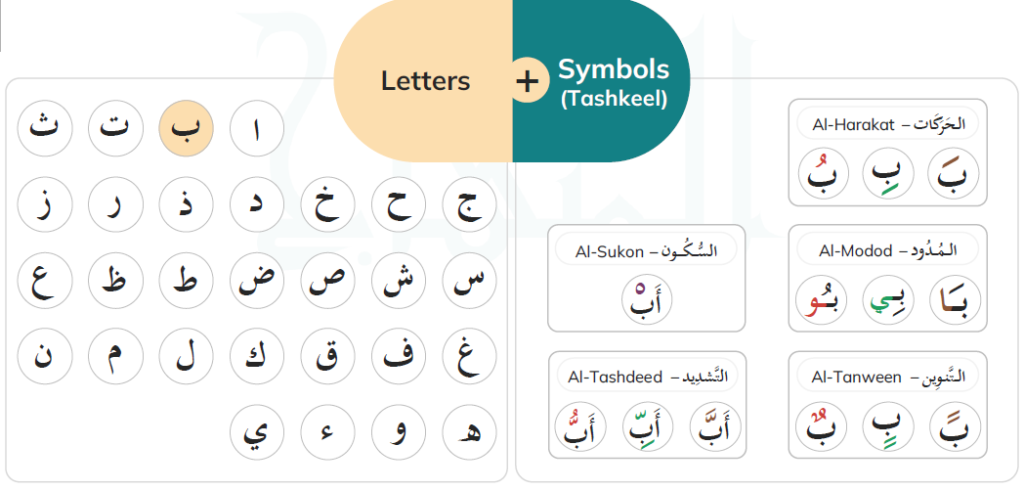
Here is a complete overview of all eight diacritical marks:
| Mark | Arabic Symbol | Name | Type | Position | Sound/Function |
| فَتْحَة | ـَ | Fatha | Harakah | Above the letter | Short “a” as in “cat” |
| كَسْرَة | ـِ | Kasra | Harakah | Below the letter | Short “i” as in “bit” |
| ضَمَّة | ـُ | Damma | Harakah | Above the letter | Short “u” as in “put” |
| سُكُون | ـْ | Sukun | Harakah | Above the letter | No vowel — consonant stop |
| تَنْوِين فَتْح | ـً | Tanwin Fath | Harakah | Above the letter | “-an” ending |
| تَنْوِين كَسْر | ـٍ | Tanwin Kasr | Harakah | Below the letter | “-in” ending |
| تَنْوِين ضَمّ | ـٌ | Tanwin Damm | Harakah | Above the letter | “-un” ending |
| شَدَّة | ـّ | Shaddah | Gemination mark (not a harakah) | Above the letter | Doubles the consonant |
The table makes the distinction clear: the first seven are harakat in the classical Arabic grammatical tradition (علم النحو). Shaddah is a separate category — a diacritical mark that works alongside the harakat but is not one of them.
Explore and Study Al-Menhaj Book for Free
Shots Videos from Our Courses
What Is Fatha and How Is It Pronounced?
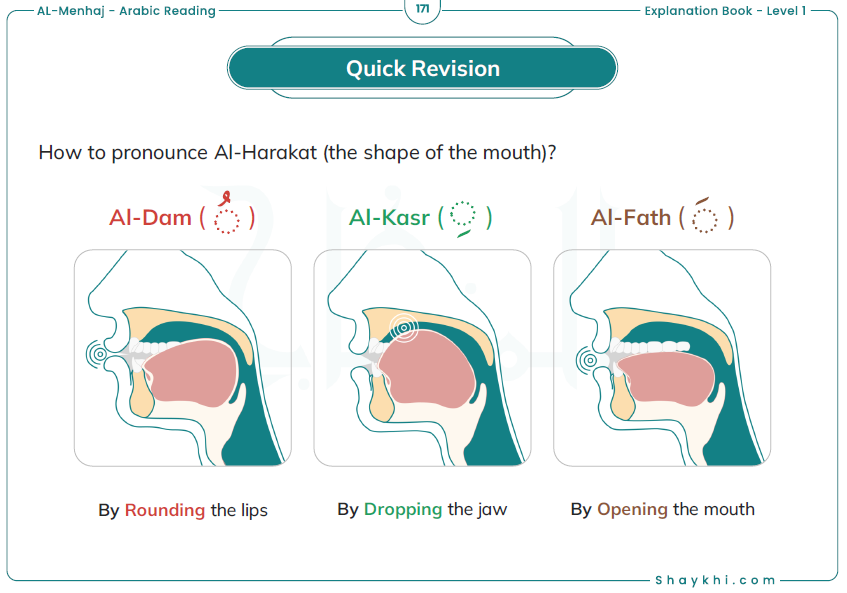
Fatha (فَتْحَة) is a small diagonal stroke placed above an Arabic letter. It produces a short open “a” vowel sound — similar to the “a” in “hat” or “man” in English.
Of all the harakat, Fatha is the most frequently occurring in Arabic text, making it the first mark most students encounter.
How Fatha Changes a Word’s Meaning
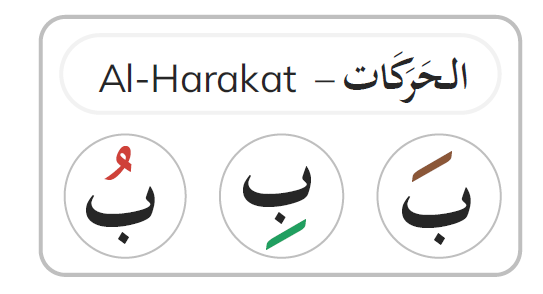
Consider the letter بَ (ba with Fatha): it sounds like “ba.” The same letter with Kasra — بِ — sounds like “bi,” and with Damma — بُ — sounds like “bu.” These are not interchangeable.
Example:
كَتَبَ kataba “He wrote”
كُتُبٌ kutubun “Books”
The same three root letters ك-ت-ب produce entirely different words depending on which harakat are placed on them. This is the root-and-pattern system (الجذر والوزن) at work — one of Arabic’s defining grammatical features.
At The Arabic Learning Centre, our Learn to Read Arabic Course introduces Fatha as the opening mark in every structured reading lesson, giving learners an immediate, confidence-building entry point into the vowelization system.
Start Reading Arabic with a FREE Trial

What Is Kasra and Where Does It Appear in Arabic Grammar?
Kasra (كَسْرَة) is placed below an Arabic letter and produces a short “i” sound — similar to the “i” in “bit” or “sit.” In Arabic grammar, Kasra carries a specific grammatical signal: it marks the majrur (مَجْرُور) — the genitive case — indicating a noun is governed by a preposition or part of an idafa (إضافة) construction.
Kasra in the Idafa Construction
The إضافة (idafa) — the Arabic possessive construction — is one of the first grammatical structures Arabic students learn. The second noun in an idafa always takes Kasra as its case marker.
Example:
كِتَابُ الطَّالِبِ
kitābu aṭ-ṭālibi
The student’s book
Notice that الطَّالِبِ ends in Kasra — because it is the second term in the idafa. Beginners consistently overlook this case marker when reading. Recognizing Kasra’s grammatical role — not just its sound — is what separates passive reading from genuine Arabic literacy.
Students at The Arabic Learning Centre regularly find that understanding why Kasra appears — not just what sound it makes — accelerates their reading accuracy significantly. Our Arabic Grammar Course covers genitive case marking in dedicated structured lessons.
Start Learning Arabic Grammar with a Free Trial

What Is Damma and How Does It Signal Arabic Case?
Damma (ضَمَّة) is a small curl placed above an Arabic letter, producing a short “u” sound similar to the “u” in “put.” Grammatically, Damma marks the marfu’ (مَرْفُوع) — the nominative case — identifying the subject of a sentence.
Damma as a Grammatical Signal
In formal Arabic (Fusha), the subject of a verb always carries Damma on its final letter.
Example:
ذَهَبَ الطَّالِبُ
dhahaba aṭ-ṭālibu
“The student went”
الطَّالِبُ ends in Damma because it is the فَاعِل (fa’il) — the grammatical subject performing the action. In Arabic grammar (Nahw), the rule of fa’il marfu’ is foundational: the doer of the verb always takes the nominative case, marked by Damma.
Understanding this link between Damma and subject status is essential for reading Arabic accurately — not just reciting it aloud.
What Is Sukun and Why Is It Essential for Arabic Pronunciation?
Sukun (سُكُون) is a small circle placed above an Arabic letter. It indicates that the letter carries no vowel — the consonant is held without a following vowel sound. Sukun is essential for accurate Arabic pronunciation because Arabic consonant clusters require it to be read correctly.
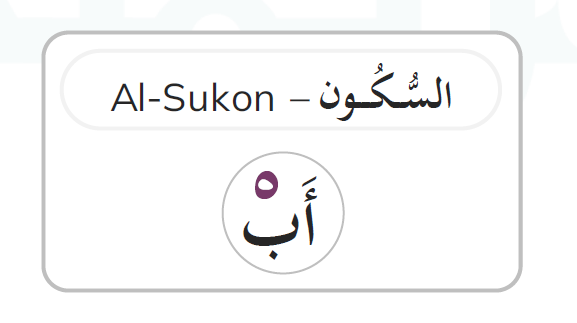
How Sukun Affects Letter Pronunciation
When a letter carries Sukun, the reader stops the sound at that consonant without adding any vowel. This is particularly important for:
- Final consonants in words
- Consonant clusters within words
- The first consonant in a Shaddah (شَدَّة) sequence — which, as explained below, is always preceded by a Sukun on the first of the two merged consonants
Example:
كَلْبٌ
kalbun
“A dog”
The لْ in the middle carries Sukun — meaning it is pronounced as a clean “l” with no following vowel before the “b.” Without Sukun awareness, beginners often insert phantom vowels between consonants, producing pronunciation errors that compound over time.
In our instructors’ experience at The Arabic Learning Centre, Sukun errors are among the most persistent pronunciation challenges for non-Arabic speaking adults — often because English phonology does not commonly require the same consonant-stop discipline Arabic demands.
What Is Tanwin and How Does It Work in Arabic?
Tanwin (تَنْوِين) is the Arabic nunation system — it adds a final “n” sound to words and signals that a noun is indefinite (equivalent to the English indefinite article “a” or “an”). Tanwin has three forms, each corresponding to one of the three short vowels: Tanwin Fath (ـً), Tanwin Kasr (ـٍ), and Tanwin Damm (ـٌ).
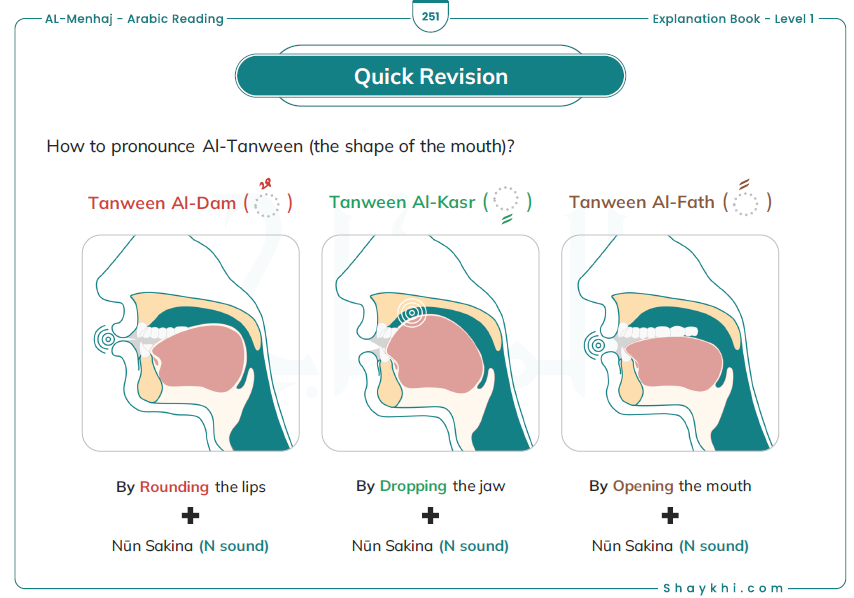
The Three Tanwin Forms and Their Cases
| Tanwin Form | Case | Grammar Function | Sound |
| Tanwin Fath ـً | Accusative (مَنْصُوب) | Object of verb / adverb | “-an” |
| Tanwin Kasr ـٍ | Genitive (مَجْرُور) | After prepositions / idafa | “-in” |
| Tanwin Damm ـٌ | Nominative (مَرْفُوع) | Subject of sentence | “-un” |
Example:
قَرَأَ وَلَدٌ كِتَابًا
qara’a waladun kitāban
“A boy read a book”
وَلَدٌ (a boy) carries Tanwin Damm as the subject. كِتَابًا (a book) carries Tanwin Fath as the object. The tanwin markers here do two jobs simultaneously: they mark indefiniteness and signal grammatical case.
For learners working toward Quranic comprehension, mastering tanwin is non-negotiable. Our Quranic Arabic Course builds tanwin recognition systematically within Quranic sentence structures.
Is Shaddah a Harakah?
Shaddah (شَدَّة) is not a harakah in the classical grammatical sense — this is an important distinction every Arabic learner should understand clearly. The seven harakat indicate vowel sounds or their absence.
Shaddah does neither. It is a gemination mark — it signals that a consonant is doubled, held for twice the normal duration. Because it always appears alongside a harakah (never alone), it is the eighth diacritical mark in the complete Arabic vowelization system.
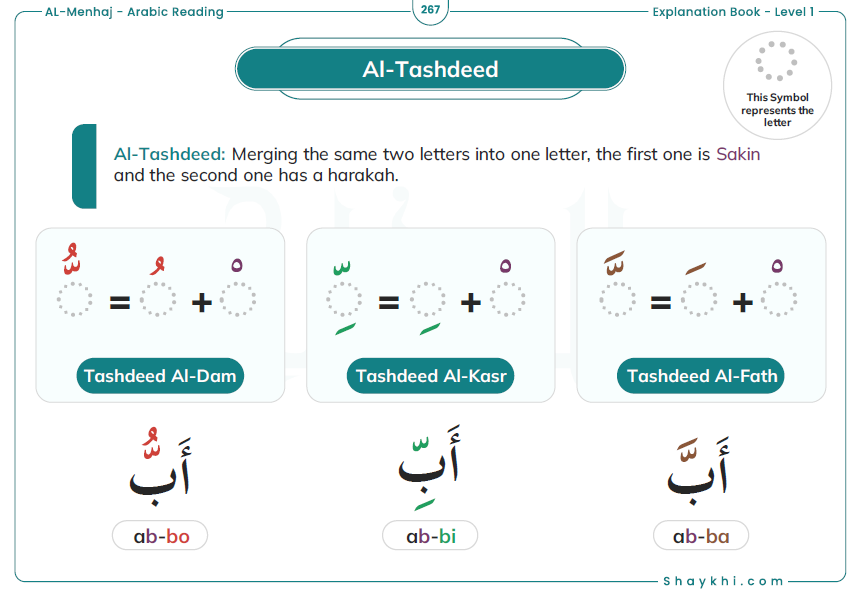
Why Shaddah Is Not Classified as a Harakah
In classical Arabic grammar (علم النحو) and traditional Tajweed scholarship, the harakat are defined as the marks that indicate vowel movement (حَرَكَة) on a letter — Fatha, Kasra, Damma — or the absence of vowel movement — Sukun.
Tanwin extends this vowel system. Shaddah, by contrast, does not produce a vowel. It merges two identical consonants into one written form, requiring the reader to pronounce the consonant with double the duration.
Example:
مُدَرِّسٌ mudarrisun “A teacher”
The رّ carries Shaddah — the “r” is doubled and held. Mispronouncing Shaddah by treating it as a single consonant is a common beginner error that changes both meaning and grammatical form entirely.
How Shaddah and Sukun Relate
Phonologically, Shaddah represents two consonants merged: the first carries an implicit Sukun, and the second carries the visible harakah written above or below the Shaddah. This is why correct Tajweed recitation requires understanding both Sukun rules and Shaddah rules in sequence — they are interconnected at the phonological level.
For learners focused on correct Quranic recitation, Shaddah is non-negotiable. You can explore the reading and pronunciation foundations in our guide on how to pronounce Arabic.
Why Are Harakat Omitted in Most Arabic Texts?
Most modern Arabic newspapers, books, novels, and websites are printed without harakat. This is not a printing shortcut — it reflects how fluent Arabic readers process text. Proficient readers recognize words from their consonantal root and context, just as fluent English readers do not need every sound explicitly marked.
For learners, this creates a genuine challenge. Harakat-free text requires:
- Strong vocabulary knowledge to recognize words by consonant pattern
- Grammatical awareness to infer correct case endings
- Contextual reading skill to disambiguate identical consonant sequences
The progression in Arabic reading instruction at The Arabic Learning Centre moves deliberately: fully vowelized texts first, then partially vowelized, then unvowelized — mirroring how proficient readers develop. Our Arabic Course for Beginners follows this staged approach from the first lesson.
Join Our Arabic Course for Beginners With a Free Trial

If you are just starting, explore our master guide to learning the Arabic alphabet as your entry point before tackling harakat in connected text.
Read Also: The Difference Between Sukoon and Jazm in Arabic Grammar
How Long Does It Take to Learn Arabic Harakat and Diacritical Marks?
Most adult learners achieve confident recognition of all eight diacritical marks — the seven harakat plus Shaddah — within two to three weeks of focused daily study. Application — correctly placing marks when writing, and reading unvowelized text from context — takes considerably longer, typically four to six months of structured practice.
A Realistic Learning Timeline for Diacritical Mark Mastery
| Stage | Skill | Typical Timeframe |
| Recognition | Identify all 8 diacritical marks by sight | 2–3 weeks |
| Pronunciation | Produce correct vowel and gemination sounds | 4–6 weeks |
| Grammatical application | Use harakat to signal case correctly | 3–5 months |
| Reading without harakat | Infer vowels from context and vocabulary | 6–12 months |
In our instructors’ experience at The Arabic Learning Centre, learners who practice diacritical mark recognition in short daily sessions — fifteen to twenty minutes — progress significantly faster than those who study in longer but infrequent sessions. Consistency of exposure matters more than session length at this stage.
You can read more about realistic Arabic learning timeframes in our article on how long it takes to learn Arabic.
Our Students Reviews
Read Also: What Is Sukoon in Arabic?
Start Learning Arabic Harakat with Certified Instructors at The Arabic Learning Centre
Harakat — and the diacritical system as a whole — are the gateway to accurate Arabic reading, correct pronunciation, and genuine Quranic comprehension. Mastering them with expert guidance saves months of self-correction later.
The Arabic Learning Centre offers:
- Certified native Arabic instructors with specialist training in Arabic literacy for non-native speakers
- 1-on-1 personalized sessions tailored to your learning pace and goals
- Flexible 24/7 scheduling to fit your lifestyle
- Structured curricula — from harakat basics through advanced Quranic Arabic
- Free trial lesson to experience the method before committing
Explore our Arabic Pronunciation Course or Learn to Read Arabic Course and take the first step today.
Check out our top courses in Arabic and choose the course you need to start learning Arabic today:
- Arabic Course for Beginners
- Arabic Script Writing Course
- Arabic Speaking Course
- Learn Arabic Letters for Tajweed
- Learning Arabic Grammar
- Arabic Vocabulary Course
- Fusha Arabic Course
- Classical Arabic Course
- Arabic Course for Islamic Studies
- Quranic Arabic Course
- Learn Arabic for New Muslims
Start with a FREE trial class and enhance your Arabic language skills

Conclusion
Arabic harakat form a precise, logical system of seven marks: three short vowels (Fatha, Kasra, Damma), Sukun, and three Tanwin forms. Each carries both a phonetic value and a grammatical signal. Shaddah — the eighth diacritical mark — works alongside this system as a gemination marker, doubling consonants without producing a vowel of its own.
Understanding this distinction is not pedantic; it is the kind of precision that produces genuinely accurate Arabic readers.
Learning all eight marks is entirely achievable with structured instruction. The system is finite, internally consistent, and designed — in the words of classical Arabic grammarians — to make the language’s meaning unambiguous to any reader, at any level. That precision is what makes Arabic one of the most systematically governed languages in the world.
Read Also: Harakat in Arabic
Frequently Asked Questions About Harakat in Arabic
How many harakat are there in Arabic?
There are seven harakat in Arabic: Fatha (short “a”), Kasra (short “i”), Damma (short “u”), Sukun (no vowel), Tanwin Fath (-an), Tanwin Kasr (-in), and Tanwin Damm (-un). When Shaddah is included — as a gemination mark rather than a harakah in the strict grammatical sense — the total number of Arabic diacritical marks used in vowelized text reaches eight.
Is Shaddah one of the harakat in Arabic?
Shaddah is not a harakah in the classical Arabic grammatical tradition. The harakat indicate vowel sounds or their absence. Shaddah indicates consonant doubling (gemination) — it doubles the duration of a consonant without producing a vowel. It is a diacritical mark that always appears alongside a harakah, making it the eighth mark in the complete Arabic diacritical system, but it belongs to a separate grammatical category.
What is the difference between Fatha, Kasra, and Damma?
Fatha produces a short “a” sound and is placed above the letter. Kasra produces a short “i” sound and is placed below the letter. Damma produces a short “u” sound and appears above the letter as a small curl. Beyond their vowel sounds, each signals a grammatical case in fully vowelized Arabic: Damma for nominative, Kasra for genitive, and Fatha for accusative.
Why do most Arabic texts not include harakat?
Most Modern Standard Arabic texts omit harakat because fluent readers identify words from consonantal root patterns and context. Harakat are retained in Quranic text, children’s books, Arabic language learning materials, and poetry — where exact pronunciation must be preserved. For learners, this means a dedicated stage of fully vowelized reading practice before transitioning to unvowelized text.
Do harakat change the meaning of Arabic words?
Yes — harakat directly affect meaning. The same Arabic root letters produce multiple different words depending on which harakat are placed on them. The root ك-ت-ب produces كَتَبَ (he wrote), كِتَابٌ (a book), and كُتُبٌ (books) through different vowelization patterns. Reading Arabic accurately without harakat requires both strong vocabulary and solid grammatical knowledge.
Related Articles
Learn Arabic