 Arabic Grammar
| Key Takeaways |
| Arabic verbs conjugate based on the subject’s person, gender, and number — all encoded within the verb itself. |
| Every Arabic verb is built on a three-letter root system; mastering roots makes conjugation patterns instantly transferable. |
| The past tense (الماضي) uses suffixes, while the present tense (المضارع) uses both prefixes and suffixes to mark agreement. |
| Arabic has masculine and feminine verb forms for all persons — even second and third person — unlike most European languages. |
| Learning conjugation systematically, starting with the past tense, is the fastest route to functional Arabic grammar. |
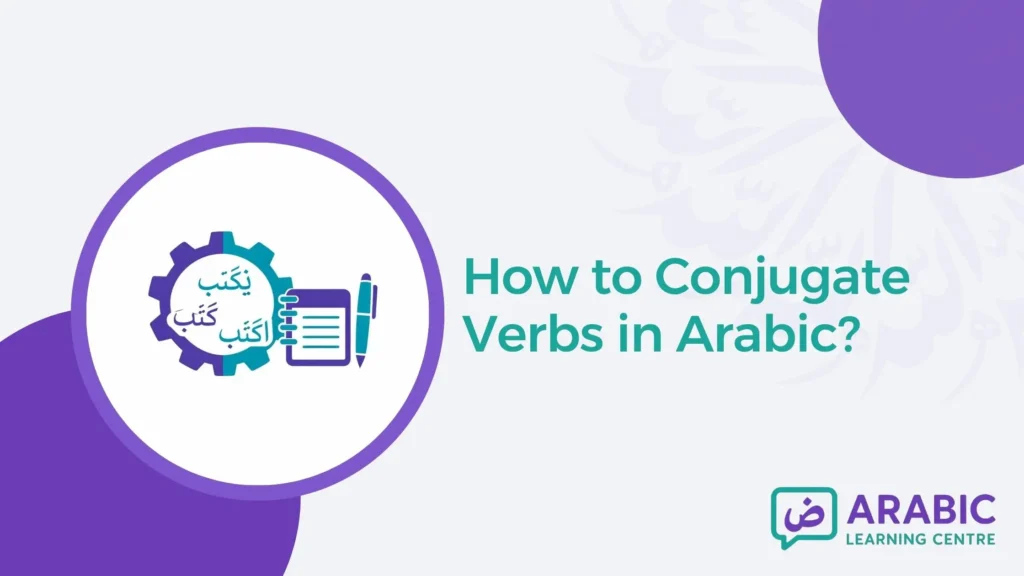
Conjugating verbs in Arabic follows a structured, rule-governed system built around three-letter roots and predictable agreement patterns for person, gender, and number.
Once you internalize the root system and the conjugation tables for past and present tense, you can conjugate thousands of Arabic verbs without memorizing each one individually. The logic is consistent — and that consistency is your greatest advantage as a learner.
Arabic verb conjugation differs fundamentally from English because the verb itself changes to reflect who is speaking, who is being spoken to, and who is being spoken about — with separate forms for masculine and feminine subjects at every level.
This guide walks you through each stage of that system methodically, so you build genuine competence rather than fragile memorization.
1. Understand the Three-Letter Root System
Arabic verb conjugation is built on the trilateral root (الجذر الثلاثي — al-jadhr al-thulāthī) — a system where nearly every Arabic verb derives from a three-consonant base that carries a core meaning. All conjugated forms are produced by applying fixed vowel patterns and affixes to this root.
Understanding roots is not optional background knowledge — it is the engine of Arabic conjugation.
Once you know the root ك-ت-ب (k-t-b, relating to writing), you can immediately recognize and produce كَتَبَ (kataba, “he wrote”), كَاتِب (kātib, “writer”), and مَكْتُوب (maktūb, “written”) — because the pattern, not the word, is what you have learned.
Why Does the Root System Change How You Learn Arabic Verbs?
Rather than memorizing individual words as isolated units, you are learning patterns applied to roots. The verb pattern for “he did” in past tense is فَعَلَ (fa’ala) — where the letters ف, ع, ل are placeholders for any root consonant.
This is the standard notation system used in classical Arabic grammar (Nahw), and every grammar explanation you encounter will reference it. Familiarize yourself with it from the start through our Arabic grammar for beginners guide.
2. Learn the Arabic Subject Pronouns and Their Grammatical Categories
Before touching a single conjugation table, you must know the Arabic pronouns — because Arabic conjugation encodes person (first, second, third), gender (masculine or feminine), and number (singular, dual, plural) simultaneously.
| Pronoun | Arabic | Transliteration | Category |
| I | أنا | anā | 1st person singular |
| You (masc. sing.) | أنتَ | anta | 2nd person masculine singular |
| You (fem. sing.) | أنتِ | anti | 2nd person feminine singular |
| He | هو | huwa | 3rd person masculine singular |
| She | هي | hiya | 3rd person feminine singular |
| We | نحن | naḥnu | 1st person plural |
| You (masc. pl.) | أنتم | antum | 2nd person masculine plural |
| You (fem. pl.) | أنتن | antunna | 2nd person feminine plural |
| They (masc.) | هم | hum | 3rd person masculine plural |
| They (fem.) | هن | hunna | 3rd person feminine plural |
| You (dual) | أنتما | antumā | 2nd person dual |
| They (dual) | هما | humā | 3rd person dual |
At The Arabic Learning Centre, our Arabic Grammar Course introduces these pronoun categories systematically before any conjugation work begins — because students who skip this step consistently struggle later with dual and feminine plural forms.
Start Learning Arabic Grammar with a Free Trial

3. Master the Past Tense Conjugation First
The الفعل الماضي (al-fi’l al-māḍī — past tense verb) is the ideal entry point into Arabic conjugation. It is formed by applying suffixes only to the verb root — no prefixes — which makes the pattern easier to isolate and memorize.
The base form of any Arabic past tense verb — third person masculine singular — is the dictionary entry form. For the root د-ر-س (d-r-s, to study), this is دَرَسَ (darasa — “he studied”).
Past Tense Conjugation Table for دَرَسَ (to study)
| Pronoun | Arabic Verb | Transliteration | Meaning |
| هو (he) | دَرَسَ | darasa | He studied |
| هي (she) | دَرَسَتْ | darasat | She studied |
| أنتَ (you, m.) | دَرَسْتَ | darasta | You studied (m.) |
| أنتِ (you, f.) | دَرَسْتِ | darasti | You studied (f.) |
| أنا (I) | دَرَسْتُ | darastu | I studied |
| هم (they, m.) | دَرَسُوا | darasū | They studied (m.) |
| هن (they, f.) | دَرَسْنَ | darasna | They studied (f.) |
| نحن (we) | دَرَسْنَا | darasnā | We studied |
| أنتم (you, m. pl.) | دَرَسْتُمْ | darastum | You studied (m. pl.) |
| أنتن (you, f. pl.) | دَرَسْتُنَّ | darastunna | You studied (f. pl.) |
| هما (they, dual) | دَرَسَا | darasā | They studied (dual m.) |
| أنتما (you, dual) | دَرَسْتُمَا | darastumā | You studied (dual) |
Notice that every change is a suffix attached after the root — this is the defining feature of the past tense system.
Shots Videos from Our Courses
4. Learn the Present Tense (الفعل المضارع) Using Prefixes and Suffixes
The الفعل المضارع (al-fi’l al-muḍāri’ — present/imperfect tense) is more complex than the past tense because it uses both prefixes and suffixes. These affixes are consistent across all verb roots, so learning them once unlocks the present tense for every verb you know.
The present tense expresses current, habitual, or ongoing actions. It is also the base form used to build the future tense — so this step has double value.
Present Tense Conjugation Table for يَدْرُسُ (to study)
| Pronoun | Arabic Verb | Transliteration | Meaning |
| هو (he) | يَدْرُسُ | yadrusu | He studies |
| هي (she) | تَدْرُسُ | tadrusu | She studies |
| أنتَ (you, m.) | تَدْرُسُ | tadrusu | You study (m.) |
| أنتِ (you, f.) | تَدْرُسِينَ | tadrusīna | You study (f.) |
| أنا (I) | أَدْرُسُ | adrusu | I study |
| هم (they, m.) | يَدْرُسُونَ | yadrusūna | They study (m.) |
| هن (they, f.) | يَدْرُسْنَ | yadrusna | They study (f.) |
| نحن (we) | نَدْرُسُ | nadrusu | We study |
| أنتم (you, m. pl.) | تَدْرُسُونَ | tadrusūna | You study (m. pl.) |
| أنتن (you, f. pl.) | تَدْرُسْنَ | tadrusna | You study (f. pl.) |
The four prefix consonants — أ، ت، ي، ن — map directly to the four persons: أ = I, ت = you/she, ي = he/they, ن = we. Learning this mapping is one of the highest-leverage moves in early Arabic grammar study.
5. Understand Gender Agreement Rules for Arabic Verbs
Arabic verb conjugation requires gender agreement between the verb and its subject — a rule called مُطَابَقَة (muṭābaqa). This applies to second and third person forms in both tenses and is one of the most consistent error patterns we observe at The Arabic Learning Centre among learners from English-speaking backgrounds.
English has no grammatical gender in verbs. Arabic has it in every single form except first person singular and plural. Learners unconsciously default to masculine forms for all subjects until gender agreement becomes habitual through deliberate practice.
Common Gender Agreement Errors and Their Corrections
| Incorrect Form | Correct Form | Rule Violated |
| هي دَرَسَ | هي دَرَسَتْ | Feminine subject requires feminine suffix ـَتْ |
| أنتِ تَدْرُسُ | أنتِ تَدْرُسِينَ | Feminine 2nd person requires ـِينَ suffix |
| هن يَدْرُسُونَ | هن يَدْرُسْنَ | Feminine plural uses نَ not وا |
Practice gender agreement actively by substituting pronouns in sample sentences — this is far more effective than rereading rules. Our Arabic speaking course builds this through structured conversation drills from the first session.
Enroll in Our Arabic Speaking Course Today With a Free Trial

6. Form the Future Tense Using the Present Tense Base
The Arabic future tense (المستقبل — al-mustaqbal) is formed simply by adding the prefix سَـ (sa-) or the particle سَوْفَ (sawfa) before the present tense verb form. No new conjugation table is required.
سَ is attached directly to the verb with no space. سَوْفَ is written as a separate word before the verb. Both express future meaning — سَوْفَ carries a slightly stronger sense of certainty or emphasis in classical usage.
Example:
يَدْرُسُ → سَيَدْرُسُ yadrusu → sayadrusu “He studies” → “He will study”
سَوْفَ تَدْرُسُ sawfa tadrusu “You will study” (with emphasis)
Once you have internalized the present tense conjugation table in Step 4, the future tense costs you nothing additional — just the two prefixes.
7. Apply the Conjugation System to Verb Types Beyond the Sound Verb
The conjugation tables above apply to what classical Arabic grammar (Nahw) calls الفعل الصحيح السالم (al-fi’l al-ṣaḥīḥ al-sālim) — the sound or regular verb, where no root letter is a و, ي, or ء (hamza). These are the most stable verb type and the correct starting point.
Once you are confident with sound verbs, you will encounter other verb types that follow modified — but still predictable — patterns.
The Main Arabic Verb Root Categories
- الفعل الصحيح السالم — Sound verb: all root letters are strong consonants (e.g., كَتَبَ, دَرَسَ)
- الفعل المثال — Assimilated verb: first root letter is و or ي (e.g., وَصَلَ — waṣala, “to arrive”)
- الفعل الأجوف — Hollow verb: middle root letter is و or ي (e.g., قَالَ — qāla, “to say”)
- الفعل الناقص — Defective verb: final root letter is و or ي (e.g., دَعَا — da’ā, “to call/invite”)
- الفعل المضاعف — Doubled verb: second and third root letters are identical (e.g., مَرَّ — marra, “to pass”)
Do not attempt all categories simultaneously. In our instructors’ experience, learners who solidify sound verb conjugation first — spending two to three weeks on it exclusively — progress through the remaining verb types significantly faster than those who try to cover all types at once.
Read Also: What Is a Verbal Sentence in Arabic?
8. Practice Conjugation in Real Sentences, Not Isolated Tables
Conjugation tables are tools for reference — not the destination. The final and most important step is deploying conjugated verbs inside real Arabic sentences, where you must simultaneously manage verb-subject agreement, word order, and meaning.
Arabic is a VSO language (Verb-Subject-Object), though SVO order is also used in Arabic. This means the conjugated verb typically appears before the explicit subject noun when both are present.
Example sentences using learned conjugation:
ذَهَبَ الطَّالِبُ إلى المَدْرَسَةِ
dhahaba aṭ-ṭālibu ilā al-madrasa
“The student (m.) went to the school.”
تَكْتُبُ الطَّالِبَةُ الدَّرْسَ
taktubu aṭ-ṭālibatu ad-darsa
“The female student writes the lesson.”
Notice that in the second sentence, تَكْتُبُ uses the feminine present prefix تَـ — because الطَّالِبَةُ is a feminine noun. Verb-subject gender agreement applies even when the subject is a noun, not just a pronoun.
For immersive practice in real communicative contexts, our Arabic conversation course gives learners structured speaking practice with live certified instructors from the first session. If you are still building your reading foundation, the how to learn Arabic guide outlines the complete beginner roadmap.
Our Students Reviews
Read Also: Types of Verbs in Arabic
Begin Mastering Arabic Verb Conjugation with The Arabic Learning Centre
Arabic verb conjugation is genuinely learnable when approached in the right sequence — roots first, then past tense, then present tense, then application in real sentences.
The Arabic Learning Centre’s Arabic Grammar Course gives you exactly that — structured, step-by-step conjugation mastery with certified native Arabic instructors in personalized 1-on-1 sessions.
- Certified native Arabic instructors with 7+ years of teaching experience
- Flexible scheduling available 24/7 — learn at your pace
- Personalized curriculum adapted to your level and goals
- Free trial lesson — no commitment required
Explore the Arabic Grammar Course →
Check out our top courses in Arabic and choose the course you need to start learning Arabic today:
- Arabic Course for Beginners
- Arabic Script Writing Course
- Arabic Speaking Course
- Learn Arabic Letters for Tajweed
- Learning Arabic Grammar
- Arabic Vocabulary Course
- Fusha Arabic Course
- Classical Arabic Course
- Arabic Course for Islamic Studies
- Quranic Arabic Course
- Learn Arabic for New Muslims
Start with a FREE trial class and enhance your Arabic language skills

Conclusion
Arabic verb conjugation becomes manageable the moment you recognize it as a pattern system rather than a memorization task. Every verb root you learn applies across the same conjugation tables — so your vocabulary and your grammar grow together, not separately.
The past tense suffixes and present tense prefix-suffix combinations are fixed across the entire language. Once internalized, they function like a key that opens every Arabic verb you encounter from that point forward.
Consistent daily practice with real sentences — not just table review — is what converts grammatical knowledge into functional fluency. Start with sound verbs, build confidence in gender agreement, then move through the remaining verb types in order. Insha’Allah, the system will click faster than you expect.
Read Also: Tenses in Arabic
Frequently Asked Questions About How to Conjugate Verbs in Arabic
What is the easiest Arabic tense to learn for conjugation first?
The past tense (الماضي) is the easiest entry point because it uses suffixes only — no prefixes. The base form is also the dictionary entry, so you can look up any verb and immediately have the third person masculine singular form. Build past tense confidence before approaching the present tense.
Do Arabic verbs change based on the gender of the subject?
Yes — Arabic verbs change form based on the subject’s gender at every person level except first person. Second and third person forms have distinct masculine and feminine versions in both past and present tense. This is called مُطَابَقَة (muṭābaqa) — gender agreement — and is one of the most important rules in Arabic grammar.
What is the Arabic three-letter root system and why does it matter for conjugation?
The trilateral root (الجذر الثلاثي) is the three-consonant base that carries the core meaning of nearly every Arabic verb. All conjugation patterns are applied to this root, so learning the pattern once allows you to conjugate any verb sharing that structure — making root knowledge essential for efficient and scalable verb learning.
How is the Arabic future tense formed from the present tense?
The future tense is formed by adding سَـ directly before the present tense verb, or سَوْفَ as a separate particle before it. No new conjugation forms are needed — the present tense table applies completely. For example, يَدْرُسُ (he studies) becomes سَيَدْرُسُ (he will study) with no other change.
How long does it take to learn Arabic verb conjugation as a complete beginner?
In our instructors’ experience at The Arabic Learning Centre, most adult learners can confidently conjugate sound verbs in past and present tense within four to six weeks of structured daily practice — approximately 20–30 minutes per day. Mastery of all verb types, including hollow and defective verbs, typically develops over three to five months of consistent study.
Related Articles
Arabic Grammar