 Learn Arabic
| Key Takeaways |
| Classical Arabic (Fusha) is the formal written language of the Quran, classical literature, and pan-Arab media, unchanged for over 1,400 years. |
| Learning Classical Arabic requires mastering 28 letters, core Nahw grammar rules, and a structured vocabulary base before attempting classical texts. |
| Classical Arabic differs from Modern Standard Arabic primarily in vocabulary formality, poetic structures, and Quranic grammatical constructions not used in MSA. |
| Most dedicated adult learners reach functional Classical Arabic reading ability within 12–18 months of consistent, structured daily study. |
| Countries across 22 Arab nations use Classical Arabic in religious, legal, and formal contexts, making it the most geographically widespread Arabic register. |
Learning Classical Arabic is achievable for non-Arabic speakers who follow a structured, expert-guided progression. Start with the Arabic alphabet, build your grammar foundation through classical Nahw rules, then systematically expand your vocabulary using authentic classical sources. The path is demanding, but it is clear.
Classical Arabic opens access to the Quran in its original form, centuries of Islamic scholarship, classical poetry, and formal written Arabic across 22 nations. The steps below reflect what actually works in the classroom — not generic advice, but the precise sequence our instructors at The Arabic Learning Centre use with non-native learners every day.
What Is Classical Arabic?
Classical Arabic (Al-Fusha) is the formal Arabic register preserved in the Quran, pre-Islamic poetry, and over fourteen centuries of Islamic scholarly literature. It follows strict grammatical rules codified by classical grammarians like Sibawayhi in Al-Kitab, and its core structure has remained stable since the 7th century CE.
This matters practically: the Arabic you encounter in Sahih Al-Bukhari, the Diwan of Imru Al-Qays, or classical legal texts (fiqh) follows the same grammatical framework. Mastering Classical Arabic gives you access to all of it.
What Is the History of Classical Arabic?
Classical Arabic developed on the Arabian Peninsula among the tribes of the Hejaz and Najd regions, with the Quraysh dialect serving as the prestige register. The Quran’s revelation in the 7th century CE standardized Classical Arabic as the highest linguistic authority in the Arab world.
The Abbasid-era grammarians of Basra and Kufa then codified its rules into the science of Nahw (Arabic grammar), producing foundational texts that classical Arabic students still study today. This grammatical tradition is what distinguishes Classical Arabic as a precisely defined, teachable system rather than a loose historical dialect.
How to Learn Classical Arabic?
Mastering Classical Arabic requires a structured approach that transitions from understanding its unique linguistic nature to practical application. By focusing on the foundational pillars of script, phonetics, and grammar, you can systematically unlock the complexities of classical texts and literature.
1. Learn the Difference Between Classical Arabic and Modern Standard Arabic
Classical Arabic vs. Modern Standard Arabic (MSA) — these are related but distinct registers. Classical Arabic refers to the language of the Quran and pre-modern classical literature. MSA is the modern formal written and broadcast Arabic used in contemporary newspapers, official speeches, and pan-Arab media, developed primarily in the 19th and 20th centuries.
| Feature | Classical Arabic | Modern Standard Arabic |
| Vocabulary | Quranic and classical literary terms | Contemporary terminology added |
| Grammar complexity | Full case ending system (iʿrab) | Case endings often simplified |
| Poetic structures | Elaborate classical metres (buhur) | Rare in modern usage |
| Dual forms | Strictly observed | Often reduced in practice |
| Primary sources | Quran, hadith, classical texts | Media, journalism, modern literature |
The grammar of Classical Arabic is more formally strict than MSA — particularly in the application of full iʿrab (case ending) rules, which mark grammatical function on every noun.
If you are learning Arabic for Quranic understanding or classical scholarship, Classical Arabic is your target. Our guide on how to learn Arabic addresses both pathways in detail.
2. Master the Classical Arabic Alphabet
To learn Classical Arabic, your first and non-negotiable step is mastering the 28 Arabic letters in all four positional forms — isolated, initial, medial, and final. Without this foundation, no grammar or vocabulary instruction will stick.
Most adult learners recognize all 28 letters within 1 to 2 weeks of daily fifteen-minute focused practice.
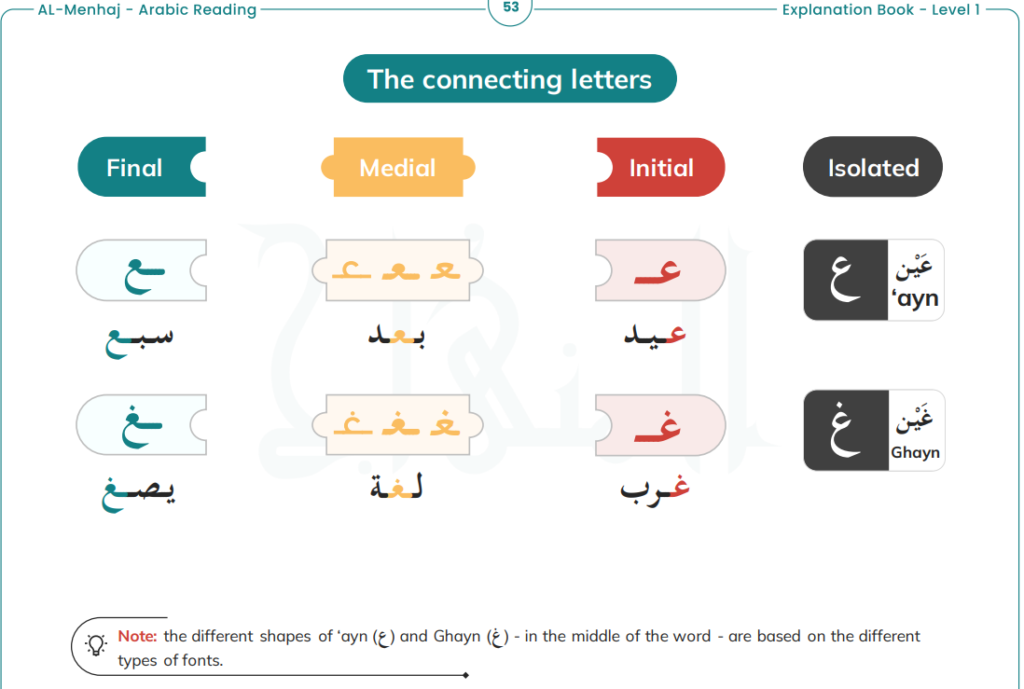
Classical Arabic is written right-to-left, and every letter changes shape depending on its position within a word. Consider the letter ع (ʿayn):
| Position | Form | Example Word |
| Isolated | ع | stands alone |
| Initial | عَلَّمَ | ʿallama — “he taught” |
| Medial | فَعَلَ | faʿala — “he did” |
| Final | سَمَعَ | samiʿa — “he heard” |
Beyond letter shapes, Classical Arabic uses tashkeel (short vowel diacritical marks) — the Fatha (َ), Kasra (ِ), and Damma (ُ) — that are essential for reading classical texts correctly.
Modern Arabic print often omits these, but classical texts, Quranic manuscripts, and formal educational materials retain them.
For a detailed breakdown of letter formation, visit our guide on mastering the Arabic alphabet.
At The Arabic Learning Centre, students in our learn to read Arabic course master letter forms and tashkeel reading before advancing to any grammar or text work. This sequencing prevents the most common early-stage errors we observe — learners who skip tashkeel training consistently misread classical verb forms months later.
Start Reading Arabic with a FREE Trial

3. Train Your Ear and Tongue on Classical Arabic Pronunciation
Classical Arabic contains sounds absent from most European languages. The مخارج الحروف (Makhārij al-Ḥurūf) — articulatory points of each letter — must be learned correctly from the outset, because mispronunciation in Classical Arabic can alter meaning entirely.
Three sounds cause near-universal difficulty for English speakers:
- ع (ʿayn): A voiced pharyngeal fricative produced by constricting the upper throat. Beginners consistently produce a plain glottal stop or omit it entirely. The correct articulation requires pressing the pharynx inward while voicing.
- ح (Ḥa): A voiceless pharyngeal fricative — a forceful, breathy “h” produced deep in the throat, distinct from the softer ه (Ha).
- ق (Qaf): A uvular stop produced at the back of the tongue touching the uvula — not the velum as in English “k.”
Correct pronunciation from day one prevents deeply embedded errors. Our Arabic pronunciation course addresses makhraj training specifically, and you can explore foundational pronunciation guidance in our article on how to pronounce Arabic.
Begin Pronouncing Arabic Fluently with a Free Trial

4. Build a Classical Arabic Vocabulary Bank
Classical Arabic, which is used in religious texts such as the Quran, differs slightly from MSA but shares much of its structure. Learning some classical Arabic vocabulary is key for deepening your understanding of the language’s roots.
| Arabic Script | Transliteration | English Translation |
| عَسَى | ʿasā | Perhaps, may |
| لَعَمْرُكَ | laʿamruka | By your life! |
| وَيْحَكَ | wayḥaka | Woe to you! |
| بَذَلَ | badhala | He gave, bestowed |
| جَهِلَ | jahila | He was ignorant |
| حَسُنَ | ḥasana | It was good, beautiful |
| خَشِيَ | khashiya | He feared |
| دَنَا | danā | He approached |
What Are the Most Used Classical Arabic Words?
The most used Classical Arabic words cluster in six categories: Quranic formulaic phrases, core verb roots, prepositions, demonstrative pronouns, connectives, and common noun patterns. Beginning with these maximizes your reading comprehension fastest.
Below are high-frequency Classical Arabic words every learner should prioritize:
| Arabic | Transliteration | Meaning | Category |
| قَالَ | qāla | He said | Core verb |
| رَبَّ | rabba | Lord (of) | Quranic noun |
| فِي | fī | In / within | Preposition |
| الَّذِي | alladhī | Who / which (masc.) | Relative pronoun |
| إِنَّ | inna | Verily / indeed | Emphatic particle |
| عَلَى | ʿalā | Upon / over | Preposition |
| كَانَ | kāna | He was | Core verb |
| مِنْ | min | From / of | Preposition |
Classical Arabic vocabulary learning is most effective when organized around trilateral roots (جذور, judhhur). The root ك-ت-ب (k-t-b), for instance, generates كَتَبَ (kataba — “he wrote”), كِتَاب (kitāb — “book”), كَاتِب (kātib — “writer”), and مَكْتَبَة (maktaba — “library”). Learning one root unlocks multiple words simultaneously.
Our Arabic vocabulary course teaches this root-based approach systematically, which our instructors find dramatically accelerates classical text reading speed compared to rote memorization.
Enroll in Our Arabic Vocabulary Course to Get Your Free Trial

Read also: Arabic Alphabet Practice
5. Build Your Classical Arabic Grammar Foundation Systematically
The most important grammar rules in Classical Arabic form the backbone of everything you will read. Classical Nahw scholarship identifies core areas every learner must master in sequence — not simultaneously.
What Are the Top Grammar Rules in Classical Arabic?
Classical Arabic grammar rests on these foundational rules every serious learner must command:
A. (Al-Iʿrab) — Case Endings
Nouns carry nominative (ضمة, Damma), accusative (فتحة, Fatha), and genitive (كسرة, Kasra) endings that signal their grammatical role.
The sentence جَاءَ الطَّالِبُ (jāʾa al-ṭālibu — “The student came”) uses the nominative Damma on الطَّالِبُ because it is the فاعل (faʿil/subject).
B. (Al-Idafa) — Possessive Construction
Two nouns placed in a possessive relationship. The first noun (المضاف) is indefinite and the second (المضاف إليه) takes the genitive case. Example: كِتَابُ الطَّالِبِ (kitābu al-ṭālibi — “the student’s book”).
C. (Al-Mubtada wal-Khabar) — Nominal Sentence
Classical Arabic sentences can begin with a noun (subject) followed directly by a predicate, with no verb required. Example: اللهُ رَبُّنَا (Allāhu rabbunā — “Allah is our Lord”).
D. (Al-Fiʿl wal-Faʿil) — Verb-Subject Agreement
Verbs must agree with their subject in gender but, in Classical Arabic, not necessarily in number when the verb precedes the subject. This surprises many learners who expect full plural agreement.
E. (Awzān Al-Afʿal) — Verb Patterns (Morphological Scales):
Classical Arabic verbs follow approximately ten core patterns (أوزان), each carrying a predictable meaning modification. The pattern فَعَّلَ (faʿʿala) typically indicates causation, while تَفَعَّلَ (tafaʿʿala) often indicates reflexive or gradual action.
For a foundational grammar introduction, see our Arabic grammar for beginners resource.
Our Arabic Grammar Course covers all these rules with structured progression specifically designed for non-native speakers.
Students at The Arabic Learning Centre who work through iʿrab rules with a qualified instructor before self-study almost always internalize case endings correctly — those who attempt grammar books alone frequently develop persistent errors that require correction later.
Start Learning Arabic Grammar with a Free Trial

Read also: The Best Arabic Language Learning Resources
Is Classical Arabic Still Spoken Today?
Classical Arabic is not used as a spoken vernacular in daily conversation — no community speaks it as a mother tongue. However, it remains actively used in formal contexts: Quranic recitation, Islamic sermons (khutbah), official religious rulings (fatwas), classical poetry recitation, and formal academic discourse.
Educated Arabs across all 22 Arab League nations share Classical Arabic as a common formal written register. A scholar in Morocco and a scholar in Iraq, speaking entirely different dialects in daily life, communicate through Classical Arabic in writing and formal speech without difficulty.
What Countries Use Classical Arabic?
Classical Arabic serves as the formal religious and literary language across all 22 member states of the Arab League, from Morocco in the west to Oman in the east. It is also the language of Islamic scholarship used by Muslims globally — including non-Arab majority countries like Iran, Turkey, Pakistan, Indonesia, and Malaysia — for religious study and Quranic literacy.
The Quran’s text is Classical Arabic, which gives the language a global reach extending far beyond Arab-majority nations. Estimates suggest over 1.8 billion Muslims worldwide have at least some exposure to Classical Arabic through religious practice.
Begin Learning Classical Arabic with Certified Instructors at The Arabic Learning Centre
Classical Arabic rewards structured, expert-guided study. The steps above give you the correct sequence — but the speed and accuracy of your progress depend heavily on working with qualified teachers who diagnose your specific errors and correct them before they calcify.
The Arabic Learning Centre offers:
- 1-on-1 personalized sessions with certified native Arabic instructors
- Flexible 24/7 scheduling to fit any time zone
- Structured courses from the Arabic alphabet through advanced classical grammar
- Free trial lesson — no commitment required
Explore our Arabic Course for Beginners or our dedicated Arabic Grammar Course and take your first step toward Classical Arabic with a teacher who has guided hundreds of learners through exactly where you are starting.
Check out our top courses in Arabic and choose the course you need to start learning Arabic today:
- Arabic Course for Beginners
- Arabic Script Writing Course
- Arabic Speaking Course
- Learn Arabic Letters for Tajweed
- Learning Arabic Grammar
- Arabic Vocabulary Course
- Fusha Arabic Course
- Classical Arabic Course
- Arabic Course for Islamic Studies
- Quranic Arabic Course
- Learn Arabic for New Muslims
Start with a FREE trial class and enhance your Arabic language skills

Frequently Asked Questions About How to Learn Classical Arabic
How long does it take to learn Classical Arabic from scratch?
Most adult non-Arabic speakers reach functional Classical Arabic reading ability — meaning they can work through classical texts with dictionary support — within 12 to 18 months of structured daily study averaging 45 to 60 minutes. Full independent comprehension of complex classical texts typically requires three or more years of consistent, guided study with a qualified instructor.
Can I learn Classical Arabic without learning Modern Standard Arabic first?
You can learn Classical Arabic directly without MSA as a prerequisite. Many learners — particularly those motivated by Quranic understanding or Islamic scholarship — begin with Classical Arabic from day one. MSA and Classical Arabic share the same grammatical framework, so progress in either register strengthens the other. Choose your starting point based on your learning goal.
What is the difference between Classical Arabic letters and the modern Arabic alphabet?
The Classical Arabic alphabet and the modern Arabic alphabet are identical — 28 letters, written right-to-left, with the same four positional forms. The primary difference is that classical texts consistently use tashkeel (short vowel diacritical marks), while modern Arabic print typically omits them. Reading classical texts therefore requires confident tashkeel recognition, which modern Arabic readers often lack.
Is Classical Arabic hard to learn for English speakers?
Classical Arabic is genuinely demanding for English speakers — the grammatical case system, the root-based morphology, the unfamiliar script, and the pharyngeal and emphatic sounds have no equivalents in English. The Foreign Service Institute classifies Arabic among the most time-intensive languages for English speakers. That said, with a structured curriculum and qualified instruction, the grammar follows logical, learnable patterns. It is difficult — not impossible.
Where can I find authentic Classical Arabic texts for practice?
The Quran is the most widely accessible and linguistically precise Classical Arabic text available, and it is the reference point for all classical grammar scholarship. Beyond the Quran, the Forty Hadith of Imam Al-Nawawi offers simpler classical prose suitable for intermediate learners. For lexical reference, the Hans Wehr Arabic-English Dictionary remains a standard resource for root-based vocabulary lookup in classical and modern texts.

Leave a Reply