What Are The Arabic Names Of Each Of The Five Pillars Of Islam?
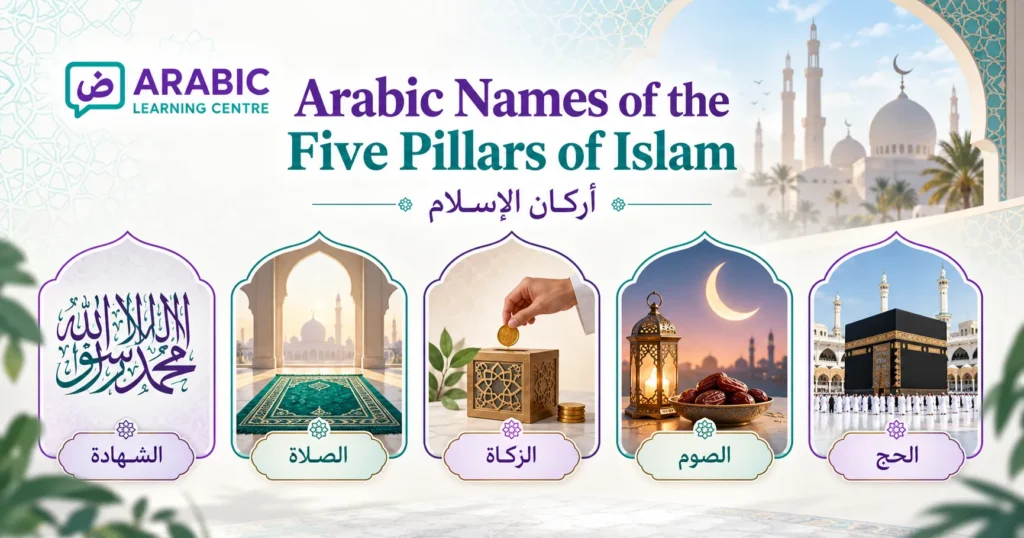
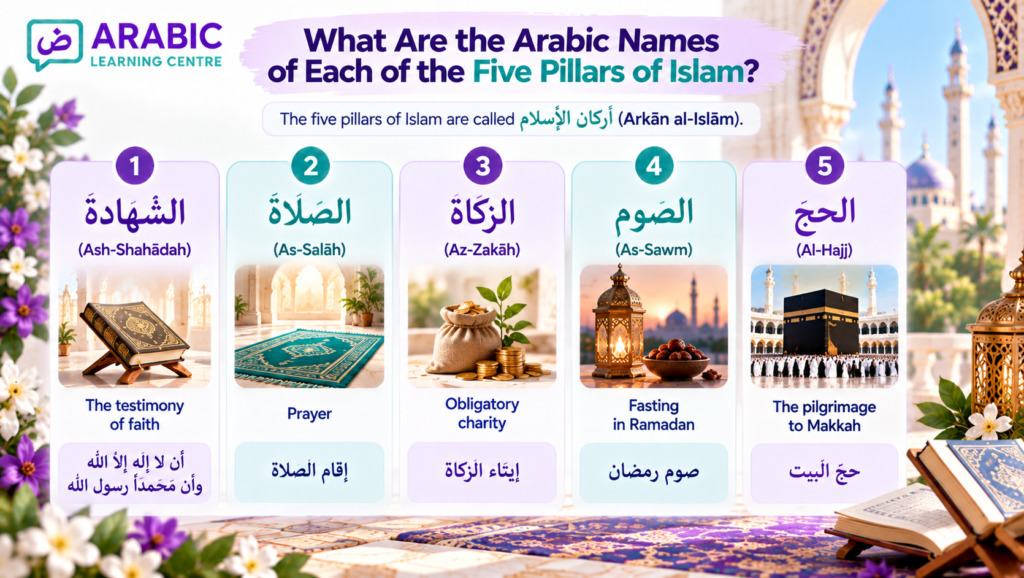
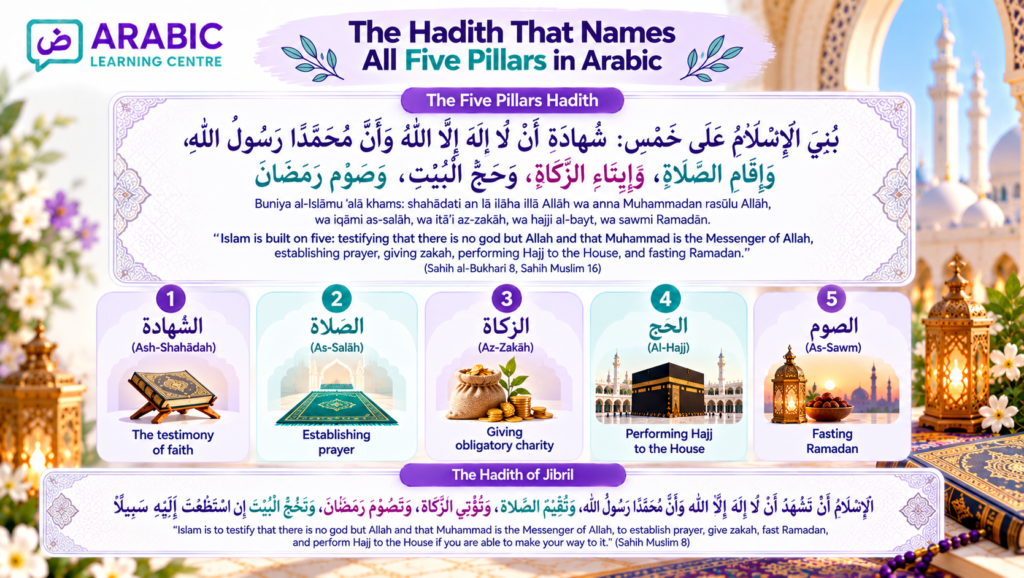
The Arabic names of the five pillars of Islam are الشهادة (Ash-Shahādah), الصلاة (As-Salāh), الزكاة (Az-Zakāh), الصوم (As-Sawm) and الحج (Al-Hajj). In English, they are the testimony of faith, prayer, obligatory charity, fasting in Ramadan and the pilgrimage to Makkah.
Together they are called أركان الإسلام (Arkān al-Islām). The singular, ركن (rukn), means the strong corner of a building, the part it cannot stand without. The image comes from the Prophet ﷺ himself, who described Islam as built on five: بُنِيَ الإِسْلَامُ عَلَى خَمْسٍ. You will find the full hadith, with its source, later in this article.
Each name begins with ال (al-), the Arabic word for “the.” Before “sun letters” such as ش, ص, ز and س, the “l” blends into the next sound. That is why we say Ash-Shahādah, As-Salāh, Az-Zakāh and As-Sawm, but Al-Hajj.
Below, you will find each pillar in Arabic script, how to pronounce it, what the word means and the short Arabic phrase used for it in the hadith.
1. الشهادة (Ash-Shahādah): The Testimony of Faith
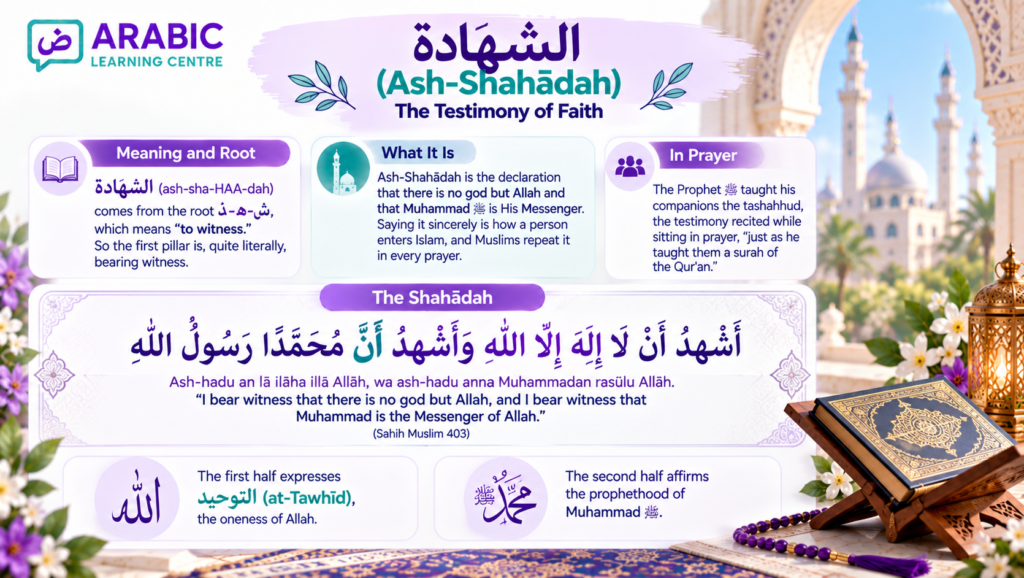
The word الشهادة is pronounced ash-sha-HAA-dah and comes from the root ش-ه-د, which means “to witness.” So the first pillar is, quite literally, bearing witness.
Ash-Shahādah is the declaration that there is no god but Allah and that Muhammad ﷺ is His Messenger. Saying it sincerely is how a person enters Islam, and Muslims repeat it in every prayer.
The Prophet ﷺ taught his companions the tashahhud, the testimony recited while sitting in prayer, “just as he taught them a surah of the Qur’an.” It ends with the Shahadah in its best-known wording:
Ash-hadu an lā ilāha illā Allāh, wa ash-hadu anna Muhammadan rasūlu Allāh “I bear witness that there is no god but Allah, and I bear witness that Muhammad is the Messenger of Allah.”
You pronounce الصلاة as-sa-LAAH. When the hadith lists this pillar, it doesn’t just say “prayer” but إقام الصلاة (iqām as-salāh), “establishing the prayer,” which means keeping it up regularly and properly.
As-Salāh is the five daily prayers, performed at set times while facing the Kaaba in Makkah. Allah says:
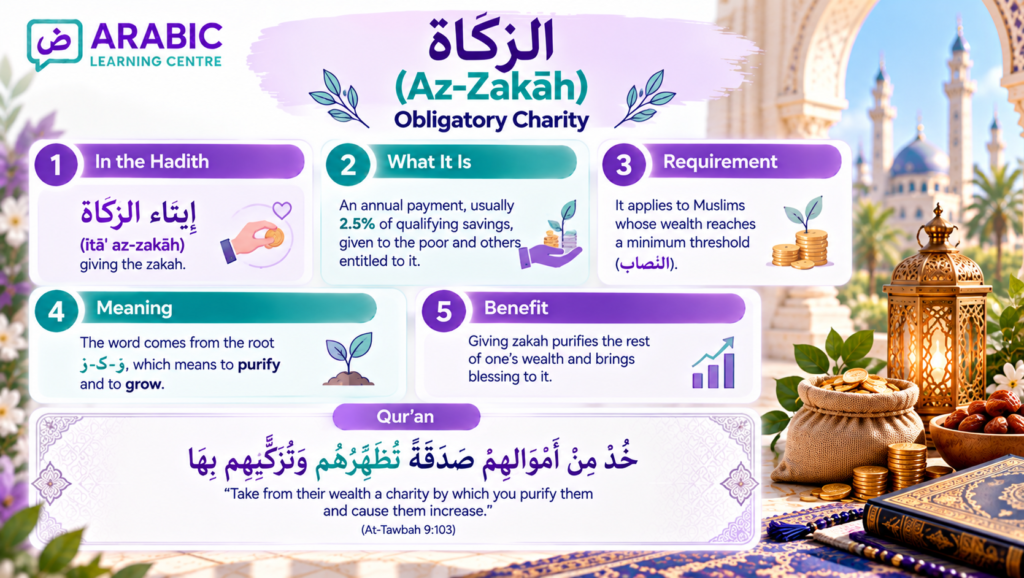
In the hadith, this pillar comes as إيتاء الزكاة (ītā’ az-zakāh), “giving the zakah.” The word itself is said az-za-KAAH.
Az-Zakāh is an annual payment, usually 2.5% of qualifying savings, given to the poor and others entitled to it. It applies to Muslims whose wealth reaches a minimum threshold, called النصاب (an-nisāb).
The word comes from the root ز-ك-و, which carries two meanings: to purify and to grow. Giving zakah purifies the rest of one’s wealth and brings blessing to it. The Qur’an captures both ideas:
Voluntary charity beyond zakah has a separate name: الصدقة (as-sadaqah). Understanding roots like ز-ك-و is a core skill in our Arabic course for high school students, where teens learn how one root branches into many related words.
Inside Our Classrooms
See how we make learning interactive and engaging! Watch a quick snippet of our live, conversational classes in action:
ض
Master the Arabic Language
Join our expert-led sessions and start your journey today.
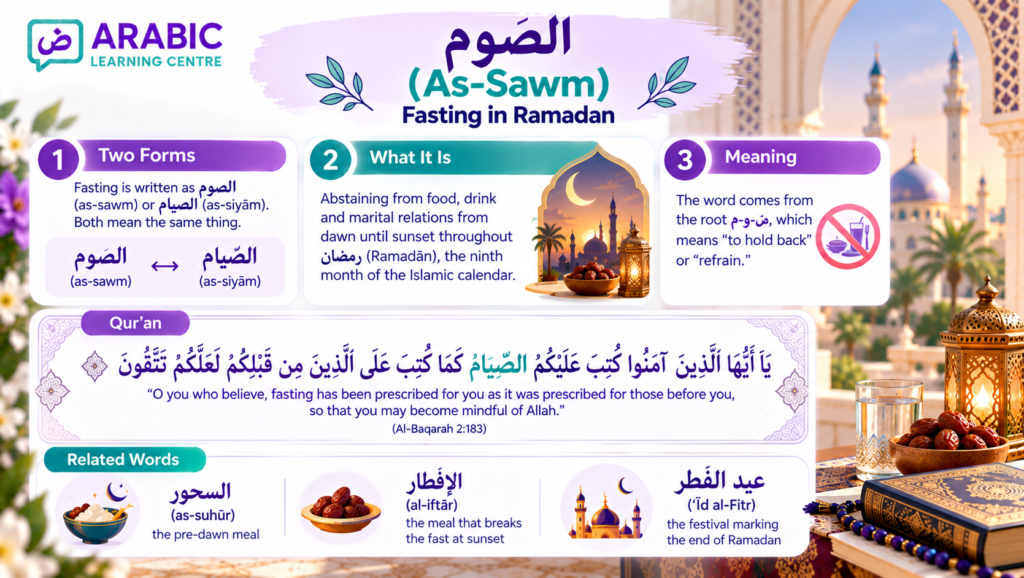
You will see fasting written two ways in Arabic: الصوم (as-sawm) and الصيام (as-siyām). Both mean the same thing. The hadith names the pillar صوم رمضان (sawm Ramadān), “fasting Ramadan.”
As-Sawm means abstaining from food, drink and marital relations from dawn until sunset throughout رمضان (Ramadān), the ninth month of the Islamic calendar. The literal meaning of the word is “to hold back” or “refrain.”
الإفطار (al-iftār): the meal that breaks the fast at sunset
عيد الفطر (‘Īd al-Fitr): the festival marking the end of Ramadan
5. الحج (Al-Hajj): The Pilgrimage to Makkah
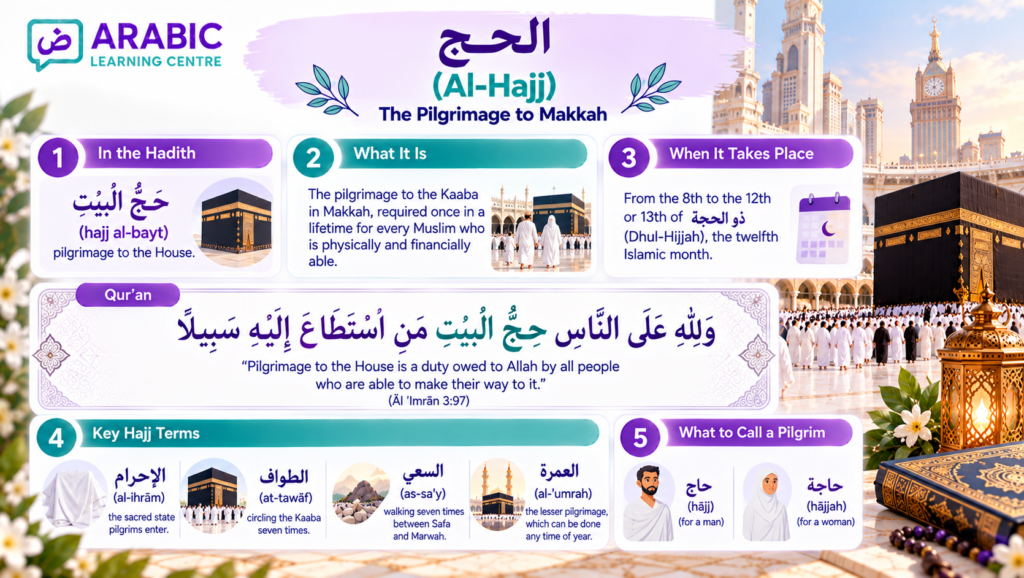
Al-Hajj is a short word with a doubled final letter, so you lean on the end: al-HAJJ. In the hadith it appears as حج البيت (hajj al-bayt), “pilgrimage to the House.”
Al-Hajj is the pilgrimage to the Kaaba in Makkah, required once in a lifetime of every Muslim who is physically and financially able. It takes place from the 8th to the 12th or 13th of ذو الحجة (Dhul-Hijjah), the twelfth Islamic month, whose name itself means “the month of Hajj.”
The condition of ability comes straight from the Qur’an:
Buniya al-Islāmu ‘alā khams: shahādati an lā ilāha illā Allāh wa anna Muhammadan rasūlu Allāh, wa iqāmi as-salāh, wa ītā’i az-zakāh, wa hajji al-bayt, wa sawmi Ramadān. “Islam is built on five: testifying that there is no god but Allah and that Muhammad is the Messenger of Allah, establishing prayer, giving zakah, performing Hajj to the House, and fasting Ramadan.”
Read it slowly and you will hear every pillar’s Arabic phrase from this article: شهادة، إقام الصلاة، إيتاء الزكاة، حج البيت، صوم رمضان. Al-Bukhārī’s narration says والحج (“and Hajj”) where Muslim’s says وحج البيت (“and Hajj to the House”); the meaning is the same.
The same five pillars appear in the famous hadith of Jibrīl, where the Prophet ﷺ defines Islam before going on to explain Imān and Ihsān:
“Islam is to testify that there is no god but Allah and that Muhammad is the Messenger of Allah, to establish prayer, give zakah, fast Ramadan, and perform Hajj to the House if you are able to make your way to it.”
Learn the Language of the Five Pillars with Arabic Learning Centre
Everything in this article, from the heavy ص in الصلاة to the root ز-ك-و hiding inside الزكاة, is the kind of Arabic we teach every day.
at Arabic Learning Centre Our teachers don’t stop at memorized words. They help students hear the difference between letters, see how one root builds a whole family of meanings and understand what they say in their own prayers.
We offer structured programs for every stage of life. Young children start with letters, sounds and simple phrases like أركان الإسلام. Teenagers move on to grammar, roots and reading real texts. Adults, whether complete beginners or returning learners, follow a flexible path built around busy schedules.
The goal is simple: that the next time you recite the tashahhud, hear إقام الصلاة in a hadith or read a verse about fasting or Hajj, you understand it directly, without waiting for a translation. That is where learning Arabic stops being a subject and becomes part of your worship.
So, what are the Arabic names of each of the five pillars? They are الشهادة (Ash-Shahādah), the testimony of faith; الصلاة (As-Salāh), the prayer; الزكاة (Az-Zakāh), the obligatory charity; الصوم (As-Sawm), fasting in Ramadan; and الحج (Al-Hajj), the pilgrimage to Makkah. Together they form أركان الإسلام, the foundation the Prophet ﷺ described when he said Islam is “built on five.”
Each name carries more than a label. الشهادة means bearing witness, الزكاة joins purification with growth, and الصوم means holding back. Once you know these meanings, the verses and hadith about the pillars read very differently. Translation gives you the outline; the Arabic gives you the full picture.
The easiest way to keep all five names in memory is the hadith itself: بُنِيَ الإسلامُ على خمس. Learn it once, and every pillar comes with its own phrase attached: إقام الصلاة، إيتاء الزكاة، صوم رمضان، حج البيت. From there, you will start to recognise these words everywhere, in the call to prayer, in the tashahhud and in the verses you hear recited.
Frequently Asked Questions
What is the Arabic word for “pillars of Islam”?
The pillars are called أركان الإسلام (arkān al-Islām). The singular is ركن (rukn), a supporting corner or essential part of something. You may also hear دعائم الإسلام (da’ā’im al-Islām), “the supports of Islam,” used by some scholars.
In what order are the five pillars listed?
The Shahādah always comes first, followed by Salāh and Zakāh. The narrations differ slightly on the last two: some mention Hajj before fasting, others fasting before Hajj. Most teachers today list them as Shahādah, Salāh, Zakāh, Sawm, Hajj, which is also the order used in this article.
Are the five pillars mentioned in the Qur’an?
Yes. Each pillar is commanded in the Qur’an, often side by side. Prayer and zakah, for example, appear together many times: وَأَقِيمُوا الصَّلَاةَ وَآتُوا الزَّكَاةَ وَارْكَعُوا مَعَ الرَّاكِعِينَ “And establish prayer and give zakah and bow with those who bow.” (Al-Baqarah 2:43) The hadith then gathered them into one list of five and explained the details of how each is performed.
Is every Muslim required to perform all five?
The Shahādah and the five daily prayers apply to every adult Muslim. Zakah applies only to those whose savings reach the nisāb. Fasting has exemptions for the sick, travellers and others who cannot fast safely. Hajj is required once in a lifetime, and only of those who are able, as the verse from Āl ‘Imrān above makes clear.
Do I need to know Arabic to practise the pillars?
The prayer itself is recited in Arabic, including Sūrat al-Fātiḥah and the tashahhud, so every Muslim learns at least some Arabic words. Knowing the meaning of what you recite, rather than only its sound, makes the prayer far more focused and personal.
 Arabic Vocabulary & Speaking