 Learn Arabic
Learning flower names in Arabic is one of the quickest ways to make your vocabulary feel alive. The general word for flower is زَهْرَة (zahra), the word for rose is وَرْدَة (warda), and dozens of other blooms follow simple, learnable patterns.
Flowers are everywhere in Arabic life. They appear in poetry and love songs, in girls’ names like Yasmin and Warda, in the jasmine-lined streets of Damascus, and in the red hibiscus drink served across Egypt. Once you know these words, you start noticing them in menus, perfume shops, gardens and literature.
This guide gives you the most useful flower names in Arabic, written in Arabic script with transliteration and English meaning. It also covers the grammar behind them, the cultural meaning they carry, and practical phrases so you can use them in real conversation.
How to Say “Flower” in Arabic?
Arabic has a small family of words for flowers, and each one has its own job. Knowing the difference saves you from a very common beginner mistake: using “warda” for every flower.
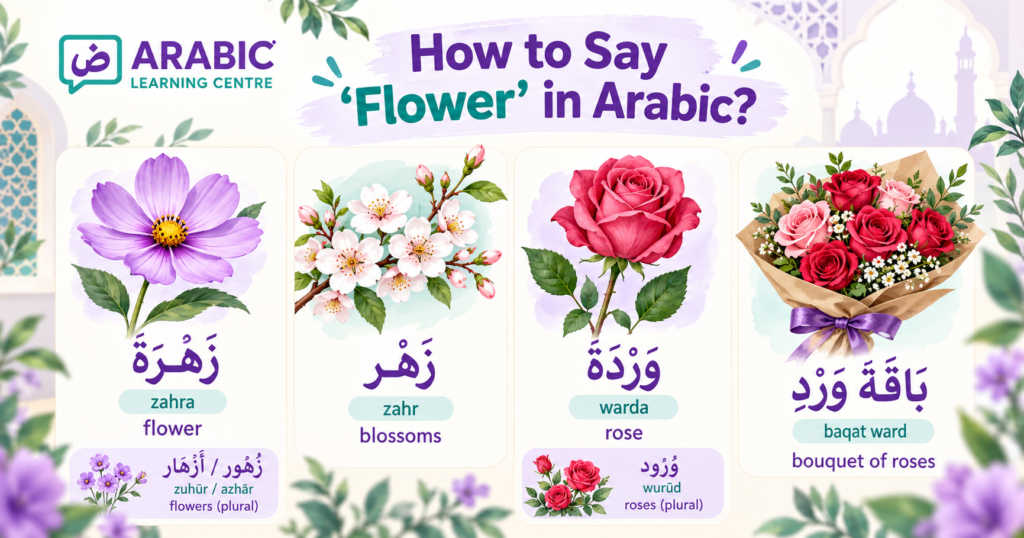
The neutral word for one flower of any kind is زَهْرَة (zahra). Its collective form زَهْر (zahr) describes blossoms as a mass, like the flowers on a tree, and the plurals زُهُور (zuhūr) and أَزْهَار (azhār) mean “flowers” in general.
The word وَرْدَة (warda) means one rose, while وَرْد (ward) and وُرُود (wurūd) mean roses. To talk about a bouquet, use بَاقَة (bāqa), as in باقة ورد (bāqat ward), a bouquet of roses.
In Modern Standard Arabic, زهرة is the neutral word for “flower”. In many dialects, especially Egyptian and Levantine, people also say وردة for almost any flower. So you may hear “وردة حلوة” for a pretty daisy, but in writing it is best to keep warda for roses.
Read also: Planets Names in Arabic – The Complete Guide to All 8 Planets
Common Flower Names in Arabic
Start with these 12. They come up most often in conversation, songs, shops and textbooks, and they form a solid base for everything else.
| English | Arabic | Transliteration | Quick note |
| Rose | وَرْدَة | warda | The most loved flower in Arab culture |
| Jasmine | يَاسَمِين | yāsamīn | Also a popular girl’s name, Yasmin |
| Lily | زَنْبَق | zanbaq | Linked with purity and elegance |
| Tulip | تُولِيب | tūlīb | Tūlīb is the everyday loanword |
| Sunflower | عَبَّاد الشَّمْس / دَوَّار الشَّمْس | ʿabbād ash-shams / dawwār ash-shams | Both mean “one who follows the sun” |
| Carnation | قُرُنْفُل | qurunful | Same word as the spice clove |
| Violet | بَنَفْسَج | banafsaj | Also the word for the colour violet |
| Narcissus | نَرْجِس | narjis | A classic image in Arabic poetry |
| Daisy / Chrysanthemum | أُقْحُوَان | uqḥuwān | Covers several daisy-like flowers |
| Chamomile | بَابُونَج | bābūnaj | Common as a herbal tea |
| Hibiscus | كَرْكَدِيه | karkadēh | Famous as a cold red drink in Egypt |
| Orchid | أُورْكِيد | ūrkīd | A modern loanword |
A quick note on tulip: in classical sources خزامى can refer to tulips, but today it almost always means lavender. If you want to be understood clearly, say توليب for tulip.
Read also: Months Names in Arabic – The 12 Months of the Year With Pronunciation and Examples
Fragrant and Garden Flower Names in Arabic
These flowers turn up in perfume descriptions, home gardens, gift shops and herbal remedies. Many Arabic perfumes are built around them, so they are worth knowing if you shop for oud or attar.
| English | Arabic | Transliteration | Quick note |
| Arabian jasmine (sambac) | فُلّ | full | Strung into necklaces in Egypt and the Gulf |
| Lavender | خُزَامَى | khuzāmā | Prized for its calming scent |
| Iris | سَوْسَن | sawsan | Also a girl’s name, Sawsan |
| Gardenia | غَارْدِينْيَا | gārdīnyā | Known for its heavy, sweet fragrance |
| Geranium | إِبْرَة الرَّاعِي | ibrat ar-rāʿī | Literally “shepherd’s needle” |
| Peony | فَاوَانْيَا | fāwānyā | Large, showy blooms |
| Magnolia | مَاغْنُولْيَا | māghnūlyā | A flowering tree |
| Lilac | لَيْلَك | laylak | Also the colour lilac |
| Oleander | دِفْلَى | difla | Common along roads; poisonous |
| Night jasmine (night queen) | مَلِكَة اللَّيْل | malikat al-layl | Literally “queen of the night” |
| Basil | رَيْحَان | rayḥān | An aromatic herb with Qur’anic mention |
Notice how many names here are loanwords from European languages, such as gardenia, magnolia and peony. Native Arabic names like فل, سوسن and خزامى tend to be older and appear far more often in poetry.
Wild Flowers, Seasonal Blooms and Blossoms
These names cover flowers that grow in fields, on hillsides and on fruit trees across the Arab world, from the Mediterranean coast to desert oases.
| English | Arabic | Transliteration | Quick note |
| Anemone | شَقَائِق النُّعْمَان | shaqāʾiq an-nuʿmān | Red spring flower of Levantine hills |
| Poppy | خَشْخَاش | khashkhāsh | Bright red field flower |
| Daffodil | نَرْجِس بَرِّي | narjis barrī | “Wild narcissus” |
| Lotus | لُوتُس / نِيلُوفَر | lūtus / nīlūfar | Symbol of rebirth in ancient Egypt |
| Water lily | زَنْبَق المَاء | zanbaq al-māʾ | Literally “lily of the water” |
| Bougainvillea | جَهَنَّمِيَّة | jahannamiyya | Vibrant climber on walls and balconies |
| Forget-me-not | لَا تَنْسَنِي | lā tansanī | Literally “don’t forget me” |
| Crocus / saffron | زَعْفَرَان | zaʿfarān | The flower that gives saffron |
| Calendula | آذَرْيُون | ādharyūn | Orange medicinal flower |
| Orange blossom | زَهْر البُرْتُقَال | zahr al-burtuqāl | Used in orange-blossom water for sweets |
| Pomegranate blossom | زَهْر الرُّمَّان | zahr ar-rummān | Deep red, often in poetry |
| Cherry blossom | زَهْر الكَرَز | zahr al-karaz | Common in modern travel writing |
| Primrose | زَهْرَة الرَّبِيع | zahrat ar-rabīʿ | Literally “spring flower” |
The name شقائق النعمان has a story behind it. It is traditionally linked to al-Nuʿmān ibn al-Mundhir, a pre-Islamic king of al-Ḥīra, and the flower still blankets hills in Palestine, Lebanon and Syria every spring.
Don’t Just Take Our Word For It
Take a look inside our vibrant classes and see our students and teachers in action. Click below to watch our classroom experience:
The Grammar Behind Flower Names in Arabic
Understanding a few Arabic grammar rules makes it easier to recognize flower names and use them correctly in sentences.
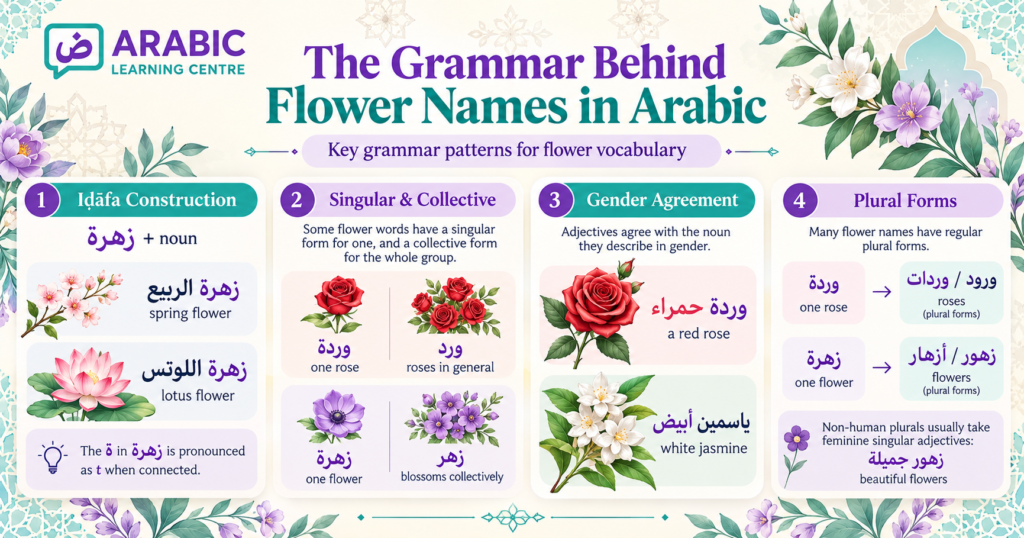
1. The Iḍāfa Construction in Flower Names
Many flower names use زهرة + noun, a structure called الإضافة (iḍāfa), meaning “flower of” or “flower associated with.”
- زهرة الربيع (zahrat ar-rabīʿ): spring flower.
- زهرة اللوتس (zahrat al-lūtus): lotus flower.
The ة in زهرة is pronounced as t when connected to the following word.
2. Collective and Singular Flower Nouns
Arabic sometimes uses related words for flowers collectively and for a single flower.
- ورد (ward): roses in general.
- وردة (warda): one rose.
- زهر (zahr): flowers collectively.
- زهرة (zahra): one flower.
3. Gender Agreement in Flower Names
Adjectives must agree with the grammatical gender of the flower name.
- وردة حمراء (warda ḥamrāʾ): a red rose.
- ياسمين أبيض (yāsamīn abyaḍ): white jasmine.
4. Plural Forms of Flower Names
Flower names can have different plural forms, such as:
- وردة → ورود أو وردات: rose → roses.
- زهرة → زهور أو أزهار: flower → flowers.
Non-human plurals generally take feminine singular adjectives, as in زهور جميلة (zuhūr jamīla), meaning “beautiful flowers.”
These rules apply far beyond flowers. If you want to build them into a solid habit, our Arabic grammar course walks you through iḍāfa, gender agreement and plural patterns step by step, with plenty of practice.

Flowers in Arab Culture and Poetry
In Arab culture, flowers carry meaning well beyond decoration. Symbolism varies by region and family, but some associations are widely shared.
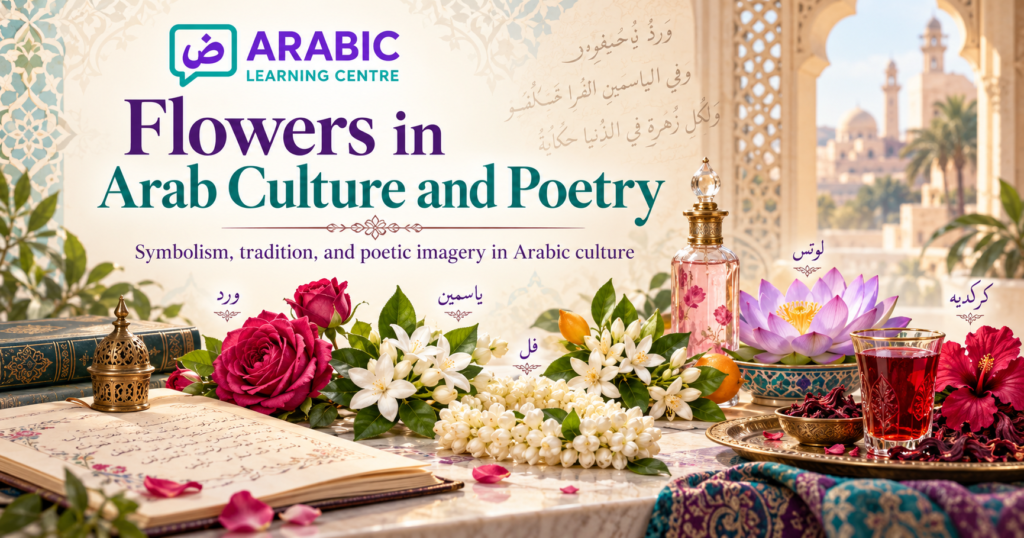
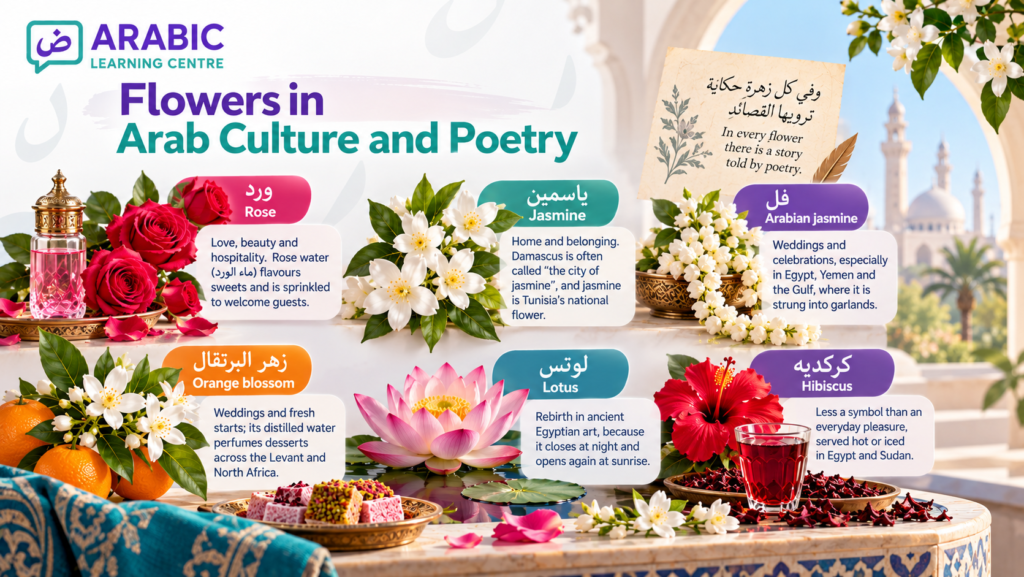
- Rose (ورد): love, beauty and hospitality. Rose water (ماء الورد, māʾ al-ward) flavours sweets and is sprinkled to welcome guests. Syria’s Damascene rose traditions were added to UNESCO’s intangible heritage list in 2019.
- Jasmine (ياسمين): home and belonging. Damascus is often called “the city of jasmine”, and jasmine is Tunisia’s national flower.
- Arabian jasmine (فل): weddings and celebrations, especially in Egypt, Yemen and the Gulf, where it is strung into garlands.
- Orange blossom (زهر البرتقال): weddings and fresh starts; its distilled water perfumes desserts across the Levant and North Africa.
- Lotus (لوتس): rebirth in ancient Egyptian art, because it closes at night and opens again at sunrise.
- Hibiscus (كركديه): less a symbol than an everyday pleasure, served hot or iced in Egypt and Sudan.
Poets have used flowers for centuries. Classical poets compared cheeks to roses and eyes to narcissus blossoms, and the narcissus became a stock image for a lover’s gaze.
In the 20th century, Mahmoud Darwish and Nizar Qabbani returned again and again to jasmine, anemones and roses as images of homeland and love.
Reading this kind of poetry in the original is a rewarding goal, but it needs strong vocabulary and a feel for classical structures. Our advanced Arabic course is designed for learners ready to read literature, poetry and authentic texts with confidence.

Arabic Names Inspired by Flowers
Many popular Arabic girls’ names are simply flower names in Arabic. Recognising them is a nice bonus: you will meet these names in classrooms, families and TV series.
| Name | Arabic | Meaning |
| Zahra | زهرة | Flower, blossom |
| Zuhour | زهور | Flowers |
| Azhar | أزهار | Flowers, blossoms |
| Warda | وردة | Rose |
| Yasmin | ياسمين | Jasmine |
| Full | فل | Arabian jasmine |
| Sawsan | سوسن | Iris, lily |
| Narjis | نرجس | Narcissus |
| Banafsaj | بنفسج | Violet |
| Rayhana | ريحانة | Sweet basil, a fragrant plant |
| Nisreen | نسرين | Wild rose, eglantine |
| Jouri | جوري | Damask rose |
Note that Zahra (زهرة, flower) and Zahraa (زهراء, radiant, shining) are different names, although both are widely loved.
Useful Phrases with Flower Names
Words stick better in sentences. Use these phrases at a florist, in a garden or in a card.
| Arabic | Transliteration | English |
| أريد باقة ورد من فضلك. | urīdu bāqat ward min faḍlik. | I’d like a bouquet of roses, please. |
| بكم هذه الزهور؟ | bikam hādhihi az-zuhūr? | How much are these flowers? |
| هل عندكم ياسمين أبيض؟ | hal ʿindakum yāsamīn abyaḍ? | Do you have white jasmine? |
| رائحة الخزامى هادئة. | rāʾiḥat al-khuzāmā hādiʾa. | The scent of lavender is calming. |
| الزهور تتفتح في الربيع. | az-zuhūr tatafattaḥ fī ar-rabīʿ. | Flowers bloom in spring. |
| هذه الوردة لكِ. | hādhihi al-warda laki. | This rose is for you. |
| حديقة الزهور جميلة جدًا. | ḥadīqat az-zuhūr jamīla jiddan. | The flower garden is very beautiful. |
Helpful related words: حديقة (ḥadīqa, garden), بتلة (batla, petal), ساق (sāq, stem), شوك (shawk, thorns), عطر (ʿiṭr, perfume), and تتفتح (tatafattaḥ, it blooms).
Tips to Remember Flower Names in Arabic
A list of 40 words can feel heavy, but small, regular steps make it manageable.
- Learn five at a time: Master one small group a week before moving on.
- Pair each flower with a colour: Say وردة حمراء or ياسمين أبيض instead of the bare noun, so you practise grammar too.
- Label real photos: Write the Arabic script, transliteration and English under pictures from your phone or garden.
- Use the patterns: Group names by structure, such as all the زهرة + noun names, to remember them as a set.
- Listen for them: Pay attention to flower words in Arabic songs, ads and shop signs.
- Review out loud: Saying words aloud helps with tricky sounds like ḥ in أقحوان and ʿ in شقائق النعمان.
This kind of themed vocabulary is a core part of school Arabic curricula and exams. If you are a teenager studying Arabic, or a parent supporting one, our high school Arabic course builds vocabulary, reading and writing skills in a structured way that fits school goals.

Inside Our Classrooms
See how we make learning interactive and engaging! Watch a quick snippet of our live, conversational classes in action:
Expand Your Arabic Vocabulary with Arabic Learning Centre
Learning Arabic becomes more enjoyable when you connect new words with everyday life, nature, and culture. Flower names are a great starting point for building vocabulary, understanding common expressions, and discovering how Arabic words are used in different contexts.
At Arabic Learning Centre, you can develop your Arabic skills through structured lessons designed to help you improve vocabulary, grammar, reading, and speaking. Whether you are a beginner or an advanced learner, you can follow a learning path that matches your level and helps you use Arabic with greater confidence.
With expert guidance and regular practice, you can go beyond memorizing individual words and learn how to use them naturally in sentences and conversations. Build a stronger foundation in Arabic and make steady progress toward your language goals.
Start learning Arabic today with a free trial at Arabic Learning Centre.
Courses We Offer:
- Business Arabic Course
- Learn Arabic from Zero
- Medical Arabic Course
- Learning Arabic for Non Arabic Speakers
- Learn Arabic in Saudi Arabia
- Learn to Read Arabic Course

Conclusion
Learning flower names in Arabic is a simple and enjoyable way to expand your vocabulary and connect with Arabic culture. From roses and jasmine to lavender and hibiscus, these words help you describe nature, understand everyday conversations, and appreciate the role of flowers in Arabic poetry and traditions.
To remember these names more easily, practise a few words each day, learn their pronunciation, and use them in short sentences. Combining flower names with colours, adjectives, and useful expressions will also help you understand Arabic grammar and communicate more naturally.
As you continue learning, explore other vocabulary topics and practise reading, writing, and speaking regularly. With consistent effort, you can build a stronger Arabic vocabulary and become more confident using the language in everyday situations.
Frequently Asked Questions About Flower Names in Arabic
What is the general word for flower in Arabic?
The word is زهرة (zahra) for one flower. Its common plural forms are زهور (zuhūr) and أزهار (azhār), which are used when talking about flowers in general.
Is warda the same as zahra?
Not exactly.
وردة (warda) means rose, while زهرة (zahra) means flower in general. In everyday Arabic dialects, warda may also be used more broadly to refer to a flower.
How do you say “bouquet of flowers” in Arabic?
You can say باقة زهور (bāqat zuhūr), meaning “bouquet of flowers.” For a bouquet of roses, use باقة ورد (bāqat ward), a common expression when buying or giving flowers.
What is the Arabic word for jasmine?
Jasmine is ياسمين (yāsamīn), a name associated with its delicate, fragrant flowers. Arabian jasmine is also commonly called فل (full), especially when referring to its small, white, strongly scented blossoms.
Which Arabic flower names should beginners learn first?
Beginners can start with وردة, ياسمين, زنبق, توليب, عباد الشمس, بنفسج, خزامى, نرجس, قرنفل, and كركديه. These common names help learners describe gardens, identify flowers, and talk about plants in everyday conversations.
How can I memorize flower names in Arabic more easily?
Learn five words at a time, practise their pronunciation, and group them by colour or appearance. For example, وردة حمراء (warda ḥamrāʾ) means “red rose,” while زهرة بيضاء (zahra bayḍāʾ) means “white flower.” Creating short phrases makes the vocabulary easier to remember and use naturally.








[…] Read also: Flower Names in Arabic – A Complete Guide for Learners […]
[…] Read also: Flower Names in Arabic – A Complete Guide for Learners […]