 Learn Arabic
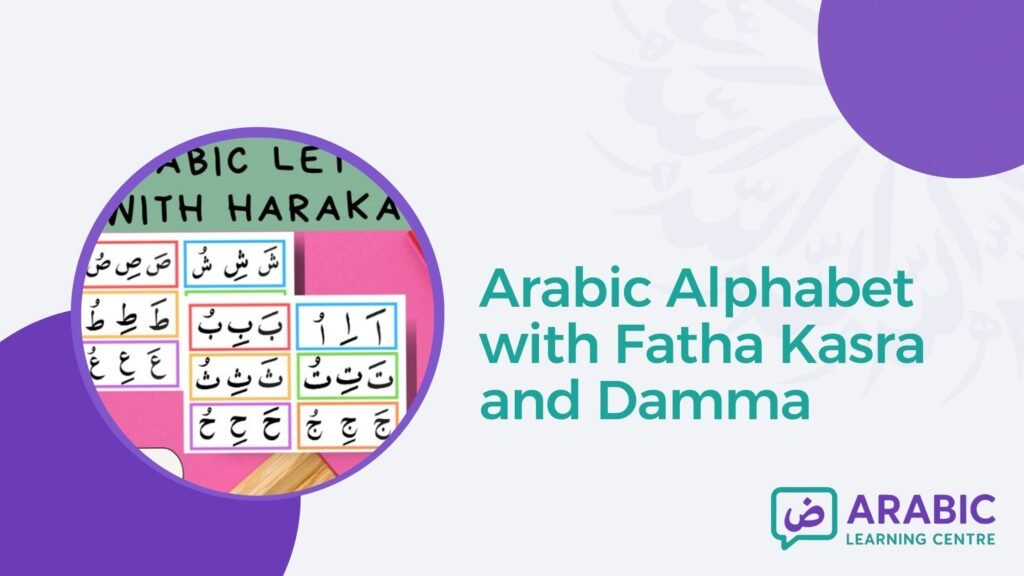
Learning the Arabic alphabet with Fatha Kasra and Damma is one of the most important early steps for anyone who wants to read Arabic confidently. Recognizing the shape of an Arabic letter is only part of the process. You also need to know how that letter sounds when a short vowel is added to it.
This is where Fatha (ـَ), Kasra (ـِ), and Damma (ـُ) become essential. These small marks, known as harakat in Arabic, tell you how a letter should be pronounced. For example, the letter ب can be read as بَ (ba), بِ (bi), or بُ (bu) depending on the vowel mark attached to it.
Once beginners understand these three sounds, reading Arabic stops feeling like memorizing isolated symbols.
Letters begin to form recognizable syllables and words, creating a strong foundation for vocabulary, reading, pronunciation, and eventually grammar.
What Are Fatha, Kasra, and Damma in Arabic?
Fatha, Kasra, and Damma are the three main short vowel marks used in Arabic. Unlike English vowels, they are normally represented by small marks placed above or below a consonant rather than by separate letters.
Together, these short vowel marks are called حَرَكَات (harakat). They are especially common in beginner Arabic materials, children’s books, dictionaries, educational texts, and other texts where pronunciation needs to be clear.
Here is the basic difference:
| Haraka | Arabic | Symbol | Position | Basic Sound | Example |
| Fatha | فَتْحَة | ـَ | Above the letter | Short “a” | بَ = ba |
| Kasra | كَسْرَة | ـِ | Below the letter | Short “i” | بِ = bi |
| Damma | ضَمَّة | ـُ | Above the letter | Short “u” | بُ = bu |
The principle is simple: the consonant remains the same, but the short vowel changes the sound that follows it.
For example:
بَ = ba
بِ = bi
بُ = bu
Learning to recognize this difference quickly is one of the first major milestones in Arabic reading.
Why Should Beginners Learn the Arabic Alphabet with Fatha Kasra and Damma?
Memorizing the 28 Arabic letters without their vowel sounds can help you recognize the alphabet, but it does not automatically teach you how to read words.
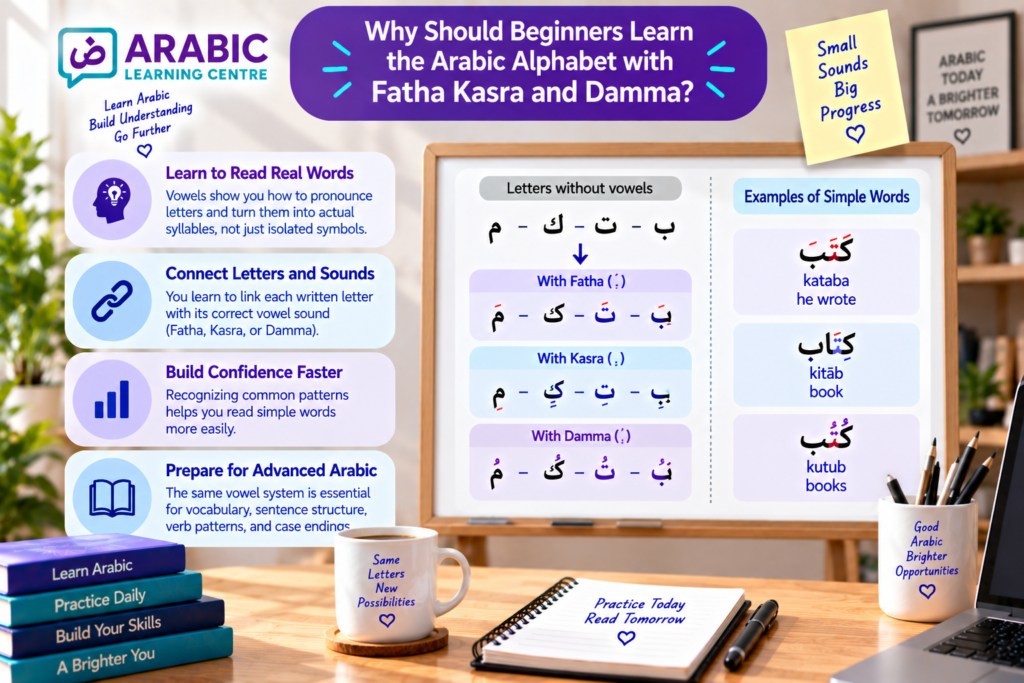
Arabic words are built from combinations of consonants and vowels. When beginners study the Arabic alphabet with Fatha Kasra and Damma, they learn to connect each written letter with an actual spoken syllable.
Instead of seeing:
ب – ت – ك – م
as separate symbols, learners begin recognizing patterns such as:
بَ – تَ – كَ – مَ
or:
بِ – تِ – كِ – مِ
This makes it much easier to progress toward simple words such as:
كَتَبَ — kataba — he wrote
كِتَاب — kitāb — book
كُتُب — kutub — books
Learning short vowels also prepares students for more advanced Arabic. Once you progress beyond individual sounds, the same vowel system becomes important when studying vocabulary, sentence structure, verb patterns, and case endings.
Learners who want a structured introduction to reading, speaking, and foundational language skills can build these basics through an Arabic course for adults rather than trying to memorize the alphabet without practical pronunciation practice.

Arabic Alphabet with Fatha Kasra and Damma Chart
The best way to understand the system is to look at every letter with all three short vowels. The following Arabic alphabet with Fatha Kasra and Damma chart can be used as a reference while practising pronunciation.
| Letter | Letter Name | Fatha | Kasra | Damma |
| ا / أ | Alif | أَ (a) | إِ (i) | أُ (u) |
| ب | Baa | بَ (ba) | بِ (bi) | بُ (bu) |
| ت | Taa | تَ (ta) | تِ (ti) | تُ (tu) |
| ث | Thaa | ثَ (tha) | ثِ (thi) | ثُ (thu) |
| ج | Jeem | جَ (ja) | جِ (ji) | جُ (ju) |
| ح | Haa | حَ (ḥa) | حِ (ḥi) | حُ (ḥu) |
| خ | Khaa | خَ (kha) | خِ (khi) | خُ (khu) |
| د | Daal | دَ (da) | دِ (di) | دُ (du) |
| ذ | Dhaal | ذَ (dha) | ذِ (dhi) | ذُ (dhu) |
| ر | Raa | رَ (ra) | رِ (ri) | رُ (ru) |
| ز | Zaay | زَ (za) | زِ (zi) | زُ (zu) |
| س | Seen | سَ (sa) | سِ (si) | سُ (su) |
| ش | Sheen | شَ (sha) | شِ (shi) | شُ (shu) |
| ص | Saad | صَ (ṣa) | صِ (ṣi) | صُ (ṣu) |
| ض | Daad | ضَ (ḍa) | ضِ (ḍi) | ضُ (ḍu) |
| ط | Taa | طَ (ṭa) | طِ (ṭi) | طُ (ṭu) |
| ظ | Dhaa | ظَ (ẓa) | ظِ (ẓi) | ظُ (ẓu) |
| ع | Ayn | عَ (‘a) | عِ (‘i) | عُ (‘u) |
| غ | Ghayn | غَ (gha) | غِ (ghi) | غُ (ghu) |
| ف | Faa | فَ (fa) | فِ (fi) | فُ (fu) |
| ق | Qaaf | قَ (qa) | قِ (qi) | قُ (qu) |
| ك | Kaaf | كَ (ka) | كِ (ki) | كُ (ku) |
| ل | Laam | لَ (la) | لِ (li) | لُ (lu) |
| م | Meem | مَ (ma) | مِ (mi) | مُ (mu) |
| ن | Noon | نَ (na) | نِ (ni) | نُ (nu) |
| ه | Haa | هَ (ha) | هِ (hi) | هُ (hu) |
| و | Waaw | وَ (wa) | وِ (wi) | وُ (wu) |
| ي | Yaa | يَ (ya) | يِ (yi) | يُ (yu) |
Do not worry if some transliterations appear difficult at first. Letters such as ع, ح, خ, غ, ق, ص, ض, ط, and ظ represent Arabic sounds that do not have perfect English equivalents.
Transliteration can help beginners temporarily, but listening and repeating the actual Arabic pronunciation is much more useful in the long term.
What Is Fatha in Arabic?
Fatha (فَتْحَة) is a small diagonal mark ـَ placed above an Arabic letter. It gives the letter a short “a” sound, such as بَ (ba), تَ (ta), مَ (ma), and كَ (ka).
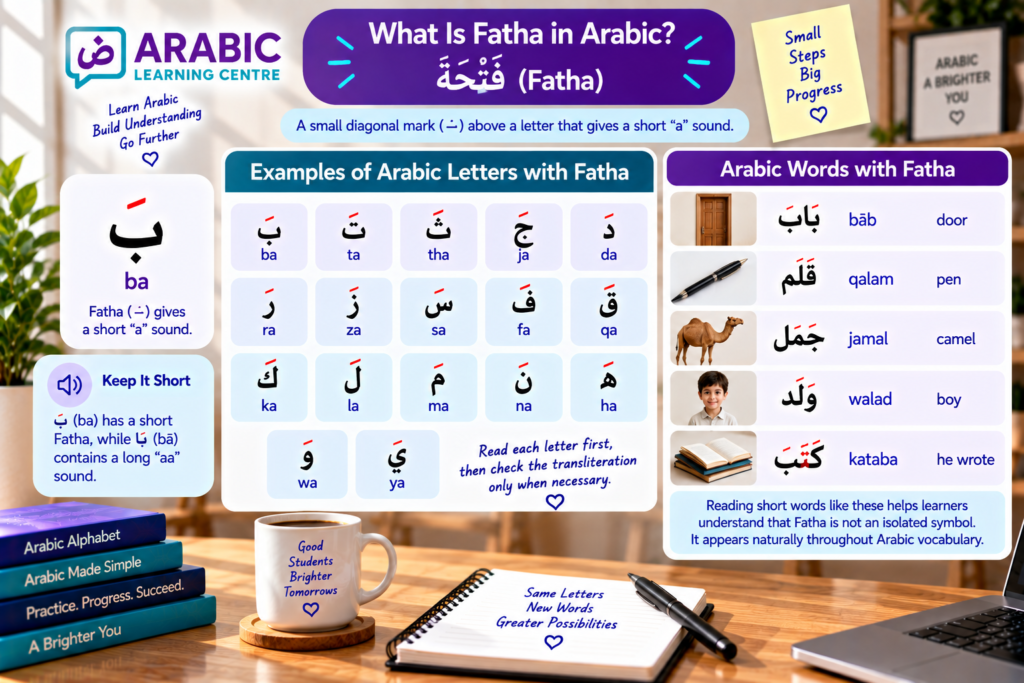
Keep the sound short. For example, بَ (ba) has a short Fatha, while بَا (bā) contains a long “aa” sound.
Examples of Arabic Letters with Fatha
Practice the Fatha sound with these simple groups:
بَ (ba) – تَ (ta) – ثَ (tha) – جَ (ja)
دَ (da) – رَ (ra) – زَ (za) – سَ (sa)
فَ (fa) – قَ (qa) – كَ (ka) – لَ (la)
مَ (ma) – نَ (na) – هَ (ha) – وَ (wa) – يَ (ya)
Read each Arabic letter first, then check the transliteration only when necessary. This will help you recognize the Fatha sound without depending on English spelling.
Arabic Words with Fatha
Here are some simple words containing Fatha:
بَاب — bāb — door
قَلَم — qalam — pen
جَمَل — jamal — camel
وَلَد — walad — boy
كَتَبَ — kataba — he wrote
Reading short words like these helps learners understand that Fatha is not an isolated symbol. It appears naturally throughout Arabic vocabulary.
What Is Kasra in Arabic?
Kasra (كَسْرَة) is a small diagonal mark ـِ written below an Arabic letter. It gives the letter a short “i” sound, as in بِ (bi), تِ (ti), كِ (ki), and مِ (mi).
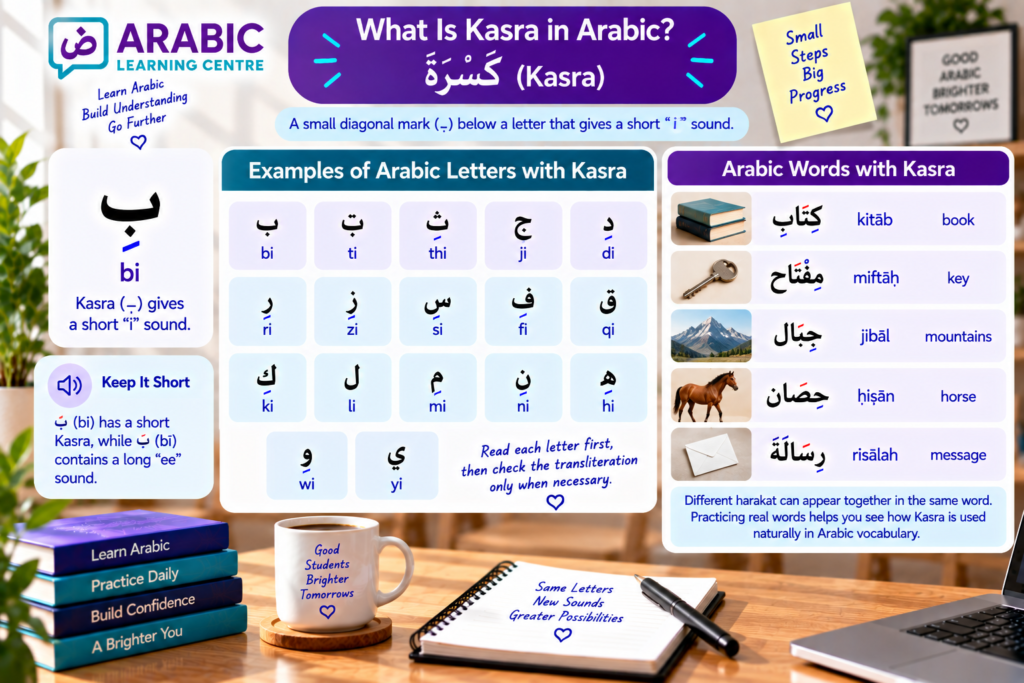
Kasra is easy to recognize because it is written below the letter. Keep the sound short rather than stretching it into a long “ee” sound.
Examples of Arabic Letters with Kasra
Practice the Kasra sound with these groups:
بِ (bi) – تِ (ti) – ثِ (thi) – جِ (ji)
دِ (di) – رِ (ri) – زِ (zi) – سِ (si)
فِ (fi) – قِ (qi) – كِ (ki) – لِ (li)
مِ (mi) – نِ (ni) – هِ (hi) – وِ (wi) – يِ (yi)
Read each Arabic letter first and use the transliteration only when needed.
Arabic Words with Kasra
Examples include:
كِتَاب — kitāb — book
مِفْتَاح — miftāḥ — key
جِبَال — jibāl — mountains
حِصَان — ḥiṣān — horse
رِسَالَة — risālah — message
At this stage, learners start seeing how different harakat can occur together inside the same word.
Read also: Preposition in Arabic – A Complete Guide
What Is Damma in Arabic?
Damma (ضَمَّة) is a small curved mark ـُ placed above an Arabic letter. It resembles a small و and gives the letter a short “u” sound, as in بُ (bu), تُ (tu), كُ (ku), and مُ (mu).
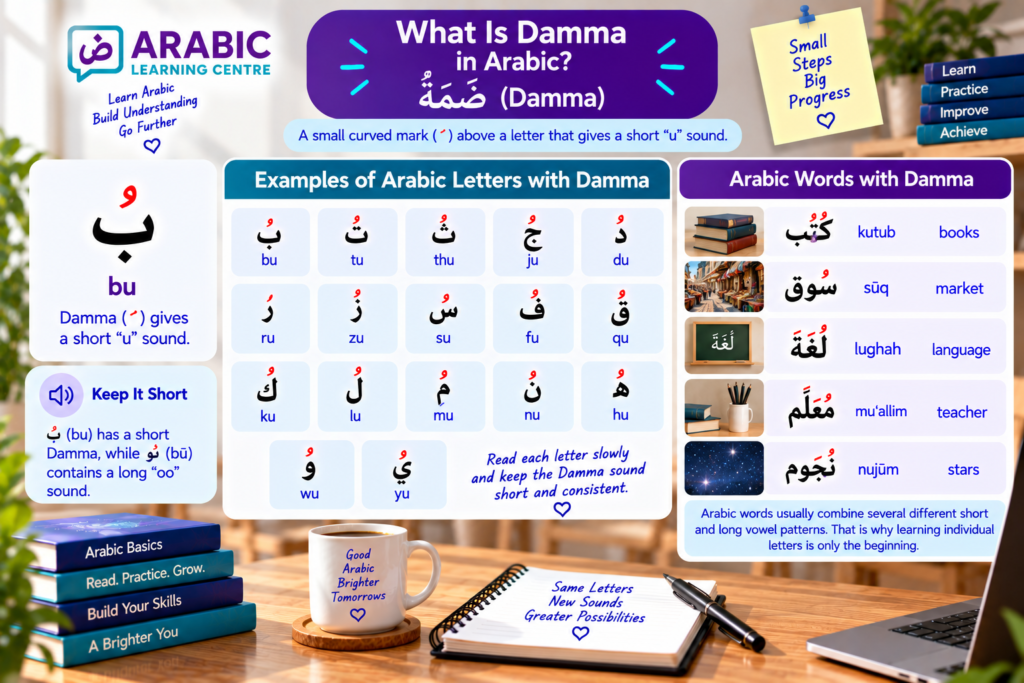
Keep the sound short and lightly rounded rather than stretching it into a long “oo” sound.
Examples of Arabic Letters with Damma
Practice the Damma sound with these groups:
بُ (bu) – تُ (tu) – ثُ (thu) – جُ (ju)
دُ (du) – رُ (ru) – زُ (zu) – سُ (su)
فُ (fu) – قُ (qu) – كُ (ku) – لُ (lu)
مُ (mu) – نُ (nu) – هُ (hu) – وُ (wu) – يُ (yu)
Read each group slowly and keep the Damma sound short and consistent.
Arabic Words with Damma
Examples include:
كُتُب — kutub — books
سُوق — sūq — market
لُغَة — lughah — language
مُعَلِّم — mu‘allim — teacher
نُجُوم — nujūm — stars
Notice that Arabic words usually combine several different short and long vowel patterns. That is why learning individual letters is only the beginning.
Inside Our Classrooms
See how we make learning interactive and engaging! Watch a quick snippet of our live, conversational classes in action:
What Is the Difference Between Fatha, Kasra, and Damma?
The easiest way to remember the difference is to focus on position + sound.
| Vowel | Position | Sound | Example |
| Fatha | Above | a | بَ = ba |
| Kasra | Below | i | بِ = bi |
| Damma | Above | u | بُ = bu |
With the same letter ب, changing only one small mark produces three different syllables:
بَ — ba
بِ — bi
بُ — bu
This difference becomes increasingly important as you begin studying real Arabic words because vowels can contribute to changes in pronunciation, word patterns, and grammatical functions.
For learners who want to understand why word endings and vowels change inside complete sentences, an Arabic grammar course can help connect these basic vowel marks with grammatical concepts rather than treating them as pronunciation signs alone.
Short Vowels vs Long Vowels in Arabic
Beginners should learn the difference between short and long vowels early, as vowel length can affect the pronunciation and meaning of Arabic words.
The three short vowels are:
- Fatha ـَ → short a
- Kasra ـِ → short i
- Damma ـُ → short u
Long vowels are formed using ا (Alif), ي (Yaa), and و (Waw) in the appropriate vowel patterns.
Compare these examples:
| Short Vowel | Long Vowel |
| بَ — ba | بَا — bā |
| بِ — bi | بِي — bī |
| بُ — bu | بُو — bū |
The first sound in each pair is short, while the second is held longer. Practising this difference helps beginners avoid stretching Fatha, Kasra, or Damma when reading Arabic.
Read also: Can You Learn Arabic on Babbel? – Best Alternatives for Arabic Learners
How Do Fatha, Kasra, and Damma Work in Arabic Words?
Once individual letters become familiar, the next step is to combine them and practise reading complete words. This helps you understand how Fatha, Kasra, and Damma affect pronunciation when letters appear together.
For example:
كَتَبَ → كَ + تَ + بَ → ka + ta + ba → kataba
Each letter carries a Fatha, so you can read the word gradually before joining the sounds together.
Now compare it with:
كُتُب → كُ + تُ + ب → ku + tu + b → kutub
Here, the vowel pattern changes from Fatha to Damma, which changes both the pronunciation and the word. Paying attention to each Harakah helps you avoid guessing how a word should be read.
Practising this way allows beginners to move gradually from individual letters to syllables and then complete words. It is one of the easiest ways to become more comfortable reading the Arabic alphabet with Fatha Kasra and Damma in real Arabic vocabulary.
A structured Fusha Arabic course can help bridge this gap by allowing learners to apply vocabulary, pronunciation, reading, and grammatical patterns in complete Arabic sentences.

How to Practice the Arabic Alphabet with Fatha Kasra and Damma?
Learning the vowel chart once is not enough. Regular practice helps you recognize each Haraka quickly and use it correctly when reading letters, syllables, and complete Arabic words.
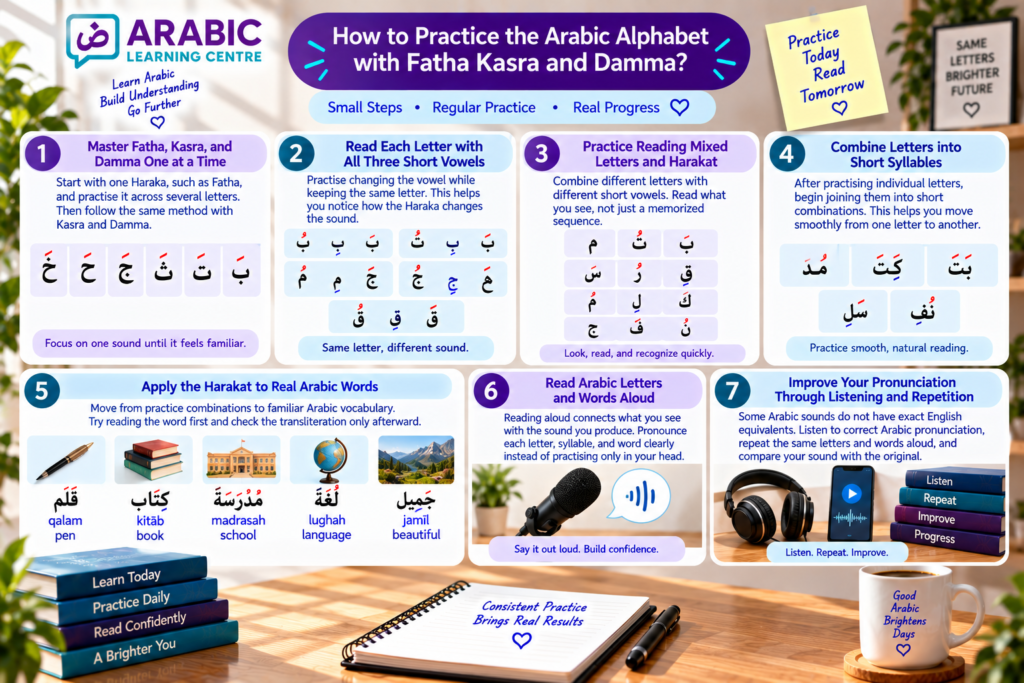
1. Master Fatha, Kasra, and Damma One at a Time
Start with one Haraka, such as Fatha, and practise it across several letters:
بَ تَ ثَ جَ حَ خَ
Continue through the alphabet until the sound becomes familiar. Then follow the same method with Kasra and Damma before mixing the three together.
2. Read Each Arabic Letter with All Three Short Vowels
Once you recognize each Haraka separately, practise changing the vowel while keeping the same letter:
بَ بِ بُ
تَ تِ تُ
جَ جِ جُ
مَ مِ مُ
قَ قِ قُ
This exercise helps you focus on the vowel mark and notice how it changes the sound of the same Arabic letter.
3. Practice Reading Mixed Letters and Harakat
Next, combine different letters with different short vowels:
بَ تُ مِ
قِ رُ سَ
كَ لِ مُ
نُ فَ جِ
Read what you actually see rather than memorizing the sequence. This develops faster recognition of Fatha, Kasra, and Damma.
4. Combine Vowelled Letters into Short Syllables
After practising individual letters, begin joining them into short combinations:
بَتَ
كِتَ
مُدَ
سَلِ
نُفِ
These combinations help you practise moving smoothly from one vowelled letter to another before reading complete words.
5. Apply Fatha, Kasra, and Damma to Real Arabic Words
Move from practice combinations to familiar Arabic vocabulary:
قَلَم — qalam — pen
كِتَاب — kitāb — book
مَدْرَسَة — madrasah — school
لُغَة — lughah — language
جَمِيل — jamīl — beautiful
Try reading the Arabic word first and checking the transliteration only afterward.
6. Read Arabic Letters and Words Aloud
Reading aloud connects what you see with the sound you produce. Pronounce each letter, syllable, and word clearly instead of practising only through silent recognition.
With regular repetition, this helps Fatha, Kasra, and Damma become easier to recognize and pronounce while reading.
7. Improve Your Pronunciation Through Listening and Repetition
Some Arabic sounds do not have exact English equivalents, so transliteration alone cannot teach accurate pronunciation.
Listen to correct Arabic pronunciation, repeat the same letters and words aloud, and compare your sound with the original. Combining listening with reading practice makes it easier to use the Arabic alphabet with Fatha Kasra and Damma confidently.
What Should You Learn After Fatha, Kasra, and Damma?
Once you can comfortably read the Arabic alphabet with Fatha Kasra and Damma, you can move to other essential parts of Arabic reading.
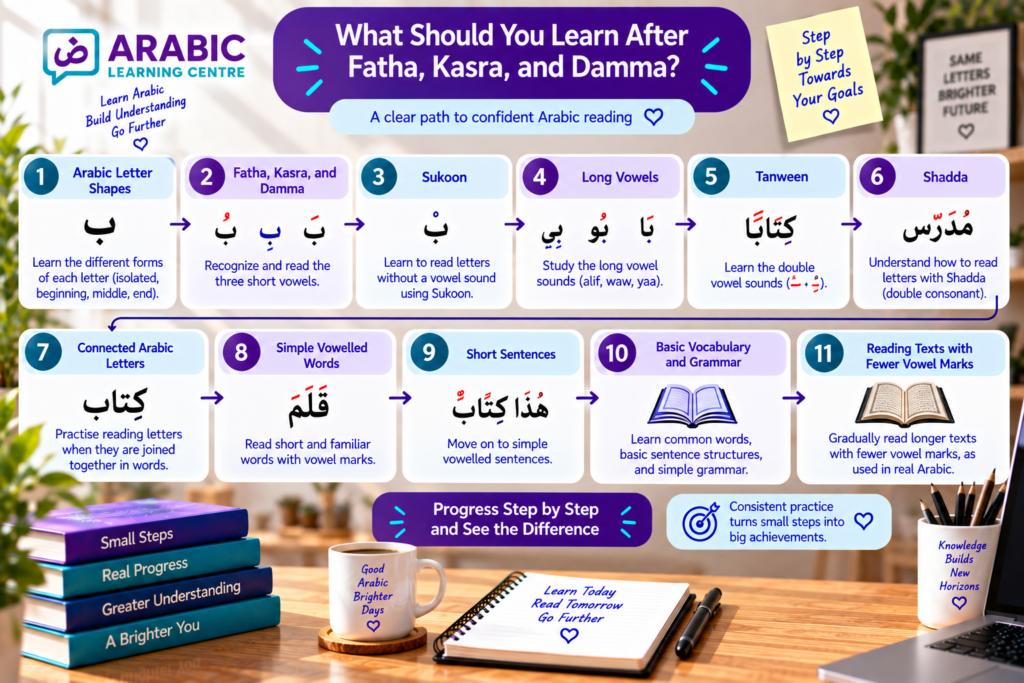
A useful progression is:
- Arabic letter shapes.
- Fatha, Kasra, and Damma.
- Sukoon.
- Long vowels.
- Tanween.
- Shadda.
- Connected Arabic letters.
- Simple vowelled words.
- Short sentences.
- Basic vocabulary and grammar.
- Reading texts with fewer vowel marks.
The key is progression. Beginners often struggle when they attempt advanced grammar or unvowelled Arabic texts before short vowel recognition becomes automatic.
Read also: The Importance of Arabic Language in Quran – 10 Reasons
Common Mistakes When Learning Fatha, Kasra, and Damma
Beginners often understand how the three Harakat work but still make small mistakes when reading aloud. Recognizing these problems early can improve both pronunciation and reading accuracy.
1. Stretching Short Vowels into Long Vowels
Fatha, Kasra, and Damma should remain short. Avoid changing:
بَ (ba) → بَا (bā)
بِ (bi) → بِي (bī)
بُ (bu) → بُو (bū)
Practise keeping the short and long vowel sounds clearly different.
2. Relying Too Much on English Transliteration
Transliteration such as ba, bi, and bu can help at the beginning, but it should not replace reading Arabic directly.
Try to look at the Arabic letters and Harakat first, using transliteration only when you need help.
3. Recognizing the Letter but Ignoring Its Haraka
Knowing the letter ب is not enough. You also need to notice whether it appears as بَ (ba), بِ (bi), or بُ (bu).
Train yourself to read the letter and its vowel mark together rather than focusing only on the consonant.
4. Reading Arabic Letters Too Quickly
Trying to read quickly can cause you to miss or confuse the Harakat. Start slowly with combinations such as:
بَ — بِ — بُ
Focus on accuracy first. Your reading speed will improve naturally as vowel recognition becomes more automatic.
5. Focusing on Harakat but Mispronouncing Arabic Letters
Correctly identifying Fatha, Kasra, or Damma does not automatically mean the consonant is being pronounced correctly.
Letters such as ح, خ, ع, غ, ق, ص, ض, ط, and ظ may require extra pronunciation practice. Listen carefully to their correct sounds and practise them with each short vowel.
Read also: Arabic Alphabet Beginning Middle End
Don’t Just Take Our Word For It
Take a look inside our vibrant classes and see our students and teachers in action. Click below to watch our classroom experience:
Build a Strong Foundation in Arabic with Arabic Learning Centre
Learning the Arabic alphabet with Fatha Kasra and Damma is an important first step toward reading Arabic accurately and confidently.
Once you can recognize how each Haraka changes the sound of a letter, it becomes much easier to progress from individual sounds to complete words and sentences.
At Arabic Learning Centre, lessons are structured to help learners build their Arabic skills gradually.
Instead of simply memorizing letters and vowel marks, students practise pronunciation, reading, vocabulary, and language patterns in a way that helps them understand how Arabic works in real use.
Whether you are starting from the alphabet or want to develop stronger reading and language skills, guided learning can give you a clearer path forward.
With consistent practice and structured support, Fatha, Kasra, and Damma become natural parts of reading rather than marks you have to stop and think about.
Start your Arabic learning journey with Arabic Learning Centre and book a free trial lesson today.
Courses We Offer:
- Online Arabic Course
- Classical arabic course
- Modern Standard Arabic Course
- Fusha Arabic Course
- Learn Saudi Arabic
- Arabic Course for Beginners
- Arabic Classes for Adults
- Arabic Classes for Ladies
- Advanced Arabic Course
- Intensive Arabic Course

Conclusion
The Arabic alphabet with Fatha Kasra and Damma provides beginners with one of the clearest entry points into Arabic reading.
Fatha ـَ gives a short a sound, Kasra ـِ gives a short i sound, and Damma ـُ gives a short u sound. Applying these three vowel marks to all 28 Arabic letters teaches learners how written consonants become pronounceable syllables.
Start slowly. Practice one vowel at a time, combine all three with individual letters, progress to syllables, and then begin reading fully vowelled words. With regular listening, repetition, and correction, recognizing Arabic harakat gradually becomes automatic.
From there, learners can move into connected words, Fusha, vocabulary, and Arabic grammar with a much stronger reading foundation.
Frequently Asked Questions
What are Fatha, Kasra, and Damma?
Fatha, Kasra, and Damma are the three main short vowel marks in Arabic. Fatha ـَ produces a short “a” sound, Kasra ـِ produces a short “i” sound, and Damma ـُ produces a short “u” sound.
What are Fatha, Kasra, and Damma called together?
They are commonly called harakat (حركات), meaning Arabic vowel or pronunciation marks. They form part of the wider Arabic system of diacritics or tashkeel.
How do you pronounce Ba with Fatha, Kasra, and Damma?
The letter ب changes as follows:
بَ = ba
بِ = bi
بُ = bu
The consonant remains Baa, while the vowel sound changes.
Are Fatha, Kasra, and Damma short vowels?
Yes. They represent short vowel sounds. Beginners should avoid stretching them into the corresponding long vowel sounds.
How many letters are in the Arabic alphabet?
The standard Arabic alphabet contains 28 letters. Each consonant can be practised with Fatha, Kasra, and Damma to develop accurate vowel recognition.
Can I learn Arabic without Fatha, Kasra, and Damma?
Advanced Arabic texts frequently omit many short vowel marks because experienced readers identify words from vocabulary and context. Beginners, however, benefit greatly from learning Fatha, Kasra, and Damma because they provide clear guidance on how words should be pronounced.
Related Articles
Learn Arabic