 Learn Arabic
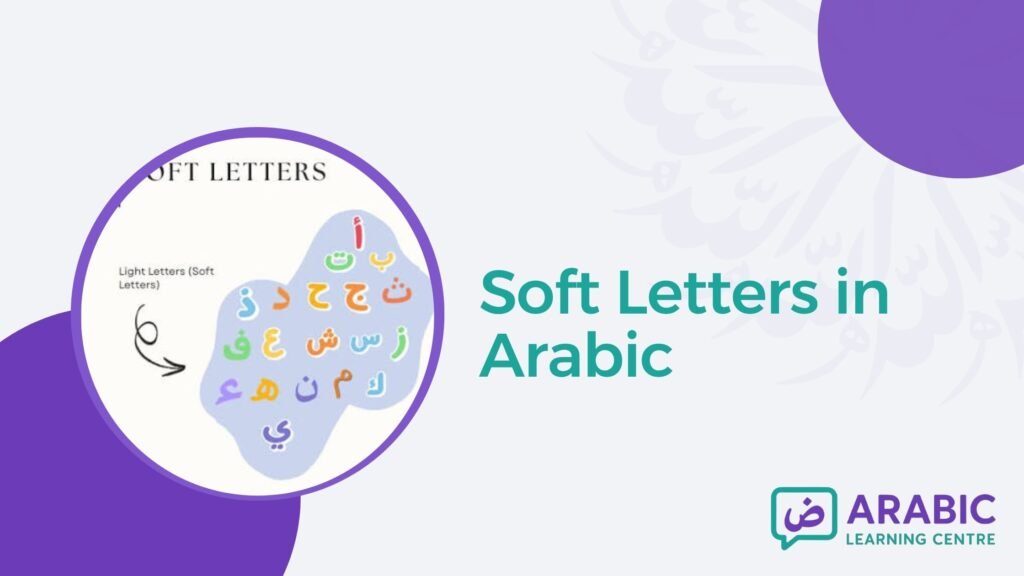
The soft letters in Arabic, known as Huroof al-Leen (حروف اللين) in Tajweed, are an important part of learning accurate and natural Arabic pronunciation. They appear frequently in Quranic words and create a smooth, gentle glide when pronounced correctly.
For beginners, however, leen letters in Arabic can be confusing. Are there two soft letters or three? Is Waw always a Leen letter? What is the difference between Leen and Madd? And why can the sound sometimes be lengthened when stopping during Quran recitation?
The basic rule is simple: in Tajweed, the two Leen letters are Waw (وْ) and Ya (يْ) when they carry a sukoon and the letter immediately before them has a fatha. Once you recognize this pattern, identifying and pronouncing them becomes much easier.
In this guide, you will learn what the soft letters Arabic learners encounter are, how many there are, how to pronounce them, and how Leen letters differ from Madd letters.
What Are Soft Letters in Arabic?
The word Leen (لين) means softness, gentleness, or ease. In Tajweed, the term describes a smooth sound produced without unnecessary pressure or difficulty in articulation.
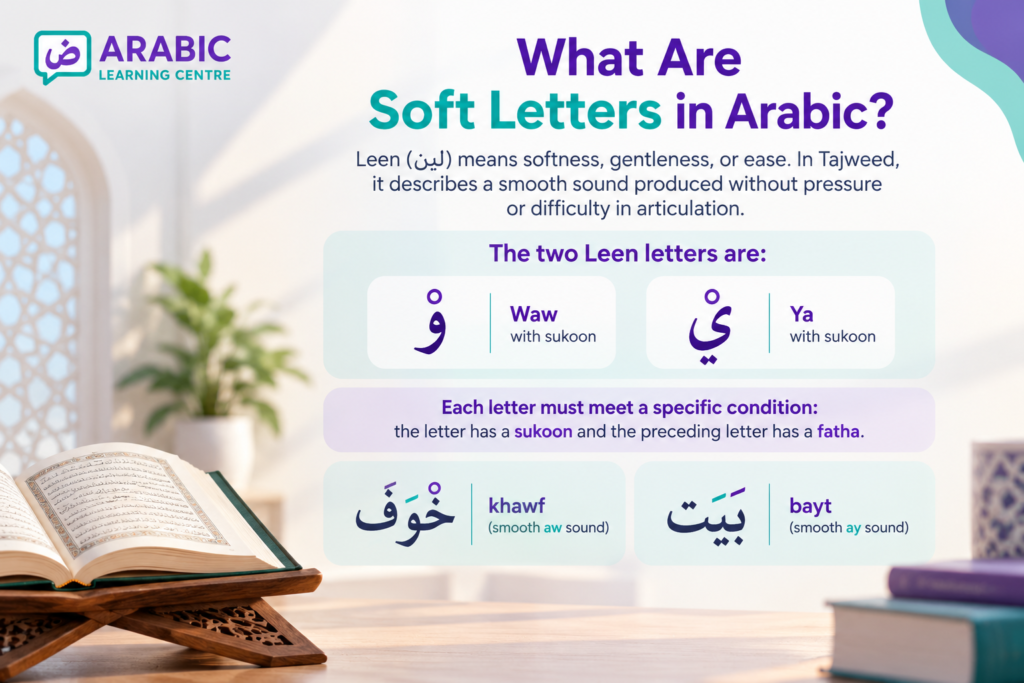
The two Leen letters in Arabic are:
- وْ — Waw with sukoon
- يْ — Ya with sukoon
However, Waw and Ya are not automatically Leen letters every time they appear. Each must meet a specific condition: the letter must carry a sukoon and the preceding letter must have a fatha.
For example:
- خَوْف — khawf: the Waw has sukoon and is preceded by a fatha.
- بَيْت — bayt: the Ya has sukoon and is preceded by a fatha.
Notice the smooth aw sound in khawf and the ay sound in bayt. These are the characteristic gliding sounds associated with Huroof al-Leen.
Learning to recognize combinations like these becomes easier when you already understand Arabic letters, vowels, and how words are formed. Students developing these foundations can strengthen them through a structured Arabic writing course, especially if they are still learning to identify Arabic letters with their different vowel marks.

How Many Soft Letters in Arabic Are There?
There are two soft letters in Arabic Tajweed, known as Leen letters:
- Waw (وْ)
- Ya (يْ)
However, Waw and Ya are considered Leen letters only under specific conditions: the letter must carry a sukoon, and the letter immediately before it must carry a fatha.
Waw Leen — وْ
A Waw becomes Waw Leen when it carries a sukoon and is preceded by a fatha:
ـَوْ
Examples include:
- خَوْف — khawf — fear
- يَوْم — yawm — day
- قَوْم — qawm — people
- سَوْف — sawfa — will/soon
The sound should move smoothly from the fatha into the Waw without turning into a long oo sound.
Ya Leen — يْ
A Ya becomes Ya Leen when it carries a sukoon and is preceded by a fatha:
ـَيْ
Examples include:
- بَيْت — bayt — house
- خَيْر — khayr — good
- شَيْء — shay’ — thing
- عَيْن — ‘ayn — eye
The sound should form a soft, natural glide without unnecessary elongation.
Are There 3 Soft Letters in Arabic?
You may sometimes see the phrase “3 soft letters in Arabic” referring to Alif (ا), Waw (و), and Ya (ي). More accurately, these three are known as Huroof al-‘Illah (حروف العلة), or weak letters, in Arabic grammar and morphology.
They should not be confused with Huroof al-Leen in Tajweed, which are only Waw and Ya when they meet the conditions explained above.
Why Are They Called Leen or Soft Letters?
They are called Leen letters because their pronunciation is characterized by ease and softness.
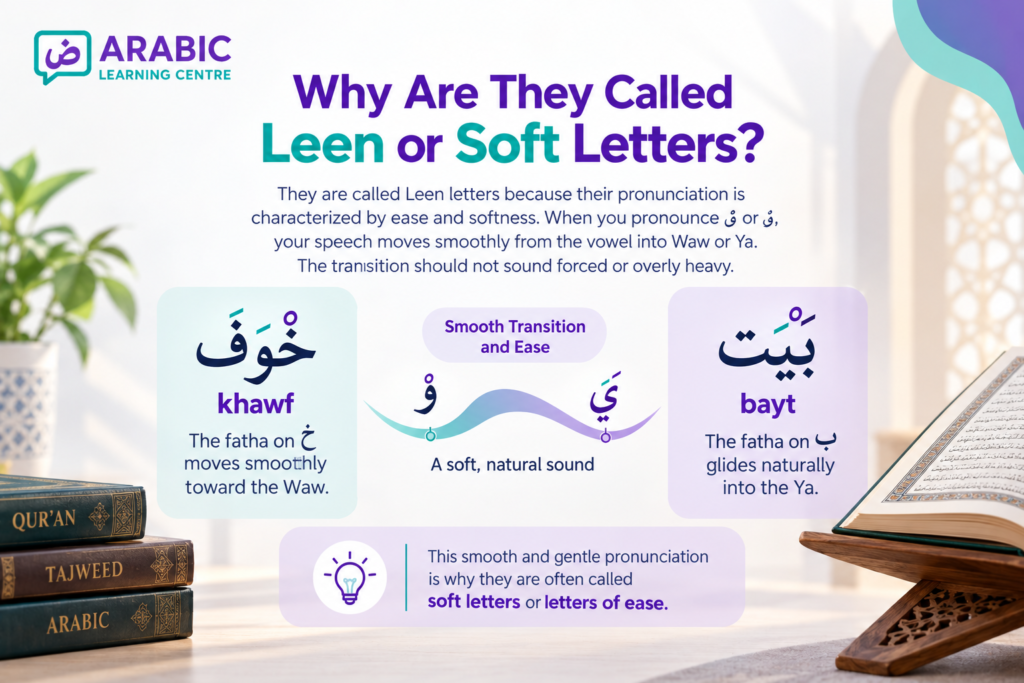
When you pronounce ـَوْ or ـَيْ, your speech moves smoothly from the vowel into Waw or Ya. The transition should not sound forced or overly heavy.
Compare: خَوْف — khawf
The fatha on خَ moves smoothly toward the Waw.
Similarly: بَيْت — bayt
The fatha on بَ glides naturally into the Ya.
This characteristic explains why English descriptions often call Huroof al-Leen soft letters or letters of ease.
For non-native speakers, hearing and reproducing these subtle differences can take practice. A comprehensive Arabic course for non-Arabic speakers can help learners build the pronunciation and reading foundations needed to recognize these patterns naturally rather than relying only on transliteration.

What Is the Difference Between Leen Letters and Madd Letters?
One of the most important things to understand is that Leen letters and Madd letters are not the same.
They can involve the same Arabic letters, particularly Waw and Ya, but the vowel immediately before the letter determines its function.
Madd Letters
There are three Madd letters:
- ا preceded by a fatha: ـَا
- وْ preceded by a damma: ـُو
- يْ preceded by a kasra: ـِي
Examples include:
- قَالَ — qaala
- يَقُولُ — yaqoolu
- قِيلَ — qeela
These produce long vowel sounds.
Leen Letters
There are only two:
- وْ preceded by fatha: ـَوْ
- يْ preceded by fatha: ـَيْ
Examples:
- خَوْف — khawf
- بَيْت — bayt
The key difference can therefore be summarized like this:
| Feature | Leen Letters | Madd Letters |
| Letters | وْ and يْ | ا, وْ and يْ |
| Vowel before Waw | Fatha | Damma |
| Vowel before Ya | Fatha | Kasra |
| Alif included? | No | Yes |
| Normal sound | Soft glide | Long vowel |
| Basic examples | خَوْف، بَيْت | قَالَ، يَقُولُ، قِيلَ |
A simple memory rule is:
Fatha + Waw/Ya with sukoon = Leen.
Matching vowel + Madd letter = Madd.
Read also: Hams Letters in Arabic – Meaning, Examples, and the Difference Between Hams and Jahr
Inside Our Classrooms
See how we make learning interactive and engaging! Watch a quick snippet of our live, conversational classes in action:
Examples of Soft Letters in the Quran
Recognizing soft letters in Arabic becomes much easier when you see them in real Quranic words. Here are clear examples of both Waw Leen and Ya Leen.
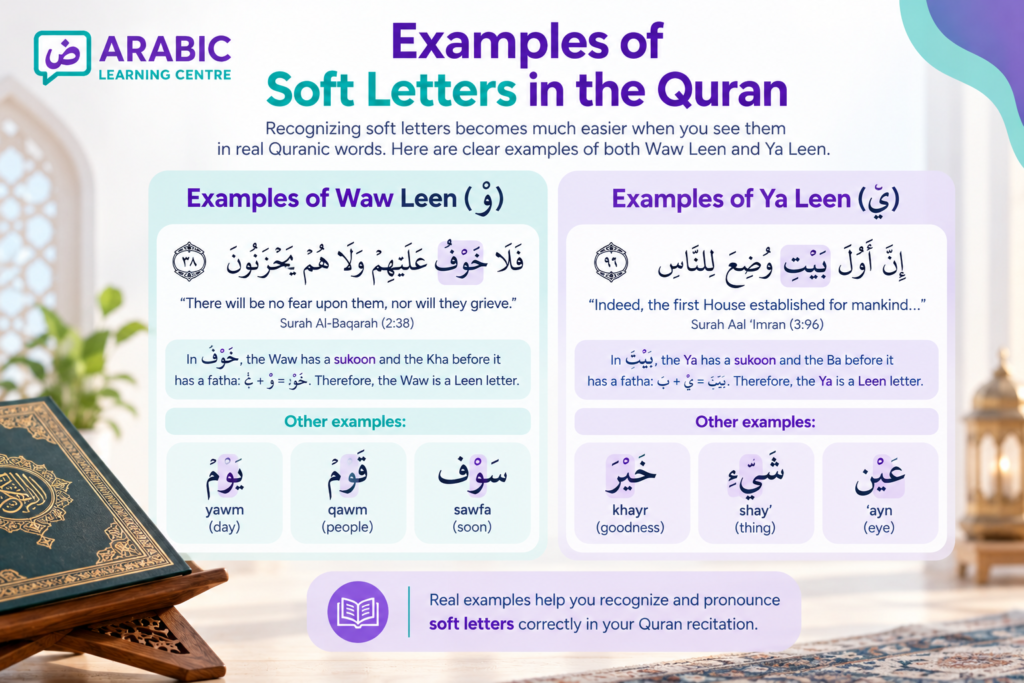
Examples of Waw Leen
A clear example of Waw Leen is خَوْفٌ (khawfun), meaning “fear.”
Allah says:
فَلَا خَوْفٌ عَلَيْهِمْ وَلَا هُمْ يَحْزَنُونَ
“There will be no fear upon them, nor will they grieve.”
Surah Al-Baqarah 2:38
In خَوْفٌ, the Waw carries a sukoon and the Kha before it carries a fatha: خَ + وْ = خَوْ. Therefore, the Waw is a Leen letter.
Other examples include يَوْم (yawm), قَوْم (qawm), and سَوْف (sawfa).
Examples of Ya Leen
A clear example of Ya Leen is بَيْتٍ (baytin), meaning “house.”
Allah says:
إِنَّ أَوَّلَ بَيْتٍ وُضِعَ لِلنَّاسِ
“Indeed, the first House established for mankind…”
Surah Aal ‘Imran 3:96
In بَيْتٍ, the Ya carries a sukoon and the Ba before it carries a fatha: بَ + يْ = بَيْ. Therefore, the Ya is a Leen letter.
Other examples include خَيْر (khayr), شَيْء (shay’), and عَيْن (‘ayn).
How to Identify Leen Letters in Arabic?
You do not need to memorize every Arabic word that contains Leen. Instead, learn to recognize the simple pattern that creates a Leen letter.
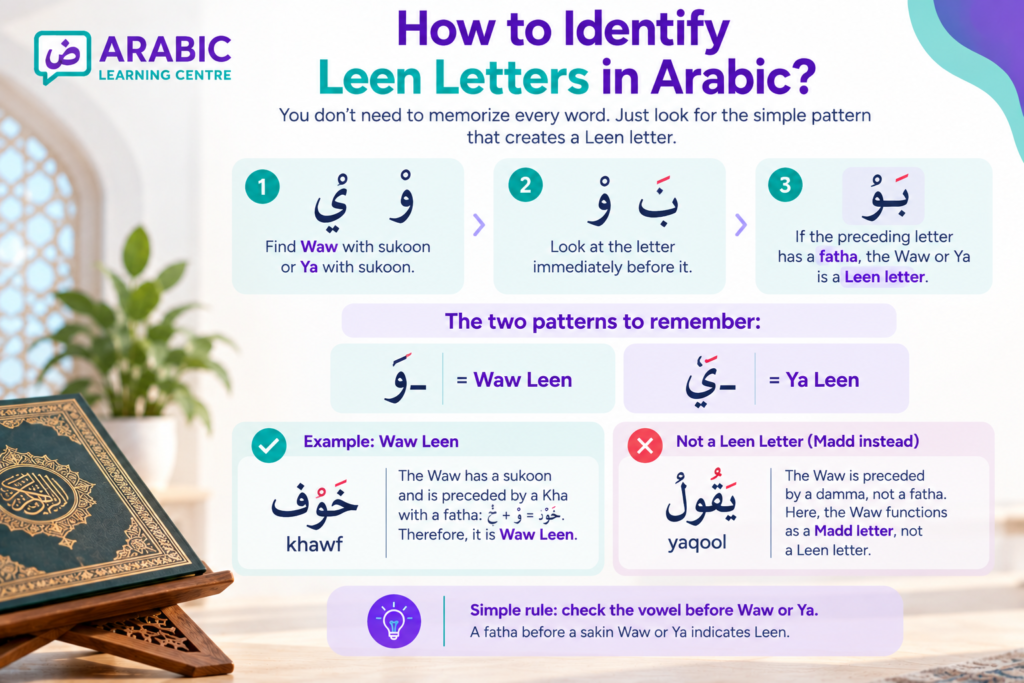
When reading Arabic, check for:
- وْ (Waw with sukoon) or يْ (Ya with sukoon).
- Look at the letter immediately before it.
- If the preceding letter has a fatha (َ), the Waw or Ya is a Leen letter.
The two patterns to remember are:
- ـَوْ = Waw Leen
- ـَيْ = Ya Leen
For example, in خَوْف (khawf), the Waw has a sukoon and is preceded by a Kha with fatha: خَ + وْ = خَوْ. Therefore, it is Waw Leen.
By contrast, in يَقُول (yaqool), the Waw is preceded by a damma, not a fatha. Here, the Waw functions as a Madd letter, not a Leen letter.
A simple rule to remember is: check the vowel before Waw or Ya. A fatha before a sakin Waw or Ya indicates Leen, while the vowel conditions for Madd are different.
Read also: Idgham Letters in Arabic – Rules, Types, and 10 Examples from the Quran
How to Pronounce Waw Leen Correctly?
To pronounce Waw Leen, begin with the fatha on the letter before the Waw, then move smoothly into the sakin Waw without adding an extra vowel or unnecessary lengthening.
Take the word خَوْف (khawf) as an example. Start with خَ, then glide naturally into وْ:
خَ + وْ = خَوْ
The movement should be smooth and light, with the lips naturally rounding as you move into the Waw.
When pronouncing Waw Leen, avoid:
- Turning the Waw into a long oo sound.
- Adding an extra vowel after the Waw.
- Making the sound unnecessarily heavy.
- Stretching it during normal connected recitation as if it were a Madd letter.
The key is to produce a smooth glide rather than an automatically prolonged sound.
How to Pronounce Ya Leen Correctly?
For Ya Leen, begin with the fatha and smoothly transition toward Ya.
Take:
بَيْت — bayt
Start with بَ and glide into the Ya, producing the ay sound heard in bayt.
Avoid changing it into a long ee sound. A long ee corresponds to a different vowel pattern and can turn the letter into a Madd Ya rather than Ya Leen.
Compare:
- بَيْ — bay → Ya Leen pattern
- بِي — bee → Madd Ya pattern
Hearing this contrast repeatedly can make the difference much easier to recognize.
What Is Madd al-Leen?
Madd al-Leen (مد اللين) is related to Leen letters, but the two terms should not be treated as identical.
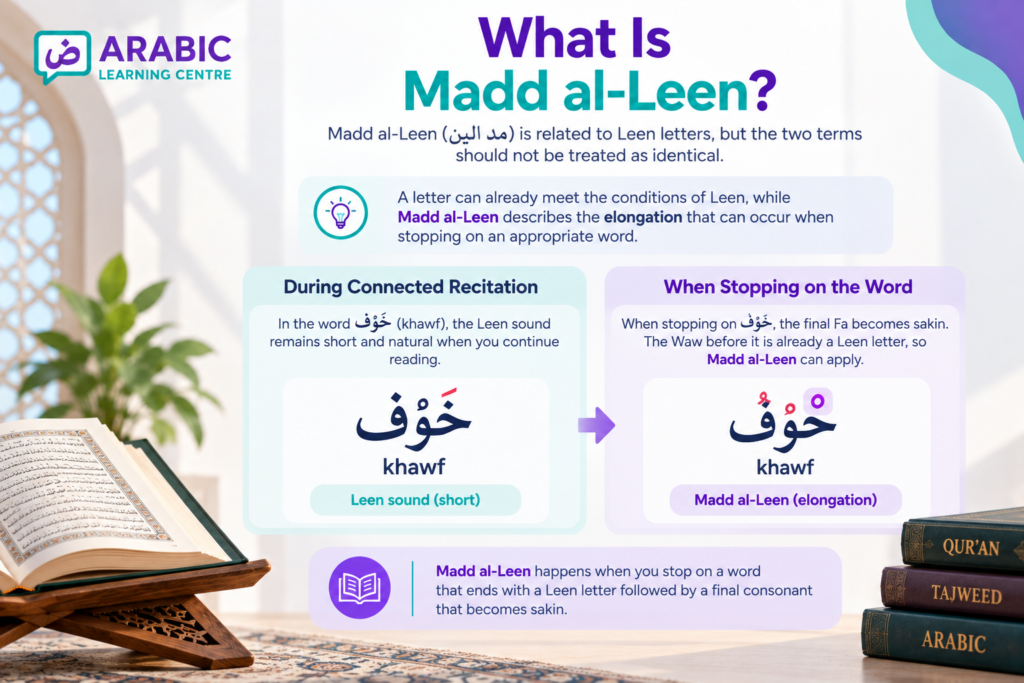
A letter can already meet the conditions of Leen, while Madd al-Leen describes the elongation that can occur when stopping on an appropriate word.
Consider a word such as: خَوْف
During connected recitation, the Leen sound remains short and natural.
When stopping on a word in which a Leen letter comes before a final consonant that becomes sakin because of the stop, the conditions for Madd al-Leen are present.
For example: خَوْفْ
Here, the final Fa is made sakin because the reciter stops. The Waw before it is already a Leen letter, so Madd al-Leen can apply.
In the commonly taught Hafs recitation, the sound may be read for 2, 4, or 6 counts when stopping, with consistency in the chosen recitation method.
| Reading Situation | Treatment |
| Continuing the recitation (Wasl) | Soft, natural Leen sound without Madd al-Leen |
| Stopping (Waqf) under Madd al-Leen conditions | 2, 4, or 6 counts |
This distinction between Wasl and Waqf is essential for applying the rule correctly.
How Does the Pronunciation of Leen Letters Change During Wasl and Waqf?
The pronunciation of Leen letters depends on whether you continue reciting or stop at the word. Understanding this difference helps you know when to pronounce the natural Leen sound and when Madd al-Leen may apply.
During Wasl
Wasl means continuing the recitation without stopping. When a Leen letter appears during Wasl, pronounce its natural soft glide without applying the special elongation of Madd al-Leen.
The presence of Waw Leen or Ya Leen alone does not mean that the sound should be stretched.
During Waqf
Waqf means stopping. When the consonant following a Leen letter becomes sakin because of the stop, Madd al-Leen may apply according to the recitation rules being followed.
The key distinction is that Leen describes the soft quality of the letter, while Madd al-Leen refers to the elongation that can occur when stopping under the required conditions.
Why Are Soft Letters Important in Arabic and Tajweed?
Learning soft letters in Arabic may seem like a small part of pronunciation, but it supports several broader skills.
- They Improve Quranic Pronunciation: Recognizing Leen helps you pronounce Waw and Ya according to their actual vowel environments rather than treating every occurrence in the same way.
- They Prevent Confusion Between Short and Long Sounds: A learner who cannot distinguish Leen Waw from Madd Waw may stretch words that should remain short during connected recitation.
- The same problem can occur between Leen Ya and Madd Ya.
- They Improve Reading Fluency: Once the pattern fatha + sakin Waw/Ya becomes familiar, you no longer need to stop and analyze every occurrence. The correct glide begins to happen naturally.
- They Prepare You for Madd Rules: Understanding Leen provides a useful foundation before studying more detailed rules of Madd, including those affected by stopping and temporary sukoon.
- They Develop Better Listening Skills: Correct Tajweed depends on hearing subtle differences as well as understanding written rules. Practicing Leen trains your ear to distinguish aw, ay, oo, and ee patterns more accurately.
Read also: Izhar Letters in Arabic – Rules, Pronunciation, and 10 Examples from the Quran
An Easy Way to Remember the Leen Letters
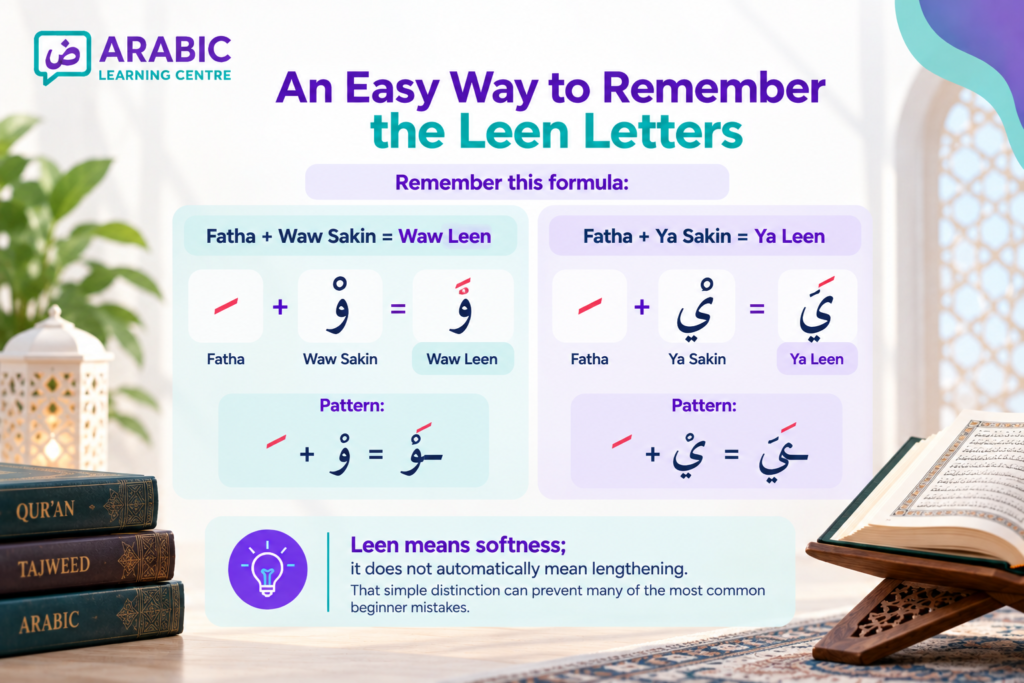
Remember this formula:
Fatha + Waw Sakin = Waw Leen
ـَ + وْ = ـَوْ
And:
Fatha + Ya Sakin = Ya Leen
ـَ + يْ = ـَيْ
Then remember one additional principle:
Leen means softness; it does not automatically mean lengthening That simple distinction can prevent many of the most common beginner mistakes.
Don’t Just Take Our Word For It
Take a look inside our vibrant classes and see our students and teachers in action. Click below to watch our classroom experience:
Learn Arabic with Arabic Learning Centre
Mastering soft letters in Arabic is easier when you learn with clear explanations, guided practice, and expert support.
Arabic Learning Centre helps learners build strong Arabic skills step by step, from recognizing letters and vowel patterns to improving reading, pronunciation, and overall language confidence.
Whether you are a beginner or looking to strengthen your Arabic, the academy provides a supportive learning environment that helps you understand the language and use it more naturally and accurately.
Start your learning journey with Arabic Learning Centre and book a free trial lesson today.
Courses We Offer:
- Online Arabic Course
- Classical arabic course
- Modern Standard Arabic Course
- Fusha Arabic Course
- Learn Saudi Arabic
- Arabic Course for Beginners
- Arabic Classes for Adults
- Arabic Classes for Ladies
- Advanced Arabic Course
- Intensive Arabic Course

Conclusion
Understanding soft letters in Arabic becomes simple once you recognize their defining pattern. In Tajweed, the two Leen letters in Arabic are Waw (وْ) and Ya (يْ) when they are sakin and preceded by a fatha.
This creates the familiar patterns ـَوْ and ـَيْ, which are pronounced with a smooth, natural glide.
The key is to distinguish Leen from Madd and to remember that Alif, Waw, and Ya may be grouped separately as Huroof al-‘Illah in Arabic grammar. With regular listening and reading practice, recognizing and pronouncing Leen letters becomes increasingly natural.
Mastering this small but important rule can improve pronunciation, strengthen Arabic reading skills, and support more accurate and confident Quranic recitation.
Frequently Asked Questions About Soft Letters in Arabic
What are the soft letters in Arabic?
In Tajweed, the soft letters in Arabic, or Huroof al-Leen, are Waw (وْ) and Ya (يْ) when they carry sukoon and are immediately preceded by a letter carrying fatha. Examples include خَوْف and بَيْت.
How many soft letters in Arabic are there?
In Tajweed, there are two Leen letters: Waw and Ya under the required conditions. In broader Arabic grammar and morphology, Alif, Waw, and Ya are commonly grouped as the three Huroof al-‘Illah, which explains references to 3 soft letters in Arabic.
What are the 3 soft letters in Arabic?
When the phrase refers broadly to the weak letters or Huroof al-‘Illah, the three letters are Alif (ا), Waw (و), and Ya (ي). In Tajweed, however, Huroof al-Leen specifically consist of only Waw and Ya when sakin and preceded by fatha.
What are Leen letters in Arabic?
Leen letters in Arabic are Waw with sukoon and Ya with sukoon when preceded by fatha. They create the smooth aw and ay glides found in words such as خَوْف (khawf) and بَيْت (bayt).
What is the difference between Leen and Madd?
Leen Waw and Ya are preceded by fatha and normally create a soft glide. Madd Waw is preceded by damma, while Madd Ya is preceded by kasra. Madd letters create long vowel sounds, whereas Leen letters are not automatically lengthened during connected recitation.
Is Alif a Leen letter?
No. Alif is not one of the two Huroof al-Leen in Tajweed. Alif functions as a Madd letter when preceded by fatha. It may, however, be grouped with Waw and Ya as one of the three Huroof al-‘Illah in Arabic grammar and morphology.
What is an example of Waw Leen?
خَوْف (khawf) is a common example. The Waw carries sukoon and the Kha immediately before it carries fatha, making the Waw a Leen letter.