 Learn Arabic
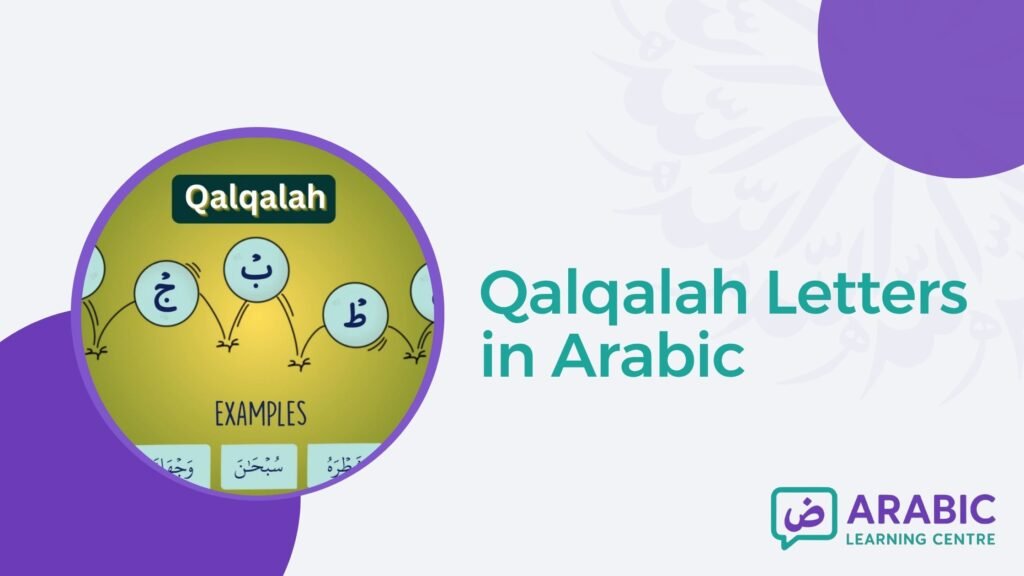
The Qalqalah letters in Arabic are ق، ط، ب، ج، د — Qaaf, Taa, Baa, Jeem, and Daal. In Tajweed, these five letters produce a distinct bouncing or echoing sound when they become Sakin, meaning they carry a Sukoon or are made still because the reciter stops on them.
Qalqalah is one of the most recognizable Tajweed rules because even a small change in how the letter is released can noticeably affect Quranic recitation. The sound should be clear enough to preserve the letter, but not so strong that it turns into a new vowel or syllable.
In this guide, you will learn the meaning of Qalqalah, the five Arabic Qalqalah letters, when the rule applies, the main types of Qalqalah, and practical Qalqalah examples from Quran.
What Is Qalqalah in Arabic?
Qalqalah (قلقلة) literally means movement, disturbance, shaking, or vibration. In Tajweed, it refers to the slight bounce or echo produced when one of the five Qalqalah letters is pronounced in a state of Sukoon.
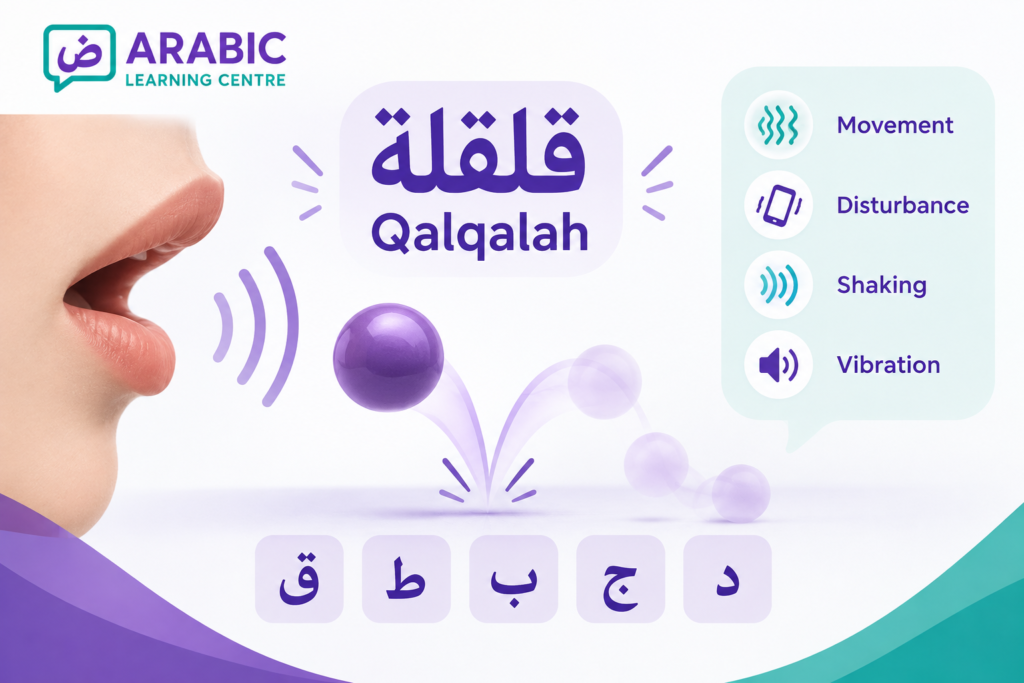
This bounce helps the consonant remain clear instead of sounding swallowed, muffled, or abruptly cut off. However, Qalqalah does not mean adding another vowel after the letter; it is simply a controlled release of the consonant.
For this reason, Qalqalah in English is commonly described as a bounce, echo, or rebound in the sound.
What Are the Qalqalah Letters in Arabic?
There are five Qalqalah letters in Arabic: ق، ط، ب، ج، د. Each produces the characteristic Qalqalah bounce when it occurs in a state of Sukoon.
| Arabic Letter | English Name |
| ق | Qaaf |
| ط | Taa |
| ب | Baa |
| ج | Jeem |
| د | Daal |
How to Remember the Five Qalqalah Letters?
The five letters are traditionally collected in the easy-to-remember phrase:
قُطْبُ جَدٍّ — Qutbu Jadd
Memorizing Qutbu Jadd gives learners a simple way to recognize all five Qalqalah letters while reading the Quran.
For learners who are also building their wider Arabic knowledge, practicing these letters inside real words is useful. Studying them alongside Arabic vocabulary helps connect Tajweed pronunciation with meaningful Arabic words rather than treating the letters only as isolated sounds.

Why Do Qalqalah Letters Produce a Bounce?
The Qalqalah letters share phonetic qualities that cause the sound to be held firmly at the articulation point and then released.
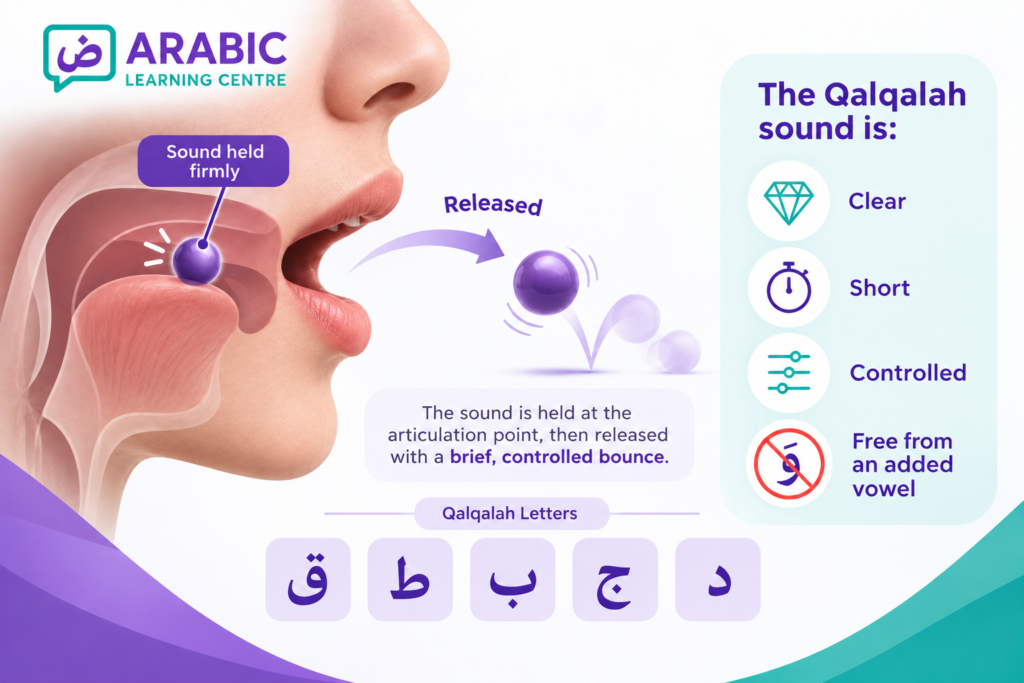
When one of these letters is Sakin, the sound cannot flow in the same way as a vowelled letter. As a result, the reciter gives the consonant a brief, controlled release.
That release creates the characteristic Qalqalah effect.
The sound should be:
- Clear
- Short
- Controlled
- Free from an added vowel
The goal is to preserve the identity of the letter without exaggerating it.
When Does Qalqalah Apply?
Qalqalah applies when one of the five letters ق، ط، ب، ج، د becomes Sakin.
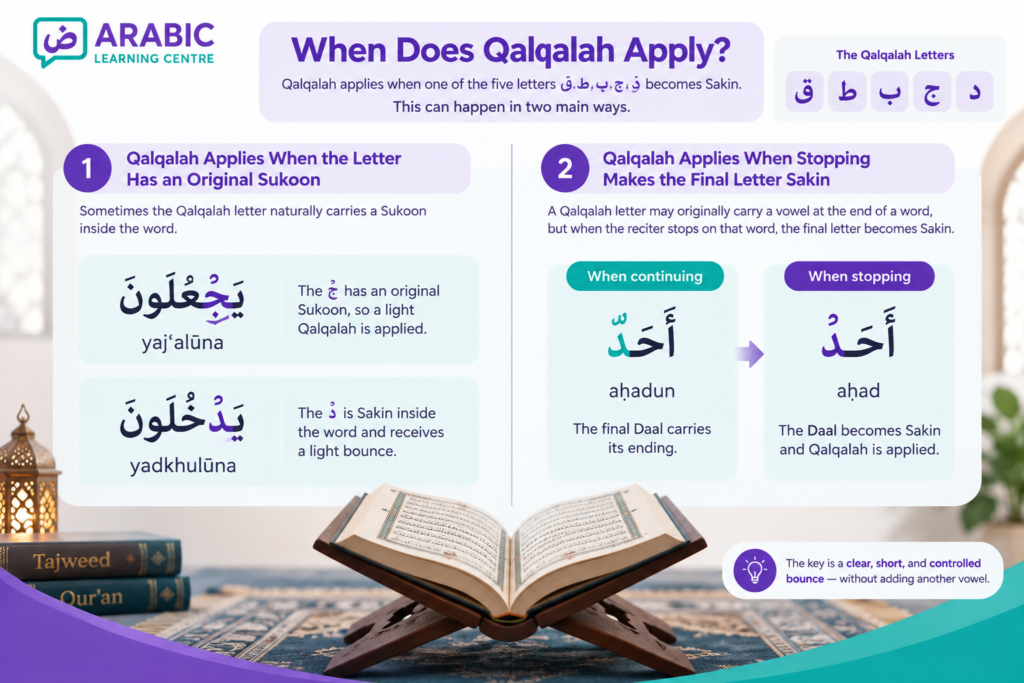
This can happen in two main ways.
1. Qalqalah Applies When the Letter Has an Original Sukoon
Sometimes the Qalqalah letter naturally carries a Sukoon inside the word.
For example:
يَجْعَلُونَ — yajʿalūna
The جْ has an original Sukoon, so a light Qalqalah is applied.
Another example is:
يَدْخُلُونَ — yadkhulūna
The دْ is Sakin inside the word and receives a light bounce.
2. Qalqalah Applies When Stopping Makes the Final Letter Sakin
A Qalqalah letter may originally carry a vowel at the end of a word, but when the reciter stops on that word, the final letter becomes Sakin.
For example:
أَحَدٌ — aḥadun
When recitation continues, the final Daal carries its ending.
When stopping:
أَحَدْ — aḥad
The Daal becomes Sakin and Qalqalah is applied.
What Are the Types of Qalqalah?
The types of Qalqalah are commonly classified according to the position of the Qalqalah letter and the strength of its bounce.
A practical classification includes three levels: Qalqalah Sughra, Qalqalah Kubra, and Qalqalah Akbar.
| Type | When It Occurs | Strength |
| Qalqalah Sughra | A Qalqalah letter is Sakin within the flow of recitation | Light |
| Qalqalah Kubra | The reciter stops on a word ending with a Qalqalah letter | Stronger |
| Qalqalah Akbar | The reciter stops on a final Qalqalah letter with Shaddah | Strongest |
Some Tajweed materials teach only two broad categories, Sughra and Kubra, while others distinguish the strongest form of Kubra as a separate level called Qalqalah Akbar.
1. Qalqalah Sughra: A Light Bounce on a Sakin Letter
Qalqalah Sughra (القلقلة الصغرى) occurs when a Qalqalah letter is already Sakin within the flow of recitation. Since the reciter continues directly to the next sound, the bounce is light and brief.
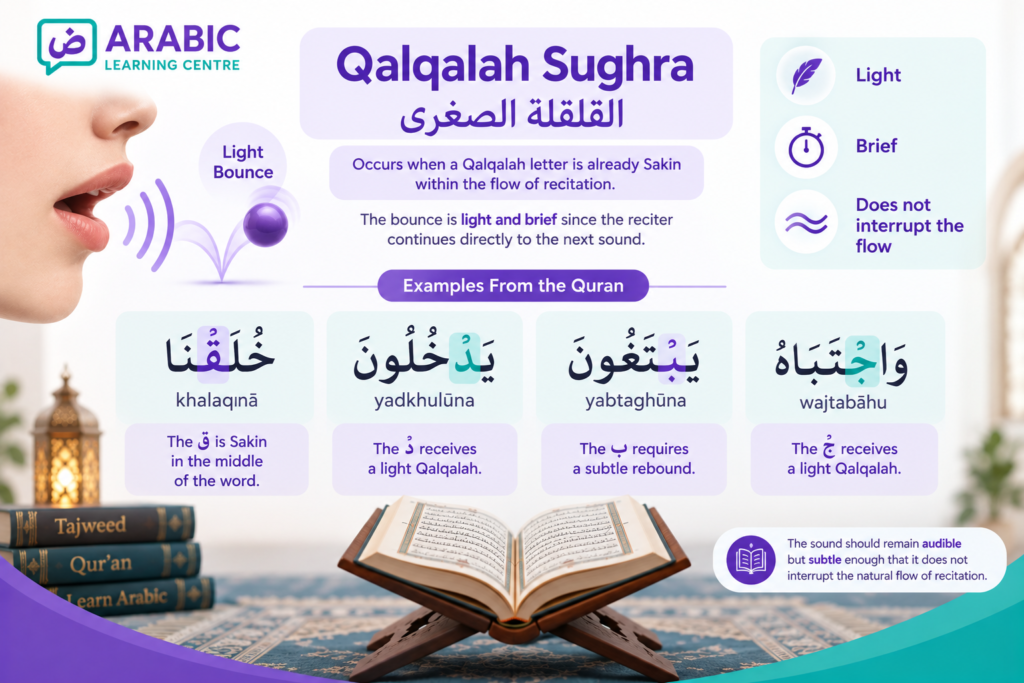
Qalqalah Sughra Examples From the Quran
- خَلَقْنَا — khalaqnā: The قْ is Sakin in the middle of the word.
- يَدْخُلُونَ — yadkhulūna: The دْ receives a light Qalqalah.
- يَبْتَغُونَ — yabtaghūna: The بْ requires a subtle rebound.
- وَاجْتَبَاهُ — wajtabāhu: The جْ receives a light Qalqalah.
The sound should remain audible but subtle enough that it does not interrupt the natural flow of recitation.
2. Qalqalah Kubra: A Stronger Bounce When Stopping
Qalqalah Kubra (القلقلة الكبرى) occurs when the reciter stops on a word ending with one of the five Qalqalah letters.
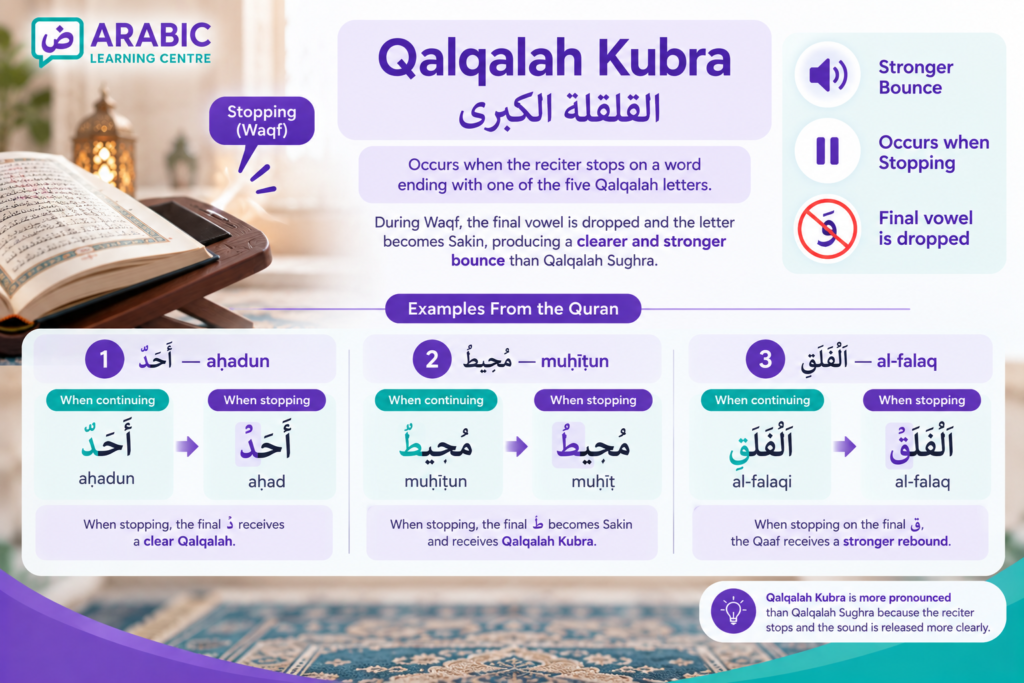
During Waqf, the final vowel is dropped and the letter becomes Sakin, producing a clearer and stronger bounce than Qalqalah Sughra.
Qalqalah Kubra Examples From the Quran
- أَحَدٌ — aḥadun: When stopping as أَحَدْ — aḥad, the final د receives a clear Qalqalah.
- مُحِيطٌ — muḥīṭun: When stopping, the final ط becomes Sakin and receives Qalqalah Kubra.
- الْفَلَقِ — al-falaq: When stopping on the final ق, the Qaaf receives a stronger rebound.
3. Qalqalah Akbar: The Strongest Bounce on a Doubled Letter
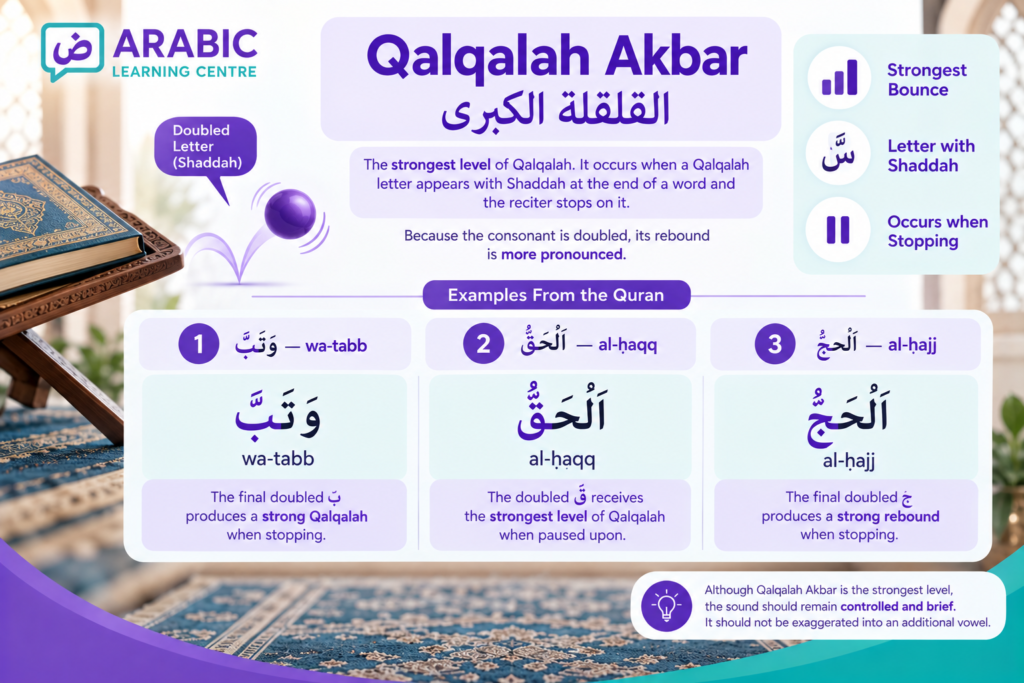
Qalqalah Akbar is the strongest level of Qalqalah. It occurs when a Qalqalah letter appears with Shaddah at the end of a word and the reciter stops on it. Because the consonant is doubled, its rebound is more pronounced.
Qalqalah Akbar Examples From the Quran
- وَتَبَّ — wa-tabb: The final doubled بّ produces a strong Qalqalah when stopping.
- الْحَقُّ — al-ḥaqq: The doubled قّ receives the strongest level of Qalqalah when paused upon.
- الْحَجُّ — al-ḥajj: The final doubled جّ produces a strong rebound when stopping.
Although Qalqalah Akbar is the strongest level, the sound should remain controlled and brief. It should not be exaggerated into an additional vowel.
Read also: Tongue Letters in Arabic – Makharij and Pronunciation Guide
Qalqalah Sughra, Kubra, and Akbar Compared
The main difference between Qalqalah Sughra, Kubra, and Akbar is the strength of the bounce and the position of the Qalqalah letter.
| Type | Example | When It Occurs | Strength |
| Qalqalah Sughra | يَجْعَلُونَ | A Qalqalah letter is Sakin within the flow of recitation | Light |
| Qalqalah Kubra | أَحَدْ | The reciter stops on a word ending with a Qalqalah letter | Stronger |
| Qalqalah Akbar | وَتَبَّ | The reciter stops on a final Qalqalah letter with Shaddah | Strongest |
In all three cases, the same principle applies: the Qalqalah letter should be released with a clear, controlled rebound without adding an extra vowel.
Inside Our Classrooms
See how we make learning interactive and engaging! Watch a quick snippet of our live, conversational classes in action:
Qalqalah Examples From the Quran for Each Letter
The five Qalqalah letters in Arabic — ق، ط، ب، ج، د — can all be found in Quranic words. The examples below show how the rule applies to each letter.
| Letter | Quranic Example | How Qalqalah Applies |
| ق — Qaaf | خَلَقْنَا | The قْ is Sakin and receives a light Qalqalah. |
| ط — Taa | مُحِيطٌ | When stopping, the final ط becomes Sakin and receives a stronger Qalqalah. |
| ب — Baa | يَبْتَغُونَ | The بْ is Sakin and receives a light Qalqalah. |
| ج — Jeem | يَجْعَلُونَ | The جْ is Sakin and receives a light Qalqalah. |
| د — Daal | أَحَدٌ | When stopping, the final د becomes Sakin and receives Qalqalah Kubra. |
Practicing Qalqalah examples from the Quran for all five letters helps learners recognize where the rule occurs and distinguish between a light bounce within recitation and a stronger bounce when stopping.
How to Recognize Qalqalah While Reading?
Recognizing Qalqalah while reading the Quran becomes easier once you know what to look for. Start by memorizing the five Qalqalah letters:
ق ط ب ج د — Qutbu Jadd
Then follow these simple steps:
- Find a Qalqalah letter: Look for ق، ط، ب، ج، or د in the word.
- Check for Sukoon: If the letter already has a Sukoon, Qalqalah applies.
- Check whether you are stopping: If a word ends with a Qalqalah letter, stopping on it makes that letter Sakin and activates Qalqalah.
- Determine the strength: Apply a lighter bounce within the flow of recitation and a stronger bounce when stopping, with the strongest level occurring on a final doubled Qalqalah letter.
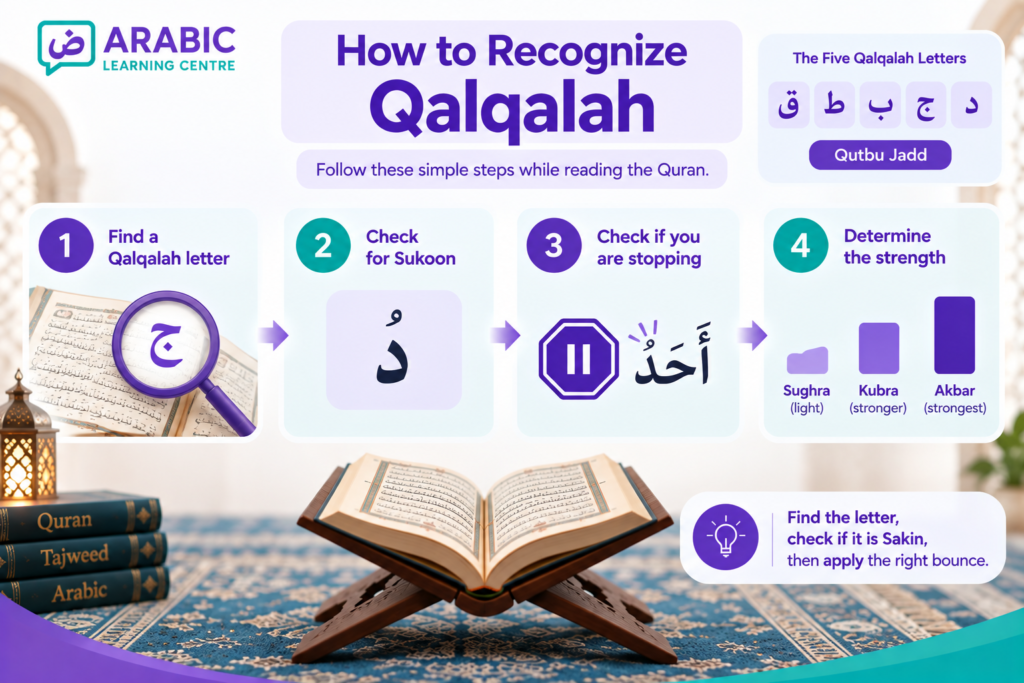
A simple rule to remember is: find the Qalqalah letter, check whether it is Sakin, and then determine the strength of the bounce.
How to Practice Qalqalah Correctly?
Qalqalah improves through a combination of listening, visual recognition, and repetition. The best approach is to begin with individual letters before progressing to Quranic words and different levels of Qalqalah.
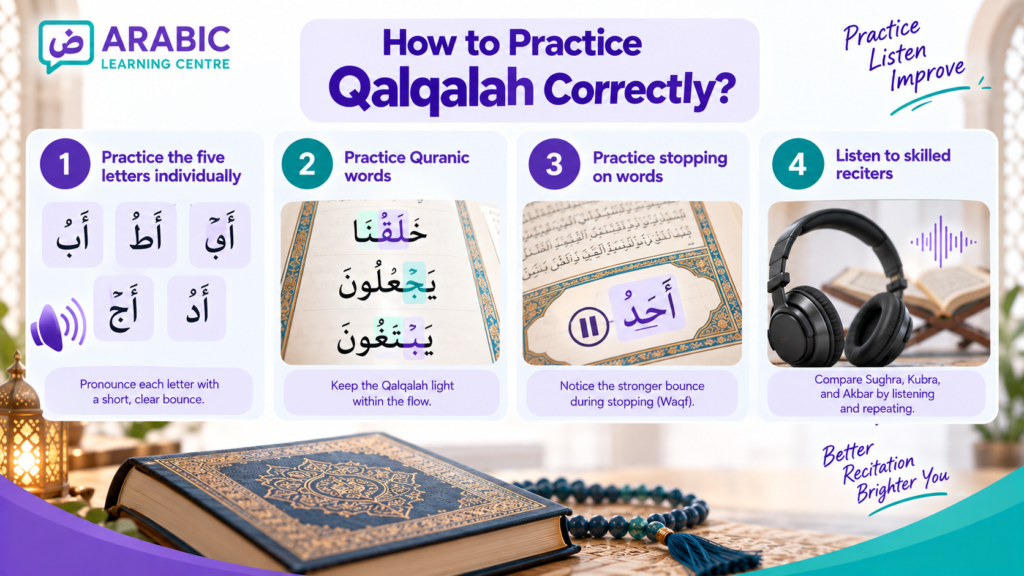
1. Start by Practicing the Five Qalqalah Letters Individually With Sukoon
Begin by pronouncing each letter separately:
أَقْ — أَطْ — أَبْ — أَجْ — أَدْ
Focus on producing a short, clear bounce without adding an extra vowel.
2. Move From Individual Qalqalah Letters to Complete Quranic Words
Once the individual sounds become familiar, practice words such as:
- خَلَقْنَا
- يَجْعَلُونَ
- يَبْتَغُونَ
Keep the Qalqalah light when the Sakin letter occurs within the flow of recitation.
Read also: Arabic Throat Letters – A Guide to Pronunciation and Articulation
3. Practice a Stronger Qalqalah When Stopping on Words
Next, practice stopping on words that end with ق، ط، ب، ج، or د. Notice how the bounce becomes stronger during Waqf compared with Qalqalah within the flow of recitation.
4. Listen to Skilled Reciters to Distinguish Sughra, Kubra, and Akbar
Listen carefully to skilled Quran reciters and compare the strength of Qalqalah Sughra, Kubra, and Akbar. Repeating after a correct model can help you hear and reproduce the differences without exaggerating the bounce.
For learners who prefer a supportive learning environment, Arabic Learning Centre also provides structured learning options for female students through its Arabic learning for ladies section, where learners can strengthen their Arabic foundation and pronunciation skills progressively.

Common Mistakes When Applying Qalqalah
Several mistakes can affect the correct application of Qalqalah, particularly when learners are still developing control over the strength and duration of the bounce.
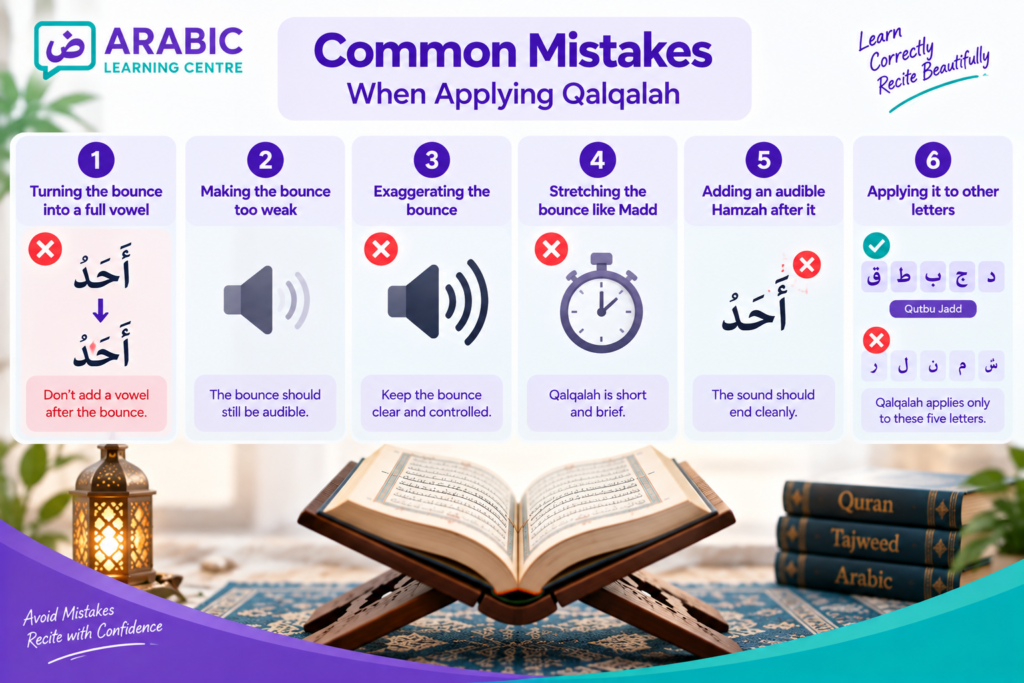
1. Avoid Turning the Qalqalah Bounce Into a Full Vowel
Qalqalah is a rebound of the consonant, not a new Fathah, Kasrah, or Dammah. For example, أَحَدْ should not become aḥada when stopping.
2. Do Not Make a Sakin Qalqalah Letter So Weak That the Bounce Disappears
Some learners pronounce a Sakin Qalqalah letter too weakly, causing the consonant to become unclear. The bounce may be light, but it should still be audible.
3. Avoid Exaggerating Qalqalah Until It Creates an Extra Syllable
Making the Qalqalah too strong can cause the consonant to sound unnatural or create an additional syllable. The rebound should remain clear and controlled.
4. Keep the Qalqalah Bounce Brief Instead of Stretching It Like Madd
Qalqalah is a short rebound and should not be elongated like a Madd sound.
5. Do Not Add an Audible Hamzah After the Qalqalah Bounce
The Qalqalah sound should end cleanly. Adding an audible Hamzah after the bounce changes the intended pronunciation.
6. Apply Qalqalah Only to the Five Letters ق ط ب ج د
Qalqalah applies specifically to the five letters collected in:
قُطْبُ جَدٍّ
Other Sakin letters do not automatically receive a Qalqalah bounce.
Is Qalqalah Difficult for Beginners?
No, Qalqalah is generally one of the easier Tajweed rules for beginners because it involves only five letters and follows clear conditions. The greater challenge is not memorizing ق، ط، ب، ج، د, but learning to control the bounce correctly during recitation.
Beginners should focus on:
- Producing a clear bounce without adding an extra vowel.
- Distinguishing between light and stronger levels of Qalqalah.
- Recognizing when stopping on a word creates Sukoon.
- Keeping the rebound brief rather than stretching it.
- Maintaining the correct articulation point of each Qalqalah letter.
With regular listening, practice, and correction, learners can gradually recognize and produce the different levels of Qalqalah more naturally.
Read also: Lip Letters in Arabic – Baa, Meem, Waw, and Faa Explained
Don’t Just Take Our Word For It
Take a look inside our vibrant classes and see our students and teachers in action. Click below to watch our classroom experience:
Improve Your Arabic Pronunciation With Arabic Learning Centre
Learning Qalqalah in Arabic helps sharpen Quranic pronunciation, but strong recitation also depends on understanding the Arabic sounds that surround each Tajweed rule.
Developing your vocabulary and familiarity with real Arabic words can make it easier to recognize patterns, follow recitation, and pronounce letters with greater confidence.
At Arabic Learning Centre, learners can build their Arabic step by step with guidance designed to strengthen pronunciation, comprehension, and practical language use.
Whether you are focusing on Quranic sounds or broader Arabic communication, consistent practice helps turn individual pronunciation rules into natural reading habits.
Start your learning journey with Arabic Learning Centre and book a free trial lesson today.
Courses We Offer:
- Online Arabic Course
- Classical arabic course
- Modern Standard Arabic Course
- Fusha Arabic Course
- Learn Saudi Arabic
- Arabic Course for Beginners
- Arabic Classes for Adults
- Arabic Classes for Ladies
- Advanced Arabic Course
- Intensive Arabic Course

Conclusion
The Qalqalah letters in Arabic are ق، ط، ب، ج، د, remembered through the phrase قُطْبُ جَدٍّ. These letters receive a short bouncing or echoing sound when they are Sakin.
The main types of Qalqalah are Sughra, Kubra, and Akbar. Sughra is lighter and usually occurs within the flow of recitation, Kubra is stronger when stopping on a final Qalqalah letter, and Akbar is strongest when stopping on a doubled Qalqalah letter.
Learning the rule means more than memorizing the five letters. The real goal is to control the rebound so that it remains clear, brief, and free from added vowels.
With regular practice and careful listening, Qalqalah becomes one of the easiest Tajweed features to recognize and apply correctly.
FAQs About Qalqalah Letters in Arabic
What Are the Five Qalqalah Letters in Arabic?
The five Qalqalah letters in Arabic are ق، ط، ب، ج، د — Qaaf, Taa, Baa, Jeem, and Daal. They are commonly memorized through the phrase قُطْبُ جَدٍّ — Qutbu Jadd.
What Does Qalqalah Mean in Arabic?
Qalqalah (قلقلة) means movement, disturbance, shaking, or vibration. In Tajweed, it describes the controlled bounce or rebound produced when one of the five Qalqalah letters is Sakin.
What Are the Qalqalah Letters in English?
The Qalqalah letters in English are written as Qaaf (ق), Taa (ط), Baa (ب), Jeem (ج), and Daal (د).
How Many Types of Qalqalah Are There?
Qalqalah is commonly explained through three levels: Qalqalah Sughra, Qalqalah Kubra, and Qalqalah Akbar. Some Tajweed classifications use only two main categories, treating Akbar as the strongest form of Kubra.
What Is the Difference Between Qalqalah Sughra and Kubra?
Qalqalah Sughra is a lighter bounce that occurs on a Sakin Qalqalah letter within the flow of recitation. Qalqalah Kubra produces a stronger bounce when the reciter stops on a word ending with a Qalqalah letter.
When Does Qalqalah Akbar Occur?
Qalqalah Akbar occurs when the reciter stops on a word ending with a Qalqalah letter that carries Shaddah. It produces the strongest level of Qalqalah.
Does Qalqalah Apply to Every Sakin Arabic Letter?
No. Qalqalah applies specifically to the five letters ق، ط، ب، ج، د when they are Sakin, either originally or because of stopping.
Does Qalqalah Add a Vowel to the Letter?
No. Qalqalah is a brief, controlled rebound of the consonant. It should not create an additional Fathah, Kasrah, or Dammah.
Related Articles
Learn Arabic