 Arabic Grammar
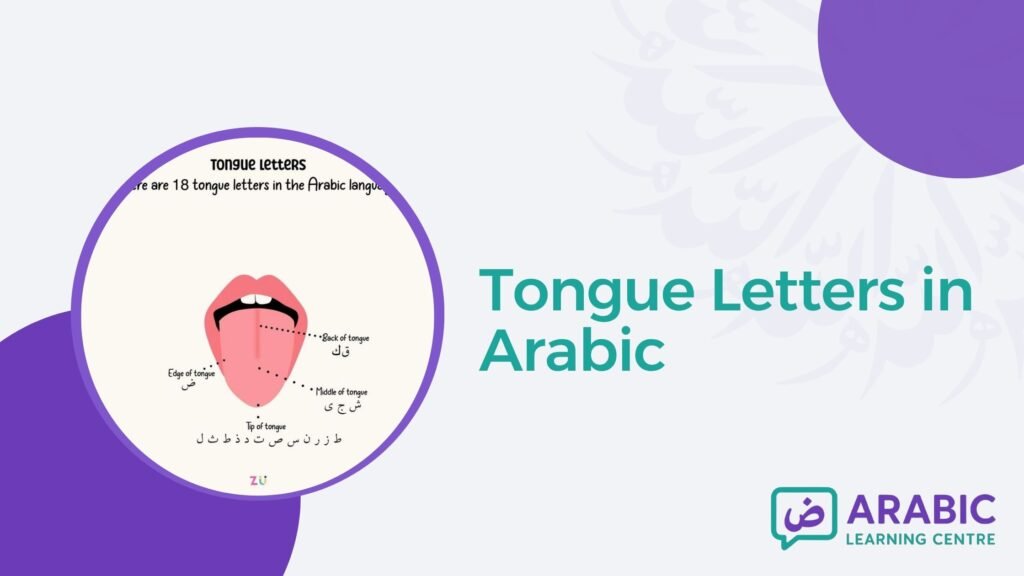
The tongue letters in Arabic are among the most important sounds to master for anyone learning correct Arabic pronunciation or Quranic recitation.
The tongue is responsible for producing 18 Arabic letters through 10 specific articulation points, making it the speech organ with the greatest number of Arabic letter makharij.
These articulation points extend from the deepest part of the tongue near the throat to the very tip near the front teeth. Some letters require contact with the palate, others involve the upper molars or gums, while several tip of the tongue letters in Arabic depend on extremely precise positioning around the teeth.
Understanding these positions helps learners distinguish letters that can initially sound similar, such as ق and ك, ت and ط, or د and ض. It is especially important in Tajweed, where pronouncing a letter from the wrong makhraj can affect the accuracy of Quranic recitation.
What Are the Tongue Letters in Arabic?
The tongue letters in Arabic are the 18 letters articulated from different parts of the tongue. They are produced through 10 specific articulation points (makharij) extending from the back of the tongue to its tip.
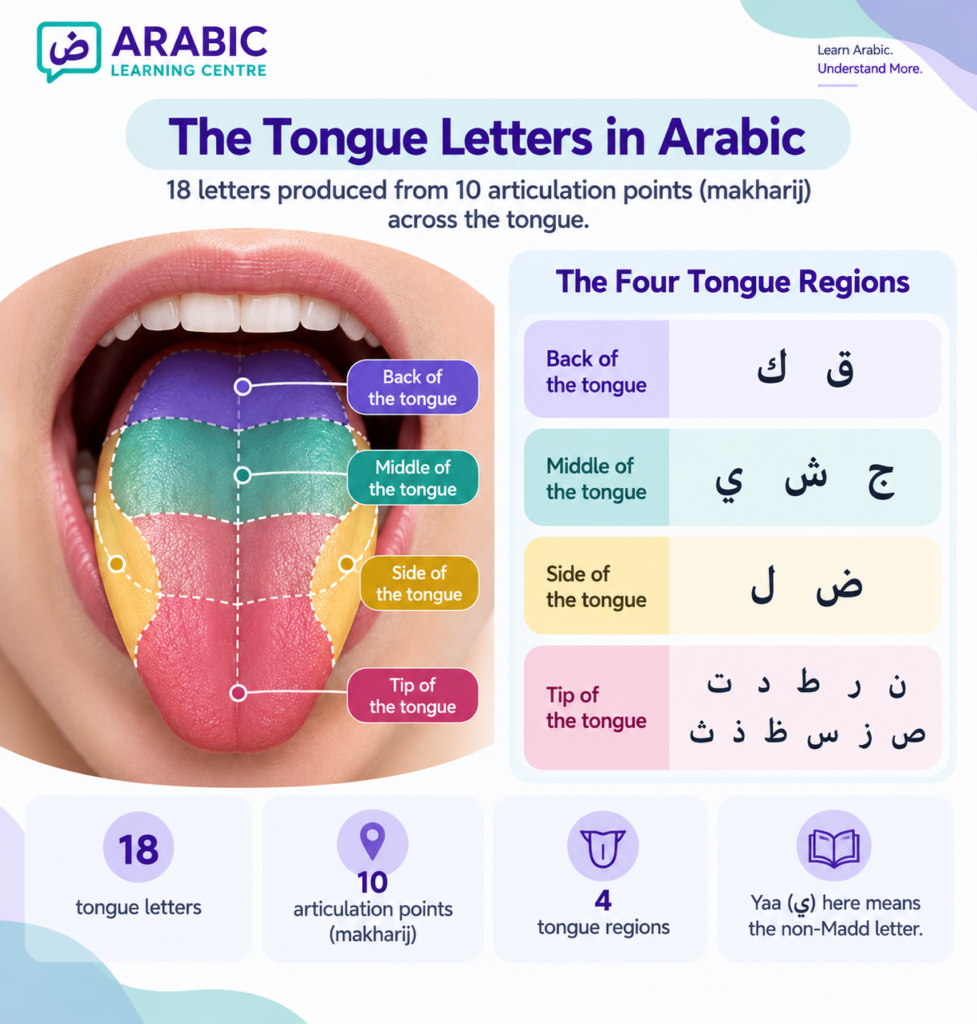
The 18 Arabic tongue letters are: ق، ك، ج، ش، ي، ض، ل، ن، ر، ط، د، ت، ص، ز، س، ظ، ذ، ث
They are divided into four main groups according to the part of the tongue used to pronounce them:
| Tongue Region | Arabic Letters |
| Back of the tongue | ق، ك |
| Middle of the tongue | ج، ش، ي |
| Side of the tongue | ض، ل |
| Tip of the tongue | ن، ر، ط، د، ت، ص، ز، س، ظ، ذ، ث |
Note: The Yaa (ي) included among the tongue letters refers to the non-Madd Yaa, not the long-vowel Yaa used for elongation.
Together, these four regions contain 10 detailed makharij, with each articulation point determining exactly where one or more Arabic letters are produced.
Learning these letters alongside real Arabic words also makes it easier to recognize their sounds and use them correctly in context.
The Arabic Learning Centre’s Arabic Vocabulary Course helps learners expand their vocabulary while strengthening their understanding and pronunciation of Arabic words.

What Does Makhraj Mean in Arabic?
Makhraj (مَخْرَج) literally refers to a place of exit. Its plural is makharij (مَخَارِج). In Arabic phonetics and Tajweed, a makhraj is the specific location from which the sound of a letter emerges.
For example, ق and ك are both produced toward the back of the tongue, but they do not come from exactly the same point. Similarly, ث and ت both involve the front of the tongue, yet their tongue placement relative to the teeth is different.
Learning makharij therefore teaches you more than the names of Arabic letters. It teaches you where each sound should physically originate.
One traditional method of identifying a letter’s makhraj is to pronounce the letter in a state of sukoon after a vowelled Hamzah, such as: أَقْ — أَكْ — أَتْ — أَضْ The point at which the sound is stopped or clearly formed helps reveal its articulation point.
The 10 Tongue Articulation Points in Arabic
The tongue contains ten detailed articulation points distributed across its back, middle, sides, and tip.
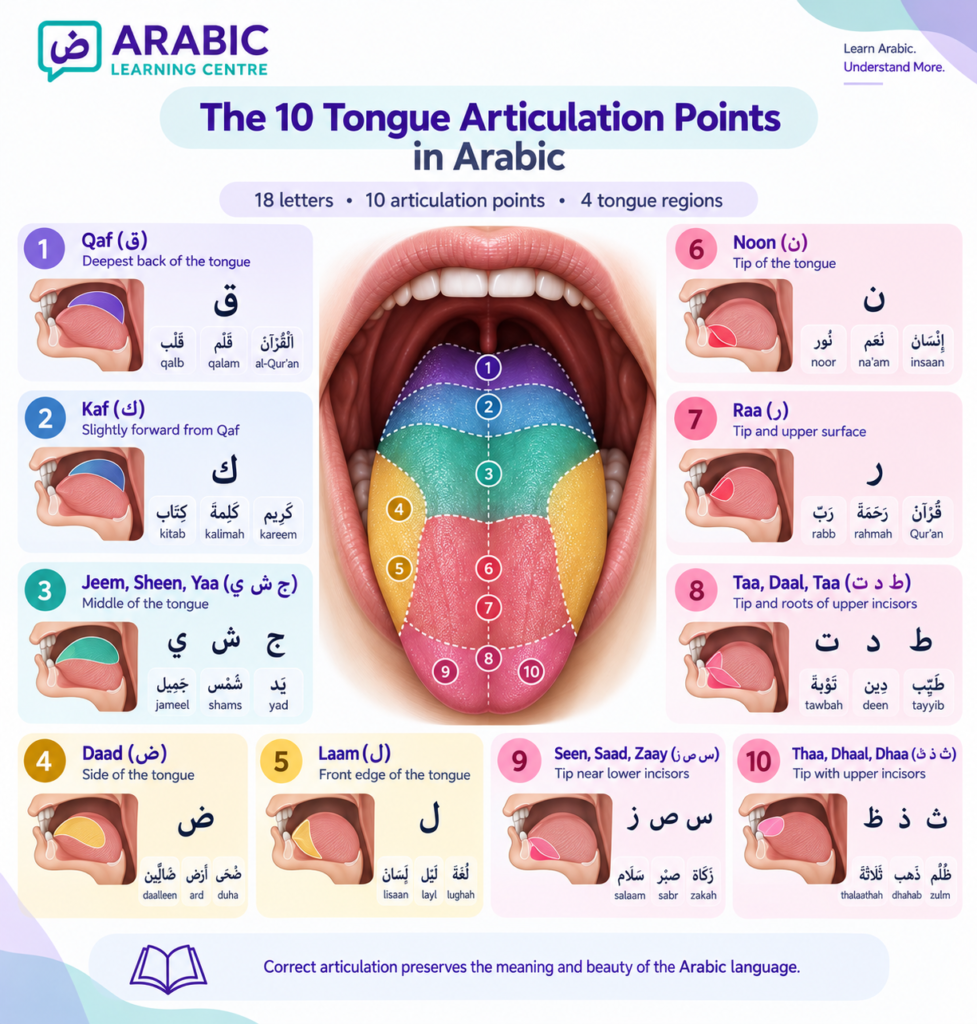
1. Qaf (ق) – Deepest Back of the Tongue
Qaf is produced from the deepest part of the tongue, where the rear of the tongue rises toward and contacts the corresponding area of the upper palate.
It has a strong and distinct sound and is one of the Arabic letters characterized by Isti’laa, meaning that the back of the tongue rises during pronunciation. This contributes to the heavy quality associated with Qaf.
Examples include:
- قَلْب — qalb — heart
- قَلَم — qalam — pen
- الْقُرْآن — al-Qur’an — the Quran
2. Kaf (ك) – Slightly Forward from Qaf
Kaf is articulated slightly forward from the makhraj of Qaf. The back of the tongue rises toward the corresponding part of the palate, but its position is not as deep as Qaf.
Examples include:
- كِتَاب — kitab — book
- كَلِمَة — kalimah — word
- كَرِيم — kareem — generous
Incorrect tongue positioning can make Qaf sound too close to Kaf or vice versa. Consider قَلْب — qalb — heart and كَلْب — kalb — dog: the words have almost the same structure, yet replacing ق with ك produces a completely different meaning. This illustrates why learning the correct Arabic tongue letters is not just a matter of accent — precise articulation helps protect the identity and meaning of Arabic words.
3. Middle of the Tongue – Jeem, Sheen, and Yaa (ج، ش، ي)
These three letters are grouped together because their articulation involves the middle of the tongue and the corresponding area of the upper palate. A useful Arabic mnemonic is جَيْش — jaysh — army, a word that contains all three letters: ج، ي، ش.
Jeem (ج): Jeem is formed from the middle region of the tongue meeting the corresponding palate.
Examples: جَمِيل — jameel — beautiful; جَنَّة — jannah — garden/Paradise; مَسْجِد — masjid — mosque.
The exact sound of ج can vary in modern Arabic dialects, but students studying Quranic or Classical Arabic should learn its standard articulation rather than relying on a regional dialect pronunciation.
Sheen (ش): Sheen is also produced from the middle of the tongue with the corresponding palate. Its sound allows air to flow, giving it the familiar “sh” quality.
Examples: شَمْس — shams — sun; شَيْء — shay’ — thing; شُكْر — shukr — gratitude.
Non-Madd Yaa (ي): The Yaa belonging to this makhraj is the consonantal or non-elongation Yaa, as in يَد — yad — hand and يَوْم — yawm — day.
This should be distinguished from Yaa Madd, the long-vowel Yaa preceded by a kasrah, which is associated with the oral cavity rather than this specific tongue makhraj.
4. Side of the Tongue – Daad (ض)
Daad is one of the most distinctive Arabic tongue letters. Its articulation involves the side of the tongue coming into contact with the corresponding upper molars. It may be articulated using one side of the tongue, and classical descriptions also discuss articulation involving both sides.
The letter is particularly challenging for many non-native speakers because its articulation does not correspond neatly to the ordinary English “d.”
Examples: ضَالِّين — daalleen; أَرْض — ard — earth; ضُحَى — duha — morning brightness.
Daad is also an emphatic letter, so correct pronunciation requires attention both to its makhraj and its sifat, or phonetic characteristics. A common mistake is replacing it with an ordinary د or producing a sound too close to ظ; careful practice with a qualified teacher can help learners distinguish these sounds.
5. Front Edge of the Tongue – Laam (ل)
Laam involves the front portion of the sides or edges of the tongue, together with the tip, contacting the corresponding upper gums.
Examples: لِسَان — lisaan — tongue; لَيْل — layl — night; لُغَة — lughah — language.
Laam also demonstrates an important Tajweed principle: knowing the makhraj alone does not explain every pronunciation rule. For example, the Laam in the name Allah (الله) may be pronounced heavily or lightly according to the vowel that precedes it.
6. Tip of the Tongue – Noon (ن)
Noon is articulated using the tip of the tongue near the gums behind the upper front teeth. The oral articulation of Noon is accompanied by ghunnah, the nasal resonance associated with Noon.
Examples: نُور — noor — light; نَعَم — na’am — yes; إِنْسَان — insaan — human being.
The ghunnah itself has a nasal origin, but the basic letter Noon still has an oral makhraj involving the tongue. This distinction becomes particularly important when students later study the Tajweed rules of Noon Sakinah and Tanween.
Read also: Arabic Throat Letters – A Guide to Pronunciation and Articulation
7. Tip and Upper Tongue Surface – Raa (ر)
Raa is also produced near the upper gums, but its tongue placement differs slightly from Noon. The tip of the tongue approaches or makes contact with the gum area behind the upper teeth, while the articulation involves a small portion of the upper surface of the tongue as well.
Examples: رَبّ — rabb — Lord; رَحْمَة — rahmah — mercy; قُرْآن — Qur’an.
One of the phonetic characteristics of Raa is Takrir, or repetition. However, this does not mean that the reciter should deliberately exaggerate the rolling of Raa. A common Tajweed mistake is allowing the tongue to vibrate repeatedly, producing an excessive trill instead of a controlled Arabic Raa.
8. Tip with the Roots of the Upper Incisors – Taa, Daal, and Taa (ط، د، ت)
These three letters share a general articulation area involving the tip of the tongue and the roots of the upper front teeth. Although they have closely related makharij, their characteristics make them clearly different.
Taa (ط)
ط is emphatic and belongs to the heavy letters.
Examples: طَيِّب — tayyib — good; طَرِيق — tareeq — road; صِرَاط — siraat — path.
Daal (د)
د is lighter than ط.
Examples: دِين — deen — religion; دَرْس — dars — lesson; وَلَد — walad — boy.
Taa (ت)
ت is also a light letter.
Examples: تَوْبَة — tawbah — repentance; تِين — teen — fig; بَيْت — bayt — house.
Learners should avoid turning ت into the heavier ط or weakening ط until it resembles ت.
9. Tip Near the Lower Incisors – Seen, Saad, and Zaay (س، ص، ز)
These letters are associated with the sharp front portion of the tongue near the lower incisors, while the sound passes through a narrow channel.
They share an important characteristic called Safeer (الصَّفِير), often translated as a whistling or sharp sound.
Seen (س)
Seen is light.
Examples: سَلَام — salaam — peace; سَمَاء — samaa’ — sky; نَاس — naas — people.
Saad (ص)
Saad shares a related airflow pattern with Seen but is an emphatic, heavy letter.
Examples: صَبْر — sabr — patience; صَلَاة — salah — prayer; صِرَاط — siraat — path.
Confusing س with ص is particularly common among beginners.
Zaay (ز)
Zaay is voiced and produces a sound comparable in some respects to English “z,” although correct Arabic articulation should still be learned directly.
Examples: زَكَاة — zakah; زَيْت — zayt — oil; عَزِيز — ‘azeez — mighty/dear.
10. Tip with the Upper Incisors – Thaa, Dhaal, and Dhaa/Za (ث، ذ، ظ)
For these letters, the tip of the tongue reaches the edges of the upper front teeth. They are sometimes described as dental or interdental letters.
Thaa (ث)
ث is similar to the unvoiced “th” in the English word “think.”
Examples: ثَلَاثَة — thalaathah — three; ثَوْب — thawb — garment; كَثِير — katheer — much/many.
Dhaal (ذ)
ذ resembles the voiced “th” found in English “this.”
Examples: ذَهَب — dhahab — gold; ذِكْر — dhikr — remembrance; هَذَا — haadha — this.
Dhaa/Za (ظ)
ظ uses a similar front-tongue position but is an emphatic letter.
Examples: ظُلْم — zulm — injustice; عَظِيم — ‘azeem — great; حِفْظ — hifz — preservation/memorization.
Learners should pay particular attention to the distinction between ذ and ظ, since making one too heavy or the other too light can blur the difference between them.
Summary of the Tip of the Tongue Letters in Arabic
The 11 tip of the tongue letters in Arabic are divided into five groups according to the exact position of the tongue and its contact with the gums or teeth:
| Group | Letters | Tongue Position |
| Noon | ن | Tip near upper gum ridge |
| Raa | ر | Tip/upper surface near upper gums |
| Upper tooth-root letters | ط، د، ت | Tip against roots of upper incisors |
| Whistling letters | ص، ز، س | Tip near lower incisors with narrow airflow |
| Dental/interdental letters | ظ، ذ، ث | Tip contacting edges of upper incisors |
These 11 tip of the tongue letters in Arabic demonstrate how a very small area of the mouth can produce many distinct sounds simply by altering tongue position, airflow, voicing, and other letter characteristics.
Inside Our Classrooms
See how we make learning interactive and engaging! Watch a quick snippet of our live, conversational classes in action:
What Are the Full Mouth Letters in Arabic?
Learners searching for Arabic tongue letters sometimes also encounter the term full mouth letters.
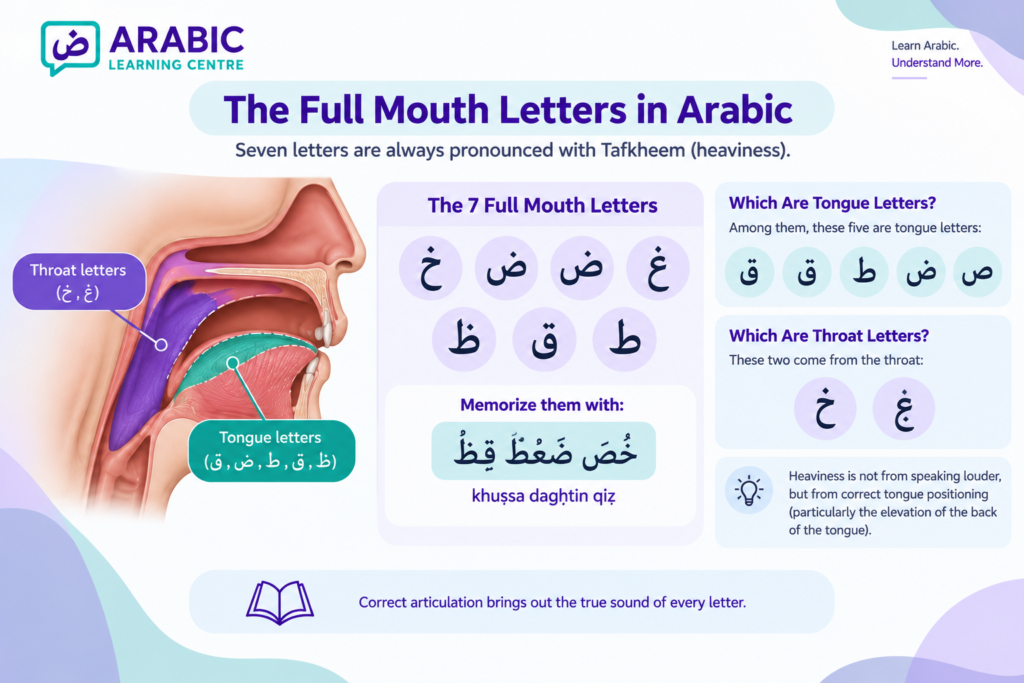
This refers to letters pronounced with Tafkheem, or heaviness.
The seven letters that consistently possess Isti’laa are:
خ، ص، ض، غ، ط، ق، ظ
They are traditionally memorized using the phrase:
خُصَّ ضَغْطٍ قِظْ
Not all of these are tongue letters. For example, خ and غ originate from the throat rather than the tongue.
Among the tongue letters, however, several important heavy letters occur:
ص، ض، ط، ق، ظ
Correct articulation is essential because heaviness is not produced merely by speaking louder. It involves specific positioning, particularly the elevation of the back of the tongue.
Read also: Lip Letters in Arabic – Baa, Meem, Waw, and Faa Explained
What Are the Full Mouth Letters in Arabic?
The full mouth letters in Arabic are the seven letters consistently pronounced with Tafkheem (heaviness) due to the characteristic of Isti’laa, in which the back of the tongue rises toward the upper palate during pronunciation.
These seven letters are: خ، ص، ض، غ، ط، ق، ظ
They are traditionally memorized using the phrase: خُصَّ ضَغْطٍ قِظْ
Not all full mouth letters are tongue letters in Arabic. The letters خ and غ are articulated from the throat, while the other five—ص، ض، ط، ق، ظ—are produced using different areas of the tongue.
Among them, ق comes from the back of the tongue, ض from its side, and ص، ط، ظ involve the tip of the tongue.
Correct Tafkheem is not achieved by simply making the voice louder. Its heavy quality comes from proper articulation and tongue positioning, particularly the elevation of the back of the tongue toward the upper palate.
For students progressing into traditional texts, pronunciation also supports a stronger overall understanding of the language.
The Classical Arabic Course at Arabic Learning Centre develops learners’ knowledge of classical grammar, morphology, vocabulary, and textual interpretation, helping them engage more confidently with the linguistic structures found in historical and religious Arabic works.

What Is the Difference Between Makhraj and Sifat?
A makhraj tells you where a letter comes from A sifah tells you how the letter behaves when it is pronounced.
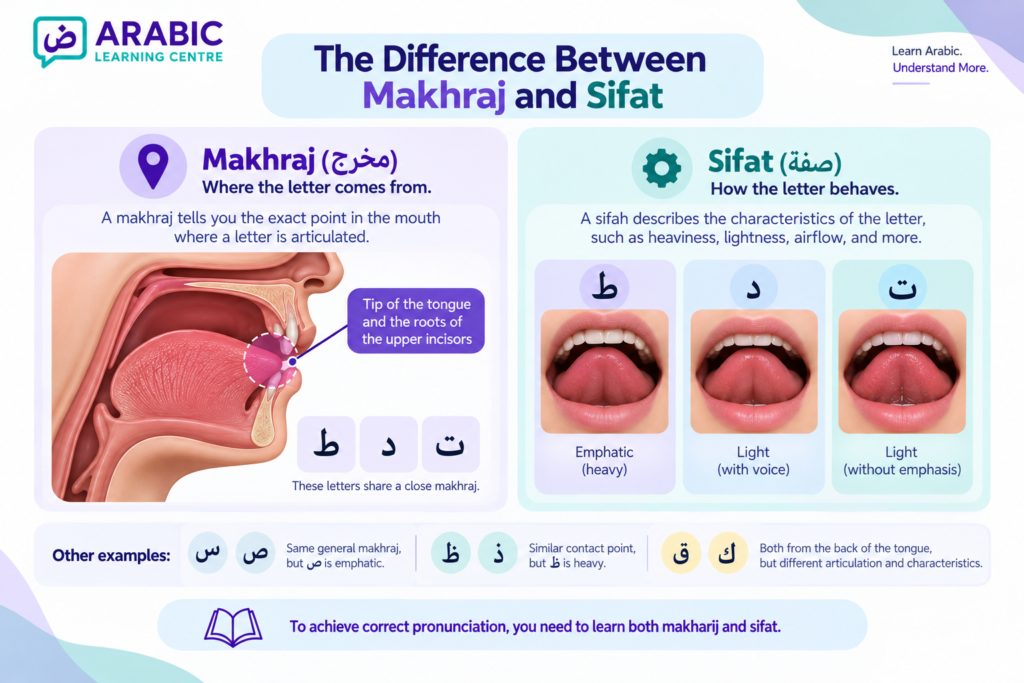
For example, ط، د, and ت are articulated from closely related positions around the tip of the tongue and the roots of the upper incisors. Yet they sound very different because their phonetic characteristics are different.
Similarly:
- س and ص have related front-tongue articulation, but ص is emphatic.
- ذ and ظ involve a similar contact point, but ظ is heavy.
- ق and ك are both back-tongue letters, but they differ in exact articulation and characteristics.
Correct Arabic pronunciation therefore requires learning both makharij and sifat Knowing one without the other can still leave a learner with an inaccurate sound.
Why Is Learning Arabic Tongue Placement Important?
Learning correct tongue placement provides several practical benefits for students of Arabic.
1. It Makes Arabic Pronunciation Clearer
Arabic contains contrasts that do not exist in many other languages. Learners who rely only on English transliteration may pronounce different Arabic letters almost identically.
Studying tongue placement teaches the mouth how to reproduce the actual Arabic sound instead of approximating it through English.
2. It Helps Preserve Word Meaning
A single-letter change can create a completely different Arabic word.
The earlier example demonstrates this clearly:
قَلْب — qalb — heart
كَلْب — kalb — dog
Likewise, replacing an emphatic letter with its lighter counterpart can distort pronunciation and potentially produce another word.
3. It Improves Quranic Recitation
Makharij form one of the foundations of accurate Quranic reading.
Tajweed rules cannot fully compensate for a letter that is being produced from the wrong place. A learner should first be capable of articulating the letter correctly before applying rules that affect it in connected recitation.
4. It Improves Listening Skills
Learning how Arabic sounds are physically produced also trains the ear.
Once students understand why س and ص are different, for example, they often become better at hearing the difference when native speakers or skilled Quran reciters pronounce them.
5. It Supports Vocabulary Learning
Pronunciation and vocabulary reinforce one another. When learners can distinguish similar Arabic letters accurately, new words become easier to recognize, remember, and reproduce.
Structured vocabulary study can complement articulation practice by giving students repeated opportunities to encounter each sound in real Arabic words.
Read also: Qalqalah Letters in Arabic – Types, Rules, and Quran Examples
Common Mistakes When Pronouncing Tongue Letters in Arabic
Many pronunciation problems are not caused by an inability to make the sound. They result from placing the tongue slightly too far forward, backward, high, or low.
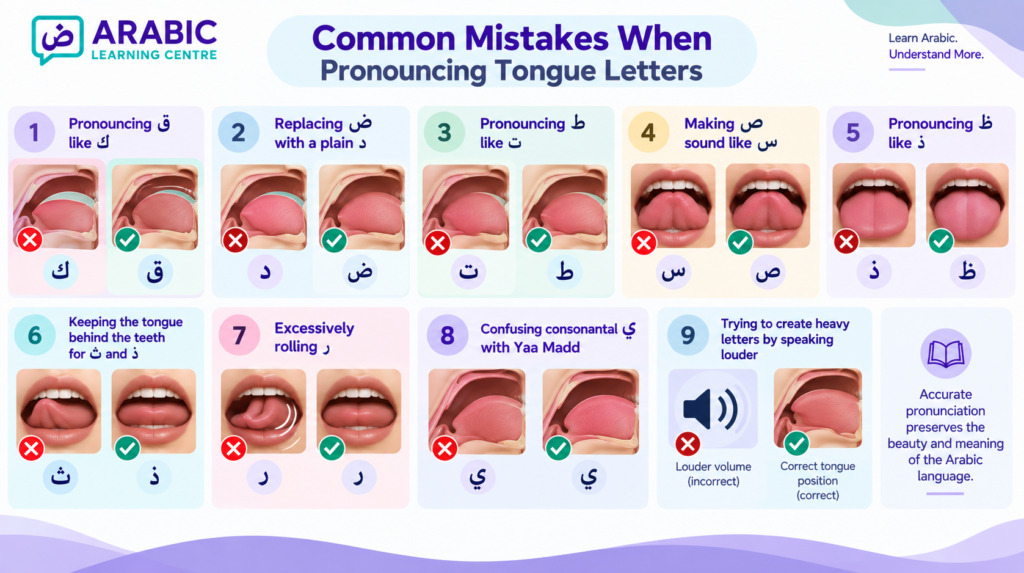
Some common mistakes include:
- Pronouncing ق too much like ك
- Replacing ض with a plain د
- Pronouncing ط like ت
- Making ص sound like س
- Pronouncing ظ like ذ
- Keeping the tongue behind the teeth when pronouncing ث and ذ
- Excessively rolling ر
- Confusing consonantal ي with Yaa Madd
- Trying to create heavy letters by increasing volume rather than using correct tongue position
These errors can become habitual if they are repeated for a long time, which is why direct listening and pronunciation correction are useful from the beginning.
How Can Non-Arabic Speakers Master Tongue Letters?
For a non-Arabic speaker, the goal should not be to convert Arabic letters into the nearest English sounds.
Some sounds overlap approximately with English, but others—particularly ض، ط، ظ، ص، ق—require tongue positions and phonetic characteristics that English does not use in the same way.
A stronger learning process combines:
- Listening carefully to a correct pronunciation.
- Observing where the tongue should be positioned.
- Producing the sound slowly.
- Practicing it with Fathah, Kasrah, Dammah, and Sukoon.
- Comparing it with similar Arabic letters.
- Practicing the sound inside real words.
- Receiving correction when necessary.
As pronunciation improves, learners can connect their phonetic knowledge with grammar, morphology, vocabulary, and authentic texts.
Don’t Just Take Our Word For It
Take a look inside our vibrant classes and see our students and teachers in action. Click below to watch our classroom experience:
Learn Correct Arabic Pronunciation with Arabic Learning Centre
Knowing that Arabic has 18 tongue letters and 10 tongue articulation points is useful, but real mastery comes from training the tongue to reproduce each sound consistently.
At The Arabic Learning Centre, students learn Arabic through structured instruction designed to develop essential skills such as pronunciation, vocabulary, grammar, reading, listening, writing, and speaking.
Working with native Arabic tutors can be especially valuable for non-native learners because small pronunciation errors are often difficult to identify independently.
Direct feedback helps students recognize where their articulation differs from the target sound and correct it before the mistake becomes established.
Whether your goal is clearer Arabic speech, stronger reading ability, access to Classical Arabic texts, or more accurate Quranic pronunciation, building a sound phonetic foundation gives you a stronger base for everything that follows.
Courses We Offer:
- Online Arabic Course
- Classical arabic course
- Modern Standard Arabic Course
- Fusha Arabic Course
- Learn Saudi Arabic
- Arabic Course for Beginners
- Arabic Classes for Adults
- Arabic Classes for Ladies
- Advanced Arabic Course
- Intensive Arabic Course

Conclusion
The tongue letters in Arabic demonstrate the remarkable precision of Arabic pronunciation. The tongue produces 18 letters through 10 articulation points, extending from the deepest back portion of the tongue to its sides, middle, and highly mobile tip.
The back produces ق and ك, the middle produces ج، ش، ي, the sides contribute ض and ل, and the tip of the tongue letters in Arabic account for another eleven sounds: ن، ر، ط، د، ت، ص، ز، س، ظ، ذ، ث.
Learning these positions makes it easier to distinguish similar sounds, pronounce Arabic words clearly, preserve meaning, and develop accurate Tajweed.
Rather than treating makharij as an advanced subject, learners can benefit from studying correct tongue placement from the beginning. Once the mouth learns where each Arabic letter belongs, reading and speaking become more precise and natural.
Frequently Asked Questions
How Many Tongue Letters Are There in Arabic?
There are 18 tongue letters in Arabic. They are produced through ten detailed articulation points located across the back, middle, sides, and tip of the tongue.
The letters are:
ق، ك، ج، ش، ي، ض، ل، ن، ر، ط، د، ت، ص، ز، س، ظ، ذ، ث
What Are the Tip of the Tongue Letters in Arabic?
There are 11 tip of the tongue letters in Arabic:
ن، ر، ط، د، ت، ص، ز، س، ظ، ذ، ث
They are articulated through several different positions involving the upper gums, roots of the upper front teeth, lower front teeth, and edges of the upper incisors.
What Letters Come from the Back of the Tongue in Arabic?
The back of the tongue produces Qaf (ق) and Kaf (ك).
Qaf is articulated from a deeper position, while Kaf is produced slightly farther forward. Correctly distinguishing the two is important because substituting one for the other can change word meaning.
Which Arabic Letters Come from the Middle of the Tongue?
The middle of the tongue produces:
ج — Jeem
ش — Sheen
ي — non-Madd Yaa
They can conveniently be remembered through the Arabic word جَيْش (jaysh).
Which Letters Come from the Side of the Tongue?
The principal letters associated with the side or edge of the tongue are Daad (ض) and Laam (ل).
Daad involves the side of the tongue with the upper molars, while Laam involves a more forward portion of the tongue’s edge and tip with the upper gums.
What Is the Hardest Arabic Tongue Letter to Pronounce?
Daad (ض) is frequently one of the most challenging Arabic letters for non-native speakers because its articulation involves lateral tongue contact with the upper molars and must also retain its emphatic characteristics.
However, difficulty varies according to a learner’s first language. Some students struggle more with Qaf, Raa, or the distinction between emphatic and non-emphatic letters.
What Are the Seven Heavy Letters in Arabic?
The seven consistently heavy letters associated with Isti’laa are:
خ، ص، ض، غ، ط، ق، ظ
They are commonly memorized using the phrase:
خُصَّ ضَغْطٍ قِظْ
Five of these—ص، ض، ط، ق، ظ—are among the tongue letters.
What Is the Difference Between Makhraj and Tajweed?
Makhraj is the physical articulation point from which a letter emerges. Tajweed is the broader discipline governing correct Quranic recitation, including articulation points, characteristics of letters, elongation, nasalization, stopping and starting, and other recitation rules.
Correct makharij therefore form an essential foundation for Tajweed.
Why Is Tongue Placement Important in Arabic?
Tongue placement determines which Arabic sound is produced. Moving the tongue even slightly can turn one letter into another, such as ت into ط, س into ص, or ذ into ظ.
Learning correct tongue placement therefore improves pronunciation, protects word meaning, strengthens listening ability, and supports accurate Quranic recitation.
Related Articles
Arabic Grammar