 Arabic Grammar
Every letter in the Arabic language has a home — a precise point where the tongue, lips, or throat shape the sound before it leaves the mouth.
For most letters, that home is easy to find. But for six specific letters, the answer takes you somewhere deeper: the throat itself.
These six sounds, known as Huruf al-Halq (حروف الحلق), sit at the heart of correct Quranic recitation. Mispronounce them, and you risk more than an accent — you can quietly change the meaning of the very word you’re reciting.
Pronounce them correctly, and your Tajweed instantly carries the precision and confidence of someone who truly understands the language.
For many learners, especially non-native Arabic speakers, these throat sounds are the hardest part of pronunciation to master — simply because English has no real equivalent for letters like ع, ح, غ, or خ.
That’s exactly why this guide exists: to walk you through what throat letters are, where each one comes from, and how to correct the small mistakes that quietly hold so many learners back.
What Are Throat Letters in Arabic?
Throat letters in Arabic, known as Huruf al-Halq (حروف الحلق), are six Arabic letters whose articulation points (Makharij) are located in different parts of the throat (Al-Halq — الحلق).
Unlike many Arabic letters that are articulated mainly with the tongue, lips, or teeth, throat letters originate from the throat. Some of these sounds, particularly ع، ح، غ، and خ, can be challenging for non-native Arabic speakers because they do not have exact equivalents in English.

Learning these letters correctly is especially important for Arabic pronunciation and Quranic recitation, where each letter should be pronounced clearly from its correct articulation point.
The 6 Throat Letters in Arabic
The six Huruf al-Halq are:
- ء — Hamzah
- هـ — Haa
- ع — ‘Ayn
- ح — Haa
- غ — Ghayn
- خ — Khaa
These six letters are traditionally summarized in a well-known line used in Tajweed study:
هَمْزٌ فَهَاءٌ ثُمَّ عَيْنٌ حَاءُ
مُهْمَلَتَانِ ثُمَّ غَيْنٌ خَاءُ
“Hamzah, then Haa, then ‘Ayn and Haa, then Ghayn and Khaa.”
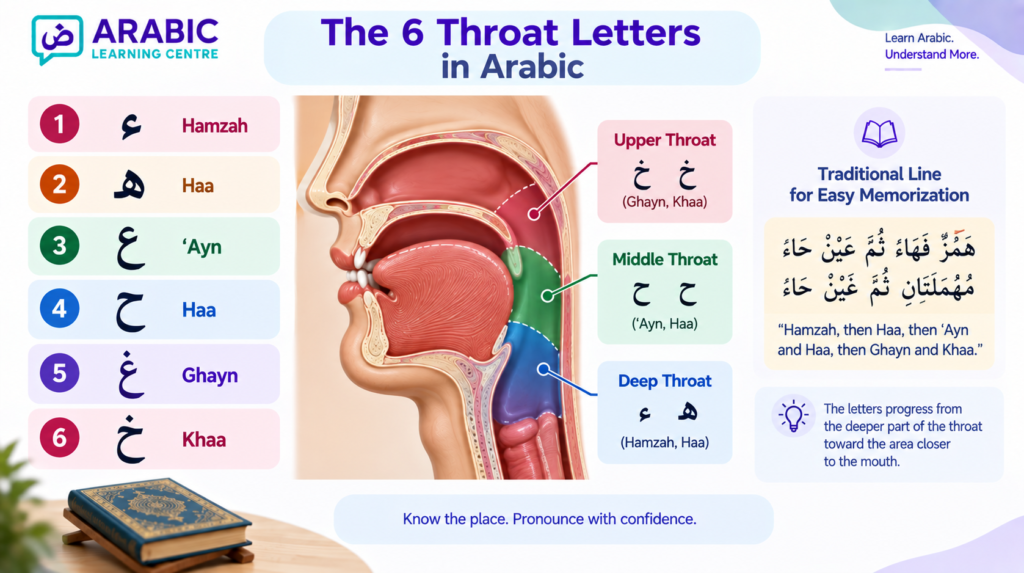
This sequence also helps learners remember the six throat letters and their general progression from the deeper part of the throat toward the area closer to the mouth.
Where the Throat Fits Among the Five Makharij?
In traditional Tajweed study, the articulation points of Arabic letters are commonly organized into five general regions:
- Al-Jawf (الجوف) — the open cavity of the mouth and throat
- Al-Halq (الحلق) — the throat
- Al-Lisan (اللسان) — the tongue
- Ash-Shafatan (الشفتان) — the two lips
- Al-Khayshum (الخيشوم) — the nasal passage
Among these regions, Al-Halq contains three distinct articulation points: the deepest part of the throat, the middle of the throat, and the upper part closest to the mouth. Together, these three points produce the six throat letters.
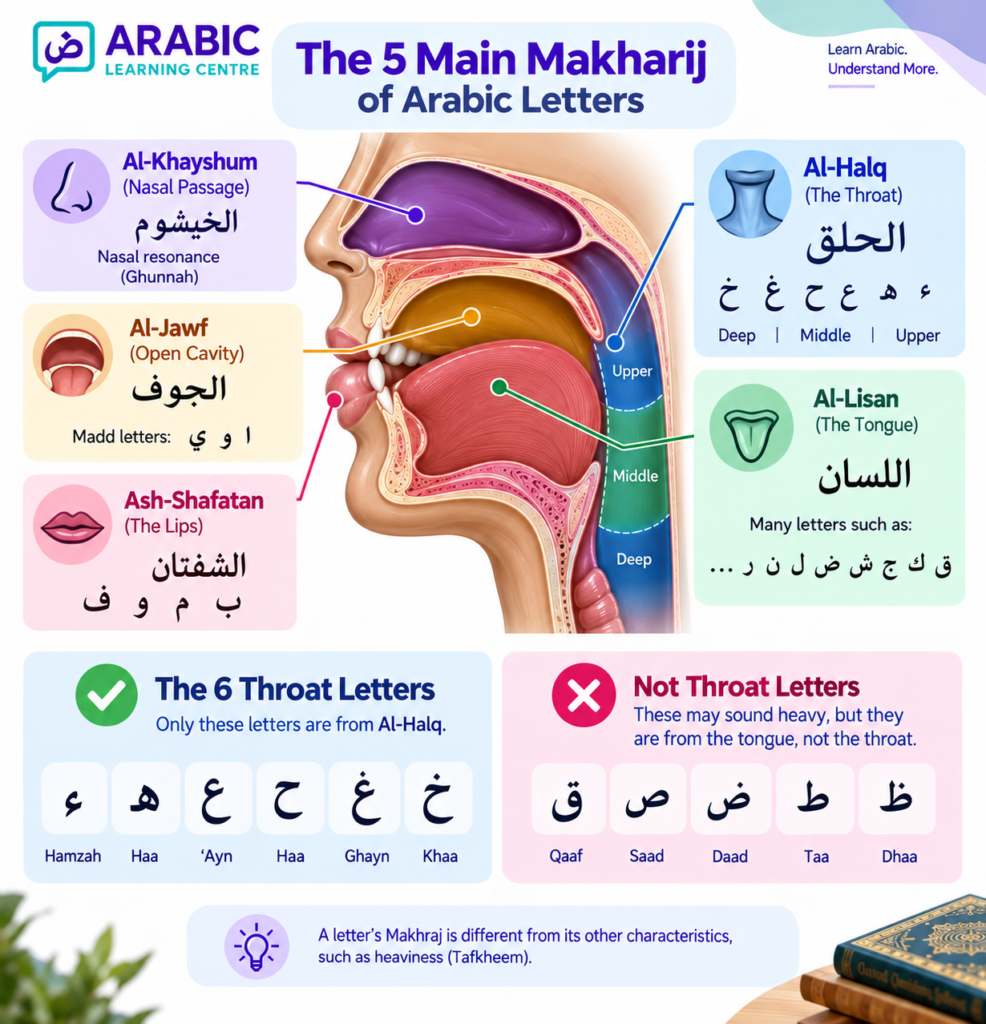
It is also important not to confuse throat letters with heavy-sounding Arabic letters. Letters such as ق، ص، ض، ط، and ظ may sound deep or emphatic to beginners, but they are not classified as Huruf al-Halq. Their articulation points involve different parts of the tongue rather than the throat.
For example, ق is produced using the back of the tongue, while ص، ض، ط، and ظ are among the letters characterized by Tafkheem, or heaviness, in pronunciation.
The key distinction is simple: only six Arabic letters are classified as Huruf al-Halq:
ء، هـ، ع، ح، غ، خ
Remembering this distinction helps learners separate a letter’s Makhraj, or articulation point, from its other pronunciation characteristics.
Remembering this distinction helps learners separate a letter’s Makhraj, or articulation point, from its other pronunciation characteristics — a skill closely tied to a solid grasp of Arabic grammar more broadly.

Why the Throat Letters Are Divided Into Three Zones?
In traditional Tajweed, the throat (Al-Halq — الحلق) is divided into three distinct articulation zones. Each zone produces two letters, giving us the three pairs:
ء هـ — ع ح — غ خ
This division helps learners understand exactly where each throat letter originates and makes it easier to distinguish sounds that may initially seem similar.
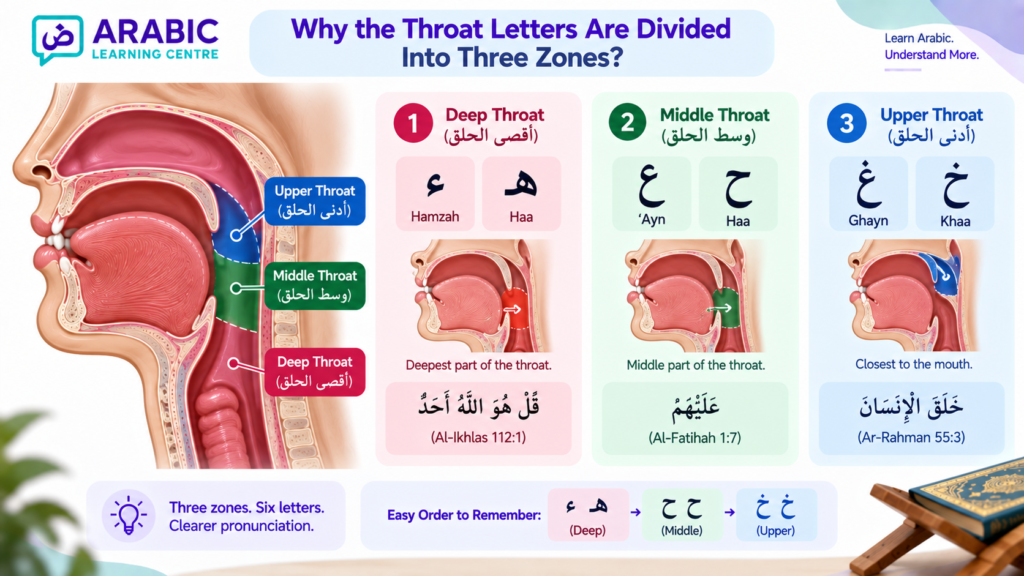
1. Deep Throat (Aqsa al-Halq) — أقصى الحلق
Aqsa al-Halq is the deepest part of the throat, farthest from the mouth.
Letters: ء and هـ
- Hamzah (ء) is produced from the deepest throat area with a clear closure and release. Its sound is distinct and does not flow continuously.
- Haa (هـ) comes from the same general area but is soft and breathy, allowing the air to flow rather than stopping it firmly.
Quranic example:
قُلْ هُوَ اللَّهُ أَحَدٌ
Qul huwa Allahu ahad — “Say: He is Allah, One.”
Surah Al-Ikhlas, 112:1
The هـ in هُوَ should remain soft and airy rather than becoming harsh like ح or خ.
2. Middle Throat (Wasat al-Halq) — وسط الحلق
Wasat al-Halq is the middle part of the throat.
Letters: ع and ح
- ‘Ayn (ع) is a voiced sound produced through constriction in the middle of the throat. It has no exact English equivalent, which makes it one of the more challenging Arabic letters for non-native speakers.
- Haa (ح) comes from the same general articulation area but is breathy and voiceless. It should be clearly distinguished from the softer هـ and the rougher خ.
Quranic example:
غَيْرِ الْمَغْضُوبِ عَلَيْهِمْ وَلَا الضَّالِّينَ
Ghayri al-maghdubi ‘alayhim wa la ad-dallin
Surah Al-Fatihah, 1:7
The ع in عَلَيْهِمْ should originate clearly from the middle of the throat rather than being replaced by a simple vowel sound.
Read also: Tongue Letters in Arabic – Makharij and Pronunciation Guide
3. Upper Throat (Adna al-Halq) — أدنى الحلق
Adna al-Halq is the part of the throat closest to the mouth.
Letters: غ and خ
- Ghayn (غ) is a voiced sound produced with friction in the upper throat. It has a fuller, heavier quality and should remain distinct from خ.
- Khaa (خ) is produced from the same general region but with a voiceless flow of air, creating its characteristic rough sound. The friction should be clear without being exaggerated.
Quranic example:
خَلَقَ الْإِنسَانَ
Khalaqa al-insan — “He created humankind.”
Surah Ar-Rahman, 55:3
The خ in خَلَقَ should be pronounced clearly from the upper throat without forcing or exaggerating its rough quality.
A simple way to memorize the three zones is:
Deep throat: ء هـ
Middle throat: ع ح
Upper throat: غ خ
Practicing the letters in this order helps learners feel how the articulation moves gradually from the deepest part of the throat toward the mouth.
Inside Our Classrooms
See how we make learning interactive and engaging! Watch a quick snippet of our live, conversational classes in action:
How Do Throat Letters Affect Tajweed Rules: Idh-har Halqi?
Understanding the Makharij of throat letters is not only important for pronunciation; it also helps learners understand a major Tajweed rule known as Idh-har Halqi (الإظهار الحلقي), or clear throat pronunciation.
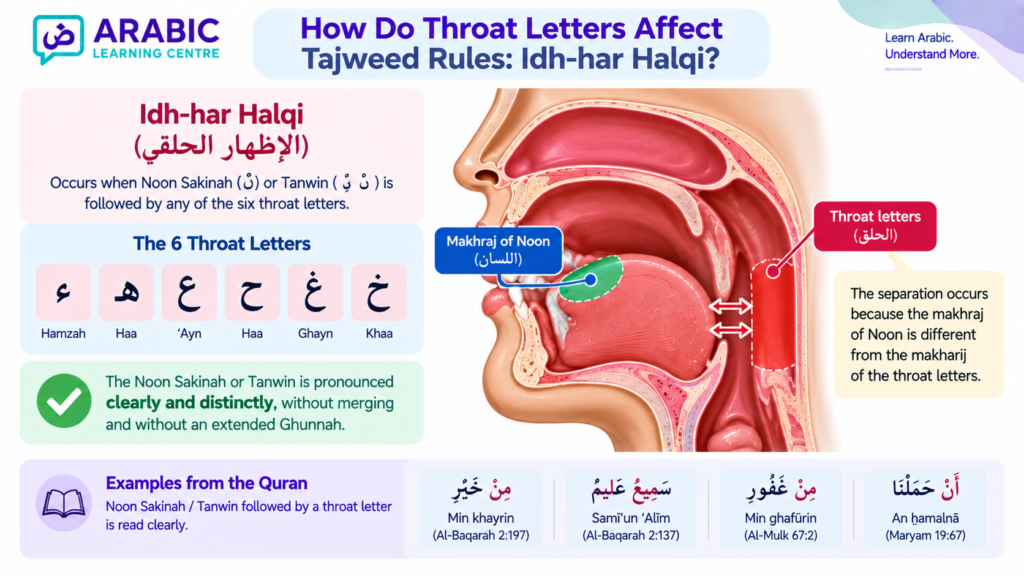
Idh-har Halqi occurs when Noon Sakinah (نْ) or Tanwin (ــًــٍــٌ) is followed by any of the six throat letters:
ء، هـ، ع، ح، غ، خ
When this happens, the Noon Sakinah or Tanwin is pronounced clearly and distinctly, without merging into the following letter or adding an extended Ghunnah.
The separation is connected to the distance between the articulation point of Noon and the articulation points of the throat letters.
Examples of Idh-har Halqi
The following examples show Idh-har Halqi with each of the six throat letters in Arabic and Quranic words.
| Throat Letter | Example | Meaning |
| ء | مَنْ آمَنَ | “Whoever believes” |
| هـ | مِنْهُمْ | “From them” |
| ع | مِنْ عَمَلٍ | “Of any deed” |
| ح | عَزِيزٌ حَكِيمٌ | “Exalted in Might, the Wise” |
| غ | مِنْ غِلٍّ | “Of any ill-will” |
| خ | مِنْ خَوْفٍ | “From fear” |
In each example, the Noon Sakinah or Tanwin remains clear before the throat letter. It is not merged into the following sound.
This is why recognizing the six throat letters is essential for Tajweed: once a learner sees ء، هـ، ع، ح، غ, or خ after Noon Sakinah or Tanwin, they can immediately recognize that Idh-har Halqi should be applied.
Read also: Lip Letters in Arabic – Baa, Meem, Waw, and Faa Explained
Common Mistakes When Pronouncing Arabic Throat Letters
Throat letters can be difficult for non-native speakers, but recognizing these common mistakes makes them easier to correct.
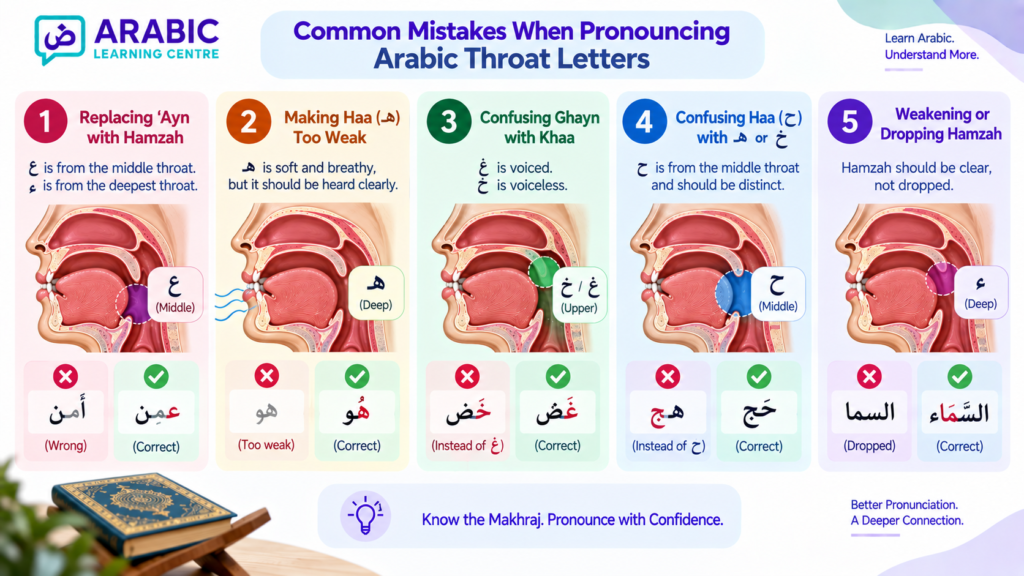
- Replacing ‘Ayn (ع) with Hamzah (ء): ع comes from the middle throat, while ء comes from the deepest throat. Replacing one with the other can change or distort the word.
- Making Haa (هـ) Too Weak: هـ is soft and breathy, but it should not become so weak that it disappears during recitation.
- Confusing Ghayn (غ) with Khaa (خ): Both come from the upper throat, but غ is voiced while خ is voiceless. Practicing them together helps clarify the difference.
- Confusing Haa (ح) with هـ or خ: ح comes from the middle throat and should remain distinct from the softer هـ and the rougher خ.
- Weakening or Dropping Hamzah (ء): Hamzah should remain clear rather than being dropped or turned into a simple vowel sound, especially at the end of words such as السَّمَاء.
Why Correct Pronunciation of Throat Letters Matters?
Correctly pronouncing the six throat letters is important for both Arabic communication and accurate Quranic recitation.
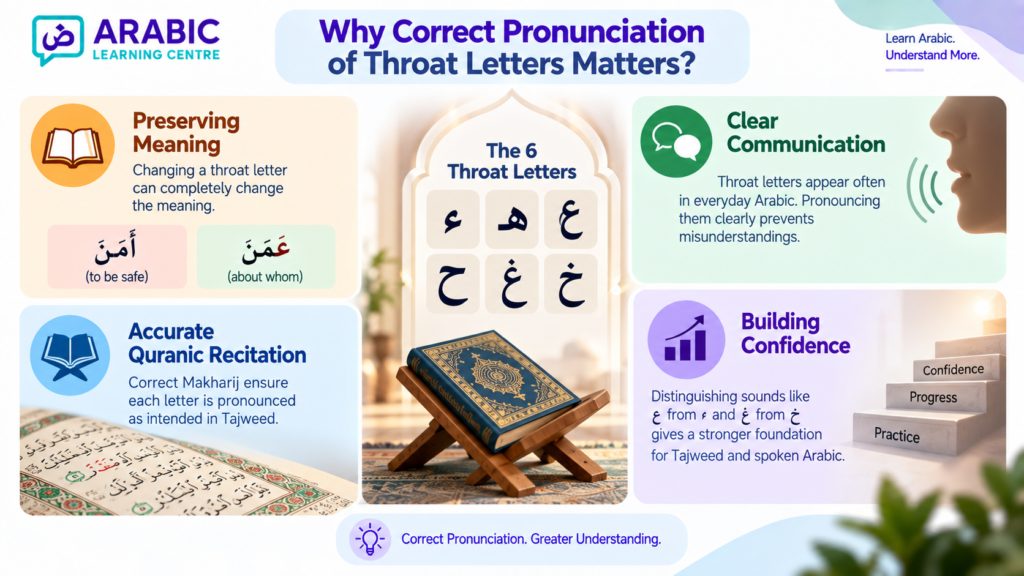
Their articulation can affect meaning, clarity, and the correct application of Tajweed.
- Preserving meaning: Similar-looking or similar-sounding words can have different meanings when a throat letter changes or is pronounced incorrectly.
- Accurate Quranic recitation: Correct Makharij help learners give each letter its proper articulation and characteristics during recitation.
- Clear communication: Throat letters occur frequently in Arabic vocabulary, so pronouncing them clearly helps prevent misunderstandings in everyday speech.
- Building confidence: Learning to distinguish sounds such as ع from ء and غ from خ gives students a stronger foundation for progressing in both Tajweed and spoken Arabic.
Are All Arabic Throat Letters Pronounced with the Same Heaviness?
No. Although all six letters come from the throat, they do not have the same sound quality. Some are pronounced with Tafkheem (تفخيم), while others remain light with Tarqeeq (ترقيق).
- Heavy Throat Letters: غ and خ: Ghayn (غ) and Khaa (خ) are pronounced with Tafkheem, giving them a fuller and heavier sound.
- Light Throat Letters: ء، هـ، ع، ح: Hamzah (ء), Haa (هـ), ‘Ayn (ع), and Haa (ح) are pronounced with Tarqeeq and should remain light, even when they appear next to a heavy letter. For example, in أَصَابِعَهُمْ, the Hamzah (ء) remains light even though ص is a heavy letter.
- Avoid Adding or Removing Heaviness: A common mistake is making ء، هـ، ع, or ح heavier than they should be. Learners may also weaken غ and خ and lose their natural Tafkheem.
The key is to give every throat letter both its correct Makhraj and its correct pronunciation characteristics.
Read also: Qalqalah Letters in Arabic – Types, Rules, and Quran Examples
Don’t Just Take Our Word For It
Take a look inside our vibrant classes and see our students and teachers in action. Click below to watch our classroom experience:
Master Arabic Throat Letters with Expert Guidance
Learning the six Arabic throat letters is much easier when you can hear the correct pronunciation and receive direct feedback on your own.
At The Arabic Learning Centre, native Arabic tutors provide structured online instruction that helps learners strengthen their pronunciation, reading, and overall Arabic skills.
Whether you struggle to distinguish ع from ء, ح from هـ, or غ from خ, guided practice can help you develop clearer articulation and avoid common pronunciation habits. Take the next step beyond studying the rules and
start learning Arabic with The Arabic Learning Centre today.
Courses We Offer:
- Business Arabic Course
- Learn Arabic from Zero
- Medical Arabic Course
- Learning Arabic for Non Arabic Speakers
- Learn Arabic in Saudi Arabia
- Learn to Read Arabic Course
- Arabic Grammar Course
- Arabic Speaking Course
- Arabic Script writing course
- Arabic Vocabulary Course
- Arabic Pronunciation Course

Conclusion
Mastering the makharij of the six throat letters (ء, هـ, ع, ح, غ, خ) is far more than a theoretical detail in Tajweed — it’s a foundational skill for anyone aiming to recite the Quran correctly or speak Arabic with proper pronunciation. Each of these letters has its own distinct articulation point and quality, and confusing them can genuinely change the meaning of a word.
The path to mastering them starts with understanding the three throat zones, and develops through consistent practice and listening to skilled reciters.
But the fastest and most effective step is having a qualified teacher who can listen to you and correct you in real time — because only a trained ear can catch the subtle differences between ع and ء, or between غ and خ.
Frequently Asked Questions
How Many Throat Letters Are There in Arabic?
There are six throat letters in Arabic, known as Huruf al-Halq (حروف الحلق):
ء، هـ، ع، ح، غ، خ
They are grouped together because their articulation points are located within the throat.
What Are the Three Articulation Zones for Throat Letters?
The throat is divided into three articulation zones, with two letters produced from each:
Aqsa al-Halq (أقصى الحلق) — deepest throat: ء، هـ
Wasat al-Halq (وسط الحلق) — middle throat: ع، ح
Adna al-Halq (أدنى الحلق) — upper throat, closest to the mouth: غ، خ
Together, these three areas account for all six throat letters.
Which Throat Letters Are Most Difficult for Non-Arabic Speakers?
ع (‘Ayn) and ح (Haa) are often among the most challenging because they do not have exact equivalents in English. Learners need to practice producing them from the middle of the throat rather than replacing them with more familiar English sounds.
How Do Throat Letters Affect Tajweed Rules?
The six throat letters are important in the rule of Izhar Halqi (الإظهار الحلقي). When Noon Sakinah (نْ) or Tanwin comes before one of the six throat letters, the Noon or Tanwin is pronounced clearly rather than being merged into the following letter.
Are Throat Letters the Same as Qalqalah Letters?
No. They are two different Tajweed categories. Throat letters are classified according to their articulation point, while Qalqalah letters are grouped according to a particular sound characteristic that appears when the letters ق، ط، ب، ج، د are in a state of Sukoon.
The six throat letters remain:
ء، هـ، ع، ح، غ، خ
Can I Learn Throat Letter Pronunciation on My Own?
You can begin by studying articulation diagrams, listening carefully to correct recitation, and practicing each throat zone separately. However, letters such as ع and ح can be difficult to evaluate by yourself. Feedback from a qualified Arabic or Tajweed teacher can help identify subtle pronunciation errors and prevent incorrect habits from becoming established.
Related Articles
Arabic Grammar