 Arabic Vocabulary & Speaking
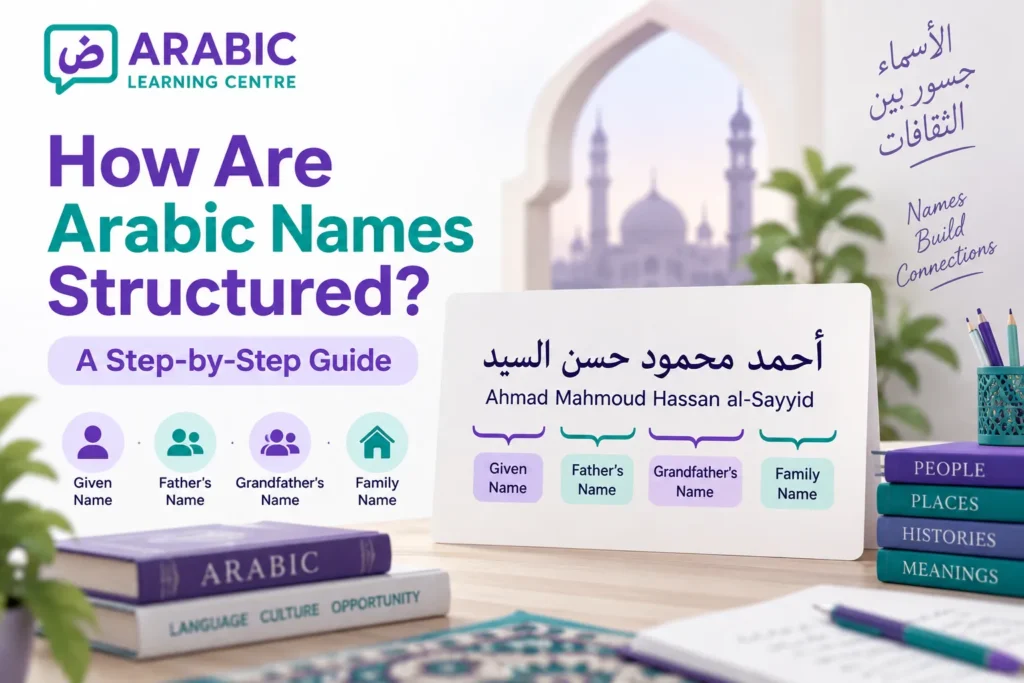
You’re filling out a form, and the name in front of you is Ahmad Mahmoud Hassan al-Sayyid. The form wants a first name, a middle name, and a surname — but this name isn’t built that way. It’s built from a personal name, a father’s name, a grandfather’s name, and a family name, and forcing it into three boxes loses information.
So, how are Arabic names structured? A common modern Arabic name follows the pattern given name + father’s name + grandfather’s name + family name. Traditional names can carry more layers still — a kunya, a nisba, a laqab — each adding a different kind of information about the person.
This guide walks through that structure one step at a time, so a name that looks like a string of unrelated words becomes something you can actually take apart and read.
Step 1: Find the Person’s Given Name (Ism)
The ism (اسم) is the personal name — the closest equivalent to an English first name. In Ahmad Mahmoud Hassan al-Sayyid, Ahmad is the ism: the element that identifies this specific person, separate from everything that follows about his family.
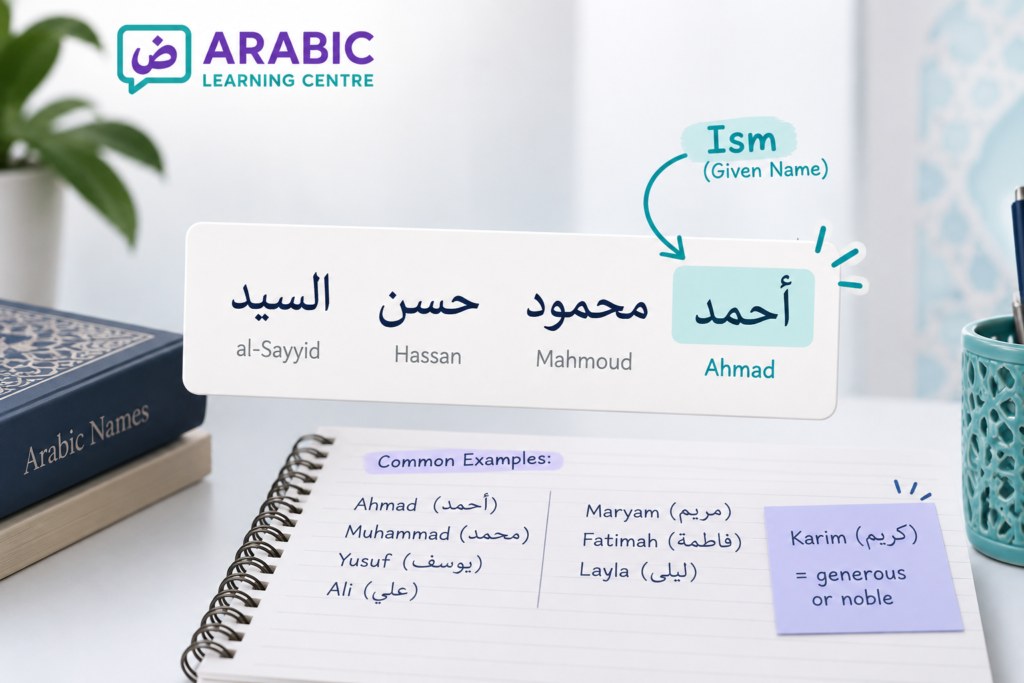
Common examples of an ism:
- Ahmad (أحمد), Muhammad (محمد), Yusuf (يوسف), Ali (علي)
- Maryam (مريم), Fatimah (فاطمة), Layla (ليلى)
Many Arabic personal names have a direct meaning attached to them. Karim (كريم) means generous or noble. Hasan (حسن) means good or beautiful.
For learners building their Arabic skills later in life, an Arabic course for adults can make it easier to recognize common names, understand their meanings, and eventually read them directly in Arabic rather than relying only on transliteration.

Step 2: Read the Father’s and Grandfather’s Names as Lineage (Nasab)
The names that follow the personal name usually represent nasab (نسب), or lineage — the father, and often the grandfather. Written out in full, this looks like Ahmad ibn Mahmoud ibn Hassan: “Ahmad, son of Mahmoud, son of Hassan.”
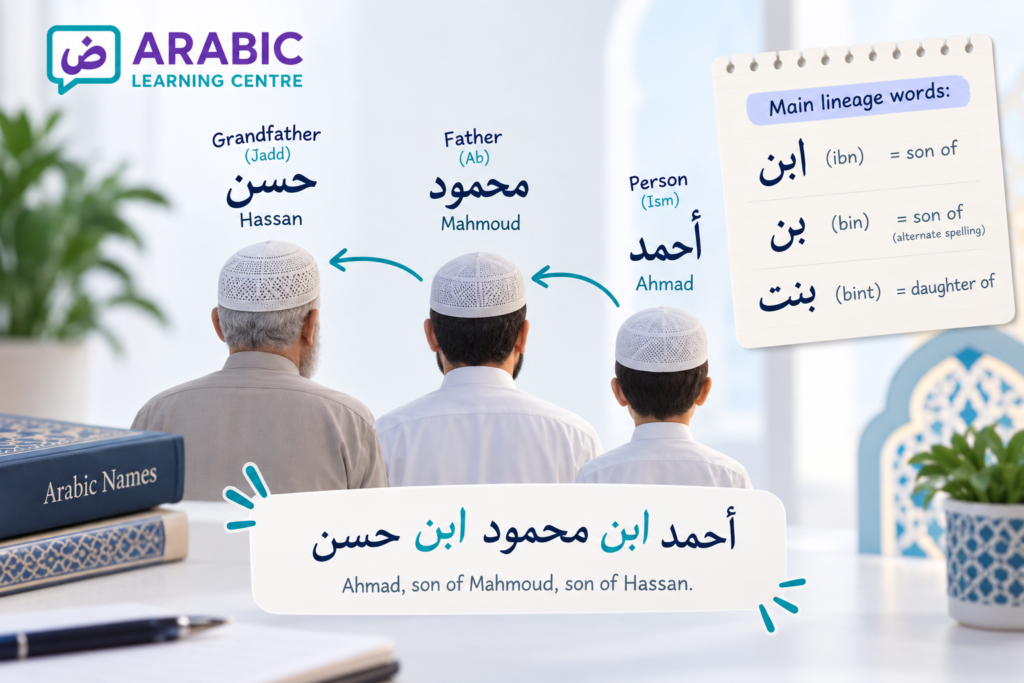
The main lineage words to know:
- ibn (ابن) — son of
- bin (بن) — son of (alternate spelling)
- bint (بنت) — daughter of
For example, Yusuf ibn Khalid is Yusuf, son of Khalid, and Maryam bint Abdullah is Maryam, daughter of Abdullah. These words are not middle names — they state a direct relationship between the person and the parent named after them.
Step 3: Recognize Lineage Even When Ibn or Bint Isn’t Written
In many modern names, ibn, bin, and bint are simply dropped, while the lineage still shows up in the order of the words.
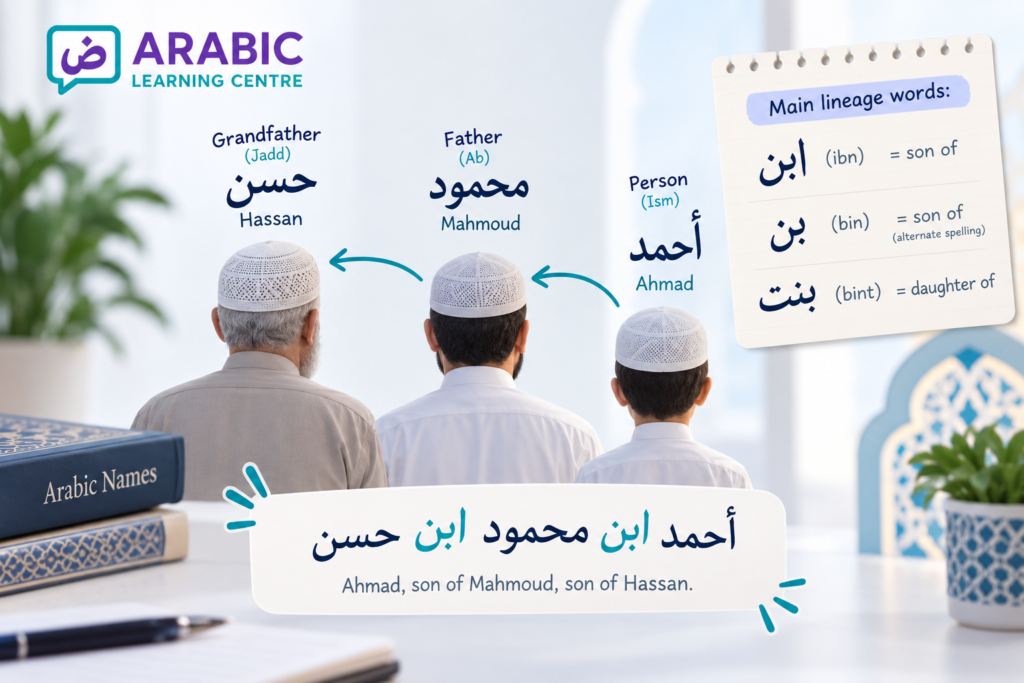
Instead of Ahmad ibn Mahmoud ibn Hassan al-Sayyid, an official document might read Ahmad Mahmoud Hassan al-Sayyid — and the meaning doesn’t change:
- Ahmad — the individual
- Mahmoud — his father
- Hassan — his grandfather
- al-Sayyid — the family name
This is the single biggest source of confusion for anyone used to Western naming. Mahmoud and Hassan look exactly like middle names on paper, but they can represent two full generations of lineage rather than a middle name in the Western sense.
The exact pattern varies by country and family, so treat it as a common structure, not a fixed rule.
Step 4: Identify the Inherited Family Name
After the lineage elements comes the family name — the one part of the name built to stay stable across generations. In Ahmad Mahmoud Hassan al-Sayyid, al-Sayyid functions as the family surname.
Ahmad’s son might be named Yusuf Ahmad Mahmoud al-Sayyid: the personal and lineage names shift with each generation, while al-Sayyid stays fixed.
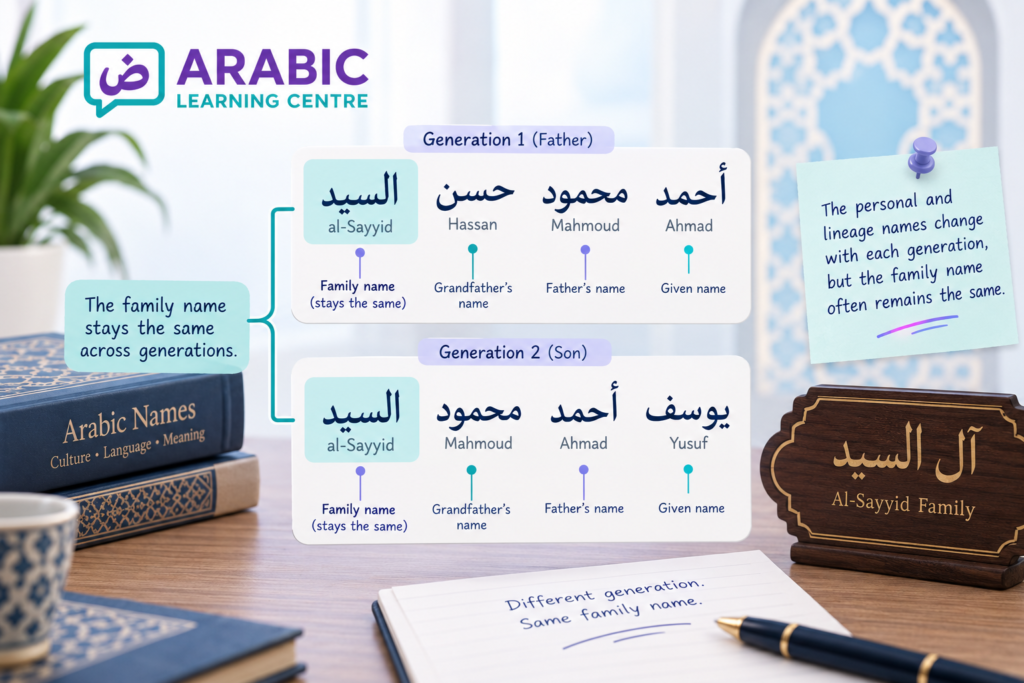
Not every family uses a fixed surname the same way — some rely on tribal, regional, or extended lineage names instead.
A common and costly mistake is assuming the last word in any Arabic name is automatically the surname without checking the person’s actual official documentation. Building real reading fluency through an Arabic course for non-Arabic speakers pays off exactly in moments like this.
Step 5: Recognize a Nisba That Shows Origin, Tribe, or Profession
A nisba (نسبة) marks an association with a location, tribe, family, or profession.
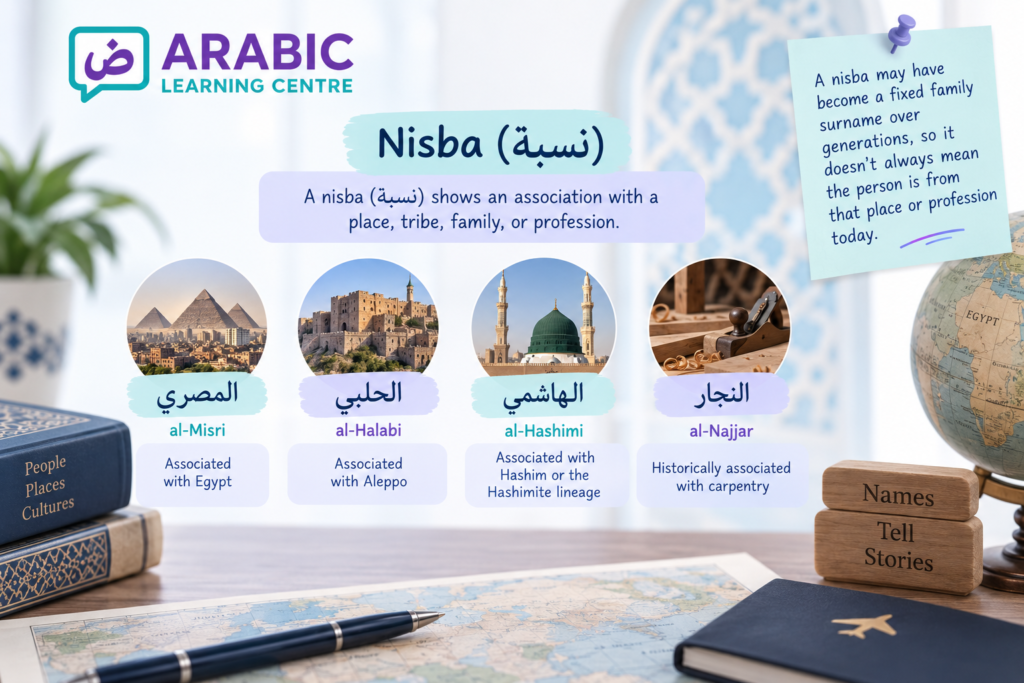
Common examples:
- al-Misri (المصري) — associated with Egypt
- al-Halabi (الحلبي) — associated with Aleppo
- al-Hashimi (الهاشمي) — associated with Hashim or the Hashimite lineage
- al-Najjar (النجار) — historically associated with carpentry
Over generations, many nisbas settled into fixed family surnames — so someone named al-Misri today isn’t necessarily from Egypt personally; the name may have entered the family line generations back and simply stayed.
Step 6: Recognize Abu and Umm as a Kunya
A kunya (كنية) typically opens with:
- Abu (أبو) — father of
- Umm (أم) — mother of
For example, Abu Ahmad means “father of Ahmad,” and Umm Yusuf means “mother of Yusuf.” A kunya functions as a respectful or familiar form of address, and it isn’t always literal — many historical figures are known chiefly by a kunya that’s symbolic or traditional rather than tied to an actual living child. Don’t assume Abu always names a real son.
Don’t Just Take Our Word For It
Take a look inside our vibrant classes and see our students and teachers in action. Click below to watch our classroom experience:
Step 7: Recognize a Laqab as a Title or Epithet
This section answers: what role does a title or epithet play inside a full name?
A laqab is a title or descriptive epithet, common in historical and Islamic names:
- al-Rashid — the rightly guided
- al-Mansur — the victorious
- Salah al-Din — righteousness of the faith
- Nur al-Din — light of the faith
In Harun al-Rashid, Harun is the personal name and al-Rashid the epithet attached to it. Laqabs matter less in everyday modern names, but they’re essential for reading classical texts and historical figures correctly.
Step 8: Keep Compound Arabic Personal Names Together
Some Arabic personal names are made of two words that function as one unit, most commonly built around Abd (عبد):
- Abdullah (عبد الله)
- Abd al-Aziz (عبد العزيز)
- Abd al-Rahman (عبد الرحمن) — servant of the Most Merciful
It would be wrong to read Abd al-Rahman as “Abd” for a first name and “al-Rahman” for a surname — together, the two words form one personal name. The same rule applies to compound forms such as Salah al-Din (صلاح الدين), Nur al-Din (نور الدين), and Sayf al-Din (سيف الدين).
Recognizing these patterns becomes much easier with regular exposure to Arabic from an early stage.
An Arabic course for kindergarten can introduce young learners to Arabic letters, sounds, and familiar words in an age-appropriate way, giving them a foundation for recognizing names and other common Arabic forms.

Step 9: Tell Al- Apart from Aal
These two forms look almost identical in English but mean different things.
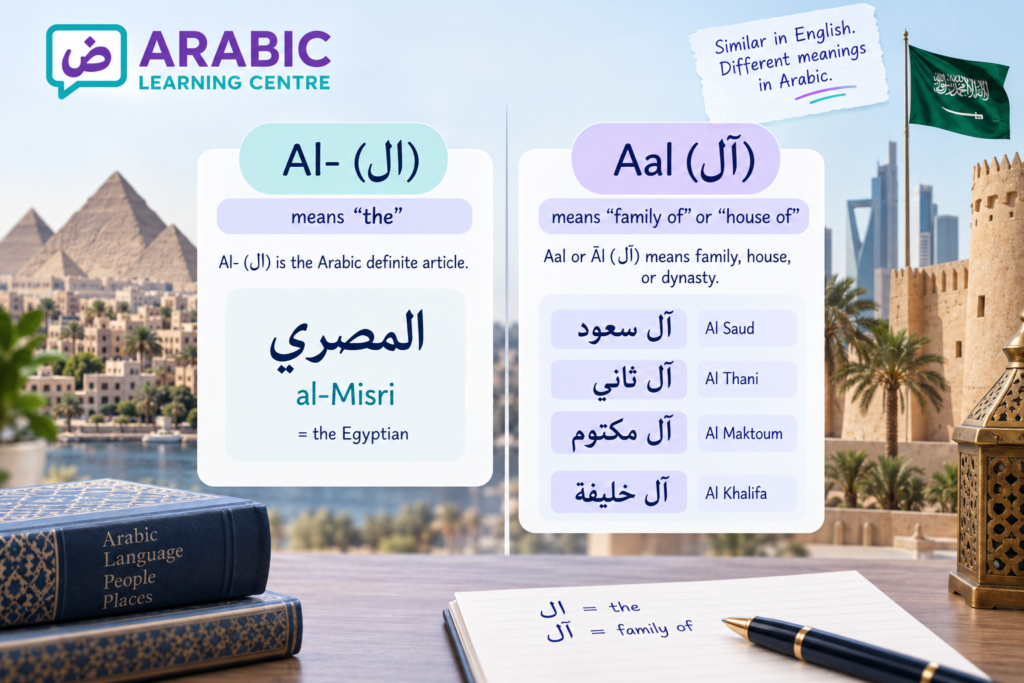
Al- Means “The”
Al- (ال) is the Arabic definite article. Al-Misri (المصري) means roughly “the Egyptian.”
Aal Means “Family of” or “House of”
Aal or Āl (آل) means family, house, or dynasty:
- Al Saud (آل سعود)
- Al Thani (آل ثاني)
- Al Maktoum (آل مكتوم)
- Al Khalifa (آل خليفة)
Khalid Al Saud signals Khalid’s connection to the House of Saud, while Khalid al-Hashimi signals an affiliation rather than a royal house. In Arabic script the two words are visually distinct — ال versus آل. The confusion appears almost entirely in English transliteration, where both can render as “al.”
Step 10: Decode a Full Arabic Name From Start to Finish
With every component defined, a full name becomes readable piece by piece. Take Abu Yusuf Ahmad ibn Muhammad ibn Hanbal al-Shaybani al-Baghdadi:
| Name element | Type | Meaning |
| Abu Yusuf | Kunya | Known as father of Yusuf |
| Ahmad | Ism | Personal name |
| ibn Muhammad | Nasab | Son of Muhammad |
| ibn Hanbal | Nasab | Lineage through Hanbal |
| al-Shaybani | Nisba | Tribal affiliation |
| al-Baghdadi | Nisba | Association with Baghdad |
Read this way, the name stops being a wall of unfamiliar words and becomes a compact record: who the person is, who his father and ancestor were, and where his affiliations lay.
Step 11: Compare Modern Arabic Names With Classical Arabic Names
Classical names could stack five elements: kunya + ism + nasab + nisba + laqab, as in Abu Yusuf Ahmad ibn Muhammad al-Baghdadi.
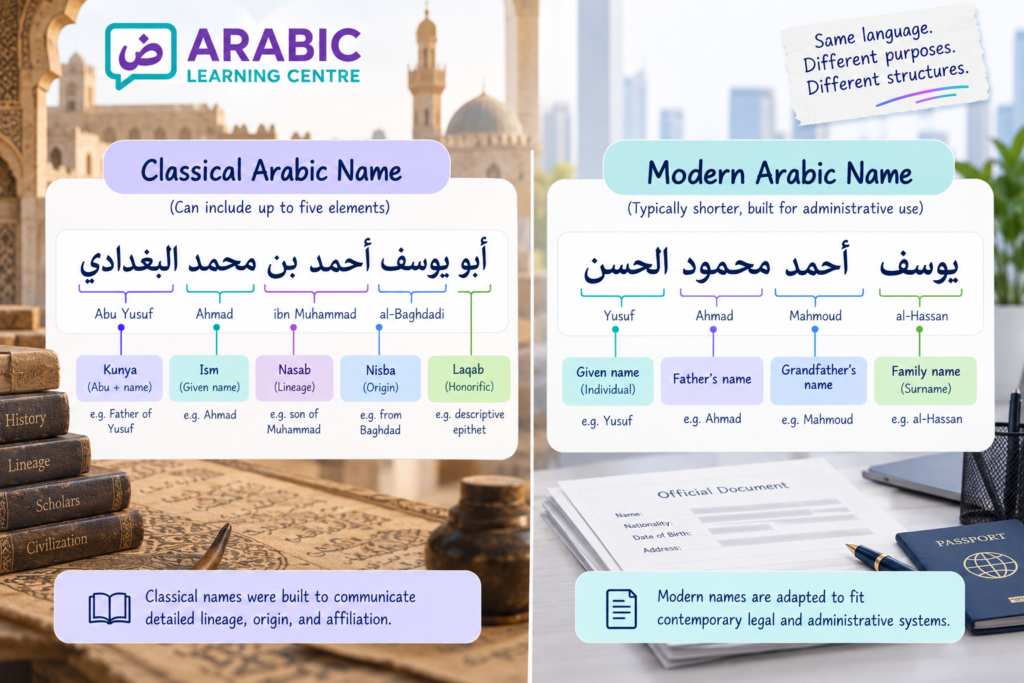
Modern Arabic names are typically shorter and built for administrative use:
- Given name — the individual (e.g., Yusuf)
- Father’s name — his father (e.g., Ahmad)
- Grandfather’s name — his grandfather (e.g., Mahmoud)
- Family name — the fixed surname (e.g., al-Hassan)
Not every Arab uses exactly four names, and conventions differ across Egypt, the Gulf, the Levant, and North Africa.
The underlying difference is purpose: classical names were built to communicate detailed lineage and affiliation, while modern names are adapted to fit contemporary legal and administrative systems.
Step 12: Match Arabic Names Carefully to Western Form Fields
Forms asking for first name, middle name, and last name don’t map cleanly onto ism, nasab, and family name. In Ahmad Mahmoud Hassan al-Sayyid, Mahmoud and Hassan aren’t “middle names” in the cultural sense, even when a database forces them into middle-name fields.
This matters directly on:
- Visa applications and immigration records
- Passports and airline bookings
- Employment contracts and university applications
- Banking documents
The safest rule across every one of these: copy the name exactly as it appears and is divided on the person’s own official document.
Don’t independently decide which element is the surname based on general naming conventions — a mismatched guess here can create a real conflict between a passport and a booking or contract later.
[image: sample form showing given name, father’s name, grandfather’s name, and family name fields correctly matched to an Arabic name]
Why Can the Same Arabic Name Have Different English Spellings?
Arabic sounds don’t map onto English letters in one fixed way:
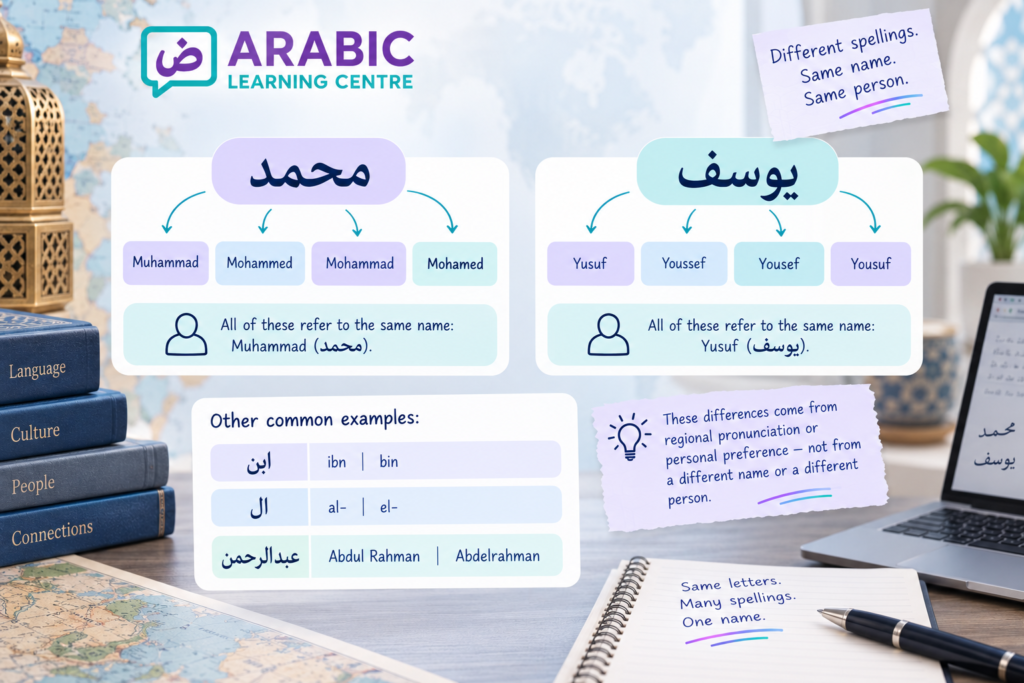
- محمد → Muhammad, Mohammed, Mohammad, Mohamed
- يوسف → Yusuf, Youssef, Yousef, Yousuf
You’ll also see ibn/bin, al-/el-, and Abdul Rahman/Abdelrahman used interchangeably. These differences usually come from regional pronunciation or personal preference — not from a different name or a different person.
If you’d rather stop guessing at spelling variants altogether and read names directly from the Arabic script, that’s exactly the gap a structured Arabic course for non-Arabic speakers is built to close — once you can read the root letters, spelling variation mostly stops mattering.
Common Mistakes When Reading Arabic Names
Arabic names can be misread easily when they are interpreted through Western naming conventions. The safest approach is to identify each element by its function rather than assuming that its position in the name tells you what it means.
Avoid assuming that:
- the second word is always a middle name.
- the father’s name is always the surname.
- ibn or bin functions as a middle name.
- the last word is always the legal family name.
- every word beginning with al- is a family surname.
- al- and Aal mean the same thing.
- Abu always refers to a literal, living son.
- two different English spellings must belong to two different people.
- every Arabic name follows the same fixed structure.
Arabic naming conventions vary between countries, families, and legal systems, so these patterns should be used as guides rather than absolute rules. For official purposes, always rely on the way the name is written and divided in the person’s passport or other legal documents.
Inside Our Classrooms
See how we make learning interactive and engaging! Watch a quick snippet of our live, conversational classes in action:
Start Reading Arabic Names Directly in Arabic
Working through the theory gets you most of the way there, but real confidence comes from reading the script itself, recognizing root patterns, and hearing how names are actually pronounced by native speakers.
At Arabic Learning Centre, the Arabic course for non-Arabic speakers is built around exactly this kind of practical reading — working from real names, real documents, and everyday Arabic rather than isolated grammar drills. If you’d prefer a class designed specifically for women, the Arabic course for ladies covers the same material in a dedicated setting.
Courses We Offer:
- Online Arabic Course
- Classical arabic course
- Modern Standard Arabic Course
- Fusha Arabic Course
- Learn Saudi Arabic
Conclusion
An Arabic name like Ahmad Mahmoud Hassan al-Sayyid isn’t a first name with two extra middle names bolted on — it’s a personal name, a father’s name, a grandfather’s name, and a family name, and once you separate those four pieces, most modern Arabic names read clearly.
Classical names add more layers still: a kunya, nisba, or laqab, each carrying its own type of information about a person’s family, origin, or reputation.
The two traps worth remembering are treating lineage words as filler and confusing al- with Aal. Once you know how Arabic names are structured — step by step, from ism through nasab to family name and beyond — a long name stops looking like noise and starts reading as exactly what it is: a compact record of a person’s identity and family history.
FAQs About How Arabic Names Are Structured
How are Arabic names structured?
A common modern Arabic name follows the pattern given name + father’s name + grandfather’s name + family name. Traditional names may add a kunya, nasab, nisba, and laqab on top of this base structure.
What does ibn mean in an Arabic name?
Ibn (ابن) means “son of.” In Ahmad ibn Khalid, Ahmad is described as the son of Khalid. Bin is an alternate spelling of the same word.
What does bint mean in Arabic names?
Bint (بنت) means “daughter of.” In Maryam bint Abdullah, Maryam is identified as the daughter of Abdullah.
Is the father’s name the surname in Arabic naming?
Not necessarily. The father’s name usually represents lineage rather than an inherited surname, so the actual legal family name should always be confirmed against the person’s official documents.
What is a nisba in an Arabic name?
A nisba is a name element showing affiliation with a place, tribe, family, or profession — examples include al-Misri (Egypt) and al-Halabi (Aleppo). Many nisbas became fixed family surnames over time.
What is the difference between al- and Aal?
Al- (ال) is the Arabic definite article, meaning “the,” while Aal (آل) means “family of” or “house of.” Al Saud (آل سعود) therefore means the House of Saud, not “the Saud.”
Why can one Arabic name have several English spellings?
Arabic sounds can be transliterated into English in more than one way. That’s why names such as Muhammad, Mohammed, Mohammad, and Mohamed can all represent the exact same Arabic name.
Related Articles
Arabic Vocabulary & Speaking