 Learn Arabic

Learning to speak Arabic fluently in six months sounds ambitious — and if “fluency” means composing classical poetry or debating political philosophy with a scholar, it is. But that is not what six months delivers, and it is not what this guide promises.
For anyone wondering how to learn Arabic in 6 months, what six months of structured, daily effort can realistically deliver is practical conversational fluency: the ability to introduce yourself, hold everyday conversations, understand common media, and express yourself clearly without pausing to mentally translate every sentence.
Month 1: Master the Arabic Alphabet and Pronunciation
If your goal is to learn how to learn Arabic in 6 months successfully, Month 1 has one job: getting you to read and write Arabic script while producing its sounds correctly, and producing its sounds correctly. Everything else — vocabulary, grammar, conversation — depends on this foundation being solid. Rushing past it is the single most expensive mistake a beginner can make.
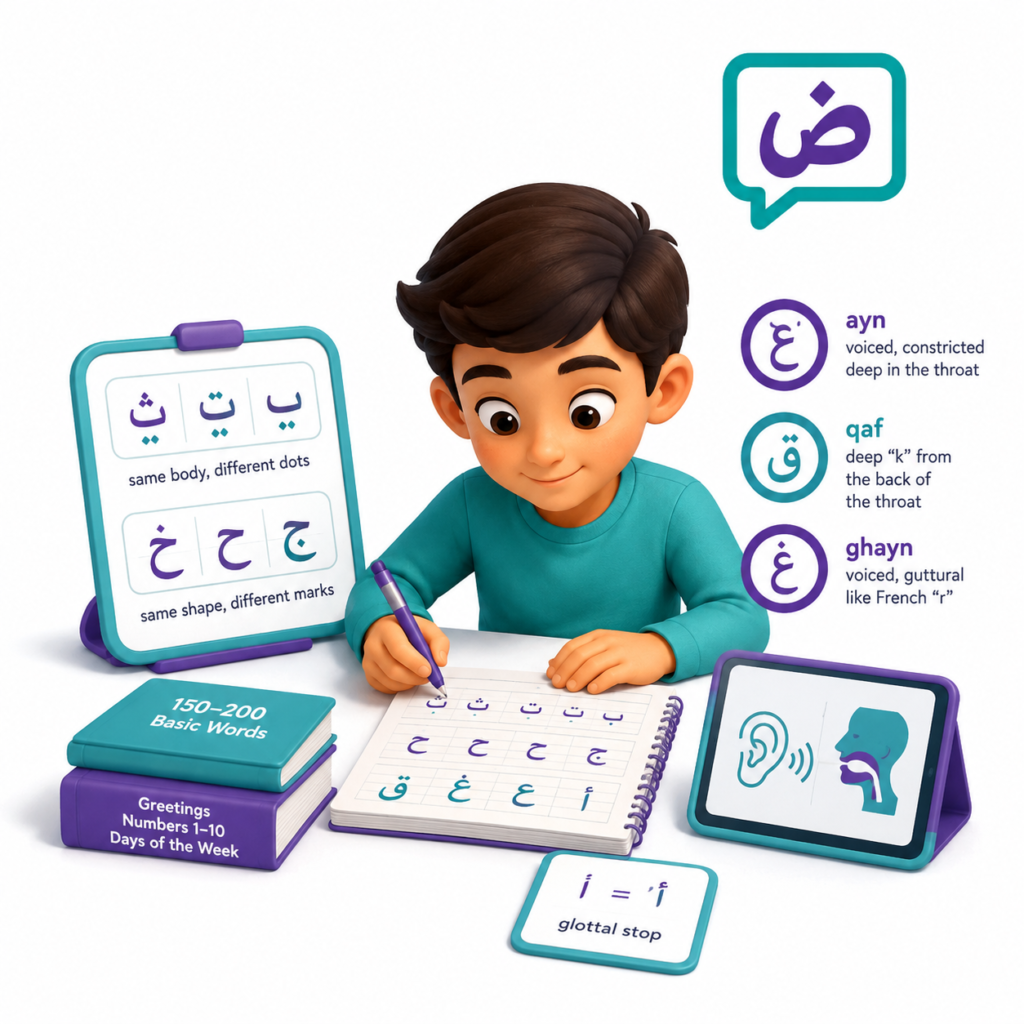
Arabic has 28 letters, each with up to four positional forms (isolated, initial, medial, final). The most effective way to learn them is in visually similar clusters rather than alphabetical order — grouping ب، ت، ث together (same body, different dots) and ج، ح، خ together (same shape, different marks) prevents the confusion that slows most beginners down.
The Sounds That Don’t Exist in English
Arabic contains several sounds with no English equivalent. Mispronouncing them early creates habits that are genuinely difficult to correct later — and in Arabic, a single letter change can produce an entirely different word. The difference between ح (a breathy h from the throat) and هـ (a regular h) changes meaning completely. The difference between أ (a glottal stop) and ع (a voiced, constricted sound from the back of the throat) distinguishes between different names and words that would otherwise sound identical to an untrained ear.
Three sounds deserve priority attention in Month 1:
- ع (ayn) — voiced, constricted, produced deep in the throat; has no English equivalent
- ق (qaf) — a deep “k” from the very back of the throat, not the soft palate
- غ (ghayn) — voiced and guttural, similar to a French “r”; nothing like English “g”
Spend 15–20 minutes daily on handwriting practice. Say every letter aloud as you write it. The Arabic speaking muscles — the breath, throat, and articulatory coordination required — need time to develop. Start on Day 1.
Month 1 target: full recognition and production of all 28 letters in all positional forms; 150–200 words of basic vocabulary including greetings, numbers 1–10, and days of the week.
Month 2: Essential Grammar and Core Vocabulary
With the alphabet solid, Month 2 introduces the grammatical structures that make vocabulary usable — and begins building the word bank that will fuel your listening and speaking practice in the months ahead.
The Grammar Foundations You Actually Need
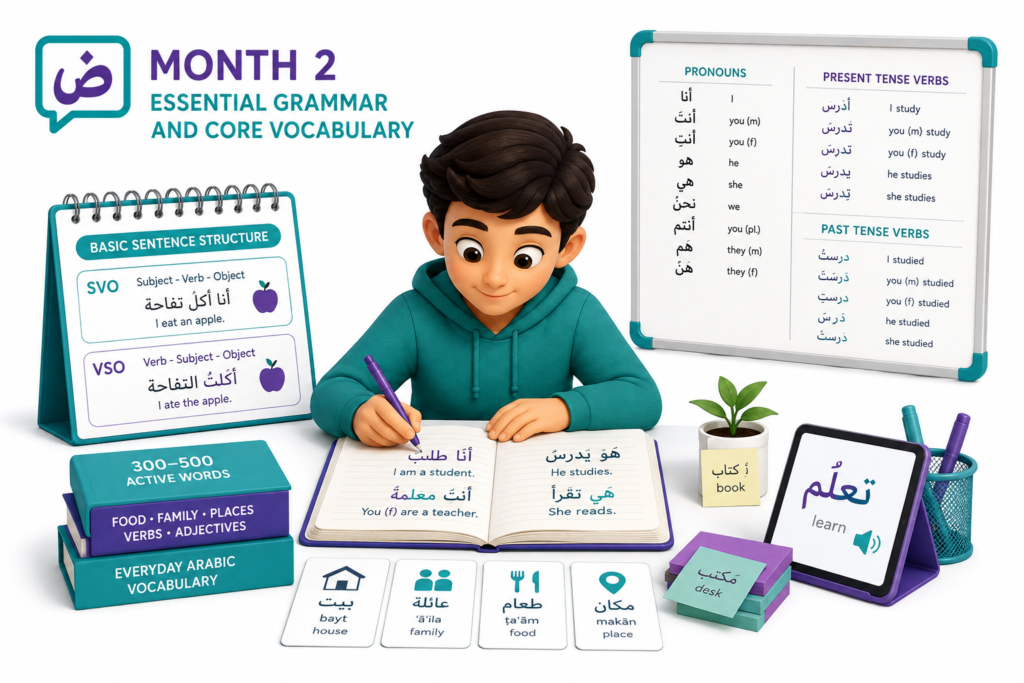
Arabic grammar has a reputation for complexity, and at its full classical depth, that reputation is earned. But the layer you need for basic conversation is more accessible than most learners expect. Month 2 focuses on three things: pronouns, basic verb conjugation, and sentence structure.
Arabic offers both Subject-Verb-Object (SVO) and Verb-Subject-Object (VSO) word order — both grammatically correct. SVO mirrors English and is easier for beginners. Start there.
One detail that most beginner resources skip entirely: Arabic nominal sentences — sentences like “I am a student” — carry no present-tense equivalent of the verb “to be.” أنا طالب (Ana Talib) literally means “I student.” This is grammatically complete, not an error. Understanding this early prevents significant confusion when you encounter it in reading and listening.
Building Vocabulary the Right Way
The most common Month 2 mistake is memorizing random word lists. Isolated words do not stick — they are forgotten within days because they have no context to anchor them. Learn vocabulary in sentences. Use it immediately in writing or speech. Prioritize the highest-frequency words in daily life: food, family, places, common verbs, basic adjectives.
A structured Arabic vocabulary course sequences words in the order that makes them immediately usable — not alphabetically, and not randomly. This sequencing difference between structured learning and self-study compounds significantly over six months.

Use spaced repetition (Anki is free and effective) for drilling. Label objects around your home with Arabic sticky notes. Narrate simple actions in Arabic as you do them. The goal is to create as many daily touchpoints with new vocabulary as possible.
Month 2 target: 300–500 active words; ability to build simple sentences using pronouns, present and past tense verbs, and basic adjectives.
Inside Our Classrooms
See how we make learning interactive and engaging! Watch a quick snippet of our live, conversational classes in action:
Month 3: Listening Immersion — Training Your Ear
Any realistic plan for how to learn Arabic in 6 months shifts the emphasis from grammar to listening by Month 3, because your ear needs daily exposure before your speaking becomes natural Your ear needs to adjust to Arabic before your brain can process it efficiently — and the only way to train it is sustained, daily listening.
Arabic has sounds that do not exist in English. Even learners who have studied the alphabet and grammar correctly will find, in Month 3, that natural Arabic speech sounds faster, denser, and less decipherable than expected. This is normal. It is not a sign that you are behind — it is a sign that your ear training has begun.
Active Listening vs. Passive Listening
These are not the same activity and should not be treated as such.
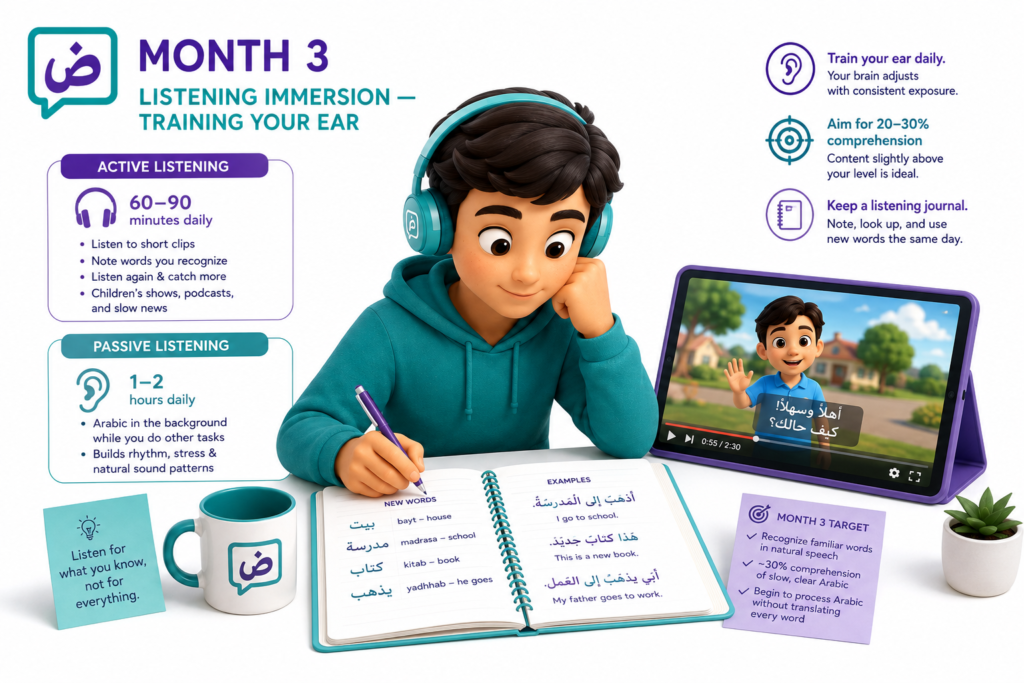
Active listening (60–90 minutes daily) means focused engagement: listen to a 2–3 minute clip, note every word you recognize, listen again, catch more. Children’s Arabic television is genuinely effective for adult beginners at this stage — the vocabulary is simple, the speech is slow, and visual context aids comprehension. Arabic podcasts designed for beginners and news broadcasts in simplified Arabic are also appropriate.
The key technique: do not try to understand everything. Listen for words you already know. Every time you catch a familiar word in natural speech, your brain reinforces that word’s retention. Listening to content slightly above your current level — where you understand perhaps 20–30% — is more valuable than content you fully understand.
Passive listening (1–2 hours alongside other tasks) means Arabic playing in the background while you cook, commute, or exercise. Your brain absorbs Arabic prosody — its rhythm, stress patterns, and sound combinations — without conscious effort. This is a complement to active listening, not a substitute for it.
Keep a listening journal: note new words and expressions you encounter. Look them up. Use them the same day in a sentence.
Month 3 target: recognition of familiar words in natural speech; approximately 30% comprehension of slow, clear Arabic; beginning to process Arabic without mentally translating every word.
Month 4: Daily Speaking Practice
Month 4 is the month most learners dread — and the month that matters most. Speaking Arabic before you feel ready is uncomfortable. It is also the only way to become fluent.
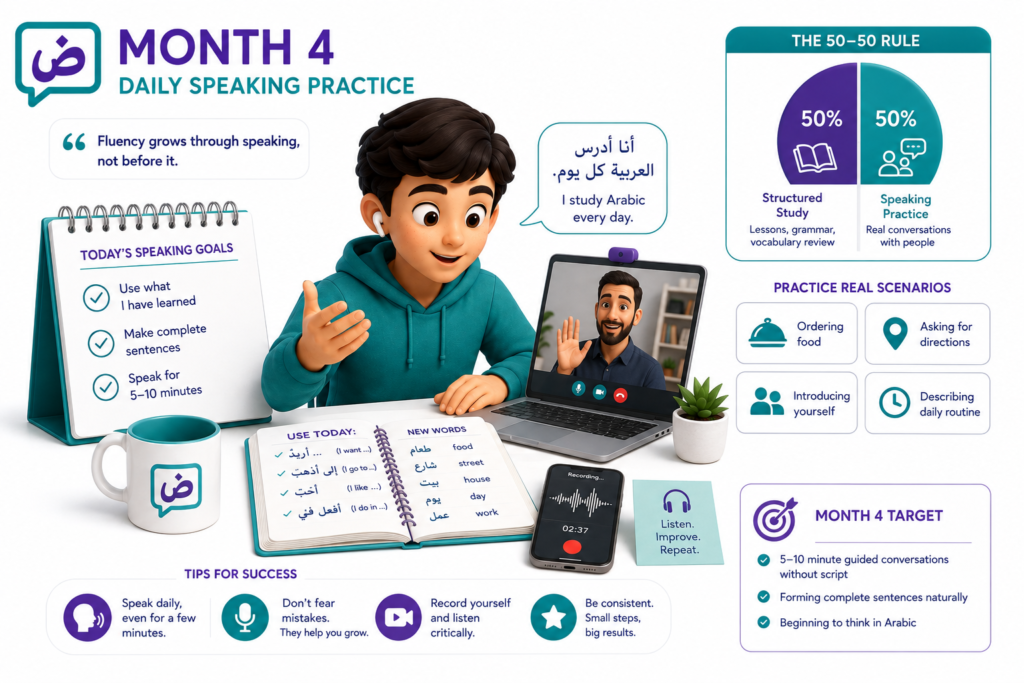
Waiting for “perfect grammar” before speaking is one of the most well-documented failure patterns in language learning. Fluency grows through speaking, not before it. Mistakes at this stage are not failures — they are the mechanism by which the language moves from memory into instinct.
The 50-50 Rule
A useful framework for Month 4: roughly 50% of your Arabic progress comes from structured study (lessons, grammar, vocabulary review), and 50% comes from speaking practice with real people. No app, no textbook, and no video can replace the cognitive load of a live conversation — the pressure to retrieve and produce language in real time is precisely what builds fluency.
Arrange speaking sessions with native Arabic speakers through language exchange platforms. Use only what you have learned. The constraint of a limited vocabulary forces creative sentence construction — and creative sentence construction is exactly the cognitive work that accelerates fluency.
Role-play practical scenarios: ordering food, asking for directions, introducing yourself to someone new, describing your daily routine. Record yourself and listen back. The gap between how you sound and how a native speaker sounds narrows faster than most learners expect when they listen critically to their own output.
Month 4 target: 5–10 minute guided conversations without script; forming complete sentences naturally; beginning to think in Arabic rather than translating from English.
Month 5: Real-World Interaction and Immersion at Scale
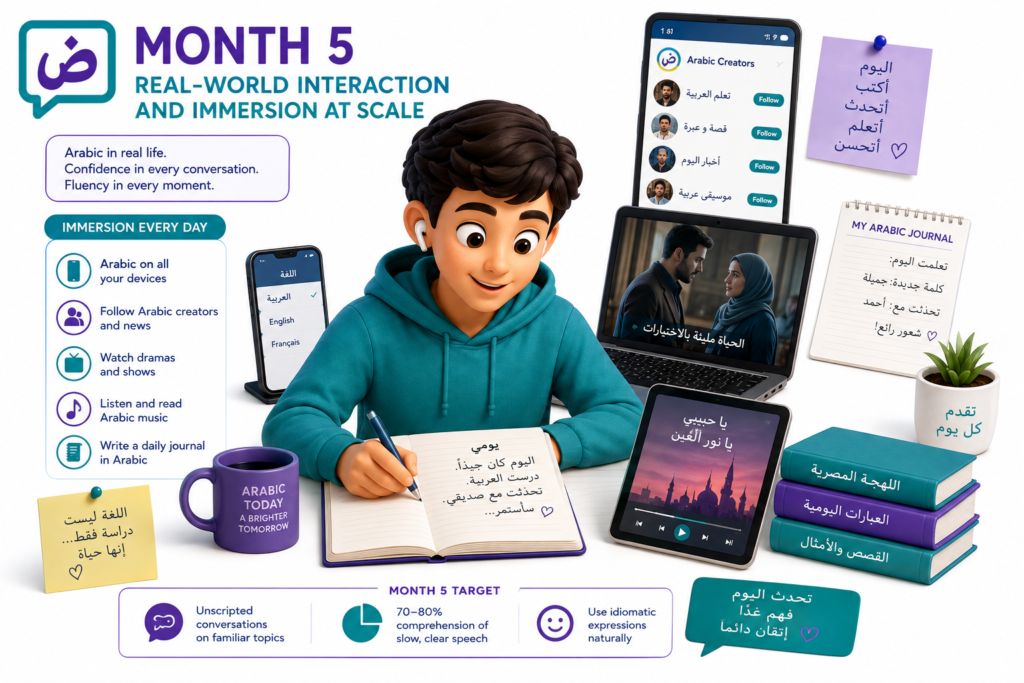
By Month 5, anyone following a plan for how to learn Arabic in 6 months should move beyond controlled practice into real-world interaction and immersion The goal is not perfection — it is functional engagement with Arabic as it actually exists: in media, in conversation, and in daily life.
Creating Immersion Without Travelling
One of the most persistent myths about language learning is that immersion requires living in an Arabic-speaking country. It does not. What immersion requires is making Arabic a natural part of your daily environment — so present and so constant that switching back to English feels unusual.
Practical immersion strategies that work regardless of location:
- Change your phone, laptop, and social media language settings to Arabic
- Follow Arabic-speaking creators, educators, and news channels on social media
- Watch Arabic television dramas or comedies in your chosen dialect — with subtitles at first, then without
- Listen to Arabic music and read along with the lyrics; music reinforces vocabulary, pronunciation, and the natural rhythm of the language simultaneously
- Keep a short daily journal in Arabic — even three sentences — to consolidate new vocabulary and grammar
Idiomatic Language and Colloquial Expression
Month 5 is where you begin encountering the Arabic that textbooks rarely teach: idioms, colloquial expressions, humour, and the cultural references embedded in everyday speech. Engage with these rather than avoiding them. A language’s idioms are not decoration — they are the way native speakers actually think and communicate.
If your goal includes access to classical texts, Islamic scholarship, or formal Arabic literature, a classical Arabic course at this stage provides the grammatical depth to begin engaging with those materials — building on the MSA foundation you established in Months 1 and 2.
Month 5 target: unscripted conversations on familiar topics; 70–80% comprehension of slow, clear native speech; use of idiomatic expressions naturally in context.

Month 6: Consolidation and Fluency
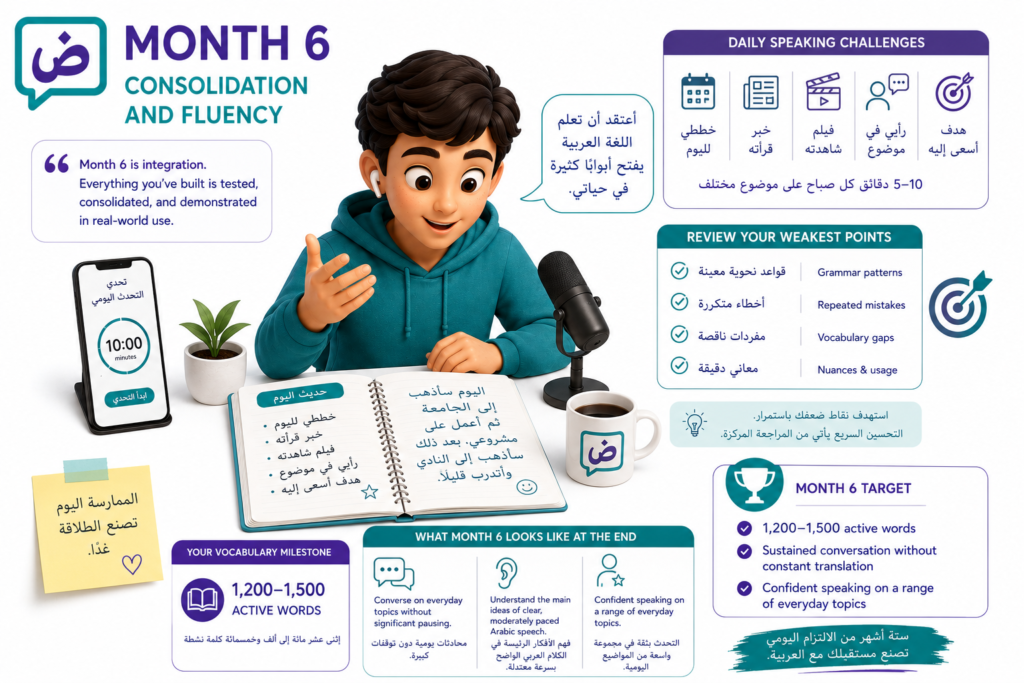
Month 6 is not a learning month in the conventional sense. It is an integration month — the point at which everything you have built over five months is tested, consolidated, and demonstrated in sustained, real-world Arabic use.
Daily Speaking Challenges
Speak in Arabic for 5–10 minutes each morning on a different topic — your plans for the day, a news story you read, a film you watched, an opinion you have. The discipline of speaking on unfamiliar topics forces you to stretch beyond comfortable, rehearsed phrases. This stretch is where fluency lives.
Review Your Weakest Points Systematically
Month 6 is the right time to return to the specific grammar points and vocabulary gaps that have caused repeated difficulty across Months 3–5. These are not random weaknesses — they are consistent patterns. Targeted review of consistent weak points produces faster improvement than continuing to practice areas that are already strong.
What Month 6 Looks Like at the End
A learner who has followed this plan with genuine daily commitment — 1–2 hours of focused study, active speaking from Month 4, consistent listening immersion — arrives at the end of Month 6 with approximately 1,200–1,500 words of active vocabulary, the ability to hold conversations on everyday topics without significant pausing, and the capacity to understand the main ideas of clear, moderately paced Arabic speech.
That is not native fluency. It is practical, functional, conversational fluency — and it is a genuine achievement in six months.
Month 6 target: 1,200–1,500 active words; sustained conversation without constant translation; confident speaking on a range of everyday topics.
Types of Arabic: Which One Should You Learn First?
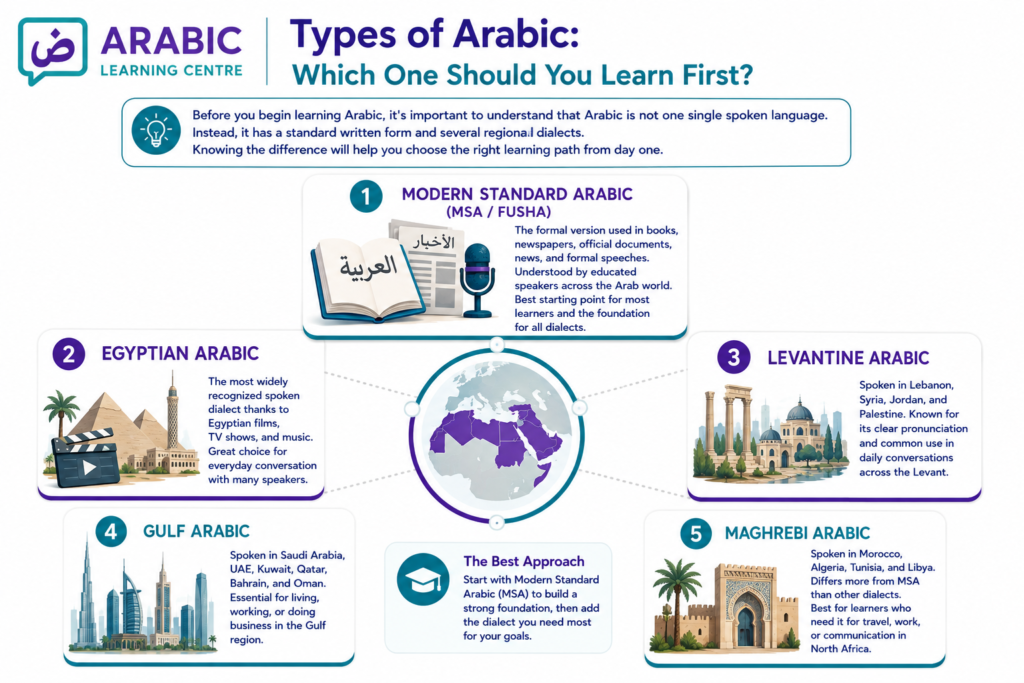
Before you begin learning Arabic, it’s important to understand that Arabic is not one single spoken language. Instead, it has a standard written form and several regional dialects. Knowing the difference will help you choose the right learning path from day one.
1. Modern Standard Arabic (MSA / Fusha)
Modern Standard Arabic (MSA), or Fusha, is the formal version of Arabic used in books, newspapers, official documents, news broadcasts, and formal speeches. It is understood by educated Arabic speakers across the Arab world, making it the best starting point for most learners. Because MSA forms the grammatical foundation of Arabic, learning it first makes it much easier to understand and later learn regional dialects.
2. Egyptian Arabic
Egyptian Arabic is the most widely recognized spoken dialect thanks to the popularity of Egyptian films, television shows, and music. If your goal is everyday conversation with a large number of Arabic speakers, Egyptian Arabic is an excellent choice after building a foundation in MSA.
3. Levantine Arabic
Levantine Arabic is spoken in Lebanon, Syria, Jordan, and Palestine. Many learners choose this dialect because of its clear pronunciation and widespread use in daily conversations across the Levant region.
Read Also: How Long Does It Take to Learn to Read Arabic?
4. Gulf Arabic
Gulf Arabic is commonly spoken in countries such as Saudi Arabia, the UAE, Kuwait, Qatar, Bahrain, and Oman. It is especially useful for people planning to live, work, or do business in the Gulf region.
Read Also: How to Learn Arabic in 5 Minutes?
5. Maghrebi Arabic
Maghrebi Arabic is spoken in Morocco, Algeria, Tunisia, and Libya. It differs more noticeably from MSA than other dialects, so it is usually recommended for learners who specifically need it for travel, work, or communication in North Africa.
Working through a structured Fusha Arabic course from the start gives you the grammatical foundation that makes dialect learning dramatically faster in the second half of your six months.
Read Also: How to Get Better at Reading Arabic?
Don’t Just Take Our Word For It
Take a look inside our vibrant classes and see our students and teachers in action. Click below to watch our classroom experience:

Start Your Arabic Journey with Expert Guidance
Six months of structured self-study builds a real foundation. The learners who reach genuine fluency fastest are those who combine independent daily practice with structured, expert-led instruction — because a qualified teacher identifies and corrects errors before they solidify into habits, and calibrates the pace of progression to the individual learner rather than a generic curriculum.
Arabic Learning Centre offers structured courses across vocabulary, grammar, Fusha, and classical Arabic — led by qualified instructors with direct experience teaching non-native speakers at every level, from complete beginner to advanced.
Courses We Offer:
- Online Arabic Course
- Classical arabic course
- Modern Standard Arabic Course
- Fusha Arabic Course
- Learn Saudi Arabic
- Arabic Course for Beginners
- Arabic Classes for Adults
- Arabic Classes for Ladies
- Advanced Arabic Course
- Intensive Arabic Course
[Book Your Free Trial Lesson →]

Conclusion
Six months of daily, structured Arabic study will not make you indistinguishable from a native speaker. What it will do — if you follow this plan with genuine consistency — is give you something real: a working alphabet, a substantial vocabulary, functional grammar, and the ability to hold authentic conversations in one of the world’s most spoken and significant languages.
For most people searching how to learn Arabic in 6 months, the greatest barrier is not the language itself but maintaining consistent daily practic It is the belief — remarkably common, remarkably wrong — that Arabic is impossibly hard. Six months of honest daily effort dismantles that belief permanently. And once it is dismantled, there is no ceiling on how far you can go.
What you do on Day 1 of Month 7 determines everything that follows. Keep the daily habit. Expand your vocabulary. Deepen your grammar. Find more people to speak with. The foundation you have built in six months will support everything you build on top of it — but only if you keep building.
FAQs About How to Learn Arabic in 6 Months
Is it realistic to learn Arabic in 6 months?
Conversational fluency — the ability to hold everyday conversations, understand common media, and express yourself without constantly translating — is realistic in six months with 1–2 hours of focused daily study. Native-level mastery is not. Setting the right expectation is what keeps learners progressing past the inevitable difficult days.
Should I learn Modern Standard Arabic or a dialect first?
Start with Modern Standard Arabic for structure, script, and grammar — then layer your chosen dialect on top for conversational practice. MSA provides the grammatical backbone that makes dialect learning faster and more systematic. Egyptian Arabic is the most accessible dialect to add first, given its global reach through Egyptian media.
How many words do I need to hold a basic conversation in Arabic?
Research in language acquisition suggests that 1,000–1,500 high-frequency words cover approximately 80–85% of everyday spoken Arabic. This is an achievable target by the end of six months with consistent vocabulary study and spaced repetition. The critical factor is learning words in context — in sentences, not isolated lists — so that they are retrievable under the pressure of real conversation.
Can I learn Arabic without a teacher?
Self-study with quality resources produces real results, particularly for alphabet, vocabulary, and reading. For speaking and pronunciation, however, a qualified teacher provides something no app can replicate: real-time identification and correction of errors before they become ingrained habits. Even two or three sessions per month with a native teacher alongside independent study will significantly accelerate your progress.
What is the hardest part of learning Arabic in six months?
Consistency. The linguistics are challenging — the unfamiliar sounds, the root-based vocabulary system, the grammatical cases — but all of these are manageable with the right resources and enough time. What derails most learners is not difficulty but inconsistency: the gap between intensive periods where nothing is practiced and previous learning decays. Twenty minutes of daily review is worth more than a three-hour session once a week.
Does Arabic writing direction make it harder to learn?
Arabic is written right to left, which feels counterintuitive for native English speakers. In practice, most learners adapt to reading direction within two to three weeks of consistent alphabet practice. It is one of the earlier challenges to resolve, not one of the later ones.
Related Articles
Learn Arabic