 Arabic Grammar
Arabic calligraphy is one of the most admired forms of Islamic art, combining language, history, and creativity into a single visual composition. Yet for many learners, beautifully written calligraphy can seem impossible to read because letters are stretched, stacked, or stylized in ways that look very different from everyday Arabic writing.
The good news is that Arabic calligraphy doesn’t use a different alphabet—it uses the same 28 Arabic letters arranged in artistic styles. Once you understand how these styles work and follow a systematic reading process, even complex calligraphic designs become much easier to interpret. In this guide, you’ll learn how to identify the main calligraphy styles, recognize letters despite decorative changes, and build the practical skills needed to read Arabic calligraphy with confidence.
1. Understand Why Calligraphy Is Hard to Read
Arabic calligraphy is not decorative handwriting — it’s a visual art form where real letters are stretched, compressed, interlocked, or rotated to build a composition. Three features cause almost all of the difficulty, and knowing them in advance tells you what to look for when a piece looks unreadable.
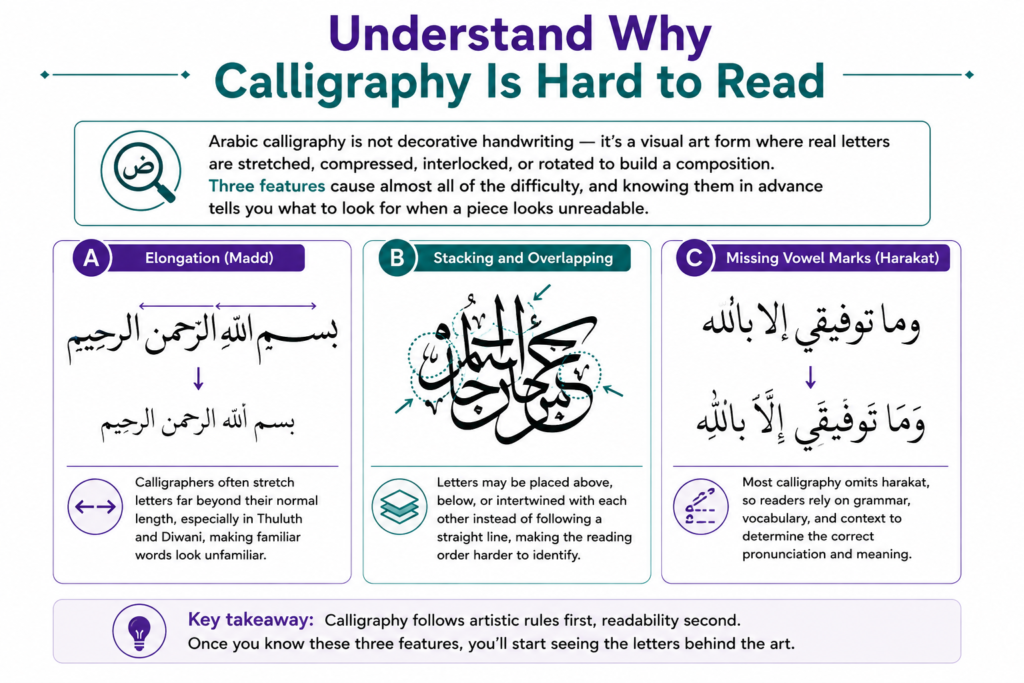
A. Elongation (Madd)
Calligraphers often stretch letters far beyond their normal length, especially in Thuluth and Diwani, making familiar words look unfamiliar.
B. Stacking and Overlapping
Letters may be placed above, below, or intertwined with each other instead of following a straight line, making the reading order harder to identify.
C. Missing Vowel Marks (Harakat)
Most calligraphy omits harakat, so readers rely on grammar, vocabulary, and context to determine the correct pronunciation and meaning.
This is the step where prior grammar knowledge pays off directly — a structured grammar course builds the vowel-inference instinct that calligraphy reading depends on.
Start Your Arabic Grammar Course with a Free Trial

2. Identify the Script Type
Every calligraphy style distorts the alphabet differently, so naming the style first gives you a framework before you touch individual letters.
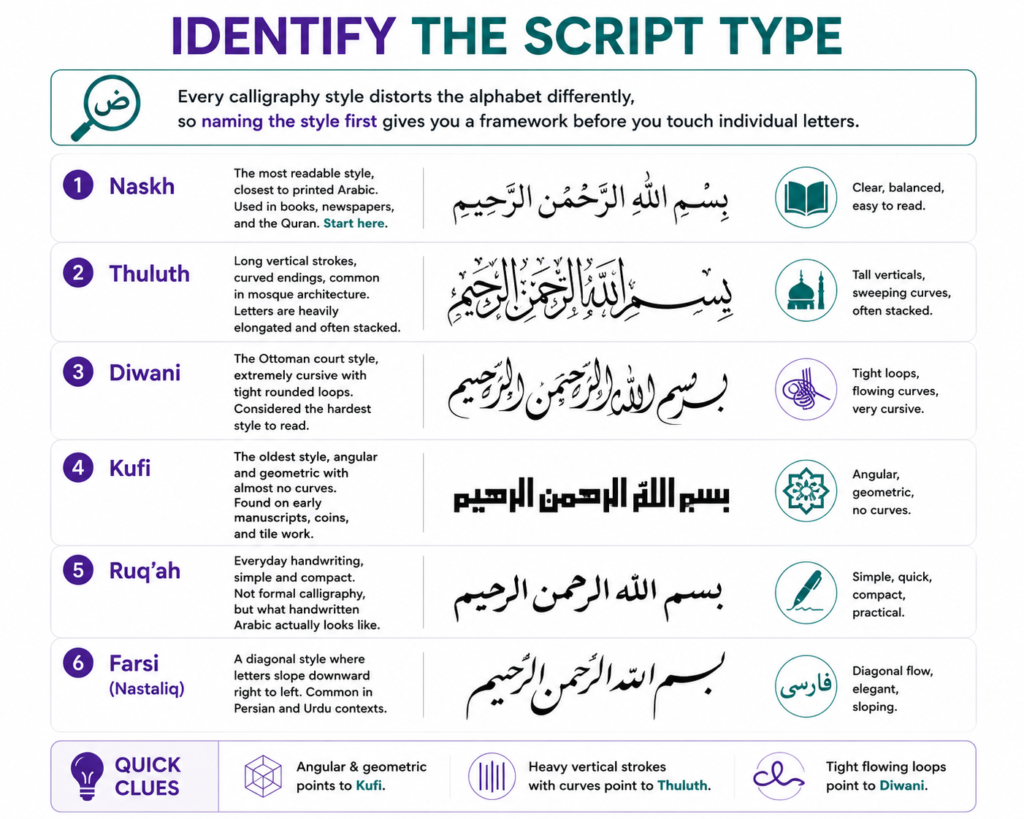
- Naskh — the most readable style, closest to printed Arabic. Used in books, newspapers, and the Quran. Start here.
- Thuluth — long vertical strokes, curved endings, common in mosque architecture. Letters are heavily elongated and often stacked.
- Diwani — the Ottoman court style, extremely cursive with tight rounded loops. Considered the hardest style to read.
- Kufi — the oldest style, angular and geometric with almost no curves. Found on early manuscripts, coins, and tile work.
- Ruq’ah — everyday handwriting, simple and compact. Not formal calligraphy, but what handwritten Arabic actually looks like.
- Farsi (Nastaliq) — a diagonal style where letters slope downward right to left. Common in Persian and Urdu contexts.
Angular and geometric points to Kufi. Heavy vertical strokes with curves point to Thuluth. Tight flowing loops point to Diwani.
Inside Our Classrooms
See how we make learning interactive and engaging! Watch a quick snippet of our live, conversational classes in action:
3. Learn the Alphabet Through Letter Families
Arabic’s 28 letters are most efficiently learned in shape families — letters sharing one base form, differentiated only by dots.
| Base shape | Letters | Distinguishing feature |
| One-curve base | ب / ت / ث | 1, 2, or 3 dots below or above |
| Hook base | ج / ح / خ | No dot, dot below, dot above |
| Diagonal base | د / ذ | No dot, one dot above |
| Curved hook | ر / ز | No dot, one dot above |
| Double curve | س / ش | No dots, 3 dots above |
| Oval base | ص / ض | No dot, one dot above |
| Vertical stroke | ط / ظ | No dot, one dot above |
| Eye shape | ع / غ | No dot, one dot above |
| Open hook | ف / ق | One dot above, two dots above |
| Palm shape | ك / ل / م / ن | Distinct connecting forms |
| Loop | ه / و | Distinct isolated forms |
| Vertical | ا / ي | Simplest, most modified in calligraphy |
The base shapes survive even heavy stylization — the proportions change, the dots don’t. Dots are your anchor. When a letter looks unreadable, find the dots first; they tell you the letter family before you’ve deciphered the exact shape.
One shortcut worth memorizing early: alif (ا) and lam (ل) appear together constantly as the definite article al- (ال). Spotting this pair at a glance gives you an anchor point in almost any composition. Learning to write these forms — including their initial, medial, final, and isolated positions — builds this recognition faster than reading alone, which is why an Arabic course built for non-native speakers starts from letter formation rather than assuming you already have it.
Begin Learning Arabic with a Free Trial Class

4. Apply the Four-Part Reading Method
Reading Arabic calligraphy becomes much easier when you follow a consistent process instead of trying to identify every letter immediately. This four-step method helps you break even complex designs into readable words.
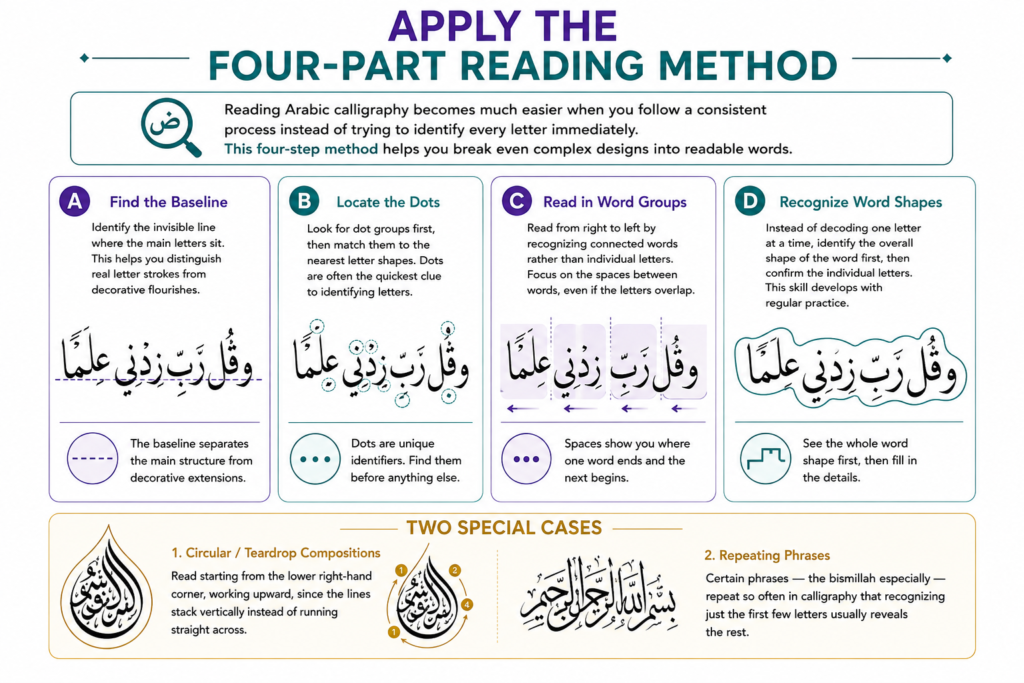
A. Find the Baseline
Identify the invisible line where the main letters sit. This helps you distinguish real letter strokes from decorative flourishes.
B. Locate the Dots
Look for dot groups first, then match them to the nearest letter shapes. Dots are often the quickest clue to identifying letters.
C. Read in Word Groups
Read from right to left by recognizing connected words rather than individual letters. Focus on the spaces between words, even if the letters overlap.
D. Recognize Word Shapes
Instead of decoding one letter at a time, identify the overall shape of the word first, then confirm the individual letters. This skill develops with regular practice.
Two special cases worth knowing: circular or teardrop compositions are read starting from the lower right-hand corner, working upward, since their lines stack vertically instead of running straight across. And certain phrases — the bismillah especially — repeat so often in calligraphy that recognizing just the first few letters usually reveals the rest.
5. Practice on Known Examples
Reading theory builds the framework; reading real examples of Arabic calligraphy builds fluency. Start with phrases whose meaning you already know, so you’re only decoding shapes — not shapes and vocabulary at the same time.
- Bismillah (بسم الله الرحمن الرحيم) — the most widely reproduced phrase, available in nearly every style.
- The Shahada (لا إله إلا الله محمد رسول الله) — common in Thuluth and Kufi on mosque walls.
- Allahu Akbar (الله أكبر) — short enough for quick cross-style comparison.
- Surah Al-Fatiha — longer, best attempted once shorter phrases feel comfortable.
The single most efficient exercise: take one phrase and find it rendered in five different styles — Naskh, Thuluth, Kufi, Diwani, Ruq’ah. Reading identical words across styles isolates the one variable that’s actually changing.
6. Build a Daily Reading Habit
Consistent practice is the fastest way to improve your ability to read Arabic calligraphy. A few minutes of focused training each day will build recognition much more effectively than occasional long study sessions.
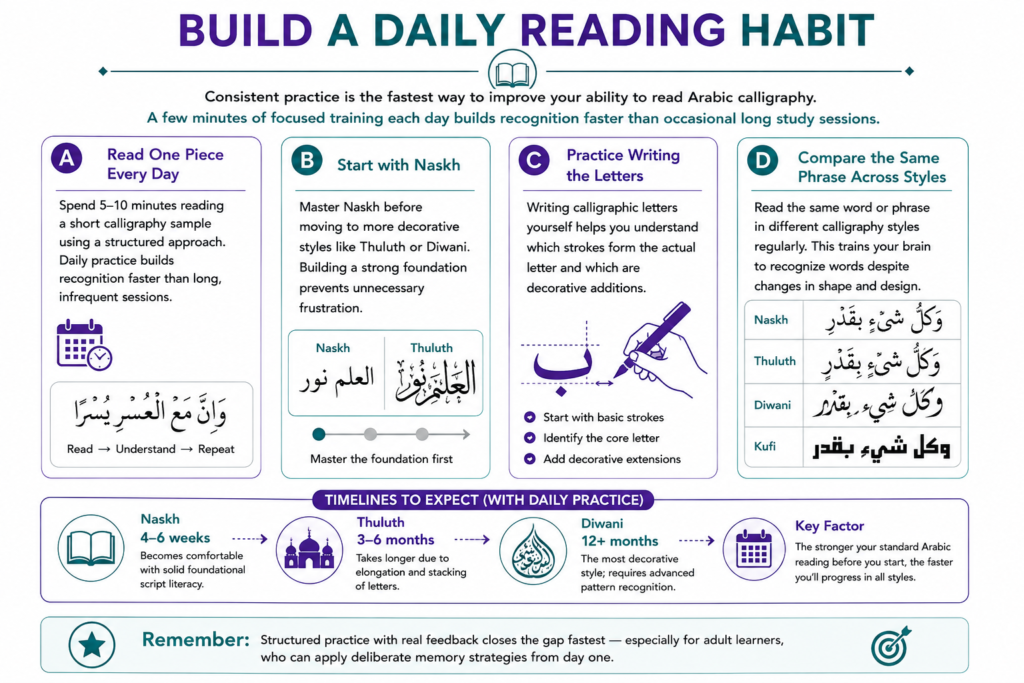
A. Read One Piece Every Day
Spend 5–10 minutes reading a short calligraphy sample using a structured approach. Daily practice builds recognition faster than long, infrequent sessions.
B. Start with Naskh
Master Naskh before moving to more decorative styles like Thuluth or Diwani. Building a strong foundation prevents unnecessary frustration.
Read Also: How to Read Arabic Without Harakat?
C. Practice Writing the Letters
Writing calligraphic letters yourself helps you understand which strokes form the actual letter and which are decorative additions.
Read Also: How to Read Arabic Dates?
D. Compare the Same Phrase Across Styles
Read the same word or phrase in different calligraphy styles regularly. This trains your brain to recognize words despite changes in shape and design.
Timelines to expect: Naskh becomes comfortable in four to six weeks with daily practice and solid foundational script literacy. Thuluth typically takes three to six months. Diwani, the most decorative style, can take a year or more. The biggest factor is how strong your standard Arabic reading is before you start — which is exactly the gap structured practice with real feedback closes fastest, something adult learners in particular benefit from since they can apply deliberate memory strategies from day one.
Join Our Arabic Classes for Adults with a Free Trial

Read Also: How to Read Arabic for Beginners?
Don’t Just Take Our Word For It
Take a look inside our vibrant classes and see our students and teachers in action. Click below to watch our classroom experience:
Learn to Read Arabic Calligraphy with Confidence at Arabic Learning Centre
Reading Arabic calligraphy doesn’t have to feel overwhelming. At Arabic Learning Centre, you’ll develop the letter recognition, vocabulary, and reading skills needed to understand authentic calligraphic texts step by step. With expert guidance and a structured learning path, you’ll progress much faster than through self-study alone.
Whether your goal is to appreciate Islamic manuscripts, read mosque inscriptions, or explore classical Arabic art, our experienced teachers will help you build the confidence to recognize different calligraphy styles and read them with ease.
Courses We Offer:
- Business Arabic Course
- Learn Arabic from Zero
- Medical Arabic Course
- Learning Arabic for Non Arabic Speakers
- Learn Arabic in Saudi Arabia
- Learn to Read Arabic Cours
- Arabic Grammar Course
- Arabic Speaking Course
- Arabic Script writing course
- Arabic Vocabulary Course
- Arabic Pronunciation Course
Book your free trial class today and start your journey with Arabic Learning Centre.

Conclusion
Reading Arabic calligraphy is a skill that develops through understanding and consistent practice rather than artistic talent. By learning why calligraphy looks different, identifying the script style, recognizing letter families, and applying a structured reading method, you’ll gradually train your eyes to see the words behind the artwork instead of just the decoration.
Start with simple scripts like Naskh, practice on familiar Islamic phrases, and make reading calligraphy part of your daily routine. As your Arabic reading skills improve, you’ll find it easier to recognize different styles, appreciate the beauty of classical manuscripts and Islamic architecture, and confidently read calligraphic compositions that once seemed impossible to understand.
Frequently Asked Questions
Here are clear answers to some of the most common questions beginners ask before they start learning and practicing Arabic calligraphy.
How do you read Arabic calligraphy for beginners?
Identify the script type first — Naskh is the most readable and the right starting point. Then find the baseline, locate the dots to anchor letter identification, and read right to left in word units, starting with phrases like Bismillah that you already know.
What are the main Arabic calligraphy script types?
The six types are Naskh (clear, closest to print), Thuluth (monumental, elongated), Diwani (flowing Ottoman court style), Kufi (angular and geometric), Ruq’ah (everyday handwriting), and Farsi/Nastaliq (diagonal baseline).
How do you read the Arabic calligraphy alphabet?
Learn letters in shape families — groups sharing a base form, distinguished only by dots. The dots remain the most reliable anchor even when calligraphy heavily stretches or decorates the base shape.
What are good examples of Arabic calligraphy to practice reading?
Bismillah (بسم الله الرحمن الرحيم), the Shahada (لا إله إلا الله محمد رسول الله), Allahu Akbar (الله أكبر), and Surah Al-Fatiha. They’re short, widely reproduced across every style, and their meaning is already known.
How long does it take to learn to read Arabic calligraphy?
Naskh becomes comfortable within four to six weeks of daily practice. Thuluth typically takes three to six months. Diwani, the most decorative style, can take a year or more — the biggest factor is your existing Arabic reading strength.
Can I learn to read Arabic calligraphy without knowing Arabic?
You can recognize individual letter shapes without knowing Arabic, but you can’t read calligraphy meaningfully without the language, since reading it means decoding words, not just identifying decorative forms. Building foundational reading ability first makes calligraphy both faster to learn and more rewarding.
Related Articles
Arabic Grammar