 Arabic Alphabet & Writing
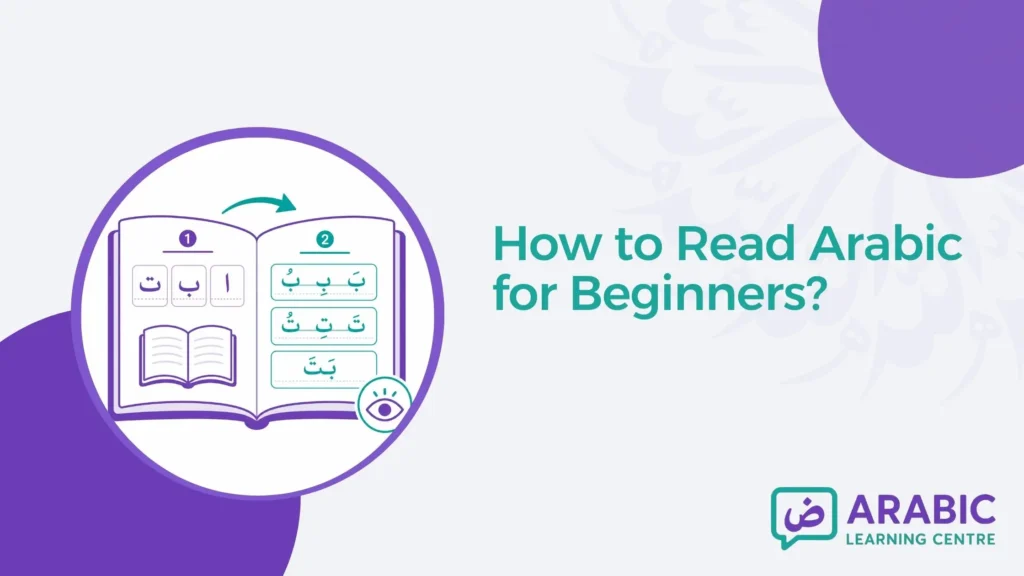
If you’ve stared at Arabic script and felt like it’s a wall of unfamiliar shapes, you’re not alone — and you’re not stuck. Learning how to read Arabic for beginners is a sequence of specific, learnable steps, not a talent some people have and others don’t.
This guide walks through how to read Arabic for beginners step by step, in 11 stages: from the alphabet itself through vowel marks, elongation letters, context reading, and daily practice habits. Follow the order below and you’ll avoid the most common trap beginners fall into — jumping to full sentences before the fundamentals are automatic.
Whether you’re using how to read Arabic for beginners free resources or a guided course, these 11 steps are the backbone of every method that actually works.
1. Learn the Arabic Alphabet and Letter Shapes
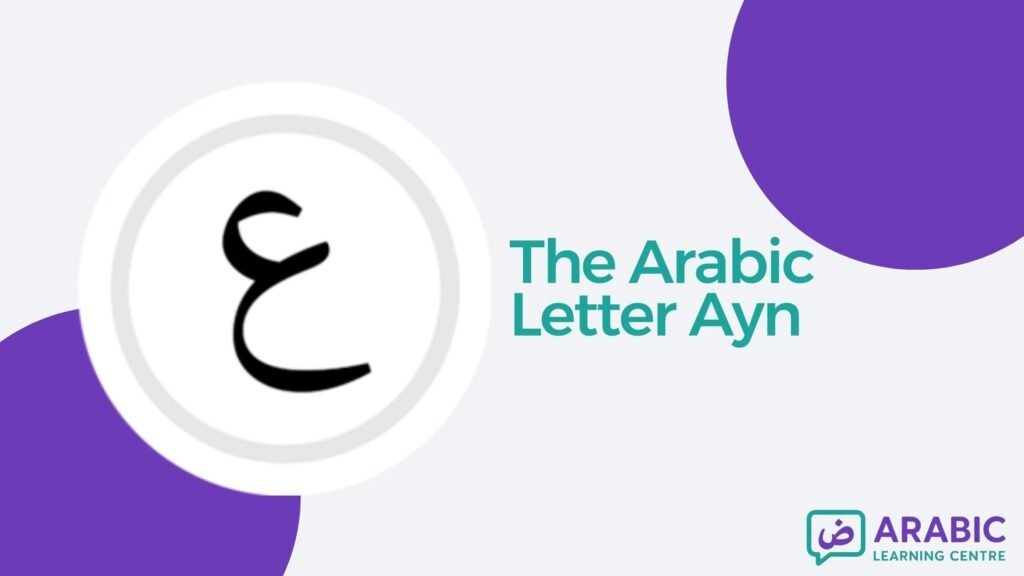
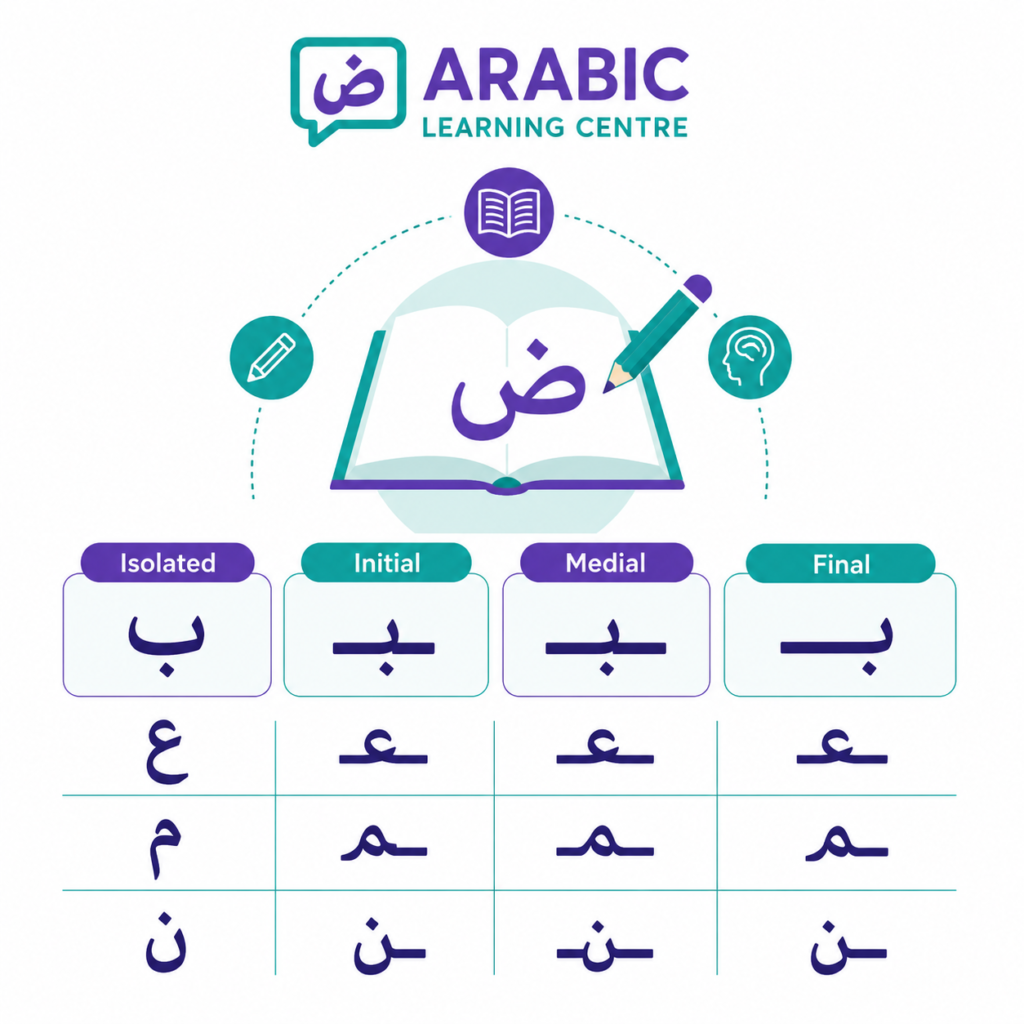
The Arabic alphabet is a 28-letter system, and every other reading skill depends on knowing these letters without hesitation. Arabic letters also change shape depending on their position in a word — beginning, middle, end, or standing alone — which makes this step more involved than memorizing a static list.
A learner who only memorizes the standalone form of each letter will struggle the moment that letter appears mid-word, since the connected forms can look noticeably different from the isolated one.
Practicing All Four Letter Positions
Each letter has up to four written forms. Write out each letter in all four positions repeatedly before moving to the next step.
A structured Arabic grammar course reinforces this naturally, since grammar lessons expose you to letters in all their forms across real words rather than isolated flashcards.
Begin Your Arabic Grammar Journey with a Free Trial

2. Connect Every Letter to Its Sound
Recognizing Arabic letters is only the first step—you also need to connect each letter instantly to its correct sound. Reading is an active skill, so say the sound of every letter and word aloud instead of recognizing it silently. This helps your brain build a direct connection between what your eyes see and what your mouth produces.
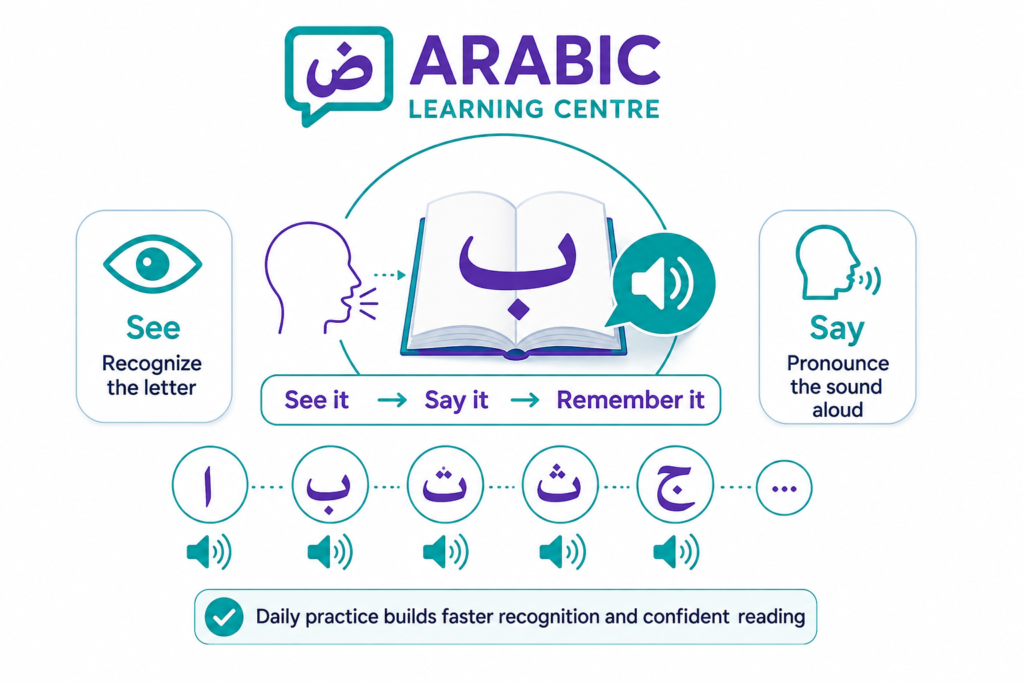
Many self-taught learners skip this stage, which is why they can identify letters but still read slowly or hesitate when reading words. From the beginning, practise reading aloud every day, even if you are working with simple words. Repeating the sounds consistently develops faster recognition, improves pronunciation, and lays the foundation for reading Arabic confidently without harakat.
Inside Our Classrooms
See how we make learning interactive and engaging! Watch a quick snippet of our live, conversational classes in action:
3. Master the Five Core Vowel Marks (Tashkeel)
Tashkeel is the system of marks placed above or below Arabic letters to indicate short vowel sounds. Without it, a word’s bare letters can be read multiple ways — with it, pronunciation becomes exact.
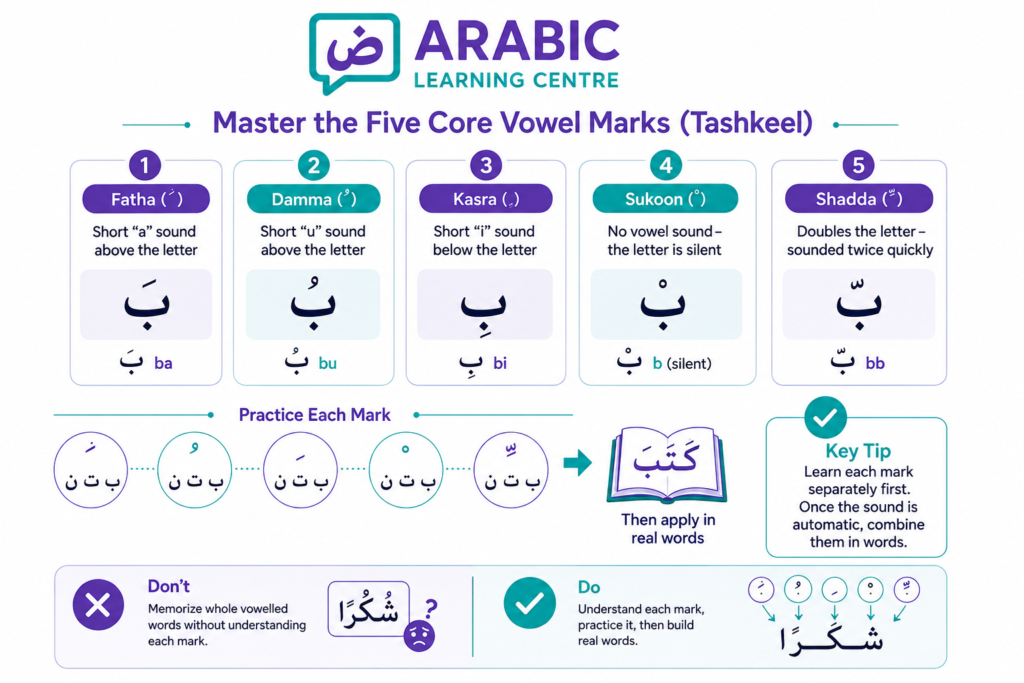
There are five marks to recognize on sight:
- Fatha (َ) — a short “a” sound above the letter
- Damma (ُ) — a short “u” sound above the letter
- Kasra (ِ) — a short “i” sound below the letter
- Sukoon (ْ) — marks the letter as silent, no vowel follows
- Shadda (ّ) — doubles the letter’s pronunciation, sounded twice quickly
Avoiding the Most Common Tashkeel Mistake
A frequent error: beginners memorize whole vowelled words instead of internalizing what each mark does on its own. That breaks down the moment an unfamiliar word appears. Drill each mark separately against a handful of letters until the sound is automatic, then combine marks into real words.
4. Learn the Three Madd (Elongation) Letters
Madd letters extend a vowel rather than keeping it short. There are exactly three of them.
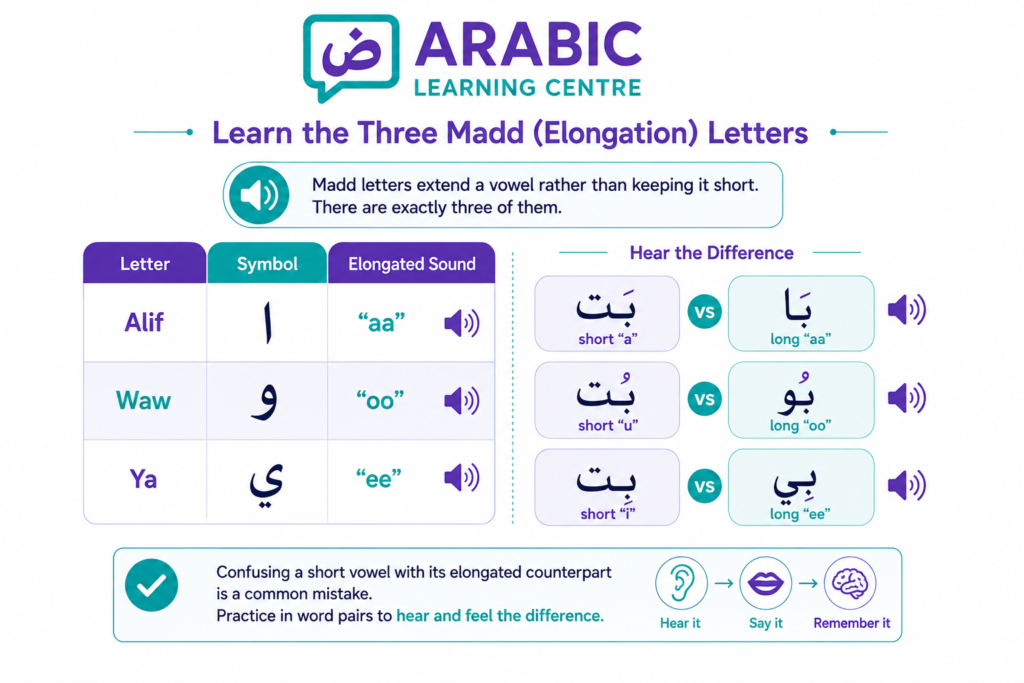
Here’s how each one changes pronunciation:
| Letter | Symbol | Elongated Sound |
| Alif | ا | “aa” |
| Waw | و | “oo” |
| Ya | ي | “ee” |
Confusing a short vowel with its elongated counterpart is one of the most common pronunciation errors among beginners, since the two can look similar at a glance. Practicing madd letters in isolated word pairs — a short version next to its elongated version — makes the difference audible fast.
5. Understand Tanween, the Extra “N” Sound
Tanween is a pair of vowel marks that adds an “n” sound to the end of an indefinite noun. It appears as a doubled fatha (ً), damma (ٌ), or kasra (ٍ) and is one of the first pronunciation patterns Arabic learners encounter. For example, كِتَابٌ (kitābun) ends with the additional “n” sound, while كِتَابًا (kitāban) and كِتَابٍ (kitābin) use different tanween endings depending on their grammatical case.
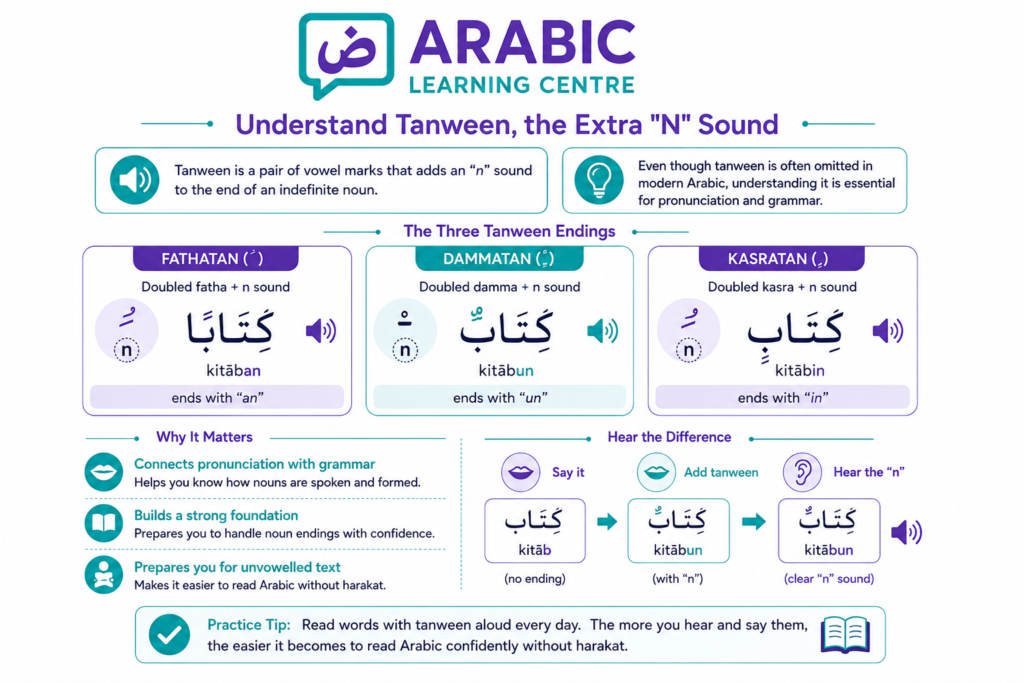
Although modern Arabic books, newspapers, and websites usually omit tanween along with the rest of the harakat, understanding how it works is still essential. It helps you recognize how nouns are pronounced, reinforces basic grammar, and prepares you to supply the correct endings yourself when reading unvowelled text.
Reading words with tanween aloud is especially valuable because it connects pronunciation with grammar. As you become familiar with these endings, you’ll find it much easier to transition from fully vowelled texts to reading Arabic confidently without harakat.
6. Learn the Two Types of Hamza
There are two distinct hamza types, and confusing them creates an unnaturally choppy reading rhythm.
Here’s the key difference between them:
| Type | Symbol | When It’s Pronounced |
| Hamzat al-qat’ | أ | Always, regardless of position |
| Hamzat al-wasl | ا | Only when its word starts a sentence |
If your reading goals include religious texts, this distinction carries extra weight, since Quranic Arabic depends heavily on precise hamza and madd pronunciation — a reason many learners eventually pair general reading skills with a course built for Islamic studies.
Start Learning Arabic for Islamic Studies with a Free Trial

7. Start Reading Simple, High-Frequency Words
Once you are comfortable with the Arabic alphabet, tashkeel, madd, and hamza, begin reading simple, high-frequency words instead of jumping straight into long sentences or difficult passages. Learning the words you encounter most often helps your brain recognize them instantly, making reading faster and more natural over time.
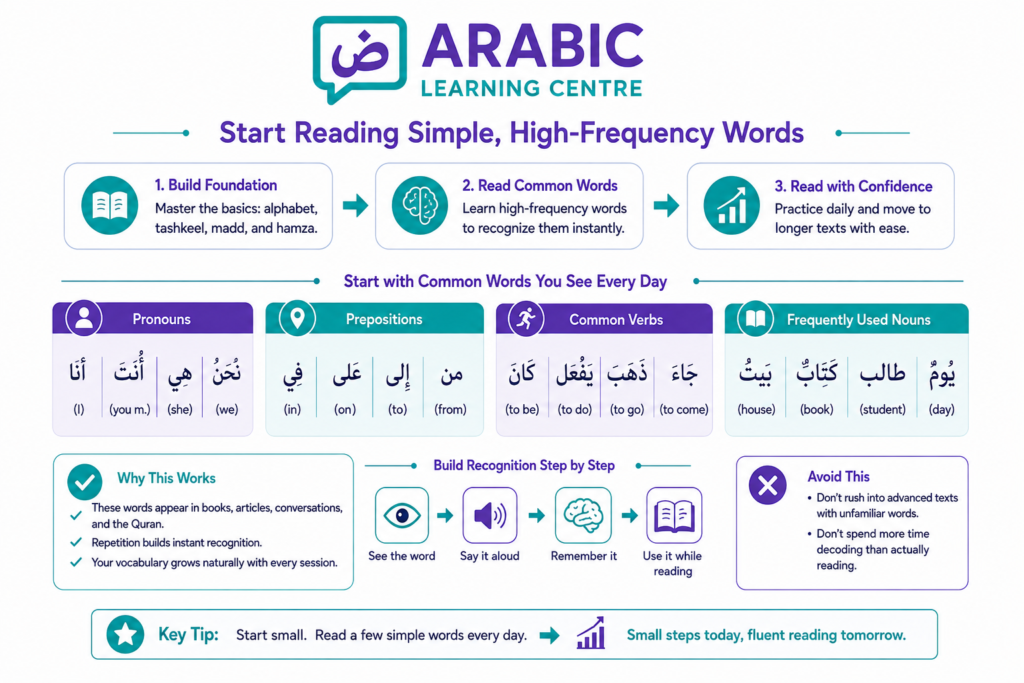
Focus on common vocabulary such as pronouns, prepositions, everyday verbs, and frequently used nouns. Because these words appear repeatedly in books, articles, conversations, and the Quran, every reading session reinforces what you have already learned and gradually expands your vocabulary.
Avoid rushing into advanced texts filled with unfamiliar words. Many beginners lose confidence because they spend more time decoding new vocabulary than actually reading. Building a strong foundation with common words first creates momentum and prepares you to read longer passages with greater accuracy and fluency.
8. Read Aloud, Every Time
Reading aloud is one of the fastest ways to improve your Arabic reading skills because it reveals mistakes that silent reading often hides. When you pronounce each word, you actively connect spelling, pronunciation, and meaning, helping your brain process Arabic more naturally.
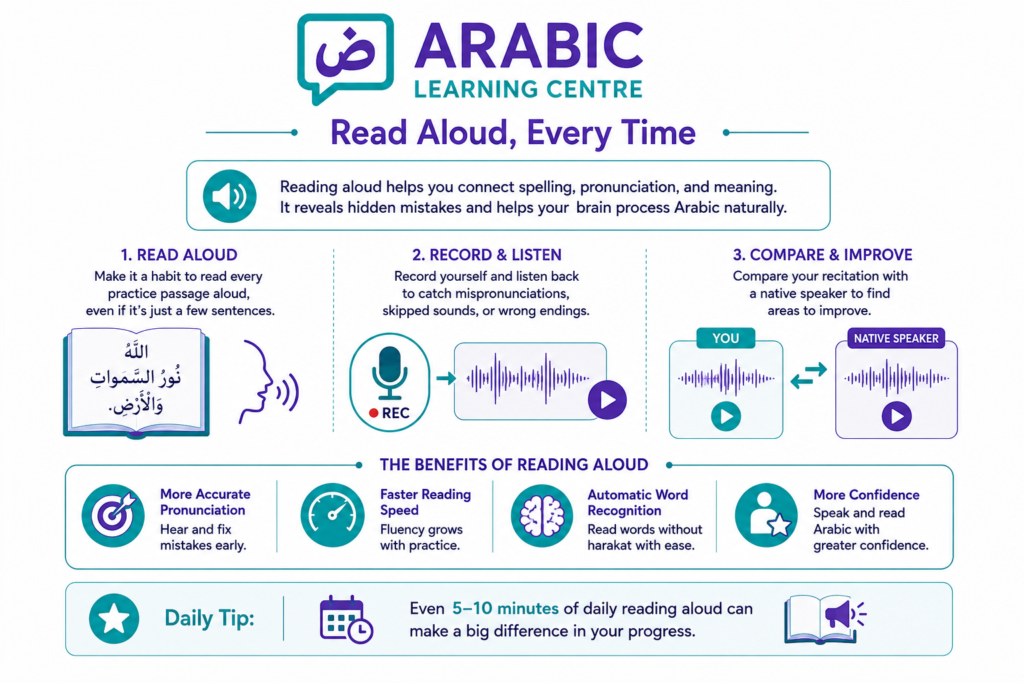
Make it a habit to read every practice passage aloud, even if it is only a few sentences. Recording yourself and listening to the playback can be especially helpful, as it allows you to notice mispronunciations, skipped sounds, or incorrect word endings that you may not hear while reading. Comparing your recording with a native speaker’s recitation is an excellent way to identify areas for improvement.
Consistent oral reading also strengthens fluency and confidence. Over time, your pronunciation becomes more accurate, your reading speed increases, and recognizing words without harakat becomes much more automatic. Even five to ten minutes of daily reading aloud can make a noticeable difference in your progress.
9. Train Your Ear With Native Audio
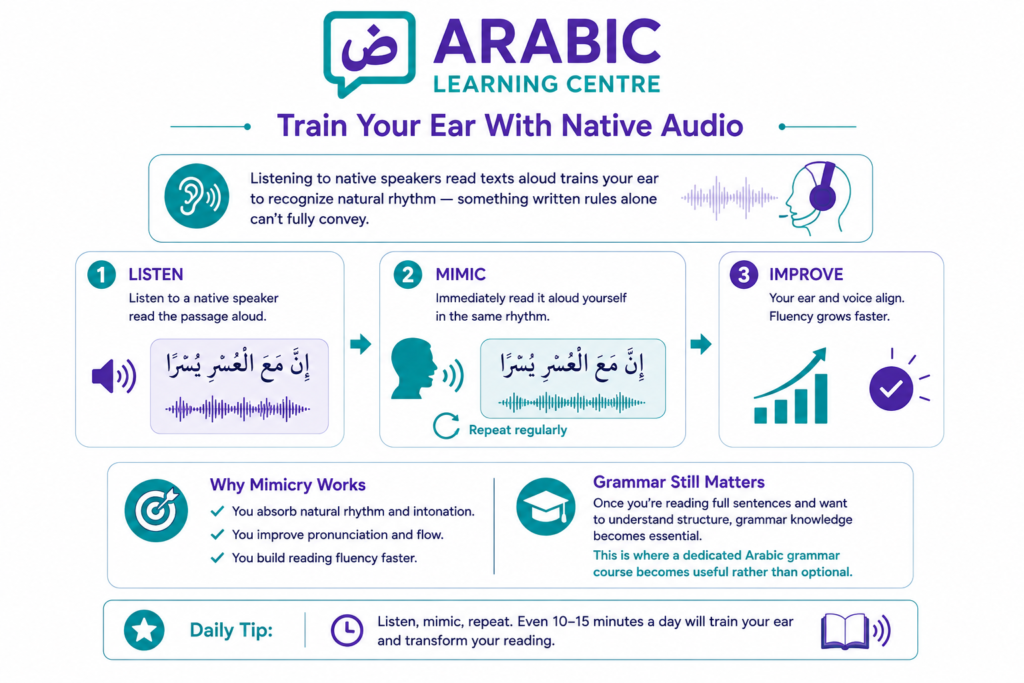
Listening to native speakers read texts aloud trains your ear to recognize natural rhythm — something written rules alone can’t fully convey. After listening to a passage, immediately try reading it aloud yourself in the same rhythm.
This mimicry method works faster than isolated drilling for building reading fluency specifically. Grammar knowledge still matters once you’re reading full sentences and want to understand structure, which is where a dedicated Arabic grammar course becomes useful rather than optional.
Read Also: How to Read Arabic Calligraphy
10. Use Context to Handle Words You Don’t Know
Context clues — the words and sentences around an unfamiliar word — often reveal enough meaning to make an educated guess and keep your reading moving. Stopping at every unfamiliar word is what makes reading feel exhausting rather than natural.
Train yourself to flag uncertain words for later review instead of pausing mid-sentence. Readers who build this habit gain reading speed noticeably faster than those who stop constantly to look every word up.
This kind of context-based reading is exactly what a structured course reinforces well. Students preparing for academic Arabic requirements, for instance, often benefit from a high school–level Arabic course that paces new vocabulary and sentence complexity deliberately, rather than leaving learners to guess what “harder” should mean next.
Join Our Arabic High School Programme with a Free Trial Class

Read Also: How to Read Arabic Without Harakat?
11. Practice Daily and Increase Difficulty Gradually
Fluency comes from repetition, not from learning additional rules. Start easy and build up gradually.
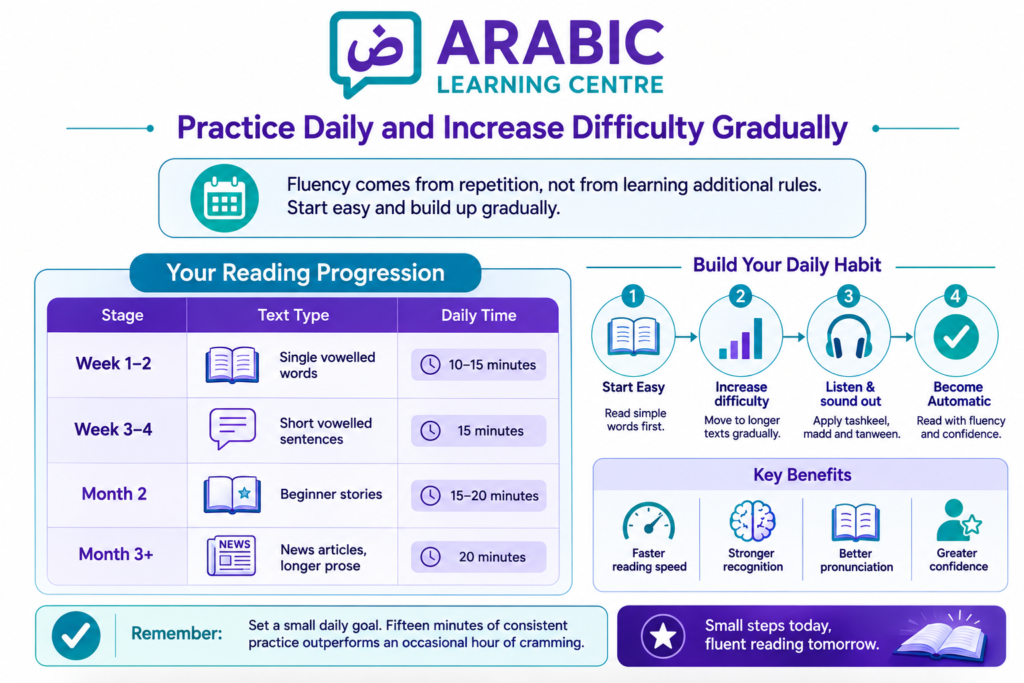
Here’s a simple progression to follow:
| Stage | Text Type | Daily Time |
| Week 1–2 | Single vowelled words | 10–15 minutes |
| Week 3–4 | Short vowelled sentences | 15 minutes |
| Month 2 | Beginner stories | 15–20 minutes |
| Month 3+ | News articles, longer prose | 20 minutes |
Set a small daily goal rather than occasional long sessions; fifteen minutes of consistent practice outperforms an occasional hour of cramming. As difficulty increases, keep applying every earlier step — sounding out unfamiliar letters, checking tashkeel, listening for madd and tanween — until it becomes automatic rather than deliberate.
Read Also: How to Read Arabic Dates?
Don’t Just Take Our Word For It
Take a look inside our vibrant classes and see our students and teachers in action. Click below to watch our classroom experience:
Start Your Arabic Journey with The Arabic Learning Centre
The Arabic Learning Centre offers structured online Arabic courses designed for children, adults, and non-native speakers who want to develop practical language skills. Through live lessons with qualified native Arabic teachers, students build confidence in reading, writing, speaking, and understanding Arabic in a supportive learning environment.
The academy follows a step-by-step teaching approach that makes learning Arabic clear and engaging, regardless of your starting level. With flexible schedules, interactive classes, and personalized guidance, students can progress steadily toward academic, professional, or personal language goals.
Courses We Offer:
- Business Arabic Course
- Learn Arabic from Zero
- Medical Arabic Course
- Learning Arabic for Non Arabic Speakers
- Learn Arabic in Saudi Arabia
- Learn to Read Arabic Course
- Arabic Grammar Course
- Arabic Speaking Course
- Arabic Script writing course
- Arabic Vocabulary Course
- Arabic Pronunciation Course
Start your Arabic learning journey today with expert guidance and a proven learning approach.

Conclusion
Learning how to read Arabic for beginners comes down to sequence: the 28 letters and their shifting shapes first, then tashkeel, then madd letters, tanween, and hamza rules, then simple words, then full aloud practice with native audio and context reading.
The one thing to take from this guide: consistency beats intensity. Fifteen minutes of correct daily practice outperforms occasional long sessions every time. Whether you’re working through how to read Arabic for beginners online free materials or a structured program, these 11 steps stay the same regardless of pace.
Frequently Asked Questions
If you’re just starting to learn Arabic, it’s natural to have questions about the learning process, pronunciation, and the best way to build strong reading skills. Below are answers to some of the most common questions beginners ask about learning to read Arabic confidently and effectively.
How long does it take to learn how to read Arabic for beginners?
Most beginners can read basic vowelled words within a few weeks of consistent daily practice. Full comfort with unvowelled text — newspapers, novels — typically takes several months, since it depends on vocabulary exposure as much as letter recognition.
What istashkeel and why does it matter for reading?
Tashkeel is the set of vowel marks (fatha, damma, kasra, sukoon, shadda) placed above or below Arabic letters to show pronunciation. Without it, a word’s core letters could be read several different ways, so tashkeel is essential for exact pronunciation.
Can I find how to read Arabic for beginners online free resources that actually work?
Yes — recorded native-speaker readings and printable letter charts can teach the basics effectively for free. They work best paired with daily reading-aloud practice, since free materials rarely offer real-time pronunciation correction.
Is it better to learn Arabic reading step by step or all at once?
A step-by-step approach — letters, then vowel marks, then simple words, then full texts — produces stronger retention than absorbing everything at once. Beginners who skip ahead often have to circle back and relearn fundamentals anyway.
Do I need to learn Arabic grammar before I can read?
No — basic reading (sounding out letters and vowels) doesn’t require grammar knowledge first. Grammar becomes important once you’re reading full sentences and want to understand structure, not just pronunciation.
What’s the biggest mistake beginners make when learning how to read Arabic for beginners?
The most common mistake is skipping tashkeel practice and moving straight to unvowelled text. Without solid vowel-mark recognition first, beginners guess at pronunciation instead of reading accurately, which slows progress significantly.
Related Articles
Arabic Alphabet & Writing