 Quran
Quran
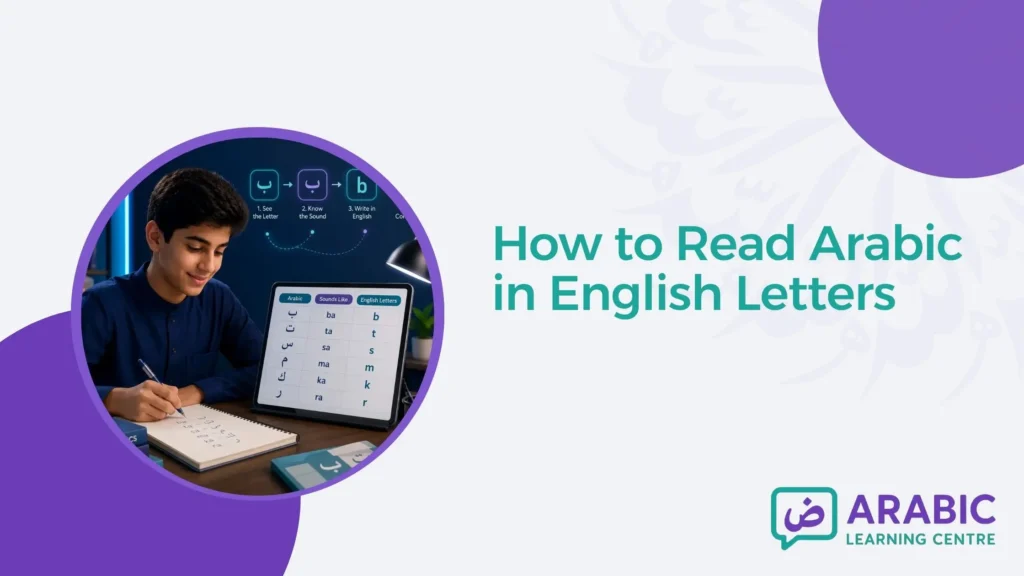
Millions of beginners ask the same question when they first encounter Arabic: can I read these words using English letters first? The answer is yes — and this guide shows you exactly how to read Arabic in English letters, what the complete system looks like from A to Z, which sounds English letters cannot capture, and the precise moment you must stop relying on transliteration before it permanently slows your progress.
Before diving in, understand the two things transliteration does and does not do. It gives you a pronounceable approximation of Arabic words using familiar characters. It does not give you accurate Arabic pronunciation — because Arabic contains sounds that English letters cannot represent. Both of these facts matter equally.
1- Transliteration Gives You a Phonetic Bridge but Never an Accurate Reading System
Transliteration is the process of representing Arabic letters using Latin characters. When you read Arabic in English letters online, you are reading someone’s best attempt to map Arabic phonetics onto the nearest English equivalents available — not a precise reproduction of the original sounds.
The structural problem is fundamental. Arabic has 28 consonant letters while English has 26, and the two sound inventories overlap only partially. Approximately 18 Arabic letters have reasonably close English equivalents. The remaining 10 do not exist in English at all — and for those 10, transliteration produces approximations that mislead as much as they help.
A second problem is that no single universally agreed transliteration system exists for Arabic. The same Arabic word appears in English letters differently across different sources — محمد becomes Muhammad, Mohammed, Mohamad, and Mohamed depending on the source. A beginner relying solely on transliteration will encounter this inconsistency constantly.
What transliteration genuinely does well for beginners:
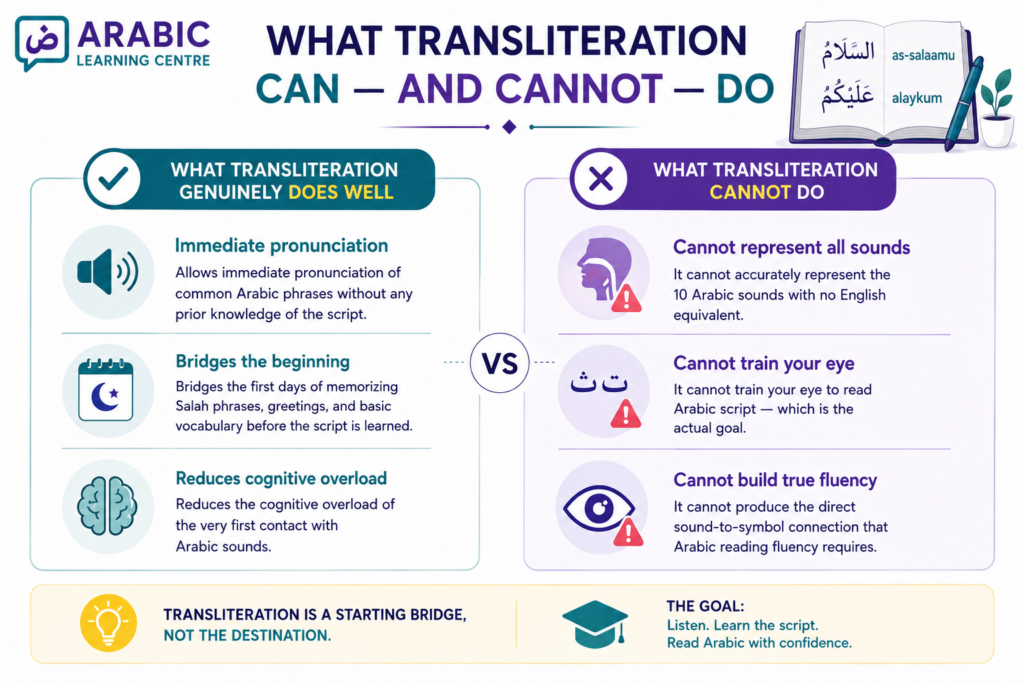
- It allows immediate pronunciation of common Arabic phrases without any prior knowledge of the Arabic script.
- It bridges the first days of memorizing Salah phrases, greetings, and basic vocabulary before the script is learned.
- It reduces the cognitive overload of the very first contact with Arabic sounds.
What transliteration cannot do:
- It cannot accurately represent the 10 Arabic sounds with no English equivalent.
- It cannot train your eye to read Arabic script — which is the actual goal.
- It cannot produce the direct sound-to-symbol connection that Arabic reading fluency requires.
The verdict from Arabic language specialists across multiple institutions is consistent: transliteration is a reasonable bridge for the first days of study. After that, it actively impedes learning by preventing the direct sound-to-symbol connection that real reading fluency depends on.
At The Arabic Learning Centre, the Arabic Script Writing Course builds the direct Arabic script foundation that makes transliteration unnecessary — taught by certified native tutors who correct pronunciation from the very first session.
Move from English letters to real Arabic script today.
2- The Complete Arabic Alphabet in English Letters Covers All 28 Letters A to Z
How to read Arabic in English letters a to z requires understanding the full 28-letter system and its English approximations. The table below gives every letter in traditional Arabic order — its name, its closest English transliteration, and a pronunciation description that tells you how close the English approximation actually is:
| # | Arabic | Name | English Letters | Pronunciation Guide |
| 1 | ا | Alif | A / Aa | “A” in apple — long “Ah” |
| 2 | ب | Ba | B | “B” in boy — accurate |
| 3 | ت | Ta | T | “T” in top — accurate |
| 4 | ث | Tha | Th | “Th” in think — close |
| 5 | ج | Jeem | J | “J” in jump — close |
| 6 | ح | Ha | H* | Deep breathy H from throat — no English equivalent |
| 7 | خ | Kha | Kh | Like Scottish “loch” — approximation only |
| 8 | د | Dal | D | “D” in dog — accurate |
| 9 | ذ | Dhal | Dh | “Th” in this — close |
| 10 | ر | Ra | R | Rolled R like Spanish “pero” — close |
| 11 | ز | Zay | Z | “Z” in zero — accurate |
| 12 | س | Seen | S | “S” in sun — accurate |
| 13 | ش | Sheen | Sh | “Sh” in ship — accurate |
| 14 | ص | Sad | S* | Heavy emphatic S — no English equivalent |
| 15 | ض | Dad | D* | Unique to Arabic — no English equivalent |
| 16 | ط | Ta | T* | Heavy emphatic T — no English equivalent |
| 17 | ظ | Dha | Dh* | Heavy emphatic Dh — no English equivalent |
| 18 | ع | Ayn | Voiced throat constriction — no English equivalent | |
| 19 | غ | Ghayn | Gh | French uvular R — no English equivalent |
| 20 | ف | Fa | F | “F” in fan — accurate |
| 21 | ق | Qaf | Q | Deep K from uvula — no English equivalent |
| 22 | ك | Kaf | K | “K” in king — accurate |
| 23 | ل | Lam | L | “L” in lamp — accurate |
| 24 | م | Meem | M | “M” in moon — accurate |
| 25 | ن | Noon | N | “N” in name — accurate |
| 26 | هـ | Ha | H | “H” in hat — close |
| 27 | و | Waw | W / Oo | “W” in water / long “Oo” |
| 28 | ي | Ya | Y / Ee | “Y” in yes / long “Ee” |
Letters marked with * have no English equivalent — their transliteration is an approximation only. For these letters, native audio is the only way to develop accurate pronunciation. The free audio platform Forvo provides recordings of every Arabic letter from native speakers across multiple regions — use it specifically for the starred letters above.
Inside Our Classrooms
See how we make learning interactive and engaging! Watch a quick snippet of our live, conversational classes in action:
3- Ten Arabic Letters Have No English Equivalent and Require Native Audio Practice
The 10 Arabic letters with no English equivalent are precisely where how to read Arabic in English letters for beginners reaches its limit.
These are the letters that make Arabic sound distinctly Arabic to English ears — and they are also the letters that transliteration misrepresents most severely. Each of these 10 letters requires a specific articulation point in the mouth or throat that English speakers have never trained:
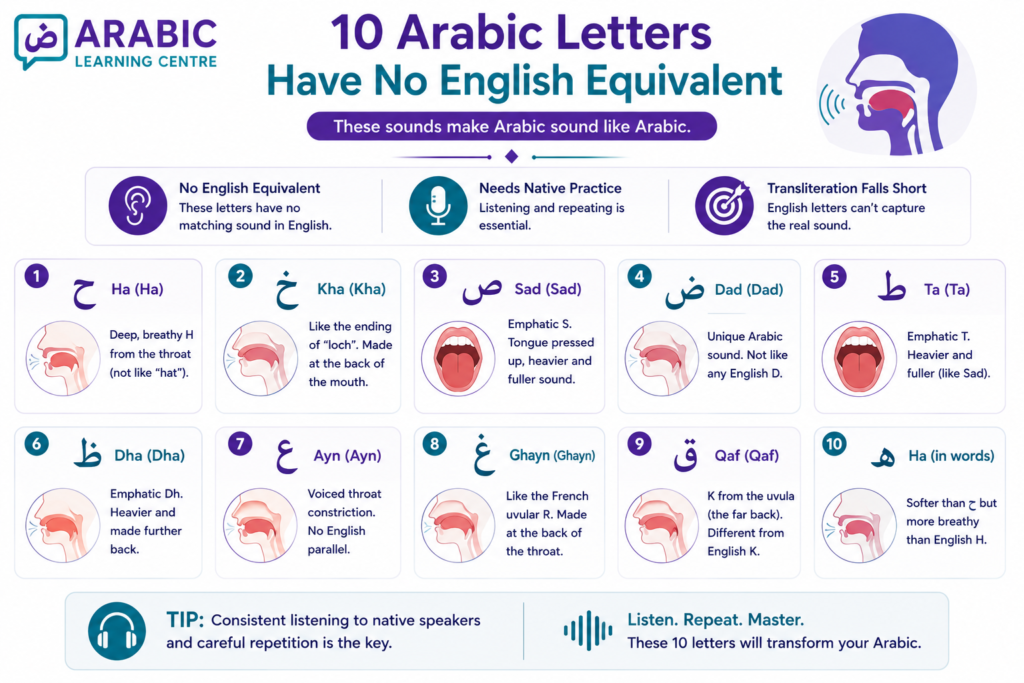
- ح (Ha): A deep, breathy H produced from the throat — not the soft H in “hat.” Imagine breathing on cold glass but from deep in the throat.
- خ (Kha): The sound at the end of the Scottish word “loch” — a friction sound produced at the back of the mouth.
- ص (Sad): An emphatic S produced with the back of the tongue pressed toward the roof of the mouth, creating a heavier, fuller sound than the regular S.
- ض (Dad): Unique to Arabic — no other language produces this sound in the same way. Often approximated as a heavy D, but the actual articulation is distinct.
- ط (Ta): An emphatic T produced the same way as Sad — heavier and fuller than the regular T.
- ظ (Dha): The emphatic version of the Dh sound — heavier and produced further back in the mouth.
- ع (Ayn): A voiced constriction of the throat that has no parallel in any European language. Often written as an apostrophe in transliteration, which gives beginners no guidance whatsoever on how to produce it.
- غ (Ghayn): Similar to the French uvular R — a voiced friction sound produced at the back of the throat.
- ق (Qaf): A K sound produced from the uvula — the furthest back position in the mouth. Distinctly different from the English K produced at the front of the mouth.
- ه (Ha in words): Lighter than ح but still more breathy than the English H — requires careful listening to distinguish from ح in context.
The practical method for mastering these 10 letters:
- Listen to each letter pronounced by a native speaker at least 20 times before attempting to produce it.
- Record yourself producing the sound and compare it to the native recording.
- Ask a native speaker to confirm your pronunciation — not an app, not a recording comparison, but a human correction in real time.
At The Arabic Learning Centre, the Arabic Classes for Non-Arabic Speakers provides real-time Makharij correction for every one of these 10 letters from the very first session — eliminating the mispronunciation habits that transliteration creates.

Get your Arabic pronunciation corrected by a native tutor today.
4- Short Vowels in Arabic Transliteration Follow Three Simple Rules
How to read Arabic in English letters online requires understanding not just the consonants but also the vowel system. Arabic short vowels — called harakat — are not separate letters. They are small marks placed above or below consonants.
In transliteration, they are represented by the letters a, i, and u placed after each consonant. The three short vowel rules every beginner must know:
| Haraka | Arabic Mark | English Letters | Sound | Example |
| Fatha | ـَ | a | Short “a” as in “cat” | بَ = ba |
| Kasra | ـِ | i | Short “i” as in “sit” | بِ = bi |
| Damma | ـُ | u | Short “u” as in “put” | بُ = bu |
Long vowels in transliteration follow a different convention. They are typically written as double letters to signal that the vowel is held longer:
- Long “aa” — written as “aa” or with a line over the letter (ā) — represents the letter Alif ا.
- Long “oo” — written as “oo” or “ū” — represents the letter Waw و when used as a vowel.
- Long “ee” — written as “ee” or “ī” — represents the letter Ya ي when used as a vowel.
A practical example that shows the full vowel system in transliteration:
كَتَبَ الْوَلَدُ رِسَالَةً
Kataba al-waladu risaalatan
“The boy wrote a letter.”
Every vowel in this sentence is visible in the transliteration — the short a in “kataba,” the u in “waladu,” the long aa in “risaalatan.” This is how to read Arabic in English letters at its most useful: a fully vowelized sentence where every sound is shown explicitly.
The important limitation: most real Arabic text outside the Quran and children’s books does not include harakat. This means transliteration of everyday Arabic text requires the writer to supply vowels from their own knowledge — and different writers supply different vowels, producing inconsistency that confuses beginners.
5- Common Arabic Phrases in English Letters Give Beginners an Immediate Head Start
The most practical application of how to read Arabic in English letters for beginners is learning the high-frequency phrases used in daily Arabic conversation and Islamic context.
These phrases appear so frequently that memorizing them in transliteration first — then learning their Arabic script immediately after — gives beginners an immediate vocabulary foundation.
The most important Arabic phrases with full transliteration:
| Arabic | English Letters | Meaning |
| السلام عليكم | As-salamu alaykum | Peace be upon you |
| وعليكم السلام | Wa alaykum as-salam | And upon you peace |
| بسم الله | Bismillah | In the name of Allah |
| الحمد لله | Alhamdulillah | Praise be to Allah |
| إن شاء الله | In sha Allah | If Allah wills |
| ما شاء الله | Ma sha Allah | What Allah has willed |
| جزاك الله خيراً | Jazakallahu khayran | May Allah reward you with good |
| مرحبا | Marhaba | Hello / Welcome |
| شكراً | Shukran | Thank you |
| من فضلك | Min fadlak | Please |
| كيف حالك؟ | Kayfa halak? | How are you? |
| بخير | Bikhayr | Fine / Good |
| أسماء | Asma’ | Names |
| يوم جيد | Yawm jayyid | Good day |
| مع السلامة | Ma’a as-salama | Goodbye |
For each phrase in this table, the correct learning sequence is:
- Pronounce the transliteration aloud 5 times using the pronunciation guide from the table in Section 2.
- Find the Arabic script version and trace the letters — connecting the sound you just practiced to the script it comes from.
- Within one week, read the Arabic script directly without needing the transliteration.
At The Arabic Learning Centre, the Arabic Speaking Course builds exactly this kind of practical phrase foundation — with a certified native tutor confirming pronunciation accuracy for every phrase from the first session.

Learn Arabic phrases with accurate pronunciation from Day 1.
6- Transliteration Must Be Abandoned Within Two Weeks Before It Becomes a Permanent Obstacle
This is the most important section in this guide — and the one most beginner resources omit entirely. How to read Arabic in English letters is a valid starting point. What no one tells beginners clearly enough is when to stop.
The consensus among Arabic language specialists is unambiguous: transliteration is a reasonable bridge for the very first days of study. After two weeks maximum, it actively impedes learning. The reasons are specific and serious:
Prevention of direct sound-to-symbol connection
Reading Arabic fluency requires your brain to connect Arabic letters directly to their sounds. Transliteration routes that connection through English letters instead — creating a detour that slows reading speed and prevents fluency from developing.
Encouraging English pronunciation of Arabic sounds
When a beginner reads “kh” in transliteration, their brain automatically applies the nearest English sound — not the correct Arabic خ. The mispronunciation solidifies before the correct sound has been learned.
Creating dependency
Learners who use transliteration for months report the same experience — they can say words but cannot read a single Arabic sign, menu, or message. The transliteration habit has trained the eye to depend on Latin characters.
Production of inconsistency
With no standardized system, different sources transliterate the same Arabic word differently. A beginner who has memorized “Mohammed” will encounter “Muhammad” and “Mohamad” in other sources — causing confusion about what the actual Arabic word is.
It cannot represent 10 Arabic sounds at all
The emphatic letters ص، ض، ط، ظ and the throat sounds ع، ح have no English letter equivalents. Any transliteration of these sounds is a placeholder, not a representation — and beginners who practice transliteration develop wrong muscle memory for these sounds that requires active correction later.
The correct two-week plan for using transliteration without becoming dependent on it:
| Day | Action |
| Days 1–3 | Use transliteration to learn basic phrases and hear Arabic sounds |
| Days 4–7 | Learn the first 14 Arabic letters in real Arabic script — stop using transliteration for those letters |
| Days 8–14 | Learn the remaining 14 Arabic letters — transliteration use drops to zero |
| Day 15 onward | Real Arabic script only — transliteration is permanently retired |
7- Free Online Tools Let You Read Arabic in English Letters Instantly
How to read Arabic in English letters online free is genuinely possible through four reliable tools — each targeting a different skill. Use them in combination, never as substitutes for each other.
Arabic Transliteration Converter Turns Any Arabic Text into English Letters Instantly
Arabic Transliteration Tool lets you paste any Arabic text and instantly receive its Latin-character phonetic version. The tool follows both ALA-LC and ISO romanization standards, reaching 95% accuracy — the highest among free available tools.
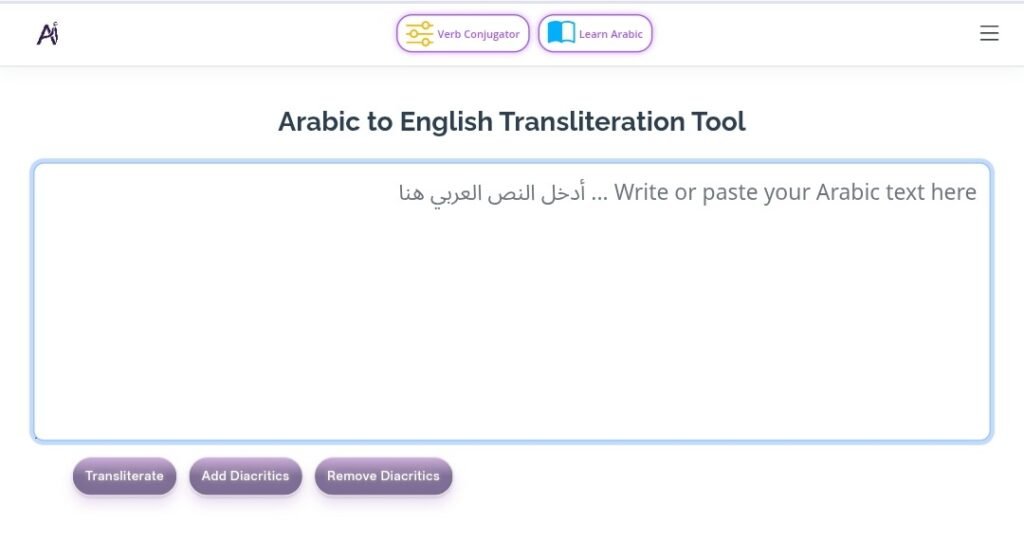
Use it to check pronunciation of specific words, not to read entire texts. It cannot represent the 10 Arabic letters with no English equivalent accurately, so treat its output as a starting approximation for those sounds.
Forvo Lets You Hear Every Arabic Letter from Native Speakers for Free
Forvo is the world’s largest pronunciation database, with recordings of Arabic words produced by native speakers across different countries and dialects.
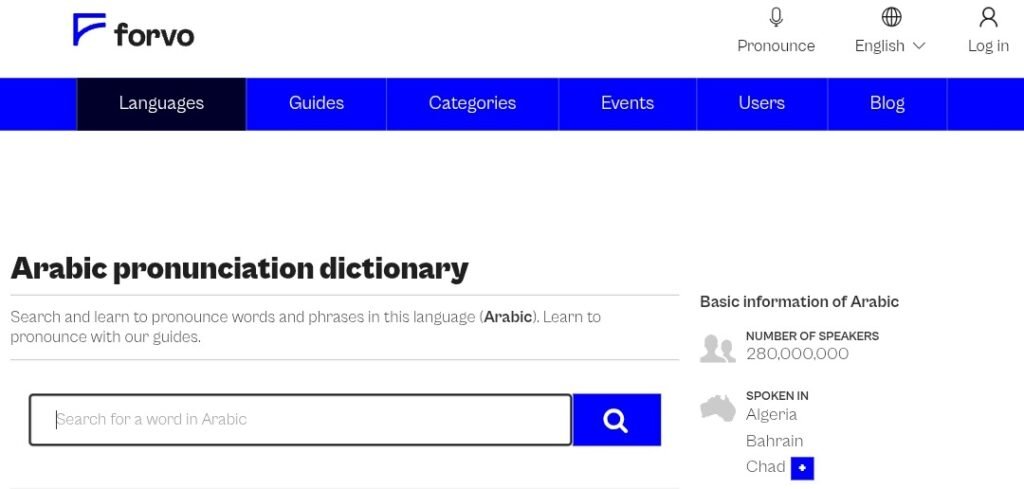
It is the most valuable free tool specifically for the 10 Arabic letters that transliteration cannot represent — ح، خ، ص، ض، ط، ظ، ع، غ، ق — because hearing the actual sound from a native speaker is the only way to learn it accurately. Search any Arabic word or letter and hear multiple native recordings instantly, at no cost.
Online Arabic Keyboard Lets You Practice Real Arabic Script Directly in Your Browser
The Arabic Keyboard allows you to type in real Arabic script from any device without installing any software. It supports full tashkeel — fatha, kasra, damma, sukoon, shadda — making it ideal for beginners who want to practice writing vowelized Arabic. It also includes a transliteration input mode where you type phonetic English and the keyboard converts it to Arabic script automatically.
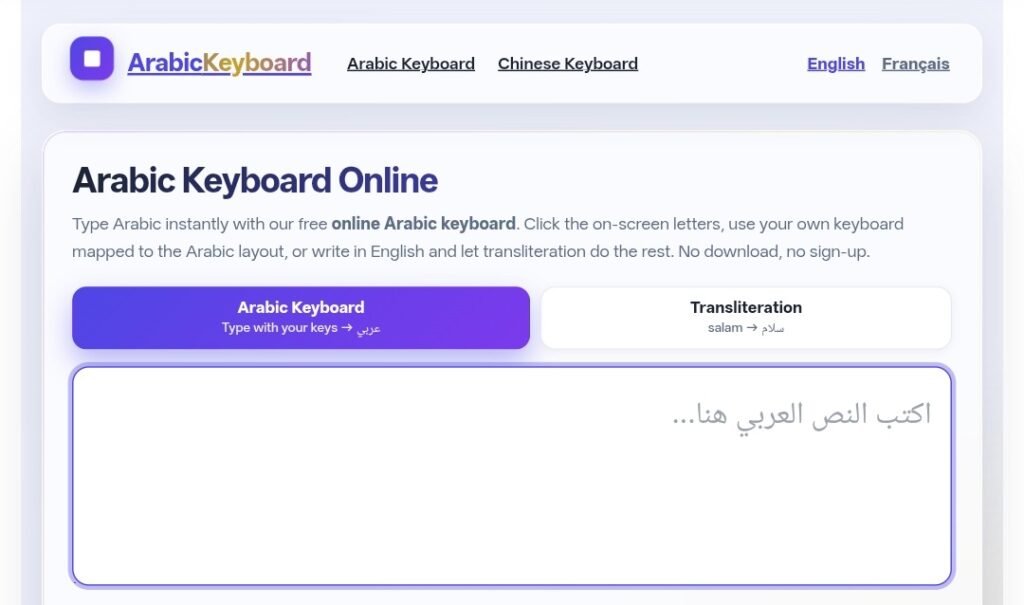
Use it from Day 1 of script study so that your fingers begin building the muscle memory for Arabic letter positions alongside your reading practice.
Read Also: How to Read Arabic Quran?
Tanzil Displays Fully Vowelized Quranic Arabic Text for Accurate Reading Practice
Tanzil provides the complete Quran in fully vowelized Arabic text with verse-by-verse navigation, multiple translations, and direct links to specific verses. Because the Quran is always published with full tashkeel, it is the most reliable source of fully vowelized Arabic reading material available for free online.
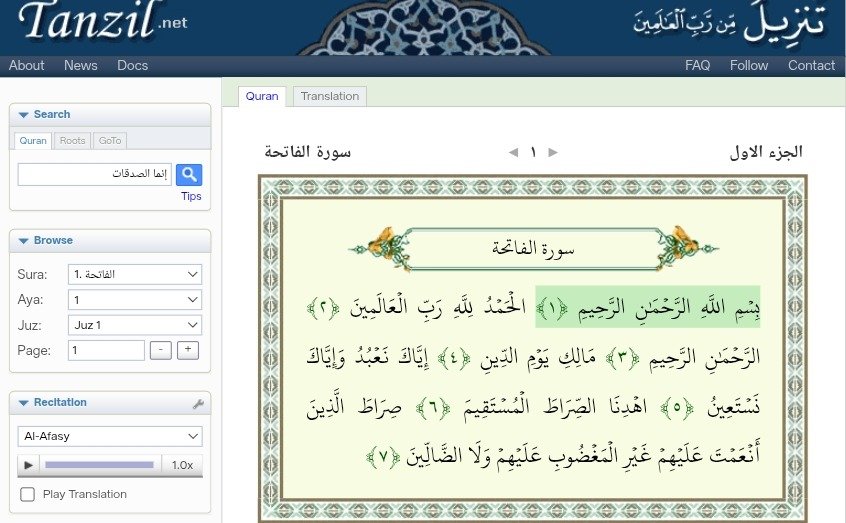
Once you know the Arabic alphabet, use Tanzil to practice reading real Arabic text where every vowel is visible — the closest thing to a vowelized reading environment outside of a printed beginner textbook.
At The Arabic Learning Centre, the Arabic Grammar Course gives learners the structured foundation that connects pronunciation, script, and grammar — moving beyond what any free online tool can provide.
Read Also: How to Read Arabic Letters?

Build Arabic fluency beyond what transliteration can offer
Don’t Just Take Our Word For It
Take a look inside our vibrant classes and see our students and teachers in action. Click below to watch our classroom experience:
Read Also: How to Read Arabic Indic Numbers
Start Reading Real Arabic Script at The Arabic Learning Centre
Transliteration is where Arabic learning begins — not where it ends. Every beginner who learns how to read Arabic in English letters is taking a legitimate first step. The critical next step, within two weeks, is moving to the real Arabic script with a qualified teacher who corrects pronunciation from the very first session.
The Arabic Learning Centre provides every resource needed for that transition:
- Certified Arab tutors with native-level proficiency and specialized training in Arabic phonetics, Makharij correction, and pedagogy for non-native speakers.
- One-on-one live sessions that move from transliteration dependency to direct Arabic script reading at the learner’s specific pace.
- Real-time pronunciation correction for the 10 Arabic sounds that English letters cannot represent — the most critical skill gap transliteration creates.
- Female Arabic teacher options for learners who prefer culturally sensitive instruction.
- Flexible scheduling across all global time zones — EST, PST, GMT, CET, IST, GST, and MYT.
- Monthly progress reports and written feedback after every session.
Courses We Offer:
- Online Arabic Course
- Classical arabic course
- Modern Standard Arabic Course
- Fusha Arabic Course
- Learn Saudi Arabic
- Arabic Course for Beginners
- Arabic Classes for Adults
- Arabic Classes for Ladies
- Advanced Arabic Course
- Intensive Arabic Course
Your free trial session is one step away
Conclusion
How to read Arabic in English letters is a legitimate question with a clear, practical answer: use the complete A to Z transliteration table, understand the three short vowel rules, master the common phrases, and use free online tools as pronunciation checkpoints.
Then — within two weeks — close the transliteration guide and open the Arabic alphabet. The bridge has served its purpose. The real language is written in Arabic script, and every day spent reading English letters instead of Arabic ones is a day of delayed progress.
FAQ
How to read Arabic in English letters for complete beginners with no prior knowledge?
Start with the A to Z transliteration table in Section 2 of this guide. Learn the approximate English sound for each of the 28 Arabic letters, then immediately begin learning the Arabic script — giving transliteration a maximum of two weeks before moving to real Arabic letters.
How to read Arabic in English letters online free without installing any software?
Use a browser-based Arabic transliteration converter for instant phonetic conversion, Forvo for native audio of any Arabic word, and a free online Arabic keyboard for script practice — all available without any installation.
How to read Arabic in English letters a to z — does Arabic map directly to the English alphabet?
No — Arabic has 28 letters while English has 26, and 10 Arabic sounds have no English equivalent at all. The A to Z mapping is approximate, not precise — particularly for the letters ح، خ، ص، ض، ط، ظ، ع، غ، ق.
Is transliteration a reliable long-term method for reading Arabic?
No. Specialists across multiple Arabic language institutions agree that transliteration impedes progress after two weeks by preventing the direct sound-to-symbol connection that Arabic reading fluency requires.
Why do different sources transliterate the same Arabic word differently?
There is no single universally standardized Arabic transliteration system. Different publishers, scholars, and developers use different conventions — which is one of the strongest arguments for learning the actual Arabic script rather than depending on transliteration.