 Arabic Vocabulary & Speaking
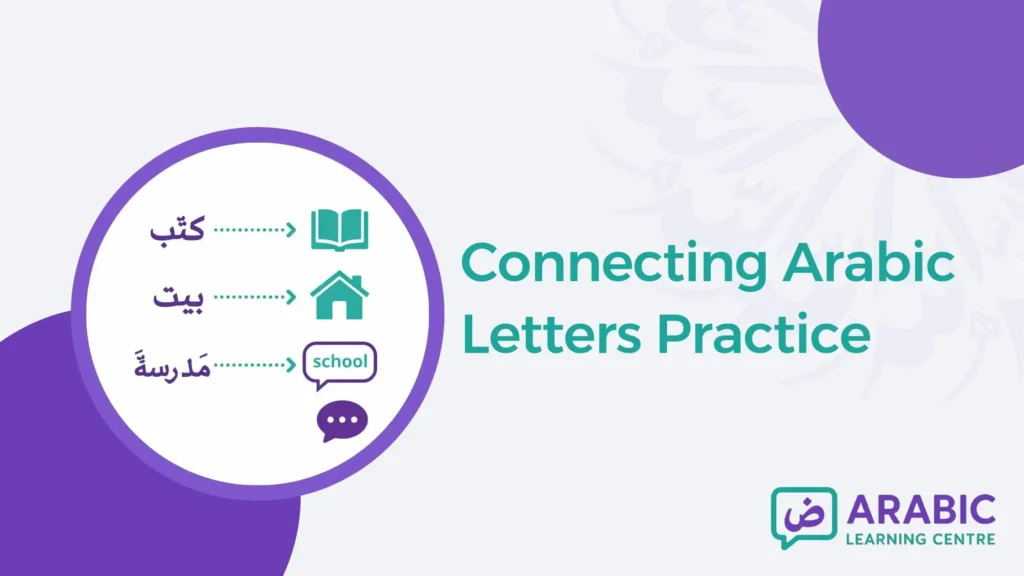
Connecting Arabic letters practice is the single most important skill bridge between knowing the alphabet and actually reading Arabic. Once a learner recognises the 28 letters individually, the next step — understanding how they join, which letters refuse to join, and how each letter’s shape shifts by position — determines whether they move forward or stay stuck. These four structured worksheets give you a practical, sequenced path through that exact skill.
Most learners can name every Arabic letter within a few weeks of study. The challenge is that Arabic is a cursive script by nature: letters within a word connect like handwriting, and each letter may look different depending on whether it sits at the start, middle, or end of a word.
Practising with focused worksheets — rather than random word lists — builds the pattern recognition and muscle memory that turns letter knowledge into genuine reading ability.
Worksheet 1: Identifying the Four Positional Forms of Arabic Letters
Connecting Arabic letters practice begins with understanding that most letters have four distinct forms — isolated, initial, medial, and final (نِهَائِيَّة) — and that the core shape of each letter remains recognisable across all four.
Learning to spot that shared core is what allows a reader to identify letters regardless of where they appear in a word. This foundational recognition must come before any connection practice can stick.
Download Worksheet 1 Identifying the Four Positional Forms.pdf
Why Positional Forms Matter Before You Connect Anything
Many beginners make the mistake of jumping straight into tracing full words without understanding why a letter looks different mid-word than it does when written alone. The answer lies in connection: when a letter joins its neighbour, parts of its isolated form are abbreviated or absorbed into the connecting stroke.
For example, بَاء (bā’) in isolation looks like this: بـ with a clear horizontal base and a dot below. In medial position it becomes ـبـ, where the base shrinks and the dot remains, but the extended tail disappears. The dot is what anchors recognition — and that is exactly what learners must train their eyes to find.
At The Arabic Learning Centre, our Learn to Read Arabic Course trains students to identify this shared core systematically — letter by letter — before any connection tracing begins, because instructors consistently observe that skipping this step causes persistent reading confusion at the word level.
Start Reading Arabic with a FREE Trial

Here is a reference table showing four letters across their positional forms:
| Letter Name | Isolated | Initial | Medial | Final |
| بَاء (bā’) | بَ | بـَ | ـبـَ | ـبَ |
| عَيْن (ʿayn) | عَ | عـَ | ـعـَ | ـعَ |
| مِيم (mīm) | مَ | مـَ | ـمـَ | ـمَ |
| كَاف (kāf) | كَ | كـَ | ـكـَ | ـكَ |
Worksheet 2: Practicing the Six Non-Connecting Arabic Letters
The six non-connecting Arabic letters — أَلِف (alif)، دَال (dāl)، ذَال (dhāl)، رَاء (rā’)، زَاي (zāy)، وَاو (wāw) — connect to the letter preceding them on the right but never connect to the letter that follows them on the left.
This creates a natural visual break within words that beginners often misread as a space between two separate words. Recognising these letters as internal word breaks — not word ends — is one of the most practically significant rules in connecting Arabic letters practice.
Download Worksheet 2 The Six Non-Connecting Letters.pdf
How Non-Connecting Letters Break the Flow Without Breaking the Word
Consider the word كَتَبَ versus دَرَسَ. In دَرَسَ (darasa — “he studied”), the دَال connects to the رَاء on its right but cannot pass its connection rightward. The رَاء similarly connects to what is on its right but refuses to connect left. So within a three-letter word, there are two visible gaps — and it is still one unbroken word.
This is precisely the pattern that confuses learners who have only practised isolated letter recognition. In our instructors’ experience at The Arabic Learning Centre, the majority of reading errors in the first month of script study occur at non-connecting letters — learners pause, assume the word has ended, and misread the structure entirely.
The fix is targeted: drilling these six letters specifically within words, not in isolation. You can learn more about building this foundational reading skill through our guide on mastering Arabic alphabet learning.
| Non-Connecting Letter | Arabic | Example Word | Transliteration | Meaning |
| Alif | ا | بَاب | bāb | door |
| Dāl | د | وَلَد | walad | boy |
| Dhāl | ذ | أَخَذَ | akhadha | he took |
| Rā’ | ر | كَرَم | karam | generosity |
| Zāy | ز | مَزْرَعَة | mazraʿa | farm |
| Wāw | و | نُور | nūr | light |
Read Also: Types of Verbs in Arabic
Shots Videos from Our Courses
Worksheet 3: Tracing and Writing Connected Letter Groups
Connected letter groups — clusters of two or three letters that join seamlessly — are the functional building blocks of Arabic word recognition.
Practising these clusters in isolation, before tackling full words, builds the precise muscle memory and visual fluency that connecting Arabic letters practice is designed to develop. A learner who has drilled بـكـ, مـنـ, and لـعـ as connected units will read words containing those clusters almost automatically.
Download Worksheet 3 Tracing and Writing Connected Letter Groups.pdf
How to Sequence Your Connected Cluster Practice Effectively
The most effective sequence — based on instructors’ observations at The Arabic Learning Centre — moves from two-letter clusters to three-letter clusters, and always pairs the writing exercise with reading the cluster aloud. Silent tracing alone builds handwriting habit but not reading speed.
Start with clusters that share a common baseline — letters that sit on the same horizontal line when joined — before moving to letters with descenders (like نُون in medial position) that dip below the baseline.
For learners working through this simultaneously with structured instruction, our Arabic Course for Beginners covers connected letter formation with certified instructors in live 1-on-1 sessions, so errors in stroke order and connection angle are caught and corrected before they become habits.
Join Our Arabic Course for Beginners With a Free Trial

You can also explore the foundational theory behind Arabic script in our guide on how to learn Arabic to understand how letter connection fits into the broader learning arc.
| Two-Letter Cluster | Transliteration | Appears In | Connection Type |
| بـكـ | bk | كَتَبَ (kataba) | Both connect left |
| مـنـ | mn | مَنَعَ (manaʿa) | Both connect left |
| لـعـ | lʿ | فَعَلَ (faʿala) | Both connect left |
| سـتـ | st | اسْتَمَعَ (istamaʿa) | Both connect left |
Read Also: Arabic Broken Plurals
Worksheet 4: Reading and Writing Complete Arabic Words Using Connection Rules
Reading and writing complete Arabic words — applying all connection rules simultaneously — is where connecting Arabic letters practice becomes real literacy. At this stage, the learner is no longer thinking about individual letters or clusters; they are recognising words as visual units, the way a fluent reader does.
This worksheet bridges structured drilling and authentic reading by using high-frequency Arabic words that appear constantly in everyday text, Islamic supplications, and Quranic passages.
Download Worksheet 4 Reading and Writing Complete Arabic Words.pdf
How Whole-Word Practice Consolidates All Connection Rules at Once
When a learner writes مَدْرَسَة (madrasa — school) correctly, they are simultaneously applying four distinct skills: connecting مِيم to دَال, recognising that دَال cannot connect left, connecting رَاء correctly to سِين, and attaching the تَاء مَرْبُوطَة (tā’ marbūṭa) at the end. Each word becomes a mini consolidation exercise.
In our instructors’ experience at The Arabic Learning Centre, learners who progress to whole-word writing exercises within their first four to six weeks — rather than extending isolated letter drilling — show measurably faster gains in reading fluency.
The pattern recognition that comes from encountering letters in real word contexts simply cannot be replicated by drilling letters alone.
For learners with a Quranic focus, many of these high-frequency words appear directly in the Quran. You can also explore how Arabic grammar for beginners connects to reading comprehension at this stage.
Example word with full annotation:
مَكْتَبَة maktaba “library / bookstore”
Connection map: مـ connects to كـ → كـ connects to تـ → تـ connects to بـ → بـ connects to ة. No non-connecting letters present. All five letters join in a single unbroken stroke sequence.
Our Students Reviews
Read Aldo: Arabic Attached Pronouns
Start Learning Arabic with Certified Instructors at The Arabic Learning Centre
These four worksheets give you a structured, sequenced foundation in Arabic letter connection. Real fluency comes from consistent practice guided by expert feedback.
The Arabic Learning Centre offers:
- Certified native Arabic instructors with 7+ years of teaching experience
- 1-on-1 personalised sessions tailored to your pace and goals
- Flexible scheduling available 24/7 — learn from anywhere
- Structured curriculum from letter connection through to reading fluency
- A free trial lesson so you can experience the teaching before committing
Explore our Learn to Read Arabic Course or our Arabic Course for Beginners and book your free trial today.
Check out our top courses in Arabic and choose the course you need to start learning Arabic today:
- Arabic Course for Beginners
- Arabic Script Writing Course
- Arabic Speaking Course
- Learn Arabic Letters for Tajweed
- Learning Arabic Grammar
- Arabic Vocabulary Course
- Fusha Arabic Course
- Classical Arabic Course
- Arabic Course for Islamic Studies
- Quranic Arabic Course
- Learn Arabic for New Muslims
Start with a FREE trial class and enhance your Arabic language skills

Conclusion
Mastering how Arabic letters connect is not a minor technical detail — it is the gateway to reading every Arabic word ever written. The twenty-two connecting letters and six non-connecting letters follow consistent, learnable rules that, once internalised, make the script feel natural rather than foreign.
The four worksheets above move deliberately: from positional form recognition, through non-connecting letter awareness, into cluster-level muscle memory, and finally into whole-word fluency. Each stage builds on the last, and no stage can be safely skipped.
Learners who approach this skill systematically — and who practise daily with structured materials — consistently reach confident word-level reading within six to eight weeks. The script is logical, the rules are finite, and with the right practice, Arabic handwriting becomes second nature. Insha’Allah, these worksheets are a strong step in that direction.
Read Also: Tenses in Arabic
Frequently Asked Questions About Connecting Arabic Letters Practice
How many Arabic letters connect on both sides?
Twenty-two of the 28 Arabic letters connect to both the preceding and following letter within a word. The remaining six — أَلِف، دَال، ذَال، رَاء، زَاي، وَاو — connect only to the letter on their right and never extend their connection leftward, creating visible breaks within otherwise unbroken words.
How long does it take to learn Arabic letter connections?
Most adult learners who practise connecting Arabic letters for 15–20 minutes daily can reliably apply all connection rules within three to five weeks. Recognising letter forms across all four positions typically comes within the first two weeks, with confident whole-word writing following shortly after with consistent structured practice.
Should children practise Arabic letter connections differently from adults?
Children benefit from larger tracing templates, more visual colour-coding of connecting versus non-connecting letters, and shorter, more frequent sessions of five to ten minutes. The underlying rules are identical, but pacing and visual presentation matter more for younger learners. Our online Arabic classes for kids address these differences through age-adapted materials.
What is the most common mistake when connecting Arabic letters?
The most consistent error is incorrectly connecting a non-connecting letter — particularly رَاء — to the letter on its left. Learners see two letters adjacent within a word and assume connection. Drilling the six non-connecting letters specifically, as in Worksheet 2 above, directly corrects this pattern.
Does connecting Arabic letters practice help with Quranic reading?
Yes — directly and significantly. The Quran is written in connected Arabic script, and every word a learner encounters requires accurate letter connection recognition. Learners who have specifically drilled connection rules read Quranic text with considerably less hesitation. For dedicated Quranic reading preparation, see our guide on how to learn Arabic for Quran.
Related Articles
Arabic Vocabulary & Speaking