 Arabic Alphabet & Writing
| Key Takeaways |
| Writing the Quran in Arabic begins with mastering 28 letters, each with four positional forms depending on word placement. |
| Quranic Arabic uses tashkeel (diacritical marks) to indicate short vowels — essential for accurate Quranic recitation and writing. |
| Arabic script is written exclusively right to left, and most letters connect to neighbouring letters within a word. |
| Learning Naskh script style is recommended for beginners writing Quran, as it is the standard used in most printed Masahif. |
| Systematic progression — from isolated letters to connected words to full Ayat — is the most effective writing method for non-native learners. |
Writing the Quran in Arabic means learning a precise, structured script with specific letter forms, mandatory diacritical marks, and strict orthographic rules unique to Quranic text. It is entirely achievable for non-Arabic speakers who follow a methodical step-by-step approach — starting from individual letter formation before attempting connected words or full Ayat.
This skill matters far beyond calligraphy. When you can write Quranic Arabic correctly, your reading comprehension deepens, your tajweed pronunciation sharpens, and your relationship with the text becomes more intimate.
The steps ahead will walk you through everything — from your first Alif stroke to writing complete Quranic verses with accurate tashkeel.
1. Understand the Arabic Script Fundamentals Before Writing a Single Letter
To write the Quran in Arabic, you must first understand that Arabic script is a cursive, right-to-left writing system where letters change shape depending on their position within a word.
This foundational understanding prevents the most common beginner mistake: treating Arabic letters as isolated units rather than as part of a fluid, connected system.
There are 28 letters in the Arabic alphabet. Each letter has up to four positional forms:
| Position | Description | Example (letter ب Ba) |
| Isolated | Letter stands alone | بَ |
| Initial | Letter begins a word | بعد |
| Medial | Letter sits in the middle | قبل |
| Final | Letter ends a word | عنب |
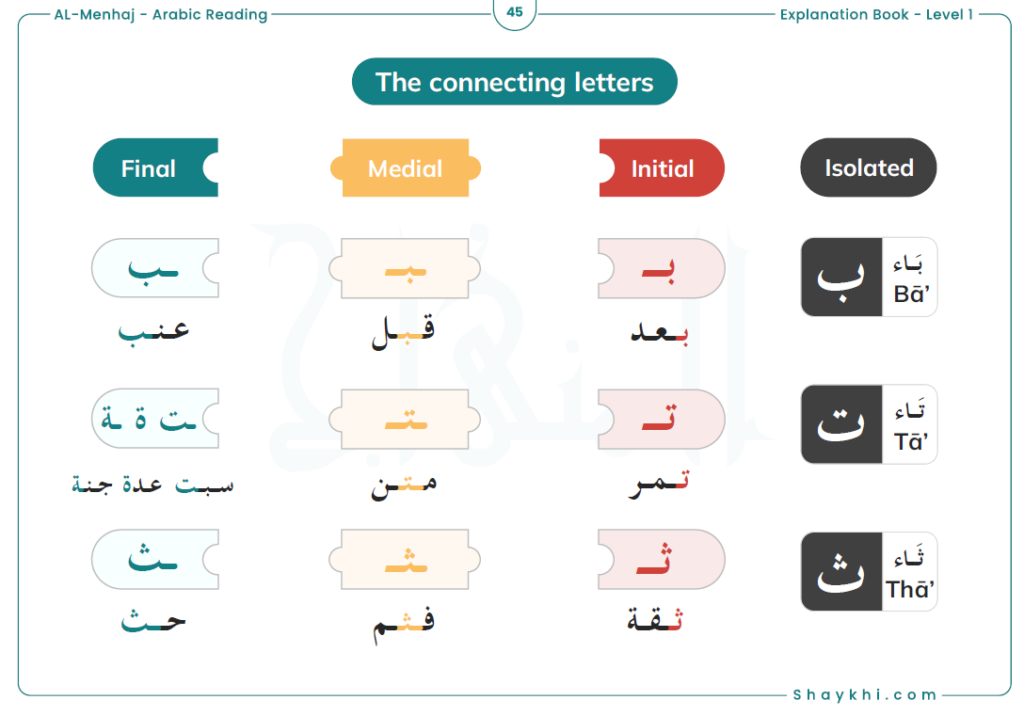
Explore and Study Al-Menhaj Book for Free
Six letters — و، ز، ر، ذ، د، ا — are non-connectors. They connect only to the letter before them, never to the letter that follows. This rule governs the entire flow of Quranic handwriting.
If you are brand new to the Arabic alphabet, our guide on mastering the Arabic alphabet is an essential starting point before continuing with Quranic writing practice.
2. Learn the Correct Stroke Order for Each Arabic Letter
Writing Quran in Arabic correctly requires learning the precise stroke direction and sequence for every letter — not just its shape. Arabic calligraphy and standard script both follow stroke conventions rooted in classical penmanship tradition, and deviating from these creates malformed letters that are difficult to connect.
At The Arabic Learning Centre, we observe that beginners who learn stroke order alongside letter shapes — rather than after — progress to connected writing significantly faster. The habit forms correctly from day one.
How to Approach Letter Groups by Shape Family?
Arabic letters can be grouped by shared geometric bases, which simplifies learning stroke order:
- Alif family (ا، ل، ب، ت، ث): Vertical strokes dominating, left-curving bases
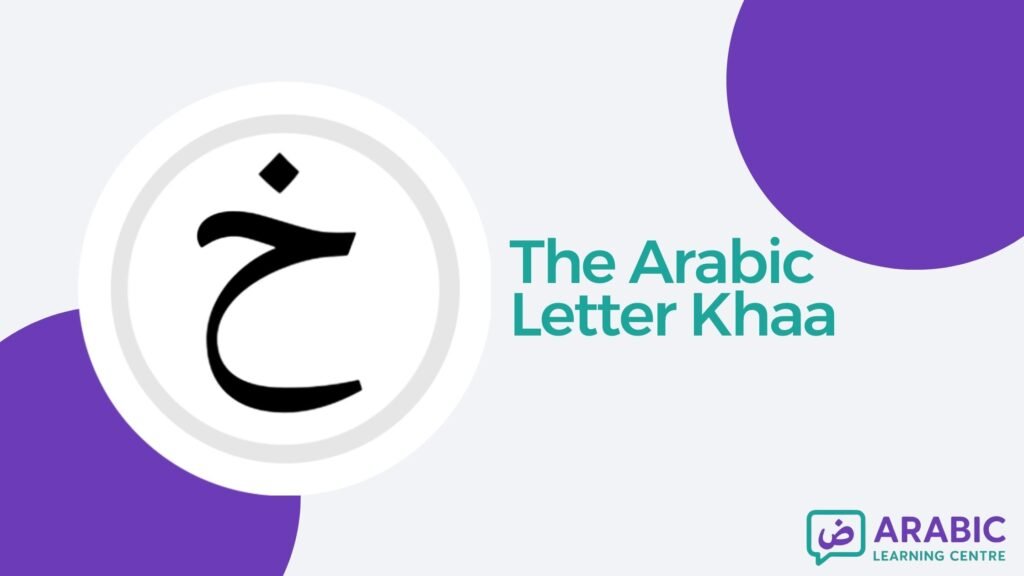
- Jim family (ج، ح، خ): Deep bowl shape, stroke moves right to left then curves down
- Ayn family (ع، غ): Compressed loop structure requiring deliberate pressure
Practice each letter group in isolation for at least two to three sessions before mixing letter families. Muscle memory is built through repetition, not variety.
Shots Videos from Our Courses
3. Master the Four Positional Forms of Every Letter
Quranic Arabic writing demands that you recognize and reproduce the initial, medial, final, and isolated forms of all 28 letters accurately. This is non-negotiable for writing Ayat correctly, because letters shift shape within every word.
Take the letter عين (Ayn) as an example — one of the most positionally variable letters in Quranic text:
| Position | Arabic Form | Notes |
| Isolated | ع | Open hook shape |
| Initial | عَ | Open, connects right |
| Medial | ـعـ | Compressed, connected both sides |
| Final | ـع | Closed loop, tail extends |
Students at The Arabic Learning Centre who drill positional forms using flashcard systems — associating each form with a real Quranic word — consistently outperform those who only study isolated letter charts. Context accelerates retention dramatically.
For learners focused specifically on Quranic vocabulary building alongside script practice, explore our Quranic Arabic vocabulary resource to reinforce word-level recognition simultaneously.
4. Learn to Write the Tashkeel — Quranic Diacritical Marks
Tashkeel are the short vowel marks placed above and below Arabic letters in the Quran. They are not optional in Quranic writing — they are mandatory orthographic elements that distinguish correct Quranic text from unvocalised everyday Arabic.
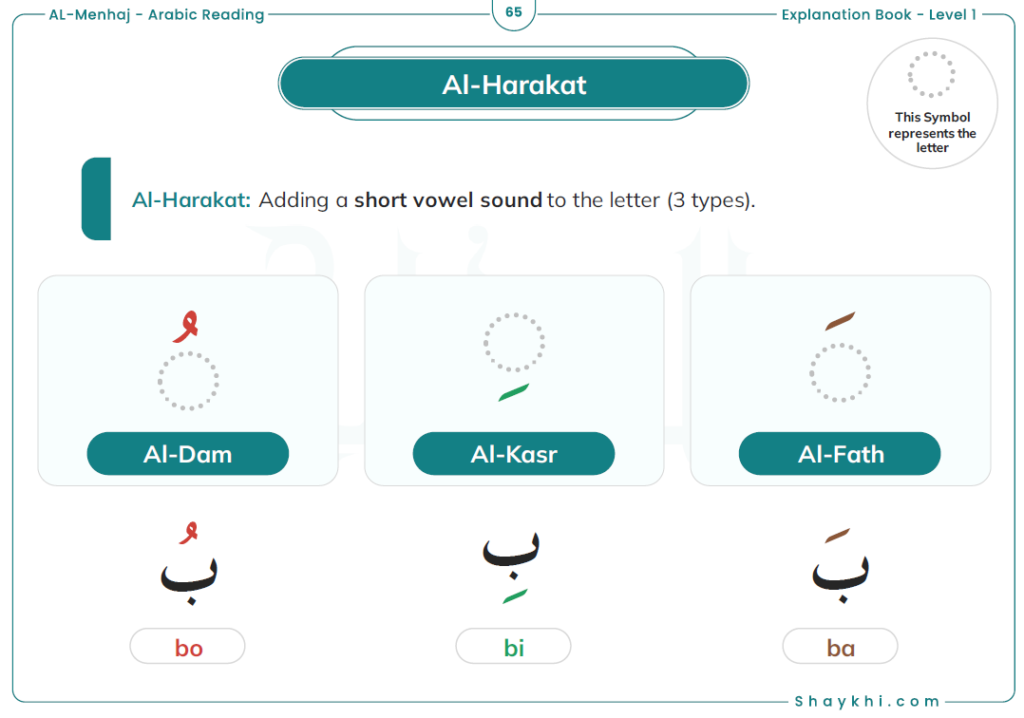
The six primary tashkeel marks every Quran writer must master:
| Mark | Arabic Name | Pronunciation | Symbol |
| Fatha | فَتْحَة | Short “a” | َ |
| Kasra | كَسْرَة | Short “i” | ِ |
| Damma | ضَمَّة | Short “u” | ُ |
| Sukun | سُكُون | No vowel (consonant closure) | ْ |
| Shadda | شَدَّة | Consonant doubling | ّ |
| Tanwin | تَنْوِين | Nunation (n-sound ending) | ً ٍ ٌ |
A particularly common error we observe: beginners consistently place the kasra above the letter rather than below it — likely because most English punctuation sits above the baseline. Developing muscle memory for below-baseline placement requires deliberate, slow practice.
Our Quranic Arabic grammar course explains how these vowel marks interact with grammatical case — essential for understanding why the tashkeel appears as it does across different Ayat.
Start Learning Arabic Grammar with a Free Trial

5. Select the Correct Script Style — Why Naskh Is the Standard for Quran Writing
To write Quran in Arabic, you should learn the Naskh script style (النَّسْخ) before any other calligraphic style. Naskh is the script used in the overwhelming majority of printed Masahif (Quran copies) worldwide, including the widely used Hafs narration standard printed in Madinah.
Naskh is characterised by:
- Clear, rounded letterforms with consistent proportions
- Moderate letter size — neither compressed nor overly extended
- Legibility optimised for long-form text reproduction
- A clear baseline that makes tashkeel placement straightforward
Other scripts such as Thuluth (ثُلُث), Diwani (ديواني), or Kufic (كُوفِي) are used in decorative Quranic artwork, but they introduce stylistic complexity that is unsuitable for learners whose primary goal is accurate Quranic reproduction.
Begin with Naskh. Master it fully before exploring any other script style.
6. Practice Letter Connection Rules Before Writing Full Words
Connecting Arabic letters correctly is one of the most skill-dependent aspects of writing Quranic Arabic. Incorrect connections produce words that are either unreadable or — more problematically for Quran — orthographically incorrect in ways that alter meaning.
The core connection principle: letters connect from right to left, and the connecting stroke flows from the end of one letter into the opening of the next.
The Six Non-Connecting Letters You Must Memorise
These six letters never connect to the letter that follows them:
ا، د، ذ، ر، ز، و
(Alif, Dal, Dhal, Ra, Zayn, Waw)
When any of these letters appears mid-word, the next letter begins a new connection sequence. For example:
كِتَابٌ Kitābun “A book”
Here, Alif (ا) breaks the connection between Ta (ت) and Ba (ب). Recognising this break is essential for accurate writing.
Read Also: How to Write in Arabic?
7. Copy Quranic Ayat Using a Grid or Lined System
The most effective method for learning to write Quran in Arabic accurately is direct, supervised copying of Quranic Ayat — beginning with the shortest Surahs and progressing toward longer passages.
Start with:
بِسْمِ اللَّهِ الرَّحْمَٰنِ الرَّحِيمِ
Bismi -llāhi r-raḥmāni r-raḥīm
“In the name of Allah, the Most Gracious, the Most Merciful.”
This Basmala is the ideal first complete Quranic phrase to practise. It contains:
- Common letter connection patterns
- All three short vowel marks (fatha, kasra, damma)
- The Shadda on ر in Raḥmān and Raḥīm
- The Lam-Alif ligature (لا) — a mandatory connected form that must be written as a single unit
Use Arabic calligraphy practice paper with a four-line grid system: a baseline, a median line, an ascender line, and a descender line. This keeps letter proportions consistent — a discipline that becomes instinctive within three to four weeks of daily practice.
Our learn to read Arabic course provides structured progression from letter-level reading to full Ayat — the same progression that underpins effective Quranic writing development.
Start Reading Arabic with a FREE Trial

Read Also: How to Read and Write Arabic Numbers?
8. Learn the Special Quranic Orthographic Rules That Differ from Standard Arabic
Quranic Arabic uses several orthographic conventions that differ from Modern Standard Arabic (MSA) writing. These are not errors — they are deliberate textual traditions preserved across centuries of Quran transmission.
Key Quranic orthographic features every learner must know:
| Quranic Feature | Standard Arabic | Quranic Quran Writing |
| Alif al-Wiqaya (protective Alif) | Not used | Added in certain words e.g. فَعَلُواْ |
| Hamza above the line | Follows standard rules | Special placement in several words |
| Alif Maqsura endings | Standard ى | Preserved in classical form |
| Silent letters | Generally not written | Written and marked with sukun |
These rules mean that copying Quran requires a verified reference Mushaf — not a digital typing tool — as your source text. The Hafs narration Madinah Mushaf is the gold standard reference for most learners in non-Arabic-speaking contexts.
Read Also: How Many Letters Are in the Arabic Alphabet?
9. Build Writing Fluency Through Structured Daily Practice
Consistent, short practice sessions outperform irregular long sessions for building Arabic writing muscle memory. For Quranic Arabic writing specifically, we recommend the following progression structure:
Weeks 1–2: Isolated letter forms, stroke order, non-connectors Weeks 3–4: Positional forms, initial connection practice, tashkeel placement Weeks 5–8: Two-to-three letter words from Quranic vocabulary Weeks 9–12: Short Ayat copying with full tashkeel from Surah Al-Fatiha and Al-Ikhlas
In our instructors’ experience at The Arabic Learning Centre, students who commit to twenty minutes of focused Quranic writing practice daily reach consistent letter-connection fluency within six to eight weeks — far faster than students practising in irregular two-hour sessions.
For a structured learning path combining reading and writing for Quran, our dedicated Quranic Arabic course offers personalised 1-on-1 sessions with certified instructors who specialise in guiding non-Arabic speakers toward Quranic literacy.
Join Our Quranic Arabic Course With a Free Trial

Read Also: Best Arabic Course in Sharjah
10. Seek Qualified Correction — Writing Errors That Go Uncorrected Become Permanent
Self-teaching Arabic writing without expert feedback carries a significant risk: incorrect letter forms and tashkeel placements that go unnoticed become deeply ingrained habits. Correcting them later requires substantially more effort than learning correctly from the start.
The most common writing errors we observe in self-taught learners of Quranic Arabic:
- Lam-Alif written as two separate letters rather than the obligatory ligature لا
- Shadda placed to the right of the letter rather than centred above it
- Tanwin fath (double fatha ً) written as two separate fathas rather than the standard angled double mark
- Waw and Ra confused in their final forms when written quickly
Each of these errors, uncorrected, produces Quranic text that diverges from the authentic transmitted orthography. Working with a qualified Arabic instructor who can review your writing in real time eliminates this risk entirely.
Our Students Reviews
Read Also: Arabic Course in Egypt
Begin Your Quranic Arabic Writing Journey with The Arabic Learning Centre
Writing the Quran in Arabic is a skill built through structured progression — from letter forms to tashkeel to connected Ayat. Expert guidance makes the difference between building correct habits from day one and spending years unlearning errors.
The Arabic Learning Centre offers:
- Certified native Arabic instructors specialising in Quranic Arabic literacy
- Personalised 1-on-1 sessions with flexible 24/7 scheduling
- Structured curriculum from letter formation through full Ayat writing
- A free trial lesson — no commitment required
- Our Al-Menhaj Book, a dedicated Learn to Read Quran resource developed by instructors with 25+ years of teaching experience
Explore our Quranic Arabic Course or our Arabic Course for Islamic Studies and book your free trial today.
Check out our top courses in Arabic and choose the course you need to start learning Arabic today:
- Arabic Course for Beginners
- Arabic Script Writing Course
- Arabic Speaking Course
- Learn Arabic Letters for Tajweed
- Learning Arabic Grammar
- Arabic Vocabulary Course
- Fusha Arabic Course
- Classical Arabic Course
- Arabic Course for Islamic Studies
- Quranic Arabic Course
- Learn Arabic for New Muslims
Start with a FREE trial class and enhance your Arabic language skills

Conclusion
Writing Quranic Arabic is a methodical skill — not a talent. Every letter you form with care is an act of connection to one of humanity’s most precisely preserved texts. The script rewards patience, and the milestones come steadily when the foundation is correct.
The steps in this guide reflect what genuinely works for non-native learners: structured letter-by-letter progression, tashkeel mastery, and consistent supervised practice. These are not shortcuts — they are the actual path.
Insha’Allah, with the right method and qualified guidance, writing Quranic Arabic accurately is within reach for any learner willing to commit to the process.
Read Also: Free Arabic Practice Worksheets
Frequently Asked Questions About How to Write Quran in Arabic
How long does it take to learn to write Quran in Arabic from scratch?
Most non-Arabic-speaking adult learners achieve basic Quranic writing fluency — forming connected letters with accurate tashkeel — within eight to twelve weeks of structured daily practice. Reaching the level of copying full Surahs accurately typically takes four to six months with consistent, guided study.
Can I learn to write Quranic Arabic without learning spoken Arabic first?
Yes. Quranic Arabic script writing is a distinct skill set that can be developed independently of spoken Arabic. Many learners begin with reading and writing Quranic text before developing conversational ability. However, understanding Arabic pronunciation through Arabic pronunciation study improves tashkeel placement accuracy significantly.
What is the best tool for practicing Quranic Arabic handwriting?
Begin with a broad-tipped Arabic calligraphy pen or a medium-nib fountain pen on Arabic-ruled four-line practice paper. Digital tools such as stylus tablets can supplement practice but should not replace paper-based writing in the early stages, as physical pen pressure develops the motor control essential for Naskh script formation.
Is Quranic Arabic writing the same as Modern Standard Arabic writing?
They share the same 28-letter alphabet and right-to-left direction, but Quranic Arabic writing includes unique orthographic conventions — such as protective Alifs, specific Hamza placements, and silent letters that are written and marked — that do not appear in Modern Standard Arabic text. These require specific instruction from a Quran-focused teacher.
Do I need to memorise the Quran to write it correctly?
Memorisation is not a prerequisite for writing Quranic Arabic. However, familiarity with the text — particularly with frequently occurring words and phrases — accelerates accurate writing significantly. Learners who combine Quranic vocabulary study with handwriting practice progress to Ayat-level writing faster than those focusing on script alone.
Related Articles
Arabic Alphabet & Writing